International Journal of Emerging Technology and Advanced Engineering
Website: www.ijetae.com (ISSN 2250-2459, ISO 9001:2008 Certified Journal, Volume 7, Issue 10, October 2017)
244
Lack of Closed Loop Feedback Mechanism in Recording and
the Proposed Framework
Rajendra Deshpande
1, Ulhas Shiurkar
2, Satish Devane
3 1Intelenet Global Services, Mindspace, Malad (West), Mumbai, India 2Devogiri Institute of Engineering & Management Studies, Aurangabad, India3
Datta Meghe College of Engineering, Mumbai, India
Abstract— Regulatory requirements or client demands or training needs have necessitated contact centers across the world to implement screen and voice recording solutions. These regulations are applicable to both inbound customer service type contact centers as well as outbound contact centers which deal with telemarketing or any sales activities. However, how much screen and voice recordings need to be captured varies based on industry to industry and service to service. Commercial recording systems deployed in BPO do not provide a single and correct picture of the amount of recording that has been done or the recording percentages as applicable to the business. Objective is to develop a wrapper framework in order to control how the screen and voice recording takes place without discrepancy. The objective of this paper is also to address how in such a federated environment we can address the challenges in getting the right representation of recording percentages by integrating different elements together and in the process improving the recording percentages. Objective is also to compare the validation and percentage compliance achieved with respect to business requirements.
Keywords— Screen recording, performance, compliance of BPO and wrapper.
I. INTRODUCTION
Recording of Voice and Screen is backbone of compliance requirement in BPO industry to address various compliance and contractual need imposed during the outsourcing of business.
Most of the industry deployment of voice and screen recorder receives the trigger through CTI and the recording is undertaken on the premise that the calls landed is equivalent to calls recorded. The gap is addressed by manual reconciliation and there is no closed loop feedback mechanism to different recording components and is further away from the business needs.
This paper provides the approach to address this problem by understanding interconnectivity of different devices in contact centre and provides methodology to address this.
II. BACKGROUND
At a contact center, the ACD receives all the calls received by the contact center. Once a call is received information on how the call is to be treated resides in the ACD such as which sub process should be sent this call, which skill set does this call have to be sent to, which agent for that skillset is available and this call should be sent to, what to do after the call has been received. On a certain action by the agent for that call, such as transfer or conference – the ACD facilitates the action for the agent. The ACD advertises the arrival of calls and their associated status or actions to any device that integrates with it. This advertisement is then used by the devices to conduct activities of their own. It also assigns a unique call identification number, so that the call can be tracked completely within the time that it is being handled at the contact center.
International Journal of Emerging Technology and Advanced Engineering
Website: www.ijetae.com (ISSN 2250-2459, ISO 9001:2008 Certified Journal, Volume 7, Issue 10, October 2017)
245 The ACD, Recorder, Trunk and the Desktops are part of the federated landscape and are not truly integrated to provide the timely feedback across components. They rely on several synchronous and asynchronous communications between each other to achieve the overall recording objective. They report data in their own reporting layer to authorized users – the ACD reports provide the call received information, the Recorder provides the calls recorded information. Federated systems such as these results in disparate views and lack of the capability of showing a single version of the truth, which is so critical in a real-time environment.
Situation also arises when the screen recorder does not have the correct status to initiate recording resulting in gaps in screen recordings vis a vis the calls.
Apart from this an additional parameter is not considered by the BPO team. Today each business process requires different percentage of call or screen recordings. Our analysis of more than 100 contracts across four geographies indicated a varying need for recording. Analysis further showed that public sector banks expected extreme and stringent recording percentages i.e. 100% in both voice and screen recordings, while insurance industry needs similar requirements and some of the other industry requirements vary from X number of calls to be recorded per associate per day. TABLE I shows how the recording requirements in some of the key industry verticals.
TableI Contract Wise Recording
Sr No No of
contracts
Vertical Recording Percentage
1 62+ BFSI 100% voice recording, few
process require - 100% screen recording
X number of calls / screens per agent per day
2 1 Ecommerce 100% voice recording
3 12 Government 100% voice recording
4 5 Healthcare 100% voice recording
5 7 Manufacturing 100% voice recording
6 12 Retail 100% voice recording
7 3 Telecom 100% voice recording
8 3 Transport 100% voice recording, 100%
screen recording (1/3rd of the processes)
9 10 Travel 100% voice recording, 100%
screen recording for half
10 1 Utilities 100% voice recording
III. WRAPPER FRAMEWORK FOR ADDRESSING THE GAPS IN SCREEN RECORDING IN BPO ENTERPRISE
The solution principles recommended in this paper to address the gaps between screen and voice recording consists of building a system (wrapper system) for automating the entire process. It further recommends usage of raw data directly rather than pre calculated data to eliminate wrong reporting and defining business rules within wrapper system.
To overcome the challenges mentioned earlier in the paper it relies on developing a wrapper which would provide the appropriate signals for screen recording and voice recording based on voice calls and vice versa. It also provides automation of the entire process right from extraction to comparison to deriving the necessary metrics and also providing a mechanism to identifying outliers and attribute the reasons to each of the outliers. Business rules are applied to publish recording status automatically with an aim to provide reports for the business directly from within the system. System would also make available alert mechanism for the discrepancies in the recording system.
International Journal of Emerging Technology and Advanced Engineering
Website: www.ijetae.com (ISSN 2250-2459, ISO 9001:2008 Certified Journal, Volume 7, Issue 10, October 2017)
[image:3.612.50.565.127.329.2]246
[image:3.612.57.556.356.622.2]FIGURE II Schematic Architecture with Wrapper System For Addressing The Gaps Between Screen And Voice Recording
International Journal of Emerging Technology and Advanced Engineering
Website: www.ijetae.com (ISSN 2250-2459, ISO 9001:2008 Certified Journal, Volume 7, Issue 10, October 2017)
247
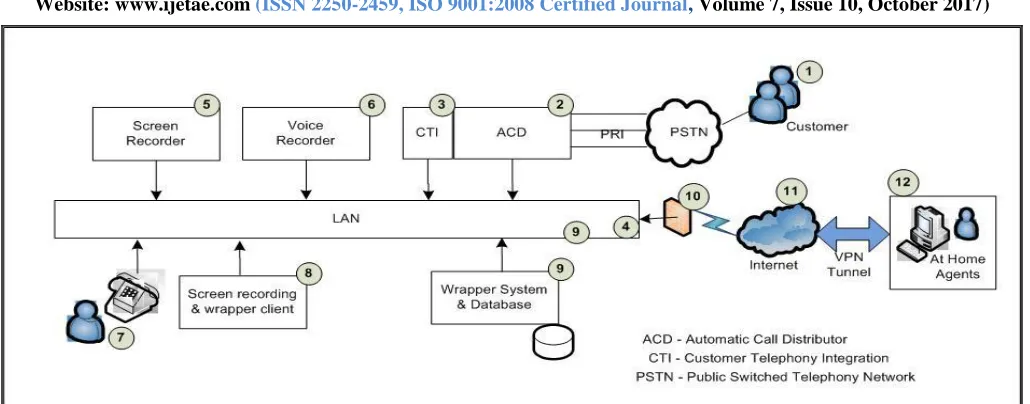
Referring Figure 1
1. Customer calls are routed through the PSTN network
to the ACD.
2. ACD (Automatic Call Distributor) distributes the calls
received from customer to an agent. Upon sending the call to the agent, the event information is generated by ACD, which is passed onto CTI interface.
3. CTI (Computer telephony interface) transfers the event
to logger interface
4. (Local Area Network allows interconnection of all
components.
5. Screen recording server records all screens and is also
responsible for collecting and archiving the screen database.
6. Call recording server responsible for collecting and
archiving the voice calls.
7. Desktops used by an agent for application usage during
conversation with customers
8. Screen recording client, is installed on each agent
desktop, to identify the IP address of the agent workstation and is sent to the recorder. Wrapper client to address the gaps between screen and voice recording is also installed on the agent desktop.
9. Wrapper system to provide the appropriate signals for
screen recording and voice recording based on voice calls and vice versa 10, 11, 12 – At home agents infrastructure to connect to LAN.
Referring Figure 2
1. Advisor (user) logins to the ACD or CRM
2. The wrapper framework exe to start monitoring the
recording services is initiated
3. Wrapper framework (exe) would monitor both the
voice and screen recording services in the background at a pre defined interval of time.
4. If the recording services are running as expected then
wrapper would not take any action. If the recording services are inactive then the wrapper would display a message pop up to the user intimating that the recording services have stopped and needs action.
5. Wrapper stored the recording status in its own database
(refer block 9 in figure 1).
6. Wrapper would wait for user confirmation for
re-activation of recording services. If the response is positive indicating restarting of the recording services then pop up is closed. If the response is negative then the pop up remains on the screen and the user is not allowed to take the call.
7. Email service is initiated by the wrapper to indicate the
recording status inactiveness.
8. Email notifications are send to admin members when
the recording services are inactive.
9. IT admin or the user starts the recording service as per
the alert received.
10. Once the recording service is started, user confirms on
the pop up.
11. Wrapper monitoring the recording services
understands that the recording service has been re started.
12. Pop up is closed by the wrapper which allows the user
to start attending to calls.
As wrapper is integrated with the ACD by CTI, it send triggers to start / stop screen recording services based on ACD status as well as user confirmation on the screen pop up on the unavailability of screen recording services.
IV. WRAPPER –DATA COLLECTION
Wrapper framework had played a vital role in plugging the gap of not able to achieve the required level of screen recording to meet the compliance and contractual requirements. The below section provides details of the procedures carried out for data collection.
In the setup, wrapper client was installed on all the desktops through which users would be taking the calls landing on the ACD.
Wrapper client monitors recording services on each desktop. In case the recording device was not running, wrapper client sends a message to the wrapper backend. Wrapper then inserts an entry in service monitor table along with the windows id and IP address of the desktop for which recording services has stopped. Similarly an entry was also recorded in service log notification table.
All this monitoring information is stored in wrapper database (block 9 in figure 1) and allows to provide closed loop feedback.
At the backend, wrapper keeps on checking the entries in the service log notification table. On finding an entry it sends a pop up message with the user and also sends emails notification to respective IT admin. Entry from the service log notification table is removed post sending of the alerts by the wrapper.
International Journal of Emerging Technology and Advanced Engineering
Website: www.ijetae.com (ISSN 2250-2459, ISO 9001:2008 Certified Journal, Volume 7, Issue 10, October 2017)
248 TABLEIIII
SERVICE MONITOR
Sr No Data points Description
1 Record Id Sequential primary reference for the record
2 Windows Id Windows reference for which the recording service is not running 3 IP Address IP address for the desktop for which
the recording service is not running
4 Log
Message
Message shown to the user
5 Updated On Date time for which the record exists 6 Notified On Date time when the notification was
send
TABLEIVII SERVICE LOG NOTIFICATION
Sr No Data points Description
1 Record Id Sequential primary reference for the record
2 Windows Id Windows reference for which the recording service is not running 3 IP Address IP address for the desktop for which
the recording service is not running
4 Log
Message
Message shown to the user
5 Updated On Date time for which the record exists 6 Notified On Date time when the notification was
send
V. SIMILAR WORK IN THIS CONTEXT
Our study provides a framework on providing closed loop feedback mechanism in recording. We have not seen similar study being carried out in this space though there are numerous researchers and companies that already provides some reference work in this context. Followings are the works presented:
Ref. [1] Rajendra Deshpande, Ulhas Shiurkar, Satish Devane (2015) provides analysis of issues in screen recording for high transaction BPO Industry. This research has addressed the following areas in the field of screen recording - Identified gap in current measurement process and provided clear approach for actual measurement process, Carried out Systematic identification of key issues responsible for not meeting compliance.
Arockiasamy and Abdullah (2013) defined the service quality as determinant of customer satisfaction. Service quality has come from the service outcome from service providers in most of the organizations.
Authors have pointed that the perceived service quality acts as component of customer satisfaction. In addition to these, service quality has the tendency to focus evaluation and it also has reflected the perceptions of customer with
reliability, assurance, empathy, tangibility and
responsiveness.
Agarwal, et al (2013) researches about the impact of dimensions in quality service of call centres India towards the satisfaction of customers. The organizations are based on the stakeholders, i.e. the customers, so the satisfaction level is important and to render the service quality in the competitive environment of BPO. The service quality is essential for the reducing the cost, increase the profitability, market share raising, satisfying the customers and providing the better competitive advantages. The call centres in India are found to give more importance to customers as they are path to success, they interact with customers, delivering the better services and enhancing the technological performances.
According to Vidicode, (2015) studied about the recording of calls which are most integral part of business developments and also gives the security strategies for the audio analysis in any call services. These call recordings can bring reliability in the recording platforms of the call services with extra features for better functionality and bring up ideal solutions for customers. The logs of the recording are managed for future use and can be play back and accessed anytime and every time with privacy and interiority from the managing systems. It acts as a valuable tool for protecting the data, ie the comments and feedbacks given by the clients and they also screen recordings during each call, add notes, start or stop and tag the calls with its information.
Chen W-N, Hang H-M. H.264/AVC motion estimation implementation on compute unified device architecture
(CUDA). Proceedings of the IEEE International
Conference on Multimedia and Expo (ICME '08); June 2008; pp. 697–700
When it comes seeking true testimony of how much closed loop feedback mechanism can built in recording, we haven’t seen significant research being conducted in this area.
VI. CONCLUSION AND FUTURE WORK
International Journal of Emerging Technology and Advanced Engineering
Website: www.ijetae.com (ISSN 2250-2459, ISO 9001:2008 Certified Journal, Volume 7, Issue 10, October 2017)
249
Service quality in BPO is of paramount importance.
This paper caters to the improvement of service quality through in-depth study of the gaps existing in screen and voice recording and providing a closed loop functionality to address it.
The results also concludes that even though the screen
recording is not functional the voice calls can’t be stopped by the current solutions available in the market since there is no way the feedback is given to address the limitation in the architecture.
Developed a structured wrapper framework to address
the feedback limitation existing between the screen and voice recording
Real time integration between the recording
components resulting in improved recording
percentages.
Improved regulatory compliance due to resultant
synchronization between voice and screen recording.
REFERENCES
[1] Ref. [1] Rajendra Deshpande, Ulhas Shiurkar, Satish Devane (2015) provides analysis of issues in screen recording for high transaction BPO Industry. This research has addressed the following areas in the field of screen recording - Identified gap in current measurement process and provided clear approach for actual measurement process, Carried out Systematic identification of key issues responsible for not meeting compliance.
[2] Ref. [CDAC242, IJETMAS, June 2017, ISSN 2349-4476] Rajendra Deshpande, Ulhas Shiurkar, Satish Devane (2017) provides model for predicting call recording at a contact center.
[3] Chang.S et al (2011), R2A: Realtime Resolution Adapter for Asymmetric Computer Screen Recording, IEEE Asia-Pacific Services Computing Conference.
[4] Chen W-N, Hang H-M. H.264/AVC motion estimation
implementation on compute unified device architecture (CUDA). Proceedings of the IEEE International Conference on Multimedia and Expo (ICME '08); June 2008; pp. 697–700
[5] Deshpande, S.G. and Jenq Neng Hwang, "A real-time interactive virtual classroom multimedia distance learning system," in proc. of IEEE Transactions on Multimedia, Vol.3 Issue: 4, Dec. 2001 [6] Ejeye.A.O and Walker.S (2014), 4kUHD H264 Wireless Live Video
Streaming using CUDA, Journal of Electrical and Computer Engineering.
[7] Fong, A.C.M., and Hui, S.C., "Low-bandwidth Internet streaming of multimedia lectures," in proc. of Engineering Science and Education Journal, Vol.10 Issue: 6, Dec. 2001.
[8] Gong.Y et al (2013), A Benchmark for User-Perceived Display Quality on Remote Desktops, Technical Journal.
[9] Jaffer.S et al (n,d), Improving Remote Desktopping Through Adaptive Record/Replay, Retrieved on: 20th May 2015, Retrieved from: http://www.cse.iitd.ernet.in/~sbansal/pubs/rdrr.pdf
[10] Kung MC, Au OC, Wong PHW, Liu CH. Block based parallel motion estimation using programmable graphics hardware. Proceedings of the International Conference on Audio, Language and Image Processing (ICALIP '08); July 2008; pp. 599–603 [11] Kwou.Y et al (2014), A Parallelized Implementation for H.264
Real-time Encoding Scheme, International Journal of Control and Automation, vol 7, no 6, pp:379-388
[12] Marder, M. ; Geva, A. ; Yaoping Ruan “Lightweight searchable screen video recording,” in Visual Communications and Image Processing (VCIP), 2012 IEEE Conference dtd27-30 Nov. Page(s):1 - 6E-ISBN :978-1-4673-4406-7
[13] Pieters B, Hollemeersch CF, Lambert P, van de Walle R. Motion estimation for H.264/AVC on multiple GPUs using NVIDIA CUDA. Applications of Digital Image Processing XXXII; August 2009; San Diego, Calif, USA
[14] Sanchez.R et al (2013), Adapting Hierarchical Bidirectional Inter Prediction on a GPU-based platform for 2D and 3D H.264 video coding, EURASIP Journal on Advances in Signal Processing, 67. [15] Su.Hetal (2014), Efficient Parallel Video Processing Techniques on
GPU: From Framework to Implementation, Scientific World Journal.
[16] Taibo J, Gulias VM, Montero P, Rivas S. GPU-based fast motion estimation for on-the-fly encoding of computer-generated video streams. Proceedings of the ACM 21st International Workshop on Network and Operating Systems Support for Digital Audio and Video (NOSSDAV '11); June 2011; pp. 75–80.
[17] Wu.P et al (2014), A Fast Media Synchronization Mechanism for Streaming Screen Recording Applications, IEEE 17th International conference on computation science and engineering.
[18] J. Hari Narayan, IRDA Guidelines on Distance Marketing –
irda.gov.in, Document ID
-IRDA/ADMN/GDL/MISC/059/04/2011,Published on 05/04/2011 [19] RBI Guideline on Call recording, Document ID - RBI/2007-2008/78