International Journal of Emerging Technology and Advanced Engineering
Website: www.ijetae.com (ISSN 2250-2459, ISO 9001:2008 Certified Journal, Volume 7, Issue 8, August 2017)
358
Mobile Agents Model for Computer System‟s Price Enquiries
and Reporting in a Distributed Environment.
Souley Boukari
1, Afolabi Oluranti
21,2Department of Mathematical Sciences, Abubakar Tafawa Balewa University (ATBU), Bauchi, Bauchi State. Nigeria.
Abstract— Over period of time, Mobile Agent systems have been identified as a promising paradigm for the design and implementation of distributed applications. In the past, many functions of agents have been explored such as information retrieval, automating looping tasks and workflow. Mobile Agents model for Computer System’s Price Enquiries, booking and Reporting (MACSPER) has been developed. Java Development Kit 8 was used as a programming language, while Java Agent DEvelopment Framework (JADE) was used as the platform and MySQL was used as database. Unlike traditional software, the model is personalized, and autonomous, it navigates round the network looking for a product across different shops as specified by the user. Using this model, at different shops site client particular queries could be implemented. Performance evaluation of the Mobile Agents model and Client Server in[1] were carried out using turnaround time as performance metric. The results revealed in the first test case that Mobile Agents model took turnaround time of 1.06secs to visit 26 shops and Client Server took 2.84secs. Other three test cases were also considered and results for Mobile Agents Model and Client Server were obtained as: (1.06 and 2.79)secs, (1.04 and 2.77)secs, (1.06 and 2.79)secs respectively. It was discovered that the turnaround times taken by Mobile Agent were less than Client Server because no communication of result to the buyer server until the whole 26 shops have been visited. Where as Client Server communicates each results of the visit to the buyer server and return to visit another shop. Mobile Agent model is therefore, an exact technology for implementation of electronic commerce applications, since it moves the execution closer to the users.
Keywords— Autonomous, Buyer, Catalog, Communication, Client server, Distributed Applications, E-commerce, Enquiries, Itinerary, Mobile Agents Model, Performance Evaluation, Reporting, Turnaround time.
I. INTRODUCTION
There is a trend towards increasingly heterogeneous networks in today‟s communications environment. Managing these diverse networks requires the collection of large quantities of data from the network, which must be analysed before management activity can be initiated [10]. Price enquiries of items in an open market is all about making confirmation of the market value of items in monetary terms.
There are many ways to this approach starting from early method of physically moving from one shop to another to confirm the price of items. Most at times people move from one town to another, one state to another, one country to another etc in making enquiries on items of interest. This gives opportunity to have access to varieties of such items and to get best market price. This approach encourages human influence for self interest reasons. Many organizations that are saddled with the responsibility of procuring items for people have been adopting the above method and later change to a conventional method by physically surfing the internet to search for items of their interest. This method involves the users sending request to the server whenever items are to be procured. The server in turn sends a response to the request and the “handshaking” occurs again and again. Each request/response of this conventional approach requires a complete round trip across the network which consumes a lot of bandwidth.
A mobile agent is a software or program that is able to migrate to some remote machine, [10], execute some functions or collect some relevant data and then migrate to other machines in order to accomplish another task. The basic idea of this paradigm is to distribute the processing throughout the networks, that is, sending the code to the data instead of bringing the data to the code.
Mobile agents are already prevalent in the Internet, and are used for performing a variety of tasks such as collecting information, negotiating a business deal, or for online shopping. When the data needed for a computation is physically dispersed, it can be sometimes beneficial to move the computation to the data, instead of moving all the data to the node performing the computation. The use of mobile agents has been advocated for various reasons such robustness against disruptions in network connectivity, improving the network latency and reducing network load, providing more autonomy, and so on[14].
International Journal of Emerging Technology and Advanced Engineering
Website: www.ijetae.com (ISSN 2250-2459, ISO 9001:2008 Certified Journal, Volume 7, Issue 8, August 2017)
To know the prices of items like Computer System over an area is always a big problem as the users need to move from place to another, confirming the prices and comparing reports for decision-makings. Time and efforts are spent to do this.
The conventional way of getting the prices of items on the networks is the clients sending request to the server whenever the tasks are to be performed which consumes a lot of system resources such as bandwidth.
Unrealistic Network Connection: Most of the time, the networks are not reliable, making it difficult to perform intended tasks. That is, the task has to be repeated several times because of connection problem.
II. RELATED LITERATURE
Mobile agents are suite of programs that have the ability to migrate across the network participating in tasks dynamically assigned by a designer, a human or agent supervisor. They can start their execution at one location (initiation), suspend execution, resume execution, and roam wide area network, interacting with foreign hosts, gathering information on behalf of their owner and come „back home‟ having performed the duties set by their owner [8].
This posed some benefits such as reduction of communication costs.
According to [1], mobile agents provide a new programming paradigm for building agile distributed systems. The ability to travel allows a mobile agent system to move computation to data source systems. This decentralized approach improves network efficiency since the processing is performed locally. For example, in a market survey and reporting which relates to the major focus of this research work is e-commerce scenario and is shown in figure 1 below; where searching for the product is a client server operation but a mobile agent is used to purchase products. Once the Buyer Server receives a buyer‟s purchase request, it sends it to the Information Server to search wholesalers and retailers who sell the product. The Buyer Server dispatches a mobile agent visiting these wholesalers and retailers, the mobile agent negotiates with seller‟s agents and reports the offers to the Buyer Server. The Buyer Server evaluates all the offers, and sends a purchase mobile agent to the best offer (seller) to make the final purchase.
International Journal of Emerging Technology and Advanced Engineering
Website: www.ijetae.com (ISSN 2250-2459, ISO 9001:2008 Certified Journal, Volume 7, Issue 8, August 2017) Mobile agents were identified as a suitable tool for
e-commerce [17]. A commercial transaction may require real-time access to remote resources such as stock quotes and perhaps even agent-to-agent negotiation. Different agents will have different goals, and will implement and exercise different strategies to accomplish these goals. Mobile agent technology is a very appealing solution to this kind of problem. An electronic commerce transaction may be viewed in terms of four different phases, namely:
product brokering, merchant brokering, negotiation, payment and delivery [8].
A. Classification of Mobile Agents in E-Commerce
The application of Mobile Agents to electronic-commerce gives another dimension of conducting business- to-business, business-to-consumer, and consumer-to-consumer transactions. The existing Mobile Agents applications in electronic-commerce are categorised into three, namely; shopping agents, salesman agents, and auction agents[12].
1) Shopping agents: These are Mobile Agents that buys in e-marketplaces on behalf of their owner as specified by the user. A shopping agent visits several online stores, compare features of different products and report the best choice to its owner. The Mobile Agent‟s owner specified set of features to be considered and their ideal values and carries it along as It may be given one or more sites to visit and may dynamically visit other sites based on subsequent information. Mobile Agent goes to the source of information; therefore overhead repeatedly transferring potentially large amounts of information over a network is eliminated. One example of a system that implements shopping agents is Mobile Agents for Networked Electronic Trading (MAgNET), where agents deal with procurement of the many components needed to manufacture a complex product [14].
2) Salesman agents: These Mobile Agents behave like a travelling salesman who visits customers to sell his wares. This model of e-commerce uses a supplier driven marketplace and is particularly attractive for products with a short shelf-life. A supplier creates and dispatches a Mobile Agent to potential buyers by giving it a list of sites to visit. The Mobile Agents carries with it information about available stock and price of the product. [8].
3) Auction agents: These categories of Mobile Agents bids for and sell items in an online auction on behalf of their owners. Each of the Mobile Agent carries along its bidding information as specified by the owner; for example bidding range, time within which the item is to be procured, bidding pattern, and other relevant attributes.[15].
B. Secure Mobile Agent System (SMAS)
A number of advantages of using mobile code and mobile agent computing paradigms have been proposed in ([4]; [7]; [3]). One of the main obstacles to the widespread adoption of mobile agents is the legitimate security concern of system developers, network administrators, and information officers. It has been argued that once the security issues have been resolved and a collection of security mechanisms have been developed to counter the associated risks, then the users of mobile agent technology will be free to develop useful and innovative solutions to existing problems and find a wide array of application areas that will benefit from this technology.
Using this collection of security mechanisms to mitigate agent-to-agent, agent-to-platform, and platform-to-agent security risks may, however, introduce performance constraints that could dictate design decisions or negate the benefit of using mobile agents for certain applications.
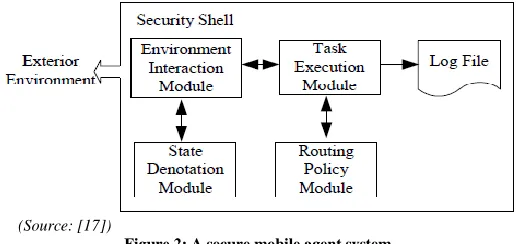
SMAS consists of mobile agents and agent server (e.g. agent facilitator). Mobile agent has six modules:
Security shell, Environment interaction module, State denotation module, Task execution module, Routing policy module and log file as shown in figure 2 below:
[image:3.612.315.573.505.627.2](Source: [17])
Figure 2: A secure mobile agent system
1)Security shell: This is responsible for protecting the agent from attacks of malicious hosts and other agents. The main functions include encrypting and decrypting the whole agent, authorizing the visit host, deploying the different security policy according to the different trusted level of host.
International Journal of Emerging Technology and Advanced Engineering
Website: www.ijetae.com (ISSN 2250-2459, ISO 9001:2008 Certified Journal, Volume 7, Issue 8, August 2017) 2)Environment interaction module: is responsible for the
maintenance of communication between agent and exterior environment that includes sensor (apperceive outside environment), message processor (process inter-messages, data communication between agent and environment based on Knowledge Query Manipulation Language(KQML) and reactor (i.e. effect or, output the result to outside environment).
3)Task execution module: is the execution module of agent, which consists of action execution module and result integration module. From the diagram above, according to the security strategy to different methods and data deployed by security shell, task execution module executes corresponding method, and makes integrated analysis of results for its goal.
4)State denotation module: is responsible for recording the state of agent, which includes attribute value of agent and the sequence of agent‟s running environment. This makes agent to run successfully when it is hold up or resumed. Agent‟s state can also be recorded in fixed interval for its resuming in abnormal circumstance. 5)Routing policy module: plans agent‟s migration route.
There are two feasible routing policies, one is fixed routing, and the other is dynamic routing based on formula and catalog services.
6)Log file: Log file records every sensitive instruction and manipulation on agent executed by agent platform; it‟s used for audit afterwards. Log file must be encrypted so that it couldn‟t be juggled.
C. Mobility Patterns
Mobility in Mobile Agents can be characterized by the set of destinations that Mobile Agent visits, and the order in which it visits them. Therefore, the following parameters to characterize the mobility of Mobile Agent are identified: [11].
1) Itinerary: the set of sites that an Mobile Agent has to visit. This could either be statically fixed at the time of agent initialization, or dynamically determined by the Mobile Agent.
(1) Order: the order in which a Mobile Agent visits sites in its itinerary. This may also be determined statically or dynamically.
D. The Lifecycle of a Mobile Agent
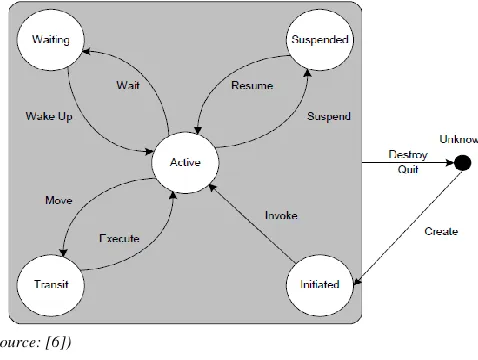
Agents have a well-defined six(6)lifecycles . The figure 4 below illustrates the states that made up these lifecycles.
[image:4.612.333.572.148.328.2](Source: [6])
Figure 3 - Agent life-cycle
1) Initiated: the Agent object is built, but hasn't registered itself yet with the AMS, has neither a name nor an address and cannot communicate with other agents.
2) Active: the Agent object is registered with the AMS, has a regular name and address and can access all the various JADE features.
3) Suspended:the Agent object is currently stopped. 4) Waiting: the Agent object is blocked, waiting for
something. (waiting till some conditions are met. 5) Deleted: the Agent is dead and the is no more
registered with the AMS.
6) Transit: a mobile agent enters this state while it is migrating to the new location.
Many authors have been making use of internet to improve e-commerce([2]; [16]; [12]; [5])
III. METHODOLOGY
A. System Analysis and Proposed System modelling
International Journal of Emerging Technology and Advanced Engineering
Website: www.ijetae.com (ISSN 2250-2459, ISO 9001:2008 Certified Journal, Volume 7, Issue 8, August 2017) Buyer who is interested in acquiring a product launches
a mobile agent and provides it with a list of shops to visit, the product specification and product evaluation logic. The buyer‟s mobile agent visits each of the shops in it itinerary in the specified order. On arrival at a shop, mobile agent contacts a stationary local agent to get the required product. The shop's local agent hands over the mobile agent to a local salesman agent, which deals with a particular category of products. The salesman agent uses local services to search the product catalog according to a given criteria and returns the result to the its agent.
Moreover, the agent then uses its evaluation logic to evaluate the product from the filtered list which match best to his taste. The agent rates each of its entries then carries this information along with it and move on to the next shop in its itinerary.
Furthermore, mobile agent also has a list of sites to visit and on completion of sites in its itinerary, it returns back to the it‟s site and contacts the stationary agent and handover the information. The stationary agent then displays the results to the user.
B. Major System’s Components
1) Buyer : This is the person(user) who want to procure a product from many online stores. He interacts with a Graphical User Interface(GUI) and provides it with his information about the product to be procured. Immediately this information is submitted, this will create a buyer's mobile agent that will get the job done.
2) Buyer's Graphical User Interface (BGUI): This is an interface between the user and the Buyer‟s Stationary Agent(BSA) that reside at the host. This Buyer Graphical User Interface allows the user to input specifications for a particular product to be searched. A buyer is required to select from the category name, a particular item to search for in the marketplace, this could be laptop, desktop, tablet or any other item.
3) Buyer's Stationary Agent (BSA): This is a local agent that responsible for managing resources and service at the buyer's end, it resides at the buyer's site inside Agent Execution Environment and its major function is to create agent, receive and dispatch agents. Buyer's Stationary Agent is the gateway for the mobile agent to access resources and services. Any mobile agent that is visiting the buyer's site will communicate his request to access some of the local resource or services to the Buyer‟s Stationary Agent which in turn perform the operation for the mobile agent immediately. Buyer‟s Stationary Agent is also used for security and authentication in order to prevent illegal access and malicious agents.
Almost immediately the user submit product parameters using the Buyer's Graphical User Interface, the information is received by the Buyer's Stationary Agent and is stored in a data structure, then it creates a buyer's mobile agent to search the product from the online stores.
4) Agent Execution Environment (AEE): This is
buyer‟s/seller‟s Execution Environment where JADE is used as platform that helps in agent creation, arrival, dispatch and management of agent. JADE is implemented in Java programming language and it provides help for, mobile objects, autonomous mobile agents and remote messaging.
5) Buyer's Mobile Agent (BMA): Buyer‟s Mobile Agent moves around the network and visit shops in its itinerary one after the other to search for a specified product. The Buyer's Mobile Agent is provided with the product specification and product evaluation logic and on visiting all the shops in its itinerary, then it returns back to the buyer‟s site with the result. Any shop the Buyer's Mobile Agent visit, it interacts with the shop's stationary agent and further with the salesman agent and store the list of products that matches the user's parameters in vector of product data structure that is been carried along with the mobile agent. After successful completion of the shops in its itinerary then, mobile agent returns back to the buyer's site and handover the result to the Buyer's Stationary Agent which in turns displays it to the user.
6) Mobile Agent's Evaluation Logic (MAEL): This is mobile agent evaluation logic that is created at the buyer‟s end, it is the evaluation criteria that helps in selecting products according to user choice. It is carried along with the mobile agent and always executed at each shop before adding a product offer to the mobile agent's product list. Mobile Agent Evaluation Logic evaluates and rates products that match user's specification and select the best offer from the list.
7) Shopkeeper: This is another user that manages shop at a given site. He is one to add new products, interacts with the system using the shopkeeper‟s graphical user interface to see the list of products at his shop and the transactions made that has been made so far. Sales transaction‟s track is been kept with the help of sales transaction log which can be shown at the Shopkeeper‟s Graphical User Interface.
International Journal of Emerging Technology and Advanced Engineering
Website: www.ijetae.com (ISSN 2250-2459, ISO 9001:2008 Certified Journal, Volume 7, Issue 8, August 2017) This is the interface used to add new product and to
modify the existing product catalogs.
9) Shop's Stationary Agent (SSA): This agent is performing almost the same function as Buyer‟s Stationary Agent(BSA). It is a local agent that resident at the shopkeeper's site for the purpose of Mobile agent management that is, receiving and dispatching mobile agents to and from its site. The first point of contact is Shop‟s Stationary Agent whenever a buyer's mobile agent looking for an item in the shop and it handles all request from the mobile agent and depending on requirement spawns salesman agent.
Also, the Shop‟s Stationary Agent keep track of list of mobile agent visiting and currently active at its shop.
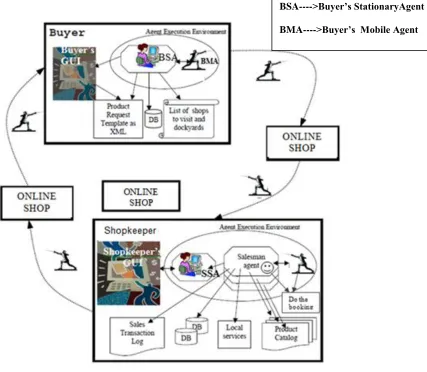
[image:6.612.135.562.283.655.2]10) Shop's Salesman Agent (SSmA): Shop's Salesman Agent transfers mobile agent‟s request to Shop Stationary Agent for accessing a particular product catalog. Shop's Sales uses local service such as filtering, searching, etc. to serve mobile agents requests. Buyer's mobile agent work on product catalog through Shop's Salesman Agent which returns the buyer's mobile agent the resultant product sub-tree. An architecture of the system is given in figure 4.
Figure 4: Proposed System Architecture
BSA---->Buyer’s StationaryAgent
BMA---->Buyer’s Mobile Agent
International Journal of Emerging Technology and Advanced Engineering
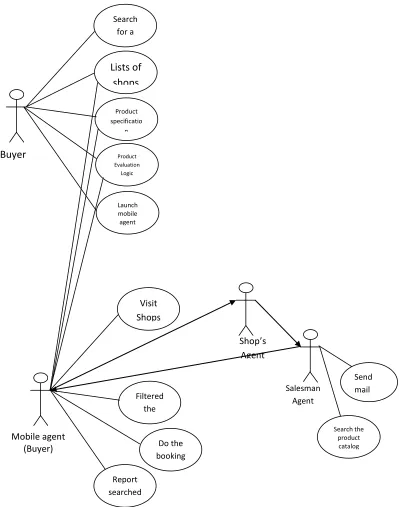
Website: www.ijetae.com (ISSN 2250-2459, ISO 9001:2008 Certified Journal, Volume 7, Issue 8, August 2017) In addition, A Use case representation of the proposed
[image:7.612.128.527.181.688.2]system is shown in figure 5 below.
Figure 5: Use Case model for the system
Salesman Agent
Buyer
Search for a product
Lists of
shops
Product specificatio
n
Product Evaluation
Logic
Launch mobile agent
Shop’s Agent
Search the product catalog Mobile agent
(Buyer)
Visit Shops
Filtered the result
Report searched
result
Do the booking
International Journal of Emerging Technology and Advanced Engineering
Website: www.ijetae.com (ISSN 2250-2459, ISO 9001:2008 Certified Journal, Volume 7, Issue 8, August 2017)
C. System Design
Systems design is the process of defining the architecture, components, modules, interfaces, and data for a system to satisfy specified requirements.
1) Database Design
In this paper, the buyer maintains a single database at the buyer‟s end. Once a buyer supply his name or company name, the product to buy, minimum rating, maximum price per product, maximum budget and maximum product count then agent can ahead for search.
At the seller‟s end, because they are at different locations, they have different databases. Product category, product name, rating, price and product sold are parameters in each of the seller‟s database.
Figure 6 below shows the Entity Relationship diagram for the system.
Figure 6: Entity Relationship diagram for MACSPER
2) Program Design
Algorithm for agent’s behavior in the market
1. /* Agent creation */
private BuyerAgent agent = this;
private BuyerGui ui;
Logger.info(agent, "Creating Buyer Agent UI...");
/* Buyer provides criterion for enquiries to be made */
2. this.category = category;
this.maxprice=maxprice
this.minRating = minRating;
this.prodcount=prodcount
this.maxBudgetPerProduct = maxBudgetPerProduct;
this.mail=mail
/*Test if buyer‟s category name i.e Laptop, Desktop, Tablets etc is available in seller‟s shop */
3. if (selectedcategoryname = sellercategoryname) then goto 9
4. if (buyerproductname=sellerproductname) then goto 9
5. if(buyeragentrating>=selleragentrating) then
goto 9
6. if(buyerprice<=sellerprice) then goto 9
7. totalamout=maxprice*prodcount
8. if(totalamount>maxBudgetPerProduct) then
Logger.info( “Insufificient fund”) goto 10
9. call booking subprogram and book the buyer agent
10. if(ShopsInBuyerAgentItenerary=0)then goto 11
Else goto 2
11. Display Results
12. End
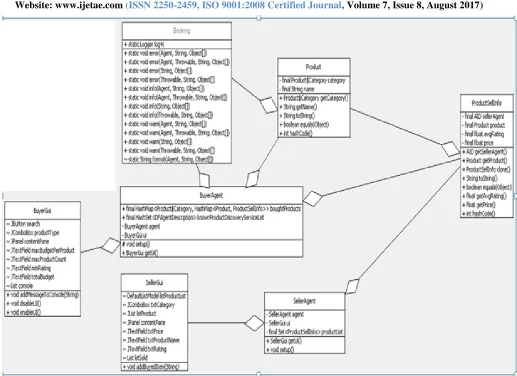
3) System Class Diagram
[image:8.612.49.298.342.521.2]International Journal of Emerging Technology and Advanced Engineering
Website: www.ijetae.com (ISSN 2250-2459, ISO 9001:2008 Certified Journal, Volume 7, Issue 8, August 2017) IV. RESULTS AND DISCUSSIONS
[image:9.612.49.259.184.300.2]A. Results Getting Started
Figure 8: How Buyer Agent is being created
The name of the buyer agent will be typed, take for instance “T-SHIP, BAUCHI” as shown in the figure 8 above, then “Add” will be clicked for that agent to be created.
[image:9.612.50.289.402.520.2]Once agent is created, the next thing is to supply the specifications of the product to make enquiries. i.e input data
Figure 9: input data for the buyer agent
[image:9.612.47.290.568.677.2]From the above; “category” is Laptop. In the category combo box, there are other types of computer like Desktop, Tablet etc as shown in the figure 10 below.
Figure 10: “category” of the computers
From the figure 9 above, after category might have been selected the next thing is “Mini rating” that is minimum rating which is the user‟s assessment of a particular item in term of quality. An item is been rated by assigning number that correspond the qualitative performance of the item for instance “0” is bad, “1”is fair, “2” is Better, “3” is Good, “4” is Very .good and “5” is Best. For the above input data(figure 9), Minimum rating is 2. Furthermore, “Maxi price per product” is highest amount that the buyer can buy the product. Also, “Max budget” is total amount of money a buyer has reserved for the transaction. “Max product count” is the total quantity of the product a buyer intends to buy. Lastly, e-mail is the buyer‟s personal contact through which seller agent can to communicate to the buyer at the expiration of the booking.
Once criteria are entered and “Find” is clicked, agent will go round visiting one online shop to another with the specified criterions and come back with the reports. Four test cases were carried out using 26 shops and results obtained were compared with [1].
B. Performance Evaluation Results of Mobile Agent model and Bo (2010)’s Client Server)
The performance metric considered is the user turnaround time, which is the time elapsed between a user initiating a request and receiving the results and this includes the time taken for agent creation, time taken to visit, time for booking and the processing time to extract the required information.
Also, the following parameters for comparing the performance of Mobile Agent model and Client Server were considered:
number of stores (varies from 1 to 26);
processing time for servicing each request; System was timed to record time taken for agent creation(tc), time taken to visit the shop(tv), time for
booking(tb), processing time to extract the required
information(te) and time taken to return back to buyer‟s
server(tr).
Turnaround time (tt) = tc+ tv+ tb+ te+ tr
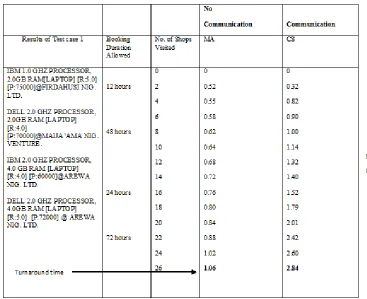
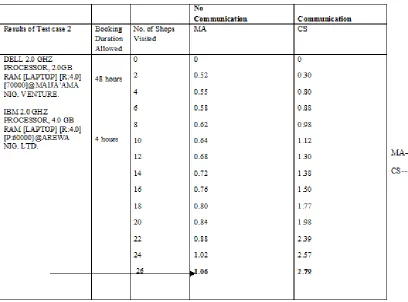
The results obtained from the simulated model were presented in the tables 1 to 4 and graphs in figures 15 to17 in the appendix. Summary of the results also presented in table 5 of the same appendix.
C. Discussion on Performance Evaluation
International Journal of Emerging Technology and Advanced Engineering
Website: www.ijetae.com (ISSN 2250-2459, ISO 9001:2008 Certified Journal, Volume 7, Issue 8, August 2017)
The performance of Mobile Agents model with turnaround time remains the same (except the scenario where there is no booking at all) while performance of Client Server varied. From table 6, test case 1 shows that Mobile Agent model took turnaround time of 1.06secs to visit 26 shops, while Client Server took turnaround time of 2.84secs to visit the same number of shops.
Test case 2 shows that Mobile Agent model took turnaround time of 1.06secs to visit 26 shops while Client Server took turnaround time of 2.79secs to visit the same shops.
Test case 3 shows that Mobile Agent model took turnaround time of 1.04secs to visit 26 shops, while Client Server took turnaround time of 2.77secs to visit the same number of shops.
Test case 4 shows that Mobile Agent model took turnaround time of 1.06secs to visit 26 shops while Client Server took turnaround time of 2.79secs to visit the same shops.
With the work done by [1] in his research, the Buyer Serverreceives a buyer‟s purchase request, and sends it to the Information Server to search wholesalers and retailers who sells the product. The Buyer Server generates and dispatches a mobile agent visiting these wholesalers and retailers, the mobile agent then visits and reports the offers to the Buyer Server. The Buyer Server then evaluates all the offers.
Comparing the Mobile Agents Model with his work, In our own work, once the mobile agent is created, it is the agent that will do the searching without depending on the outcome of information server. This simply means that our agent is autonomous and it makes process to be faster since agent doesn‟t need to wait until information server searches the shops that sells the product. Further more, in the model developed, Mobile agent has Evaluation Logic. Mobile Agent Evaluation Logic evaluates and rates products that match user's specification and carries the offer that is within its specification from the list of items in the shop. Therefore, there is no need to carry obtained result to the buyer server for evaluation any more as agent has taken care of that at different shops. Moreover, the model is tolerant to network failures and support disconnected operation. It can work operate without an active connection between the destination and the home host, therefore the problem of unrealistic network connection is solved. Lastly, as the model developed is moving to each shop the number of information exchange is not over the network, it is local; therefore saving network latencies and load; this solves the problem of bandwidth consumption.
D. Observation from Comparism.
From the above comparison, it is clear that our agent was able to carry out all the tasks from the beginning to the end without intervention. This simply means that our mobile agent is more intelligent. The turnaround time taken by Mobile Agent was less than Client Server because no communication of result to the buyer server after each visit, communication of result was done once, that is when whole 26 shops has been visited. Where as Client server communicates each results to the buyer server and return to visit another shop. Furthermore, Client Server implementations are recommended for applications where a little amount of information has to be brought out from few remote information sources, and most importantly when the level of processing required is not high (above tables 1 to 4 and graphs of figures 15 to 18 shows clear indication of these parameters. Nevertheless, these conditions may not be effective for most real world electronic commerce applications. Mobile Agents performs more brilliantly across the above parameters; therefore, it was discovered that Mobile Agents model is an exact technology for building efficient electronic-commerce applications.
V. CONCLUSION
This model was able to search, book for Computer Systems and communicate back the expiration time of booking to the buyer via e-mail. The results of the search were obtained and compared with [1]‟s Client Server. It was discovered that Mobile Agent model‟s turnaround time is less than that of Client Server, which makes Mobile Agent model better than Client Server. The electronic commerce activity among end-users takes a lot of time and is not efficient form of shopping and always includes extra steps like searching for quality and booking of items among other features. It is believe that if Mobile Agents are properly used, it can greatly eliminate the frustration that results from unrealistic networks, reduce transaction cost involved and is a very fast and effective way of carrying out transactions in an e-commerce, business-to-consumer transaction and in general.
From the result obtained through different scenarios in the test cases, it is very clear that the model developed is very intelligent and efficient.
REFERENCES
[1] Bo C. (2010), Mobile Agents in E-Commerce. Michigan Technological University, USA. pp. 846-847.
International Journal of Emerging Technology and Advanced Engineering
Website: www.ijetae.com (ISSN 2250-2459, ISO 9001:2008 Certified Journal, Volume 7, Issue 8, August 2017)
[3] David C., Colin H., and Aaron K.(1994), Mobile Agents: Are They a Good Idea?, IBM Research Report RC 19887 (88465).
[4] Danny B. L. (1998), Mobile Objects and Mobile Agents: The Future of Distributed Computing. In Proceedings of The European Conference on Object-Oriented Programming '98.
[5] Doorenbos R., Etzioni O. and Weld D.(1997), A scalable comparison/shopping agentfor the World Wide Web. Proceedings of the First International Conference on Autonomous Agents, Marina del Rey, CA. World Wide Web Journal.
[6] [6] Fabio B, Giovanni C., Tiziana T. and Giovanni R.(2010), JADE programmer‟s Guide, University of Parma.
[7] [7] Jonathan S. (1998), A Survey of Process Migration Mechanisms. Operating Systems Review, ACM Special Interest Group on Operating Systems, Vol 22, No.3, pp28-40.
[8] Maes, P., Guttman R.H. and Moukas A.G(1999).: Agents that Buy and Sell: Transforming Commerce as we Know It. In Communications of the ACM, Vol.42, No.3, pp.81-91.
[9] Mennie, D., (1998), Agent For Remote Maintenance System, 4th-year Project Report, System and Computer Engineering, Carleton University, 1998.
[10] Pagurek B., Yanrong L., Andrzej B. and Gatot S.(1998), Network Configuration Management In Heterogeneous ATM Environments. Proc. of the Int'l Workshop on Agents in Telecommunications Applications (IATA '98), AgentWorld'98, Paris, France, July 4-7.
[11] Rahul J., Mobile Agents for e-commerce, Roll No:99329011. www.it.iitb.ac.in/~sri/students/rahul-thesis.pdf retrieved on 20th Nov., 2014.
[12] Rodriguez J, Noriega P., Sierra C. and Padget J. (1997), FM96.5: A Java-based electronic auction house. Proceedings of the Second International Conference on the Practical Application of Intelligent Agents and Multi-Agent Technology, London, UK , pp. 207-224.
[13] Shantanu D.(2013), Mobile Agents in Distributed Computing: Network Exploration. Bulletin of the FATCS, 109, Pp 54-69, © European Association for Theoretical Computer Science
[14] Todd P.(2000), Mobile Information Agents for CyberSpace - State of the Art and Visions. To appear in Proc. of Cooperative Information Agents (CIA- 2000).
[15] Thomas S. and Qianbo H.(2000), "Nomad: Mobile Agent System for an Internet-Based Auction House ", IEEE Internet Computing , vol. 4, no.2.
[16] Tsvetovatyy M., Mobasher B., Gini M. and Wieckowski Z. (1997), MAGMA: An agent based virtual market for electronic commerce. Applied Artificial Intelligence, vol. 11, no. 6, pp. 501-523. [17] Wenna L. and Deli Y.(2004), Research on Mobile Agent-based
E-Commerce System Framework. The Fourth 440 International Conference on Electronic Business (ICEB2004) / Beijing. PP 440-444.
International Journal of Emerging Technology and Advanced Engineering
[image:12.612.57.574.124.500.2]Website: www.ijetae.com (ISSN 2250-2459, ISO 9001:2008 Certified Journal, Volume 7, Issue 8, August 2017)
International Journal of Emerging Technology and Advanced Engineering
[image:13.612.98.465.188.487.2]Website: www.ijetae.com (ISSN 2250-2459, ISO 9001:2008 Certified Journal, Volume 7, Issue 8, August 2017)
Table 1.
International Journal of Emerging Technology and Advanced Engineering
[image:14.612.61.575.120.486.2]Website: www.ijetae.com (ISSN 2250-2459, ISO 9001:2008 Certified Journal, Volume 7, Issue 8, August 2017)
International Journal of Emerging Technology and Advanced Engineering
[image:15.612.68.476.170.472.2]Website: www.ijetae.com (ISSN 2250-2459, ISO 9001:2008 Certified Journal, Volume 7, Issue 8, August 2017)
Table 2.
International Journal of Emerging Technology and Advanced Engineering
[image:16.612.60.577.131.455.2]Website: www.ijetae.com (ISSN 2250-2459, ISO 9001:2008 Certified Journal, Volume 7, Issue 8, August 2017)
International Journal of Emerging Technology and Advanced Engineering
[image:17.612.60.419.167.505.2]Website: www.ijetae.com (ISSN 2250-2459, ISO 9001:2008 Certified Journal, Volume 7, Issue 8, August 2017)
Table 3.
International Journal of Emerging Technology and Advanced Engineering
[image:18.612.54.565.128.402.2]Website: www.ijetae.com (ISSN 2250-2459, ISO 9001:2008 Certified Journal, Volume 7, Issue 8, August 2017)
International Journal of Emerging Technology and Advanced Engineering
[image:19.612.60.538.165.464.2] [image:19.612.81.477.169.465.2]Website: www.ijetae.com (ISSN 2250-2459, ISO 9001:2008 Certified Journal, Volume 7, Issue 8, August 2017)
Table 4.
International Journal of Emerging Technology and Advanced Engineering
[image:20.612.58.557.125.449.2]Website: www.ijetae.com (ISSN 2250-2459, ISO 9001:2008 Certified Journal, Volume 7, Issue 8, August 2017)
Figure 18. Effect of communication on turnaround time for Mobile Agents model and Client Server for test case 4
[image:20.612.57.438.532.710.2]The table 5 below shows summary of tables 1- 4 above for turnaround times of visiting 26 shops for Mobile Agents model and Client Server.
Table 5.