International Journal of Emerging Technology and Advanced Engineering
Website: www.ijetae.com (ISSN 2250-2459, ISO 9001:2008 Certified Journal, Volume 6, Issue 5, May 2016)
118
Distortion Mitigation Using Digital Predistortion
Raghvendra Yadav
1, Meenakshi Rawat
21
M.Tech. Department of Electronics & Communication Engineering IIT Roorkee-247667, India
2Assistant Professor, Department of Electronics & Communication Engineering, IIT Roorkee-247667, India
Abstract—the nonlinearity of power amplifier is affected by the characteristics of transmitted signal. The nonlinearity generates spectral regrowth i.e. broadening of signal beyond signal bandwidth which degrades the quality of transmitted signal. It also degrades the quality of transmitted signal within signal bandwidth which decreases bit error rate at receiver. The main goal of this thesis is to find a model which can identify the behavior of power amplifier and when transmitted signal is passed through Digital predistortion block and power amplifier then output signal should not distort i.e. there will be no generation of intermodulation products.
Keywords—Nonlinear distortion, power amplifier (PAs), Intermodulation, distortion (IMD), memory polynomial, predistortion.
I. INTRODUCTION
The predistortion circuit make inverse models the amplifier's gain and phase characteristics and, when combined with the amplifier, produces an overall system that is more linear and suppress the amplifier's distortion. In essence, "inverse distortion" is introduced to the input of the amplifier so that cancelling any non-linearity the amplifier might have. Presently Linearisation techniques are feed-forward, RF feedback, and RF-based predistortion [1]. Amongst them digital predistortion (DPD) applied into DSP is probably less expensive process. When the bitrate of a signal increases within its finite bandwidth, the transmission of the signal is more prone to error. Problems are additional complex on account that that PAs are nonlinear, which results in distortion of the transmitted signals. As a consequence, PA linearization is a discipline of significance in data transmission. The individual research objectives to achieve these aim is to investigation of different adaptation methods for finding the best compromise between accuracy and complexity for overcoming degradation in linearity of PA caused by variations in environmental conditions[8].
II. MEMORY STRUCTURES
Memory effects can be elaborated as time lags between amplitude and phase responses of PA.
The scattering, introduced by memory effects, produced by power amplifier are not covered by AM and AM-PM of PA model. The identification of the model parameters from input output measurements is performed by minimization of the sum-squared error between the observed data and the model output.Volterra Model is the most important model for dynamic nonlinear system. The Predistortion technique i.e. Volterra Series approximation that is based on a minimum mean square error (NMSE) approach to obtain a fixed predistorer model. If we consider symmetric kernels of memory M, second order Volterra Kernel requires the determination of M(M+1)/2 coefficients, while third order kernel requires M(M+1)(M+2)/6 coefficients[2]. For the input having a symmetric amplitude density function, such as Gaussian noise, the odd order Volterra functionalism are orthogonal to the even order Volterra functionalism. The advantage of volterra model is that there is no pre-processing needed before adaption. It follows for this type of input, a second order Volterra model, with zero DC component, is an orthogonal model. In fact, the number of parameters in conventional Volterra model increases exponentially with nonlinearity order and memory depth [3]. This is restriction for the practical use of the Volterra series. To decrease this complexity, several techniques have been demonstrated to simplify the Volterra model [4]. The Volterra-based models have demonstrated with high accuracy for frequency dependent power amplifier modelling. In this model the input and output relationship is given by
(1)
Constant
Set of jth-order volterra
International Journal of Emerging Technology and Advanced Engineering
Website: www.ijetae.com (ISSN 2250-2459, ISO 9001:2008 Certified Journal, Volume 6, Issue 5, May 2016)
119
0.1 0.2 0.3 0.4 0.5 0.6 0.7 0.8 0.9
0 0.2 0.4 0.6 0.8
input amplitude(volt)
o
u
tp
u
t
a
m
p
li
tu
d
e
(v
o
lt
)
Input amplitude versus output amplitude for volterra series(k,q=10) model
measured output model output
0.1 0.2 0.3 0.4 0.5 0.6 0.7 0.8 0.9
0 2 4
amplitude(volt)
g
a
in
volterra Model Gain versus input amplitude(volt)
[image:2.612.339.563.134.275.2]model gain measurement gain
Figure 1: Volterra Series Model with k, Q=10
A. Hammerstein modeling
The measurements is performed by minimization of the sum-squared error between the observed data and the model output. In the Hammerstein model, the static nonlinearity is applied before the linear filter. Only 10000 samples out of 184296 samples of identification of the model parameters from input and output baseband signal were used for model identification. The MATLAB programming language is used throughout this work for identifying the predistorer model and implementing them.
The output of nonlinear model is given as
(2)
This is the input of LTI system. Finally, the output of LTI system is given by
(3)
X(n) = Input complex base band signal Y(n)= Output complex baseband signal
Complex valued parameters
Q= memory depth K=order of polynomial
(4)
(5)
0.1 0.2 0.3 0.4 0.5 0.6 0.7 0.8 0.1
0.2 0.3 0.4 0.5 0.6 0.7 0.8
input amplitude(volt)
ou
tp
ut
a
m
pl
itu
de
(v
ol
t)
Vin versus Vout for hammeristein model model output
[image:2.612.62.268.140.316.2]measured output
Figure 2: Output amplitude vs. input amplitude of Hammerstein Model
0.1 0.2 0.3 0.4 0.5 0.6 0.7 0.8
0.9 1 1.1 1.2 1.3 1.4 1.5 1.6 1.7 1.8
amplitude(volt)
g
a
in
hammerstein Model Gain versus input amplitude(volt)
model gain measurement gain
Figure 3: Gain vs. input amplitude of Hammerstein Model
B. Memory polynomial modeling
The memory polynomial model is commonly used for behavioral modelling and digital predistortion of PAs/transmitters consisting memory effects [5]. It reduce of the Volterra series in which only diagonal terms are kept [6]. The identification of the model parameters from a set of input output measurements is calculated by minimization of the sum-squared error between the observed data and the model output. The MATLAB programming language is used throughout this work for determining the predistorer model and implementing them.
(6)
[image:2.612.337.547.306.461.2]International Journal of Emerging Technology and Advanced Engineering
Website: www.ijetae.com (ISSN 2250-2459, ISO 9001:2008 Certified Journal, Volume 6, Issue 5, May 2016)
120
Q= memory depth K=order of polynomial
0.1 0.2 0.3 0.4 0.5 0.6 0.7 0.8
0.2 0.4 0.6 0.8
input amplitude(volt)
o
u
tp
u
t
a
m
p
li
tu
d
e
(v
o
lt
)
Vin versus Vout
model output measured output
0.1 0.2 0.3 0.4 0.5 0.6 0.7 0.8 0.9
0 1 2 3 4
amplitude(volt)
g
a
in
Memory Polynomial Model Gain versus input amplitude(volt)
model gain measurement gain
III. INVERSE STRUCTURES
A. Volterra Series Modeling with Predistortion
Volterra series modeling as digital predistortion is used for increasing the efficiency of Power Amplifiers by reducing the distortion created by running Power Amplifiers in their non-linear regions. In this Volterra Series modeling is used as Digital predistortion. As predistortion is having an inverse characteristic of power amplifier. I have used memory polynomial modeling as power amplifier. Only 30000 samples out of 184296 samples of input and output baseband signal were used for model identification. The MATLAB programming language is used throughout this work for determining the predistorer model and implementing them.
0 0.1 0.2 0.3 0.4 0.5 0.6 0.7 0.8 0.9
0 0.2 0.4 0.6 0.8 1 1.2 1.4 1.6 1.8
amplitude(volt)
g
a
in
volterra series Modeling with nonlinearity order and memory depth of ten as Predistortion
model gain with DPD+PA measured gain
[image:3.612.335.548.296.482.2]volterra series modeling DPD
Figure 5: measured gain Vs. Volterra Series modeling (K, Q=10) as DPD with memory polynomial model as PA’s gain
B. Hammerstein Modeling as Predistortion
In this Hammerstein modeling is used as Digital predistortion. Hammerstein modeling as digital predistortion[9] is used for increasing the efficiency of Power Amplifiers by reducing the distortion created by running Power Amplifiers in their non-linear regions. As predistortion is having an inverse characteristic of power amplifier. I have used memory polynomial modeling as power amplifier. Only 50000 samples out of 184296 samples of input and output baseband signal were used for model identification. The MATLAB programming language is used throughout this work for determining the predistorer model and implementing them.
0 0.1 0.2 0.3 0.4 0.5 0.6 0.7 0.8 0.9
0 0.2 0.4 0.6 0.8 1 1.2 1.4 1.6 1.8
amplitude(volt)
g
a
in
Hammerstein Model as Predistortion
model gain with DPD+PA measured gain hammerstein DPD
Figure 6: measured gain Vs. Hammerstein modeling as DPD with memory polynomial model as PA’s gain
IV. EXPERIMENTAL RESULT
The measurement used in this research were done in Signal Processing Laboratory, Indian Institution of Technology Roorkee, Roorkee (INDIA).
A. PSD of Hammerstein Modeling with Power Amplifier
[image:3.612.62.282.543.704.2]International Journal of Emerging Technology and Advanced Engineering
Website: www.ijetae.com (ISSN 2250-2459, ISO 9001:2008 Certified Journal, Volume 6, Issue 5, May 2016)
121
2090 2100 2110 2120 2130 2140 2150 2160 2170 2180 2190
-100 -90 -80 -70 -60 -50 -40 -30 -20
Hammerstein modeling DPD with rapp modeling as PA
Frequency(MHz)
P
o
w
e
r(
d
b
m
)
PA output
DPD+PA input
[image:4.612.59.280.134.302.2]output signal HMR DPD Rapp PA input signal
Figure 7: Input and Output spectrum of Hammerstein modeling as DPD with Rapp modeling PA
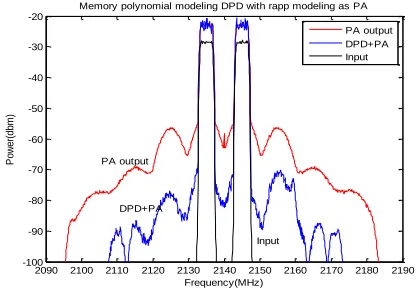
B. PSD of Memory Polynomial Modeling with Power Amplifier
The power spectrum of a signal describes the distribution of power into frequency components forming that signal. Input signal and output signal power Spectral density is drawn. In DPD scheme where a signal is inputted to the predistortion unit, whose output is given to the power amplifier for producing desired output. In this memory polynomial[10] model is considered as DPD and Rapp modeling is used as PA. The MATLAB programming language is used throughout this work for determining the predistorer model and implementing them.
2090 2100 2110 2120 2130 2140 2150 2160 2170 2180 2190 -100
-90 -80 -70 -60 -50 -40 -30 -20
PA output
DPD+PA
Input
Frequency(MHz)
P
o
w
e
r(
d
b
m
)
Memory polynomial modeling DPD with rapp modeling as PA
[image:4.612.333.557.236.384.2]PA output DPD+PA Input
Figure 8: Input and Output spectrum of MP modeling as DPD with Rapp modeling as PA
C. PSD of Volterra Series Modeling with Power Amplifier
The power spectrum of a signal describes the distribution of power into frequency components composing that signal[7]. Input signal and output signal power Spectral density is drawn.
In DPD scheme where a signal is inputted to the predistortion unit, whose output is given to the power amplifier for producing desired output. In this Rapp model is considered as power amplifier and volterra series with memory length and nonlinearity order of three modeling is used as digital predistortion. The MATLAB programming language is used throughout this work for identifying the predistorer model and implementing them.
2090 2100 2110 2120 2130 2140 2150 2160 2170 2180 2190 -100
-90 -80 -70 -60 -50 -40 -30 -20
Volterra series modeling(k,q=3) DPD with rapp modeling as PA
Frequency(MHz)
P
ow
er
(d
bm
)
PA output
DPD+PA
Input
PA output DPD+PA Input
[image:4.612.316.572.440.589.2]Figure 9: Input and Output spectrum of Volterra Series modeling (k,q=3) as DPD with Rapp modeling as PA
Table I:
Comparison of different Modeling’s NMSE
Modeling NMSE
Volterra Series modeling with nonlinearity order and memory depth of three
-31.6623 dB
Volterra Series modeling with nonlinearity order and memory depth of ten
-33.0980 dB
Memory polynomial modeling -33.5935 dB
Hammerstein modeling -42.3931 dB
V. CONCLUSION
[image:4.612.60.269.480.624.2]International Journal of Emerging Technology and Advanced Engineering
Website: www.ijetae.com (ISSN 2250-2459, ISO 9001:2008 Certified Journal, Volume 6, Issue 5, May 2016)
122
We should use highly linear power amplifier for diminishing intermodulation product generated by power amplifier. Power amplifier works in linear region when amplifier saturation power is more than average output power. But, in this process cost increases and larger DC power is required.
REFERENCES
[1] S. P. Stapleton and F. C. Costescu, ―An adaptive predistorter for a power amplifier based on adjacent channel emission,‖ IEEE Trans. Microw. Theory Tech., vol. 41, no. 1, pp. 49–56, Feb. 1992.. [2] G. Budura and I. Nafornit¸a, ―Kernels measurement techniques for
constructing nonlinear models,‖ in Proc. of the Symposium on Electronics and Telecomm, ETC 2002, Timis¸oara, 2002, pp. 190– 195.
[3] G. Budura and C. Botoca, ―La construction d’un modele non lineaire a l’aide de series Volterra et Wiener,‖ Revue de l’Academie roumaine, Bucharest, 2005, accepted to be published.
[4] A. Chatterjee and N. S. Vyas, "Non-linear parameter estimation in multi-degree of-freedom systems using multi-input volterra series", Mechanical Systems and Signal Processing, v. 18, p. 457–489, 2004.
[5] Hanxin Zhou, Guojin Wan and Limin Chen. Article: A Nonlinear Memory Power Amplifier Behavior Modeling and Identification Based on Memory Polynomial Model in Soft-defined Shortwave Transmitter. Department of Electronic Information Engineering, Nanchang University Nanchang, 330031, China 2010.
[6] T. Ogunfunmi, Adaptive Nonlinear System Identification: The Volterra and Wiener Model Approaches, Springer, 2007.
[7] H. Paaso and A. Mammela, ―Comparison of Direct Learning and Indirect Learning Predistortion Architectures‖, in IEEE Int. Symp. on Wireless Commun. Systems, pp. 309-313, Oct. 2008
[8] L. M. Correiaet al., "Challenges and enabling technologies for energy aware mobile radio networks," in IEEE Communications Magazine, vol. 48, no. 11, pp. 66-72, November 2010.
[9] S. P. Stapleton and F. C. Costescu, ―An adaptive predistorter for a power amplifier based on adjacent channel emission,‖ IEEE Trans. Microw. Theory Tech., vol. 41, no. 1, pp. 49–56, Feb. 1992. [10] L. Ding, G. T. Zhou, D. R. Morgan, Z. Ma, J. S. Kenney, J. Kim,