comm
en
t
re
v
ie
w
s
re
ports
de
p
o
si
te
d r
e
se
a
rch
refer
e
e
d
re
sear
ch
interacti
o
ns
inf
o
rmation
The human phylome
Jaime Huerta-Cepas, Hernán Dopazo, Joaquín Dopazo and Toni Gabaldón
Address: Bioinformatics Department, Centro de Investigación Príncipe Felipe, Autopista del Saler, 46013 Valencia, Spain..
Correspondence: Toni Gabaldón. Email: [email protected]
© 2007 Huerta-Cepas, et al.; licensee BioMed Central Ltd.
This is an open access article distributed under the terms of the Creative Commons Attribution License (http://creativecommons.org/licenses/by/2.0), which permits unrestricted use, distribution, and reproduction in any medium, provided the original work is properly cited.
The human phylome
<p>The human phylome, which includes evolutionary relationships of all human proteins and their homologs among thirty-nine fully sequenced eukaryotes, is reconstructed.</p>
Abstract
Background: Phylogenomics analyses serve to establish evolutionary relationships among organisms and their genes. A phylome, the complete collection of all gene phylogenies in a genome, constitutes a valuable source of information, but its use in large genomes still constitutes a technical challenge. The use of phylomes also requires the development of new methods that help us to interpret them.
Results: We reconstruct here the human phylome, which includes the evolutionary relationships of all human proteins and their homologs among 39 fully sequenced eukaryotes. Phylogenetic techniques used include alignment trimming, branch length optimization, evolutionary model testing and maximum likelihood and Bayesian methods. Although differences with alternative topologies are minor, most of the trees support the Coelomata and Unikont hypotheses as well as the grouping of primates with laurasatheria to the exclusion of rodents. We assess the extent of gene duplication events and their relationship with the functional roles of the protein families involved. We find support for at least one, and probably two, rounds of whole genome duplications before vertebrate radiation. Using a novel algorithm that is independent from a species phylogeny, we derive orthology and paralogy relationships of human proteins among eukaryotic genomes.
Conclusion: Topological variations among phylogenies for different genes are to be expected, highlighting the danger of gene-sampling effects in phylogenomic analyses. Several links can be established between the functions of gene families duplicated at certain phylogenetic splits and major evolutionary transitions in those lineages. The pipeline implemented here can be easily adapted for use in other organisms.
Background
The complete sequencing of the human genome represented a major breakthrough for the genome era [1,2]. Since then, a number of genome wide experimental and computational analyses have been performed that capture different aspects of the biology of the human cell. These analyses include, among many others, those of the so-called transcriptome [3], proteome [4], interactome [5] and metabolome [6]. The
avail-ability of such large datasets have added new dimensions to the study of the human organism; not only are they useful in elucidating the function of otherwise uncharacterized pro-teins, but they also provide information on the system-level properties of the cell [7]. The reconstruction of the evolution-ary histories of all genes encoded in a genome, the so-called phylome [8], constitutes another source of genome-wide information. Analyses of complete phylomes, however, have
Published: 13 June 2007
Genome Biology 2007, 8:R109 (doi:10.1186/gb-2007-8-6-r109)
Received: 30 November 2006 Revised: 16 March 2007 Accepted: 13 June 2007 The electronic version of this article is the complete one and can be
traditionally been prevented by their large demands on time and computer power. Only recently have faster computers and algorithms paved the way for the application of phyloge-netics to whole genomes. Such analyses have proven to be a very useful tool for the detection of specific evolutionary sce-narios [9] and for the functional characterization of genes and biological systems [10,11]. Other large-scale phylogenetic analyses have focused on the establishment of orthology rela-tionships among genes in model species. Most remarkably, the Ensembl database now includes phylogenetic trees [12], and the TreeFam [13] and HOVERGEN [14] databases pro-vide automatically derived and curated phylogenies of animal gene families. Other such databases focus on specific aspects of the evolution of gene families, such as the detection of adaptive events [15]. These databases follow a family-based approach, since they first group the genes into families and subsequently build a single phylogeny for each family.
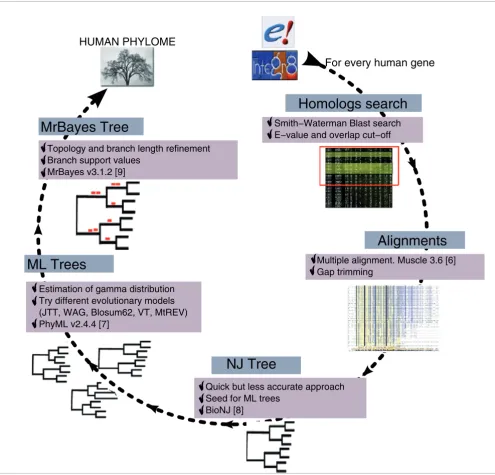
Using a different, gene-based approach that aims at maximiz-ing both the coverage over the human genome and the taxon-sampling among fully sequenced eukaryotic genomes, we have developed a fully automated pipeline (Figure 1) to recon-struct the phylogenies of every protein encoded in the human genome and its homologs in 39 eukaryotic species. Such a pipeline aims at resembling, as much as possible, the manual procedure used by phylogeneticists while remaining a fully automated process. In the search for a compromise between time and reliability, we always tried to adjust the balance towards the latter, thus assuring high quality in the resulting phylogenies. In contrast to the abovementioned TreeFam and Ensembl phylogenetic pipelines, our approach includes evo-lutionary model testing using maximum likelihood (ML), model parameter estimation and alignment trimming steps. Moreover, besides using neighbor joining (NJ) and ML approaches for phylogenetic reconstruction, our pipeline also implements a Bayesian phylogenetic reconstruction approach to provide posterior probabilities of every partition in the tree. As a result, building the human phylome pre-sented here took two months on a total of 140 64-bit proces-sors, which is roughly equivalent to 23 years in a single processor. To our knowledge, this represents the most sophis-ticated phylome reconstruction pipeline and the largest com-puting time investment for a single phylome reported to date.
The availability of such a comprehensive collection of evolu-tionary histories of protein-coding human genes constitutes a valuable source of information that allows us to test several evolutionary hypotheses. For this purpose, we investigated the consistency of the individual phylogenies within the phy-lome with alternative evolutionary scenarios, namely those involving the relative positions of rodents and primates, amoebozoans and opisthokonts and, finally, insects, nema-todes and chordates. We also scanned the human phylome for cases of putative horizontally transferred genes and found that such topologies are never highly supported, indicating that they are rather the result of phylogenetic artifacts.
More-over, we provide estimates for the number of gene duplica-tions that have occurred at different evolutionary stages in the eukaryotic lineages leading to hominids and found several over-represented functional classes in the different duplica-tion events. Finally, we explored an alternative, fully auto-mated algorithm to infer orthology relationships from phylogenetic trees that does not require a fully resolved spe-cies phylogeny and, therefore, is less sensitive to topological variations. The choice for this novel methodology for orthol-ogy prediction is based on the fact that alternative tree recon-ciliation methods have difficulties in accounting for inherent phylogenetic noise, divergences in evolutionary histories for different genes and the low resolution level of available spe-cies trees. As will be shown below, the high degree of topolog-ical variation found in the human phylome for all scenarios considered also supports the choice of alternatives to classic tree reconciliation methods. All in all, the results presented here constitute a preliminary but broad overview of the evo-lutionary history of the human genome, which is not taken as an average or represented by a limited number of genes, but instead is regarded as a complex mosaic of thousands of indi-vidual phylogenies.
Results and discussion
Phylome scope and phylogenetic pipeline
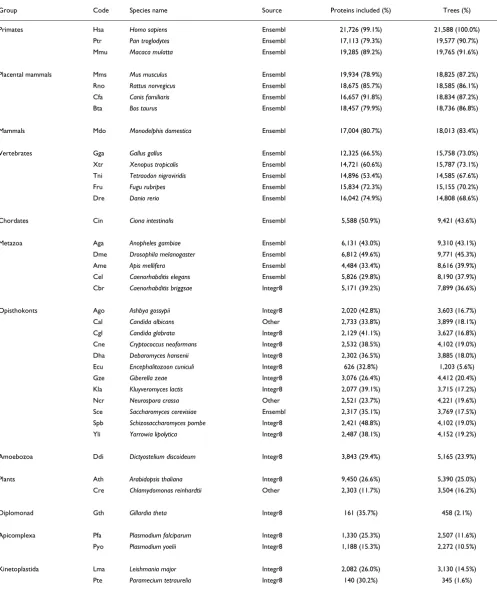
The human phylome presented here is derived from the pro-teins encoded by 39 publicly available eukaryotic genomes (Table 1). This set is particularly rich in metazoan species (19 species, 50%), including 14 chordates, 3 arthropods and 2 nematodes. The second largest group is that of fungi, com-prising 11 species and thus making a total of 30 opisthokons. The remaining group includes eight species from diverse phyla, among which are one amoebozoan (Dictyostellum dis-coideum), two plants (Arabiopsis thaliana and Chlamydomonas reinhardti), two apicomplexans ( Plasmo-dium falciparum and Plasmodium briggsae), and three exca-vates (the diplomonad Guillardia theta and the kinetoplastids Leishmania major and Paramecium tetraure-lia). This distribution of species makes our set especially suit-able for addressing the evolution of protein families among the opisthokonts. It covers, therefore, a period that is rich in important evolutionary innovations, from the origin of apop-totic pathways [16] to the emergence of complex communica-tion patterns [17].
comm
en
t
re
v
ie
w
s
re
ports
refer
e
e
d
re
sear
ch
de
p
o
si
te
d r
e
se
a
rch
interacti
o
ns
inf
o
rmation
reconstruction combines NJ, ML and Bayesian methods. Firstly, a NJ tree is constructed with BioNJ [18], and sec-ondly, this NJ tree is used as a seed in a ML analysis using PhyML [19]. In the ML analysis, up to five different evolution-ary models were tested for each tree (see below) using a dis-crete gamma-distribution model with four rate categories plus invariant positions. Both the gamma shape parameter and the fraction of invariant positions were estimated from
the data. Finally, the ML tree rendered by the model best fit-ting the data, as determined by the Akaike Information Crite-rion (AIC) [20], was further refined with a Bayesian approach as implemented in MrBayes [21]. After the Bayesian analysis, a consensus tree was produced by using the 'halfcompat' option of MrBayes, which produces a topology in which all partitions are compatible with at least 50% of the trees pro-duced by the Monte Carlo Markov Chain analysis (see
[image:3.612.57.552.86.561.2]Mate-Schematic representation of the phylogenetic pipeline used to reconstruct the human phylome Figure 1
Schematic representation of the phylogenetic pipeline used to reconstruct the human phylome. Each protein sequence encoded in the human genome is compared against a database of proteins from 39 fully sequenced eukaryotic genomes (Table 1) to select putative homologous proteins. Groups of homologous sequences are aligned and subsequently trimmed to remove gap-rich regions. The refined alignment is used to build a NJ tree, which is then used as a seed tree to perform a ML likelihood analysis as implemented in PhyML, using four different evolutionary models (five in the case of
mitochondrially encoded proteins). The ML tree with the maximum likelihood is further refined with a Bayesian analysis using MrBayes. Finally, different algorithms are used to search for specific topologies in the phylome or to define orthology and paralogy relationships.
Quick but less accurate approach Seed for ML trees
BioNJ [8]
NJ Tree
ML Trees
Estimation of gamma distribution Try different evolutionary models (JTT, WAG, Blosum62, VT, MtREV) PhyML v2.4.4 [7]
Topology and branch length refinement Branch support values
MrBayes v3.1.2 [9]
Multiple alignment. Muscle 3.6 [6] Gap trimming
Alignments
MrBayes Tree
Smith−Waterman Blast searchE−value and overlap cut−off
Homologs search
HUMAN PHYLOME
Table 1
Species included in the present phylome and their genomic coverage
Group Code Species name Source Proteins included (%) Trees (%)
Primates Hsa Homo sapiens Ensembl 21,726 (99.1%) 21,588 (100.0%) Ptr Pan troglodytes Ensembl 17,113 (79.3%) 19,577 (90.7%) Mmu Macaca mulatta Ensembl 19,285 (89.2%) 19,765 (91.6%) Placental mammals Mms Mus musculus Ensembl 19,934 (78.9%) 18,825 (87.2%) Rno Rattus norvegicus Ensembl 18,675 (85.7%) 18,585 (86.1%) Cfa Canis familiaris Ensembl 16,657 (91.8%) 18,834 (87.2%) Bta Bos taurus Ensembl 18,457 (79.9%) 18,736 (86.8%) Mammals Mdo Monodelphis domestica Ensembl 17,004 (80.7%) 18,013 (83.4%) Vertebrates Gga Gallus gallus Ensembl 12,325 (66.5%) 15,758 (73.0%) Xtr Xenopus tropicalis Ensembl 14,721 (60.6%) 15,787 (73.1%) Tni Tetraodon nigroviridis Ensembl 14,896 (53.4%) 14,585 (67.6%) Fru Fugu rubripes Ensembl 15,834 (72.3%) 15,155 (70.2%) Dre Danio rerio Ensembl 16,042 (74.9%) 14,808 (68.6%) Chordates Cin Ciona intestinalis Ensembl 5,588 (50.9%) 9,421 (43.6%) Metazoa Aga Anopheles gambiae Ensembl 6,131 (43.0%) 9,310 (43.1%) Dme Drosophila melanogaster Ensembl 6,812 (49.6%) 9,771 (45.3%) Ame Apis mellifera Ensembl 4,484 (33.4%) 8,616 (39.9%) Cel Caenorhabditis elegans Ensembl 5,826 (29.8%) 8,190 (37.9%) Cbr Caenorhabditis briggsae Integr8 5,171 (39.2%) 7,899 (36.6%) Opisthokonts Ago Ashbya gossypii Integr8 2,020 (42.8%) 3,603 (16.7%) Cal Candida albicans Other 2,733 (33.8%) 3,899 (18.1%) Cgl Candida glabrata Integr8 2,129 (41.1%) 3,627 (16.8%) Cne Cryptococcus neoformans Integr8 2,532 (38.5%) 4,102 (19.0%) Dha Debaromyces hansenii Integr8 2,302 (36.5%) 3,885 (18.0%) Ecu Encephalitozoon cuniculi Integr8 626 (32.8%) 1,203 (5.6%) Gze Giberella zeae Integr8 3,076 (26.4%) 4,412 (20.4%) Kla Kluyveromyces lactis Integr8 2,077 (39.1%) 3,715 (17.2%) Ncr Neurospora crassa Other 2,521 (23.7%) 4,221 (19.6%) Sce Saccharomyces cerevisiae Ensembl 2,317 (35.1%) 3,769 (17.5%) Spb Schizosaccharomyces pombe Integr8 2,421 (48.8%) 4,102 (19.0%) Yli Yarrowia lipolytica Integr8 2,487 (38.1%) 4,152 (19.2%) Amoebozoa Ddi Dictyostelium discoideum Integr8 3,843 (29.4%) 5,165 (23.9%) Plants Ath Arabidopsis thaliana Integr8 9,450 (26.6%) 5,390 (25.0%) Cre Chlamydomonas reinhardtii Other 2,303 (11.7%) 3,504 (16.2%) Diplomonad Gth Gillardia theta Integr8 161 (35.7%) 458 (2.1%) Apicomplexa Pfa Plasmodium falciparum Integr8 1,330 (25.3%) 2,507 (11.6%)
comm
en
t
re
v
ie
w
s
re
ports
refer
e
e
d
re
sear
ch
de
p
o
si
te
d r
e
se
a
rch
interacti
o
ns
inf
o
rmation
rials and methods). Unless stated otherwise, this tree was used in all subsequent analyses. The resulting 21,588 align-ments and 129,510 trees from the different phylogenetic approaches are available as supplementary material accom-panying this article [22].
Evolutionary model selection
Both ML and Bayesian analyses are model-based approaches that can provide divergent results when different evolution-ary models are assumed. Several authors have shown that the use of an appropriate model is crucial for the reconstruction of correct phylogenies and that the origin of the sequences involved (that is, the range of organisms involved) is not always a good predictor of the most appropriate model [23,24]. Applying a wrong evolutionary model to a given data-set might even lead to the reconstruction of wrong phyloge-nies with a high support [25]. To avoid such pitfalls, we tested using the ML approach several models that are complemen-tary in their scope, namely: JTT [26], a general model for globular, nuclear-encoded proteins; BLOSUM62 [27], inferred from protein blocks of 62% sequence identity; WAG, derived from a database of globular proteins with a broad range of evolutionary distances [28]; and VT, based on amino acid replacement rates suited for distantly related sequences [29]. Additionally, phylogenies of the proteins encoded in the mitochondrial genome were also reconstructed using mtREV, a model that has been specifically designed for this kind of data [30]. In all cases, a discrete gamma-distribution model with four rate categories plus invariant positions was used. The gamma parameter and the fraction of invariant positions were estimated from the data.
Among the models tested, JTT was chosen as the best fitting model in a majority of the trees (14,683, 68.0%), followed by WAG (6,388, 29.6%), Blosum62 (461, 2.1%) and VT (26, 0.1%). MtREV was chosen as the best model in ten out of the thirteen mitochondrial-encoded human proteins. Surpris-ingly, the phylogenies of subunit 6 of NADH dehydrogenase and subunits 1 and 2 of cytochrome oxidase were best fitted by JTT, Blosum62 and WAG models, respectively.
To assess whether a tree produced by the NJ approach has sufficient predictive value for the model selection step, we compared the model chosen by the full ML approach (that is, reconstructing a ML phylogeny for every model) to the model selected when the likelihood of the seed NJ tree was assessed under different models, allowing for branch-length optimiza-tion. In 86.7% of the cases the model chosen by both methods was the same. This confirms and extends earlier results [23] and, more importantly, suggests that the pipeline can be sim-plified by basing the model selection on the tree produced by BioNJ.
The tree of eukaryotes and the topological diversity within the human phylome
Recent advances in resolving the tree of eukaryotes are con-verging into a model that comprises a few large super-groups [31]. Despite the general agreement on the classification of these major groups, several relationships, both among and within the different groups, remain controversial. In recent years, a number of large-scale approaches have been devel-oped that combine the information obtained from several genes to resolve evolutionary relationships. Among these, the construction of super-trees and trees based on concatenated alignments are among the most widely used [32]. These trees are useful in that they constitute a straightforward way of vis-ualizing the combined phylogenetic signal of genes that are widespread in the species considered. However, it has been claimed that these trees are representative of only a small fraction of the genes encoded in a given genome, and that gene-sampling effects might lead to biased results supporting a specific species phylogeny [33,34].
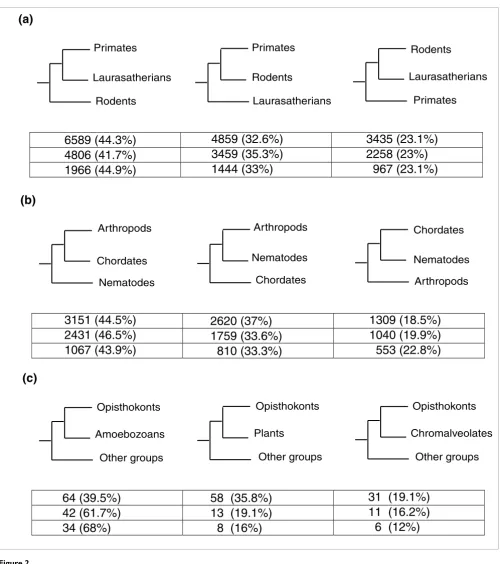
A phylome represents a broader, yet more complex to inter-pret, reconstruction of the evolution of an organism, since it comprises the phylogenies of all its genes. Most notably, the availability of a phylome opens the possibility for studying the relationships among species in a different way: that of quan-tifying the fraction of individual phylogenies whose topolo-gies are consistent with a given hypothesis. Here we explored this methodology by specifically contrasting a number of evolutionary relationships that are controversial to some extent. We chose three different scenarios for which there is some level of controversy in the literature and that involve three different depths of the eukaryotic tree (Figure 2). Namely, the relative positions of nematodes, chordates and arthropods, the relationships among rodents, primates and laurasatherians, and, lastly, the grouping of opisthokonts with amoebozoans. To scan for phylogenies compatible with the different hypotheses, we adapted a previously described algorithm [9] (see also Materials and methods).
Ecdysozoa versus coelomata hypotheses
Perhaps one of the most debated issues regarding the tree of eukaryotes is the relative position of arthropods, nematodes and chordates. Traditionally, comparative anatomy placed arthropods and chordates in the coelomata clade, which con-tained animals with a true body cavity, while pseudocoelo-mates such as nematodes occupied a more basal position. However, phylogenetic analyses of 18S and 28S rRNAs sup-ported an alternative view that grouped nematodes and arthropods, dubbed ecdysozoa, to the exclusion of chordates [35]. Since then, numerous multi-gene phylogenetic studies that support either of the hypotheses have been published (see, among others, [36-39]).
represent-atives from the three groups, 3,151 (44.5%) support the Coe-lomata hypothesis, placing nematodes at a basal position,
compared to 2,620 (37%) and 1,309 (18.5%) that group nem-atodes with arthropods (Ecdysozoa hypothesis) or with
[image:6.612.59.559.80.644.2]chor-The alternative phylogenetic relationships among the taxa involved in the three evolutionary hypotheses considered Figure 2
The alternative phylogenetic relationships among the taxa involved in the three evolutionary hypotheses considered. (a) Placental mammals: primates, laurasatheria and rodents. (b) Ecdysozoa versus Coelomata hypothesis: relationships among arthropods, chordates and nematodes. And (c) the Unikont hypothesis: relationship among opisthokonts, amoebozoans and other eukaryotic groups. The numbers indicate the number of trees supporting each topology. For each alternative topology numbers on the top row refer to the total number of trees with a given topology, and what percentage of the total it represents; numbers in the middle row refer to those trees for which the posterior probabilities of the two partitions shown in the figure are 0.9 or higher. Numbers in the bottom row refer to the number and percentage of gene families supporting each topology.
Primates
Laurasatherians
Rodents
Primates
Laurasatherians
Rodents
Primates
Laurasatherians
Rodents
Chordates
Arthropods
Nematodes
(a)
Other groups
Chromalveolates
Opisthokonts
(b)
(c)
Chordates
Arthropods
Nematodes
Chordates
Arthropods
Nematodes
Other groups
Plants
Opisthokonts
Other groups
Amoebozoans
Opisthokonts
6589 (44.3%)
4806 (41.7%)
1966 (44.9%)
4859 (32.6%)
3459 (35.3%)
1444 (33%)
3435 (23.1%)
2258 (23%)
967 (23.1%)
3151 (44.5%)
2431 (46.5%)
1067 (43.9%)
2620 (37%)
1759 (33.6%)
810 (33.3%)
1309 (18.5%)
1040 (19.9%)
553 (22.8%)
64 (39.5%)
42 (61.7%)
34 (68%)
58 (35.8%)
13 (19.1%)
8 (16%)
comm
en
t
re
v
ie
w
s
re
ports
refer
e
e
d
re
sear
ch
de
p
o
si
te
d r
e
se
a
rch
interacti
o
ns
inf
o
rmation
dates, respectively. The relative fraction of trees supporting each topology is similar if we consider only the 5,230 trees with the highest topology support (posterior probabilities higher than 0.9 in the nodes grouping the considered taxa (Figure 2). Since the algorithm treats each gene individually, a certain level of redundancy exists because protein families with many members in the human genome contribute more trees to the phylome. These would affect the topological anal-ysis if there are great differences in the distribution of family sizes supporting each topology. To correct for this redun-dancy we grouped the individual gene-trees into families if their seed sequences appeared together in a tree. Then each family was considered to support a single topology. If more than a single topology was supported, the one supported by a majority of members was chosen. As shown in Figure 2 (bot-tom row), the percentage of families supporting each topol-ogy is similar to the results obtained when genes are treated individually.
The finding that all three possible topologies, including the one widely considered as wrong in the literature, are sup-ported by a significant number of trees illustrates the inher-ent difficulty of resolving the species phylogeny from gene phylogenies. We have found similar topological diversity in the three scenarios considered (see below) and also, to smaller degrees, in apparently undisputed evolutionary rela-tionships (results not shown). Similar results showing varia-bility in the relative positions of arthropods, nematodes and chordates have also been found in topological analyses of the phylogenies of 507 eukaryotic orthologous groups [38] and of 100 protein families [40]. These deviances from the species phylogeny might be the result of different processes, includ-ing convergent evolution or varyinclud-ing evolutionary rates. In the case of the Ecdysozoa and Coelomata hypotheses, the acceler-ated rate of evolution in the nematode sequences has been proposed as the main cause preventing the acceptance of the Ecdysozoa hypothesis. For instance, some studies have shown that when fast evolving genes are removed from the dataset, the ecdysozoa group is accepted with high confidence [36,39]. Therefore, the relative abundance of the different topologies should be considered with caution, since differ-ences in evolutionary rates, if they are widespread, could result in a majority of the gene trees supporting a wrong spe-cies phylogeny.
Relationships among placental mammals
The phylogenetic relationship among placental mammals has attracted great interest in recent years [41]. A still open ques-tion is the relative grouping and branching order of the groups rodentia, primates, lagomorpha, artyodactyla and car-nivora. Four of these groups are represented in the present phylome, namely primates (human, chimpanzee and macaque), artyodactyla (cow), carnivora (dog) and rodents (rat and mouse). While the monophily of artyodactyla and carnivores, both belonging to laurasatheria, is largely undis-puted, the crucial question is whether rodents have a basal
position relative to the other groups or whether they join pri-mates on a common node. Analyses of concatenated align-ments from nuclear genes are consistent with the rodents being a basal group and primates being monophyletic with laurasatheria [42,43]. However, phylogenies based on mito-chondrial genes as well as the common presence of several mutational events and the insertion of MLTA0 elements sup-port the clustering of primates and rodents to the exclusion of laurasatheria [41,44].
In our analyses the results seem to favor the basal position of rodents, although the difference with the alternative hypoth-esis of a clade grouping rodents and primates is not great (Figure 2). From the 14,883 trees in the human phylome with representatives for the three groups (Figure 2), 6,589 (44.3%) show a topology in which rodents are basal, compared to 4,859 (32.6%) and 3,435 (23.1%) trees in which rodents are monophyletic with primates and laurasatheria, respectively. As in the case of arthropods, nematodes and chordates, all possible topologies are fairly represented. Here too, differ-ences in the relative evolutionary rates, and the possible long-branch attraction effect, might have an effect on the high pro-portion of trees showing rodents at a basal position, since rodent sequences have been shown to have the highest rates of substitutions when compared with primates and artiodac-tyls [45,46].
Unikont hypothesis
probability in the partition supporting the monophyly are considered. In this case the Unikont hypothesis is consistent, with 42 (61.7%) trees compared to 13, 11 and 2 trees support-ing the alternative hypotheses of opisthokonts groupsupport-ing with plants, chromoalveolates and excavates, respectively.
Lineage-specific gene duplication
During the course of evolution, gene families can increase their size through events of gene duplication [48]. These events may correspond to massive duplications affecting many genes in the genome at the same time, such as in whole genome duplications (WGDs) or may be restricted to chromo-somal segments or specific genes. The idea that gene duplica-tion has played a major role in evoluduplica-tion, acting as a source for novel functions, was originally developed by Ohno [49]. Accumulating evidence now supports this idea. Not only recent genomics surveys have provided evidence for the abundance of duplicated genes in all organisms [50], but it has also been observed that gene duplication is often associ-ated with processes of neo-functionalization and/or sub-functionalization [51].
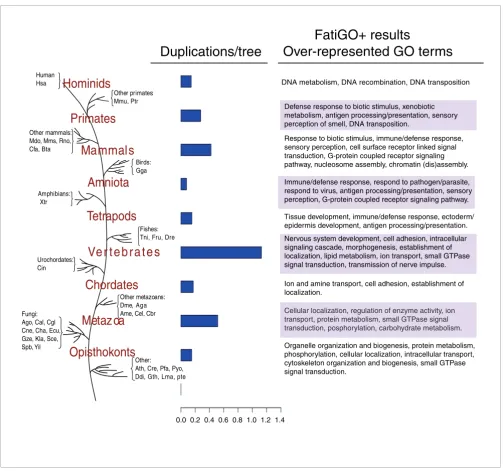
To quantify the extent of gene duplication that has occurred in the lineages leading to human, we scanned the trees to find duplication events (see Materials and methods) and subse-quently mapped them onto a species phylogeny that marks the major branching points in the lineage leading to hominids (Figure 3). The relative number of duplication events per gene at each branching point was estimated by dividing the number of duplication events detected at that stage by the number of trees rooted at a deeper branching point; for exam-ple, from a tree rooted on a fungal sequence, only duplications following the split of fungi and metazoans were taken into account.
The highest peak in gene duplication events corresponds to the base of chordate evolution, after the split of urochordates (Ciona intestinalis) and vertebrates. This observation is con-sistent with previous results supporting the existence of at least one round, and probably two rounds, of whole genome duplications before the radiation of vertebrates [52,53], which could explain the increase in phenotypic complexity of vertebrates relative to other chordates such as cephalochor-dates (amphioxus) and urochorcephalochor-dates (Ciona). The second largest peak appears at the base of the metazoans, after their split with fungi. The relatively large duplication rate (0.58 duplications per tree) at this point could be interpreted as a result of a WGD at the base of metazoan evolution or, alterna-tively, an accumulation of smaller scale duplications. To the best of our knowledge, the possibility of a WGD at the base of metazoan evolution has not been proposed in the literature [54] and we believe it deserves some deeper consideration in future analyses. If the WGD scenario is considered, then an extensive gene loss should have followed it, since the duplication rate here is lower than the one found at the base of vertebrate evolution. The alternative scenario would
assume a high number of smaller scale duplications that affected more than 50% of the genes. These duplication events would have accumulated over the period of time extending from the split of fungi and metazoans to the split of chordates and other metazoans.
Also remarkable is the relatively high duplication rates found in the lineages leading to mammals, primates and hominids. This suggests that duplications have played a major role in the evolution of these groups, something that has already been noted from comparisons of primate genomes [55].
Functional trends among duplicated gene sets
The duplication of genes might result in the amplification and/or diversification of the biological processes in which they play a role; if this provides a selective advantage, the duplicated copies will likely be retained. Therefore, inspect-ing the functions of gene families that have undergone dupli-cation at different evolutionary stages may provide clues about the processes that played roles in the major transitions that occurred during those stages. To detect such functional trends we searched for Gene Ontology (GO) terms that are significantly over-represented in the set of genes that under-went duplications during the different stages of eukaryotic evolution. We performed this analysis automatically with the aid of the program Fatigo+, from the Babelomics suite [56]. At each evolutionary stage (Figure 3) we compared the annotations of the duplicated human genes with those of the rest of the human genome. We selected those terms whose over-representation was significant based on a false discovery rate test (adjusted p-value < 0.00001). Due to space limita-tions we represent only a fraction of the over-represented terms for the category 'biological process' (Figure 3). A com-plete list of enriched terms in each stage is given in the sup-plementary material [22]. The present analysis detects over-represented functional categories among genes duplicated at different evolutionary periods. It is, therefore, different from complementary analyses that detect functional shifts and dif-ferent patterns of amino acid replacement among duplicated pairs [57,58]. Interestingly, these complementary analyses also show differences among functional classes.
dupli-comm
en
t
re
v
ie
w
s
re
ports
refer
e
e
d
re
sear
ch
de
p
o
si
te
d r
e
se
a
rch
interacti
o
ns
inf
o
rmation
cated before the divergence of fungi and metazoans, suggest-ing major transitions in cellular organization common to all opisthokonts. The expansion of the process 'small GTPase signal transduction' in almost all major stages from the origin of opisthokonts to the vertebrates indicates a continuous expansion of signaling cascades that is likely related to the increasing level of multi-cellularity and tissue differentiation observed at these evolutionary stages. Similarly, protein fam-ilies related to 'G-protein coupled receptor signaling pathway' were expanded before the amniota and mammalian
radia-tions. Also remarkable are the consecutive waves of expan-sion observed for the 'immune response' and related terms. They have occurred at every split from the origin of tetrapods to the origin of primates and suggest an increasing sophisti-cation of the immune system. Xenobiotic metabolism terms are also over-represented in genes duplicated in primates. As noted before [55], the sophistication of the immune response and xenobiotic recognition and detoxification might have facilitated adaptation to changes in food sources and infec-tious agents.
[image:9.612.54.557.82.553.2]Estimates for the number of duplication events occurred at each major transition in the evolution of the eukaryotes Figure 3
Estimates for the number of duplication events occurred at each major transition in the evolution of the eukaryotes. Species abbreviations are the same as in table 1. Horizontal bars indicate the average number of duplications per gene. Boxes on the right list some of the GO terms of the biological process category that are significantly over-represented compared to the rest of the genome in the set of gene families duplicated at a certain stage. A full list of significantly over represented terms is given as a table in the supplementary material [22].
Primates
Hominids
Mammals
Ve r t e b r a t e s
Chordates
Amniota
Tetrapods
Metaz oa
Opisthokonts
Other primates: Mmu, Ptr
Birds: Gga
Fishes: Tni, Fru, Dre
Other metazoans: Dme, Aga Ame, Cel, Cbr Fungi:
Ago, Cal, Cgl Cne, Cha, Ecu, Gze, Kla, Sce, Spb, Yil
Other: Ath, Cre, Pfa, Pyo, Ddi, Gth, Lma, pte Urochordates:
Cin Amphibians:
Xtr Other mammals: Mdo, Mms, Rno, Cfa, Bta
Human Hsa
Over-represented GO terms
Duplications/tree
DNA metabolism, DNA recombination, DNA transposition
Defense response to biotic stimulus, xenobiotic metabolism, antigen processing/presentation, sensory perception of smell, DNA transposition.
Response to biotic stimulus, immune/defense response, sensory perception, cell surface receptor linked signal transduction, G-protein coupled receptor signaling pathway, nucleosome assembly, chromatin (dis)assembly. Immune/defense response, respond to pathogen/parasite, respond to virus, antigen processing/presentation, sensory perception, G-protein coupled receptor signaling pathway. Tissue development, immune/defense response, ectoderm/ epidermis development, antigen processing/presentation. Nervous system development, cell adhesion, intracellular signaling cascade, morphogenesis, establishment of localization, lipid metabolism, ion transport, small GTPase signal transduction, transmission of nerve impulse. Ion and amine transport, cell adhesion, establishment of localization.
Organelle organization and biogenesis, protein metabolism, phosphorylation, cellular localization, intracellular transport, cytoskeleton organization and biogenesis, small GTPase signal transduction.
0.0 0.2 0.4 0.6 0.8 1.0 1.2 1.4
FatiGO+ results
The specific association of terms such as 'transmission of nerve pulse' or 'nervous system development' with families duplicated just before the vertebrate expansion is consistent with the development of a complex nervous system as com-pared to that of simpler chordates. Later on, the expansion of 'sensory perception' and related terms in the lineages leading to amniota, mammals and primates indicates increasing sophistication of the senses. Similarly, the term 'epidermis development' is over-represented in genes duplicated in tetrapods. This might be related to major skin modifications, which potentially allowed the conquering of the terrestrial environment by this group.
Absence of horizontal transfers of eukaryotic genes in the human lineage
The extent and scope of horizontal gene transfer (HGT) events among organisms has been the subject of intense debate [59]. The emerging view is that HGT constitutes an important process of evolution in prokaryotes and that it is more restricted, if not virtually absent, in eukaryotes. How-ever, as more eukaryotic genomes are being sequenced, the number of putative cases of gene transfers in eukaryotes is growing. Reported cases include acquisition of prokaryotic genes [60-62] and transfers of mitochondrial genes between plants [63] and between animals [64]. Horizontal gene trans-fer in the human genome has been addressed in the past. For instance, after the initial sequencing of the human genome the claim was made that up to 223 bacterial genes, likely acquired by HGT, could be found in the human genome [65]. This claim, however, was later rejected on the basis of phylo-genetic analysis [66]. The existence of horizontally trans-ferred genes from other eukaryotes in the human genome has never been reported despite the fact that integrative viral sequences can migrate between vertebrate species and that these viruses can sometimes carry genes within their sequences, making the hypothesis theoretically plausible [67].
The species represented in our phylome include organisms that are tightly linked to human, either because they are path-ogens (plasmodium and several fungi), or used as a source of food (cow, yeast). A recent transfer from any of these species to the human genome could, in principle, be detected as a human protein being placed in a 'wrong' phylogenetic con-text. However, caution must be taken when interpreting phy-logenies, since such topologies can also be explained by alternative processes such as multiple gene-loss or lack of phylogenetic resolution.
To find such putative cases we scanned the human phylome to detect trees in which the phylogenetic position of the human seed protein could suggest a possible HGT event. For this purpose we applied a series of increasingly stringent fil-ters. These filters consisted in identifying trees in which: the human seed protein has non-primate proteins as nearest phy-logenetic neighbors; such topology cannot be explained
sim-ply by the loss of the orthologous sequences in the other primates or multiple losses in mammalian groups; the parti-tion suggesting the HGT is supported by a high posterior probability (>0.9) in the Bayesian analysis; and that partition is also supported by ML analysis. This methodology bears some similarity to that proposed by Hallet et al. [68] in that it specifically defines possible scenarios for HGT.
A total of 99 trees (0.47%) passed the first two filters, thus having a topology that could be explained by an HGT event. However, only 8 of these trees had a posterior probability supporting the HGT partition of 0.9 or higher in the Bayesian analysis, and none of these was supported by the ML analy-ses, indicating that the partitions suggesting the horizontal transfer are not strongly supported.
We interpret these results as a lack of evidence supporting the existence of human genes originating from recent horizontal transfers from the lineages considered and argue that the observed HGT-like topologies are rather the result of phylo-genetic artifacts. This interpretation is consistent with the generally adopted view that horizontal gene transfers among multi-cellular eukaryotes is virtually absent due to the exist-ing natural barriers that prevent transferred genes from reaching the germ-line [69].
Towards a complete catalogue of orthology and paralogy relationships
Although an increasing number of genome-wide experimen-tal datasets is becoming available for human, most experi-mental analyses are performed in model species such as mouse, fruit fly, yeast and the nematode Caenorhabditis ele-gans. Additionally, for historical or practical reasons, alterna-tive model species are used to investigate specific systems or pathways. Such is the case with the use of Neurospora crassa, Yarrowia lipolytica and Bos taurus models in the character-ization of the multiprotein enzyme NADH:Ubiquinone oxi-doreductase (Complex I), in which an intricate evolution and the use of different naming schemas in the various species complicate the transfer of knowledge among investigators studying the different model species [70].
comm
en
t
re
v
ie
w
s
re
ports
refer
e
e
d
re
sear
ch
de
p
o
si
te
d r
e
se
a
rch
interacti
o
ns
inf
o
rmation
different genomes is a pre-requisite for comparing genomics data, something that, in turn, allows the detection of evolu-tionarily conserved functional associations [72].
The need for detecting orthology at a genome-scale has trig-gered the development of a variety of automatic approaches that identify orthology relationships by means of similarity searches. The first and still most widely used such method is based on the detection of best reciprocal hits (BRHs), that is, pairs of sequences from different species that are, recipro-cally, the best hit of each other in a sequence search [73]. Extensions of the BRH approach include the definition of 'tri-angular' BRH relationships across a minimum of three spe-cies [48], and recent implementations thereof, such as Inpar-anoid [74] or OrthoMCL [75], that include closely related paralogs in the orthologous groups. Although these methods perform reasonably well in most cases, they have been shown to present many drawbacks that can lead to annotation errors or misinterpretation of data [76,77]. More recently, in an attempt to approximate the classic, phylogeny-based approach, several automatic methods have been proposed that delineate orthology relationships from phylogenetic trees. Generally, these methods rely on the detection of dupli-cation and speciation events by comparing the gene tree with the species tree [78]. Several databases have been developed that employ such algorithms to derive orthology relationships from automatically reconstructed trees [79-81]. However, these methods are very sensitive to slight variations in the topology of the gene tree and, when applied at a large-scale, they may perform similarly or even worse than standard pair-wise methods [82]. Some recent developments that use soft-parsimony [83] and model-based approaches [84] for tree-reconciliation allow some level of uncertainty in both the gene-tree and the species-tree.
Considering the high degree of topological diversity observed in the human phylome (see above), we reasoned that any algorithm based on reconciliation with a specific species tree would inevitably infer false duplication events in the trees showing topologies that depart from the canonical species tree. Therefore, we decided to explore an alternative, fully automated approach that does not require a fully resolved species phylogeny and a reconciliation phase. The algorithm (see Materials and methods) uses the level of overlap in the species connected to two related nodes to decide whether their parental node represents a duplication or speciation event. The full list of predicted ortology and paralogy rela-tionships is provided as supplementary material [22].
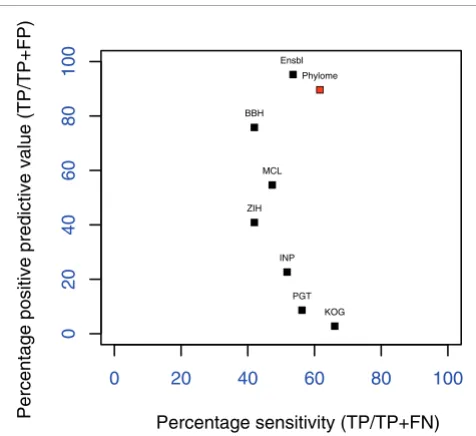
We compared our predictions with those from other algo-rithms by using a recent reference dataset comprising 67 human-mouse and 45 human-worm orthologous pairs from five multi-gene families [82]. Considering the size of the fam-ilies and the intricate evolutionary histories involved, this ref-erence set should be considered a highly stringent test. For each of the methods compared we computed the sensitivity,
which is a measure of the coverage over the reference set, and the positive predictive value, which is the proportion of cor-rect orthology predictions, that is, the number of true posi-tives over the sum of true posiposi-tives and false negaposi-tives. The results of the benchmark showed narrow differences in terms of sensitivity (Figure 4). All methods are able to predict only about half (40% to 66%) of the orthologous pairs in the refer-ence set. Our method scores second best, with 61.6% sensitiv-ity compared to 66.1% for the clusters of eukaryotic orthologous genes (KOG) method; Ensembl reaches a cover-age of 55.57%. As we noted before, this low covercover-age reflects the inherent difficulty of the reference set, in which manual orthology assignments have taken into account domain organization analysis and other sources of information.
Most remarkable are the big differences encountered in the positive predictive values. These range from 2.8% (KOG) to 86.61% (our algorithm) and 95.24% (Ensembl). Altogether, the results show that phylogeny-based orthology detection methods can provide substantial improvement in terms of positive predictive value when sophisticated phylogenetic pipelines are implemented. Note that the other phylogeny-based method included (Phylogenetic tree, PGT), uses NJ trees. The low rate of false positive prediction achieved by sophisticated phylogeny-based methods makes them
[image:11.612.315.553.382.600.2]espe-Benchmarking comparison of different orthology inference algorithms Figure 4
Benchmarking comparison of different orthology inference algorithms. The reference set used in the benchmark of Hulsen et al. [82] is taken as a gold standard to compute the number of true positives (TP), false positives (FP) and false negatives (FN) yielded by each method. For each method the sensitivity (S = TP/(TP+FN)) and the positive predictive value (P = TP/(TP + FP)) are computed. Methods described in [82] are indicated as BBH (Best reciprocal hits), MCL (OrthoMCL), ZIH (Z-score 1-hundred.), INP (Inparanoid), PGT (phylogeny-based algorithm used in [95]), KOG (Clusters of eukaryotic orthologous goups). 'Phylome' represents the results of our pipeline and algorithm, and Ensbl the orthology relationships predicted by Ensembl database.
0 20 40 60 80 100
0
2
04
06
08
0
1
0
0
Percentage sensitivity (TP/TP+FN)
Percentage positive predictive value (TP/TP+FP)
BBH
INP
KOG MCL
PGT ZIH
cially suited for cases in which orthology prediction is used for the transfer of functional annotations among model species. In such cases, minimizing the level of wrong assignments, which will lead to wrong annotations, is more important than reaching a high coverage at a cost of many false assignments.
Conclusion
We have shown the feasibility of reconstructing complex phy-lomes, comprising the evolutionary histories of all genes from a given species and their homologs in dozens of other genomes. The pipeline and genome sampling is fully auto-mated and can easily be tailored for specific needs, therefore paving the way for the reconstructions of other phylomes using different parameters or species sampling. Because of its significance, we have initially applied this pipeline to the human genome. The resulting phylome constitutes a valuable dataset that can be explored by the research community. In the near future we are planning to implement this and other phylomes in a fully searchable database. To illustrate the potential of the human phylome we have performed several analyses, but many others can be envisaged. Overall, our results indicate that there is a great topological diversity affecting the three unresolved scenarios that we have dis-cussed (ecdysozoa versus coelomata, relationships among rodents, primates and laurasatheria and the unikont hypoth-esis). This and other recent findings [85] reinforce the older view [86] that topological differences among phylogenies of proteins are to be expected even in the absence of HGT and underscore the danger of gene-sampling effects when com-bining the phylogenetic signals of several genes [34]. We share the view of others [87] that there is an urgent need for improved models of molecular evolution that account for the inherent phylogenetic noise in the protein record and of new genomic characters that are less prone to homoplastic effects. We have found that such noise may eventually produce HGT-like topologies, highlighting the need for stringent cut-offs and alternative tests before an HGT event is assumed.
Mapping speciation and duplication events on the complete phylome has allowed us to derive a comprehensive set of orthology and paralogy relationships among the genomes involved. The results obtained in the benchmark analysis show that although automatic methods for phylogeny-based detection of orthology are progressing in the right direction, there is still room for improvement both in the algorithms and the quality of the trees. Taking into account the levels of topological diversity mentioned above, it follows that the algorithms for phylogeny-based orthology detection need to cope with levels of topological uncertainty.
The results obtained in the present analysis are consistent with the existence of at least one round of whole genome duplication occurring before the radiation of verebrates [49]. If a relatively high level of gene loss in eukaryotic genomes is assumed [88], the finding of an average level of duplication
events per tree higher than one would indeed favor the scenario of two rounds of whole genome duplication at that evolutionary stage (2R hypothesis).
Materials and methods
Sequence dataProteomes derived from 39 fully sequenced eukaryotic genomes (Table 1) were downloaded from Ensembl v36 [12] and the Integr8 database at EBI [89], except those of Candida albicans [90]N. crassa [91] and C. reinhardtii [92]. Wher-ever mitochondrial proteins were not included in the gene set per species, these were downloaded separately from the NCBI eukaryotic organelles site. Mitochondrial genomes from Caenorhabditis briggsae, Giberella zeae, Debaromyces hansenii and Leishmania major have apparently not been deposited in the public databases and, therefore, are missing from this study. The final proteome database contains 542,423 unique protein sequences from 39 different genomes (Table 1).
Database searches
For each human protein a Smith-Waterman [93] search was performed against the above-mentioned proteome database to retrieve a set of proteins with a significant similarity (E-value < 10-3). Only sequences that aligned with a continuous
region longer than 50% of the query sequence were selected.
Multiple sequence alignment and phylogenetic reconstructions
Sets of homologous protein sequences were aligned using MUSCLE 3.6 [94]. Positions in the alignment with gaps in more than 10% of the sequences were eliminated before the phylogenetic analysis, unless this procedure removed more than one-third of the positions in the alignment. In such cases the percentage of sequences with gaps allowed was automati-cally increased until at least two-thirds of the initial positions were conserved.
NJ trees were derived using scoredist distances as imple-mented in BioNJ [18]. ML trees were derived from the align-ments using PhyML v2.4.4 [19]. For each protein family ML trees were reconstructed with four different evolutionary models (JTT, WAG, BLOSUM62 and VT), except for the 13 mitochondrially encoded proteins in which the mtREV model was also used. In all cases a discrete gamma-distribution model with four rate categories plus invariant positions was used, the gamma parameter and the fraction of invariant positions were estimated from the data. The evolutionary model best fitting the data was determined by comparing the likelihood of the used models according to the AIC criterion [20].
gen-comm
en
t
re
v
ie
w
s
re
ports
refer
e
e
d
re
sear
ch
de
p
o
si
te
d r
e
se
a
rch
interacti
o
ns
inf
o
rmation
erations in two runs of two chains each, using the best-fitting model, as determined in the ML analysis, but allowing branch swapping and re-estimation of the gamma distribution parameters. The posterior probability of each tree partition was estimated by sampling the trees every 100 generations after discarding the first 25%. This approach to obtain sup-port values was faster than performing standard bootstrap analysis with PhyML. Starting the MrBayes runs with an already optimized tree resulted in fair levels of convergence being reached after fewer generations than in standard MrBayes analyses.
A final tree produced by this Bayesian reconstruction consists of a consensus phylogeny, using the 'halfcompat' option in MrBayes, in which partitions with a posterior probability lower than 0.5 are collapsed. The alignments and all trees produced for each human protein are made available as sup-plemental information [22]. Unless stated otherwise the con-sensus tree produced by MrBayes analysis was used in all analyses.
Inference of duplication and speciation events and orthology assignment using a novel algorithm independent of species-tree reconciliation
We used a phylogeny-based algorithm to detect duplication and speciation events on the trees. In contrast to alternative phylogeny-based methods that use reconciliation of the gene tree with the species tree to infer duplication events, our approach does not require any previous fully resolved species topology. The only evolutionary information required is that used to root the trees to define a polarity so each internal node is connected to two children nodes. The orthology prediction algorithm was run independently for each human gene using the tree generated using its protein sequence as a seed. The algorithm was implemented in a series of python scripts spe-cifically developed for this project.
To map duplication and speciation events on an internal node of the tree, the algorithm proceeds as follows. First, two tree partitions are defined that contain the sequences connected to each of the two children nodes. Second, a species-overlap score is defined between the two partitions as follows: species common to both partitions/species in any of the partitions. Third, if the score is higher than a given threshold the node is mapped as a duplication event, otherwise it is considered a speciation event. In the present study the species-overlap threshold was set to 0.0 - that is, no common species between the two partitions were allowed - because this produced the best results in the benchmark. The algorithm does so for all internal nodes in the tree. Once all the nodes in the tree are marked as a duplication or speciation event, the algorithm establishes orthology relationships between the seed protein and other proteins in the tree. For each protein, the algorithm tracks the nodes that connect it to the seed protein and estab-lishes an orthology relationship only if this connection pro-ceeds exclusively through speciation nodes, disregarding
intra-specific duplications. After mapping speciation and duplication nodes onto the phylogeny, several situations may arise in which orthology relationships are not one-to-one relationships, but rather one-to-many or many-to-many.
To root the trees the following procedure was used. The spe-cies present in the tree were grouped according to the branch-ing pattern of the tree in Figure 3; thus, non-opisthokont species constitute the deepest group, followed by 'fungi', 'other metazoans', 'urochordates', and so on. Among the sequences belonging to the deepest group with representa-tives in the tree, the one with the longest distance to the seed protein was chosen as the out-group.
Assigning duplications to different evolutionary periods
The duplication events detected by the algorithm described above can be assigned to different evolutionary periods by examining the species represented after the duplication event. To do so we used as a reference a set of clearly defined phylogenetic relationships that mark the major branching points in the lineage leading to hominids (Figure 3). For each duplication event, all the species represented after the dupli-cation node are tracked and the duplidupli-cation is assigned to the deepest branching point in the reference tree that contains all these species. For instance, if only sequences from mammals and fishes are found after the duplication event, this duplica-tion is assigned to the branching point that is at the base of vertebrates.
The orthology detection algorithm can detect only duplica-tions that occurred after the root of the tree; for example, if a tree is rooted in a fungal sequence, only duplications that occurred in the metazoan lineage could be detected. There-fore, to compare the results obtained at the different evolu-tionary stages we computed the relative number of duplication events per gene at each branching point. This was done by dividing the number of duplication events mapped at a particular evolutionary stage by the number of trees rooted at a deeper branching point; for example, duplications that occurred at the base of metazoans were divided by the number of trees rooted on either a fungal or a non-opisthokont sequence.
Topology scanning algorithm
For instance, a partition supporting the grouping of rodents and primates to the exclusion of laurasatherians can be defined as a partition containing any sequence (s) from pri-mates (Homo sapiens, Macacca mulata, Pan troglodites) and any sequence (s) from rodents (Mus musculus, Rattus norvergicus) within a larger partition that contains these sequence plus any sequence (s) from Laurasatherians (Canis familiaris, Bos taurus). Sequences from other species are not allowed in the partition and the presence of the seed sequence in the partition is required. This algorithm has been imple-mented in a series of Python scripts developed for this project.
In the topology scanning analyses presented here we dis-carded the trees based on alignments in which less than 100 columns were left after applying the gap filter. This procedure eliminated 1,714 (7.9%) from the total phylome.
Benchmarking
The reference set used in a recent benchmark of orthology assignment methods [82] is used to compute the number of true positives (TPs), false positives (FPs) and false negatives (FNs) yielded by each method. For each method the sensitiv-ity, S = TP/(TP + FN), and the positive predictive value, P = TP/(TP + FP), were computed.
Additional data files
The following additional data are available with the on-line version of this paper. Additional data file 1 is a table listing the over-represented GO terms in the duplicatons depicted in Figure 3. Additional data file 2 is a table listing the orthologs predicted for every human protein.
Additional data file 1
Over-represented GO terms in the duplicatons depicted in Figure 3 Over-represented GO terms in the duplicatons depicted in Figure 3 Click here for file
Additional data file 2
Orthologs predicted for every human protein Orthologs predicted for every human protein Click here for file
Acknowledgements
A significant part of the computational analysis presented in this paper has been performed at the Mare Nostrum supercomputer (Barcelona Super-computing Center). JHC is supported by a grant from the Fundación Genoma España and the Instituto Nacional de Bioinformática. TG is a recip-ient of an EMBO long-term fellowship (LTF 402-2005). Part of this study is funded by grants from the Spanish Science Ministry BFU2006-15413-C02-02 and Generalitat Valenciana GV06/080 and the National Institute of Bio-informatics a platform of Genoma España. We acknowledge Tim Hulsen for kindly providing the predicted orthologous pairs used in the benchmark. We are grateful to Jordi Burguet and Anibal Bueno Amorós for providing technical support and to Leo Arbiza and other members of the department for discussions.
References
1. McPherson JD, Marra M, Hillier L, Waterston RH, Chinwalla A, Wallis J, Sekhon M, Wylie K, Mardis ER, Wilson RK, et al.: A physical map of the human genome. Nature 2001, 409:934-941.
2. Venter JC, Adams MD, Myers EW, Li PW, Mural RJ, Sutton GG, Smith HO, Yandell M, Evans CA, Holt RA, et al.: The sequence of the human genome. Science 2001, 291:1304-1351.
3. Suzuki Y, Sugano S: Transcriptome analyses of human genes and applications for proteome analyses. Curr Protein Pept Sci 2006, 7:147-163.
4. Humphery-Smith I: A human proteome project with a begin-ning and an end. Proteomics 2004, 4:2519-2521.
5. Gandhi TK, Zhong J, Mathivanan S, Karthick L, Chandrika KN, Mohan
SS, Sharma S, Pinkert S, Nagaraju S, Periaswamy B, et al.: Analysis of the human protein interactome and comparison with yeast, worm and fly interaction datasets. Nat Genet 2006, 38:285-293. 6. Nielsen J, Oliver S: The next wave in metabolome analysis.
Trends Biotechnol 2005, 23:544-546.
7. Benner SA: Interpretive proteomics - finding biological mean-ing in genome and proteome databases. Adv Enzyme Regul 2003, 43:271-359.
8. Sicheritz-Ponten T, Andersson SG: A phylogenomic approach to microbial evolution. Nucleic Acids Res 2001, 29:545-552. 9. Gabaldón T, Huynen MA: Reconstruction of the
proto-mito-chondrial metabolism. Science 2003, 301:609.
10. Gabaldón T: Evolution of proteins and proteomes, a phyloge-netics approach. Evolutionary Bioinformatics Online 2005, 1:51-56. 11. Huynen MA, Gabaldon T, Snel B: Variation and evolution of
bio-molecular systems: searching for functional relevance. FEBS Lett 2005, 579:1839-1845.
12. Birney E, Andrews D, Caccamo M, Chen Y, Clarke L, Coates G, Cox T, Cunningham F, Curwen V, Cutts T, et al.: Ensembl 2006. Nucleic Acids Res 2006:D556-561.
13. Li H, Coghlan A, Ruan J, Coin LJ, Heriche JK, Osmotherly L, Li R, Liu T, Zhang Z, Bolund L, et al.: TreeFam: a curated database of phy-logenetic trees of animal gene families. Nucleic Acids Res 2006:D572-580.
14. Duret L, Mouchiroud D, Gouy M: HOVERGEN: a database of homologous vertebrate genes. Nucleic Acids Res 1994, 22:2360-2365.
15. Roth C, Betts MJ, Steffansson P, Saelensminde G, Liberles DA: The Adaptive Evolution Database (TAED): a phylogeny based tool for comparative genomics. Nucleic Acids Res 2005:D495-497.
16. Blackstone NW, Green DR: The evolution of a mechanism of cell suicide. Bioessays 1999, 21:84-88.
17. Fisher SE, Marcus GF: The eloquent ape: genes, brains and the evolution of language. Nat Rev Genet 2006, 7:9-20.
18. Gascuel O: BIONJ: an improved version of the NJ algorithm based on a simple model of sequence data. Mol Biol Evol 1997, 14:685-695.
19. Guindon S, Gascuel O: A simple, fast, and accurate algorithm to estimate large phylogenies by maximum likelihood. Syst Biol 2003, 52:696-704.
20. Akaike H: Information theory and extension of the maximum likelihood principle. In Proceedings of the 2nd International Sympo-sium on Information Theory: 1973; Budapest, Hungary Edited by: Institute of Electrical & Electronics Engineers. Piscataway, NJ; 1973:267-281. 21. Ronquist F, Huelsenbeck JP: MrBayes 3: Bayesian phylogenetic
inference under mixed models. Bioinformatics 2003, 19:1572-1574.
22. Supplementary material [http://bioinfo.cipf.es/data/ human_phylome/human_phylome.html]
23. Keane TM, Creevey CJ, Pentony MM, Naughton TJ, McLnerney JO: Assessment of methods for amino acid matrix selection and their use on empirical data shows that ad hoc assumptions for choice of matrix are not justified. BMC Evol Biol 2006, 6:29. 24. Bruno WJ, Halpern AL: Topological bias and inconsistency of maximum likelihood using wrong models. Mol Biol Evol 1999, 16:564-566.
25. Buckley TR, Cunningham CW: The effects of nucleotide substi-tution model assumptions on estimates of nonparametric bootstrap support. Mol Biol Evol 2002, 19:394-405.
26. Jones DT, Taylor WR, Thornton JM: The rapid generation of mutation data matrices from protein sequences. Comput Appl Biosci 1992, 8:275-282.
27. Henikoff S, Henikoff JG: Amino acid substitution matrices from protein blocks. Proc Natl Acad Sci USA 1992, 89:10915-10919. 28. Whelan S, Goldman N: A general empirical model of protein
evolution derived from multiple protein families using a maximum-likelihood approach. Mol Biol Evol 2001, 18:691-699. 29. Müller T, Vingron M: Modeling amino acid replacement. J
Com-put Biol 2000, 7:761-776.
30. Adachi J, Hasegawa M: Model of amino acid substitution in pro-teins encoded by mitochondrial DNA. J Mol Evol 1996, 42:459-468.
31. Keeling PJ, Burger G, Durnford DG, Lang BF, Lee RW, Pearlman RE, Roger AJ, Gray MW: The tree of eukaryotes. Trends Ecol Evol 2005, 20:670-676.