Discovering costeffective action rules
Kalanat,, N, Shamsinejad, P and Saraee, MH
Title
Discovering costeffective action rules
Authors
Kalanat,, N, Shamsinejad, P and Saraee, MH
Type
Conference or Workshop Item
URL
This version is available at: http://usir.salford.ac.uk/18726/
Published Date
2011
USIR is a digital collection of the research output of the University of Salford. Where copyright
permits, full text material held in the repository is made freely available online and can be read,
downloaded and copied for noncommercial private study or research purposes. Please check the
manuscript for any further copyright restrictions.
Discovering Cost-Effective Action Rules
Nasrin Kalanat, Pirooz Shamsinejad, Mohammad H. Saraee
Electrical and Computer Engineering DepartmentIsfahan University of Technology Isfahan, Iran
[email protected], [email protected] , [email protected]
Abstract—Mining informative patterns from databases is the historical task of data mining. But now, mining actionable patterns is becoming the new duty of data mining. Most of machine learning and data mining algorithms only focus on finding patterns and usually don't take any step for suggesting actions and users will be responsible for it. Therefore users will be faced with many patterns that they are confused about how and what to do with them. So that extracting actionable knowledge from database, to offer actions that lead to an increase in profit is very critical.
Up to now few works have been done in this field and they usually suffer from drawbacks such as incomprehensibility to the user, neglecting cost, not providing rule generality. Here we attempt to present a method to resolving these issues. In this paper CEARDM method is proposed to discovering effective action rules from data. These rules offer some cost-effective changes to transferring low profitable instances to higher profitable ones.
Keywords- actionable knowledge discovery; cost-effective action rules; profit mining
I. INTRODUCTION
One of the best describing definitions of Data Mining in literature is “the process of discovering patterns in data. The process must be automatic or semiautomatic. The pattern discovered must be meaningful in that they lead to some advantage, usually an economic advantage. ” [1]. Up to now most of the researches in this area have focused on finding different types of patterns from data but a few of them have paid enough attention on usability of mined patterns. The reason may be how much term “usable” is elusive.
Actionable Knowledge Discovery is a direct respond to the need of finding more usable patterns. Let illustrate this concept by an example in CRM. Consider a bank loan system. We can define two types of useful knowledge in this system. First, “How much is the probability of a customer pay back his loan?” and second, “How we can increase the probability of a customer pay back his loan?” The first question is more informative and less actionable and it is the concern of traditional data mining, but the second one is more actionable and AKD aiming for answering it.
We can divide the works have been done in AKD from the types of mined patterns point of view into two categories: those who try to define some actionability measures for filtering mined patterns[2,3] and those who try to extract new actionable patterns from mined patterns[4,5]. In other words
methods in first category don’t create new patterns but those in second one extract new type of pattern namely “action rules”. This presented work is one of those in second category.
Action rule generally means a rule that suggest an action to user to gain a profit in his/her domain. For example in our bank loan system an action rule could be like this : “If we can change marital status of male customers from single to married in some way then the probability of they pay back their loan will be more ”. It is worth noting that action rules are not talking about causality but about probability.
Up to now a few works have been done on mining action rules. For example in [4,5] a method for extracting cost-effective action rules for each customer from decision tree is proposed. In [6] some pruning strategies devised for filtering most actionable patterns. In that work the actions supposed to be present. Constructing action rules from certain pairs of previously mined classification rules is presented in [7,8,9,10] but in these works the cost of actions is neglected. There are two important factors in constructing an action rule. First is the generality of action rule that means to how many instances it can apply. Second is the cost of action rule in its domain. In current paper a new method is proposed for mining cost-effective action rules. Our contribution is to combine the generalization power of E-action rules [9] and cost-effectiveness. For doing this a new algorithm, namely CEARDM is devised for extracting cost effective E-action rules from an information system. The rest of paper is as follows: In section II action rules are defined and the method of constructing them is described. The CEARDM is explained in section III. Finally we conclude the paper in section IV.
II. ACTION RULES
Action rules would be constructed from certain pairs of previously mined classification rules [10,11]. These rules suggest changes in the value of some attributes of an instance to make it probably more profitable. For example let assume after mining purchasing data of a company two classification rules have been found as follows:
1 : ( , ) ( , ) ( , )
r sex male service H loyality high
1 : ( , ) ( , ) ( , )
By combining these two rules that are only informative we can make this action rule that suggests some changes to improve the loyalty of a group of customers:
1 2 : ( , ) ( , )
( , )
r r action rule sex male service L H
loyality low high
This rule suggests if we change the service status of male customers from low to high then it will be probable that their loyalty goes from low to high. But the problem is how to construct these rules from data and how to find the most valuable of them. Both of these will be discussed in this paper.
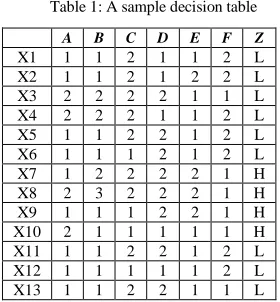
We assume data are placed in a table named decision table. Columns of table are attributes and rows are instances. Attributes are of two types: condition attributes and decision attributes. Decision attributes are attributes that profit in domain is related to them directly. In above example “loyalty” is a decision attribute and “sex” and “service” are condition attributes. Table 1 is a decision table for a fictitious problem. In this table {A,B,C,D,E,F} are condition attributes, Z is a decision attribute and {X1,X2,…,X13} are instances. For simplicity it’s assumed that values of condition attributes are numbers or are mapped to numbers, and there is only one decision attribute shown by Z.
Domain Driven Data Mining [15, 16] suggests that for making the results of DM process more applicable in real domains more characteristics of domain must be integrated to the process. According to this rule we took a more realistic look at condition attributes and divided them to three types: 1. Stable attributes which their values can’t change at sensible cost like “sex”. 2. Flexible attributes which their values can change at reasonable cost i.e. “service level”. 3. Asymmetric attributes which changing some of their values is sensible and others is not, i.e. “experience level” that it can be changed from low to high by spending some money and time but it can’t be changed from high to low at a sensible cost.
For integrating characteristics of all types of attributes in mining cost-effective action rules it is defined a cost matrix CMA for each attribute A. Rows and columns of CMA are both values of attribute A and CMA[i][j] shows the cost of changing ith value to jth value; changes with unreasonable cost show by infinity value in their corresponding cells. Cost matrixes for attributes of above example are depicted in Fig. 1.
In addition to cost, we must consider the profit that gained from an action. In this work we assume the decision attribute has two values low and high and the profit of changing decision attribute value from low to high for an instance is measurable and is shown by (P LH). Changes that their cost is more than (P LH)are worthless. The minimum cost of a change in value of an attribute is called flexibility factor of that attribute and it can be simply computed from cost matrix of each attribute.
[image:3.612.367.507.73.224.2]Based on the above discussion the attributes are divided into two main types: Attributes that their flexibility factor is more than (P LH), namely invaluable attributes and those with flexibility factor less than (P LH), namely valuable
Table 1: A sample decision table
A B C D E F Z
X1 1 1 2 1 1 2 L X2 1 1 2 1 2 2 L X3 2 2 2 2 1 1 L X4 2 2 2 1 1 2 L X5 1 1 2 2 1 2 L X6 1 1 1 2 1 2 L X7 1 2 2 2 2 1 H X8 2 3 2 2 2 1 H X9 1 1 1 2 2 1 H X10 2 1 1 1 1 1 H X11 1 1 2 2 1 2 L X12 1 1 1 1 1 2 L X13 1 1 2 2 1 1 L
attributes.
Valuable attributes contain at least one possible change at a reasonable cost regarding the most profit that may be gained. If V stands for set of valuable attributes of decision table T and IV for its invaluable attributes then table schema can be shown by T V( IV{ })Z . The new concept of valuable and invaluable attributes makes it possible to define flexibility or stability of attributes in a dynamic way which means their flexibility in a particular domain will depend on the profit that may be obtained by their changes in that domain.
Classification rules are the raw material of action rules, so that for discovery of action rules the first step is mining classification rules from data. There are many algorithms for finding classification rules like C4.5, ID3, CART[17]. Table 2 shows some classification rules mined from decision table shown in Table 1. In this table each row represents a classification rule and first column of each row shows the instances satisfied that rule. For example the first row of the table represents the following rule R and also informs instances X1 and X2 satisfy this rule.
: ( 1) ( 1) ( 2) ( 2) ( )
R A B C F Zlow
For describing the process of constructing action rules some notations must be defined. Let LR to be the set of the left attributes of rule R, ValR,A to be the value of attribute A in rule R and DR to be the value of decision attribute of R. So that for above rule, LR would be the set {A,B,C,F}, ValR,A equals 1 and DR would be “low”. Also the following notations are persumed:
( , )
A v
means attribute A must have the value of v.
( ,
A
v
)
means the value of attribute A must be changed to the value of v. [image:3.612.330.549.630.709.2]
( ,
A v
w
)
means attributes A must be changed from the value of v to the value of w.Figure 1: Cost Matrixes for attributes in decision table shown in table 1
Table 2: Mined classification rules with their supporting objects
A B C D E F Z
x1,x2 1 1 2 1 2 L x3,x4 2 2 2 1 L x1,x5,x6,x11,x12,x13 1 1 1 L x7,x8 2 2 2 1 H
x9,x10 1 1 1 H
There are two following preconditions for each pair R1 and R2of classification rules to be able to construct an action rule:
1 2
1, 2,
R R
R R
Val Val attr IV L L attr attr
1, 2,
R R
Val low Val high
Z Z
Where LRis the set of attributes in left side of rule R. If the preconditions hold then R1 and R2 can construct an action rule by the algorithm described in Algorithm 1.
But the problems are how to find the consistence pair of classification rules and how to extract the most cost-effective action rules. In the next section the CEAT algorithm is presented as a solution to these problems.
III. EXTRACTING COST-EFFECTIVE ACTION RULES
A. Net Profit of Action Rule
For computing the net profit of an action rule it is necessary to compute the number of instances that support it in the population of instances. Let assume R be an action rule that has been constructed from R1 and R2, (b1, b2,.., bp) be set of all valuable attributes of R which have different values in R1 and R2. If viand wistands for values of attribute biin R1 and R2 respectively, then instance X is said to support R if there is another instance Y as the following conditions hold:
Algorithm 1: The algorithm of constructing an action rule from a pair of classification rules.
ValX Z, low Val Y Z, high
, X, i
i b
i p Val v
, Y, i
i b
i p Val w
attr{IVLR}, ValX attr, ValY attr, X support R1
Y support R2
The above conditions simply say that an object X supports an action rule R if there is another instance Y that it is possible to apply R on X and convert it to Y. This definition is close to that described in [9] but with a change in defining new concept of valuable and invaluable attributes instead of flexible and stable attributes.
The net profit of an action rule R defines as follow:
( ) support ( , )
PNet r x set of objects that rPNet x r (1) Where PNet(x,r) is the net profit that gained from applying action rule R on the instance X and can be computed using Eq. (2):
( , ) ( ) ( )
PNet x r P LH iCost xi (2) Where Costi(x) is the cost of changing i
th
attribute of instance X based on action rule R. For example, consider rule r as below that is extracted from two rules which exist in first row and last row of Table 2.
: ( ,1) ( , 2 1) ( , 2 1) ( , )
r B C F Z LH
Based on above formulas its net profit can be computed as follow:
( ) ( 1, ) ( 2, ) 2(10 (8 3)) 2
PNet r PNet x r PNet x r
We assume (P LH) = 10; the negative value for net profit shows this rule is not cost-effective.
B. Discovering Cost-Effective Action Rule Algorithm
In this section we present a new algorithm for discovering Cost-Effective action rules called CEARDM.
The algorithm works in two phases: 1- constructing a cost-effective action tree from previously mined classification rules, 2- Extracting cost-effective action rules from the action tree. Action tree partitions rules based on invaluable attributes. Each leaf of action tree will be containing set of rules that the values of their invaluable attributes have no conflict with each other. Two rules have no conflict in their invaluable attributes if the values of their invaluable attributes are the same or not important in at least one of them. After constructing the action tree, algorithm extracts action rules from the rules placed in leaves of the action tree using algorithm 1 and finally select the most cost-effective of them using Eq. (1). The complete algorithm is shown in Algorithm 2.
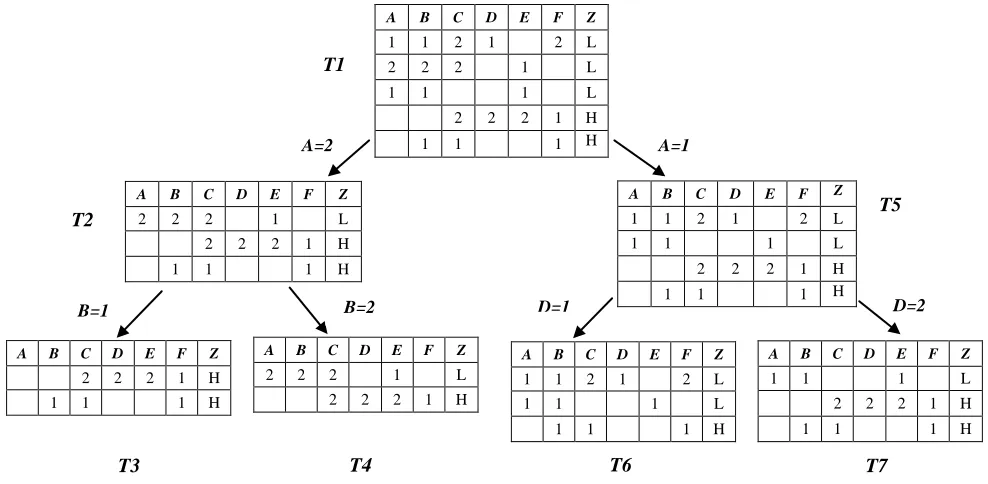
Let us take Table 1 as an example of a decision table T that cost matrixes of its attributes are presented in Fig. 1. Assume now that our goal is to re-classify some objects from the class H into the class L.
ARCM (R1, R2, IV, V) {
R= {}; for each
2 1
[ ( )]
A IV L L
R R
do
2
[ , ];
, R
R R A Val A
for each
2 1
[ ( )]
A V L L R R
do
If (
1 2
& &
, ,
Val vi Val vi
R A R A ) then
1 2
[ , ];
, ,
R R A Val Val R A R A
for each
2 1
[ ( )]
A V L L
R R
do
2
[ , ];
,
R R A Val R A
We represent the set R of classification rules extracted from T as a table (see Table 2). First, CEARDM method finds set of invaluable attributes and sorts them descending based on theirs FF values. Since in our example FFA=100, FFB=20, FFC=8, FFD=18, FFE=1, FFF=3, this set will be like IV= {A, B, D}. Then the algorithm calls CEAT method. In this step the construction of a cost-effective action tree starts with all extracted classification rules as the root of the tree (T1 in Fig. 2). Then CEAT select an unmarked attribute from AIV which number of it's different values in current node be more than one, then marks it and creates a branch for each of its values. Then it places rules on corresponding branches based on their value of selected attribute. Rules with “don’t
care” value for selected attribute will be placed in all branches.
In our example the root node selection is attribute A, so the table is divided into two sub-tables: one table contains rules with value “1” or “don’t care” for attribute A and the other contains rules with value “2” or “don’t care” for A. Then the process is repeated recursively for each child node. If at any time all instances at one node have the same decision value, then the algorithm stops growing the tree through that node (T3 in Fig. 2). When all invaluable attributes are selected, tables in leaf nodes which contain at least two rules with different decision values will be added to EndTables (T4, T6, and T7 in Fig. 2). In second phase cost-effective action rules will be extracted from each table in EndTables.
The following action rule is extracted from T4 and it is considered as cost-effective action rule because its net profit is positive.
1: ( , 2) ( , 2) ( ,1 2) ( , 1) ( , )
r D C E F Z LH
1 3 1
( ) ( , ) 9
PNet r PNet x r
T6 results the following action rule that is not considered as cost-effective action rule because its net profit is not positive.
2: ( ,1) ( , 2 1) ( , 2 1) ( , )
r B C F Z LH
2 1 2 2 2
( ) ( , ) ( , ) 2
PNet r PNet x r PNet x r
Also r3 that is a cost-effective action rule is gained from T7:
: ( , 2) ( , 2) ( ,1 2) ( , 1) ( , ) 3
r D C E F Z LH
13 3
3 5 3 6 3 11 3
( ) ( , ) ( , ) ( , )
( , ) 12
PNet r PNet x r PNet x r PNet x r
PNet x r
Presented algorithm returns all cost-effective action rules without any unnecessary comparison. It selects an attribute with maximum FF value in each level of tree and dividing rules based on it. If the cost of changing selected attribute is more than resulting profit of changing decision attribute from low to high, algorithm continues. Selecting attributes and dividing table will be continued until FF value of the selected attribute becomes less than (P LH). In this step more dividing the table may cause losing some cost-effective action rules. After stopping the branching process algorithm will extract all cost-effective action rules from resulted tables in leaves of action tree. Then it is possible to sort them based on their net profit and select the most cost-effective ones.
IV. CONCLUSION
Actionable knowledge discovery is almost a new and quite necessary concept in knowledge engineering and action rules are one of the most effective actionable knowledge. So that action rule mining has attracted a lot of attentions recently.
Define EndTables as a global empty set of tables; CEARDM (T, Attributes, CostMatrixes){ Input:
T: Table of instances Attributes: Set of all attributes
CostMatrixes: Set of all Cost Matrixes of attributes Output:
print all cost-effective action rules
IV = an empty list of attributes ; for eachA Attributes do
FFA = minimum value of CMA ; if ( (p LH)FFA) then Add A to IV
Sort IV descending based on the FF values ; UnMarked = IV;
Marked = an empty list of attributes ; CEAT ( T , UnMarked , Marked ) ; CEAR ( CostMatrixes ) ; }
CEAT ( T , UnMarked , Marked ) {
if ( ∃ ri, rj∈ rows of T that decision value of ri ≠ decision value of rj ) then
A= first attribute of UnMarked;
NV= number of different values of attribute A in T while ( A ! = null && NV < 1) do
Move A from UnMarked to Marked;
A = next attribute of UnMarked; if ( A ! = null ) then
Move A from UnMarked to Marked;
for eachvi∈ set of different values of attribute A in T do t = empty table;
Add to t each ri ∈ rows of T that have vi or null value for attribute
A;
CEAT ( t , UnMarked , Marked ); else
Add T to EndTables ; }
CEAR (CostMatrixes ){ for each table t in EndTablesdo
for each row ri of t with decision value of L do for each row rj of t with decision value of H do
AR = Construct an action rule by Algorithm1; NP = Calculate the net profit of AR by Eq. (1); if (NP > 0)
Print AR as a cost-effective action rule; }
A B C D E F Z
1 1 2 1 2 L
2 2 2 1 L
1 1 1 L
2 2 2 1 H
1 1 1 H
A B C D E F Z
1 1 2 1 2 L
1 1 1 L
2 2 2 1 H
1 1 1 H
A B C D E F Z
2 2 2 1 L
2 2 2 1 H
1 1 1 H
A B C D E F Z
1 1 1 L
2 2 2 1 H
1 1 1 H
A B C D E F Z
1 1 2 1 2 L
1 1 1 L
1 1 1 H
A B C D E F Z
2 2 2 1 L 2 2 2 1 H
A B C D E F Z
2 2 2 1 H
[image:6.612.71.565.76.318.2]1 1 1 H
Figure 2. Cost_effectve action tree for discussed example
In this work we introduced cost-effective action rules and presented a new method for discovering them. Cost-effective action rules in spite of traditional action rules consider cost of an action in addition to its profit. For handling this we considered a cost matrix for each attribute and integrate it into action rule mining process.
Our presented method can integrate more background knowledge into mining process and therefore can find more useable actions. The detailed algorithm along with simple examples has been brought in this paper to show how the new method works.
REFERENCES
[1] I. Witten, E. Frank. “Data Mining, Practical Machine Learning Tollas and Techniques”, Morgan Kaufman, 2005.
[2] K. McGarry, “A Survey of Interestingness Measures for Knowledge Discovery”. The Knowledge Engineering Review, pp. 39-41, 2005. [3] B. Liu, W. Hsu, and Y. Ma. “Identifying non-actionable association
rules”. ACM New York, NY, USA, 2001.
[4] Q. Yang, J. Yin, C. Ling, and Rong Pan, “Extracting Actionable Knowledge from Decision Trees”, IEEE Transactions on Knowledge and Data Engineering, VOL. 19, NO. 1, pp. 43-56,January 2007. [5] Q. Yang, J Y. Ling, T. Chen, “Postprocessing Decision Trees to
Extract Actionable Knowledge", Proceedings of the Third IEEE International Conference on Data Mining, IEEE, pp. 685-688, 2003. [6] K. Wang, Y. Jiang, A. Tuzhilin, “mining actionable patterns by role
models”, Proceedings of the 22nd International Conference on Data Engineering, IEEE, 2006.
[7] L-S. Tsay, Z W. Ra´s, " E-Action Rules ", Post-Proceeding of FDM’04 Workshop Advances in soft Computing, Springer, Berlin Heidelberg New York, pp. 277-288, 2006.
[8] L-S Tsay, Z W. Ras, “Action rules discovery: system DEAR2, method and experiments”, Journal of Experimental & Theoretical Artificial Intelligence, Vol. 17, No. 1–2, pp. 119–128, 2005. [9] Z W. Ra´s, L-S Tsay, “Mining E-Action Rules, System DEAR”,
Studies in Computational, pp. 289-298, 2008.
[10] Z W. Ra´s, A. Wieczorkowska, “Action rules: how to increase profit of a company”, Principles of Data Mining and Knowledge Discovery, Proceedings of PKDD’00 (Eds: DA. Zighed, J. Komorowski, J. Zytkow). Lyon, France, LNCS/LNAI, No. 1910, Springer, Berlin Heidelberg New York, pp. 587–592, 2000.
[11] H. Geffner, J. Wainer, “ Modeling action, knowledge and control. In: ECAI 98”, Proceedings of the 13th European Conference on AI, (Ed: Prade H). Wiley, New York, 532–536, 1998
[12] Z. Pawlak, “Rough sets-theoretical aspects of reasoning about data Algorithms for Packet Classification”, Kluwer, Dordrecht, 1991. [13] B. Liu, W. Hsu, S. Chen, “Using general impressions to analyze
discovered classification rules”, of KDD97 Conference. AAAI, Newport Beach, CA288 L.-S. Tsay and Z.W. Ra´s, 1997.
[14] Z. Pawlak, “Information systems – theoretical foundations”, InformationSystems Journal, Vol. 6, pp. 205–218, 1981.
[15] Z. Zhu, J. Gu, W. Yang, X. Li, “Toward Domain-Driven Data Mining”, Intelligent Information Technology Application Workshops, International Symposium, IEEE, pp. 44-48, 2008.
[16] L. Cao, “Domain Driven Data Mining”, International Conference on Data Mining Workshops, IEEE, pp. 74-76, 2008.
[17] J. Han, M. Kamber, “data mining : concepts and techniques”, 2nd ed., Morgan Kaufman, 2006.
B=1 D=1 D=2
T5
B=2
A=2 A=1
T2
T1