International Journal of Emerging Technology and Advanced Engineering
Website: www.ijetae.com (ISSN 2250-2459,ISO 9001:2008 Certified Journal, Volume 5, Issue 6, June 2015)
226
Palmprint Identification Using Transform Domain and DRLBP
Techniques
Malu. Dandi
1, Meeta Bakuli
2 1ME-VLSI & Embedded, G.H.Raisoni COEM Wagholi, Pune, India 2Associate Professor, G.H.Raisoni COEM Wagholi, Pune, India
Abstract -Palmprint biometric trait is suitable to identify a person as it has more number of features compared to other biometric traits. Palmprint recognition is a promising biometric system for commercial applications. In last few years a wide research has been occurred on Palmprint identification. In this project, Local Binary Pattern technique (LBP) is used to identify palmprint identification along with Discrete Wavelet Transform (DWT) which gives more non-overlapping information. In Pre-processing image is cropped and resize it. Discriminative Robust Local Binary Pattern (LBP) is used to generate contour features. The input and original palmprint features are compared using Euclidean Distance (ED). It is observed that the proposed method gives better Contour features as compared to existing method. MATLAB is used for simulation to get the desired results.
Keywords - DWT, LBP, DRLBP, Palm print Biometric
I. INTRODUCTION
For security purpose many techniques are used like, physiological and behavioral traits. ID cards and password which can be stolen and simple passwords can easily guess. In recent years, biometric based personal identification is considered as a reliable method. Biometric are unique, reliable and stable physical or behavioral characteristics that can be effectively used. Because of these characteristics these systems can provide a higher level of accuracy is security systems. For identification of individual fingerprint, hand geometry, Iris and palmprint are mostly used. Palmprint has several advantages as compare to others.
Feature extraction from palm area is critical step in palmprint identification. Many researches using different techniques are performed for palmprint identification. An image has to be reducing to a series of numbers that can be manipulated by the computer to process it digitally. Each number representing the brightness value of the image at a particular location called as pixel. A digitized image typically has 512 × 512 pixels, although much larger images are becoming common. There are three basic operations as image has digitized which can be performed on it. For local operations, several neighboring pixels in the input image determine the value of an output image pixel.
In a global operation, all of the input image pixels contribute to an output image pixel value. The rest of this paper is organized as follows. Section II describes existing works. Section III describes about details of proposed palmprint identification system. Section IV contains experimental results. At last section V is conclusion this paper.
II. LITURATURE REVIEW
V. Kanhangad et al. [5] presented a novel approach for hand matching that achieves significantly improved performance even in the presence of large hand pose variations. Feature extraction of 3D and 2D palm images has fused for matching. Runbin Cai and Dewen Hu [3] proposed two methods for fusion of images from multi-sensor imaging system with the objective of establishing some preprocessing algorithms in palm authentication system. This is decomposed by dual-tree complex wavelet transform (DTCWT). For identification, entropy of the fused image and the source image is used.
T. Ahonen et al. [2] used Local Binary pattern (LBP) for facial image representation. The image is divided into several regions from which the LBP feature distributions are extracted and concatenated into an enhanced feature vector to be used as a face descriptor. The performance of the method is assessed in the face recognition problem under different challenges. N. Dalal and B. Triggs [4] presented grids of histograms of oriented gradient (HOG) descriptors significantly outperform existing feature sets for human detection. 1800 annotated human images are used with large range of pose variations and backgrounds.
International Journal of Emerging Technology and Advanced Engineering
Website: www.ijetae.com (ISSN 2250-2459,ISO 9001:2008 Certified Journal, Volume 5, Issue 6, June 2015)
227
It means “shrink boost” is used to select sparse features from histograms of local binary pattern (LBP) of multiple quantization and image channels to learn classifier of additive lookup tables (LUT).
S. Liao et al. [8] approached to extract image features for texture classification. It comprises of two sets of features: dominant local binary patterns (DLBP) in a texture image and the supplementary features extracted by using the circularly symmetric Gabor filter responses. D. Nguyen et al. [9] worked on Non-Redundant Local Binary Pattern (NRLBP) to detect object. NRLBP provides a more compact description of object's appearance and reflects the relative contrast between the background and foreground.
A. Satpathy et al. [11] and [12] used quadratic classification on subspace of Extended Histogram of Gradients (ExHoG) to detect human. Dimensionality of ExHoG is reduced by Asymmetric Principal Component Analysis (APCA).Extended Histogram of Gradients (ExHoG) comprises two components, UHoG and histogram of absolute bin value differences of opposite gradient directions computed from Histogram of Gradients. A. Satpathy et al. [13] used Discriminative Robust Local Binary Pattern (DRLBP) for human detection which overcomes the problems of LBP and RLBP by considering weighted sum and absolute difference of LBP code and its complement.
III. PROPOSED MODEL
The following diagram show steps proposed for palmprint identification system.
Fig.01. Flowchart of palmprint Identification
A. Pre-processing
In this research palmprint images are acquired from PolyU database as most of previous researches. As we know most significance part of palmprint is in center of palmprint. Therefore, at first significance part of palmprint must be extracted. A palmprint image is cropped, resized, and enhanced using histogram equalization technique.
B. Discrete Wavelet transform
Wavelet Transform is a type of signal representation that can give the frequency content of the signal at a particular instant of time or spatial location. The DWT decomposes that pre-processed image into four subband images i.e. LL, LH, HL, and HH subband as shown.
Fig.02. Wavelet subband structure
A high-frequency subband contains the edge information of input image and LL subband contains the clear information about the image. It describes structural details about an image. The analysis of texture done by using local descriptor called discriminative robust local binary pattern. The computation of above mentioned two dimensional subbands is performed by Row wise and column wise processing to get LL, LH, HL, HH
Row wise processing:
H = (R
o-R
e)/2
L = (R
e+ R
o)/2
Where Ro and Re - odd Row and even Row wise pixel values
Column wise processing:
LH = (L
odd-L
even)/2, LL = (L
even+ L
odd)/ 2,
International Journal of Emerging Technology and Advanced Engineering
Website: www.ijetae.com (ISSN 2250-2459,ISO 9001:2008 Certified Journal, Volume 5, Issue 6, June 2015)
228
Where,
Hodd – odd column of H, Lodd- odd column of L, Heven- even column of H, Leven- even column of L.
Fig.03. Wavelet decomposition
C. Discriminative Robust Local Binary Pattern (DRLBP)
The descriptor local binary pattern is used to compare all the pixels including the center pixel with the neighboring pixels in the kernel to improve the robustness against the illumination variation. An LBP code for a neighborhood is produced by multiplying the threshold values with weights given to the corresponding pixels and summing up the result. The histogram of discriminative robust LBP is generated after Upper and lower robust LBP codes are weighed using gradient vector. DRLBP is represented by set of normalized histogram bin. This local texture feature is used to discriminate the local edge texture of palmprint invariant to changes of contrast and shape.
The gradient is detected from input image to determine the histogram of local binary pattern. Robust and discriminative features are determined, which involves two descriptors i.e. gradient magnitude and orientation. The gradient is measured in both horizontal and vertical directions with derivative operators. The ith weighted LBP bin value of a M × N block is as follows:
( ) ∑ ∑ ( )
( ) {
Fig.04. DRLBP Flow
The histogram RLBP is as follows
h ( ) h ( ) h ( )
Where hrlbp (i)) is ith RLBP bin value. Consider the absolute difference between the bins of a LBP code and its complement to form Difference of LBP (DLBP) histogram as follows:
( ) | ( ) ( )|
Where hdlbp(i ) is the ith DLBP bin value. As B=8, number of DLBP bins are 128, which is then reduced to 30 Using uniform codes.
DLBP assigns small values to the mapped bins. The Discriminative Robust LBP (DRLBP) is obtained from histogram features, RLBP and DLBP, as follows:
( ) {
( )
(
)
International Journal of Emerging Technology and Advanced Engineering
Website: www.ijetae.com (ISSN 2250-2459,ISO 9001:2008 Certified Journal, Volume 5, Issue 6, June 2015)
229
Fig.05 a) Grayscale Palm b) Palm textureD. Matching
The similarity between two different feature vectors is measured by Euclidean distance method:
√∑( )
Where J is the length of the feature vector, Fvj is the feature vector for individual j. Each feature vector is matched with the remaining feature vectors using Euclidean Distance in the database.
At recognition stage, features from input images (palm print) are combined to form a common feature vector. Before matching, same features are extracted from available palm print pair of database which is then used to match the input image features with database image features to identify the authorized person.
IV. EXPERIMENTAL RESULTS
A. Database description
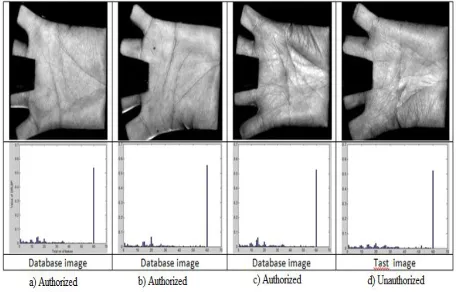
In order to evaluate the performance of proposed algorithm, we use 4 people database. This database contains 28 gray-scale images, 7 images of each palm. The 2 unknown palms are used for testing. so total 42 test images are used from which 14 will show the unrecognized image and 28 will show recognized image as a result. The accuracy is obtained 100%. We can add more than 500 palms database.
[image:4.612.330.558.136.282.2]The Result obtained by using MATLAB is shown in fig.
Fig.05 Palm database Images with authentication.
V. CONCLUSION
This project presented the implementation of palmprint biometric security system based on discrete wavelet transform (DWT) and discriminative robust local binary pattern (DRLBP). Palm is the inner surface of a hand between the wrist and the fingers. Palm has principal lines, wrinkles and ridges. Palmprint Identification gives more security as the palm of each individual is different from others. Palmprint Identification using transform domain & DRLBP techniques are used intending to get high security while accessing banking or personal details.
The discriminative robust local binary pattern is used for different object texture and edge contour feature extraction process. This approach is used to identify the illumination changes, intensity distributions characteristics. Then matching is done between test input and database samples using Euclidean distance metrics. These features are useful to distinguish the maximum number of samples accurately. Finally the simulated results shows that used methodologies provides better recognition rate with minimum error rate for all samples.
REFERENCES
[1] Amit Satpathy, Xudong Jiang, How-Lung Eng, “LBP-Based Edge-Texture Features for Object Recognition”, IEEE Trans. vol. 23, no. 5, MAY 2014.
International Journal of Emerging Technology and Advanced Engineering
Website: www.ijetae.com (ISSN 2250-2459,ISO 9001:2008 Certified Journal, Volume 5, Issue 6, June 2015)
230
[3] Runbin Cai and Dewen Hu, “Image fusion of palmprint and palmvein: Multispectral palm image fusion,” IEEE International Congress on Image and Signal Processing, Vol. 6, pp 2778 – 2781, Oct 2010. [4] N. Dalal and B. Triggs, “Histograms of oriented gradients for human
detection,” in Proc. IEEE Int. Conf. Comput. Vis. Pattern Recognit., Jun. 2005, pp. 886–893.
[5] Vivek Kanhangad, Ajay Kumar and David Zhang , “Contactless and Pose Invariant Biometric Identification Using Hand Surface,” IEEE Transactions on Image Processing, Vol. 20, No. 5, pp 1415-1424, May 2011.
[6] Z. Guo, L. Zhang, and D. Zhang, “A completed modeling of local binary pattern operator for texture classification,” IEEE Trans. Image Process., vol. 19, no. 6, pp. 1657–1663, Jun. 2010.
[7] C. K. Heng, S. Yokomitsu, Y. Matsumoto, and H. Tamura, “Shrink boost for selecting multi-LBP histogram features in object detection,” in Proc. IEEE Int. Conf. Comput. Vis. Pattern Recognit., Jun. 2012, pp. 3250–3257.
[8] S. Liao, M. Law, and A. Chung, “Dominant local binary patterns for texture classification,” IEEE Trans. Image Process., vol. 18, no. 5, pp. 1107–1118, May 2009.
[9] D. T. Nguyen, Z. Zong, P. Ogunbona, and W. Li, “Object detection using non-redundant local binary patterns,” IEEE Int. Conf. Image. Process. 2010, pp. 4609–4612.
[10] K P Shashikala, K. B. Raja “Palmprint Identification Using Transform Domain and Spatial Domain Techniques”, 978-0-7695-4817-3/12 IEEE Int'l Conference DOI 10.1109/ICCS.
[11] A. Satpathy, X. Jiang, and H.-L. Eng, “Human detection by quadratic classification on subspace of extended histogram of gradients,” IEEE Trans. Image Process., vol. 23, no. 1, pp. 287–297, 2014.
[12] A. Satpathy, X. Jiang, and H.-L. Eng, “Extended histogram of gradients feature for human detection,” in Proc. IEEE Int. Conf. Image. Process., Sep. 2010, pp. 3473–3476.