http://dx.doi.org/10.4236/ojbm.2016.41002
Issues in Distribution Center Relocation
Charles G. Petersen, Gerald R. Aase
College of Business, Northern Illinois University, DeKalb, USA
Received 21 September 2015; accepted 7 December 2015; published 10 December 2015
Copyright © 2016 by authors and Scientific Research Publishing Inc.
This work is licensed under the Creative Commons Attribution International License (CC BY).
http://creativecommons.org/licenses/by/4.0/
Abstract
This paper examines distribution center relocation where a firm needs to move from a current distribution center to a new distribution center in a different location. The authors present a deci-sion framework as well as a case study of a pharmaceutical distribution company that recently underwent a distribution center relocation. One of the major factors in determining how to ac-complish this relocation is the customers’ service expectations especially if customers will not to-lerate a disruption in deliveries or if they expect all product to be a single delivery. The capabili-ties of the firm to handle operate both distribution centers simultaneously is another considera-tion. Lastly, firms need to determine the cost of the relocation including transportation, inventory, and additional picking costs.
Keywords
Distribution Center Relocation, Supply Chain Management, Warehouse Operations, Network Design
1. Introduction
This paper describes a large pharmaceutical distributor (titled XYZ for purposes of this paper) with a new state-of-the-art (LEED certified) distribution center with pick-to-light and automated A-frames. The existing fa-cility was leased and increased demand was causing distribution costs to increase to an unacceptable level. XYZ has approximately 32,000 stock-keeping units (SKUs), 5000 pallets of inventory and processes about 240,000 lines each week to almost 1400 customers ranging from pharmacies, hospitals, nursing homes and doctor’s of-fices. The majority of these customers are served from hubs where the sealed totes from XYZ are transferred to several local shipping companies for final delivery. In the past, XYZ distribution centers are traditionally moved over a single weekend; however, management is considering moving over a longer time period to address cus-tomer service concerns, such as, service interruptions, missed deliveries, incorrect orders and labor constraints. Risk is a major concern for XYZ as hospitals, pharmacies, and other health care outlets rely on them to make error-free next-day deliveries. Picking errors can also severely affect XYZ’s relationship with their customers with the potential of millions of dollars in lost revenue if a customer switches to another pharmaceutical distrib-utor. This firm is chosen as it is similar to many distribution firms in that it has a large number of SKUs and processes a large number of orders each day.
2. Literature Review
Literature addressing the process of relocating a distribution center is rather limited. Min and Melachrinoudis [1] present a real-world case involving relocation of a combined manufacturing and distribution facility. The au-thors used analytical hierarchy process (AHP) to design the configuration of the supply chain networks and to assess the viability of the proposed sites from a supply chain perspective. For this paper we will assume that the location has already been determined and we are only interested in the move process. This means that all the li-terature on facility location and network design is not relevant for this paper.
Economides and Fok [2] develop a small-scale mixed integer programming model to evaluate warehouse re-location or modernization at Lockheed Missiles and Space Company’s complex in Sunnyvale, California. Major cost categories were facility, operation, and transportation costs. The practitioner literature provides two addi-tional examples of relocation. Mix [3] states that moving a distribution center is a major undertaking and the most important part is planning. The effort involved in making a detailed plan forces a firm’s thinking and mi-nimizes the number of problems and “surprises” during the actual move. The author states that when customers hear of a possible impending shutdown, they tend to over-order, creating a significant workload just when a firm needs it least. Of course, having the heavy order load prior to the move can be of benefit, as there is less work-load while “learning” to operate in the new facility. Also a firm needs a plan to handle customer requirements during the move and if the firm is contemplating shutting down for an extended period of time, the firm should develop a plan for handling emergency orders. Kempfer [4] describes the move of Diebold into a new distribu-tion center with their goal of making the move transparent to their customers. However, the author only briefly discusses the potential problems of missing parts or inefficiencies associated with the longer move period cho-sen by the Diebold managers.
While the logistics literature is limited, the systems literature provides several relevant insights for the reloca-tion problem. In one of the earliest models for managing organizareloca-tional change it is argued that change is a three-step process: unfreeze, move, and refreeze [5] [6]. The first step is to unfreeze the existing norms and ha-bits so change is possible. The second step is to move or transition from the old system to the new. This transi-tion or migratransi-tion plan must address many issues to facilitate this transitransi-tion. Within this must be a conversion strategy to determine the method of switching from the old to the new system. A business contingency plan must be developed to handle any problems that arise during the transition. The final part of the migration plan in-volves assisting people who are affected by the new system to understand the change and to motivate them to adapt to the new system. The third step in Lewin’s model is to refreeze the new system as the habitual way of performing the work to ensure that the new system successfully becomes the standard way of performing the business process [5] [6]. An important part of this step is a project assessment to evaluate the process to identify what went well and what could be improved upon in the future.
re-placement of the old system with the new system. Direct conversion is simple and straightforward, but also risky as any problems not detected during testing may seriously disrupt the organization’s ability to function. A more gradual conversion is made with parallel conversion in which both the old and the new systems are used simul-taneously for a period of time. Parallel conversion reduces risk by providing the organization with a fallback op-tion if major problems are encountered with the new system, but it does add expense since both systems require resources to operate. Grabowksi and Roberts [8] discuss lessons learned in mitigating risk in large-scale systems. The necessity for good communication cannot be overemphasized as it insures that hazards and warnings can be heard. A strong organizational culture is an important risk mitigation measure as empowerment of individuals, groups and the organization to make choices that reinforce organizational culture.
This paper explores a gap in the literature by looking into several warehouse relocation strategies and their cost, customer service and other managerial considerations. A distribution center relocation framework and cost considerations are presented in the next two sections before we summarize key managerial implications in the conclusions.
3. Distribution Center Relocation Framework
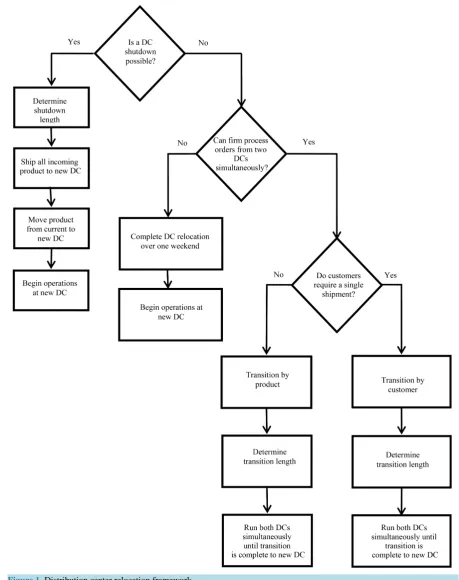
Based on the literature and insights gained from discussion with our pharmaceutical distributor, we have devel-oped the following framework (Figure 1) to help supply chain professionals plan and prepare for a DC reloca-tion. This framework focuses on three decisions managers must address regardless of their industry. The first decision examines whether a DC shutdown is possible during the relocation. If another DC can service the cus-tomers or if cuscus-tomers have been given enough notice to plan their orders accordingly, then a DC shutdown is possible. When a DC shutdown is possible, managers need to determine the duration of the shutdown. The firm will then need to decide when they should begin shipping all incoming product to the new DC in advance of the relocation. Managers of the firm will also need to plan how the remaining product from the current DC will be moved to the new DC. The speed of this move will depend on the amount of product to be moved, labor and transportation constraints, and the cost of the move especially if it involves overtime or weekend pay additions. Mix [3] discusses how much shutdown time is practical. He suggests the shorter the shutdown, the longer the time to achieve smooth operations after the move. In one situation with a manufacturer’s distribution center, op-erations were shut down for nearly three weeks with stabilized smooth opop-erations achieved relatively quickly. In another instance, with a distributor moving a much shorter distance, the move was made over a long weekend with a one-business-day shutdown but resulted in excessive overtime for two months afterward. The length of the shutdown will be strongly influenced by senior management, and rightfully so, as it affects all aspects of the business including marketing and sales.
The second decision explores whether it is practical to operate both DCs simultaneously if a shutdown is not possible. If the firm cannot process orders from the two DCs simultaneously, then the DC relocation must take place over a single weekend. To reduce the amount of inventory to be moved, the new stock is delivered to the new DC while inventory is drawn down at the current DC. Advance stocking of the new facility while depleting the stock of the current DC greatly reduces the quantity of merchandise to be moved and experience is gained from receiving and storing merchandise at the new facility [3]. This is a simple strategy but also risky if any problems arise that may lead to a disruption of service [7]. Traditionally, XYZ has completed the relocation move over a one weekend time frame without any disruptions in service. However, some concerns have arose regarding labor and liability issues that may limit the overtime hours employees can work during the weekend. In addition, XYZ has never relocated a DC of this size before.
The third decision explores whether customers can be serviced from both DCs simultaneously. Since custom-ers may perceive shipments from two locations as a disruption in service, DC managcustom-ers must carefully plan their operations when operating two DCs. The firm can operate both DCs simultaneously, and then there are two possible actions: transition by product or transition by customer.
Figure 1. Distribution center relocation framework.
method is not feasible for XYZ.
identify which customers are transitioned first. We recommend transitioning by customers in three steps. First, move customers with larger amounts of inventory (30 to 50 percent) and smaller amounts of SKUs (10 to 20 percent) as this offers an opportunity to test out the new DC. Also consider the proximity of customers as transi-tioning closer customers first allows for an opportunity to recover if the new DC has any initial problems. Second, move customers with larger amount of SKUs (50 to 70 percent) irrespective of the amount of inventory as by now the new DC should be operating smoothly. Lastly, move the remainder of the inventory and SKUs as this allows for additional time to move miscellaneous and any potentially hazardous items. Based on analysis of the order data at XYZ, the top twenty customers accounted 51.7 percent of the sales volume at the current DC, but only 4.3 percent of the SKUs making it difficult to have a soft opening at the new DC.
4. Financial Analysis
The analysis of the major costs associated with relocating a DC include transportation to move product from the current DC to the new DC, the labor cost of moving the product, the any additional picking cost (savings) of uti-lizing the current DC versus a more efficient new DC, and the cost of carrying additional inventory in both DC’s during an extended move. The amount of stock to be moved and the move time-frame is used to calculate the number of truckloads per day required for the move [3]. By translating truckloads per day into man and equip-ment days, the following analysis compares the manpower and equipequip-ment needs to accomplish the move in the allotted time.
Based on XYZ’s inventory records, there are 5000 total pallets of inventory with 500 full pallets and 4500 partial pallets. For the move scenarios involving relocating over two or three weeks, the inventory per move is based on the average quantity of products ordered per week divided by the total amount of product ordered dur-ing a week. The number of pallets to be moved is then used to estimate the transportation and move labor cost required to complete the move. To estimate the transportation cost, the number of trucks needed is found by taking the number of pallets to be moved and dividing it by the capacity of the track (26 pallets per truck). The estimated travel time from the current DC to the new DC, including unloading, is 2 hours and 20 minutes. In ad-dition, the time to load a truck is 11 minutes and only two trucks can be loaded at once therefore no more than 24 trucks will be in use at a given time. Assuming 94 trucks are needed to move the inventory, then 70 of those trips will be roundtrips between the current and new DC and 24 will be one-way trips from the current DC to the new DC. The estimated round trip cost is $550 and a one-way trip costs $275 per XYZ’s transportation depart-ment.
The total labor hours need to move the product from the current DC onto a truck and then put it away in the new DC was calculated using the following data provided by XYZ. It is estimated that it would take 85 seconds to retrieve a full pallet and move it to the staging area in the current DC. Partial pallets would take 290 seconds as sometimes the product has to be loaded onto a pallet before it can be moved to the current DC’s staging area. To secure the pallets (full and partial) with shrink wrap and load them onto a truck takes 50 seconds. At the new DC it takes 35 seconds to unload a pallet from the truck to the staging area and to remove the shrink wrap. Put away time is 185 seconds for full pallets and 440 seconds for partial pallets. These time estimates are multiplied by the number of full and partial pallets to be moved to determine the required number of workers and then converted into labor cost by using the overtime cost per worker of $23.66 per hour.
The picking operation at the new DC is estimated to be at least 5% more efficient than the current DC due to its improved layout and use of pick-to-light and automated A-frames to handle a majority of the line items. The picking cost of the current DC is $0.36 per line item and the new DC has a picking cost of $0.342 per line item with the 5% efficiency improvement. In a two or three week move scenario, picking costs will increase for each item that is not picked at the new DC versus the current DC. Another drawback of not moving to the new DC over one weekend is the need to carry extra safety stock at the current DC until the move is completed. Using one extra day of product sold as safety stock at the weighted cost of capital of 20% yields $29,477 per week in additional cost of relocating over two or three weeks.
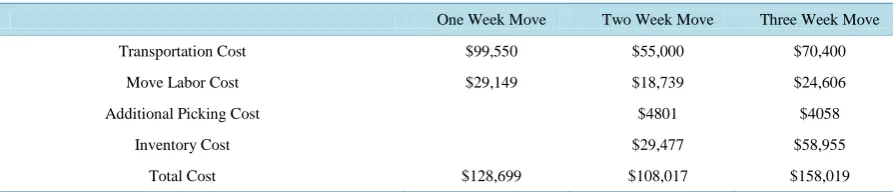
Table 1. Cost summary by scenario.
One Week Move Two Week Move Three Week Move
Transportation Cost $99,550 $55,000 $70,400
Move Labor Cost $29,149 $18,739 $24,606
Additional Picking Cost $4801 $4058
Inventory Cost $29,477 $58,955
Total Cost $128,699 $108,017 $158,019
processed in the new facility with its improved layout and modern picking technologies. Lastly, the inventory cost is the cost of carrying additional safety stock to process orders from both DCs simultaneously. Since the new XYZ distribution center is 5% more efficient than the current DC, the longer transition scenarios XYZ picking costs increase for each item that is not picked at the new DC. A drawback of not moving to the new DC over one weekend is the need to carry extra safety stock at the current DC until the move is completed. The dif-ference in operations (transportation, move labor, and picking) cost between the three scenarios is roughly less than $50,000 with the two week move having the lowest cost.
The two and three week scenarios have the following advantages over a one week transition. First, they re-quire less temporary labor compared to a one week transition. There is also a decreased opportunity for errors as a result of moving all inventory over two or three weeks and the reduced managerial stress as a result of not moving all operations in one week. Lastly, the new DC will have the opportunity for a soft opening. However, these options also have several disadvantages. First, there are higher inventory costs because safety stock will be needed for two DCs and there may be higher overhead costs due to operating two DCs simultaneously for two or three weeks. There is also the increased managerial stress of operating two DCs simultaneously for two or three weeks. Lastly, the new DC is technologically advanced and more efficient than the current DC, but XYZ will not be able to take full advantage of that efficiency until end of the second week.
Based on the relatively small difference in total cost between these various transition strategies, the authors realized that attempting to evaluate the various move strategies with more detailed analysis would be pointless especially given XYZ’s number one priority during the move-no interruption of service and maintaining order integrity in order to keep customer satisfaction high. For firms relocating DCs the potential cost savings of vari-ous move strategies may outweigh the customer service and managerial implications.
5. Conclusion
This paper examines the major considerations in distribution center relocation. For many firms today, the con-cerns of customer satisfaction are of upmost importance as evidenced by the example of XYZ pharmaceutical distributor with the expectation of timely and accurate delivery of pharmaceutical products to hospitals, pharma-cies, and doctor’s offices. A firm also needs to assess their capabilities in being able to either complete the relo-cation quickly or process customer orders simultaneously from two distribution centers while transitioning to the new DC. Lastly, in the competitive global marketplace, a firm must evaluate the cost of various relocation strat-egies. Regardless of the relocation strategy, a firm must carefully plan for any contingency as their reputation in the marketplace is at stake. The final decision in determining a relocation strategy is dependent on all these fac-tors but also the firm’s corporate culture. This research is applicable to every type of distribution firm whether small or large and for any kind of product line as the issues of cost, customer requirements and capabilities are important even if they may differ in relative importance. Clearly, this paper that looks into the managerial and strategic decisions involved in the choice of relocation transitions is much needed in this stream of research.
References
[1] Min, H. and Melachrinoudis, E. (1999) The Relocation of a Hybrid Manufacturing/Distribution Facility from Supply Chain Perspectives: A Case Study. Omega, 27, 75-85. http://dx.doi.org/10.1016/S0305-0483(98)00036-X
[2] Economides, S. and Fok, E. (1984) Warehouse Relocation or Modernization: Modeling the Managerial Dilemma. In-terfaces, 14, 62-67. http://dx.doi.org/10.1287/inte.14.3.62
[4] Kempfer, L.M. (2005) Warehousing Moving Day. Material Handling Management, 60, 20-22. [5] Lewin, K. (1947) Frontiers in Group Dynamics. Human Relations, 1, 5-41.
http://dx.doi.org/10.1177/001872674700100103
[6] Lewin, K. (1958) Group Decision and Social Change. In: Maccoby, E.E., Newcomb, T.M. and Hartley, E.L., Eds., Readings in Social Psychology, Holt, Rinehart, Winston, New York, 197-211.
[7] Dennis, A., Wixom, B.H. and Roth, R.M. (2009) System Analysis and Design. 4th Edition, John Wiley, New York.