Implementation of OBE in a MoT Program:
Lesson Learned
Alina Shamsuddin
Center of Academic Development & Training
[email protected]
Chee-Ming Chan
Center of Graduate Studies
Universiti Tun Hussein Onn Malaysia, Johor Malaysia.
[email protected]
Azeanita Suratkon
Faculty of Civil and Environmental Engineering
Universiti Tun Hussein Onn Malaysia
Johor, Malaysia
[email protected]
Abstract
There is a growing concern among practitioners on the competencies of fresh graduates in Malaysia. Some of the organizations have developed ‘special’ trainings to equip our graduates who are perceived as lack of soft skills and not ready to join the workforce. The Education Ministry has even developed a BLUEPRINT on our graduates attributes that needed by the industries. Outcome Based Education (OBE) has been introduced and implemented for more than 5 years in Malaysia. However, the program learning outcomes (PLOs) that supposedly converted into competencies and attributes of graduates have failed to satisfy the industries. Hence, this paper explores the issues and challenges in implementing OBE in a course in a management of Technology (MoT) program in UTHM. It adopts the qualitative methodology. The research strategy is a case study. The case study protocol is based on the stages in OBE implementation. The findings discovered that there are three critical issues that hinder the success of the implementation of the OBE concepts; which are at least the human capital factor (lecturers and students), the system (management) and the infrastructure (e.g. library, classroom, etc.) that related to OBE implementation.
Keywords
OBE, graduate attributes, learning outcomes, competencies, management, infrastructure
1. Introduction
Outcome-based Education (OBE) approach has been mentioned in the literature as early in the 1960s by Carroll (1963), Bloom (1968) Spady (1998), Davis (2003) and others. The main aim is to equip students with knowledge, competencies and orientation for their future professional development. The focus of OBE is students but the key players are the educators. Educators are expected to be innovative and creative in their teaching to ensure they produce thinking and caring graduates. OBE involves the restructuring of curriculum, assessment and reporting practices in education to reflect the achievement of high order learning and mastery rather than accumulation of course credits. In a nutshell, OBE main aim is to capture students’ capabilities or qualities.
Hence, writing and evaluating the outcomes demand the educators to focus not only the cognitive educational
2. Background of OBE in Malaysia
The concept of OBE was indicated in Malaysia in 1999 where all programs should published generic attributes which were accepted by the industrial market. Later in 2003, the planning of OBE implementation had been shown. Only in 2007 with the establishments of Malaysian Qualification Agency (MQA) [1] in 2007 OBE implementation has become mandatory for all programs. MQA was established resulted from the merging of the National Accreditation Board (LAN) and the Quality Assurance Division, Ministry of Higher Education (QAD). The main task of the MQA is ensuring the quality assurance of higher education for both the public and the private sectors.
The need for OBE was ignited by the industrial needs as our graduates were not able to perform functions because of their lack of knowledge, skills and attitudes. Consequently, competence is developed by proper education, training and experience. Hence, educational system which is based on learning outcome is needed. Literature has highlights the advantages of the OBE approach. OBE is about measuring what the students are able to do [2].
3. Methodology
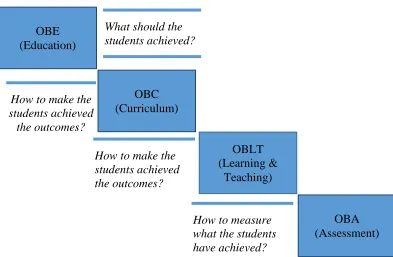
[image:2.612.118.511.364.621.2]This is a qualitative research which employed qualitative single-case study approach [3]. One of the Management of Technology (MoT) programs at undergraduate levels at a public university was chosen. 101 students who enrolled for the Technology Transfer course were chosen to be the respondents. The analysis was then guided by the Miles and Huberman’s techniques [4] which are data reduction, data display and drawing conclusions [4]. According to Yin [2003] a case study protocol is needed to enhance the consistency of the case study research [3]. Thus, this paper adopts the three essential OBE; (i) OBC which refers to the Outcome based Curriculum, (ii) OBLT which is Outcome-based Learning and Teaching and OBA which is Outcome-based Assessment as depicted in Figure 1.0 as the case study protocol.
Figure 1.0: Outcome Bases-Education (OBE) Flows
OBE
(Education)
OBC
(Curriculum)
OBLT
(Learning &
Teaching)
OBA
(Assessment)
What should the
students achieved?
How to make the
students achieved
the outcomes?
How to make the
students achieved
the outcomes?
4. Result and Discussions
OBC: Defining Curriculum Objectives and Intended Learning Outcomes (ILO)
The curriculum objectives were defined through the formulation of Program Educational Objectives (PEO) and the Program Learning Objectives (PLO). PEO refers to the competencies of the graduates to obligate after 3-5 years of working experience in the respective discipline.
Graduates from Bachelor of Technology Management Program are supposed to have (i) the ability to integrate management and technology application in the working environment, (ii) the ability to show creative and innovative thinking and competencies in problem solving to achieve the organization’s goal and (iii) to exercise excellence leadership, communication skills and team-working in achieving the organization’s goal and (iv) to portray accountability and professional ethics.
PLOs represent the competences of the graduates upon completion of the program. The competencies are divided into three essential domains which are knowledge, skills and interpersonal skills (communication skills, critical thinking and problem solving, teamwork skills, long life learning skills, entrepreneurship skills, ethical and leadership skills). The program’s learning outcomes (PLO) for the program are as the following:
To master the principles of business and technology management in the industrial environment. To apply technical knowledge and analytical skills in technology management.
To communicate effectively in written and verbal forms within the industrial environment.
To identify and solve management problems in a creative, innovative and effective manner within the business and technology management areas.
To demonstrate aptitude and attitude that contribute towards excellent team work. To engage in lifelong learning and to be able to manage information professionally. To embed entrepreneurial culture in career development.
To show commendable character and sense of duty in leadership roles.
Another term which is essential to understand is the Course Learning Outcomes (CLOs). The CLOs are mapped against the PLOs of the program which determine the delivery and the assessment methods for a particular course.
Mapping CLOs of the Courses on the PLOs of Bachelor of Technology Management Program
The program is at a degree level, comprises of 44 courses and is offered by Department of Technology and Management. It comprises of staff in two major disciplines which are business and management. More than 20% of the staff is PhD holders and less than 80% are Masters Holders. The development of the program was first introduced by the government in 2001 as part of the collective effort towards fulfilling the National Agenda to be a developed nation by year 2020. Consequently, it was aligned with the mission and vision of the University as one of the Malaysian Technical University Network [MTUN].
The program has undergone few reviews that resulted by the comments of the stakeholders from the ALUMNI, private sectors and even government sectors. Further amendments were carried out when MQA stipulated a pre-requisite of minimum 120 credits for undergraduate level programs, in accordance with the Malaysia Qualification Framework1 [MQF] Program Specification, as well as to meet the fundamental three taxonomies, namely the
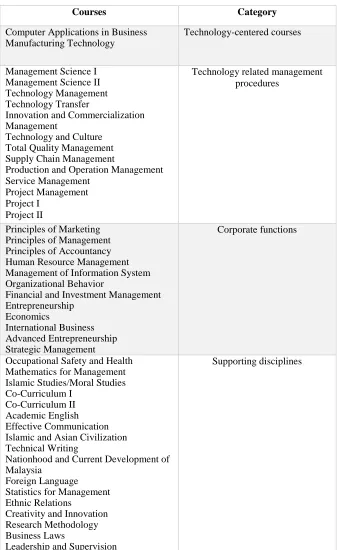
Table 1.0: MoT Courses and its category
Courses Category
Computer Applications in Business Manufacturing Technology
Technology-centered courses
Management Science I Management Science II Technology Management Technology Transfer
Innovation and Commercialization Management
Technology and Culture Total Quality Management Supply Chain Management
Production and Operation Management Service Management
Project Management Project I
Project II
Technology related management procedures
Principles of Marketing Principles of Management Principles of Accountancy Human Resource Management Management of Information System Organizational Behavior
Financial and Investment Management Entrepreneurship
Economics
International Business Advanced Entrepreneurship Strategic Management
Corporate functions
Occupational Safety and Health Mathematics for Management Islamic Studies/Moral Studies Co-Curriculum I
Co-Curriculum II Academic English Effective Communication Islamic and Asian Civilization Technical Writing
Nationhood and Current Development of Malaysia
Foreign Language Statistics for Management Ethnic Relations
Creativity and Innovation Research Methodology Business Laws
Leadership and Supervision
OBTL: Types of Assessment Tools and Methods
In order to determine the assessment tools and methods, we need to formulate the CLO for the Technology Transfer Course and the assessment methods.
Designing the Assessment of Technology Transfer Course
The role of assessment in learning and teaching activities are the attainment of the outcomes. Hence, assessment methods or the outcome indicators employed must be constructively aligned with the Program Learning Outcomes (PLOs) and Course Learning Outcomes (CLOs). The lecturers must ensure that the students are ‘learning’ and the delivery methods meet well in ensuring the achievement of the CLOs and hence assist the attainment of the PLOs. As mentioned earlier, each of the courses in the program must have at least three CLO statements. For the Technology Transfer course the statements are as the following:
1. Use the concepts and approaches of technology transfer in adopting new technology in organizations.
2. Practice the approaches and concepts of technology transfer in deciding business strategy and strategic management in organizations.
3. Initiate solutions in technology transfer issues effectively and efficiently in organizations.
The formulation of the CLOs is made based on the mapping of CLOs and PLOs. In our case, during the development of the program, after undergone phases of;
i) Benchmarking with other universities (local and overseas)
ii) Market survey on the feasibility of the potential graduates to be accepted by industries. iii) Input from renown professors and industries players
All the lectures debated on identifying the mapping of the CLOs and PLOs. In this exercise, each course owner (respective lecturer) justify on why the focus must be on the selected PLOs. During the first lecture each time, the lecture shares the lesson plan which comprises of the summary of the course (eg. include the name of the course, lecturer’s name and contact number, section, student learning time (SLT), topics, synopsis of the course, assessment and delivery methods, main references etc.). After each assessment, the result is communicated to students in a reasonable time frame. The monitoring of this exercise is carried out by the Head of Department (HoD) and the Deputy Dean (Academic & Internationalization). The grading, appeal system are also make known to the students orally (in class) and in written form. At least two (2) governances are responsible to ensure the fairness of the assessment of the students. The governance acts as the moderating body in ensuring the validity and reliability of the assessment process.
OBA: Assessment Methods
There is no absolute ways of assessment in ensuring the attainment of the CLOs. It is all determined by the normal practice in each of the knowledge discipline and the experience and knowledge of the lecturer. For instance, in assessing cognitive, mid-term and final examination can be used as methods of assessments. For psychomotor domain, lab work, workshops and projects can be adapted. Lastly, for affective domain, presentations, debate can also be used.
For our course, we have chosen quiz, mid-term and final examination be the methods of assessment representing the cognitive knowledge. For psychomotor domain, we have chosen a case study where students were asked to identify issues and challenges faced in technology transfer using interview as the data collection method. Lastly, the affective domain part, presentation has been chosen as the assessment method. The class consisted of 101 students and was divided into two sections.
During the implementation of the OBE approach, we discovered that factors like the total number of each class did have influence on the delivery methods used for the course. If we have so many students, we were not able to focus on the ability of each student. As a result, we only used lecture as the main method. We tried to have group discussions, but it was a failure. The classroom was too small to accommodate 11 groups (56 students, each group 5-6 people).
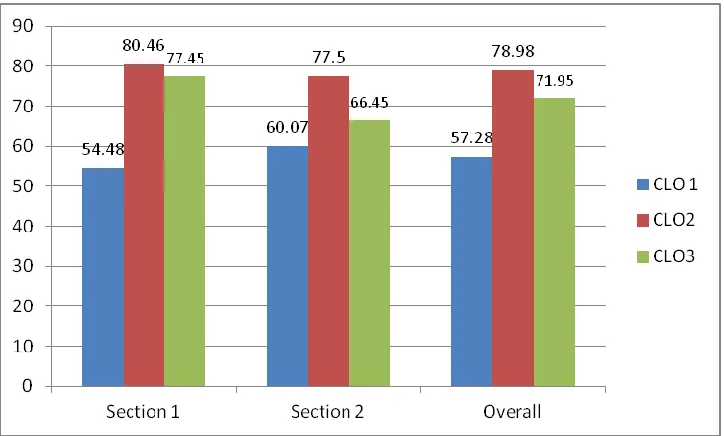
Figure 2.0: Overall Achievements of the students for each CLOs.
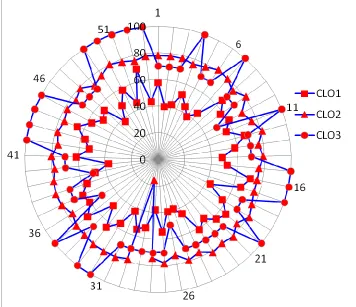
[image:6.612.135.482.479.689.2]Figure 3.0 and 4.0 indicate that the attainment of the first CLO which is the cognitive is the lowest compared to the skills (CLO2) and the soft skills (CLO3). CLO1 is represented by the quiz, mid-term examination and final examination. CLO2 is represented by the assignment and CLO 3 is by the presentation. The data is contradicting with the feedback that we received from our stakeholders which is our students are lack of soft skills. In our opinion, this is resulted from the numbers of students in a class that hinder us from exercising individual assessment for the soft skills. Hence, the result is based on the ‘group ‘representative rather than the individual.
Figure 4.0: Attainment of the students for each evaluation
5. Conclusions
This paper discusses on the implementation of the OBE approach in a MoT program in Malaysia. The discussions are based on the four stages of the OBE implementation. It is apparent that the attainment of CLOs and PLOs are achievable. However, the main issue that need to be explored further is on OBTL that refer to the learning and teaching of the curriculum. The key conclusions are:
The educators (lecturers) need to understand all the four stages of the OBE implementation and not focusing on the assessment only. Whenever a lecturer teaches, he should remember the competence and attributes of the graduates that he should mold during the processes of learning and teaching (OBE). The connectivity and relationship of the courses in the curriculum need to be understood (OBC).
The classroom size and the number of students in a class do have influence on the success of OBE implementation. During the assessment, (OBA) the smaller the number of students are the better. The smaller the number in a class enable a lecturer to vary the delivery methods which determine the assessment methods (OBA).
References
[1] COPPA Code of Practice for Programme Acreditation, Malaysian Qualifications Agency, Ministry of Higher Education, Malaysia, 2009.
[2] Butler, M (2004). Outcome Based/Outcomes Focused Education Overview. REtreived on the 17th June 2015. [3] Yin, R. (2003). Case Study Research:Design and Methods.Third Edition. Sage Publication
[4] Miles, M.B. and Huberman, A.M. 91994). Qualitative Data Analysis. An Expanded Source Book. Second Edition. Sage Publication.
Biography
Alina Shamsuddin is currently an Associate Professor (Technology Management) with the Faculty of Technology Management and Business of Universiti Tun Hussein Onn Malaysia. Being a founding member of her faculty, Dr. Alina is not only knowledgeable on the immediate related fields of performance measurement, production and management, she is also an expert on educational quality assessment and assurance, with 5-year experience as an auditor for the Malaysian Quality Agency (MQA). Her research concerns are myriad but inter-related, encompassing higher education quality assurance and reforms, effective teaching and learning, as well as innovative technology adoption for SMEs. Currently heading the Unit of New Programmes Development, Dr. Alina is consolidating her effort to make a difference in the quality of programme design and delivery in the overall higher educational arena, institutionally and nationally.
Chee-Ming Chan is an Associate Professor with the Civil Engineering Technology Department, Faculty of Engineering Technology, Universiti Tun Hussein Onn Malaysia. She is presently holding the office of Deputy Dean in Academic and Research at the Centre for Graduate Studies in the University. Her area of expertise includes geo-materials, engineering education and higher education improvement. More recently, Dr. Chan’s current work on dredged materials from Malaysian waters has gained momentum and support from the Ministry of Science, Technology and Innovation and Department of Marine, Malaysia. She is also involved in professional bodies, including the Society for Engineering Education Malaysia (SEEM), Malaysian Geosynthetics Society (MyIGS), Institution of Engineers Malaysia (IEM), Board of Engineers Malaysia (BEM), and is an education quality auditor for the Malaysian Qualification Agency (MQA). From 2009-2011, Dr. Chan served as a Postdoctoral Research Fellow at the Port and Airport Research Institute (PARI), Japan.