The Impact of Crossover and Mutation Operators on a
GA Solution for the Capacitated
Vehicle Routing Problem
Hazan Da˘glayan
,
Murat Karakaya
∗Department of Computer Engineering, Atilim University, ˙Incek, 06836, Ankara, Turkey
Copyright c2016 by authors, all rights reserved. Authors agree that this article remains permanently open access under the terms of the Creative Commons Attribution License 4.0 International License
Abstract
The Vehicle Routing Problem (VRP) is one of the well-known NP hard problems requiring excessive time to be exactly solved. Therefore, for solving this type of problems, some researchers implemented meta-heuristics such as Genetic Algorithm (GA). In this paper, we study the Capacitated VRP (CVRP) which has some constraints on the capacities of the vehicles used in VRP. The goal of this study is to observe the impact of the selected operators of GA on the quality of the generated solutions. Therefore, we propose 6 different GAs by mixing and combining 3 crossover and 5 mutation operators. We observed the performance of these solutions by applying them over 10 CVRP benchmarks.Keywords
Capacitated Vehicle Routing Problem, Ge-netic Algorithm, Vehicle Routing Problem1
Introduction
The Vehicle Routing Problem (VRP) is first introduced by Dantzig and Ramser in 1959 [1]. The problem deals with delivering goods to customers from different depots provided that customer locations and demands are known and the route starts and finishes at the same depot. The aim is to find an optimum route with the minimum cost.
There are many variants of the VRP according to the con-sidered constraints: Capacitated VRP (CVRP) [2–4], Multi-ple Depot VRP (MDVRP) [5, 6], VRP with Time Windows (VRPTW) and VRP with Pick-Up and Delivering (PDVRP) [7] which are the most popular problems.
In CVRP, the goods are delivered to customers with a ca-pacitated vehicle. Therefore, the vehicle should be reloaded at the depot when the goods are delivered. As a result, the vehicle may visit the depot more than once. CVRP is origi-nally proposed for network problems, but then it helps to find solution to travelling, customer’ demands and location prob-lems [8] as well.
The proposed solutions to the problem can be classified under three headings: exact solutions, heuristic methods, and
meta-heuristic methods. While exact solutions provide the optimal solutions, meta-heuristic and heuristic does not guar-antee it. However, for the problems with considerable num-ber of customers exact solutions may be infeasible [9]. To find solutions for such problems, heuristic and meta-heuristic methods are proposed. Meta-heuristic methods can provide some good solutions exploiting wisely heuristic methods. Some popular meta-heuristics are Genetic Algorithm (GA), Ant Colony Optimization (ACO), Particle Swarm Optimiza-tion (PSA) among others [8]. GA is a meta-heuristic method that imitates evolutionary process in the nature. In essence, GA modifies the population of individual solutions repeat-edly with the operations such as crossover and mutations to reach an optimized solution. Due to its success and easy im-plementation, GA is applied to different optimization prob-lems of different research areas [10].
In this paper, we investigate the quality of the solutions generated by GA when different crossover and mutation op-erators are implemented for solving CVRP. We opt to imple-ment, mix, and compare 3 number of crossover and 5 number of mutation operators proposed in two GA solutions in [11] and [12]. Our aim is to observe the impact of the selected op-erators on the quality of the solution. As GA is a stochastic search method, random and heuristic choices can affect the success of the process.
The remainder of this paper is organized as follows. A detailed presentation of CVRP is given in Section2. GA and its operators are described in Section 3. In Section 4 and Section 5, we propose GA implementations using different mutation and crossover operators are presented. The results of these GA implementations are given in Section 6. Finally, in Section 7, we provide conclusions.
2
Capacitated Vehicle Routing
Prob-lem
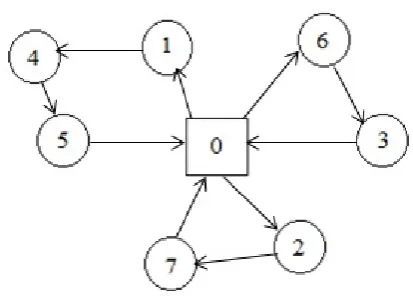
As seen in Fig. 1, Vertex0 is the central depot while ver-tices1,2, . . . , ncorrespond toncustomers. Each customer has demands di and the vehicle has a delivery capacityC.
A solution for CVRP consists ofkroutes{R1, R2, . . . , Rk}
satisfying the following equation
X
i∈Rj
di≤C (1)
In the CVRP, the aim is to minimize the total cost as de-scribed in (2) where the costcij is associated with each arc
(i, j)∈A.
T otalCost= X
i,j∈V
cij (2)
Each costcij represents the distance between customeri
and customerj.
3
Genetic Algorithm
GA belongs to class of evolutionary algorithms. GA be-gins with some possible problem solutions which is called as population. The of each individual (solutions) in the popu-lation is the solution cost. Optimization problem is to find an individual which minimize or maximize this fitness value. New generations are created with crossover and mutation op-erators applied on selected individual in the population. With a selection method, two individuals are chosen from the pop-ulation as parents, and two offsprings are created applying crossover and mutation operators on these parents. When an optimum route satisfying a threshold is obtained or genera-tion number is reached to the limit, the terminagenera-tion condigenera-tion is met and GA outputs the solution with maximum or mini-mum fitness value.
3.1
InitializationInitialization is the first process of the GA meta-heuristic. It may be usually randomized, while sometimes the solution of a heuristic method may be joined to the random population [13]. However, improper selection of initial population may lead to stack to local maximum or minimum points. That is, some solution may be so dominant that other individual (chromosomes) cannot create better offsprings (solution).
In most of the solution for CVRP, after random initial-ization, a greedy approach is used to handle capacity limi-tations [11]. Thus, it is assumed that the vehicle visits the first customer and serves the customer according to customer demand and vehicle capacity. If the vehicle has enough deliv-ery for the next customer, it will visit. Otherwise, the vehicle returns to the depot. For instance, considering Fig. 1, if the order of a possible solution (chromosome) is as 1 4 5 6 3 7 2, the demand of the customers is 3 2 1 3 3 2 4, and the capacity of vehicle is6, the chromosome consist of 3 separate tours initiating and ending at the starting depot0as seen in Fig. 1.
3.2
Encoding Schema [image:2.595.313.520.83.234.2]In this paper, we represent each city with a unique number, and except the depot no number will be repeated in a chro-mosome. For example, if we have 10 cities the individual
Figure 1.Representation of a CVRP example
consists of 10 or more numbers (with depot 0) from 1 to 10 with the order randomly permutation. The individual may be like that 3 2 8 0 1 7 6 0 4 5 9 0 1 0, where zero indicates the depot [14].
3.3
Fitness ValueFitness value is calculated after a new offspring is created. Each individual (chromosome) has a fitness value. It helps to find the best individual. If the individual has the maximum fitness value, it will be the best individual of the population. In CVRP, if the total distance is the minimum for an individ-ual (solution), it means that it has the maximum fitness value. Therefore, usually the fitness value is formulated as [8, 15]
fi=
100
T otalDisti
fi=
T otalDisti PT otalDist
i
(3)
wherefi is the fitness value and T otalDisti is the total
distance of theithindividual.
3.4
Selection OperatorThe selection operator is used to choose the parents from the current population to create new individual for the next generation by applying crossover or mutation operators.
Some well-known selection operators are tournament se-lections, roulette wheel selection, and steady-state approach. The tournament selection helps to find the best individual of tournament size number individuals [4, 8, 11]. For instance, if the tournament size is 2, which is called binary tournament size, two individuals are selected randomly, and the one with the better fitness value is the winner and selected as the par-ent.
The Roulette Wheel Selection is proposed to select the chromosomes which have greater fitness values. If the fit-ness value is greater, the probability of being selected will be greater [7, 8].
The steady-state approach ensures that two parents and two offsprings are compared; it selects the best two chromo-somes of them [2].
3.5
Crossover OperatorSelected two parents consist of two offsprings implementing some steps according to type of crossover. There are var-ious types of crossover operators such as Partially Mapped Crossover (PMX), Route Better Adjustment Recombination, Order Crossover, Pereira Crossover, etc.
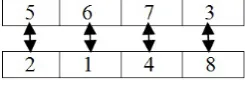
PMX is one of the well-known crossover operators. Two cut points are selected randomly and offspring inherits the genes between these two cut points with the same order. Then, a mapping table is constructed between two parents. According to second parent’s position, if the gene is not lo-cated between cut points, it is placed in the first childs chro-mosome. However, if the gene is already copied, it is ignored. The following example explains how PMX operates. As-sume that the chromosomes of selected parents are as fol-lows:P1is (3 5 2 1 4 8 7 5) andP2is (2 4 5 6 7 3 1 8). Then,
[image:3.595.323.541.71.113.2]two cut points randomly generated and showed as black.
Figure 2.The example of parent for CVRP
[image:3.595.321.543.159.225.2]Exchanging genes between the cut points:
Figure 3.The example of interim offsprings for CVRP
[image:3.595.61.295.277.324.2]Mapping will be as:
Figure 4.Mapping table for CVRP
After mapping, new generations will be as:
Best Route Better Adjustment Recombination (BRBAX) is a constructed crossover for this problem [11]. This oper-ator aims to transmit the best routes to the new generations which have less distance and satisfy the capacity constraint. The procedure is as follows. As a first step, one of the par-ents is selected and itsmroutes are sorted andm/2routes which have minimum distance are selected and placed as the first genes of the childs chromosome. Then, in the second step, the other parent’s genes are inherited to the child ac-cording to order of parents chromosome. Figure 6 provides an example operation of the BRBAX crossover.
The crossover suggested by Pereira is another operator which may be used in CVRP [12]. Firstly, randomly a sub-route is selected from second parent. After, the next gene to the first gene of the sub-route is chosen, the sub-route is in-serted; therefore it is satisfied shorter distance probably. In the following example, assume that customer 6 is closer to customer 9. (9, 1, 10) sub-route is selected randomly and it is put on near 6.
Figure 5.The example of offsprings for CVRP
Figure 6.The example of offsprings for BRBAX
3.6
Mutation OperatorMutation operator is used to escape the local optimum points. When mutation is not used, the local points can be seen optimum solution. Swap, insertion, displacement and inversion mutations are well-known mutation types. Details of these mutation operators are provided below.
Swap: Two points are selected randomly from the chromo-some, and swaps them. The genes can be same or different routes [11, 12].
Insertion: A gene is selected randomly and it is removed from the position and it is reinserted a new position [12].
Displacement: A sub-route is selected and then it is rein-serted a new position. It may be added a route or it may be a new route [12].
Inversion: The points between two positions which are se-lected randomly are reversed [16]
Scramble: A sub-route is selected randomly and the genes are mixed [17].
All mutations mentioned above may be local and global, this means that they may be in a route or in a chromosome.
3.7
ElitismThe best individual may be preserved by without changing the result of the crossovers and mutations. Therefore, it will be inherited to next generations without any changes, it is called elitism.
4
Selected Solutions
We have selected two solutions to implement their GA methods by mixing a permutation of crossover and mutation operators.
[image:3.595.60.294.390.433.2] [image:3.595.116.239.502.545.2]4.1
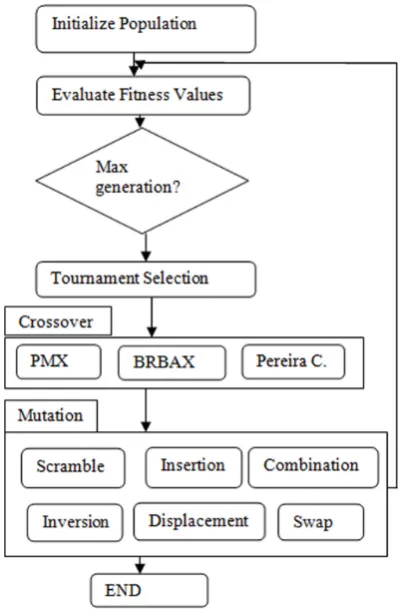
Solution AWe selected Graglias solution as the first solution [11]. In Graglias solution, an initial population is created randomly. The population goes into a cycle and then it continues with crossover, mutation, selection and evaluation. Two good chromosomes are chosen by tournament selection. And then with a probability of crossover PMX or BRBAX are applied. The next process is to choose mutation with a probability. Three types mutation is tried: swap, insertion and combina-tion of them. Also elitist strategy takes part in the algorithm. The procedure goes on until the max generation is reached.
4.2
Solution BThe solution proposed by Pereira is selected as the second solution [12]. The solution of Pereira starts with creating an initial population with the following algorithm: 1. Build a set with a random permutation of all the demands 2. While there are elements in D Repeat: 2.1. Create one new route with K demands. K is a random value between 1 and the current number of elements from D 2.2. Remove first K elements from D and assign them to the new route. Fitness function of the algorithm is the total distance of the routes, and the aim is minimizing the function. Until the maximum genera-tion number is reached, the genetic operators will be applied. The crossover which is described above in crossover part is used and swap, insertion, inversion and displacement muta-tions are used in this algorithm. The elitist strategy also is included.
[image:4.595.350.486.272.323.2]The common flowchart of the algorithms are given on Fig. 8
Figure 8.The flowchart of algorithms
5
Simulation Experiments and Results
[image:4.595.61.261.479.784.2]The algorithms described in the previous section are coded in MATLAB. 10 different CVRP benchmark files are used for testing the algorithms. We used 6 different combinations of crossover and mutation operators. The crossover and muta-tions are presented on Table 2 for each algorithm. The al-gorithms are repeated 10 times and their average values are given on Table 3. The benchmark files nodes change between 32 and 101. The default values of GA are given on Table 1. The values of crossover and mutation probability are deter-mined according to the empirical experiments in which the best performance values are observed when these probability values are tested. In each algorithm, the default values are constant to compare the algorithms results.
Table 1.GA parameters and their values
Parameter Default Value Population Size 200 Crossover Probability 0.9 Mutation Probability 0.15 Generation number 5000
To compare the algorithms, we utilise the error formula given in 4 based on the best known value and obtained value.
Error=|BestKnown| − |GA|
|BestKnown| (4)
The first and second algorithm (A1, A2) have the same
properties with Graglia’s algorithm [11]. In the first algo-rithm, BRBAX crossover is applied whereas PMX is used in the second algorithm. Pereira’s method is tested in the third algorithm. We obtained better results with Pereira’s al-gorithm. Since Pereira’s algorithm has more mutation types, scrabble mutation is also inserted the mutation types which we used. Finally, we tested all crossover types with these mutations.
We obtained the best results from the algorithmA4which
is consist of Pereira’s crossover and 5 mutations (swap, in-sertion, inversion, displacement and scrabble). Since the mu-tation types are common onA4,A5andA6, we have the
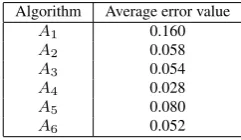
in-formation that Pereira’s crossover is the best type crossover. The values in Table 4 gives the average error obtained by (4) for each algorithms. If we compare the algorithms A3
andA4, it is obtained that the increase the number of
muta-tion type decreases the error value. Moreover, comparing the algorithmA1andA5supports this idea.
When algorithms A4 and A6 are compared, Pereire’s
crossover gives better results than PMX crossover. Besides, the average error value of PMX crossover are less than BR-BAX crossover with the help of algorithmsA5andA6.
6
Conclusion
Table 2.Properties of Algorithms
GA Crossover Mutation Note
A1 BRBAX swap, insertion Graglia’s method
A2 PMX swap, insertion, combination of them Graglia’s method
A3 Pereira’s crossover swap, insertion, inversion, displacement Pereira’s method
A4 Pereira’s crossover swap, insertion, inversion, displacement, scrabble
A5 BRBAX swap, insertion, inversion, displacement, scrabble
[image:5.595.144.464.134.298.2]A6 PMX swap, insertion, inversion, displacement, scrabble
Table 3.Comparisons of Algorithms
Algorithms (Average)
Benchmarks A1 A2 A3 A4 A5 A6 Best Known
A-n32-k5 889.8 829.4 828.7 787.1 788.3 787.2 784 E-n33-k4 909.7 837.9 859.1 837.7 869.1 846.7 835 A-n37-k6 973.2 984 1002.4 970.6 999.5 976.3 949 A-n45-k7 1274.2 1193.9 1203.8 1186.7 1206.8 1203.8 1146
vrpnc1 619.2 546.8 569.9 539.5 561.7 558.5 524.6 vrpnc6 578.6 590.5 567.4 557.2 608.6 569.3 555.4 A-n53-k7 1177.1 1090.1 1048.1 1046.8 1079.6 1052.1 1010 A-n69-k9 1348.1 1220.8 1226.2 1219.7 1250.7 1243.7 1168 vrpnc2 996.9 902.8 888.0 886.3 907.1 896.5 835.2 vrpnc3 1247.8 955.4 906.3 863.4 1042.1 965.5 826.1
Table 4.Average error values of the proposed algorithms compared to best-known solutions for 10 benchmarks
Algorithm Average error value
A1 0.160
A2 0.058
A3 0.054
A4 0.028
A5 0.080
A6 0.052
tests to observe the effect of crossover and mutation opera-tors on the generated solutions. We compared the generated results with the best-known values. We observed that select-ing suitable crossover and mutation operators considerably affects the generated solution quality. Among the consid-ered methods, the results shows that Pereiras crossover with higher number of different types of mutations outperforms the other combinations of operators. Thus, we can conclude that designing better crossover and mutation operators leads better genetic algorithms.
REFERENCES
[1] G. B. Dantzig, J. H. Ramser. The truck dispatching problem, Management science 6.1, 80-91, 1959.
[2] M. Filipec, D. Skrlec, S. Krajcar. An efficient implementation of genetic algorithms for constrained vehicle routing problem, Systems, Man, and Cybernetics, 1998, 1998 IEEE Interna-tional Conference on. Vol. 3. IEEE, 1998.
[3] S. Wink, T. Bck, M. Emmerich. A meta-genetic algorithm for solving the capacitated vehicle routing problem, 2012 IEEE Congress on Evolutionary Computation, IEEE, 2012.
[4] H. Nazif,L. S. Lee. Optimised crossover genetic algorithm for capacitated vehicle routing problem, Applied Mathematical Modelling 36.5, 2110-2117, 2012.
[5] M. Filipec, D. Skrlec, S. Krajcar. Darwin meets computers: New approach to multiple depot capacitated vehicle routing problem, Systems, Man, and Cybernetics, 1997, Computa-tional Cybernetics and Simulation., 1997 IEEE InternaComputa-tional Conference on. Vol. 1. IEEE, 1997.
[6] M. Skok, D. Skrlec, S. Krajcar. The genetic algorithm method for multiple depot capacitated vehicle routing problem solv-ing, Knowledge-Based Intelligent Engineering Systems and Allied Technologies, 2000, Proceedings, Fourth International Conference on. Vol. 2. IEEE, 2000.
[7] A. S. Tasan, M. Gen. A genetic algorithm based approach to vehicle routing problem with simultaneous pick-up and de-liveries, Computers & Industrial Engineering 62.3, 755-761, 2012.
[8] M. A. Mohammed, M. S. Ahmad, S. A. Mostafa. Using ge-netic algorithm in implementing capacitated vehicle routing problem, Computer & Information Science (ICCIS), 2012 In-ternational Conference on. Vol. 1. IEEE, 2012.
[9] G. Laporte. The vehicle routing problem: An overview of ex-act and approximate algorithms, European Journal of Opera-tional Research 59.3, 345-358, 1992.
[10] D. Beasley, D. R. Bull, R. R. Martin. An overview of ge-netic algorithms: Part 2, research topics, University comput-ing 15.4, 170-181, 1993.
[11] P. Graglia, N. Stark, H. Alfonso, C. Salto. A comparison of re-combination operators for capacitate vehicle routing problem. In XIV Congreso Argentino de Ciencias de la Computacion, 2008.
[12] F.B. Pereira, J. Tavares, P. Machado, E. Costa. GVR: a new genetic representation for the vehicle routing problem, Irish Conference on Artificial Intelligence and Cognitive Science, Springer Berlin Heidelberg, 2002.
[13] E. Khaji, A. S. Mohammadi. A Heuristic Method to Gener-ate Better Initial Population for Evolutionary Methods, arXiv preprint arXiv:1406.4518, 2014.
[14] N. Kumar, R. K. Karambir. A comparative analysis of pmx, cx and ox crossover operators for solving traveling salesman problem, International journal of Latest Research in science and technology 1, 2012.
[image:5.595.115.236.346.416.2][16] K. Pulji´c. An Evolutionary Algorithm Based on Repeated Mu-tations for Solving the Capacitated Vehicle Routing Problem, CIT. Journal of Computing and Information Technology 20.1, 51-58, 2012.
[17] Y. Y. Leu, L. A. Matheson, L. P. Rees. Assembly Line