Journal of Chemical and Pharmaceutical Research, 2017, 9(4):201-205
Research Article
CODEN(USA) : JCPRC5
ISSN : 0975-7384
201
Comparative Study on Axial Load Behaviour of CFST Columns with
Different Stiffeners
S Kesavan, S Durgadevagi
*and S Syed Abdul Rahman
Department of Civil Engineering, SRM University, Kattankulathur, Tamil Nadu, India _____________________________________________________________________________
ABSTRACT
Concrete-filled steel box column is widely used as a major structural element in tall buildings as it provides efficient structural performance in resisting axial compression. The concrete core adds stiffness and compressive strength to the tubular column. The steel tube acts as longitudinal and lateral reinforcement for the concrete core helping it to resist tension, bending moment and shear and providing confinement for the concrete But when the slenderness ratio of the plate is large, box columns fails under local buckling. From the past researches, it is also found that the thin walled sections are less stiffened. To overcome these defects, different types of stiffeners should be used inside the tube section. Thus, there is a need to investigate of the structural behavior of concrete filled thin walled steel tube column with different type of stiffeners, to increase stiffness and to reduce the local buckling failures. In this research, the effects of five different types of stiffeners were investigated experimentally and the results were compared with the column without stiffeners. Stiffeners were attached to the columns by using weld connections. From the results, it was observed that the stiffener enhances both the axial load carrying capacity and stiffness of the concrete filled thin walled steel tube columns.
Keywords: Concrete filled tubes; Thin walled column; Stiffeners
_____________________________________________________________________________
INTRODUCTION
Concrete filled steel tubular (CFST) column is a structural system with excellent structural characteristics, which resulted from the confinement provided by the steel tube to the concrete core. However, this confinement is not very effective in a square section as compared to that of a circular section. Therefore, when a thin walled square steel section of CFST is used, a stiffening method is desirable. There are several types of stiffening methods available for use in CFST columns like welding longitudinal stiffeners on the inner surfaces of the steel tube, inserting shear studs in the steel tube and by using either tie bars or restraining rods to strengthen the plastic zones of the CFSTs. The previous studies demonstrated that the longitudinal stiffeners effectively delay the local buckling of the tube, increase the sectional capacity and improve the lateral confinement of the concrete core. However, they did not significantly influence the ductility of the stiffened CFST specimens. The shear studs function as shear connectors to ensure reliable stiffness of the composite cross section even in the region of elastic behavior. This stiffening scheme primarily aims at enhancing the ultimate strength of the steel tube and improving the bond between the steel tube and concrete core interface. However, the shear studs only enhance the ductility of square CFT columns but they contribute nothing to the strength. The literature study indicates that strength and ductility are equally important in CFST stiffening design. A CFST stiffener that possesses both characteristics is still lacking, therefore further study in this area is desirable.
This paper presents an experimental investigation on the axial load carrying capacity of concrete filled thin walled tubular columns with various stiffeners. The main purpose of this stiffening method is to increase the ultimate load carrying capacity, to improve the ductility and also to overcome the shortcoming of weak concrete confinement at the center of the sidewalls of the steel tubes [1-8].
Stiffeners Used in the Study
202
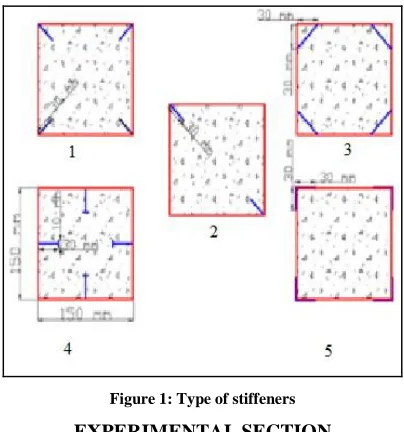
[image:2.596.197.399.140.356.2]A series of parametric studies was performed to characterize and quantify the collected data analytically. A new equation for the minimum required moment of inertia for the longitudinal stiffeners was derived. Through the evaluation of a few selected case studies and a design example, the validity and reliability of the proposed equation was demonstrated. To increase the column stiffness the various types of stiffeners are used as shown in Figure 1.
Figure 1: Type of stiffeners
EXPERIMENTAL SECTION General
In the experimental study, six square specimens with various stiffeners were prepared. All the specimens were subjected to compression test, to determine the axial load capacity. The primary parameter studied was the behaviour of different types of stiffeners in CFST columns. The specimens are square shaped with an overall width (B) of 150 mm, height (h) of 600 mm, thickness (t) of 1.25 mm and average yield strength (fy) of 250 MPa. According to the design code, the slenderness of the walls must satisfy the limiting value of B/t to avoid local buckling of the steel. The limiting value of B/t for CFTs is given in equation 1.
(1)
According to this equation, the slenderness limit of all the specimens is 120. However, a width-to-thickness ratio (B/t) of all the specimens in this study is 120; all specimens were considered to be thin walled sections. A stiffening measure was taken to compensate for the local buckling effects of the thin walled tubes. The length of each specimen is chosen to be three times the height of the square thin walled steel columns to avoid the effects of overall buckling and end conditions.
Mix Design
The basic raw materials used in the Concrete Filled Steel Tube with columns are Ordinary Portland Cement of 53 grade, Fine Aggregate confirming to zone II, Coarse Aggregate of size 10mm and below, water, class F fly ash, and Conplast SP 430. Self-Compacting Concrete is used as an infill to avoid external vibrations requirements for the compaction of concrete. The Mix design was done by ACI method. For the test trial M30 grade self-compacting concrete with water cement ratio 0.4 and mix proportion 1:1.3:2.1 was used. Based on EFNARC acceptance criteria, the filling and flowing ability of concrete is investigated by slump flow test V-funnel test, L-box test and U-box test. The slump value of concrete obtained from the experiment was 600 mm, the flow time in V-funnel test was 6 seconds, the value of (h1/h2) in L-box test was 0.876 mm and the value of
(h1-h2) in U-box test was 5.26. It was observed that all the values satisfy the EFNARC guidelines.
Casting and Curing of Specimens
203
Table 1: Column specifications with stiffeners
Column No Type of Stiffener
1 Internal Stiffener at 4 corners
2 Internal Stiffener at 2 opposite corners
3 Diagonal Stiffener at 4 corners
4 Intermediate Stiffeners at 4 phases
5 External Stiffener L-angle type at 4 corners
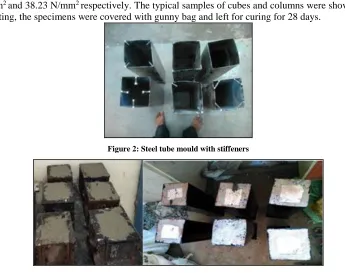
Standard cubes of size 150×150×150 mm were also casted to test the strength of the self-compacting concrete at 3 days, 7 days and 28 days of curing period. The typical samples of cubes were shown in Figure 3. The characteristic compressive strength of concrete obtained at 3 days, 7 days and 28 days were 23.85 N/mm2,
27.26 N/mm2 and 38.23 N/mm2 respectively. The typical samples of cubes and columns were shown in Figure
2. After casting, the specimens were covered with gunny bag and left for curing for 28 days.
Figure 2: Steel tube mould with stiffeners
Figure 3: Typical sample of cubes and columns
Testing of Specimens
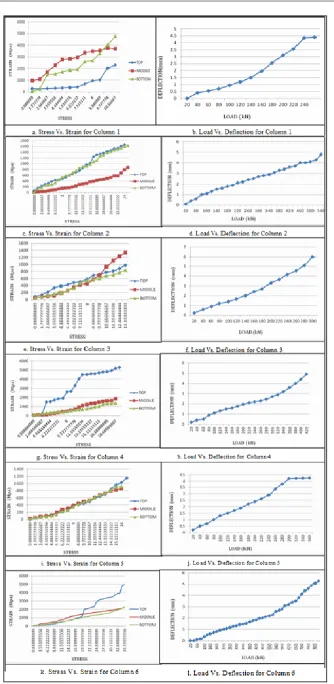
The Specimens were tested in Compression Testing Machine. Strain gauge strip was placed at top, bottom and middle of the specimens. All Strain gauge strips are directly connected to data logger, to which the strain indicator was connected. Dial gauge was fixed to the bottom of the specimen. Axial load was constantly applied through the hydraulic jack. The column was subjected to a constant deflection till the ultimate load was reached. For every 20 kN increase in load, deflection and strain values were noted using dial gauge and strain gauge strip respectively.
RESULTS AND DISCUSSION
[image:3.596.120.465.195.468.2]204
205
CONCLUSION
In this study, the axial load behavior of six columns with different stiffeners was studied experimentally. Based on the results, it was observed that the ultimate load carrying capacity of composite column with various stiffeners shows increased load carrying capacity by 2.25, 1.25, 1.75, 1.5 and 3.33 times more than the composite columns without stiffeners. Also the maximum deflections of the columns 1, 2, 3, 4, 5 and 6 are 4.4 mm, 5.2 mm, 6 mm, 4.9 mm, 4.25 mm and 5.3 mm respectively. It is also observed that the CFST column with External L-angle stiffener at 4 corners shows improved performance than the other stiffeners.
REFERENCES
[1] C Petrus; HA Hamid; A Ibrahim; G Parke. J Constr Steel Res. 2010, 66(7), 915-922. [2] HL Hsu; FJ Jan; JL Juang. J Constr Steel Res. 2009, 65(4), 869-878.
[3] IS 383, Indian Standard for specification for coarse and fine aggregates from natural sources for concrete (second revision), reaffirmed Feb-97, 1970.
[4] IS 12269, Indian Standard for 53 grade OPC, Reaffirmed January 1999, Bureau of Indian Standards, New Delhi, India, 1987.
[5] RP Johnson. Composite structures of steel and concrete: beams, slabs, columns, and frames for buildings. John Wiley & Sons, 2008.
[6] SA Wagh; UP Waghe. IJERA. 2014, 4(4), 369-376.