Journal of Chemical and Pharmaceutical Research, 2016, 8(12):180-184
Research Article
CODEN(USA) : JCPRC5
ISSN : 0975-7384
180
A Comparative Analysis of Slab with Different Shape of Cutout for Various
End Conditions Using ANSYS
S Durgadevagi and NA Jabez
*Department of Civil Engineering, SRM University, Kattankulathur-603203, Tamil Nadu, India _______________________________________________________________________________________
ABSTRACT
In Slab, cut-outs are provided to decrease the self-weight, to provide services and even aesthetics. When these structures are loaded, the presence of cut-outs will cause changes in the member mechanical properties, consequently there will be change in the bending characteristics of the slab as well as on the ultimate load capacity of the structure. ANSYS is finite element software which is used to analyse the reinforced concrete (RC) slab models. Present study is aimed to know the variation of displacement, strain and stresses, in slab with different boundary conditions. The different slab size has been designed for uniform factor load of 12 kN/m2.This factored load has been applied on the slab to calculate the maximum and minimum displacement, strain and stresses at each slab has been noted down. The results shows that displacement is highest in slab having simple support on all sides and stresses are least in same slab along the edges. Also slab with fixed support on all sides shows least displacement and highest stresses along the edges of the slab.
Keywords: Cutout slabs; Boundary conditions; ANSYS
____________________________________________________________________________________________
INTRODUCTION
In General Openings are unavoidable and absolutely reduce the ultimate strength of structures. Understanding the behavior of reinforced concrete (RC) components in structures subjected to different loading conditions is very important in order to obtain comprehensive knowledge to design a safe and functional structure. Experimental testing is one of the most reliable methods to understand the behavior of structure. Considering economy & time, Finite Element Analysis (FEA) method has become popular in recent years. In this study, two way reinforced concrete slabs with openings are modeled using Analysis System ANSYS software to understand the behavior of slab with different boundary conditions. The aim of this study is to determine the effect of stresses and deflection due to openings.
The objective of the work is to study the comparative analysis of slab with different shape of cutout for various end conditions. The study helps to identify the essential and effective slab of different cutout with various end condition for possibilities of architectural planner to select the comfort of construction.
LITERATURE REVIEW
181
having supported on four edges have little effects on slab. Majid Mohammed Ali Kadhim (2013) Studied the strengthening of full Scale RC one way slab with Cut outs. The study is based on behaviour of full scale one-way reinforced concrete slab with cut out and ways of strengthening by using overlay concrete and Carbon Fiber Reinforced Polymer (CFRP) sheet.The nonlinear finite element analysis use to model different CFRP strengthening arrangement of one way slab by using ANSYS. Sheetal Gawas and S.V. Itti (2014) Studied. Two way RC slab using ANSYS with and without central opening. The study is based on the fact that stress and displacement variation depends on boundary conditions of slab. The study shows that displacement is highest in slab having simple support on all sides and stresses are least in same slab along the edges.
From the above literature, it is clear that the behavior, strengthening, stress, strain and deformation variation on different type of slab with various cut-out has been analyzed. The above studies have not represented anything about the effectiveness and essentiality based on the type of slab with different type of opening. Hence in this study the trail has been made to identify the effectiveness and essentiality of type of slab and the opening in it. This study also shows the minimum and maximum values for stress, strain and deformation for different type of slab with various shape of cut-outs. ANSYS workbench image made it easy to identify the behaviour of different types of slab with cut-out.
MATERIALS AND METHODOLOGY
The rectangular RC slabs with tensile reinforcement have been analyzed using a finite element model in ANSYS. Here, a non-linear analysis is considered throughout the study by assuming that there is a perfect bonding between concrete and steel reinforcement. The Cross sectional dimension considered for the slab is 2 m X 3 m & 3 m X 3 m. The compressive uniaxial stress-strain relationship for the concrete model was obtained using the following equations.
{ | }
=
=
Where, f = Stress at any Strain, = Strain at Stress f, = Strain at ultimate compressive strength, = Concrete Modulus of Elasticity, = Uniaxial Crushing stress.
The methodology adopted in this study includes four different boundary conditions as follows. Case (i) Slab with fixed support on all four edges, Case (ii) Slab with two adjacent edge discontinuous, Case (iii) Slab with two opposite edge discontinuous, Case (iv) Slab with simply supported on all four edges. The different slab size with openings shown in figure 1 has been designed for uniform factor load of 12 kN/m2.
182
This factored load has been applied on the slab to calculate the maximum and minimum values for Stress, Strain and displacement at different type of slab with different boundary condition has been noted down. All slabs were 120 mm thickness. Concrete cover 20 mm is used and reinforcement adopted is 8 mm diameter bar at 250 mm c/c on both sides.
RESULTS AND DISCUSSION
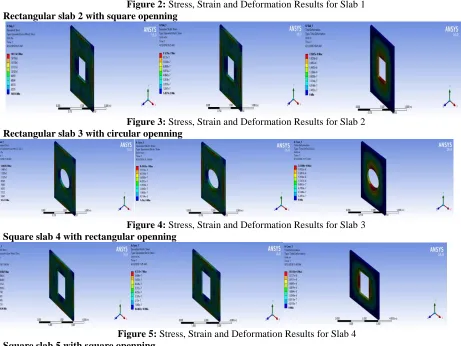
The results for slabs with four different types of boundary conditions are being analysed and studied. The different slab size has been designed for uniform factor load of 12kN/m2.This factored load has been applied on the slab to calculate the maximum and minimum values for stress, strain and displacement for all the slab types are shown in Figure 2-7.
Rectangular slab 1 with rectangular openning
Figure 2: Stress, Strain and Deformation Results for Slab 1
Rectangular slab 2 with square openning
Figure 3: Stress, Strain and Deformation Results for Slab 2
Rectangular slab 3 with circular openning
Figure 4: Stress, Strain and Deformation Results for Slab 3
[image:3.612.83.531.210.304.2]Square slab 4 with rectangular openning
Figure 5: Stress, Strain and Deformation Results for Slab 4
Square slab 5 with square openning
[image:3.612.69.530.317.663.2]183
Figure 6: Stress, Strain and Deformation Results for Slab 5
Square slab 6 with circular openning
Figure7: Stress, Strain and Deformation Results for Slab 6
Comparative analysis for stresses
[image:4.612.72.519.190.281.2]Result of comparison of variation in stresses N/m2 in different types of slab with opening for various boundary conditions refer table 1.
Table 1: Comparative Statement of Minimum and Maximum Values for Stress
DESCRIPTION CASE 1 CASE 2 CASE 3 CASE 4
MIN MAX MIN MAX MIN MAX MIN MAX
SLAB 1 160.94 1.82E+05 163.97 1.42E+06 877.18 2.79E+05 1069.6 2.25E+07
SLAB 2 160.94 1.82E+05 163.97 1.42E+06 877.18 2.79E+05 1069.6 2.25E+07
SLAB 3 165.37 1.68E+05 169.79 1.37E+06 996.05 2.86E+05 1565.2 2.30E+07
SLAB 4 160.96 1.91E+05 111.63 1.63E+06 419.34 4.03E+05 789.56 2.07E+07
SLAB 5 151.36 2.03E+05 115.98 1.44E+05 536.27 3.93E+05 715.5 1.96E+07
SLAB 6 147.59 2.06E+05 119.33 1.39E+06 661.54 3.90E+05 713.3 1.91E+07
Comparative analysis for strain
Result of comparison of variation in Strain in different types of slab with opening for various boundary conditions refer table 2.
Table 2: Comparative statement of minimum and maximum values for strain
DESCRIPTION CASE 1 CASE 2 CASE 3 CASE 4
MIN MAX MIN MAX MIN MAX MIN MAX
SLAB 1 1.41E-09 9.13E-07 1.18E-09 8.00E-06 8.05E-09 1.39E-06 2.14E+07 0.0001125
SLAB 2 1.41E-09 9.13E-07 1.18E-09 8.00E-06 8.05E-09 1.39E-06 2.14E+07 0.0001125
SLAB 3 1.45E-09 8.45E-07 1.19E-09 6.90E-06 2.20E-08 1.43E-06 2.50E-07 0.0001151
SLAB 4 8.05E-10 9.56E-07 7.86E-10 8.79E-06 4.07E-09 2.02E-06 4.02E-09 0.0001034
SLAB 5 7.57E-10 1.07E-06 9.55E-10 7.22E-06 4.15E-09 1.97E-06 3.69E-09 9.82E-05
[image:4.612.96.515.567.683.2]184
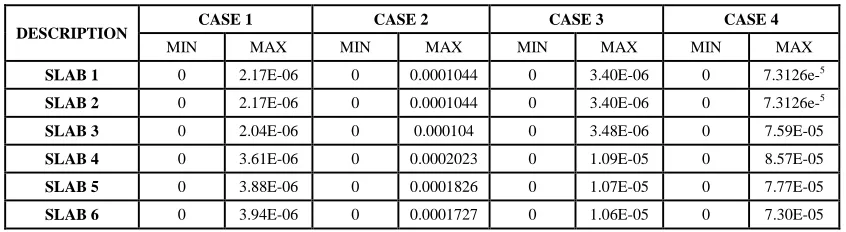
Comparative analysis for deformation [image:5.612.95.518.136.252.2]Result of comparison of variation in Deformation mm in different types of slab with opening for various boundary conditions refer table 5.3
Table 3: Comparative statement of minimum and maximum values for deformation
DESCRIPTION CASE 1 CASE 2 CASE 3 CASE 4
MIN MAX MIN MAX MIN MAX MIN MAX
SLAB 1 0 2.17E-06 0 0.0001044 0 3.40E-06 0 7.3126e-5
SLAB 2 0 2.17E-06 0 0.0001044 0 3.40E-06 0 7.3126e-5
SLAB 3 0 2.04E-06 0 0.000104 0 3.48E-06 0 7.59E-05
SLAB 4 0 3.61E-06 0 0.0002023 0 1.09E-05 0 8.57E-05
SLAB 5 0 3.88E-06 0 0.0001826 0 1.07E-05 0 7.77E-05
SLAB 6 0 3.94E-06 0 0.0001727 0 1.06E-05 0 7.30E-05
SUMMARY AND CONCLUSIONS
ANSYS which is capable for modelling the behaviour of the reinforced concrete two-way slabs with opening for various end condition. The analysis yields good results as demonstrated by the analysis of slabs. It is evident from ANSYS workbench images. The effect of stress, strain and displacement of slab with cutout was found out at different end conditions . Comparing the slabs with different boundary conditions with opening, the slab simply supported on all the edges shows highest displacement and slab fixed at all the edges shows least displacement. A slab with other boundary conditions shows negligible variation in displacement. The slab having fixed support on all the edges with opening shows highest stresses, whereas slab simply supported on all edges shows least. Slab with other boundary conditions shows very less variation as compared to slab with other support. Based on the stress results, The square slab with rectangular Opening is found to be efficient by providing two adjacent edges discontinuous (end Condition). Based on the strain results, The square slab with Circular Opening is found to be efficient by providing fixed support on all four edges (end Condition).
REFERENCES
[1] Antonio F. Barbosa; Gabriel O. Ribeiro.“Analysis of Reinforced Concrete Structures Using Ansys Nonlinear Concrete Model”, Computational Mechanics New Trends And Applications, Spain 1998, pp, 1-9.
[2] Bureau of Indian standard code book “code of practice for design of loads for building and structures” second revision IS 875 – I, IS 875 – II, via dead and live load calculation.
[3] Bureau of Indian standard code book “Plain and Reinforced concrete code practice”, fourth revision IS 456, 2000pp, 39-49
[4] Gupta A; Sen S. “Design of Flexural Reinforcement in Concrete Slabs”, april 1977.
[5] Hosam A Daham.“Analytical Study of Reinforced Concrete Two way Slabs With And Without Opening Having Different Boundary Conditions”,Al-Rafidain Engineering, 2011, 19(4),11-27.
[6] Kitjapat Phuvoravan; Elisa D Sotelin. J Struct Eng, ASCE, 2005, 131(4), 643-649.
[7] Krishna raju N. “Design of reinforced concrete structures” third edition refer table 7.2 bending moment co- efficient for slabs , 104
[8] Majid Mohammed Ali Kadhim. Journal of Babylon University/ Engineering Science, 2013, 21(2), 570-581. [9] Priya Bansal, “Finite Element Modeling of Reinforced Concrete Slab”,M.E. Thesis, Thapar University, Patiala, July 2013.
[10] Shatha S. Kareem, Shaimaat. Sakinand And Mohammad Z. Yousif, “Non-Linear FE Modeling Of Two-Way Reinforced Concrete Slab Of NSC, HSC.