How to transfer innovative research
knowledge into teaching programmes?
Amaratunga, RDG and Senaratne, S
Title How to transfer innovative research knowledge into teaching programmes?
Authors Amaratunga, RDG and Senaratne, S
Type Conference or Workshop Item
URL This version is available at: http://usir.salford.ac.uk/9933/
Published Date 2005
USIR is a digital collection of the research output of the University of Salford. Where copyright permits, full text material held in the repository is made freely available online and can be read, downloaded and copied for noncommercial private study or research purposes. Please check the manuscript for any further copyright restrictions.
EXPLORATORY CASE STUDY IN THE BUILT
ENVIRONMENT
Dilanthi Amaratunga, Sepani Senaratne, David Baldry, Mike Kagioglou and Ghassan Aouad
Research Institute for the Built and Human Environment, The University of Salford, UK
The higher education system in the UK has significantly changed over the last decade due to a growing emphasis on student learning activities, quality assurance procedures and research funding mechanisms. According to previous studies, there is no automatic link between research and teaching. Thus, the link needs to be created to enhance staff productivity and student learning.
This paper reports findings of the first phase of a research study that aimed at developing guidelines on how to transfer research knowledge into teaching in higher education, in order to create such a productive relationship. The framework that is presented in this paper is developed for the built environment sector through a literature survey and an exploratory study. T he framework provides useful guidance for research-based higher education departments in the built environment to transfer research knowledge into teaching.
The next phase of this research will explore the implementation of this model across different disciplines through a series of case studies.
Keywords: research and teaching, built environment, knowledge transfer, learning process.
INTRODUCTION
This paper presents the findings of a research study that aimed at exploring the transfer of research knowledge into teaching in the built environment (BE) sector in UK higher education institutions. The study was conducted by the School of Construction & Property Management (SCPM) at the University of Salford. The literature findings of the study are discussed in the first section. This literature review is followed by a discussion of the empirical findings that emerged from the exploratory study. Following the complete
literature synthesis and the empirical study, the paper presents a framework on ‘research
knowledge transfer into teaching’. Finally the conclusions and future research are presented.
KEY ISSUES FROM THE LITERATURE
Background study
within higher education institutions with regard to their mission (scholarly research versus excellent teaching) and also resourcing problems (research and teaching requires different resources). Third, tensions arise among academics due to the funding mechanisms and the inequity of rewards for research and for teaching (McLernon & Hughes, 2003). Due to research being more rewarding compared to teaching (Rowland, 1996), academics aim for research excellence while sacrificing their teaching duties (Baker et al, 1998). This issue is not just unique to UK, but is an issue of international relevance. For instance, the Boyer Commission report (1998) addresses this issue by calling for significant changes in undergraduate education in the United States.
In addition to these general factors, BE higher education is also affected due to specific trends. For example, the move towards collaborative approaches (Wood, 1999) has created a positive environment to introduce active learning and thereby feeds research into teaching. This positive learning environment is further enhanced by other learning initiatives in the BE sector. For example the Centre for Education in the Built Environment (CEBE) has initiated activities such as the Teaching Enhancement Networks (TENS) and Special Interest Groups (SIGS) to enhance teaching and learning in the BE (Ashworth, 2003). Further reflections are the initiation of CIB W89 International Conference on Building Education and Research and the formation of the FDTL (Fund for the Development of Teaching and Learning) funded live project: ‘Best Practice Building Network’ (Online 1).
With this background knowledge of the UK higher education system and the BE sector, the next section discusses the relationship between research and teaching in higher education.
THE RELATIONSHIP BETWEEN RESEARCH AND TEACHING
The complex relationship between research and teaching (R&T) has been extensively studied. The findings of these studies reveal two opposing viewpoints: the ‘trade-off between R&T’ against the ‘synergetic relationship between R&T’ (Baker et al, 1998). Generally, the quantitative studies show the lack of relationship between R&T (for example, see Hattie & Marsh, 1996) while qualitative studies strongly depict the existence of a symbolic relationship (for example, see Robertson & Bonds, 2001). However, both quantitative and qualitative research establishes the absence of an automatic link between R&T and the loosely coupled nature of these two activities (Jenkins & Zetter, 2003). By strengthening these loosely coupled activities, a productive relationship between staff research and teaching can be achieved. Recent studies have introduced several strategies to create this beneficial relationship as opposed to the problematic one that naturally exists (for example, see Linking Research & Teaching, Online 2 and LINK: Good Practice resources Database, Online 3; Fawcett et al, 2003; Cech, 2003).
practice, for managing staff research with teaching commitments, both ‘T to R’ and ‘R to T’ strategies appear to be useful to appropriate degrees based on type of department.
Comparing these strategies based on this two-way nature of the R&T link, the generation of research from teaching activities is straightforward despite the doubts about the quality of such research. Activities associated with the transfer of research into teaching are comparatively difficult and form part of a long-term process. Further, it is the ‘R to T’ transfer that enhances student learning processes rather than the T to R transfer. Taking these facts into account, the research study, on which this paper is based, focuses on how to implement ‘R to T transfer for research-based departments’ as opposed to ‘T to R transfer for teaching-based departments’.
Among the previous research on R&T link in the BE sector, the work of ‘Link: Good Practice Resource Database’ (Online 3) offers significant contributions. This provides a generic model with guidelines on how to set-up the environment in linking R&T and a list of strategies that can be considered. Although this stands as a seminal work, the work is limited in identifying appropriate strategies for research-based departments, in implementing and also maintaining such a link. The work also lacks the due appreciation of the extant knowledge transfer literature that helps to understand the total process of research knowledge transfer into teaching. Hence, this study is different from this earlier work in that it aims to provide a guide in the light of knowledge transfer literature which can be followed by research-based departments in the BE to improve student-learning processes. The next section will attempt to bring in the knowledge transfer literature into this discussion along with student learning processes.
RESEARCH INTO TEACHING: KNOWLEDGE TRANSFER AND
LEARNING PERSPECTIVE
Feeding research knowledge into teaching can be viewed as a knowledge transfer process. According to Davenport & Prusak (1998), effective knowledge transfer does not involve mere transmission, but also absorption and use following the transmission. As such, simply initiating the R&T link in a department and feeding research knowledge into teaching is insufficient. This transfer needs to be viewed from the recipient’s end, in that it is equally important to explore to what extent this knowledge is absorbed and used by the student.
originate from the organisation level (research-based department in this case) such as resources, strategies and practices should also need to be considered.
Following the above discussion, the importance of focusing on the user perspective is affirmed. In fact, Huberman (2002) claims that research data penetrates only very slowly into the consciousness of the potential user, helped along by discussions and observations and that the dissemination depends on usefulness to the user and the absorptive capacity of the users. Accordingly, when students are considered as the users of research knowledge, student learning, followed by such a diffusion of research into teaching, is an essential consideration. In fact, learning is the key driving force that link research and teaching (Bradley, 1999; Turrell, 2003).
As such, in transferring research knowledge into teaching, different student learning styles need to be addressed. The literature on learning styles can be grouped into various theories. These theories on learning suggest that everyone cannot be taught in the same way and the teaching approach needs to consider these differences.
• The field dependency theory-learning can be influenced by the context within which
the students learn; for example, student learning can differ depending on whether they learn within a field environment or a classroom environment (Smith, 2002);
• Holistic vs. sequential learning theory - the fact that some students prefer visual
approaches whereas some prefer verbal approaches (Smith, 2002);
• Experiential learning theory originated by Kolb (1984, cited in Smith, 2002) - an
individual’s learning cycle has four stages: activist, reflector, theorist and pragmatist. This role of experience in learning calls for activities such as project-based work that provide students with first hand experience; and
• Surface vs. deep learning theory – Vita (2001) argues that it is the deep-learning
styles that should be encouraged in higher education institutions.
In summing up, the educational research has established that R&T link is not automatic and needs to be created in each academic department based on their specific discipline. The applicability of different strategies is further dependent on the type of department, whether it is research-based or teaching-based. The knowledge transfer and learning literature values the importance of absorption and use following an immediate transmission process. To this end, the user perspectives and the maintenance of R&T link are of high priority. In effect, the key research question formulated for this study is ‘how would a research-based department transfer its research knowledge into its teaching activities in the BE sector? An exploratory case study was carried out in finding solutions to this particular research question. The next section will describe this empirical study.
THE EMPIRICAL STUDY
Validating literature findings: Case Study Method
such as school review reports were referred to. The questions addressed at the workshop and interviews were mainly on five aspects: the importance of the R&T link; key issues/concepts; present examples of the existence of R&T link; present barriers and enablers in creating such a link; and finally suggestions to improve the R&T link.
DISCUSSION ON FINDINGS
The importance of the ‘R to T’ transfer
The academic staff and students were positive towards creating an explicit R&T link within SCPM. The benefits that they identified were gaining academic rigour, creating market differentiation, raising standards, keeping ahead of change and complying with the mission statement. Research staff and postgraduates also made positive remarks in that they said the opportunity to present their work to a different audience might trigger new insights into their research. An interesting view was the opportunity for financial gains by way of implementing academic enterprises and short programmes for undergraduates using research staff and postgraduates as teachers. Students on the other hand, were happy as they felt they were the immediate party who benefited from such a link.
Key issues and concepts on ‘R to T’ transfer
Regarding new insights on the R&T link, the staff raised the issue as to ‘what research knowledge is more important to be transferred to students.’ Some members said that it is the research learning process that is more important compared to research project findings. However, the majority view was that both types of knowledge are equally important to be fed into teaching. Another recurring issue was how to address different learning styles. In achieving compatibility between curriculum and research activities, staff suggested using process mapping techniques to map the existing links within the school. In an industry which is still favouring old practices, the staff view was that students should be exposed to research outputs that are suitable for the industry of today. A final point was the clear distinction between student groups. It was evident that the link is clearly different between postgraduate and undergraduate levels. At postgraduate level, the R&T link was already in place at a satisfactory level. Even within the undergraduate level, the part-time students viewed the R&T link differently to full-time students. For part-time students, who are closer to the industry, such a link should relate to their work prospects, whereas for full-time students the value is not immediate.
Best practices of ‘R to T’ transfer
In exploring the current status of this R&T link, interviews revealed that a mixed approach is already informally in place and the question was whether it was in right balance. Staff strongly favoured creating the missing strategies or workable processes to deal with this at a formal level. The best practice examples were project-based work such as the Group Integrated Project and special modules such as ‘Construction Innovation’, the Dissertation module at undergraduate levels, and other research modules at postgraduate levels. In fact, certain research within SCPM has generated new Masters level programmes showing the effective R&T link at postgraduate level. Other informal best practice examples within SCPM as identified in the School Review (2003) are certain workshops that present research outputs to undergraduates, active engagement of all members of professorial staff in teaching activities and new academic staff recruitments such as the Graduate Training Programme.
Enablers and barriers on ‘R to T’ transfer
slowly changing industry were raised. From the staff-side barriers, personal goals and resources were highlighted. From student-side barriers, their lack of motivation, attitudes towards gaining wider knowledge and self-learning and tendency to do superficial research were noted. With regard to implementation barriers staff pointed out the fear and risk factor such as students’ ability to absorb research knowledge, wrongly designed programmes and key staff leaving amidst implementations. On the other hand enablers found were the mission statement of SCPM; research strength within SCPM; positive attitude of all staff members; and the external links with CEBE, LTSN and other universities. Another enabler for improving student learning in general was setting the infrastructure for a personal development planning programme (PDP) through a pilot project.
Suggestions to improve ‘R to T’ transfer
In terms of suggestions, first consideration was how to overcome the existing barriers. In order to overcome the conceptual barriers, suggestions raised included engaging staff more in teaching and learning activities; structuring the programme to highlight research; and improving interaction with industry. To avoid staff concerns, suggestions such as generating business through new programmes were made. With respect to students’ side barriers, creating a cultural change was suggested by way of encouraging project-based work; improving students’ research skills from inception; engaging students in various research activities; and informing students of the value of research. An interesting idea that came from the interviews was creating a live interaction between undergraduates and postgraduates, so that both parties will benefit. With regard to implementation issues, departmental support in terms of resources (both physical and human), changing policies, valuing teaching to align both teaching and research activities and changing recruitment policies were proposed.
Through the findings of the literature review and this exploratory case study, a generic model with guidelines was developed to assist research-based departments to transfer their research knowledge into teaching activities. The next section will briefly explain this model and its development.
GENERIC MODEL TO TRANSFER RESEARCH INTO TEACHING
Model Development
As explained in the literature review, previous studies have introduced various strategies to create the R&T link. However, they do not explain how to formalise these strategies. This led to recommend assigning a new staff position called ‘R&T co-ordinator’ with ‘R&T team’. By allocating human resources in this way, not only can the link be initiated but it can also be maintained, while creating a learning environment. Therefore, the start-up activity of the model will be assignment of ownership and resources.
The specific ‘R to T’ transfer strategies are then considered. With the recurrent issues on ‘student motivation’ and ‘use and absorption’ that emerged from the literature on learning and from the primary survey, a cultural change is introduced within departments through an “Innovation Week” at each year of study. Both literature and primary survey results on ‘R to T’ transfer strategies are integrated through this Innovation Week. The understanding received from the knowledge transfer and learning literature further led to suggest all possible learning loops in enhancing the student learning process through this Innovation Week at each year. The primary survey highlighted the importance of enabling different group interactions and industry-student interaction. Hence, this Innovation Week will not just provide a research environment among students by promoting research awareness and improving their research knowledge, but will also provide an enabling context for ‘PhD-undergraduates interaction’ and ‘industry-student interaction’. Both literature and primary survey revealed the importance of project-based learning. Thus, an integrated project task is introduced as another ‘R to T’ transfer strategy. Further, to provide not only new findings within the discipline, but also to give students first hand research knowledge, a separate module called ‘Research Module’ and short courses on specific subjects are proposed. The best practice examples from the selected case study shaped these proposals.
Both literature and primary data raised the importance of valuing teaching activities in research-based departments. Consequently, as an outcome activity of this ‘R to T’ transfer process, recognising and rewarding best ‘R to T’ practices are finally proposed.
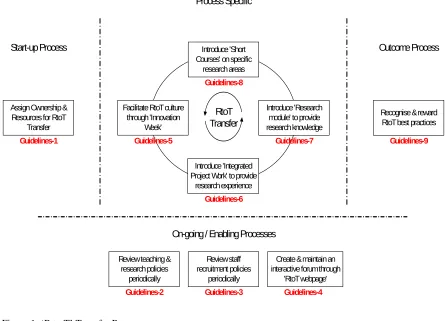
A MODEL FOR “R TO T” TRANSFER PROCESS
Assign Ownership & Resources for RtoT
Transfer
Introduce 'Integrated Project Work' to provide
research experience Introduce 'Short Courses' on specific
research areas
Introduce 'Research module' to provide research knowledge Facilitate RtoT culture
through 'Innovation Week'
Recognise & reward RtoT best practices
Review teaching & research policies
periodically
Review staff recruitment policies
periodically
Create & maintain an interactive forum through
'RtoT webpage'
RtoT Transfer
On-going / Enabling Processes
Start-up Process Outcome Process
Process Specific
Guidelines-1 Guidelines-5
Guidelines-2 Guidelines-3 Guidelines-4 Guidelines-7
Guidelines-6 Guidelines-8
[image:9.595.69.514.78.399.2]Guidelines-9
Figure 1: ‘R to T’ Transfer Process
Brief descriptions on associated guidelines are listed below:
Guideline 1: Assign ownership and resources:
As explained in the literature review, previous studies have introduced various strategies to create the R&T link. However, they do not explain how to formalise these strategies. This led to recommend assigning a new staff position called ‘R&T co-ordinator’ with ‘R&T team’. By allocating human resources in this way, not only can the link be initiated but it can also be maintained, while creating a learning environment. Therefore, the start-up activity of the model will be assignment of ownership and resources.
Guidelines 2-4: Review teaching and research policies; Review staff recruitment policies; Create and maintain an interactive forum through web
Guidelines 5-8: Facilitate ‘R to T’ culture through a week of research-based activities; Introduce collaborative project-based work; Introduce a research-focused module; Introduce short courses on specific research areas
The specific ‘R to T’ transfer strategies are then considered. With the recurrent issues on ‘student motivation’ and ‘use and absorption’ that emerged from the literature on learning and from the primary survey, a cultural change is introduced within departments through an “Innovation Week” at each year of study. Both literature and primary survey results on ‘R to T’ transfer strategies are integrated through this Innovation Week. The understanding received from the knowledge transfer and learning literature further led to suggest all possible learning loops in enhancing the student learning process through this Innovation Week at each year. The primary survey highlighted the importance of enabling different group interactions and industry-student interaction. Hence, this Innovation Week will not just provide a research environment among students by promoting research awareness and improving their research knowledge, but will also provide an enabling context for ‘PhD-undergraduates interaction’ and ‘industry-student interaction’. Both literature and primary survey revealed the importance of project-based learning. Thus, an integrated project task is introduced as another ‘R to T’ transfer strategy. Further, to provide not only new findings within the discipline, but also to give students first hand research knowledge, a separate module called ‘Research Module’ and short courses on specific subjects are proposed. The best practice examples from the selected case study shaped these proposals.
Guidelines 9: Recognise and reward ‘R to T’ best practices
Both literature and primary data raised the importance of valuing teaching activities in research-based departments. Consequently, as an outcome activity of this ‘R to T’ transfer process, recognising and rewarding best ‘R to T’ practices are finally proposed.
CONCLUSIONS AND FUTURE RESEARCH
Through the literature survey and the case study, this paper presents a model of the transfer of research knowledge into teaching. This model is supplemented by a detailed guidelines document, which is produced as a key deliverable of this study. Furthermore, with the new insights from the literature on knowledge transfer and learning processes, in addition to the initiation of research to teaching transfer, the absorption and use, including learning loops are captured substantially into this model and guidelines. Next stage of this research aims to test the implementation of the guidelines and to extend the study beyond the Built Environment sector to other related disciplines. Thus, in the phase-02 of this research study the above-developed guidelines will be validated by using a series of case studies across other disciplines. The final outcome of the research will be the development and validation of a more generic set of guidelines relating to the transfer of research knowledge into teaching.
ACKNOWLEDGEMENT
An early version of this paper was presented at an internal conference: 2nd Education in
REFERENCES
Ashworth, A. (2003) Disseminating best practices in built environment education, Proceedings of the
CIB W89 Building Education and Research conference, April 2003, Salford.
Baker III, H. E. Bates, H. Garbacik-Kopman, V. and McEldowney, J. (1998) A preliminary investigation into the correlation between teaching and research in the Florida State University
system, Management Research News, Vol 21 (9), pp 1- 9
Boyer Commission on Educating Undergraduates in the Research University (1998) Reinventing
Undergraduate Education: A Blueprint for America's Research Universities, Carnegie Foundation for the Advancement of Teaching, CA.
Cech, T. R. (2003) Rebalancing Teaching and Research, Editorial in SCIENCE, Vol 299 (10), pp 165
Cohen, W. M. and Levinthal, D. A. (1990) Absorptive capacity: a new perspective on learning and
innovation, Administrative Science Quarterly, Vol 35 (1), pp 128-153
Davenport, T. H. and Prusak, L. (1998) Working knowledge: how organizations manage what they
know, Harvard Business School Press, Boston.
Fawcett, J. Aber, C. and Weiss, M. (2003) Teaching, Practice and Research: An integrative approach
benefiting students and faculty, Journal of Professional Nursing, Vol 19 (1), pp 17-21
Felder, R. M. and Silverman, L. (1988) Learning and teaching styles in engineering education, Engineering Education, Vol 78, pp 674-681
Hattie, J. and Marsh, H. W. (1996) The Relationship between Research and Teaching: A
Meta-Analysis, Review of Educational Research, Vol. 66 (4), pp507-542
Huberman, A. M. (2002) Moving Towards the Inevitable: the sharing of research in education,
Teachers and Teaching, Vol 8 (3/4), pp 257-268
Jenkins, A. and Zetter, R. (2003) Linking Research and Teaching in Departments, LTSN Generic
Centre, Learning and Teaching Support Network, Oxford Brookes University, UK.
McLernon, T. and Hughes, D. (2003) Research versus Teaching in the Built Environment discipline, The Proceedings of the CIB W89 Building Education and Research conference, April 2003, Salford.
Online 1, Best Practice Building Network, www.be.coventry.ac.uk/BPBNetwork
Online 2, Linking Research & Teaching, www.ltsn.ac.uk/genericcentre >projects>Research &
Scholarship>Linking Research & Teaching
Online 3, LINK: Good Practice Resource Database,
http://www.brookes.ac.uk/schools/planning/LTRC/team.html
Rowland, S. (1996) Relationships between teaching and research, Teaching in Higher Education, Vol
1(1), pp 7-20
School Review (2003) Self Evaluation Document - May 2003, The School of Construction & Property
Management, The University of Salford, UK.
Senaratne, S. Amaratunga, D. Baldry, D. Kagioglou, M. Aouad, G. and Bowden, A. (2003) Research
knowledge transfer into teaching in the built environment, The proceedings of the inaugural
learning and teaching research conference, 17th & 18th September 2003, The University of Salford, UK
Smith, J. (2002) Learning styles: Fashion fad or lever for change? The application of learning style
theory to inclusive curriculum delivery, Innovations in Education and Teaching International,
Vol 39 (10, pp 63-70
Turrell, P. (2003) Teaching and Research – strengthening the relationship, The Proceedings of the CIB W89 Building Education and Research conference, April 2003, Salford.
Vita, G. D. (2001) Learning styles, culture and inclusive instruction in the multicultural classroom: a
business and management perspective, Innovations in Education and Teaching International,
Vol 38 (2), pp 165-174
Wood, G. (1999) Interdisciplinary working in built environment education, Education + Training,