Journal of Chemical and Pharmaceutical Research, 2014, 6(6):1932-1939
Research Article
ISSN : 0975-7384
CODEN(USA) : JCPRC5
Study on the deformation process of titanium alloy bars based on
compact hot continuous rolling
Yang Qin
1and Qin Jianping
21
School of Mechanical Engineering & Automation, Liaoning University of Science and Technology, China
2School of Mechanical Engineering & Automation, Taiyuan University of Science and Technology, China
_____________________________________________________________________________________________ABSTRACT
Based on the experimental study platform of compact eight-stand Y-shaped three –roll hot continuous rolling mills, the paper analyzes the continuous rolling deformation process of TC4 titanium alloy bars with the thermo-mechanical coupling of finite element aimed to observe the deformation features in specific pass sequence and conduct how the rolling technology schedule is worked out so as to achieve a stable continuous rolling process with compact production lines.
Key words:
Titanium alloy bars, hot continuous rolling, thermo-mechanical coupling and finite element
(FM)
_____________________________________________________________________________________________
INTRODUCTION
[image:1.595.160.456.633.752.2]The titanium alloy is widely used in the fields like aeronautics and astronautics, marine ships, biological health care, metallurgical construction, civil supplies, .etc. [1] with little weight, high intensity, high heat and corrosion resistance, biological compatibility, good thermal stability, no magnetic field and toxicity and other superior features. With the expansion of its application field and the increase on its demand, people’s requirement on the products made of titanium alloy is gradually improved; therefore, the production technology and equipping level of titanium alloy materials are improved. Titanium alloy bars are traditionally rolled by reciprocating rolling mills. In order to improve their mechanical property and processing technology, it is necessary to produce titanium alloy bars in small scale with hot continuous rolling technology. The paper, aimed at the production features of a certain titanium alloy bar production line, studies the rolling process with theoretical analysis and FM thermo-mechanical coupling to make clear of the deformation features of titanium alloy materials in new rolling ways and optimize the rolling technology schedule on the basis of the study [1].
CONTINUOUS ROLLING FEATURES OF TITANIUM ALLOY BARS
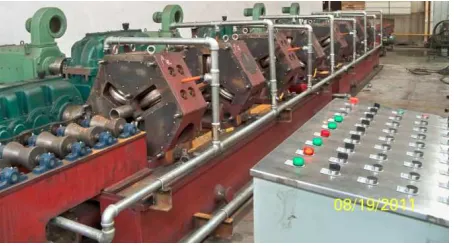
The compact bar hot continuous rolling production line (Fig.1) is made up of eight-stand 350 Y-shaped three-roll mills which are specially used in the rolling process of hard-deformed metal bars like titanium alloy. As rolling materials have the features of a narrow range of deformation temperature and high deformation resistance, both the set rolling force and the stand stiffness index of the rolling mills are higher than those of common rolling mills with the same specification.
The main technical parameters are as follows: The diameter of the rollers: 350mm
The rolling pressure: 250kN
The distance between the stands: 700mm The rolling speed: 2.5m/s
TC4 type titanium alloy with the blank of 25mm diameter is chosen. Finished products are rolled with a diameter of 15mm after 8 passes. The pass sequence is flat triangle-circle-flat triangle [3].
The technical features of the production line include:
(1) The production line is equipped with compact facilities, with a short-period technical process and small land-covering space.
(2)The temperature drop of the rolling process is slight and low-temperature rolling and good structure property can be achieved.
(3)Rolling pieces are in three-dimensional stress and products are in good quality.
(4)Flexible technology is applied to the production line and products of different specifications are easy to produce. (5)The passes are of high sharing and of low production cost.
[image:2.595.194.421.437.560.2]In the compact rolling production line, it is difficult to achieve a non-tension and non-loop rolling. Any change of the stacking/drawing ratio caused by small punctuations in the rolling parameters can lead to the results that rolling pieces are attenuated or stuck in the rolling process. To guarantee the stability of the continuous rolling process, a full understanding of the thermo-mechanical coupling features of the rolling pieces in the rolling process is needed so that a continuous rolling technology schedule and a controlling program can be reasonably worked out to make sure of a non-tension and non-loop rolling process.
Fig. 1: Y-shaped three-roll mill production line
FINITE ELEMENT ANALYSIS
Few documents or reference materials refer to the continuous rolling technology and the force-energy parameter analysis of titanium alloy bars. In the compact continuous rolling process, the stability of the rolling process becomes more sensitive to the change in the technical parameters; therefore, it is very important to make a deep analysis of the changing rules of the deformation, temperature and force of titanium alloy materials in their rolling process for building a reliable controlling model of the rolling process and formulating controlling programs. The paper analyzes the continuous rolling process of the titanium alloy bars on the continuous rolling experimental platform with the help of ANSYS/LS-DYNA [1].
The pre-processing of FM 1 Messing
According to the parameters used in the rolling mills on the site, the FM model should be built and the conditions (like the size and rotating speed of the rollers ,the material of the rolling pieces, the type of the units, boundary conditions and so on)be set.
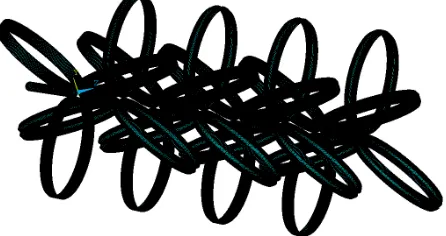
In the process of building the FM model, the rolling pieces are messed with unit SOLID164 while the rollers are messed with unit SHELL163.The distance between the stands is set as 300mm and the rolling pieces are defined as 450mm so as to make them stable in the rolling process.
When the properties of the materials in the experiment are to be defined, the rollers are defined as rigid body and the rolling pieces as elastic plastic body.
[image:3.595.203.426.266.384.2]As for setting contact, the rolling pieces and the rollers are defined as automatically face-to-face contact, the dynamic friction coefficient between the rolling pieces and the rollers as 0.2 and the static friction coefficient as 0.3.The model of the rollers, the rolling pieces and their FM are shown in Fig.2
Fig. 2: The roller model of after meshing
2 The loading process
With titanium alloy materials having low thermal conductivity coefficient, poor thermal conductivity and strong sensitivity to the deformation resistance in a certain temperature range, the coupled thermo-mechanical FM simulation is better in line with the actual hot continuous rolling process. The loading methods for temperature loading are as follows:
(1)The loading of the temperature of the rollers
For the loading of the temperature of the rollers, when heat is added to the rollers, the initial heat should not be directly added to the roller but to the nodes of the rollers.
(2)The loading of the temperature of the rolling pieces
The initial heat should be added to the rolling pieces in the way mentioned in (1). (3)The loading of the ambient temperature
The ambient temperature and the convective heat transfer coefficient should be set respectively. (4) Power thermal conversion
Due to the deformation of the rolling pieces, a larger majority of the energy is transformed into heat based on the law of conservation of energy; therefore, the power thermal conversion coefficient should be set.
(5) Heat exchange
The rolling pieces can not only generate heat currents with the air, but also exchange heat with the rollers as a result of their low temperature. Therefore, the heat exchange coefficient must be set.
The post-processing of the FM
According to the analysis of the thermo-mechanical coupling of the rolling process, The simulation process is compared with the actual using process from such aspects as the filling condition of the rolling pieces in the pass of each stand, temperature distribution, pile-pulling , biting and the deformation condition of the rolling pieces after being rolled.
1 the comparative analysis of the simulation results in the biting phase
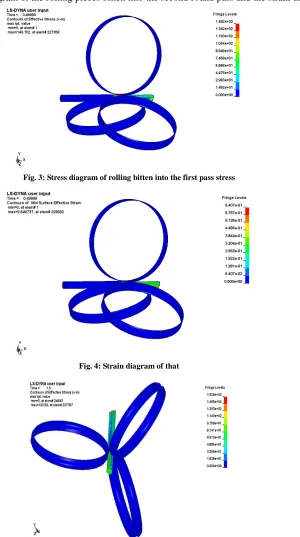
diagram of the rolling pieces bitten into the first triangle pass and the strain diagram of that.Fig.5 and Fig.6 are respectively the stress diagram of the rolling pieces bitten into the second round pass and the strain diagram of that.
Fig. 3: Stress diagram of rolling bitten into the first pass stress
Fig. 4: Strain diagram of that
Fig. 6: Strain diagram of that
Seen from the biting process mentioned above, the distributions of the stress and the strain of the rolling pieces have the features of relatively large surfaces and relatively uniform distributions. The two features are related to the rolling features of the Y-shaped three-roll mills. The rolling pieces are compressed from six directions in the following alternating rolling. The deformation and the cooling in the surrounding area are both relatively uniform and are very beneficial to guarantee the finished products with good quality.
2 The final effect of the rolling pieces after continuous rolling
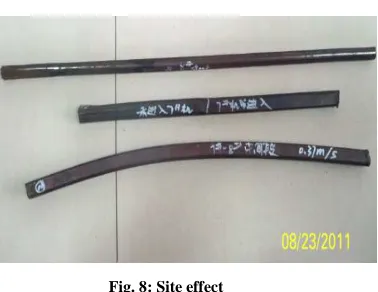
The pieces are alternately rolled by the triangle stands and the round stands.Fig.7 is the after-rolling effect by the analysis of the FM thermo-mechanical coupling and Fig.8 is the actual rolling effect shot on the site.
[image:5.595.223.412.517.663.2]Fig. 7: Finite element simulation results
Fig. 8: Site effect
After comparing the analysis result of the FM and the deformation condition of the titanium alloy bars after being rolled by the rolling mills in the experiment, we find that the deformation of the titanium alloy bars with FM simulation is much consistent with that on the site, which proves the reliability of optimizing the pass parameters and analyzing the force and the deformation of the rolling pieces with the help of FM [5].
THE ANALYSIS OF THE STACKING/DRAWING RATIO IN THE CONTINUOUS ROLLING
is a necessary condition for stable rolling. Based on the pass design, the stacking/drawing ratio is calculated with the following formula:
1
1 1−
=
− − n n n nv
S
v
S
ϕ
In the formula,
n
S
and
S
n−1 are respectively the area of the rolling piece in n passes and that in n-1 passes ,mm
2;n
v
and
v
n−1 are respectively the outlet velocity of the rolling piece in n passes and that in n-1 passes,60
n
D
v
Wnn
π
=
,mm/s; n WD
is the working diameter of n passes, mm;
n is the revolution per minute of the rollers,r/min.
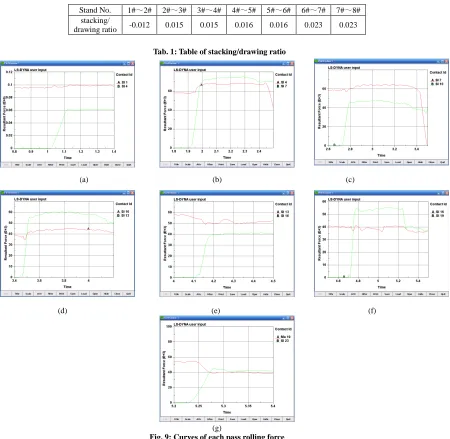
The stacking/drawing ratios in the eight-stand continuous rolling production process of titanium alloy bars are shown in Table.1
Stand No. 1#~2# 2#~3# 3#~4# 4#~5# 5#~6# 6#~7# 7#~8# stacking/
drawing ratio -0.012 0.015 0.015 0.016 0.016 0.023 0.023
Tab. 1: Table of stacking/drawing ratio
(a) (b) (c)
(d) (e) (f)
[image:6.595.89.539.327.766.2](g)
The calculating result of the above stacking/drawing ratios can be verified with the rolling force result calculated by the FM and the specific analysis is as follows:
The curves of each pass rolling force of the rolling pieces are shown in the following Fig.9
According to (a), we can find that the rolling force of the first pass increases slightly when the rolling piece bites into the stand of the second pass. Therefore, there is steel stacking between the first pass and the second one. From (b) we can find that the rolling force of the second pass decreases slightly and then increases gradually when the rolling piece begins to bite into the stand of the third pass. Therefore, there is steel drawing between the second pass and the third one. Based on (c) we can find that the rolling force of the third pass decreases slightly and then increases gradually when the rolling piece begins to bite into the stand of the fourth pass. Therefore, there is steel drawing between the third pass and the fourth one. From (d) we can find that the rolling force of the fourth pass decreases suddenly and then increases gradually when the rolling piece begins to bite into the stand of the fifth pass. Therefore, there is steel drawing between the fourth pass and the fifth one. Based on (e) we can find that the rolling force of the fifth pass decreases suddenly when the rolling piece begins to bite into the stand of the sixth pass. Therefore, there is steel drawing between the fifth pass and the sixth one. According to (f), we can find that the rolling force of the sixth pass decreases suddenly when the rolling piece bites into the stand of the seventh pass. Therefore, there is steel drawing between the sixth pass and the seventh one. From (g), we can find that the rolling force of the seventh pass decreases suddenly when the rolling piece bites into the stand of the eighth pass. Therefore, there is steel drawing between the seventh pass and the eighth one. The stacking/drawing conditions concluded from this is basically consistent with what is described in Table.1
FULLNESS CIRCUMSTANCES OF ROLLING PIECES IN PASS
[image:7.595.69.544.388.491.2]The fullness circumstances of rolling pieces in pass can show the stacking/drawing ratios in the continuous rolling as well. The fullness circumstances of rolling pieces in pass from the first to the eighth pass are shown in the following Fig.10. [6]
Fig. 10: Fullness circumstances of rolling in pass
[image:7.595.215.398.558.679.2]We can find from the above that the titanium alloy rolling pieces in each pass are in good condition, which can guarantee the precision requirement of the geometry size of final products. In the meanwhile, it can also show that the stacking/drawing rations between the stands are in permissible condition and the rolling process is stable.
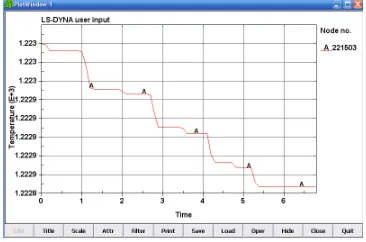
Fig. 11: Rolling temperature curve of finite element analysis
ANALYSIS OF TEMPERATURE DROP
FM software like ANSYS, so as to predict the temperature change of the rolling pieces and this is very meaningful to the control over the whole rolling process. The following Fig.11 is the rolling temperature curve of FM analysis.
From the temperature curve, it can be seen that the temperature drop is not very obvious. Therefore, we can predict that the temperature drop has little influence on whether the rolling process can be smoothly conducted. Based on this, we know that the production line is suitable for producing titanium alloy bars and other difficult-to- deformation metal materials with a narrow temperature range.
CONCLUSION
(1) The paper analyzes the continuous rolling deformation process of TC4 titanium alloy bars with finite element thermo-mechanical coupling based on the experimental study platform of compact eight-stand Y-shaped three –roll hot continuous rolling mills.
(2)Compared with the actual rolling process, the deformation of the titanium alloy bars with FM simulation is quite consistent with that on the site, which proves the reliability of optimizing the pass parameters and analyzing the force and the deformation of the rolling pieces with the help of FM.
(3)Based on the analysis of the calculating results of the rolling force, it can be concluded that the stacking/drawing ratios calculated with the formula are reasonable in this pass sequence.
(4) According to the analysis of the simulation results, it can be concluded that the titanium alloy rolling pieces in each pass are in good condition, which can guarantee the precision requirement of the geometry size of final products. In the meanwhile, it can also show that the stacking/drawing ratios between the stands are in permissible condition and the rolling process is stable.
(5) According to the analysis of the simulation results, it can be concluded that the temperature drop in the rolling process is not very obvious, which can make sure of rolling within the rolling temperature and can show that the compact heat continuous rolling production line is suitable for producing titanium alloy bars and other difficult-to- deformation metal materials with a narrow temperature range.
REFERENCES
[1]
Jia Shangwu, Parametric Design of Pro/E Three-roll Y-shaped Rolling Mills Based on Application Development [D].Taiyuan University of Science and Technology, 2012[2] Shuai Meirong, Qin Jianping, Steel pipes
,
2007, (04)[3] Wang Fuzhong, Zhang Huichun, Lu Lu, Liu Guoquan, Huang Jiankai. Journal of Liaoning Technical
University (Natural science edition)
,
2008, (06)[4] Qin Jianping, Economical Rolling Production [M] Beijing: Chemical Industry Press, 2012, 11
.
[5] Hu Haiping. Journal of Science and Technology Beijing