The Effect of the Creative Drama-supported
Problem-based Learning Approach on the
Self-efficacy Ability in Geometry
Burcu Duman1,*, Ceyda Özçelik2
1Faculty of Education, Bartın University, Bartın, Turkey 2
Institute of Education Sciences, Bartın University, Bartın, Turkey
Copyright©2018 by authors, all rights reserved. Authors agree that this article remains permanently open access under the terms of the Creative Commons Attribution License 4.0 International License
Abstract
The aim of this study is to identify the effect of creative drama-supported problem-based learning approach on self-efficacy ability of the students in the geometry classes. The pretest-posttest control group experimental design has been used in this research. The study group has been chosen from 59 students studying in 5/F and 5/E classes at an elementary school in Bartın/Turkey in 2017-2018 education years. After grouping analysis, 42 students were involved in the study group consisting of 21 students in experimental and 21 students in control groups. The experiment has lasted for six weeks. “Self-efficacy in Geometry Scale” has been used as the data collecting tool. The data has been analyzed using SPSS 20.0 programme. Parametric tests paired samples t test and independent samples t test have been used because of the homogeneity and regularity of the data. According to the evidence, it has been found out that the creative drama-supported problem-based learning approach had positive effects for self-efficacy abilities of the students who have been in the experimental group when compared to the other students in the current curriculum. Depending on the outcome of the study, it has been suggested that the creative drama supported problem-based learning could be used in other lessons and different subjects.Keywords
Creative Drama, Problem-based Learning, Self-efficacy1. Introduction
In the 21st century, along with the significant changes in technology, lots of improvements also occurred in education and teaching practices. Students need to acquire certain knowledge and skills required by the era in order to stand upright and be a benevolent individual both to the society and themselves. Therefore, it is a necessity to have
individuals who have problem solving and communication skills along with critical thinking, self-efficacy, creativity and reflection. The role of the learning and teaching approaches is important to equip individuals with these skills. The problem-based learning (PBL) approach is one of the approaches preferred and examined in the learning-teaching period.
The problems need to be solved in order to overcome the sense of uncertainty, imbalance and incompatibility occurring in the individual’s inner world [1]. John Dewey stated that the stages of defining the problem, creating hypothesis, testing the hypothesis and choosing the most appropriate hypothesis are the most efficient routes in problem solving [2]. These stages are very valuable in applying PBL approach. Even though using problems in education is not recent, it is a common learning technique used by the teachers. However, the problems in PBL are different from those in the traditional method as they are complex, open-ended, and based on real life [3].
PBL represents the organized experiences to solve complex real life problems [4]. According to Boud and Feletti [5], PBL is a method of developing abilities learnt from different resources, comparing information, problem solving skills and self-efficacy. PBL also helps develop communication skills rationally [6]. All these statements of problem-based learning show that there is a problem state on the basis of PBL approach and it focuses on the research on problem solving process rather than product. In this approach, the problem is at every stage of teaching; objectives, contents, implementation and evaluation [7]. In the implementation process of PBL, the time period until the problem definition is shown in four steps [8].
1. Discovery: A problem situation is found.
2. Preparation: Students get prepared for the problem. 3. Encounter: Students face problem situations.
In the problem finding process, written scripts, video, and tape recorders are used, and the real life-related problems are selected. In addition, while structured problems are preferred in the first stage of teaching according to the situation of the students, it is appropriate to choose unstructured problems in the following process. Unstructured problems need to be developed in a way that requires students to develop high-level thinking skills and to collect and reflect information. In this process, the teacher has the duty to encourage the students to define the problem, to determine the learning needs and to provide the materials [9].
PBL approach can be applied to only one subject, but it is an approach that has the flexibility to include a unit. This approach proceeds as different sessions in which problems are solved. The number of these sessions also varies in direct proportion to the depth of the content [10]. The combination of the multiple sessions creates PBL modules. These modules are organized in such a way as to include the objectives, the concepts that may be related to the subject, the scenario created and the pre-learning activities. The scenarios used can be presented at least as two multiple sessions [11]. For each session, different problems are required and students are asked to analyze their prior knowledge.
Creative drama is defined as a process in which a word, a behavior, or an event is presented as the improvisation in the group work, students take a role in the form of the theater or play, in which they are re-structured by putting their previous learning into work [12]. Whether the people in the group have creative drama experiences, their ages, interesting and needs affect the process of making drama [13]. Therefore, it is important to create the groups considering these features. According to Adıgüzel [14], these steps need to be taken in order to have creative drama in a healthy way:
1- Preparation-Warm-Up Studies: At this stage, students are expected to know each other, adapt and gain confidence. In order to prepare for other drama studies, the student is informed about the game, attracting interest in games and doing relaxation exercises.
2- Animation: At this stage, the revitalization of the subjects and the role play take place. The roles on the scenario can be displayed individually and in groups. 3- Evaluation-Discussion: The data obtained as a result
of animations are evaluated. Discussions are held for the process by exchanging ideas. Evaluations are made in terms of quality. The evaluation criteria of the course are applied to measure the cognitive gains of the students. Different evaluation methods can also be used.
At the mathematics class at which abstract concepts were of the majority and into which the students joined with negative prejudices, the learned in teaching the concept and operation will be emphasized through the use
of the creative drama, and the student will learn by doing and living. The students will also improve affectively and kinetically in addition to the cognitive behaviors. In addition to many methods and techniques that can be used in teaching mathematics, creative drama can be used as a method alone according to the subject or together with other methods and techniques [15]. From this point of view, creative drama method can be applied in the problem-based learning (PBL) approach. The scenarios related to the problem situations can be put forward through the creative drama. As Özsoy [15] states in, the student thus rehearses for the real situations he will meet in his/her life and learns to find solutions to the problems. At this point, one of the most important factors affecting the performance carried out is the belief of self-efficacy [16]. Bandura [17] defines the self-efficacy as the individual’s own judge related to the capacity of doing a certain affair successfully by organizing the necessary activities. When focused on the subject of geometry in the field of the mathematics teaching, it is stated that the students have met with many difficulties and that there are negative affective features among the reasons of these difficulties in learning geometry [18]. When the relationship between the behavior and the belief of self-efficacy which is of the affective features is taken into account, a wish and a positive manner will come into existence as a result of this belief if the students believe they will learn geometry [19]. While the individuals whose self-efficacy is high are more insistent, patient and determined than the others on succeeding anything, that effort is not seen in the ones whose self-efficacy is low. It is necessary for the teachers to consider these characteristics of the students during the learning process and to select the methods to improve their self-efficacy [20]. Therefore; in this study, it has been tried to identify the effect of the problem-based learning (PBL) approach supported with the creative drama on the self-efficacy skills of the students in learning geometry.
2. Methods
In this study, ‘the pre-test - post-test control group design’ was used from experimental designs. This pattern is used in conditions where the pre-experiment and post-experiment evaluations constructed with a random method are made in the experimental and control groups [21]. In this study, the students in the experimental and control groups have been selected by cluster analysis. Based on this pattern, the answers to the following questions were sought:
1- Is there a significant difference between the pre-test self-efficacy scores of the experimental and the control group?
3- Is there a significant difference between the pre-test and post-test self-efficacy scores of the control group? 4- Is there a significant difference between the pre-test and post-test self-efficacy scores of the experimental group?
2.1. Study Group
The study group has been chosen from 59 students studying in 5/F and 5/E classes of an elementary school in Bartın/Turkey in 2017-2018 education years. Cluster analysis was performed by taking the average scores of the students' mathematics average grades of the previous year and the mean score they obtained from ‘Reflective Thinking Skill Scale for Problem Solving’ [22] and ‘Geometry Self-Efficacy Scale’ [19]. As a result of the clustering analysis, 42 students were included in the study group and 21 in the control group.
2.2. Experimental Process
The experimental procedure has lasted for six weeks. First, ’the self-efficacy scale for geometry’ was applied to the students in the experimental and control groups as a pre-test. Thus, the students' self-efficacy levels were determined at the beginning of the process. In the experimental group, a total of twenty lessons (five hours per week) were taught based on a creative drama-based problem-based learning approach. In the same period, the subjects in the control group worked as required by the program. For the application in the experimental group, four acquisitions in “Geometry and Measurement” unit in the 5th Grade Maths Curriculum were taken as the basis. These acquisitions are as follows:
Names and identifies the basic elements of polygons.
Creates triangles according to their angles and edges. Classifies different triangles according to the edge and angle properties.
Determines and draws the basic elements of the rectangular, parallelogram, rhombus and gravel.
Determines the sum of the inner angles of the triangles and rectangles.
Four lessons of five hours were prepared for each acquisition. The plans were implemented as two sessions in accordance with the creative drama-supported problem-based learning approach.
Students were divided into groups. The scenarios
distributed by the teacher were read by the members of the group and played as improvisation. An environment was created for the problem to be realized, and ideas were generated for the solution. “Self-efficacy scale for geometry” was applied to the experimental and control groups in the last week of the application as a final test.
2.3. Data Collection Tool
In In the study, the self-efficacy scale developed by Cantürk-Günhan and Başer [19] was used as data collection tool. The scale, in its development phase, was applied to 385 students from 6th, 7th and 8th grades who were studying in the second stage of primary education for validity and reliability study. As a result of the analysis, it has been observed that the scale has 3 sub-factors. Twelve of the items were gathered under the “Positive Self-efficacy Beliefs”, six were under “Using Geometry Knowledge” and seven were under “Negative Self-efficacy Beliefs”. The scale consists of 25 items, 7 of which are negative and 18 (of them) are positive. The Cronbach's Alpha value of the scale was 0.90. The Cronbach's alpha reliability coefficients of the sub-factors were 0.88, 0.70, and 0.70, respectively. The 5-item Likert-type scale is graded and expressed as 1 (Never), 2 (Occasionally), 3 (Undecided-Neutral), 4 (Usually) and 5 (Always).
2.4. Data Collection and Analysis
SPSS 20.0 statistical package program was used to analyze the data obtained in the study. Since the data were homogenous and normally distributed, parametric tests were used. Independent samples t-test was used to determine whether there was a significant difference between pre-test and post-test results of the control and the experimental groups. In order to determine whether there was a significant difference between the pre-test and post-test results of the control and the experimental groups, dependent samples t test was used.
3. Results
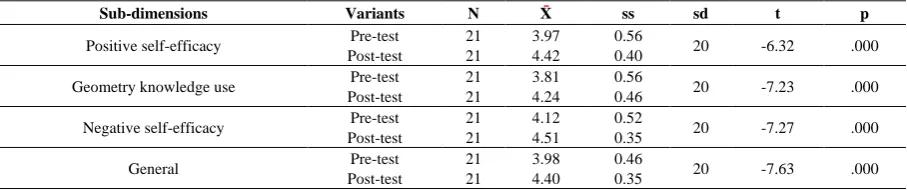
[image:3.595.71.525.656.751.2]The results are presented in the order of the hypothesis created according to the aim of the research. Table 1 shows the paired samples t-test results of the self-efficacy pretest- posttest mean scores of the experimental group.
Table 1. Experimental group self-efficacy pre-test - post-test mean scores of paired samples t test results
Sub-dimensions Variants N X ̄ ss sd t p
Positive self-efficacy Pre-test
Post-test
21 21
3.97 4.42
0.56
0.40 20 -6.32 .000
Geometry knowledge use Pre-test
Post-test
21 21
3.81 4.24
0.56
0.46 20 -7.23 .000
Negative self-efficacy Pre-test
Post-test
21 21
4.12 4.51
0.52
0.35 20 -7.27 .000
General Pre-test
Post-test
21 21
3.98 4.40
0.46
0.35 20 -7.63 .000
According to Table 1, significant differences were observed in favor of the last test in all sub-dimensions and scale as a whole. The mean pre-test score in the positive self-efficacy sub-dimension was X =3.97, and the post ̄ -test mean score was X =4.42, and the difference was si
̄ gnificant [t(20)=-6.32, p<.05]. The mean of the pretest score in the use of geometry information was X =3.81, and the posttest ̄ mean score was X =4.24, and there was a significant ̄ difference in favor of the last test [t(20)=-7.23, p<.05]. The mean pre-test score of the negative self-efficacy sub-scale was X =4.12, and the post
̄ -test mean score was X =4.51 and ̄ the difference was significant in favor of the last test [t(20)=-7.27, p<.05]. The self-efficacy pre-test mean score was X =3.98 and the post
̄ -test mean score was X =4.40 and ̄ there was a significant difference in favor of the last test [t(20)=-7.63, p<.05]. According to these findings, it is seen that creative drama-supported problem-based learning approach is effective in developing self-efficacy for geometry. Table 2 shows the paired samples t test results of the self-efficacy pretest - posttest mean scores of the control group.
According to Table 2, the mean pre-test score of the control group positive self-efficacy sub-dimension was X =3.83 and the po
̄ st-test mean score was X ̄=3.90 and the difference was significant [t(20) =-2.09, p <.05].
The mean pre-test score of the use of geometry information was X =3.85 and the post
̄ -test mean score was X =3.95 and there was no significant difference ̄ [t(20)=-1.99, p<.05]. Pre-test mean score in negative self-efficacy sub-dimension was X =4.10 and post ̄ -test mean score was X =4.10, there was no significant ̄
difference [t(20)= -0.26, p<.05]. Overall self-efficacy pre-test mean score was X =3.91 and post ̄ -test mean score was X =3.97 and the scores showed a significant difference ̄ in favor of the last test [t(20)=-2.40, p<.05]. According to these findings, it is seen that the current curriculum is effective in developing positive self-efficacy for geometry and self-efficacy in general. However, it can be said that the current curriculum does not affect the self-efficacy development in the use of geometry information. Table 3 shows independent samples t test results of the self-efficacy pre-test mean scores of the experimental and the control groups.
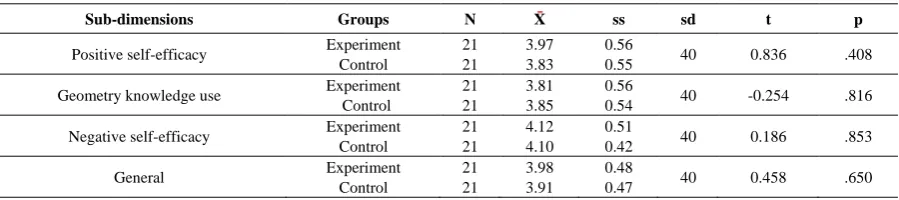
In the pre-test results of the positive self-efficacy sub-dimension according to Table 3, no significant difference was observed [t(40)=-0.836, p<.05) between the experimental group average (X =3.97)
̄ and the control group average (X =3.83). In the pre ̄ -test results of the use of geometry knowledge, no significant difference was observed [t(40)=-0.254, p<.05] between the average of the experimental group (X =3.81) and the control group ̄ average (X =3.85). In the pre ̄ -test results of the negative self-efficacy subscale, no significant difference was observed [t(40)= -0.186, p<.05) between the average of the experimental group (X =4.12) and the control group ̄ average (X =4.10). In the pre
[image:4.595.71.527.481.580.2]̄ -test results of the general self-efficacy sub-test, no significant difference was observed [t(40)=-0.836, p<.05] between the average of the experimental group (X =3.98) and the control group ̄ average (X ̄=3.91). These findings show that the experimental and the control groups have equivalent self-efficacy skills for geometry before the experiment.
Table 2. Control group self-efficacy pre-test - post-test mean scores of paired samples t test results
Sub-dimensions Variants N X ̄ ss sd t P
Positive self-efficacy Pre-test
Post-test
21 21
3.83 3.90
0.56
0.48 20 -2.09 .049
Geometry knowledge use Pre-test
Post-test
21 21
3.85 3.95
0.54
0.43 20 -1.99 .061
Negative self-efficacy Pre-test
Post-test
21 21
4.10 4.10
0.42
0.43 20 -0.26 .803
General Pre-test
Post-test
21 21
3.91 3.97
0.47
0.41 20 -2.40 .026
p<.05
Table 3. Independent samples t test results of the self-efficacy pre-test mean scores of the experimental and control group
Sub-dimensions Groups N X ̄ ss sd t p
Positive self-efficacy Experiment
Control
21 21
3.97 3.83
0.56
0.55 40 0.836 .408
Geometry knowledge use Experiment
Control
21 21
3.81 3.85
0.56
0.54 40 -0.254 .816
Negative self-efficacy Experiment
Control
21 21
4.12 4.10
0.51
0.42 40 0.186 .853
General Experiment
Control
21 21
3.98 3.91
0.48
[image:4.595.75.525.620.720.2]Table 4. Independent samples t test results of the self-efficacy post-test mean scores of the experimental and control group
Sub-dimensions Groups N X ̄ ss sd t P
Positive self-efficacy Experiment
Control
21 21
4.43 3.81
0.40
0.48 40 3.80 .000
Geometry knowledge use Experiment
Control
21 21
4.24 3.95
0.46
0.43 40 2.07 .045
Negative self-efficacy Experiment
Control
21 21
4.50 4.10
0.35
0.43 40 3.32 .002
General Experiment
Control
21 21
4.40 3.97
0.35
0.41 40 3.66 .001
p<.05
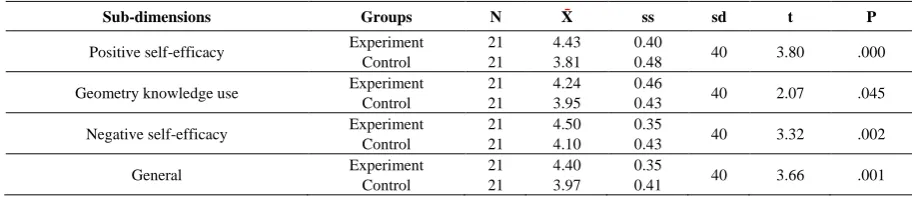
Table 4 shows the independent samples t test results of the self-efficacy post-test mean scores of the experimental and the control groups.
The average of the experimental group in the post-test results of the positive self-efficacy sub-dimension according to Table 4 was X =4.43 and the control group ̄ average was X =3.81 which shows a significant difference ̄ in favor of the experimental group [t(40)=3.80, p<.05]. The mean of the experimental group in the final test results for the use of geometry information was (X =4.24), ̄ and the control group average (X =3.95) shows a ̄ significant difference in favor of the experimental group [t(40)=2.07, p<.05]. In the final test results of the negative self-efficacy sub-scale, the average of the experimental group was (X =4.50), and the control group average ̄ (X =4.10) shows a significant difference in favor of the ̄ experimental group [t(40)=-3.32 p<.05]. In the final test results of the general self-efficacy sub-scale, the mean of the experimental group (X =4.40) and that of the control ̄ group (X =3.97) were significantly different [t
̄ (40) = 3.66, p<.05]. These findings show that the creative drama-supported problem-based learning approach is more effective in developing the self-efficacy of geometry compared to the current curriculum.
4. Discussion and Conclusions
In In this study, the effect of creative drama-supported problem-based learning on mathematics students' self-efficacy skills was investigated. The results were discussed according to the data obtained. There was a significant increase in the posttest mean of the experimental group in which the creative drama-supported problem-based learning approach was applied. As a result, the creative drama-based problem-based learning approach was found to be effective in increasing the students' self-efficacy skills for geometry. Studies carried out by Kaptan and Korkmaz [23] and Yaman [24] show that the self-efficacy beliefs of the students increased in the classes where the course was taught by problem based learning method. Cantürk Günhan and Başer’s [25] study on the ‘effect of the problem based learning method on 7th grade primary school students’ belief on self-efficacy’ also showed a positive increase as is the case with this research. In Yenilmez and Uygan’s [18] study on the
effect of ‘the creative drama method on the level of self-efficacy beliefs of the 7th grade students in geometry, there was a significant increase.
In this study, the students supported by the creative drama became themselves aware of the problem, revived the scenarios themselves without any intervention and tried to find solutions to the problem. In short, they learned to learn in this process. According to Bandura [17] self-efficacy is the individual's own judgment on the capacity of an individual to organize the necessary activities in order to be able to do a certain job. In this study, the creative drama-assisted PBL approach allowed students to make their own organization and contributed to the development of self-efficacy belief. Also, according to Yaman and Yalçın [26] in PBL approach, it is expected that the student will be able to answer the questions about what he / she knows about a problem and if he knows what he knows, he / she will be able to answer these questions of the other fields. Therefore, the process of learning to learn together with the student's inner motivation will take action and the self-efficacy belief will be expected to develop. In this study, the self-efficacy beliefs of the students who act in line with their own plans have developed. In addition, the student-centered approaches are applied together with the constructivism, and different teaching methods are used in courses. Thus, the increase in the control group post-test mean is normal. There was no significant increase in the control group in terms of the use of the other two sub-dimensions of the geometry knowledge and the final test for negative self-efficacy. There was no significant difference between the pre-test mean scores of the self-efficacy belief of the experimental and the control groups. Therefore, it is understood that the groups are equivalent to each other before the experimental procedure.
which the individuals feel themselves in any subject, their ability to motivate them, and how they cast into behavior [27]. In this study, an environment has been created in order to strengthen the students' self-efficacy perceptions by creating different scenarios by finding the solutions to the problems and working in collaboration. It has been observed that there is an improvement in students' efforts to learn, research and develop group work skills. In Hatısaru’s study [28] ‘Examination of the student development in mathematics courses where problem based learning method is applied’ it is observed that the students have the ability to study with pleasure, they are willing to solve the problem, they have an effort to learn and they have the ability to do research. Therefore, these findings coincide with the results of this study. Also, in Cerezo’s study [29] that investigated the effectiveness of PBL approach in mathematics and science courses, it was stated that the students increased the group commitment and self-efficacy, and that there were positive developments in independent study skills and motivation. According to Bandura [30], individuals can progress if they persist in the face of difficulties. As a result of their effort in difficult situations, they reappear more strongly. This is known as the first step in strengthening the self-efficacy beliefs. In addition, the self-efficacy beliefs of the individuals can develop with the successful experiences provided by the social environment. In this study, the students who work in the same role have given the opportunity to work on the scenarios given, to communicate and to model each other. Therefore, there was a significant increase in the self-efficacy beliefs of the experimental group students. In a study [31] on “The Applicability of Problem-Based Learning in Mathematics Course in the Second Level of Primary School”, it was concluded that PBL method was effective in increasing the students' self-efficacy beliefs towards geometry when compared to the traditional method.
According to the results of the study, the following suggestions were made: In the study, the PBL approach with the creative drama support was found to be more successful than the current applied curriculum. For this reason, it may be preferable to increase the creative self-efficacy with the PBL approach. It can be used in teaching different subjects in mathematics course. The effects of the creative drama-supported problem-based learning approach in other subjects can be investigated. Studies examining the effect of the creative drama-supported problem-based learning on skills such as critical thinking, metacognitive thinking and creative thinking can be carried out. A qualitative study can be conducted in which the views of the students about the creative drama-supported problem-based learning approach are obtained.
REFERENCES
[1] Z. Çubukçu. Düşünme becerileri. (Ed. S. Büyükalan Filiz). Öğrenme Öğretme Kuram ve Yaklaşımları (1.Baskı). 279-334. Ankara: Pegem Akademi. 2011.
[2] K. T. Henson, B. F. Eller. Educational Psychology for Effective Teaching. Wadswoord Publishing Company. 1999.
[3] K. H. Roh. Problem- Based Learning in Mathematics. ERIC. Clearinghouse for Science, Mathematics and Environmental Education, EDO-SE-03-07, 2003.
[4] L. Torp, S. Sage. Problem as Possibilities: Problem-Based Learning for K-16 Education, Alexandria, VA, USA: Association for Supervision and Curriculum Development. 2002.
[5] D. Boud, G. Feletti. The Challenge of Problem Based learning. Kogan Page: London. 1991.
[6] B. J. Duch, S. E. Groh, D. E. Allen. Why Problem Based Learning? The Power of Problem-Based Learning. Virginia: Stylus Publishing. 2001.
[7] A. Kılınç. Problem based learning, Kastamonu Education Journal, Vol.15, No.2, 561-578, 2007.
[8] A. Saban. Öğrenme Öğretme Süreci.(2.baskı). Ankara: Nobel Yayınevi. 2002.
[9] F. Kaptan, F., H. Korkmaz. Problem based learning approach in science education, Hacettepe University journal of education, Vol. 20, 185-192, 2001.
[10]E. Çolak. Öğrenme öğretme süreçlerinde yeni yaklaşımlara dayalı örnek uygulamalar (Ed.S.Fer). Öğrenme öğretme kuram ve yaklaşımları. Ankara: Anı Yayıncılık. 236-260. 2011.
[11]H. Abacıoğlu, E. Akal, N. Atabey, O. Dicle, S. Miral, B. Musal, S. Sarıoğlu. Probleme Dayalı Öğrenim. DEÜ Tıp Fakültesi Eğiticilerin Eğitimi Komitesi. Dokuz Eylül Üniversitesi Yayınları, İzmir. 2002.
[12]İ. San. Yaratıcı dramanın - eğitsel boyutları. (Ed H. Adıgüzel Ömer). Yaratıcı drama 1985-1998 Yazılar (1. Baskı). 81-90. Ankara: Naturel Yayıncılık. 2002.
[13]N. Tuluk. Yaratıcı drama. Pivolka, Vol.3, No.15, 10–12, 2004.
[14]H .Ö. Adıgüzel The concept, components and stages of creative drama, Creative Drama Journal, Vol.1, No.5, 17-31. 2006.
[15]N. Özsoy. Matematik Öğretiminde Alternatif Etkinlikler “Yaratıcı Drama Uygulamaları”. Adnan Menderes Üniversitesi yayınları Vol.36, 2010.
[16]D. L. Feltz,, G. M. Chow., T. J. Hepler. Path analysis and self-efficacy during performance. Journal of Sport and Exercise Psychology, Vol. 30, No.3, 401-411, 2008.
[18]K. Yenilmez, C. Uygan. The effects of creative drama method on 7th grade students’ self-efficacy beliefs on geometry, Kastamonu Education Journal, Vol.3, No.18, 931-942, 2010.
[19]B. Cantürk-Günhan., N. Başer. The development of self-efficacy scale toward geometry. Hacettepe University journal of education, Vol.33, 68-76, 2007.
[20]N. Senemoğlu. Gelişim Öğrenme ve Öğretim: Kuramdan Uygulamaya (18.Baskı). Ankara: Pegem Akademi. 2010.
[21]N. Karasar. Bilimsel Araştırma Yöntemleri. Ankara: Nobel Yayıncılık. 2006.
[22]K. Aşkar, G. Kızılkaya. The development of a reflective thinking skill scale towards problem solving, Education and Science, Vol. 34 No.154, 2009.
[23]F. Kaptan, H. Korkmaz. Probleme dayalı öğrenme yaklaşımının hizmet öncesi fen öğretmenlerinin problem çözme becerileri ve öz-yeterlik inanç düzeylerine etkisi. V. Ulusal Fen Bilimleri ve Matematik Eğitimi Kongresi Bildiri Kitapçığı (16-18 Eylül 2002), Ankara: Orta Doğu Teknik Üniversitesi. 1281-1287. 2002.
[24]S. Yaman. Fen bilgisi eğitiminde probleme dayalı öğrenmenin öğrenme ürünlerine etkisi. (Yayınlanmamış doktora tezi), Gazi Üniversitesi, Eğitim Bilimleri Enstitüsü, Ankara. 2003.
[25]B. Cantürk Günhan, N. Başer. The effect of problem based learning methods on students’ the self-efficacy beliefs towards geometry, e-Journal of New World Sciences Academy, Vol.3, No.3, 2008.
[26]S. Yaman, N. Yalçın. Effectiveness on creative thinking skills of problem based learning approach in science teaching, İlköğretim-Online, Vol.4, No.1, 42-52, 2005.
[27]B. Akkoyunlu, F. Orhan, A. Umay. A study on developing teacher self-efficacy scale for computer teachers, Hacettepe University journal of education, Vol.29,1-8. 2005.
[28]V. Hatısaru. Investigating student growth in problem based learning treatment mathematics classes, Gaziantep University Journal of Social Sciences, Vol. 14, No.2, 459-477, 2015.
[29]N. Cerezo. Problem Based Learning in the Middle School: A Research Case Study of The Perceptions Of at-Risk Females. Research in Middle Level Education Online, Vol.1, No.27, 2004.
[30]A. Bandura. Self-efficacy. In V. S. Ramachaudran (Ed.), Encyclopedia of human behavior, Vol. 4, 71-81, 1994.