DESIGN OPTIMIZATION OF ANN-BASED PATTERN RECOGNIZER FOR MULTIVARIATE QUALITY CONTROL
MUHAMAD FAIZAL BIN ABDUL JAMIL
Tesis ini dikemukakan sebagai memenuhi syarat penganugerahan
Ijazah Sarjana
Fakulti Kejuruteraan Mekanikal dan Pembuatan Universiti Tun Hussein Onn Malaysia
ABSTRACT
ABSTRAK
TABLE OF CONTENTS
CHAPTER PAGE
ACKNOWLEDGEMENTS iii
ABSTRACT iv
ABSTRAK v
TABLE OF CONTENTS vi
LIST OF TABLES ix
LIST OF FIGURES x
LIST OF ABBREVIATIONS xi
LIST OF SYMBOLS xii
LIST OF APPENDICES xiii
CHAPTER 1 : INTRODUCTION 1
1.1 Introduction
1.2 Statement of The Problem 3
1.3 Purpose of the research 3
1.4 Objectives 3
1.5 Scopes and key assumptions 4
1.6 Definitions of terms 5
CHAPTER 2 LITERATURE REVIEW
2.0 Introduction 8
2.1 Process Variation 9
2.2 Statistical Process Control 10
2.3 Classical Statistical Control Scheme 11
2.4 Statistical Multivariate Process Control 12
2.5 Monitoring Bivariate Process Variations 15
2.6 Multivariate Pattern Recognition (MPR) Scheme and Recognizer Design 14
2.7 Summary 19
CHAPTER 3 : RESEARCH METHODOLOGY
3.1 Introduction 20
3.2 Problem Situation 21
3.3 Solution concept 21
3.4 Research Methodology 21
3.5 Summary 23
CHAPTER 4 : RESULT AND DISCUSSIONS
4.1 Introduction 24
4.2 Statistical Feature-Ann Scheme 25
4.3 Data Generator 28
4.4 Bivariate Patterns 30
4.5 Extraction of Statistical Features 30
4.6 Selection of Statistical Features 32
4.6.1 Experiments Using Empirical Method 33
4.6.2 Improvement of Recognition Accuracy Using Taguchi DOE 35
4.7 The Finalised Statistical Features-ANN 39
4.9 Conclusion 41
CHAPTER 5 : CONCLUSIONS
5.1 Conclusions 43
5.2 Contributions 44
5.3 Future Research 44
References 45-48
LIST OF TABLES
TABLEE NO. TITLE PAGE
Table 2.0 : Diagnosis Performances of some existing schemes 19
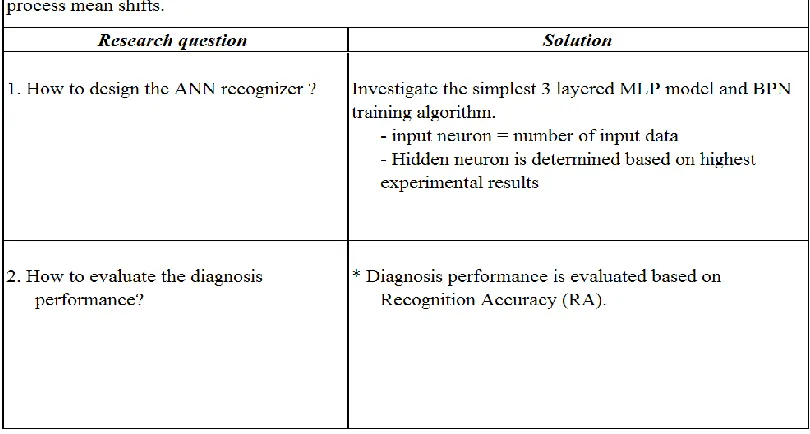
Table 3.1 : Research Question 1 22
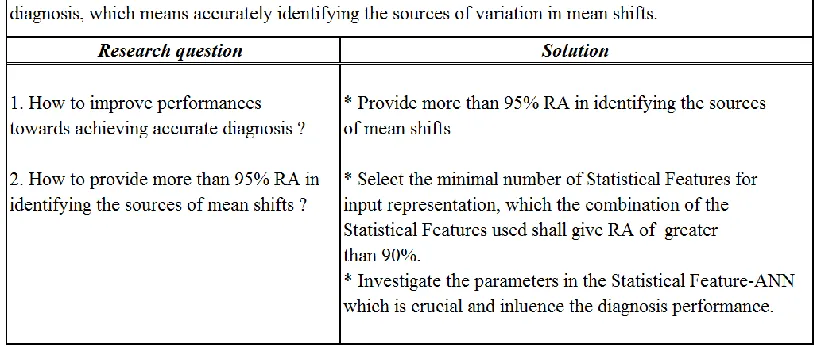
Table 3.2 : research Question 2 23
Table 4.2 : Coded Matrix Difference for the result after feature selection 34
Table 4.3 : The values of parameters to be investigated in DOE 35
Table 4.4 : Matrix of Coded Difference result after Taguchi Analysis 38
Table 4.5 : Comparison of The Recognition Accuracy At All
LIST OF FIGURES
FIGURE NO. TITLE PAGE
2.0 : Chance and assignable cause . Montgomery (2001) 9
2.1 : Process variation monitoring tools 10
2.2 : Independent monitoring 15
2.3 : Joint monitoring 16
2.4 : Novelty detector-ANN Recognizer (Zorriassatine et al, 2003) 17
2.5 : Ensemble-ANN (YU and Xi, 2009) 18
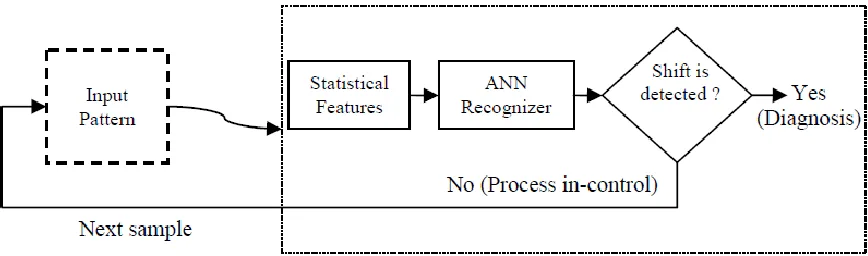
3.0 : Statistical Features-ANN Scheme 21
4.1 : Screen cut of Matlab software widow 25
showing the program files
4.2 : Framework for the Statistical Features-ANN scheme 26
4.3: Screen-cut of Minitab worksheet. 27
4.4 : Result of experiment recorded in Minitab worksheet 37
4.5 : Minitab Main Effects Plot for Means 37
4.6 : The finalised number of hidden neurons. 39
4.7 : The finalised value of window size and no of data set 39
4.8 : The portion of the Matlab program which contains 40
LIST OF ABBREVIATIONS
ANN - Artificial neural network
BPN - Back propagation network
BPR - Bivariate pattern recognition
CCPs - Control chart patterns
CUSUM - Cumulative sum
EWMA - Exponentially weighted moving average
LCL - Lower control limit
LEWMA - Last value of exponentially weighted moving average
MCUSUM - Multivariate cumulative sum
MEWMA - Multivariate exponentially weighted moving average
MPR - Multivariate pattern recognition
MQC - Multivariate quality control
MSD - (Mean) x (standard deviation)
MSE - Mean square error
MSPC - Multivariate statistical process control
PR - Pattern recognition
RA - Recognition accuracy
SPC - Statistical process control
LIST OF SYMBOLS
α - Type I error (α risk)
β - Type II error (β risk)
λ - Constant parameter for EWMA control chart
ρ - Correlation coefficient for bivariate samples
μ - Mean
σ - Standard deviation
μ0 - Mean for in-control samples
σ0 - Standard deviation for in-control samples
σ12 - Covariance for bivariate samples
X2 - Chi-square statistics
Σ - Covariance matrix for bivariate samples or basic summation
t0 - time/point the sampling begins or the shift begins
Xt - Original observation samples at time/point t
Zt - Standardized observation samples at time/point t
σ’ - Random noise level for stratification pattern
s - Mean shift for sudden shift patterns
LIST OF APPENDICES
APPENDIX TITLE PAGE
1 Tabulated Results of The Experiments 49
Using Empirical Method
2 MATLAB Program : Train_FB_ANN.m 50
CHAPTER 1
INTRODUCTION
1.1 Introduction
There are various definitions of quality; Dr. Armand Feugenbaum, states that “Quality is a customer determination which is based on the customer’s experience with the product or service, measured against his or her requirements – stated or unstated, conscious or merely sensed, technically operational or entirely subjective – and always representing a moving target in a competitive market” (Summers, 2007) . High quality of product is the vital concern for most of the companies that will survive in this highly competitive global market. One of the most effective approaches to achieve high product quality is through the applications of Statistical Process Control (SPC).
Process variation has been known to be a major source of poor quality in manufacturing industries. Monitoring process variation is important in the process of achieving best quality of product, which involves the identification of process status, either it is running within a statistically in-control or out-of-control condition. Process diagnosis refers to the identification of the source of variables of out-of-control process.
1.2 Statement of the Problem
Diagnosis of process variation is vital towards continuous quality improvement and when involving two or more dependent variables (multivariate). An appropriate scheme is needed to perform diagnosis. The existing ANN models recognizers mainly utilize raw data as input pattern representation, which resulted in limited performance. The Feature-Based ANN model is expected to perform better than the one which utilize raw data as input representation. The performance of Feature-Based ANN model depends a lot on the selection of the right and suitable combination of statistical features. In this research, the selection of suitable statistical features shall be achieved by using Forward Selection. The monitoring-diagnosis capability shall be improved using the application of Taguchi Design of Experiment.
1.3 Purpose of the Research
The purpose of this research is to design, develop and test runs a scheme for enabling accurate diagnosis of multivariate (bivariate) process mean shifts. The characteristics of the scheme are applicable for bivariate process (correlated data streams) and on-line situation (dynamic data streams). The diagnosis capability shall be improved by the application of design of experiment technique during the selection of feature input representation.
1.4 Objectives
The objectives of this research are:
(i) To develop a statistical feature-ANN scheme for enabling diagnosis of multivariate process variation.
1.5 Scope and Key Assumptions
The scopes of this research are:
(i) Multivariate quality control cases are limited to bivariate process, that is, only two dependent variables being monitored and diagnosed.
(ii) Bivariate process variables are dependent on each other based on linear cross correlation (ρ).
(iii) In a statistically out-of-control condition, predictable bivariate process patterns are limited to sudden shifts (upward shifts and downwards shift) in the source variables.
(iv) Bivariate process variation is limited to changes in mean shifts at specified data correlation, or changes in data correlation at specified mean shifts.
(v) Magnitudes of mean shifts in the source variables are limited within ±3 standard deviations based on control limits of Shewhart control chart. (vi) The foundation modelling and simulation for bivariate correlated samples
1.6 Definition of Terms
The following terms are important and frequently used in this research:
(a) On-line process
On-line process refers to in-process environment in manufacturing industries, that is, during manufacturing operation is running. Based on individual samples, continuous data streams patterns will be produced through automated measuring and inspection devices. An in-control process is represented by random/normal patterns, while an out-of-control process is represented by gradual trend or sudden shift pattern.
(b) Process monitoring and diagnosis
Process monitoring refers to the identification of process status either it is running within a statistically in-control or has become a statistically out-of-control. Process diagnosis refers to the identification of sources of variation in relation to a statistically out-of-control process.
(c) Sources of variation
Source of variation refers to a component variable or group of component variables that indicate a bivariate process has become out-of-control. In this research, it is focused on sudden shift in process mean (process mean shifts). This information is useful towards diagnosing the root cause error.
(d) Accurate diagnosis
(e) Control chart patterns (CCPs)
Control chart patterns refer to the patterns of univariate process data streams that can be indicated graphically using Shewhart control chart.
(f) Bivariate patterns
Bivariate patterns refer to the unified patterns that are able to indicate the linear correlation between two dependent variables. In this research, these patterns are represented graphically using scatter diagrams.
(g) Pattern recognition
Pattern recognition is an operation of extracting information from an unknown process data streams or signals, and assigning it to one of the prescribed classes or categories (Haykin, 1999). In this research, it deals with bivariate patterns.
(h) Pattern recognition scheme
Pattern recognition scheme refers to a set of related procedures formulated and presented in a unified manner for addressing the problem of control chart pattern recognition (Hassan, 2002).
1.7 Expected Outcomes
The main outcome of this research would be a representative pattern recognition scheme namely features-based ANN as a proof of improvement. The intended scheme should be capable of identifying the sources of variables of multivariate process variation.
CHAPTER 2
LITERATURE REVIEW
2.0 Introduction
2.1 Process Variation
In manufacturing and service industries, the goal of most processes is to produce products or provide services that exhibit little or no variation. Variation, where no two items or services are exactly the same, exists in all processes (Summers, 2006). Process variation and process precision are closely related, whereby a process with little variation is said to be 'precise'. Most processes are designed with controls that can be used to adjust the process mean, and hence increase the accuracy. Reducing the amount of process variation is usually a difficult task.
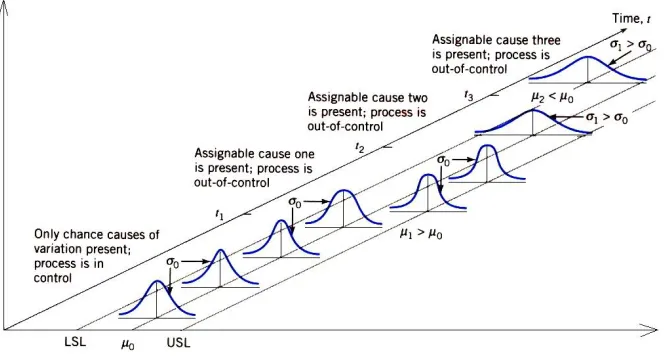
As mentioned earlier, variation in manufacturing process environment causes the parts or products to be produced in different size and properties. Process variation as shown in Figure 1 can be influenced by chance causes (random error) and/or assignable causes (systematic errors). The figure shows that from initial time t0 to period t1, process mean (μ0) and standard deviation (σ0) are in-control.
Disturbance due to assignable causes can be indicated in three situations. Firstly, at time t1, an assignable cause may shift the process mean (μ1 > μ0) but maintain the
dispersion (σ0). Secondly, at time t2, it may change the dispersion (σ2 > σ0) but
[image:20.595.118.451.508.690.2]maintain the mean (μ0). Thirdly, at time t3, other assignable cause may effects both process mean and dispersion to be out-of-control, μ3 < μ0 and σ3 > σ0.
Figure 2.0 : Chance and assignable cause . Montgomery (2001)
reducing variability in the key process variables or quality characteristics of the product (Montgomery, 2001). Statistical process control (SPC) charting is one of the SQE tools that useful for monitoring and diagnosing process variation.
2.2 Statistical Process Control (SPC)
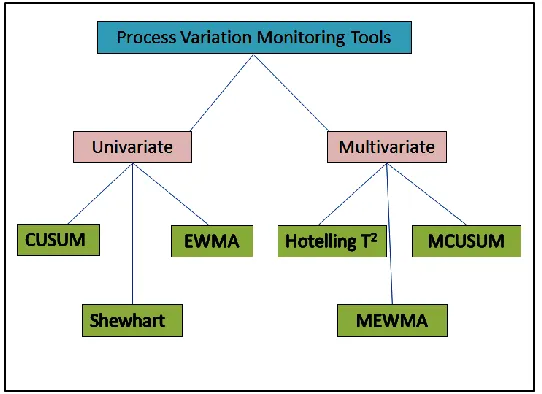
[image:21.595.124.395.244.441.2]In general, the use of statistical tools in monitoring process variation can be visualised by Figure 2.1 below :
Figure 2.1 : Process variation monitoring tools
2.3 Classical Statistical Control Schemes
The Shewhart X̅ control chart, Cumulative Sum (CUSUM) control chart, and Exponentially Weighted Moving Average (EWMA) control chart are regarded as classical control schemes. Classical statistical control techniques focus on the monitoring of one quality variable at a time. In classical control schemes, an assumption is made that the values of the process mean and variance are known prior to the start of process monitoring.
A general model for the X̅ control chart is given as follows. Let x be a sample statistic that measures some quality characteristic of interest, and suppose that the mean of x is μx and the standard deviation of x is δx. Then the control limits of the X̅ control chart are μx ± Lδx where L is defined as the “distance” of the control limits
from the in-control mean, expressed in standard deviation units. If any point exceeds the control limits, the process will be deemed out-of-control. Investigation and corrective action are required to find and eliminate the assignable cause. A major disadvantage of the X̅ control chart is that it can only use recent information, making it relatively insensitive to small to moderate shifts. Two control charts are proposed as excellent alternatives to the X̅ control chart when small to moderate shifts are of primary interest. They are the CUSUM and EWMA control charts.
The CUSUM chart incorporates all information in the sequence of sample values by plotting the cumulative sums of the deviations of the sample values from a target value. There are two ways to represent cusums: the tabular cusum and the V-mask form of the cusum. Among these two cusums, as pointed out by Montgomery (2001), tabular cusum is preferable. The mechanics of the tabular cusum are as follows. Let xi be the ith observation of the process. If the process is in control, then
The statistics are computed as follows:
where starting values are 𝐶0+ = 𝐶0− =0 and k is the reference value. If either statistic ( 𝐶0+ or 𝐶0− ) exceeds a decision interval H, the process is considered to be out-of control.
The Exponentially Weighted Moving Average (EWMA) control chart is another control scheme useful for detecting small to moderate shifts. It is defined as
𝑧
𝑖= 𝜆𝑥
𝑖+ (1 − 𝜆)𝑧
𝑖−1(2.3)
where 0 < λ ≤ 1 is a constant and the starting value is the process target, i.e., z0 =μ0.
The control limits are :
𝜇0± 𝐿𝛿√𝜆 [1−(1−𝜆)
2𝑖]
(2−𝜆) (2.4)
where L is the width of the control limits. If any observation exceeds control limits, an out-of-control condition happens.
2.4 Statistical Multivariate Process Control
In practice, many process monitoring and control scenarios involve several related variables, thus multivariate control schemes are required. The most common multivariate process-monitoring and control procedure is the Hotelling T2 control chart for monitoring the mean vector of the process. The Hotelling T2 chart was proposed by Hotelling H. (1947). There are two types of the Hotelling T2 chart : one for sub-grouped data and the other for individual observations. Since the process with individual observations occurs frequently in the chemical and process industries, the Hotelling T2method for individual observations will be introduced in the following.
(2.1)
Suppose that m samples, each of size n = 1, are available and that p is the number of quality characteristics observed in each sample. Let x̅ and S be the sample mean vector and covariance matrix of these observations respectively. The Hotelling
T2 statistic is defined as :
𝑇
2= (𝑥 − 𝑥̅)′𝑆
−1(𝑥 − 𝑥̅)
(2.5)The Upper control limit (UCL) and Lower control limit (LCL) for monitoring processes are
𝑈𝐶𝐿 = 𝑝(𝑚+1)(𝑚−1)𝑚2−𝑚𝑝 𝐹𝛼,𝑝,𝑚−𝑝 (2.6)
𝐿𝐶𝐿 = 0
where Fα,p,m-p − is the upper α percentage point of an F distribution with parameters p
and m - p.
The Hotelling T2 chart is a type of Shewhart control chart which only uses
information from the current sample. Hence, it is relatively insensitive to small and moderate shifts in the mean vector. The MCUSUM control chart and MEWMA control chart, which are sensitive to small and moderate shifts, appear as alternatives to the Hotelling T2 chart. Crosier (1988) proposed two multivariate CUSUM procedures. The one with the best ARL performance is based on the statistic:
𝐶𝑖 = {(𝑆𝑖−1+ 𝑋𝑖)′𝛴−1(𝑆
𝑖−1+ 𝑋𝑖)}1/2 (2.7)
Where
𝑆𝑖 = { 0, 𝐼𝑓 𝐶(𝑆 𝑖 < 𝑘
𝑖−1+ 𝑋𝑖) (1 −𝐶𝑘
𝑖) , 𝐼𝑓 𝐶𝑖 > 𝑘
(2.8)
𝑌𝑖 = (𝑆𝑖′𝛴−1𝑆 𝑖)
1
2 > 𝐻 (2.9)
where k and H are the reference value and decision interval for the procedure, respectively.
Two different forms of the multivariate CUSUM were proposed by Pignatiello and Runger (1990). Their best-performing control chart is based on the following vectors of cumulative sums:
𝐷𝑖 = ∑𝑖 𝑋𝑗
𝑗=𝑖−𝑙𝑖+1 (2.10)
And
𝑀𝐶𝑖 = max {0, (𝐷𝑖′𝛴−1𝐷𝑖)
1
2− 𝑘𝑙𝑖} (2.11)
where k > 0, li = li-1 + 1 if MCi-1 > 0 and li = 1 otherwise. An out-of-control signal is generated if MCi > H.
The EWMA control charts were developed to provide more sensitivity to small shifts in the univariate case, and they can be extended to multivariate quality control problems. Lowry et al. (1992) and Prabhu and Runger (1997) developed a multivariate version of the EWMA control chart (MEWMA chart). The MEWMA chart is a logical extension of the univariate EWMA and is defined as follows:
𝑍𝑖 = 𝜆𝑋𝑖+ (1 − 𝜆)𝑍𝑖−1 (2.12)
where 0 < λ ≤ 1 and Z0 = 0.
The MEWMA statistic is 𝑇𝑖2 = 𝑍𝑖′𝛴𝑧−1𝑖 𝑍𝑖 where the covariance matrix is as follows.
𝛴𝑍𝑖 = 1−𝜆𝜆 [1 − (1 − 𝜆)2𝑖]𝛴 (2.13)
2.5 Monitoring Multivariate (Bivariate) Process Variation
[image:26.595.146.499.399.720.2]In manufacturing industries, process variation has become a major source of poor quality, hence it needs to be monitored and diagnosed using the statistical process control (SPC) charting tools. Practically, processes or quality characteristics comprised of two or more dependent (correlated) variables, whereby they are need to be monitored and diagnosed simultaneously. This method of quality control is known as multivariate quality control (MQC) (Montgomery, 2005). Simultaneous monitoring approach is capable of detecting unusual sample with respect to the other samples based on joint control region, while independent monitoring approach (based on different Shewhart control charts) is nearly impossible to detect an assignable cause in the presence of bivariate correlated sample (Montgomery, 2005).
Figure 2.3 : Joint monitoring
2.6 Multivariate Pattern Recognition (MPR) Scheme and Recognizer Design
The existing MPR Scheme are categorized in to two categories, they are (i) ANN-Based model and (ii) Integrated MSPC-ANN model, based on external structures.
They are researchers who designed ANN-based model which performed process monitoring simultaneously and continuously, they are (i) Zorriassatine et al. (2003) (ii) Guh (2007) (iii) Yu and Xi, (2009) and (iv) El-Midany et al. (2010)
represents only the shift in variable-2. The performance of the scheme was based on recognition accuracy (RA).
Figure 2.4 : Novelty detector-ANN recognizer (Zorriassatine et al. 2003)
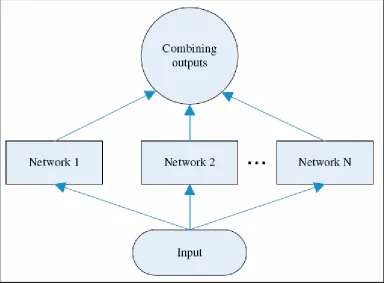
Yu and Xi (2009) designed ensemble-ANN as shown in Figure 2.5, which monitor and diagnose bivariate process mean shifts. The are three possible sources of variation, namely upward shift (1,0), upward shift (0,1) and upward shift (1,1). The upward shift (1,0) pattern represents the shift in variable-1 only, upward shift (0,1) pattern represents the shift in variable-2 only, whereas upward shift (1,1) pattern represents the shifts in both variables. The overall monitoring-diagnosis performance were measured based on average run lengths (ARL0, ARL1) and recognition
Figure 2.5 : Ensemble-ANN (Yu and Xi, 2009)
Yu et al. (2009) provided additional results based on three variables case as shown in Figure 2.5, which were designed to perform sequential process monitoring and diagnosis. Based on “one point out-of-control” charting rules, the traditional MSPC chart (T2, MCUSUM or MEWMA) was applied to monitor the process mean shifts. Once an out-of-control signal is detected, the ANN recognizer begins to identify the sources of variation (mean shifts) based on pattern recognition technique.
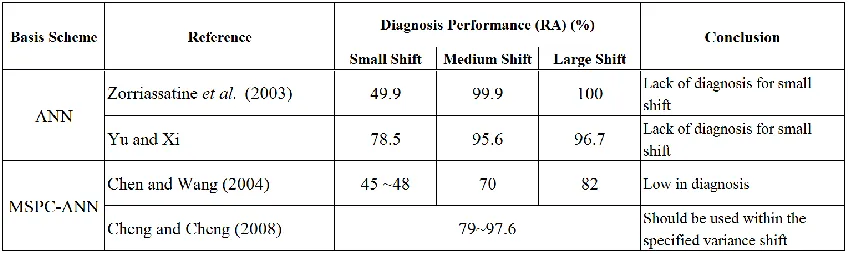
From all the literatures reviewed, it shows that the raw data-based technique is still the most common input representation technique, and in fact, the schemes described above (as in figures 2.4 to 2.5) are all using raw data as input representation. Several limitations of the existing MPR schemes has been revealed from the literature review. The main weakness can be observed based on overall diagnosis performances, which were evaluated using Recognition Accuracy (RA). Table 2.0 below shows the monitoring-diagnosis results of existing MPR schemes.
However, it was observed that there is problem to correctly identify the sources of variation when dealing with small mean shifts (≤ 1.0 standard deviation). Zorriassatine et al. (2003), Chen and Wang (2004) and Yu and Xi (2009), for examples, have reported RA less than 80% for mean shifts 1.0 standard deviation. The lack of diagnosis problems in main of the existing MPR schemes are observed as the core issues that need to be improved. In order to minimize inaccuracy in decision making in MSPC charting, it is important to enhance the overall monitoring-diagnosis performances towards achieving accurate diagnosis (capable to accurately identify the sources of variation). This issue is observed as the gap of research towards improvement.
Table 2.0 : Diagnosis Performances of some existing scheme.
2.7 Summary
CHAPTER 3
RESEARCH METHODOLOGY
3.1 Introduction
The Literature Review section has focused on MSPC Charting schemes developed for monitoring and diagnosis the bivariate/multivariate process variation,
which includes traditional charting MSPC such as T2, MCUSUM and MEWMA and
3.2 Problem Situation
An effective scheme for diagnosis of bivariate process mean shifts should be able identify the source of variation correctly. Any mistake or inaccuracy in identifying the source of variations shall lead to wrong decision making and shall increase the cost of quality due to reworks and waste produced. The existing scheme have not achieved a desirable performance in diagnosis. The scheme which is intended for such purpose is known as ANN-Based pattern recognition schemes. Generally the main interest is on identifying the sources of variation. The existing scheme is still lack of capability to identify the sources of variation when dealing with small mean shifts, which is known as “lack of diagnosis”.
3.3 Solution Concept
To overcome the “lack of diagnosis” performance, it is necessary to develop a scheme which capable to perform accurate diagnosis on the bivariate process mean shifts.
3.4 Research Methodology
[image:32.595.118.552.552.680.2]The research methodology has been designed to achieve the objectives of this research as stated in Section 1.4 in Chapter 1.
The intended scheme is called Statistical Features-ANN scheme as in Figure 3.0. In the development of this scheme, attention shall be given on basic design for accurate diagnosis operation, modelling of bivariate sampels and patterns, input representation into an ANN recognizerm design and training of an ANN recognizer and computation of diagnosis performance using Recognition Accuracy (RA). The detail of the scheme shall be provided in Chapter 4. The development of the Statistical Features-ANN also shall be focusing on internal design of the scheme, by reducing dimensional input data using statistical features input representation. This shall include the statistical features selection. Statistical features selection is crucial in developing Statistical Features-ANN. The reason is because if too many statistical features shall burden the ANN training process, while if too few statistical features used shall result in insufficient representation. Therefore a minimal number of statistical features used shall be investigated in this research.
[image:33.595.116.521.488.705.2]In developing Statistical Features-ANN scheme, several research questions related to the objectives of this research have been answered as summarised in Table 3.1 and 3.2 below.
Table 3.2 : Research question 2
3.5 Summary
CHAPTER 4
RESULT AND DISCUSSION
4.1 Introduction
In Chapter 2, it was clear that the existing scheme which use raw data as input representation has poor performance of diagnosis the process mean shift. In Chapter 3, the research methodology has outlined the research plan on the development of Statistical Feature-ANN which is expected to have better diagnosis capability than the existing scheme. In Chapter 4, the implementation of the research methodology shall be reported.
Firstly, Chapter 4 shall cover the detail in development of the Statistical Features-ANN scheme and this include the testing of the scheme. Secondly, Chapter 4 shall focus on the improvement on the Statistical Features-ANN through the selection of minimal number of suitable statistical features which could result in the high performance of diagnosis capability, which is evaluated using the value of Recognition Accuracy (RA). The targeted value of Recognition Accuracy is greater than 95%.
REFERENCES
Alt, F., “Multivariate Statistical Quality Control,” in The Encyclopedia of Statistical Sciences, edited by Kotz, S., Johnson, N., and Read, C., (New York: John Wiley, 1985): 110-122.
Chakraborty, S., & Tah, D. (2006). Real time statistical process advisor for effective quality control. Decision Support Systems, 42(2), 700–711.
Chen, L. H. and Wang, T. Y. (2004). “Artificial Neural Networks to Classify Mean Shifts from Multivariate χ2 Chart Signals.” Computers and Industrial Engineering. Vol. 47. pp. 195 − 205.
Cheng, C. S. (1997). “A Neural Network Approach for the Analysis of Control Chart Patterns.” International Journal of Production Research. Vol. 35 No. 3. pp. 667 − 697.
Cheng, C. S. and Cheng, H. P. (2008). “Identifying the Source of Variance Shifts in the Multivariate Process Using Neural Networks and Support Vector Machines.” Expert Systems with Applications. Vol. 35 pp. 198 − 206.
Chih, W. H. and Rollier, D. A. (1994). “Diagnosis Characteristics for Bivariate Pattern Recognition Scheme in SPC.” International Journal of Quality and Reliability Management. Vol. 11 No. 1. pp. 53 − 66.
Chih, W. H. and Rollier, D. A. (1995). “A Methodology of Pattern Recognition Schemes for Two Variables in SPC.” International Journal of Quality and Reliability Management. Vol. 12 No. 3. pp. 86 − 107.
El-Midany, T. T., El-Baz, M. A. and Abd-Elwahed, M. S. (2010). “A Proposed Framework for Control Chart Pattern Recognition in Multivariate Process Using Artificial Neural Networks.” Expert Systems with Applications. Vol. 37. pp. 1035 − 1042.
Gauri, S. K., & Chakraborty, S. (2006). Feature-based recognition of control chart patterns. Computers and Industrial Engineering, 51(4), 726–742.
Gauri, S. K., & Chakraborty, S. (2008). Improved recognition of control chart patterns using artificial neural networks. International Journal of Advanced Manufacturing Technology, 36(11–12), 1191–1201.
Guh, R. S. (2007). “On-Line Identification and Quantification of Mean Shifts in Bivariate Processes Using a Neural Network-Based Approach.” Quality and Reliability Engineering International. Vol. 23. pp. 367 − 385.
Guh, R. S. and Shiue, Y. R. (2005). “On-line Identification of Control Chart Patterns Using Self-Organizing Approaches.” International Journal of Production Research. Vol. 43 No. 6. pp. 1225 − 1254.
Hassan, A. (2002). “On-Line Recognition of Developing Control Chart Patterns.” Universiti Teknologi Malaysia: Ph.D. Thesis.
Hassan, A., Nabi Baksh, M. S., Shaharoun, A. M. and Jamaluddin, H. (2006), “Feature Selection for SPC Chart Pattern Recognition Using Fractional Factorial Experimental Design,” 2nd I*IPROMS Virtual International Conference on Intelligent Production Machines and Systems.
Haykin S (1999) “Neural Networks : A comprehensive foundation” (2nd Edition) Upper Saddle Rever, New Jersey : Prentice Hall.
Hotelling, H. (1947). “Multivariate Quality Control. Techniques of Statistical Analysis” New York: McGraw-Hill.
Jackson, J. E. (1991). “A User Guide to Principle Components.” New York: John Wiley.
Applications to the Eastman Challenge Problem.” Computers and Chemical Engineering. Vol. 26. pp. 161 − 174.
Lehmann, R.S. (1977) “Computer Simulation and modelling: An introduction” London : Lawrence Erlbaum
Lowry, C. A., Woodall, W. H., Champ, C. W. and Rigdon, S. E. (1992). “A
Multivariate Exponentially Weighted Moving Average Control Chart.”
Technometrics. Vol. 34. No 1. pp. 46 − 53.
Masood, I., and Hassan, A., (2010), “Issues in Development of Artificial Neural Network Based Control Chart Pattern Recognition Schemes”, European Journal of Scientific Research, Vol. 39, No. 3, pp 336-355
Montgomery, D. C. (2005). “Introduction to Statistical Quality Control.” 4th. ed. USA: John Wiley & Sons, Inc.
Niaki, S. T. A. and Abbasi, B. (2005). “Fault Diagnosis in Multivariate Control Charts Using Artificial Neural Networks.” Quality and Reliability Engineering International. Vol. 21. pp. 825 − 840.
Pham, D. T., & Wani, M. A. (1997). Feature-based control chart pattern recognition.International Journal of Production Research, 35(7), 1875–1890.
Pignatiello, J. J. and Runger, G. C. (1990). “Comparison of Multivariate CUSUM Charts.” Journal of Quality Technology. Vol. 22. No. 3 pp. 173 − 186.
Prabhu, S. S. and Runger, G. C. (1997). “Designing a Multivariate EWMA Control Chart.” Journal of Quality Technology. Vol. 29 No. 1. pp. 8 − 15.
Sepulveda, A. and Nachlas, J. A. (1997). “A Simulation Approach to Multivariate Quality Control.” Computers and Industrial Engineering. Vol. 33 No. 1 − 2. pp. 113 − 116.
Shewhart, W.A (1931) “Economic control of quality of manufactured product”. USA: D Van Nostrand Company, Inc.
Wang, T. Y. and Chen, L. H. (2001). “Mean Shifts Detection and Classification in Multivariate Process: A Neural-Fuzzy Approach.” Journal of Intelligence Manufacturing. Vol. 13. pp. 211 − 221.
Yu, J. B. and Xi, L. F. (2009). “A Neural Network Ensemble-Based Model for On-Line Monitoring and Diagnosis of Out-of-Control Signals in Multivariate Manufacturing Processes.” Expert Systems with Applications. Vol. 36. pp. 909 − 921.
Yu, J. B., Xi, L. F. and Zhou, X. J. (2009). “Identifying Source(s) of Out-of-Control Signals in Multivariate Manufacturing Processes Using Selective Neural Network Ensemble.” Engineering Applications of Artificial Intelligence. Vol. 22. pp. 141 − 152.