Journal of Chemical and Pharmaceutical Research, 2014, 6(4):396-400
Research Article
CODEN(USA) : JCPRC5
ISSN : 0975-7384
Performance mechanism of learning capability based on dynamic
capability framework-the mediating role of operational capabilities
Gao Tiantian* and Tian Yezhuang
School of Management, Harbin Institute of Technology (Affiliated to HIT Science Park 2H, Harbin), China
_____________________________________________________________________________________________
ABSTRACT
This paper propose a new vision to distinguish dynamic capabilities from operational capabilities and show how they contribute to enterprise performance. Data from International Manufacturing Strategy Survey in 2009 is used to verify the mediating model by hierarchical regression analysis. The results integrate insights from previous research in dynamic capability frame work and operational management into a generalization and extension of the performance mechanism in manufacturing enterprises.
Keywords:Dynamic capability, Operational capability, Enterprise performance.
_____________________________________________________________________________________________
INTRODUCTION
Organizations’ survival environment has changed dramatically due to the globalization and technological change. This forced enterprises to continuously adapt, update, resets the internal resources and capabilities to cope with the increasingly complex and unpredictable market. Accordingly, dynamic capabilities framework has been proposed that firm’s operational capabilities are directly involved in converting inputs into outputs and its dynamic capabilities change those operational capabilities to help the firm to adapt to changes in the external environment[1].
Although dynamic and operational capabilities are assumed to be separate constructs, current literature has not fully distinguished between them. First, without such clarification it is likely that one scholar will classify a particular capability as operational while another will classify that same capability as dynamic. Wu, Melnyk, & Flynn, for example, define product development capabilities developed within a firm’s operations function as operational[2], while Helfat and Winter categorize these same capabilities as dynamic[3]. Second, we need this distinction to understand the mechanism(s) by which dynamic capabilities change operational capabilities and ultimately firm performance. This paper provide a way to understand the distinction between dynamic and operational capabilities, and investigate empirically whether a given dynamic capability influences firm performance by updating (renewing) a single operational capability or a number of them.
LITERATURE REVIEW AND HYPOTHESIS
Distinction between dynamic capability and operational capability
If we consider the dynamic and static systems concepts developed by Knight and Klein, we might be able to apply these concepts as we develop a new framework that distinguishes dynamic capabilities from operational ones[7, 8]. Systems that change in a predictable manner should be considered static or zero-order. Applying this systems concept to the field of dynamic capabilities, I distinguish between operational and dynamic capabilities by determining whether or not the outcome resulting from a change produced by a capability is predictable. If an operational capability induces change in a different firm capability, then the outcome of that change can be estimated a prioriusing initial conditions. If a dynamic capability induces change in a different firm capability, then the outcome of that change cannot be estimated a prioriusing initial conditions.
According to the dynamic capability framework, a firm’s learning capabilities are considered dynamic capabilities[5] because knowledge created by engaging in learning activities can be used to renew a firm’s operational capabilities[9].It is difficult to estimate outcomes resulting from the creation of new capabilities and resources because the creation of new capabilities entails high levels of uncertainty[10]. Literature in the operations management field has currently classified operational capabilities into three types: quality, efficiency, flexibility. The changes inducing by these capabilities are certain and can be estimated[11].
Dynamic capability, operational capability and enterprise performance
Dynamic capabilities can impact enterprise performance in a variety of ways: First, the dynamic capabilities create market value by matching the resource base in changing environment[12]; Second, the dynamic capabilities support the mechanism of resource mining and capacities building [13]; Third, the dynamic capabilities enhance performance by promoting timeliness, speed and efficiency of organizational response to the market environment [14].
Learning capability as a dynamic capability, of which newly created knowledge can lead to the development of new capabilities and resources that help a firm gain a competitive advantage. Learning from customers and suppliers can achieve performance improvement through continuous absorption and transformation of external information and resources[5].
H1:Learning capability will have a positive relationship on enterprise performance.
The quality capability influences a firm’s overall performance and is defined as a firm’s ability to meet customers’ requirements and expectations[15];Operations managers have developed quality management tools such as qualityfunction deployment (QFD) to learn from customers and to track changing customerrequirements over time. Through the application of QFD, a firm can learn about thefeatures/attributes customers want and value in a product and use that information todesign products that conform to customers’ requirements and expectations[16]. Customer knowledge that is accumulated incrementally helps a firm tomodify and/or create new products to meet customers’ expectations. Incrementalknowledge acquired by engaging in learning activities can help a firm todesign, through many iterative processes, products that meet customers’ requirements andexpectations and eventually influence a firm’s overall performance.
H2a:Learning capability will have a positive relationship on qualitycapability.
H2b:Quality capability mediates the relationship between learning capability and enterprise performance.
A firm’s efficiency capability influences firm performance and is definedas a firm’s ability to produce goods and provide services at the lowest possible cost[17]. Tacit customer and supplier knowledge that can be used to modify a firm’s existing processesand create new one can be acquired efficiently by firms by involving customers in theproduct design and development process, encouraging them to share market informationand developing business plans together[18]. Knowledge acquired by engaging in learning activitiesrenews a firm’s efficiency capability, which in turn influences overall firmperformance.
H3a: Learning capability will have a positive relationship on efficiency capability.
H3b: Efficiency capability mediates the relationship between learning capability and enterprise performance.
H4a: Learning capability will have a positive relationship on flexibility capability.
H4b: Flexibility capability mediates the relationship between learning capability and enterprise performance.
DATA ANALYSIS AND EMPIRICAL RESULTS Data source and variables measurement
The data comes from the fifth edition of the International Manufacturing Strategy Survey (IMSS-V) in 2009. There are 506 samples of eight industries in 20 countries after removingthe missing values. Enterprise performanceis measured by return on sales (ROS) and return on investment (ROI).Learning capability measures the extent to which a firm learns aboutchanging market demands from its customers, suppliers and works with them to obtain feedback about product offerings.Quality capabilityis measured by what extent afirm produces reliable and conformable products. Efficiency capabilityis constructed by the extent to which a firm can produce products at low costs. Flexibility capability is constructed by the extent to which a firm can switch from producingone product line to another and the extent to which it can change the rate of production.
Reliability and validity
This paper uses SPSS 17.0 to test reliability. Cronbach 's Alpha coefficients of all variables are greater than 0.6, showing good reliability. Confirmatory factor analysis show fitting index as followed: chi square/df = 1.92, RMSEA = 0. 069, CFI = 0.93, GFI = 0.85, AGFI = 0.901. Model fitting results are good, and at the same time the factor loading coefficient of each variable show good convergent validity. The square root of average extraction variance (AVE)of each variable is greater than the correlation coefficient of this variable with other variables, which has better discriminant validity. Reliability, validity of test results and the correlation matrix are shown in table-1.
Table -1Reliability, validity and correlation matrix
Variables Cronbach’sα Mean s.d. 1 2 3 4 6
1 Learning capability .722 3.19 .904 .778 2 Quality Capability .816 3.88 .907 .206** .767 3Efficiency Capability .875 3.25 .919 .193** .215** .834 4 Flexibility Capability .819 3.72 .882 .185** .107* .278** .814 5Enterprise Performance .883 3.21 .771 .209** .209* .216** .269** .846
N=506, ** p<0.001, * p<0.01, numbers on the diagonal show square roots of AVE.
Empirical results
[image:3.595.141.466.521.592.2]This paper takesoperational capabilities as mediating variables and examine the relationships between dynamic capabilities in manufacturing enterpriseand performance. Results are shown in Table 2-4.
Table -2Mediating test of Quality Capability between Learning capability and Enterprise performance
Model 1 Model 2 Model 3 Variables Quality capability Enterprise performance Enterprise performance Learning capability .205** .188** .094
Quality capability .202**
F 2.75** 2.02** 2.46**
Adjusted R2 .191 .083 .096
ΔR2 .192** .167** .024*
[image:3.595.137.475.624.692.2]N=506, ** p<0.001, * p<0.01, standardized coefficients are reported.
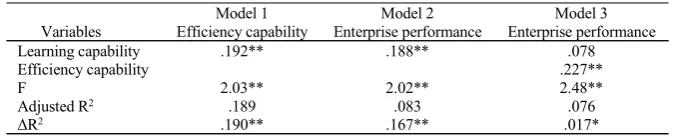
Table - 3Mediating test of efficiency Capability between Learning capability and Enterprise performance
Model 1 Model 2 Model 3 Variables Efficiency capability Enterprise performance Enterprise performance Learning capability .192** .188** .078
Efficiency capability .227**
F 2.03** 2.02** 2.48**
Adjusted R2 .189 .083 .076
ΔR2 .190** .167** .017*
N=506, ** p<0.001, * p<0.01, standardized coefficients are reported.
entering the operational capabilities. This conclusion shows the completely mediating role of operational capabilities. The hypothesis 2-4 areverified.
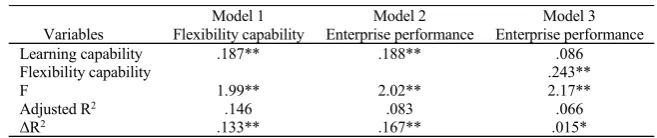
Table - 4 Mediation test of Flexibility capability between Learning capability and Enterprise performance
Model 1 Model 2 Model 3 Variables Flexibility capability Enterprise performance Enterprise performance Learning capability .187** .188** .086
Flexibility capability .243**
F 1.99** 2.02** 2.17**
Adjusted R2 .146 .083 .066
ΔR2 .133** .167** .015*
N=506, ** p<0.001, * p<0.01, standardized coefficients are reported.
DISCUSSION AND CONCLUSION
Although dynamic capability literature posits that dynamic capabilities influencefirm performance through operational capabilities, prior studies examine the directrelationship between dynamic capabilities and firm performance rather than a relationshipmediated by operational capabilities. Therefore, it is unclear from these studies ifoperational capabilities actually mediate the relationship between dynamic capabilitiesand firm performance and whether in fact dynamic capabilities consistent with thedefinition were established. It is also unclear from these studies whether dynamiccapabilities influence firm performance by renewing a single operational capability orseveral of them.
This paper finds that dynamiccapability may renew several operational capabilities, and it is appropriate forinfluencing firm performance through them. When a firm’s given dynamiccapability-learning capability influences firm performance through the renewal of operationalcapability such as quality,efficiency and flexibility capability, the firm improve its performance. It is essential for a firm to understand how its dynamiccapabilities are linked to its operational capabilities. A lack of such knowledge couldprompt firm managers to invest in a dynamic capability that minimally influences firmperformance. Danneels shows that Smith Corona’s performance did not improveeven after the firm invested substantially to develop a new dynamic capability[21].Thisstudy enhances our understanding ofdynamic capabilities by distinguishing them from operational capabilities and by showinghow they contribute to firm performance through the renewal of operational capabilities.
Acknowledgement
This work is partially supported by Professor TianYezhuang.We also gratefullyacknowledge the helpful comments and suggestions of the reviewers, which have improvedthe presentation.
REFERENCES
[1] DJ Teece; G Pisano; AShuen.Strategic Management Journal.,1997, 18(7), 509-533. [2] SJ Wu;SA Melnyk;BB Flynn.Decision Sciences.,2010, 41(4), 721-754.
[3] CE Helfat; SG Winter.Strategic Management Journal.,2011, 32(11), 1243-1250. [4] DJ Teece.Strategic Management Journal.,2007, 28(13),1319-1350.
[5] M Zollo;SG Winter.Organization Science.,2002, 13(3), 339-351.
[6] K Ferdows;ADeMeyer.Journal of Operations Management.,1990, 9(2), 168-184. [7] BH Klein.Dynamic economics,Mass, Harvard University Press,Cambridge,1977, 68.
[8] FH Knight. Risk, uncertainty and profit,HougthonMifflin company,Boston and New York1921, 121. [9] CE Helfat; MA Peteraf.Strategic Management Journal.,2003, 24(10), 997-1010.
[10] B Kogut; U Zander.Organization Science.,1992, 3(3), 383-397.
[11] RH Hayes; SC Wheelwright.Restoring our competitive edge: competingthrough manufacturing, Wiley, New York,1984, 45.
[12] KM Eisenhardt;JA Martin.Strategic Management Journal.,2000, 21(10), 1105-1121. [13]R Makadok.Strategic Management Journal.,2001, 22(5),387-401.
[14] DAChmielewski;APaladino.Management Decision.,2007, 45(3),462-483. [15] DA Garvin.Harvard Business Review.,1987, 65(6), 101-109.
[16] JR Hauser;D Clausing.Harvard Business Review.,1988,66(3), 63-73.
[17] LJ Krajewski;LP Ritzman;MK Malhotra.Operations management : processesand supply chains (9th ed.),Prentice Hall, Upper Saddle River, N.J.,2010, 87.
[18] GS Day.The Journal ofMarketing.,1994, 58(4), 37-52. [19] D Gerwin.ManagementScience.,1993, 39(4), 395-410.