Munich Personal RePEc Archive
Western guilt and Third World
Development : Part 2
Baafi Antwi, Joseph
SODERTORNS UNIVERSITY
18 May 2011
Online at
https://mpra.ub.uni-muenchen.de/31012/
1
TI TLE
WESTERN GUI LT AND THI RD WORLD DEVELOPM ENT – THE
FI NAL VERDI CT : PART 2
JOSEPH AN TW I BAAFI
MSc ECONOM I CS
Södertörns University
School of Social Science
Sweden
18th M AY, 20 11
2
ABSTRACT
This w or k consider ed the ar gument of the opponent of Wester n guilt and the
final ver dict w as issued. The four thematic ar eas; colonialism, neo-colonialism,
slave tr ade and tr ade bar r ier s w er e used. The w or k found that these events
w er e of enor mous benefits to Thir d Wor ld countr ies though w idely cr iticized by
the pr oponents of Wester n guilt. The w or k also consider ed factor s that have
r esulted in the under development of Thir d Wor ld countr ies. These factor s w er e
identified as human r esour ce development and cor r uption. I f these tw o factor s
w er e given ser ious consider ation, Thir d Wor ld countr ies w ould have developed
much faster w ith the abundant physical r esour ces at their disposal. The ver dict
w as that, the density of Thir d Wor ld countr ies lies in their ow n hands. Their
development cannot be tr ace to any event pr esent or futur e. Realizing the need
for human r esour ce development and fighting cor r uption is an impor tant
3
1.0 I N TROD U CTI ON
Part one of this work considered the arguments of the proponent of Western guilt
using four thematic areas. These areas include Colonialism, Neo-colonialism,
Slave Trade and Trade barriers. Each of these arguments gave substantial
evidence to support the fact that the West is truly responsible for the poverty of
Third World countries. This paper forms part two of the work. We shall in this
paper, consider argument against Western guilt. I n other words, we shall
consider how much positive influence the West had on Third World as a result of
their engagements. H ave the West truly ‘exploited’ Third World countries in their
engagements? We argue in favor of Western guilt and provide a verdict on the
subject.
2.0 OPPON EN TS OF W ESTERN GU I LT
We begin this section with a quote from a Lecture delivered by Professor Mazrui
(1979), a Professor of Political Science at the University of Michigan who admits
himself to have been trained and educated in a Westernized institution of which
he was trained and educated free of charge. H e writes in his lecturers,
…Afr ica, the fir st habitat of man, has decayed thr ough human neglect; it is now the least
habitable continent because of disease, lack of communication and political instability.
Afr icans though they have not exper ienced a holocaust such as that exper ienced by the
Jew s, or genocide such as that of indigenous Amer ican I ndians or Austr alians at the
hands of the white people, have been the most humiliated people in histor y thr ough the
slave tr ade, colonialism and r acial discr imination. Afr ica societies ar e not the closet
cultur ally to the West, yet they have r ecently been r apidly w ester nized. I n Afr ica,
immense miner al w ealth and agr icultur e; potential co-exist w ith extr emely low living
standar d. Afr ica, the second lar gest continent, is the most fr agmented, split into mor e
than fifty nations, many of them tiny. Finally, Afr ica, a lar ge continent centr ally and
str ategically located in the Wor ld, plays only a mar ginal r ole in Wor ld affair s…1
4
The causes of the predicament of humiliation, poverty and political impotence
and the possible remedies are Professor M azrui’s main concerns. The prime
responsibility for this predicament is as usual, the white man, the west.
Well, Bauer P., one of the notable opponent of Western guilt obviously has a reply
for him. Bauer has been an influential figure when it comes to arguments against
Western guilt and has written extensively in this area. This section will consider
some of his arguments as well as the arguments of other writers and relate them
to the happenings of today’s ‘Modern Third World Countries’. We shall delve into
four arguments using the four thematic areas as used in the part one of this work.
2.0 .1 Colonialism and N eo-colonialism
We begin the argument starting from the contact of the West with the Third
World countries. Third World countries have benefited so much from such
contact. Throughout the Third World or Developing countries, large mineral,
commercial, agricultural and industrial complexes have been built. The invasions
of the West in developing countries have contributed to such improvement. The
poorest and most backward countries in the developing part of the world really
had no contact with the West nor were they colonized. Such countries began their
growth when they opened up the more to western influence. But before that,
there were no industrial corporations. Countries that fit this situation as
examples include Chad, Nepal, Sikkim and Bhutan. Today, we see such huge
difference in the growth and development of such countries’ as compared to other
countries such as South Africa that was heavily influence by the West. South
Africa today stands as one of the most developed countries the Africa and most
Third World countries.
Contact with the West has ensured that industries have sprunged up and that
quality of life in terms of life expectancy have improved. As Peter Bauer writes in
5
…this is near ly the opposite of the tr uth as one can find. The Br itish took the r ubber to
M alaya and tea to I ndia. Ther e wer e no r ubber tr ees in M alaya or anyw her e in Asia (as
suggested by their botanical name, Hevea br aziliensis) until about one hundr ed year s
ago, when the Br itish took the fir st r ubber seeds ther e out of Amazon jungle. Fr om these
spr ang the huge r ubber I ndustr y – now ver y lar gely Asian-ow ned. Tea plants wer e
br ought to I ndia by the Br itish somewhat ear lier ; their or igin is shown in the botanical
name Camilla sinensis, as w ell as in the phr ase ‘all the tea in China’…. Again Bauer Writes …So far fr om condemning Thir d Wor ld people to death, Wester n contact have been behind the lar ge incr ease in life expectation by the same cr itics2
Another example could be cited of Tanganyika (modern day Tanzania). Before
Tanganyika made contact with the West, history has it that it was an empty
region, thinly and sparely populated with tribal people exposed to Arab slave
trade. Tanganyika virtually had no structured political and economic systems.
Residences were peasant farmer who had no idea of modern scientific technology
for farming. There were no plantations, no extractive activities; no system of
commerce, the list can go on and on. Not even the idea of it. Contact of
Tanganyika with the West has put the country on her present level. I n
Tanganyika and elsewhere in Africa and the Third World, the most prosperous
areas are those with most commercial contact with the West.
As one moves away from the concentrations of Western impact, the level of
material improvements diminishes. Areas such as West Africa, Southeast Asia,
Latin America, the mineral-producing areas of Africa and the Middle East, the
cities and ports throughout Asia, Africa and the Caribbean and Latin America
have enjoyed numerous and diversified advancement as a result of contact with
the West. These areas have improved materially far above areas that had little or
no contact with the West. The transformation of Malaya (present day Malaysia) is
instructive. I n the 1890s it was a sparsely populated area of Malay hamlets and
fishing villages. By the 1930, it had become the hub of world’s rubber and tin
2 Bauer Peter (2000), Fr om Subsistence to Exchange and other essays, Princeton University
6
industries.3 The poorest and most backward of aborigines, pygmies and desert
people are evidence examples. H istory has it that whenever there is a contact
between two countries (one developed and the other undeveloped), material gain
always tend to flow from the developed one to the undeveloped one. An example
is the contact between United State and Britain before 1776, Australasia and
Britain in the 1800s and the Scandinavia and I taly. This capital flow is a common
sense and something that has occurred through history even in bible times. Thus
the arguments that capital flow in the reverse other as put forward by proponents
of Western guilt may be wrong. These contacts offered correspondily greater
opportunities, especially in view of the great i mprovement in transportation and
telecommunication over the last two hundred years. Even the idea of material
progress in relation to man’s need of controlled sustained environment in the
quest of development came from the West. Thus not only was the West interested
in creating and opening up areas, they also took keen interest in environmental
conditions and general well being of the people.
Further quotes from Bauer can do the trick. Bauer writes
… The r oles of Wester n contacts in the mater ial pr ogr ess of black Afr ica deser ve fur ther
notice. As late as the second half of the nineteenth centur y Black Afr ica was w ithout
even the simplest, most basic ingr edients of moder n social and economic life. They wer e
br ought ther e by the Wester ner s over the last hundr ed year s or so. This is tr ue of such
fundamentals as public secur ity and law and or der ; w heeled tr affic (Black Afr ica never
invested the w heel) and mechanical tr anspor t (befor e the ar r ival of Wester ner s,
tr anspor t in Black Afr ica w as almost entir ely by human muscle); r oads, r ailw ays, and
manmade por ts; towns w ith substantial building, clean w ater , and sew er age facilities;
public health car e, hospitals and the contr ol of endemic and epidemic disease, for mal
education etc. These advanced r esulted fr om peaceful commer cial contacts
From the foregoing, it is clear that Western contact has been very important in
the development progress of the Third World countries. The main assumption
behind the concept of Western guilt has been that the richness of one country is
7
directly linked with the poverty of the other. Which can be put in a general term
called exploitation. This word is often summed up in one term called colonialism.
I t has been welcomed in many meetings and writings the world over and a few
has greeted it with hostilities. But is the whole idea of colonialism and
neo-colonialism as a major responsible fact of Third World poverty true? What about
areas that were never colonized or were touch with very few years of colonialis?
We must note that some of the most backward countries were never colonized. As
for instance Afghanistan, Tibet, Liberia and even Ethiopia are telling examples.
According to Ethiopia historians, the so called colonial activity of I taly was not a
colonial activity. I t was a war between Ethiopian and I taly that lasted for six years.
I f this is anything to go by, then it means in effects that Ethiopia was never
colonized. I f colonialism and neo-colonialism were such heavy burdens of Third
World countries in relations to their development, why is it that these countries
are not way ahead of the others? As a matter of fact, many of the African and
Asian colonies progressed very rapidly during colonial rule, much more than the
independent countries in the same period. Ghana for instance, in the 1950s was
way ahead of Liberia and Ethiopia in many respects economically and politically.
We should again be quick to acknowledge that the prosperity of the West cannot
also be linked with colonialism as most advanced countries never took colonies.
These countries include the Scandinavia (Sweden, Norway, and Finland) and
Switzerland. Even so, Australia today has become that prosperous as a result of
colonialism by the Britain. I f colonialism was that bad and negative as we see it
today, why have some countries been able to take full advantage of it and turn it
to their benefit. I n fact, foreign private investment and the activities of
multinational companies have expanded opportunities and raised incomes and
government revenue in the Third World. Thus reference to economic colonialism
and all forms of colonialism and neocolonialism both debase the language and
distort the truth.
Tribal and ethnic discrimination has been a serious argument for proponents of
8
World countries for centuries even before the West established contact. There
were racial killings between the Arabs and black skinned person and tribal and
ethnic persecution by government of Third World countries. That
notwithstanding, countries that supposedly experienced such tribal and ethnic
discrimination such as the Chinese in Southeast Asia, I ndians in part of
Southeast Asia and other have experienced much growth and development.
I t is very easy to bypass such matters as the brutal persecution on ethnic and
cultural grounds of large numbers of people in South-East Asia, the Middle East
and of course, Black Africa. I n Asia and Africa such large-scale persecution is
widespread and evident, including often officially organized and supported tribal
discrimination and its attendance genocide. Countries that easily come in mind
are Uganda, Liberia, Angola, Burundi etc. Are we just arguing about the killings
of Africans by Europeans?
What about the genocidal killings between Hutus and Tutsi in Rwanda and Burundi?
What about the various political unrest in countries such as Liberia, Angola, Uganda, Congo Dr and most recently Cote d’ivore
What about the large-scale massacres in the early wars of the Zulus, or the slaughter of the I bos’ by the H ausa in 1966
What about the extremely brutal Muslim conquest of the Sudan in the last nineteenth century?
What about the oppression of the tribal groups, the great majority of the population by the Coastal Black rulers of Liberia?
What about the lording of Amharic’s over the Galle in Ethiopia
The list goes on and on. The big question is, I s the West responsible for these
killings?
One cannot also forget of the very limited trade historically between Black Africa
and North Africa. Relationship between these two regions can only be reduced to
the intermittent conquest by North Africa of part of Black Africa and also the
9
Africans were lost on the hands of these North African slave raiders for want of
not having descendance with them. This explains why there are very few or no
African descends in the Arab land. At least in the West, there are still African
descend. Again slave trade between Africa and the Middle East and between
Africa and North Africa antedated the Atlantic slave trade by centuries and far
outlasted it. Even when slavery has been completely aborted by the west generally,
‘illegal’ trading activities were still ongoing between Black Africa and North Africa.
The big question is why ‘Arabs and Africans do not seem to feel guilty about
slavery and the slave trade; but Western Europeans and Americans often do and
are made to do so. And yet it was due to their efforts that these practices were
largely eliminated’.
Let’s take another twist to the issue. Slave trading were involved with two groups
of people on either side of the bargain; the Africans themselves (sellers) and the
West (Buyers). During the salve trade, it was the Africans themselves who
arrested their own people, maltreated them and kept them in prison long before
the white (West) touched on the Coast to buy them. Thus African themselves
co-operated very well to make sure that, trading was a success and a profitable
venture. This showed the depth of divisiveness and tribal/ ethnic discrimination
that existed among African even before the West came in. I f so, why then blame
only the West for slave trading and its attendance predicaments.
This notwithstanding, we must be quick to point out that, areas most involved in
the Atlantic slave trade, particularly West Africa, have become the economically
most advanced areas in Black Africa. A study of pre-colonial South-Eastern
Nigeria examines the economic development promoted by the slave trade which
‘led to sufficient economic development of the region’ to enable the profitable
trade in Palm Oil to burgeon in the early nineteenth century.4
10
We can turn our attention to the issues of fragmentation of Africa into smaller
countries and tribal and ethnic separating. The West have been largely blamed
for such fragmentation. I t is a widely held view that the West has fought over
territories of rich land in Africa among themselves and that have resulted in such
fragmentation. We can correct such anomalies in this thinking very easily. The
fragmentation and multiplicity of African states especially Black Africa states is
the result of ethnic and tribal diversity which is purely the creation of God and
which in turn reflects the age-old isolation of small and warring communities.
H igher numbers of ethnic and tribal grouping often result in higher number of
smaller community settlements for these groups. Thus the West cannot be
blamed for the fragmented nature of the African continent. After all, the
continent was as fragmented before the West came in. Another reason for this
fragmentation was the absence of even the rudimentary transport facilities and
public security system. There were virtually less and/ or no transport system to
link the various ethnic groups scattered around. As time went by when less or no
communication went on, tribal and ethnic groups became much more separated
and much more disintegrated. By providing transport/ communication facilities
and public security these isolations and fragmentation have in fact broken down
over large areas and have thus helped to create larger communities. But even
with that, Black communities are finding the integration quite difficult.
2.0 .2 TRAD E BARRI ERS
Proponents of Western guilt mostly argue on the line of I nternational trade as a
major factor. They claim there excites an unfavorable terms of trade of trade
between the West and Third World countries. Trade according to their arguments,
favours the West. But can these arguments be validated? Opponents of Western
guilt have the complete opposite to such ideology.
They argue that the poorest areas of the Third World have no external trade. This
can very much be true. Again trade with the West has benefited Third World.
Before the advent of external trade with the West, there were some levels of
11
and intra tribal trade between and among countries of the Third World especially
Africa countries. These trading activities really had no effect on the welfare of
people living in these countries. I t was external trade with the West that made
such changes. Before that, the Third World countries’ showed that the
backwardness are domestic and that external commercial contacts were
beneficial. There has been talk of the prices of Third World countries product on
the world market. I t is important to take i nto consideration that, prices are
determined by market forces. Simply, demand and supply. The West does not fix
and predetermine those prices of output produced by Third World countries.
That not withstanding, we must be quick to acknowledge that, products of Third
World countries have enjoyed consistent prices increase on the world market.
Peter Bauer acknowledged that ‘w hen changes in the cost of pr oduction, the
gr eat impr ovement in the r ange and quality of impor ts, and the huge incr ease
in the volume of tr ade ar e taken into account, the exter nal pur chasing pow er of
Thir d Wor ld expor ts is now r elatively high, pr obably mor e than ever befor e.
This situation has made it easier for gover nment to r etain lar ger pr opor tion of
expor t ear nings thr ough major incr eases in mining r oyalty r ates, expor t taxes
and cor por ation taxes.’
What about the issue of dumping? There is the general notion that dumping kills
infant industries by under pricing goods and services imported. But we should
consider that, prices of imported goods by the Third World countries are cheap
because of the efficiency of industries in the West producing them. I n any case,
these goods seen as dumped are goods that are actually needed by the Third
World countries. I ndustries in the Third World countries are not able to produce
enough to feed the ever increasing population. These goods are thus actual
necessities, and that without these supposedly dumped goods, life in most Third
World countries would have been unbearable. The coining of the word ‘dumped
good or pr oduct’ is thus unacceptable. The right word should be ‘abundance of
necessity’ thanks to the innovation of the West. Thus, Third World countries
12
The argument of dumping that result in the collapse of infant industries in Third
World countries is a rather disturbing one. This argument implies that in effect
Third World lack the ability to decide for themselves, how best to spend their own
hard earned incomes. They are looked on as children or even as puppets
manipulated by foreigners at will (Peter Bauer). Are we then looking down on the
self esteem of individual living in the Third Worlds? This is a definite no. I f this
answer is boldly negative, then it also intends negates the argument. I ndividual
living in Third World countries are people of unique intelligence, high self esteem
and extremely thoughtful. The argument of dumping is thus null and void. I f
Third World countries have taste and preference tilted Western goods and that
have accepted selectivity and not indiscriminately goods and services provided by
the West we must live the situation as it is. An attempt to read into the meanings
of their attitude and behaviors will warrant an indictment on the character of
Third World countries.
The argument
- That the economic future of the third world depends largely on Western
aid, grants, loans and donations
- The past exploitation by the West explains Third World sluggishness in
growth
- That economic fortunes past, present and future are determined and
predertmined by the West and
- That manipulation and unfair imbalances of international trade by the
West and other forms of Western unpredictable misconduct account for
persistent and continuous poverty
only point to one idea - the idea that the West is superior to the Third World
countries. This is rather an interesting situation. What is important to point out is
that Third World countries do not agree to this point - the point that the West is
superior to them. I f they don’t agree, then the above argument can easily be
cancelled out. I n effect whatever economic development growth and/ or decline is
13
3.0 OTH ER I SSU ES
3.0 .1 H U M AN CAPI TAL D EVELOPM EN T AN D PROD U CTI VI TY
Let’s consider other issues that have eluded proponents of Western guilt. We first
consider the issue of human capital development and productivity. As usual let’s
begin with this quote from Shiva Naipaul who writes about the Zambian economy.
H e states
…expatr iates staff the mines, the medical ser vices, the factor ies, the technical college, the
univer sities. Without them, the countr y w ould fall apar t. Zambia makes nothing:
Zambia cr eates nothing. The expatr iate lectur er s in English w aved apologetically at the
handful of books, per haps half a dozen on the libr ar y shelf. ‘Ther e, he said ‘that’s it.
That’s all the Zambian liter atur e ther e is. For him, the paucity is a sour ce of genuine
embar r assment. I w ould dear ly love to teach something Zambian to any students. But
w hat can I do if ther e’s nothing…5
This Zambian situation described above does not pertain to only Zambian but to
the rest of the Third World in general especially Black Africa. 6th March 2011
marked the celebration of Ghana’s 54th independence. Ghana will by then be 54
years of self-government, but Ghana still export raw bauxite (the sand that
contains bauxite) to UK for processing into alumina and even sometime silver.
Ghana still export raw gold bars, raw cocoa beans and the list goes on and on.
After 54 years of independence, Ghana has not been able to do anything to
change the agrarian-raw materials producing economy handed down by our
colonial masters. After Tetteh Quashie brought the Cocoa bean from
Phenamdopo in 1854, Ghanaians will have to wait for the British to start research
and plantation into the usefulness of Cocoa before it became beneficial to us.
Large tracts of jungle or semi desert were turned into productive land. Now
Cocoa is almost the backbone of the Ghanaian economy. What have happened to
the human capital in the country? The fact that a million or so years ago an
important stage in evolution may have taken place in Africa has nothing to do
with what has happened there in historical times. I f the Garden of Eden has
decayed, it is because its inhabitant has neglected it (Peter Beuer 2000, A liber al
14
Death Wish). I f we decided to inquire about the personal, social and political
determinants of economic achievement and progress of Third World countries
the results found will be bizarre. Leadership in Third World countries lacks the
political will because of personal and selfish gains at the expense of development
and growth. Leadership and individuals in Third World countries lack the
personal attributes and motivation the social and political conditions and will
power to ensure sustained progress. We can ask one big question? To narrow
down the question, why did Ghana have to wait for Kosmos Energy (An Oil
exploration company) to explore and identify Oil in commercial quantities and
start the drilling process in December 2010 after about 50 years of which the oil
has been there? Why should Ghana still export bauxite, gold, manganese, cocoa
and almost all the raw materials in their raw form? Why did Third World
countries wait for Europeans to explore, develop, process and market them?
Development and growth backwardness amidst over abundance of natural
resource is anomalous, paradoxical and surprising. I f this is the case, then
development of human resource should be key. I f Third world countries have
followed the foot print of human resource development, the issue of western guilt
would have been be null and void. Rapid advanced and large-scale achievement
of societies with negligible physical/ natural resource but massive development in
human resource such as Venice, British, Japan and more recently H ong Kong,
Singapore and Taiwan are evidenced all over. This means Third World countries
especially Africa would have been way ahead of all the rest of the world if they
had developed their human resource coupled with the amount/ quantity of
physical capital at their disposal. The physical resources of advanced countries
were developed by their people themselves, as for instance reclaiming of large
parts of Land from the sea as in the case of the Netherlands and generally
improving the land. African backwardness amidst ample natural resource is only
one conspicuous example of the fact that material progress depends on personal
qualities, social institution and norms, and political arrangement which make for
endeavour and achievement, not simply physical resources (Liberal death Wish.
15
3.0 .2 CORRU PTI ON
The following is an excerpt of a newspaper report by Ghana’s ace Journalist, Anas
Aremeway Anas, on corruption at only one revenue collection point - The Tema
H arbor.
…A ver itable commer cial beehive; the economic ner ve centr e of Ghana, sits on the shor es of the Atlantic and over looks the bubbling big blue sea. The sea br eeze seems to have been dir ected pur posely to pr oduce a calming effect on the cr ammed and tor r id atmospher e and on the br istling pace of business. The national flag, the Customs flag, and that of the Por ts and Har bour s go flutter ing and flying at full mast. Gallant men and women r esplendent in their unifor m complete with their ber ets embossed with the sacr ed Coat of Ar ms, walk ar ound in high mor ale. Businessmen in their tuxedoes and clear ing agents cr isscr oss, moving fr om office to office with an air of tenacious dedication. Do not be deceived, some of these men in Ghana’s iconic har bour city ar e busily stealing fr om the most fer tile vineyar ds of the mother land….
….The Tema Har bour has been tur ned into a goldmine for some gr eedy secur ity officials who ar e thr eatening to str ip the mine facility to satisfy their selfish ends. Many officer s fr om CEPS, the Ghana Police Ser vice, National Secur ity and the Ghana Por ts and Habour s Author ity would do all it takes in the scr amble to possess a piece of the pr ize. I t is a dar k and mur ky wor ld at the Tema Har bour , as these secur ity officials collabor ate with some clear ing agents to steal money belonging to the state thr ough tax evasion, br iber y and per sonal gr eed, ther eby defeating the nation’s r evenue mobilization effor ts. I nvar iably, potential investor s, impor ter s and or dinar y Ghanaians ar e made to bear the br unt of the selfishness and gr eed exhibited by these officer s and agents because pr ices ar e passed over …
….These discover ies follow over thr ee months of investigation by The New Cr usading GUI DE into the oper ations of the Tema Har bour . Posing as a clear ing agent under the name “Oblitey Sowah”, alias “Koose” fr om “Tiger Shipping agency”, Anas Ar emeyaw Anas, together with a team of agents, obtained secr et video footage on the daily cases of br iber y and cor r uption that gr eet any impor ter or businessper son who calls at the por t. Most impor ter s ar e made to face the har sh r ealities of delays, payment of illegal fees, destr uction and stealing of their goods as well as the sheer gr eed displayed by some secur ity officer s. The investigations also br ought to light multiple cases of br iber y, cor r uption, stealing, sever al cases of collusion between secur ity officials and clear ing agents as well as loss of goods belonging to impor ter s as a r esult of inadequate secur ity measur es at the facility. The investigation uncover ed some of the wor st for ms of br iber y and cor r uption, lack of pr ofessionalism and glar ing examples of stealing by these secur ity officials at the por t…
16
and fr iends of politicians have over the year s used their association to par liamentar ians to evade taxes whenever they clear goods fr om the Tema Har bour . These individuals sometimes impor t goods in their names for family member s and their companies. Between Mar ch 2007 and December 2009, over GH ¢ 9 0 0 m illion wor th of tax exemptions was gr anted to some individuals and institutions in the name of “Par liament”. Fur ther figur es obtained between Januar y and November 2010 indicate that appr oximately GH ¢ 17.9 m illion was lost by the state as a r esult of these special per mits in the name of Par liament.
…I t usually is a tale of toil defeated by tr eacher y, as Ghanaians who r etur n fr om the Diaspor a ar e always gr eeted with the gr im r eality of seeing their har d-ear ned pr oper ties stolen and destr oyed by men at the Tema Har bour . Becky Mensah is a Ghanaian-bor n philanthr opist based in Canada. I n Januar y last year , Becky, with the help of some fr iends and benevolent institutions in Canada, collected some mater ials to help students of an educational institution in Cape Coast. They shipped a 40-foot container loaded with educational mater ials, computer s, sewing machines, food items and a boxful of household effects to help suppor t Ghanaian school childr en. Although the container , which was addr essed in the name of the Par amount chief of Cape Coast, was or iginally destined for the Takor adi Har bour , it never ar r ived. Becky eventually had to tr avel fr om Canada to Ghana to locate it. After a long sear ch, the container r ecor ds wer e finally found at the Tema Har bour in June 2010. She was asked by Por t author ities to pay the necessar y duties in or der to have her container r eleased. With the help of her agents, she paid the r equir ed fees, totaling about GHc 5000. Yet, it took another five months and a tr ip back to Ghana to see her container . When she finally got access to it in November 2010, it had been br oken into, with almost half the humanitar ian items stolen. “When we got ther e, the customs officer checked without tag on our paper s, the tag number and check the thing that closes the container , the seal that seals the container and the number s did not match but the thing that was to my sur pr ise was one of the car r ier ther e just got closer to it and he just wiggled the thing and the whole thing opened”, she told The New Cr usading GUI DE in an inter view. Among other things, thr ee laptops, 800 stuffed backpacks for students, 68 bedspr eads, 4 sewing machines, a boxful of household items and sever al bottles of water wer e stolen. Nobody gave her any answer s and she had to make do with a half-empty container which she took to Cape Coast to suppor t needy students. Becky has finally r etur ned to Canada after this tr ouble with por t author ities. I n all, she lost goods wor th over one 120,000 dollar s. Like Becky, countless individuals have har r owing tales of abuse they endur e when they ship goods fr om var ious destinations to Ghana thr ough the Tema por t…
…Johnson Clar kson, an investor fr om the United Kingdom also faced a similar or deal at the por t. I n an inter view with The New Cr usading GUI DE, he nar r ated how over hundr ed bicycles which he shipped fr om the United Kingdom to suppor t Ghanaian far mer s in the Br ong Ahafo Region got missing…6
We use this newspaper report to form the basis for our discussion on corruption
in the Third World Countries. This is not to suggest that, there is no corruption in
17
the Advanced countries. Far from it as corruption in the later is much more
sophisticated. But we shall focus on corruption in the Third world countries as
this is the major discussion point.
CORRUPTI ON is an ancient problem. I n a discourse on public administration
dating back to the fourth century B.C. in I ndia, Kautiliya writes in his
Ar thasastr a:
Just as it is impossible not to taste the honey (or the poison) that finds itself at the tip of
the tongue, so it is impossible for a gover nment ser vant not to eat up, at least, a bit of
the king’s r evenue. Just as fish moving under w ater cannot possibly be found out either
as dr inking or not dr inking w ater , so gover nment ser vants employed in the gover nment
w or k cannot be found out (while) taking money (for themselves).7
Corruption is defined by the World Bank and Transparency I nternational (TI ) as
“the misuse of public office for private gain.” As such, it involves the improper
and unlawful behavior of public-service officials, both politicians and civil
servants, whose positions create opportunities for the diversion of money and
assets from government to themselves and their accomplices. Corruption distorts
resource allocation and government performance. The causes of its development
are many and vary from one country to the next. Among the contributing factors
are policies, programs and activities that are poorly conceived and managed,
failing institutions, poverty, income disparities, inadequate civil servants’
remuneration, and a lack of accountability and transparency. 8 Evidence of
corruption becoming “accepted behaviour” can be found in the above excerpt
from the newspaper report.
Corruption evident itself in various ways and it is useful to distinguish between
Personal Corruption (motivated by personal gain) and Political Corruption
(motivated by political gain). A further distinction can be made between
7 Pranab Bardham, Cor r uption and Development: A Review of issues, Vol XXXV, Journal of
Economic Literature, Sept 1997.
18
individual corruption and organizational or institutional corruption. I n the
context of the state, corruption most often refers to criminal or otherwise
unlawful conduct by Government Agencies, or by officials of these organizations
acting in the course of their employment.9
Nye et al defines corruption as a behavior which deviates from the normal duties
of a public role because of private – regarding (family, close private clique),
pecuniary or status gain, or violates rules against the exercise of
private-regarding influence. This includes such behavior as bribery (use of reward to
prevent the judgment of a person in a position of trust); nepotism (bestowal of
patronage by reason of ascriptive relationship rather than merit); and
misappropriation (illegal appropriation of public resources for private-regarding
use). 10
I n all the definitions of corruption given so far, it could be observed that
corruption is seen as among others, the abuse of public office, the abuse of all
offices of trust, misappropriation, private gai n etc. Corruption operates within a
system and can even be said to be a product of an economic system, such as
capitalism which was handed down by the West and which has as its political
philosophy of democratic pluralism.
UNODCCP11 identified four different types of corruption. These include;
- Petty cor r uption practiced by public servants who may be basically decent and honest individuals but who are grossly underpaid and depends
on small bribes from the public to feed and educate their families. This
activity could also be called distortion as most of the time the bribe is
demanded by the service provider rather than offered by the public. I n a
recent survey (Aug 1998) of 18412 households in Uganda, 63% of the
9 Karbo A., H., Corruption: Definition and Concept M anifestation and Typology in the Afr ica context, Aberdeen, 2006
10 Joseph Nye, Cor r uption and Political Development: A Cost-Benefit Analysis, American
political science review, Vol. 61, No2, 1967
19
public reported to have paid bribes to the police, 55% to the judiciary and
39% to local administration.
- Gr a nd cor r uption is when high-level public officials and politicians make decisions involving large public contracts or projects financed by
external donors. This corruption is motivated by personal greed. The
money or assets from such corruption usually is transferred to individuals
or political party coffers.
- Episodic cor r uption is when honest behaviour is the norm, corruption the exception, and the dishonest public servant is disciplined when
detected; and
- Sy stem ic cor r uption channels of malfeasance extend upwards from the bribe collection points, and systems depend on corruption for their
survival.
Corruption can also be categorized in other ways. A distinction can be made
between benefits that are paid willingly (bribery) and payments that are exacted
from unwilling clients (extortion). Another way to categorize is to differentiate
between bribes paid for what a client has a legal right to receive and bribes paid
to receive benefits belonging to others12.
Corruption in Third World countries are caused by a number of factors. The
causes of corruption may vary from one country to another in Third World
‘societies’. Since the causes differ, and because of the number of different
variables which are involved, it is quite difficult to attempt to achieve a global list
of factors. H owever, based on much research, this work will adopt the three
20
distinct factor put forward by Maria Gonzales de Asis. Marai et al identified three
thematic areas for the causes of corruption. These include;
- The pervasive incentives
- Lack of public information and transparency
- Lack of accountability13
The existences of pervasive/ inescapable institutional incentive contribute to the
ever increasing likelihood of corruption to occur in Third World countries. The
tendency for corruption to increase takes a new swipe as official (government)
are given new responsibilities and functions and as more official are expose to
providing quality services with a limited budget. This issue of limited budget
opens a whole new door for these officials to exploit new ways of offering these
services. Common pervasive institutional incentive as Maria et al, 2000 identified
are the lack of efficiency, ar bitr ar y discr etion, excessive complexity, low
salar ies, pr essur e fr om super ior s, unpr edictability of administr ative pr oduces
used to pr ovide public ser vices, low quality of public administr ation, lack of key
sour ces of city r evenue and existing kinship ties, civil tr aditions/ pr ide and
non-mer its based appointment and/ or pr omotion.
The lack of public information and transparency enables officials (government)
to maintain the atmosphere of confidentiality necessary for corruption to
continue. When information is treated as confidential in Third World countries,
the opportunity for corruption increase even in countries (Third World) that have
pass the freedom to information law which is very much operative. The sensation
of secrecy Maria et al noted, ‘surrounding government officials reinforces public
perception of potential wrongdoing thereby increasing the incentive for
corruption and decreasing the incentive to generate and saves the countries
resources’.14
13 M aria Gonzales de Asis, Reducing Cor r uption at the Local Level, World Bank I nstitute, 2000, p.
2
21
Lack of accountability and liberty if official are captured also tend to ensure the
practice of sustainable corruption in Third World Countries. Control of power
and the knack to subjectively make decisions without accountability a very
important incentive for corruption. Control/ Power without accountability could
be an incentive for corruption. I f a man strives to take or give bribe, he is likely to
do so if he knows that nothing will happen to him. Maria et al writes “officials ar e
tempted by cor r uption w hen the gain (or per ceived gain) is gr eater than the
penalty if they ar e caught. Cor r uption in this sense is a r ational choice based on
calculation, a ‘Cr ime of Calculation’15 ”
Other causes of corruption in Third World countries are historical and cultural
factors. Different writers attribute Third World countries’ different rates of
corruption to particular historical and cultural traditions. A surprising range of
national cultures, spanning all continents, have been thought conducive.
According to Guy Wint: "I n nearly all Asian countries there has always been a
tradition of corruption. Public office meant perquisites". “Corruption in I ndia,
has with the passage of time, become a convention, a tradition, a psychological
need and necessity so to say.”16 Argentine playwright Mario Diament asserts that:
“corruption in Latin America is not merely a social deviation; it is a way of life.”
Other writers also argue that a culture of distrust and selfishness fosters higher
rates of venality than occur in communities where generalized trust and civic
engagement are strong.Distrust and suspicion enhance the demand for corrupt
services on the part of private agents. The greater perceived uncertainty of
entering into partnerships with strangers may impede legitimate private business
activity. This may render transactions with family members and close
acquaintances—including corrupt exchanges with friends in public office—
relatively more attractive. The suspicion that competitors are getting ahead
15 M arai Gonzales explained Cr ime of Calculation as that, a specific criminal will consider the
benefits and cost derving from its commitment as well as the benefits and cost abstaining from its commitment
16 Daniel, Treisman, The Cause of Cor r uption: A Cr oss-National Study, University of California,
22
through corrupt acts and that regulatory officials will impose predatory sanctions
if not paid off may make a business strategy of keeping one’s hands clean seem
counterproductive. At the same time, the lack of trust and civic engagement may
increase the supply of corrupt services by reducing the danger to officials of being
exposed and punished. Societal organizations to monitor and protest abuses will
be weaker.17
A related argument links corruption to ethnic division. I n deeply divided
societies, the demand for corrupt services may be higher at any given price. For
one thing, generalized trust is likely to be lower. M embers of ethnic groups may
feel that demanding favors from co-ethnics in office is the only effective way to
obtain government services. At the same time, the supply of corrupt services may
be increased by the social leverage that ethnic leaders have over officials of their
ethnicity: fear of social isolation may make them reluctant to refuse their
co-ethnics’ demands. Various scholars have argued that competition between
different ethnic groups within the same state has at times fostered patronage
politics and bureaucratic predation.18
Another cause of corruption in Third World Countries is Economic Development.
Both the demand for and the supply of corrupt services may be greater in less
developed societies (Myrdal 1970, p.237; see also Ekpo 1979). Social
arrangements in reference to corruption are often thought to differ with the level
of economic development. I n “traditional” societies, such transactions may not be
clearly denounced, reducing the danger for those on both sides of the corrupt
exchange. According to Gunnar et al, in underdeveloped countries “a br ibe to a
per son holding a public position is not clear ly differ entiated fr om the ‘gifts,’
tr ibutes, and other bur dens sanctioned in tr aditional, pr e-capitalist society or
the special obligations attached to a favor given at any social level.” Because
many Third World countries are still pinned to their ‘traditional’ societal means
of governance, corruption has been very difficult to deal with. Especially, in
countries where there is no clear cut difference between what a bride is and what
23
a gift is. Third World countries have not only been a victim of ‘traditional’ societal
down pinning, but also a victim of modernization of their societies as put forward
by some writers.
The last cause of corruption this work will consider is political institutions. I n a
general form, the size of the state may influence the supply of corrupt public
services. Tanzi et al (1980) found a simple positive relationship between state size
and corruption19. Thus if this is anything to go by, Third World countries such as
Nigeria is more likely to suffer a high supply of corrupt service than other smaller
state. The greater the share of GDP redistributed by government, the greater the
swags for corrupt allocation. I n Third World countries were government
expenditure and/ or wages forms large part of GDP by expenditures, corruption is
likely to be very high as these resources land in the hands of self-centered
public/ government official. Similarly, the more officials there are in public office,
the more potential bribees available. This again is seen in Third World countries
where people are employed to work in place where machines are employed to
work in developed countries. The presence of these individuals calls for
bureaucratic process which is a very good foundation for corruption. The more
meritocratic is recruitment and the greater the extent to which bureaucracies
offer predictable and rewarding long-term careers, the greater may be a
bureaucracy’s internal discipline and the greater the incentive for staff to avoid
possible dismissal.20 Again, when bureaucracies are more decentralized, with less
internal discipline, bureaucrats may compete to extract maximal rents. I n more
decentralized or federal states, the burden of corruption may thus be greater.
This may also explain why corruption is much prevalent in Third World countries
because of a federal state system adopted by these countries.
Other writes have concentrated on the degree of corruption in an economy and
political stability/ instability. Some authors argue that by shortening the time
19 Tanzi Vita (1994), Cor r uption, Gover nmental, Activities and mar ket, I M F working paper,
Washington DC: I M F
24
horizons of those in power, political instability inclines them to make money fast
and crudely rather than to moderate their current appetites for the sake of future
earnings. Wars, civil wars, revolutions, and other occasions on which legal and
social order is weakened are often times of rampant abuse of power. Prevailing
disorder may also reduce the danger of bei ng detected and punished.21 Thus
because of political instability in most Third World countries, corruption is very
much prevalent. Years of political instability tend to sweep away evidence of
malfeasance and these officials, go unpunished.
21 Daniel, Treisman, The Cause of Cor r uption: A Cr oss-National Study, University of California,
25
3.0 .3 EFECTS OF CORRU PTI ON
The effects of corruption are enormous and we shall take a close look at these.
Corruption has its adverse effects on investment and growth. A payment of bribes
to get an investment license clearly reduces the incentive to invest which is
mostly the case in Third World countries. One might add that in the taxation
system of many countries, negative profits (losses) can be deducted from taxable
investment income, but there is no corresponding loss offset in the case of bribes
so that the latter are particularly harmful for risk-taking in the context of
innovation22.
I n Third World countries, it is very common to find that government official
easily divert input for development project such as machinery, building material,
office stationary etc., to their own personal use/ benefits. Which means that the
inputs that were hitherto be used for development to help alleviate the plait of
many individuals are channeled for the benefit of one person. Again higher
amount of resource paid in bribes is likely to reduce the profitability of
investments that were needed for the survival of such investments. The result is
the early collapse of such investments with its attendant problems. Another deep
problem is that innovators seem to be at the mercy of corrupt government
officials. This is because these government officials will have to supply goods
and/ or services such as license and permit. I t is clear that these officials will
demand higher amount of resources in return for these services. I f higher gains
are not made on the new product to offset these cost, then it means a total
collapse of an idea that would have been a major driving force for an economy.
Some writers have been able to statistically collarate the growth rate of a country
to the corruption levels. The result found a significant negative relationship
between the corruption index and the investment rate or the rate of growth. A
one-standard-deviation improvement in the corruption index is estimated to be
associated with an increase in the investment rate by about 3 percent of GDP. The
22
Pranab Bardhan, Corruption and Development: A Review of Issues, Journal of Economic Literature, 1997,
26
negative relation seems to hold even in subsamples of countries where
bureaucratic regulations are reported to be cumbersome, indicating that
corruption as a way of by-passing these regulations may not have been very
beneficial.23
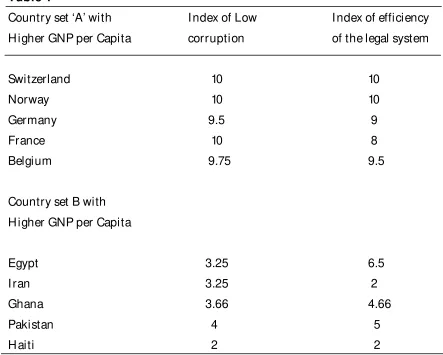
I n table one; we extract a list of ten (10) countries from the original seventy (70)
countries used in the research by Mauro (1995). We group the countries into two
sets – ‘A’ and ‘B’. Country set A includes a list of five Advanced Countries and
country set B includes a list of five Third World countries. We added two more
rows which address the index of corruption and the index of the efficiency of the
legal system. The table is presented below. Please read the underlying note
carefully:
23Ibid
27
Table 1
Country set ‘A’ with I ndex of Low I ndex of efficiency
H igher GNP per Capita corruption of the legal system
Switzerland 10 10
Norway 10 10
Germany 9.5 9
France 10 8
Belgium 9.75 9.5
Country set B with
H igher GNP per Capita
Egypt 3.25 6.5
I ran 3.25 2
Ghana 3.66 4.66
Pakistan 4 5
H aiti 2 2
Sour ce: Even though Mauro(1995) undertook the calculation, the extract was obtained from Bardhan (1997). The scale is 10 for no corruption to 0 for Maximum corruption. The indices are based on standard questionnaires filled in by business international correspondent stationed in about 70 countries in 1980-1983. I t is likely that the indices reflect what are faced by foreign businessman in a country, not necessarily what owns citizen face.
Again the author only extracted 10 countries out of the original 70 countries to ease in the analysis and with slit modification. But the figures were not affected by the modification.
From the table, it is clear that the higher a countries’ level of GNP, the lower the
corruption index and the lower the countries GNP, the higher the corruption
index. This indicates that one major problem hampering the development of
Third World countries is corruption. I f Third World countries undertake serious
steps in fighting corruption, it will serve as a major spring board for their
28
Further investigations have again reviled that over the last 100 years, corruption
has generally declined with economic growth increasing in most rich countries
and in some developing countries that have made continuous efforts of growth
such as Singapore.24
Another effect of corruption is that, it might reduce the usefulness of aid flows
through the diversion of funds from their intended projects. Most likely where
monies are not used for their intended purpose, donors might scale back their
funds. Corruption may also bring about loss of tax revenue when it takes the form
of tax evasion or the improper use of discretionary tax exemption. The reduction
in taxes implies that there will be budgetary consequences. Again, corruption
may affect the composition of government expenditure. I n other words corrupt
government officials may come to prefer those types of expenditure that allow
them to collect brides and to keep them secret25. The consequences of corruption
in Third World countries are thus enormous.
We conclude this section with a quote by Maria Gonzales de Asis. Maria writes,
‘… Cor r uption distor ts the allocation of local r esour ces and the per for mance of
local gover nments. The pr axis consequences of cor r uption ar e poor public
ser vices, incr eased social polar ization, inefficiency in public ser vices, low
investment in the municipality and decr eased economic gr ow th. Combating
cor r uption is cr ucial to the br oader goal of achieving mor e effective, fair and
efficient local gover nment. The r ational for cur bing cor r uption should not ar ise
fr om the per ception of cor r uption as ‘immor al’ and ‘ethical behavior ’. Rather ,
the r ational should be the negative impact that cor r uption has on economic
development and on investment, and it’s r ole in deepening pover ty in the local
gover nments…’26
24Ibid
, 1329 25
Paola Mauro, The effects of Corruption on Growth, Investment and Government Expenditure: A Cross
Country Analysis, p. 88
26 M aria Gonzales de Asis, Reducing Cor r uption at the Local Level, World Bank Institute, 2000, p.
29
4.0 TH E VERD I CT AN D CON CLU SI ON
Part one of this work was dominated by the ideas of the proponents of Western
Guilt. They argued on lines Colonization, Slave trade, Neo-colonialism and Trade
barriers. Various arguments regarding the responsibilities of the West as a major
adversary to the development of Third World countries were put forward by these
proponents.
Part two also considered the arguments of the opponents of Western Guilt.
Various opponents especially Bauer P., argued on the same line but showed the
importance of Salve trade, Colonization and Neo-colonialism.
I n all of these arguments, the author believes the growth and development of
Third World country lies in their hands. The West has limited or no control over
Third World countries if they decide to undertake a rigorous policy that will
ensure sustained development.
Third World countries should thus ‘take their own destiny’ into their hands. I t is
true that the West has caused more havoc but they have also been tremendous
advantage to Third World countries. I t is time for Third World countries to use
these advantages as a major spring board and a good foundation for their
developmental progress regardless of how small it might be. The author believes
that accepting the challenge of economic progress and development is a major
30
REFEREN CE
Bauer Peter (2000), Fr om Subsistence to Exchange and other essays, Princeton
University Press
Bardham P., (1997), Cor r uption and Development: A Review of issues, Vol
XXXV, Journal of Economic Literature.
Evans P., and Raus J., (1997), Bur eaucr acy and Gr ow th: A Cr oss-National
Analysis of the effects of Weber ain State Str uctur e on Economic Gr ow th,
manuscript, UC Berkeley.
Gonzales de Asis M (2000), Reducing Cor r uption at the Local Level, World Bank
31
Karbo A, H . (2006), Corruption: Definition and Concept Manifestation and
Typology in the Afr ica context, Aberdeen.
Mauro P., The effects of Cor r uption on Gr ow th, I nvestment and Gover nment
Expenditur e: A Cr oss Countr y Analysis.
Northrup D., (1978), Tr ade Without Ruler s: Pr e-Colonial Economic
Development in South-Easter n Niger ia, Oxford Claredon Press.
Nye J (1967), Cor r uption and Political Development: A Cost-Benefit Analysis,
American political science review, Vol. 61.
Shiva Naipaul, Nor th of South: An Afr ican Jour ney, London, Andre Deutsch.
Treisman D (1997), The Cause of Cor r uption: A Cr oss-National Study,
University of California, Los Angeles.
Tanzi V. (1994), Cor r uption, Gover nmental, Activities and mar ket, I MF working
paper, Washington DC: I MF
The New Cr usading Guide New spaper (2011), report by: Anas Aremeyaw Anas.
United Nations Office for Drug Control and Crime prevention (1999), Pr evention: