Munich Personal RePEc Archive
Allocation rules on networks
Ilkilic, Rahmi and Kayi, Cagatay
Bilkent University, Universidad del Rosario - Facultad de Economía
March 2012
Online at
https://mpra.ub.uni-muenchen.de/37305/
ALLOCATION RULES ON NETWORKS
Allocation Rules on Networks
∗
Rahmi ˙Ilkılı¸c
†and C
¸ a˘
gatay Kayı
‡Abstract
When allocating a resource, geographical and infrastructural constraints have to be taken into account. We study the problem of distributing a resource through a network from sources endowed with the resource to citizens with claims. A link between a source and an agent depicts the possibility of a transfer from the source to the agent. Given the supplies at each source, the claims of citizens, and the network, the question is how to allocate the available resources among the citizens. We consider a simple allocation problem that is free of network constraints, where the total amount can be freely distributed. The simple allocation problem is aclaims problem where the total amount of claims is greater than what is available. We focus onconsistent and
resource monotonic rules in claims problems that satisfy equal treat-ment of equals. We call these rules fairness principles and we extend fairness principles to allocation rules on networks. We require that
∗We would like to thank Paula Jaramillo, Herve Moulin, and William Thomson for de-tailed comments on an earlier draft of the paper. We also thank the seminar participants at First Caribbean Game Theory Conference, Katholieke Universiteit Leuven, University of Tsukuba, Maastricht University, Universidad del Rosario, and Hausdorff Research In-stitute for Mathematics for valuable discussions. Part of the research was completed when R. ˙Ilkılı¸c and C¸ . Kayı were affiliated with Maastricht University.
†Department of Economics, Bilkent University. Email: [email protected]. R. ˙Ilkılı¸c acknowledges the support of the European Community via Marie Curie Grant PIEF-GA-2008-220181.
for each pair of citizens in the network, the extension is robust with respect to the fairness principle. We call this conditionpairwise robust-ness with respect to the fairness principle. We provide an algorithm and show that each fairness principle has a unique extension which is pairwise robust with respect to the fairness principle. We give appli-cations of the algorithm for three fairness principles: egalitarianism, proportionality and equal sacrifice.
Keywords: Networks, Claims Problems, Egalitarianism, Proportionality, Equal Sac-rifice.
JEL–Numbers: D61, D85, Q20.
1
Introduction
The world has become a densely connected network, especially for markets and natural resources. Given geographical or infrastructural constraints, it is important to understand how scarce resources should be allocated. An example where such network constraints are essential is fresh water resources. As a result of increasing population and developing economies, there is a growing need for water. The principal problem is to have an efficient and fair allocation of resources (Ansink and Weikard, 2009; Hoekstra, 2006). Some other examples are aid relief during disaster situations ( ¨Ozdamar et al., 2004), common property fisheries (˙Ilkılı¸c, 2007), and the distribution of utilities like electricity and natural gas when there is a supply shock.
We study the problem of distributing a resource through a bipartite network betweencitizens with positive claims, needs, or entitlements andsources that are endowed with a limited amount of the desired resource. If there is a link between a source and a citizen, then the citizen can receive the resource from the source. Each source has a limited supply of the resource and each citizen has a claim on the resource. Given the network constraints, the demand of citizens, and the supplies at each source, the question is how to allocate the resource among the citizens. An allocation rule assigns to each citizen a quantity of resource satisfying the following feasibility constraints: First, a citizen can not receive more than his demand. Second, a source can not deliver more than its supply.
We study those problems where total demand exceeds total supply where all the agents suffer from the scarcity.1 When individuals have claims on a resource
1
that sum up to more than what is available, how should the resource be divided? This problem is a claims problem, formally introduced by O’Neill (1982). Several rules are commonly used in practice and analyzed in theoretical work (Thomson, 2003, 2006).
Anallocation problem is defined by the supplies at the sources, the claims of citizens, and the network. The question is how to allocate the resources among the citizens. First, we define a simple allocation problem that is free of network constraints, where the total amount can be freely distributed between the agents. The simple allocation problem is in fact a claims problem. We focus on a subset of rules in claims problems. A rule satisfiesequal treatment of equals if two citizens with equal claims receive equal amounts. A rule isresource monotonic if when the resource increases, each citizen receives at least as much as he did initially. For the next property, suppose a rule has been applied to a claims problem and some citizens leave with what they are prescribed by the rule. If we apply the rule to the problem with the remaining citizens and the remaining resources, then the initial prescribed allocation should not change for the remaining ones. A rule isconsistent
if it satisfies this invariance property.
We refer to the rules that are consistent and resource monotonic satisfying
equal treatment of equals as fairness principles. We extend fairness principles to allocation rules on networks. We require that for each pair of citizens in the network, the extension is robust with respect to the fairness principle. We call this condition
pairwise robustness with respect to the fairness principle. We provide an algorithm to extend a fairness principle to an allocation rule which is pairwise robust with respect to the fairness principle (Theorem 1). This algorithm is parallel to the ascending algorithms used in Moulin (1999) and Bochet et al. (2010, 2011). Then, we show that each fairness principle has a unique extension which ispairwise robust
with respect to the fairness principle (Theorem 2).
The literature on flow sharing on networks has focused on computation of egali-tarian solutions (Megiddo, 1974, 1977; Brown, 1979; Hall and Vohra, 1993). Several allocation rules for allocation problems on networks have recently been introduced and axiomatized in Branzei et al. (2008), Bjørndal and J¨ornsten (2010), Bochet et al. (2010, 2011), and Moulin and Sethuraman (2011).
Branzei et al. (2008) represent a claims problem as a standard flow problem on a simple network and implement some known rules via suitable cost functions in the related minimum cost flow problem. Bjørndal and J¨ornsten (2010) provide
an extension of two simple allocation rules (the contested-garment rule and the constrained equal awards rule) by applying to each two person problem.
Bochet et al. (2010) study the egalitarian rule for allocation problems on net-works, which they characterize with Pareto optimality, equal treatment of equals
and strategy-proofness. Their egalitarian rule is an extension of the uniform rule (Sprumont, 1991) for the simple allocation problem to an allocation problem on net-works in anagent consistent way, meaning if an agent leaves the problem with her share and the corresponding amounts are reduced from the sources she received her share, then in the remaining network the agents should receive the same amounts as in the original problem. Our aim in this paper is to extend all consistent and resource monotonic rules satisfying equal treatment of equals for the simple prob-lem to a network allocation probprob-lem in an agent consistent manner. Our pairwise robustness captures this consistency requirement.
Moulin and Sethuraman (2011) provides an alternative extension of simple al-location rules in asource consistent fashion, meaning if a source leaves the problem with its resources and the corresponding amounts are reduced from the agents receiving them, then the new problem should allocate the agents the shares they received in the original problem plus the amounts allocated from the deleted source. Bochet et al. (2011) studies the problem of balancing the demands and supplies be-tween agents where links depict the transfer from a supplier to a demander. That is different from a classic allocation problem as the agents receive the commodity they desire from other agents (Klaus et al., 1997, 1998).
The allocation problem we study is different from models where agents are located sequentially on a line or the so-called river sharing (Ambec and Sprumont, 2002; Ambec and Ehlers, 2008; Ansink and Weikard, 2011). A river sharing problem can be written as an allocation problem on a network where agents’ access to sources are hierarchical.2 Hence our model is more general than a river sharing problem as
we have no restrictions on the possible networks between sources and agents. Our model is also different than the division of a single commodity supplied by multiple sources as studied in Kar and Kıbrıs (2008). There, although an agent, a priori, can consume from any source, she must receive all her endowment from a single
2
source whereas an agent in our model can receive her share from several sources which she has access to.
In Section 2, we introduce the model and some properties of fairness principles. In Section 3, we present the algorithm and give the results. In Section 4, we give three applications of the algorithm. We conclude in Section 5.
2
Model
LetSbe the set of sourcesand|S|=m, andCbe the set of citizensand|C|=n. Each source t∈ S has a non-negative supply st ∈R+ and eachcitizen i∈ C
has a non-negativeclaim ci∈R+ for the resource.
Lets= (s1, s2, ..., sm) be the supply vector andc= (c1, c2, ..., cn) be the claims
vector. The sources and citizens are embedded in a network in which citizens can acquire the resource only from the sources they are connected to. A bipartite graph g⊆S×C consists of links betweennodesin S andC. If alinkconnects a sourcetto a citizeni ing, i.e.,ti∈g, then it is possible for citizenito acquire the resource from sourcet. We assume thatg is connected. If it is not, then we can treat each connected component ofgas a separate problem. Let Gn×m be the
set of all connected bipartite graphs betweenS andC.
A subgraph ofg is a graphg(T,D)⊆g such thatT ⊆S, D ⊆C and each link ing that connects a source inT to a citizen inDis a member of g(T, D), i.e.,
g(T, D) =g∩(T×D). For a subgraph g(T, D) ofg, we denote byg(S\T, C\D), the subgraph of g that results when we remove all nodes in T ∪D from g. Let
Ng(T) be the set of citizens connected to the set of sources T in g; Ng(T) =
{i ∈ C such thatti∈ g for somet ∈ T}. Similarly, Ng(D) be the set of sources
connected to the set of citizenDing;Ng(D) ={t∈S such thatti∈g for somei∈
D}.
Anallocationis a vectorq= (q1, q2, ..., qn)∈Rn+ showing how much resource
is allocated to each citizen. A transfer of resources, or simply aflow, is a vectorφ
∈RS+×D, whereφti is the amount sent from sourcetto citizenisuch that ifti /∈g,
thenφti= 0.
An allocationqisfeasibleif there is a flowφ∈RS+×Dthat supports it, i.e., for
each citizeni∈C, qi= P
t∈Ng(i)φti and for each source t∈S, P
i∈Ng(t)φti≤st.
An allocationqisefficientif it isfeasibleand there is no other feasible allocation
q′ such that for each citizen i ∈ C, we have c
i ≥ qi′ ≥ qi and P
iq′i > P
Anallocation problemis a tripleR= (s, c, g)such that
for allT ⊂S, X
t∈T
st< X
i∈Ng(T)
ci
Note that no subset of sources has enough resource to satisfy the claims of the citizens connected to them. Hence, the allocation problem is “genuine” in the sense that a citizen receives the resource always at the expense of some other citizen. LetR=Rm
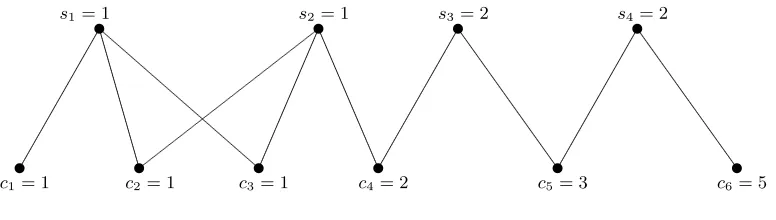
+ ×Rn+× Gm×n be the set of allocation problems. See Figure 1 for an
example of an allocation problem.
t t t t
t t t t t t
s1= 1 s2= 1 s3= 2 s4 = 2
c1= 1 c2= 1 c3= 1 c4= 2 c5= 3 c6= 5
[image:8.612.116.504.301.411.2]g
Figure 1:
An example of an allocation problem:
R = (s, c, g) is an allocation problem with S = {1,2,3,4}, C = {1,2,3,4,5,6}, s = (1,1,2,2), and c = (1,1,1,2,3,5).Anallocation rule ϕ is a function which assigns to each allocation problem (s, c, g) an efficient allocation that satisfies claim boundedness. Since each rule assigns an allocation to each problem, there is a flow supporting that allocation. If φ(s, c, g) is a flow that supports ϕ(s, c, g), then for each citizen i, ϕi(s, c, g) = P
t∈Sg(i)φti(s, c, g).
A simple allocation problemis a pairP = (c, ω)such that Pi∈Cci≥ω.
Note that P represents the problem of allocating an amount ω ≥ 0 among the citizens inC. There is no restriction on the possible flows andω can be distributed freely to citizens. LetP =Rm
+ ×R+ be the set of simple allocation problems.
A rule f is a function which assigns to each simple allocation problem (c, ω) anefficient allocation, i.e.,Pi∈Cfi(c, ω) =ω that satisfiesclaim boundedness, i.e.,
A rule f satisfies equal treatment of equals if for each simple allocation problem (c, ω) and each pair of citizens i, j ∈C with ci =cj, we have fi(c, ω) =
fj(c, ω), i.e. two citizens with equal claims receive equal amounts.
For the next property, suppose a rule has been applied to a claims problem and some citizens leave with what they are prescribed by the rule. If we apply the rule to the problem with the remaining citizens and the remaining resource, then the initial prescribed allocation does not change for the remaining ones. A rule is
consistent if it satisfies this invariance property. Formally, a rulef isconsistent
if for each simple allocation problem (c, ω), eachD⊂C, and eachi∈C\D,
fi(c−D, ω− X
j∈D
fj(c, ω)) =fi(c, ω)
wherec−D is the claims vector of the citizens inC\D.
A rule isresource monotonicif when the resource increases, each citizen receives at least as much as he did initially. A rulef isresource monotonic if for each pair of simple allocation problems (c, ω) and (c, ω′) with ω′ > ω and each i∈ C,
we havefi(c, ω′)≥fi(c, ω).
We focus onconsistent and resource monotonic rules in claims problems that satisfyequal treatment of equals. We call these rulesfairness principles. Our aim is to extend each fairness principle to an allocation rule on a network. We require the extension to conserve the essence of the fairness principle. We formalize this requirement by the following definition:
Pairwise f-Robustness: Given an allocation problem (s, c, g) and a fairness principle f, an allocation q is pairwise f-robust if for each pair of citizensi, j ∈ C with f((ci, cj), qi+qj) = (q∗i, qj∗), there exists no feasible allocation q′ for the allocation problem(s, c, g) such that for eachk6=i, j,q′
k =qk and
|qi∗−q′i|<|qi∗−qi|.
An allocation ruleϕispairwisef-robust if for each allocation problem (s, c, g)∈ R,ϕ(s, c, g) =qsatisfiespairwise f-robustness.
Next, we construct an algorithm to extend any fairness principle f to an al-location rule ϕf that is pairwise f-robust. Then, we show that for each fairness
3
The Ascending Algorithm
Let f be a fairness principle. Given the claims of the citizens c, consider the simple allocation problem with a single source of capacityω≥0. For each citizen
i, let fi(c, ω) be the amount that citizen i ∈ C would have received under the
fairness principlef in the simple allocation problem (c, ω). Note that byresource monotonicity,fi(c, ω) is an increasing function ofω.
We obtain the allocation rule ϕf(s, c, g) by an ascending algorithm based on
the following systemK(ω) of inequalities whereω is a non-negative parameter:
X
i∈D
fi(c, ω)≤ X
t∈Ng(D)
stfor allD⊆C (1)
For ω = 0, equation (1) is satisfied for each D ⊆C. For ω =Pi∈Cci, there
existsD⊆Csuch that
X
i∈D
fi(ω, c)> X
t∈Ng(D)
st
by construction. Hence, there exists a largestω1such that
X
ci∈D
qi(c, ω1)≤ X
st∈Ng(D)
st for eachD⊆C (2)
X
ci∈D
qi(c, ω1) = X
st∈Ng(D)
st for someD⊆C (3)
AsPt∈Ng(D)stis a submodular function ofD, there exists a unique largestD
1
such that equation (2) holds. The allocationϕf(s, c, g) =q is obtained by setting
qi=fi(c, ω1) for each i∈D1
and assigning other agents their allocation in the reduced problem (s\Ng(D1), c\
D1, g\(N
g(D1)∪D1)). That is, we look for the largestω2>0 such that X
i∈D
fi(c, ω2)≤
X
t∈Ng(D)\Ng(D1)
st for eachD⊆C\D1 (4)
X
i∈D
fi(c, ω2) =
X
t∈Ng(D)\Ng(D1)
st for some D⊆C\D1 (5)
Then, there exists a unique largest setD2 such that equation (4) holds. Observe
X
ci∈D1∪D2
qi(c, ω1)≥ X
ci∈D1
qi(c, ω1) + X
ci∈D2
qi(c, ω2) =
X
st∈Ng(D1∪D2) st
which contradicts the choice ofD1 as the largest set satisfying equation (2).
Theorem 1. For each fairness principlef, the allocation ruleϕf obtained by the ascending algorithm is pairwisef-robust.
Proof. Let (s, c, g) be an allocation problem, ϕf(s, c, g) = q, and i, j ∈ C. First,
suppose that the ascending algorithm assigns toiandjtheir allocations in the same iteration step, which meansqi =fi(c, ω) andqj=fj(c, ω) forω >0. Consider the
simple allocation problem ((ci, cj), qi+qj). Sincefisconsistent,f((ci, cj), qi+qj) =
(qi, qj). Hence,pairwisef-robustness is trivially satisfied.
Now, suppose that the ascending algorithm assigns toiandj their allocations in different iteration steps, meaningsqi =fi(c, ω) and qj=fj(c, ω′) for ω, ω′ >0,
which are the parameters obtained from the ascending algorithm. Assume without loss of generality thatω′ > ω. Byresource monotonicity, we haveq
i =fi(c, ω)≤
fi(c, ω′) andqj =fj(c, ω′)≥fj(c, ω). If one of these inequalities is not strict, then
f((ci, cj), qi+qj) = (qi, qj) by the same argument presented above. Hence, assume
that qi =fi(c, ω)< fi(c, ω′) andqj =fj(c, ω′) > fj(c, ω). Let fi(c, ω′) = ¯qi and
fj(c, ω) = ¯qj. Byconsistency, we havef((ci, cj), qi+ ¯qj) = (qi,q¯j) andf((ci, cj),q¯i+
qj) = ( ¯qi, qj). Then, byresource monotonicity, we havefi((ci, cj), qi+qj)≥qi and
fj((ci, cj), qi+qj) ≤ qi. If one of these inequalities are weak, then pairwise f -robustness is satisfied. Hence, assume that both are strict. Since the algorithm assignsj’s allocation after i’s allocation, there is nofeasible allocationq′ such that
for eachk6=i, j,qk=q′k andqi′> qi. The reason is that each citizen who receives
his allocation at some stephobtains no resource from the sources, he shares with citizens who receive their allocations in the steps earlier thanh. Hence,ϕfobtained
by the ascending algorithm ispairwise f-robust.
Theorem 2. For each fairness principlef, there exists a unique allocation ruleϕf which is pairwisef-robust.
Proof. Let ϕf be the allocation rule given by the ascending algorithm. Suppose
there exists some other ruleϕ6=ϕfwhich also satisfiespairwisef-robustness. Then,
there exists an allocation problem (s, c, g) such thatϕ(s, c, g) =q′6=q=ϕf(s, c, g).
LetD1, D2, ..., Dh be the set of citizens which are allocated in steps 1,2, ..., h
thatq′
i < qi. Then,qi=fi(c, ω) for someω >0. Letφ′ be a flow which supports
the allocation q′. Consider the set of sources S1 = N
g(i) connected to i. Let
C1 = {j ∈ C : ∃t ∈ S1such that φ′
tj >0}. This set is non-empty, because the
resources which were going toiinq, now must be allocated to other citizens which share sources withi, due to theefficiency of the allocation q′.
If there exists j ∈ C1 such that qj′ > fj(c, ω), then it is possible to transfer
some positive amount from j to i through the path jt, ti without changing the allocations of citizens other thaniandj, contradicting pairwisef-robustness.
So, suppose that for each citizen j ∈ C1, q′
j ≤ fj(c, ω). Consider the set
S2 =N
g(C1) and C2 ={j ∈ C : ∃t ∈ S2 such thatφ′tj >0}. Since qi′ < qi and
for each citizen j ∈ C1, q′
j ≤ fj(c, ω), C2 is non-empty. If there exists j ∈ C2
such thatq′
j > fj(c, ω), then it is possible to transfer some positive amount from
j to i through a path j2t2, t2j1, j1t1, t1i for some j2 ∈ C2, t2 ∈ S2, j1 ∈ C1,
and t1 ∈ S1, without changing the allocations of citizens other than i and j2,
contradictingpairwisef-robustness. If there exists no j ∈C2 such thatq′
j > fj(c, ω), then we continue iteratively
to look for aj such thatq′
j > qj. Such a j exists, becauseqi′< qi and the resource
allocation rule ϕ is efficient. Then, it is possible to make a transfer from j to i
without changing the allocations of other citizens. If for eachi ∈D1, q′
i ≥qi, then we haveqi′ =qi for all i∈D1. Sinceq6=q′,
there existsi∈Dh1 such that for each h2< h1 and eachj ∈Dh2, q′
j =qj and we
can apply the same iterative argument starting from i to find a contradiction to
pairwisef-robustness.
Hence,ϕf is the unique allocation rule which ispairwisef-robust.
4
Three allocation rules
4.1
Egalitarian Allocation Rule
The first fairness principle we extend is egalitarianism.
Egalitarian Rule, e : For each P = (c, ω) ∈ P, egalitarian rule assigns an allocation e(c, ω)= q such that for each i ∈ C, qi = min{ci, λ} where λ solves P
i∈Cmin{ci, λ}=ω.
We extend egalitarianism to obtain theegalitarian allocation ruleϕe(s, c, g)=
equivalent, but more revealing ascending algorithm based on the following system
E(λ) of inequalities whereλis a non-negative parameter.3
X
j∈D
λ∧cj≤ X
t∈Ng(D)
st for allD⊆C (6)
Forλ= 0, equation (6) is satisfied for eachD⊆C. Forλ=∞, there existsD⊆C
such that
X
j∈D
λ∧cj > X
t∈Ng(D) st
by construction. Hence, there exists a lowestλ1, strictly positive, such that
X
j∈D
λ1∧cj= X
t∈Ng(D)
st for someD⊆C (7)
AsPt∈Ng(D)stis a submodular function ofD, there exists a unique largestD1such
that equation (7) holds for. The egalitarian allocation ϕe(s, c, g) = q is obtained
by setting
qj =λ1∧cj forj∈D1
and assigning other agents their egalitarian allocation in the reduced problem (s\ Ng(D1), c\D1, g\(Ng(D1)∪D1)). That is, we look for the lowestλ2>0 such that
X
j∈D
λ2∧cj=
X
t∈Ng(D)\Ng(D1)
stfor some D⊆C\D1 (8)
There exists a unique largest setD2 such that equation (8) holds for. Ifλ2 ≤λ1,
we combine equations (7) and (8) to obtain
X
j∈D1∪D2
λ1∧cj≥ X
j∈D1
λ1∧cj+ X
j∈D2
λ2∧cj=
X
t∈Ng(D1∪D2)
st
which contradicts the choice ofD1 as the largest set satisfying equation (7).
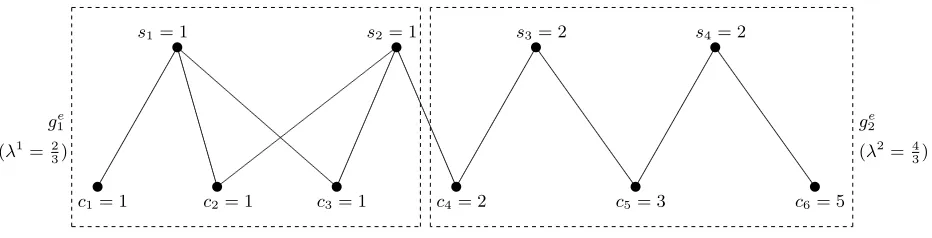
The egalitarian allocation rule is ϕe(s, c, g) = q obtained in the algorithm above. For an example of the egalitarian allocation rule, see Figure 2.
3
t t t t
t t t t t t
s1= 1 s2= 1 s3= 2 s4 = 2
c1= 1 c2= 1 c3= 1 c4= 2 c5= 3 c6= 5
ge
1
(λ1= 2 3)
g
ge
2
[image:14.612.77.543.141.260.2](λ2=4 3)
Figure 2:
Egalitarian allocation rule:
For the allocation problemR= (s, c, g), the egalitarian allocation isϕe(s, c, g) = (23, 2 3, 2 3, 4 3, 4 3, 4
3). In the algorithm, the lowestλ 1
satisfying equation (7) is 2
3 and the largest set satisfying equation (7) isD 1
={1,2,3}. Then, the lowestλ2satisfying equation (8) is 4
3 and the largest set satisfying equation (8)
isD2={4,5,6}.
4.2
Proportional Allocation Rule
The second fairness principle is proportionality.
Proportional Rule, p: For each P = (c, ω)∈ P, proportional rule assigns an allocationp(c, ω)=q=πcwhereπ= Pω
i∈Cci.
We obtain theproportional allocation rule ϕp(s, c, g)=qby an ascending
algorithm based on the following system P(π) of inequalities where π is a non-negative parameter.
X
i∈D
π.ci≤ X
t∈Ng(D)
stfor allD⊆C (9)
Forπ= 0, equation (9) is satisfied for allD⊆C. Forπ= 1 there existsD⊆C
such that
X
i∈D
π.ci> X
t∈Ng(D) st
by construction. Hence, there exists a lowestπ1, strictly positive, such that
X
i∈D
π1.ci= X
t∈Ng(D)
AsPt∈Ng(D)stis a submodular function ofD, there exists a unique largestD1
such that equation(10) holds for. The proportional allocation ruleϕp(s, c, g) =qis
obtained by setting
qi=π1.ci fori∈D1
and assigning other agents their constrained proportional allocation in the reduced problem (s\Ng(D1), c\D1, g\(Ng(D1)∪D1)). That is, we look for the lowest
π2>0 such that
X
i∈D
π2.ci=
X
t∈Ng(D)\Ng(D1)
stfor someD⊆C\D1 (11)
There exists a unique largest set D2 such that equation (11) holds for. If π2≤π1, we combine equations (10) and (11) to obtain
X
i∈D1∪D2
π1.ci ≥ X
i∈D1
π1.ci+ X
i∈D2
π2.ci=
X
t∈Ng(D1∪D2)
st
which contradicts the choice ofD1 as the largest set satisfying equation (10).
t t t t
t t t t t t
s1= 1 s2= 1 s3= 2 s4 = 2
c1= 1 c2= 1 c3= 1 c4= 2 c5= 3 c6= 5
gp2
(π2
=1 2)
g
g1p
(π1
[image:15.612.77.544.415.536.2]= 2 5)
Figure 3:
Proportional allocation rule:
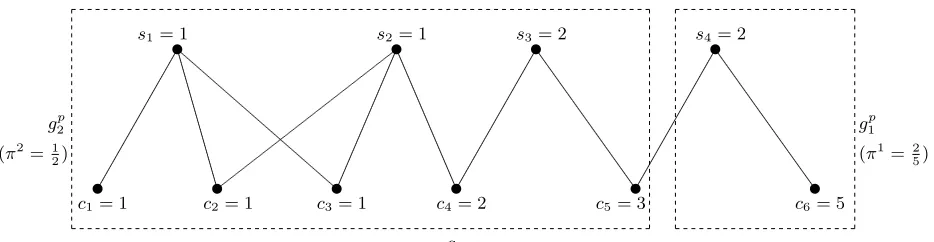
For the allocation problem R = (s, c, g), the proportional allocation is ϕp(s, c, g) = (12, 1 2,
1 2,1,
3
2,2). In the algorithm,
the lowestπ1 satisfying equation (10) is 1
2 and the largest set satisfying equation (10) is D1
={1,2,3,4,5}. Then, the lowestπ2
satisfying equation (11) is 2
5 and the largest set
satisfying equation (11) isD2={6}.
The proportional allocation rule is ϕp(s, c, g) =q obtained in the algorithm
4.3
Equal Sacrifice Allocation Rule
The third fairness principle is egalitarianism in terms of the sacrifices required from the agents.
Equal Sacrifice Rule, l : For eachP = (c, ω)∈ P, equal sacrifice rule assigns an allocation l(c, ω)= q such that for each i ∈ C, qi =max{0, ci−σ} where σ
solvesPi∈Cmax{0, ci−σ}=ω.
We obtain theequal sacrifice allocation ruleϕl(s, c, g)=qby a descending
algorithm based on the following system S(σ) of inequalities where σ is a non-negative parameter.4
X
i∈D
0∨(ci−σ)≤ X
t∈Ng(D)
stfor allD⊆C (12)
For σ = ∞, equation (12) is satisfied for allD ⊆C. For σ = 0 there exists
D⊆C such that
X
i∈D
0∨(ci−σ)> X
t∈Ng(D) st
by construction. Hence, there exists a largestσ1 such that
X
i∈D
0∨(ci−σ1) = X
t∈Ng(D)
stfor some D⊆C (13)
As Pt∈Ng(D)st is a submodular function of D, there exists a unique largest
D1 such that equation(13) holds for. The equal sacrifice allocationϕl(s, c, g) =q
is obtained by setting
qi= 0∨(ci−σ1) fori∈D1
and assigning other agents their equal sacrifice allocation in the reduced problem (s\Ng(D1), c\D1, g\(Ng(D1)∪D1)). That is, we look for the largestσ2>0 such
that
X
i∈D
0∨(ci−σ2) =
X
t∈Ng(D)\Ng(D1)
stfor someD⊆C\D1 (14)
There exists a unique largest set D2 such that equation (14) holds for. If σ2≥σ1, we combine equations (13) and (14) to obtain
4
X
i∈D1∪D2
0∨(ci−σ1)≥ X
i∈D1
0∨(ci−σ1) + X
i∈D2
0∨(ci−σ2) =
X
t∈Ng(D1∪D2)
st
which contradicts the choice ofD1 as the largest set satisfying equation (13).
t t t t
t t t t t t
s1= 1 s2= 1 s3= 2 s4 = 2
c1= 1 c2= 1 c3= 1 c4= 2 c5= 3 c6= 5
gl3
(σ3
=2 3)
g gl2(σ 2
= 1)
g1l
(σ1
[image:17.612.82.538.237.361.2]= 3)
Figure 4:
Equal sacrifice allocation rule:
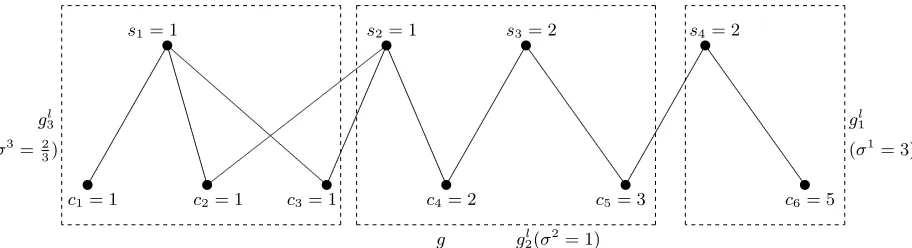
For the allocation problem R = (s, c, g), the equal sacrifice allocation is ϕl(s, c, g) = (13, 1 3,
1
3,1,2,2). In the algorithm,
the highestσ1 satisfying equation (13) is 3 and the largest set satisfying equation (13) is
D1
={6}. Then, the highestσ2
satisfying equation (14) is 1 and the largest set satisfying equation (14) isD2
={4,5}. Then, the highestσ3
satisfying equation (14*) (whereD1
is replaced withD1∪
D2 in equation (14)) is2
3 and the largest set satisfying equation (14*)
isD3={1,2,3}.
The equal sacrifice allocation rule isϕl(s, c, g) =qobtained in the algorithm above. For an example of the equal sacrifice allocation rule, see Figure 4.
5
Conclusion
Our results expand the scope of the existing literature on the claims problems. We provide a unique way to apply fairness principles to allocation problems on networks of sources and agents. Such problems with multiple sources are very commonly observed as exemplified in the introduction.
composition up, consistency, etc.) can be extended to allocation rules on networks? The egalitarian rule for network allocation problems has been characterized with
Pareto optimality,equal treatment of equals and strategy-proofness (Bochet et al., 2010). Is it possible to give a characterization of rules on how they respond to changes in the network structure? Similarly, the dual of an allocation problem (Thomson, 2006) is well defined when there is only one source. Is it possible to define the dual of an allocation problem on a network? In general, any question which is relevant for simple allocation rules can now be asked for their extensions on networks as provided by our algorithm.
References
Ambec, S. and L. Ehlers (2008). Sharing a river among satiable agents.Games and Economic Behavior 64, 35–50.
Ambec, S. and Y. Sprumont (2002). Sharing a river. Journal of Economic The-ory 107, 453–462.
Ansink, E. and H. P. Weikard (2009). Contested water rights. European Journal of Political Economy 25, 247–260.
Ansink, E. and H. P. Weikard (2011). A strategic model of social and economic networks. Social Choice and Welfare. (forthcoming).
Bjørndal, E. and K. J¨ornsten (2010). Flow sharing and bankruptcy games. Inter-national Journal of Game Theory 39, 11–28.
Bochet, O., R. ˙Ilkılı¸c, and H. Moulin (2010). Egalitarianism under earmark con-straints. mimeo. University of Bern, Bern, Switzerland.
Bochet, O., R. ˙Ilkılı¸c, H. Moulin, and J. Sethuraman (2011). Balancing supply and demand under bilateral constraints. Theoretical Economics. (forthcoming).
Branzei, R., G. Ferrari, V. Fragnelli, and S. Tijs (2008). A flow approach to bankruptcy problems. AUCO Czech Economic Review 2, 146–153.
Brown, J. (1979). The sharing problem. Operations Research 27, 324–340.
Hoekstra, A. (2006). The global dimension of water governance: Nine reasons for global arrangements in order to cope with local problems. Value of Water Research Report Series 20. UNESCO-IHE Institute for Water Education.
˙Ilkılı¸c, R. (2007). Network of commons. mimeo. Maastricht University. Maastricht, the Netherlands.
Kar, A. and O. Kıbrıs (2008). Allocating multiple estates among agents with single-peaked preferences. Social Choice and Welfare 31, 641–666.
Klaus, B., H. Peters, and T. Storcken (1997). Reallocation of an infinitely divisible good. Economic Theory 10, 305–333.
Klaus, B., H. Peters, and T. Storcken (1998). Strategy-proof division with single-peaked preferences and individual endowments. Social Choice and Welfare 15, 297–311.
Megiddo, N. (1974). Optimal flows in networks with multiple sources and sinks.
Mathematical Programming 7, 97–107.
Megiddo, N. (1977). A good algorithm for lexicographically optimal flows in multi-terminal networks. Bulletin of the American Mathematical Society 83, 407–409.
Moulin, H. (1999). Rationing a commodity along fixed paths. Journal of Economic Theory 84, 41–72.
Moulin, H. and J. Sethuraman (2011). The bipartite rationing problem. mimeo. Rice University, Houston, TX, USA.
O’Neill, B. (1982). A problem of rights arbitration from the talmud. Mathematical Social Sciences 2, 345–371.
¨
Ozdamar, O., E. Ekinci, and B. K¨u¸c¨ukyazıcı (2004). Emergency logistics planning in natural disasters. Annals of Operations Research 129, 217–245.
Sprumont, Y. (1991). The division problem with single-peaked preferences: A characterization of the uniform allocation rule. Econometrica 59, 509–519.
Thomson, W. (2003). Axiomatic analysis of bankruptcy and taxation problems: a survey. Mathematical Social Sciences 45, 249–297.