ISSN Online: 2153-120X ISSN Print: 2153-1196
Why Does Newton’s Apple Fall
Vertically
to the
Ground: The Gravitation Code
Jean-Paul Auffray
Ex: Courant Institute of Mathematical Sciences, New York University, New York, NY, USA
Abstract
No, Isaac Newton did not “explain” gravitation. What he did, and this certainly con-stituted all and by itself a great achievement, was to recognize (to “assert”) the uni-versal character of gravitation: all material objects (bodies) attract each other by gra-vitation. But how does gravitation perform its deeds? This remained a mystery to Newton. In a “desperate move” at the end of his life, he introduced the concept of “Particles which are moved by certain active Principles [our emphasis]—such as is that of Gravity” he said. We resurrect this scheme, we provide it with a quantum structure—a stunning new insight into the workings of gravitation obtains.
Keywords
Gravitation, Newton, Fatio de Duillier, Ethereal Particles, I-Meteons
1. Introduction
Ever since in 1896, the great Swedish physical chemist Svante August Arrhenius (1859- 1927) propagated the fallacious assertion making carbon dioxide (CO2) a dangerous “Greenhouse Effect” gas contributing to climate warming [1]. Physicists at large have displayed a startling ability to believe in just about anything. Astute observer of human nature, Albert Einstein, took advantage of this to cause physicists surreptitiously to see in him the greatest physicist who ever lived—after Newton, of course. Speaking of Newton, who has not heard of the legendary story of the future great Natural philoso-pher watching an apple fall off a tree to the ground under the influence of that myste-rious force, Gravitation, deciding then that he would be the one, some day, who would unravel the secrets of gravitation—decode the Gravitation Code—, a natural ambition for someone who, like himself, was destined to become a devoted theologian and alchemist [2].
How to cite this paper: Auffray, J.-P. (2016) Why Does Newton’s Apple Fall Vertically to the Ground: The Gravitation Code. Journal of Modern Physics, 7, 1702-1711.
http://dx.doi.org/10.4236/jmp.2016.713153
Received: August 23, 2016 Accepted: September 20, 2016 Published: September 23, 2016
Copyright © 2016 by author and Scientific Research Publishing Inc. This work is licensed under the Creative Commons Attribution International License (CC BY 4.0).
As it turned out, Newton did not break (decode) the Gravitation Code. What he did, and this certainly constituted all and by itself a great achievement, was to recognize (to “assert”) the universal character of gravitation: all objects (bodies) having mass attract each other by gravitation. If one of the two bodies is the Earth, gravitation is conven-tionally called gravity. This constitutes, by the way; a circular reasoning: any two bodies which have mass attract each other by gravitation; any two bodies which attract each other by gravitation have mass.
Very well, but how does gravity (gravitation) operate? This remained a frustrating puzzle to Newton to the end of his life. In an ultimate “desperate move”—and this might have been in the wake of his encounter a few years earlier with a young genius mathematician who did propose a “Mechanical” explanation of the workings of gravi-tation—Newton introduced the concept of “Particles which are moved by certain active Principles—such as is that of Gravity”, he said (our emphasizes) [3].
Gravity caused by “active principles”… Newton meant an action arising from the “Will and the Spirit” of God, i.e. not caused by any mechanical, material agent.
We retrieve this commonly ignored Newtonian scheme. We provide it with a quan-tum formulation. A breathtaking revolutionary insight into the (hidden) workings of gravitation obtains.
2. Birth of a Mechanical Model of Gravitation
2.1. Birth of a Genius
In 1683, after twenty years sharing the same rooms in Trinity College at the University of Cambridge, Newton’s companion John Wickens left Cambridge to become a country vicar somewhere else. Henceforth on his own to pursue in secrecy his alchemical expe-riments and his arduous attempts to decipher the prophecies consigned in the Old Tes-tament, Newton undertook to write the first Book of the philosophical treatise which was to make him famous, the renowned Principia. In the midst of these intense activi-ties, he suddenly became involved with a young genius mathematician twenty-two years younger than him.
Born the seventh child in a family of fourteen siblings originally established in the small town of Chiavenna in northern Italy, the boy is eight-years-old in 1672 when his father, Jean Baptiste Fatio, or Faccio short for Bonifaccio, acquires a new residence in the canton de Vaud in Switzerland, the Seigneurie de Duillier (Figure 1), whereby his son Nicolas assumed proudly henceforth the name Nicolas Fatio de Duillier.
Figure 1. Le château de Duillier.
https://upload.wikimedia.org/wikipedia/commons/thumb/a/ a4/Chateau_Duillier2.jpg/420px-Chateau_Duillier2.jpg
him with him to London, where Fatio is promptly elected a Fellow of the Royal Society. He is twenty-four years old. Newton himself had been elected a Fellow of the Royal So-ciety sixteen years earlier.
The encounter between the two Fellows left them both in a daze: young Fatio in-formed his elder that he had elaborated a “Mechanical” theory of gravitation!
Written in seventeenth century French, Fatio’s Mémoire Sur la Cause de la Pesanteur [4]—Essay on the Cause of Gravity—remained unpublished during Fatio’s lifetime. It was retrieved among his papers after his death at his residence in Maddersfield near Worcester in England on May 10th 1753.
2.2. Fundamental Assumptions
The starting points of Nicolas Fatio’s mechanical theory of gravitation are four. We first list them as formulated by Nicolas Fatio in his original language, then express them us-ing modern words and concepts. They are:
1) The World—the Universe, the Cosmos—is composed of (apparently) solid bo-dies—Fatio calls them “coarse bodies”—which in realty are composed of “Atoms” which are “porous”—i.e. full of (invisible) holes.
2) Atoms have geometrical shapes which make them look the same in all direc-tions—they are anisotropic.
3) Besides “coarse bodies”, the World—the Universe, the Cosmos—also contains another kind of matter—Fatio calls it ethereal.
4) In fine, the coarse bodies present in the Universe are so porous that the ethereal particles can move freely through them, generating in the process the phenomenon we observe as gravitation.
agglomerates of atoms themselves made up of so-called elementary particles. If the ob-servable universe—if the Cosmos—is made up of elementary particles—electrons, quarks, neutrinos and the rest—which individually occupy essentially no space, then, in fine, against all appearances said universe is fundamentally a huge vacuum—a Void— dot-ted of point-like “nothings”, a thought that Fatio expressed in his days in these words: “Je suppose que les differents Espaces du Monde sont presque entierement Vuides [sic] de Matiere. —I assume that the different Spaces in the World are almost entirely Void of Matter.”
Let us investigate these considerations in the context of a specfic example.
2.3. The Special Case of Newton’s Falling Apple
Consider the legendary example of Isaac Newton as a boy observing an apple fall off a tree down to the ground (Figure 2). To us, ordinary inhabitants of the planet Earth, nothing special about this: grass is green, the sky is blue, and ripe fruits fall off branches. Newton was more subtle: to him the Earth as a whole does not “attract” the apple; instead, the apple “sees” the Earth’s Center, “which is a mathematical point”, he said; the apple is attracted by it, or to it, and moves toward it—an Act of God, by New-ton’s reckoning.
This is where Nicolas Fatio’s genius intervenes. Let us idealize the apple by representing it as a small “coarse” solid sphere. By the criteria exposed in our Heading 2.2., this sphere is really a ghost shell containing porous Atoms immersed in the “Vuo-id”, as Fatio spells it. Essentially empty, this ghostly sphere is nevertheless capable of experiencing the effects of gravitation. How does it do that?
[image:4.595.252.495.473.672.2]Young Fatio imagined the following clever scheme. In addition to “coarse matter”, he said, the world—the universe, the cosmos—also contains other kinds or species of mat-ter, and he described their qualities…
Figure 2. Young Newton observing the falling apple.
Fatio wrote his memoir using a vocabulary composed of seventeenth century French words which are difficult to “translate” properly in any contemporary idiom. Giving up word-for-word translation, we express in modern terms Fatio’s fundamental concept of the existence in the universe of at least two distinct kinds of matter—coarse matter and ethereal matter according to one of his choices of qualifiers.
I-meteons—i-points in motion—constitute ideal quantum-world candidates to in-carnate the “ethereal” or “second-nature” particles said by young Fatio to be responsi-ble for gravitational effects. We invite the reader unfamiliar with the i-point and i-meteon concepts to consult the presentation of their significances in [5].
As per this contemporary quantum scheme, i-meteons are generated randomly, i.e. they propagate equally (indifferently) in all directions in Absolute space, the only re-striction to their activity being that they each carry precisely one element—one unit, one quantum—of “motion”, a designation introduced to replace the term “dynamical action” ill-appreciated by theoreticians in general nowadays (they prefer to speak of “energy”).
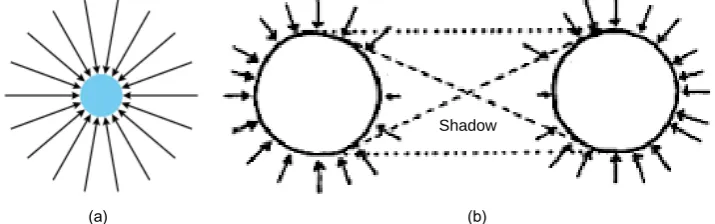
Let our idealized spherical “coarse apple” be on its own, isolated somewhere in the cosmos far from the influence of any other “coarse body” such as the Earth. Our apple is then exposed “naked” so to speak to the random flux of i-meteons arriving from all parts of the world (Figure 3(a)). Arriving randomly from all directions, the i-meteons exert no net “push” on the apple in any one particular direction—no gravitational pull or push is generated on our “apple”.
Now allow another “coarse body” to be in the viccinity of the apple, say next to it for the purpose of illustration. By Nicolas Fatio’s contention—and this is the key to the proper functioning of his Mechanical model of gravitation—, being next to each other the two coarse bodies “filter” the ethereal Particles—the i-meteons for us—arriving on them from one side (Figure 3(b)). An asymetry or imbalance is generated in the sys-tem, each of the two bodies is impiged less on one of its sides and starts moving in that direction, being apparently gravitationally “attracted” by the other body whose
[image:5.595.195.553.508.620.2]
(a) (b)
Figure 3. (a) I-meteons impinging randomly from all sides on an isolated coarse spherical body
generate no net “push” on it.
https://upload.wikimedia.org/wikipedia/commons/thumb/2/2d/Pushing1.svg/225px-Pushing1.sv g.png (b) Coarse bodies “shadowing” each other.
https://encrypted-tbn1.gstatic.com/images?q=tbn:ANd9GcRK4tfCKk7igUhiCcKXgXQJaZv7L6Y 76rq6kWJwvInTWBGpgf2C
presence causes the imbalance to occur. In reality each of the two bodies is driven to-ward the other by the “push” of unbalanced incoming i-meteons—etheral Particles for Nicolas Fatio.
And suddenly, contemplating Figure 3(b), a simple, startling “explanation” as to why Newton’s apple falls vertically to the ground and why we are held vertically when we stand erect on the ground somewhere—anywhere—on the surface of the Earth minding our own business emerges. Unseen but nevertheless present around us, i-meteons impige on our “coarse body” just about equally from all directions… from all directions but one: the massive coarse Earth under our feet prevents i-meteons from entering our body vertically upward through our feet. As a result the i-meteons which enter our coarse body vertically downward through the top of our head are not com-pensated by i-meteons entering our body from the opposite direction; they exert a net push vertically downward on our body—we stand vertically erect.
It remains to account for the quantitative aspects of the phenomenon.
3. Probing the Model
3.1. Why the Inverse Square Law
Gravitation is known to possess two fundamental characteristics: 1) it obeys an “in-verse-square” law and 2) it satisfies the law of “mass proportionality”. Does our quan-tum “shadow model” of gravitation satisfy these two requirements?
The imbalance in i-meteon distribution is independent of the size of the enclosing sphere while the sphere surface area increases as the square of the radius. The imbal-ance per unit area decreases inversely as the square of the distimbal-ance between the two body centers: the inverse-square law obtains.
3.2. Why Mass Proportionality
Nicolas Fatio spent three years of his life thinking about it, he said… until he came up with a plausible answer while in London in the Fall of 1689. The key of his discovery is this.
While crossing a “coarse body”, an ethereal particle can experience two kinds of mi-shaps: 1) be “absorbed”—Fatio calls it be “condensed”; or 2) loose some of its momen-tum—Fatio calls it loose some of its “Mouvement” (Motion). “Je reconnus que cette Condensation, he said, etoit aussi petite qu’on vouloit, de même que la Perte du Mouvement, jusques à devenir infiniment petite, si l’on faisoit les Suppositions neces-saires.”—I found that the Condensation [Absorption] was as small as one might want, as well as the loss of momentum, so as to become infinitesimally small, if one made ap-propriate Suppositions [Hypothesises].
of which is “Metaphysical in essence” and has its origin in “the Will of the Creator”, a belief he shared with Newton [2].
The fundamental question which arises in the frame of this scheme concerns the na-ture of the interaction which takes place when an ethereal Particle—an i-meteon for us—goes through the “Vuoid” contained in a given coarse body. Nicolas Fatio’s key assumption in this regard stands in one sentence (our translation): “Gravity is pro-duced, in my view, by Exceedance of the Speed of the Particles of this [ethereal] Matter which impinges on the Earth for example, or some coarse Atom of which it is com-posed, over their Speed when they are reflected...” [4]. In brief: incident ethereal Par-ticles strike the body at a very high speed, then rebound with a slightly lower speed.
Advantages; This is actually a more sophisticated model than simply assuming total absorption because it reognizes that perfect reflection would result in no anisotropy at all in the surrounding flux, and therefore no net force of gravity. Instead it allows for a combination of reflection and absorption of momentum and avoids mass accumulation (Fatio assumed his ethereal Particles to have mass). He also stressed the fact that to produce a given amount of gravity, we can suppose the bombarding Particles to be ar-bitrarily small while assuming their speeds to be arar-bitrarily great. This automatically diminishes the drag induced by the movement of coarse bodies to a negligible amount. Fatio also argued that by supposing the speed of the ethereal Particles to be extremely great, the amount by which they are slowed can be made as small as we wish, so there need be no appreciable dimunition of their agitation over time.
These considerations fare well with our quantum scheme as described in [5]. When the ubiquitous quantum sets in motion one of the points the dimensionless Void con-tains, this point becomes a e-meteon if the quantum sets it to move at the speed of light c; a i-meteon if the quantum sets it to move at speeds slower or faster than the speed of light—in brief at speeds not related to the speed of light.
This concept will come as a shock to those who believe the speed of light to be the ul-timate speed that a body can achieve while moving in the universe—a material body, yes, but i-meteons are not material bodies, they are i-meteons, i.e. they are points.
In this regard, we call attention to the invention made by the incomparable Richard Feynman, Nobel Laureate for Physics in 1965, when he postulated in 1969 the existence in nature of point-like partons defined with respect to a physical scale making it possi-ble for them to exist either as “valence constituents” of elementary particles, or as “nonvalence partons” forming a “sea” [6].
Two kinds of point-like partons…. We will not be surprised to find in this magical invention matter useful for enriching our own invention of i-meteons and help in un-derstanding the nature of their behavior in interactions. We shall leave these considera-tions for further studies to be conducted.
4. Sad Ending
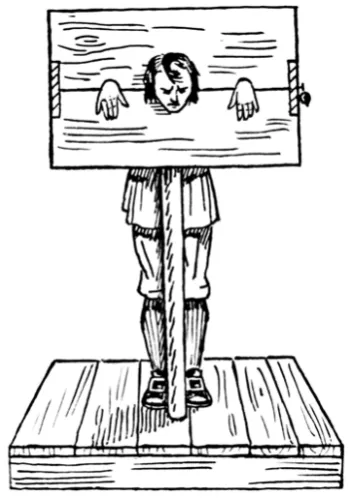
1706, after the movement was put down in France, some of the Camisards immigrated to England where they became known as the French Prophets. Fatio became a disciple of their leader, Elie Marion. He went with him into animated visionary trances during public sermons, claiming to perform miracles (including raising the dead), and made extravagant prophecies of the imminent end of the world. In 1707 Marion, Fatio, and another French Prophet were convicted of blasphemy and sedition and sentenced to be pilloried for two days. A sign placed over Fatio’s head explained the reason(s) for his being exposed to the pillory (Figure 4).
“Nicolas Fatio convicted for abbeting and favouring Elias Marion, in the Wicked and counterfeit prophecies, and causing them to be printed and published, to terrify the Queen’s people.”
[image:8.595.286.461.415.665.2]In 1710 the French Prophets left England for Holland, where Nicolas Fatio was twice more sentenced to the pillory. He accompanied Marion thereafter on travels through various European countries, attempting to make converts. While in Turkey in 1712, Marion fell ill, and died. Fatio returned to England, settling near the town of Worcester where he remained for the rest of his life, meditating on the prophecies and pursuing his scientific research. After his death on May 12, 1753 (he was then 89-years old), Swiss mathematician Georges-Louis Le Sage, himself a Huguenot, visited Fatio’s former English estate in Maddersfield and retrieved his gravitation papers. In 1784 he made Fatio’s gravitation theory known under his own name, asserting that the ethereal particles responsible for gravitation actually originated in another world, deserving to be called accordingly “ultramundane corpuscules”. But this is another story, outside the scope of
Figure 4. Pillory.
the present note.
5. Conclusions: Breaking the Gravitation Code
Newton recognized (“asserted”) in his days the universal character of gravitation, but he never found nor proposed an explanation for it. He ended up believing gravitation to be the result of a (permanent) “Act of God” and he was sharply critical of those who thought otherwise. “That gravity should be innate, inherent, and essential to matter, he wrote, so that one body may act upon another at a distance through a vacuum, without the mediation of anything else, by and through which their action and force may be conveyed from one to another, is to me so great an absurdity [our emphasis], that I believe no man who has in philosophical matters a competent faculty of thinking, can ever fall into it.” To which he added this verdict: “Gravity must be caused by an agent acting constantly according to certain laws; but whether this agent be material or im-material, I have left to the consideration of my readers.” [3]
An “agent acting constantly according to certain laws”… the quantum to us in this note.
Great mathematicians—among them James Maxwell and French mining engineer genius Henri Poincaré, inventor in 1900 of the famous relation E = mc2—have shown convincingly that classical collisions of incoming particles of some sort with the par-ticles constitutive of matter could not legitimately account for gravitation [7].
I-meteons are quantum points, not “particles”. Their interventions in the affairs of the System of the World—at speeds not related to the “speed of light”—cannot be assi-milated to those of the plain particles described in the Standard Model. Indeed, a new era in our understanding of the way motion (action) models the cosmos has been in-itiated and awaits further investigations [8].
In his dreams, Newton decided “Gravity must be caused by an agent acting con-stantly according to certain laws”. To us in this note, the agent Newton envisioned is the ubiquitous quantum. We shall leave it happily at that and salute with respect the memory of the brilliant young genius ex-Camisard sympathizer, ex-French Prophet who showed the way to Newton… and to us. Wouldn’t it be a wonder if, thanks to him, the Gravitation Code had at last been broken?
Acknowledgements
We wish to express our gratitude to Joline (Mésange) Boekschoten, and to Ms. Han Xu (Hellen), JMP Editorial Board Assistant, for her valuable help and kind advice in prop-erly preparing this note for publication in this journal.
References
[1] Arrhenius, S. (1896) PhilosophicalMagazineandJournalofScience Series 5, 41, 237-276.
http://www.rsc.org/images/Arrhenius1896_tcm18-173546.pdf [2] https://en.wikipedia.org/wiki/Isaac_Newton%27s_occult_studies
http://www.newtonproject.sussex.ac.uk/view/texts/normalized/THEM00258
[4] Fatio de Duillier, N. Sur la Cause de la Pesanteur.
http://www.mahag.com/grav/bopp/fatio-bopp.pdf (in French).
http://www.mathpages.com/home/kmath041/kmath041.htm (In English). [5] Auffray, J.-P. (2015) JournalofModernPhysics, 6, 878-889.
http://dx.doi.org/10.4236/jmp.2015.67092
[6] Feynman, R.P. (1969) The Behavior of Hadron Collisions at Extreme Energies. High Ener-gy Collisions: Third International Conference at Stony Brook, N.Y. Gordon & Breach, 237- 249.
[7] http://www.mathpages.com/home/kmath209/kmath209.htm
[8] Auffray, J.-P. and El Naschie, M.S. (2016) JournalofModernPhysics, 7, 156-161.
http://dx.doi.org/10.4236/jmp.2016.71017
Submit or recommend next manuscript to SCIRP and we will provide best service for you:
Accepting pre-submission inquiries through Email, Facebook, LinkedIn, Twitter, etc. A wide selection of journals (inclusive of 9 subjects, more than 200 journals)
Providing 24-hour high-quality service User-friendly online submission system Fair and swift peer-review system
Efficient typesetting and proofreading procedure
Display of the result of downloads and visits, as well as the number of cited articles Maximum dissemination of your research work