Munich Personal RePEc Archive
Industrial Development Of U.P. : In The
Aftermath of Globalization
Pandey, Adya Prasad
September 2012
Online at
https://mpra.ub.uni-muenchen.de/41630/
INDUSTRIAL DEVELOPMENT OF U.P.:IN THE
AFTERMATH OF GLOBALIZATION
Prof. Adya Prasad Pandey *
ABSTRACT
In the aftermath of globalization it is now, perhaps, industry alone – especially small scale industry – that holds the pass – key to employment and economic progress, which accounts for the high priority assigned to the growth and development of the small scale industry both by central and state Governments. A number of schemes have been initiated by the various state governments to attract prospective entrepreneurs to their own parlors. After Gujarat and Maharastra , Uttar Pradesh has had the distinction of having received the largest number of letters of intent (LOI) and industrial entrepreneurial memorandum (IEM).
The U.P. government is resolved to change Uttar Pradesh into “Udyog Pradesh” and its policies in regard to export and minerals deserves a little more than casual notice. To attract the maximum capital investment in the state, non- resident Indians have been singled out of certain special concessions. Likewise to ensure private sector participation in major industrial projects the development of Industrial corridors, marketing of products of small scale industries through private agencies, creation of the single – table system and technology mission are being employed as instruments of growth of important industrial groups in the state.
The comparative pictures of data reveal that the industrial policies evolved by the Government of India have put the whole SSI sector into hot water. This is purely because of policy of liberalization and Globalization put to operation indiscriminately. In order to bring about even distribution of of SSIs in different regions of the country to encourage and help the prospective persons to establish SSIs in backward areas. The only way to liberate the SSI in the country is to evolve a policy of easy credit, marketing, tax free period, reservation of products for manufacturing. Delicensing , lessening of bueracrating control, up gradation of technology etc.
INDUSTRIAL DEVELOPMENT OF U.P. :IN
THE AFTERMATH OF GLOBALIZATION
Prof. Adya Prasad Pandey *
Uttar Pradesh has had a storied past – variegated, many slandered and rooted in antiquity .Known one time as Madyadesh, it has been sung in lore and legend as being the cradle of Vedic Civilization and a place where philosopher kings ruled and saints and seers lived austere live deep in the midst of nature and the seclusion of caves and craggy corners in contemplation of mystery of universe aspecting both the spiritual and temporal. They passed on their knowledge to their devoted bands of disciples, mostly through discourse and occasionally through writing, preparing them for the battle ahead.
‘Ramayan’ and ‘Mahabharat’, the two great epics, whose heroes Lord Rama and Lord Krishna have moulded the lives and thought processes of a succession of generations of Indians for centuries together, where the son of the soil, born at Ayodya and Mathura, respectively.
The First sermon on Buddhism by Gautam Buddha, the enlightened one was, by a remarkable coincidence, delivered on the soil of Uttar Pradesh at Sarnath in Varanasi district. Likewise, that torch-bearer of Hindu renaissance, Adi Shankar, while criss-crossing the land chose Varanasi for a learned debate on Vedanta with the great Mandan Misra. He also installed the –“Jyotirlinga”, at Badrinath (now in Uttaranchal) considered one of the foremost sacred “Dhams” to be visited by devout Hindus at least once in their life – time.
The last great Hindu emperor of ancient India, Harshvardhana, exhaustive accounts of whose reign and personal demeanor have been left by that famous Chinese pilgrim and traveler Yuan- Chwang, had his capital at Kannauj, now a district of U.P. Although not much is known about primordial U.P., the discovery of weapons and tools in use in ancient times, neopaleolithic finds in the districts of Mirzapur, Sonbhadra , Bundelkhand besides Banda and Sarai Naher area in Pratapgarh district together with archeological excavation of objects dating to the Harappan age in Alamgirpur in Meerut establish the antiquity of the state convingly.
Uttar Pradesh (U.P.) is the fourth largest state after Rajasthan, Maharastra and Madhya Pradesh in geographical area covering 7.3 percent (2, 40.928 sq. kms.) of the country’s total geographical area. In sheer magnitude it is half of the area of France, three times of Portugal, four times of Ireland, seven times of Switzerland and ten times of Belgium
and a little bigger than England. As regards population, U.P. is the populous state in country accounting for 16.17 percent of the total population of the nation. Only four countries in the World (Brazil, China, Indonesia and the U.S.) have more population than Uttar Pradesh which is just one of the state in India.
According to 2001 census, the population of the state is 16,60,52,859 comprising of 8,74,66,301 (52.67 percent) males and 7,85,86,558 (47.33 percent) females . The density of population in the state is 689 persons per sq.km. As against 324 for the country . The sex ratio is 898 for the State in 2001 census as against 933 for the nation . The literacy rate is 57.36 percent with 70.23 percent for males and 42.98 percent for females. There are 39 district which have recorded literacy rate above the State average ( 57.36 percent).
The State bounded by Uttranchal and Himanchal Pradesh in the north Haryana in the west, Madhya Pradesh in the south in the south and Bihar in the east. The important rivers of the State are the Ganga, Yamuna , Ramganga, Gomti and Ghagra. The State has a number of canals. Some important canals are Agra canal, easter Yamuna canal, lower and upper Ganga canal .Sharda canal (the longest canal of the state), Betva canal , Ghagra canal , canal of Lalitpur Dam , Gandak canal. Based on available opportunities, the projects like Rihand Hydro –Electric Project, Matateela Hydro – Electric Project, Obra Thermal Power centre , Haduaganj Thermal Power House ,Anpara Project , Tanda project , Narora Atomic Power project , etc, are in operation .
In the aftermath of globalization it is now, perhaps, industry alone – especially small scale industry – that holds the pass – key to employment and economic progress, which accounts for the high priority assigned to the growth and development of the small scale industry both by central and state Governments. A number of schemes have been initiated by the various state governments to attract prospective entrepreneurs to their own parlors. After Gujarat and Maharastra , Uttar Pradesh has had the distinction of having received the largest number of letters of intent (LOI) and industrial entrepreneurial memorandum (IEM).
QUICK DISPOSAL OF IEM AND LOI
There has been a consistent growth of both big and small industries in the state under the watchful eyes of U.P. Finance Corporation, U.P. state Industrial Development Corporation ,greater Noida authority etc. As a result of quick disposal of requests i,e, IEM and LOI , as many as 2056 industries have already been setup as against 3966 IEM .; Another 3162 projects are being finalized . Meanwhile, 123 industries have materialized against 360 LOI , with 37 projects in the final stages of implementation .
PROGRESS OF HEAVY AND MEDIUM INDUSTRIES
Development of Heavy and medium industries in the state has maintained a progressively upward trend in state. By the end of seventh Five year plan , 935 big and medium industrial units have been setup. These units, with a total capital investment of Rs. 7843 crore , had an employment potential of 4,48,938. Today, however there are as many as 2616 heavy and medium industries functioning in U.P. The investment has gone up to Rs. 41,266.20 crore and opportunity of employment have been created for 7,38,582 people . Under the relaxed government of India industrial policy of 1991, altogether 3966 IEM (Ichcha Patra) had been issued (between 31 September 1991 and December 2000) in favour of entrepreneurs, entailing a capital investment of Rs. 68,740 crore and posiibly of employment for 6,32,586 persons.
The positive and friendly stance of the government reflected in speedy decisions , doing away with red-tape, simplified official procedures and transparency in administration has encouraged entrepreneurs to come forward in ever increasing numbers and establish their industries in U.P.. As against 3066 IEM issued by 31 December 2000, already 2056 industrial units have been setup in the state and another 162 proposals/ projects are in pipeline. Similarly, of the 360 LOI received upto the same period, involving a capital investment of Rs. 9919 crore and employment potential for 1,03,100 persons, as many as 123 proposals had materialized , while 37 of the projects were in different stages of implementation.
Table No1
Year IEM issued Planned Capital investment (in Employment crores of rupees Potential
1996 520 6,504 81,698
1997 403 5,155 51,723
1998 273 3,244 41,028
1999 228 5,103 27,794
2000 260 2,011 21,767
Source : Uttar Pradesh 2002
The Progress of LOI, during the corresponding period is indicated below in:
Table No.2
Year LOI issued Planned capital Employment investment (in potential crores of rupees)
1996 90 3,233 31,283
1997 35 1,064 14,220
1998 14 591 2,375
1999 11 74 1,525
2000 6 17 773
Source : Uttar Pradesh 2002
STAR CATEGORY FOR OUTSTANDING INDUSTRIES
SMALL SCALE INDUSTRIES
To promote the growth and development of small scale industries in the state, the government has been liberal with incentives inform of exceptions to entrepreneurs, wherever possible , under the trade tax scheme , training to Industrial craftsmen, priority to small industries government purchases and necessary infrastructural facilities. The single table system and the critical infrastructural scheme are among other steps designed to encourage the expansion of small scale industries in U.P.
The following table No 3 details the progress of small scale industries during the five years 1996-97 to 2000-01
Table No-3
Years Target Number Planned Capital Employment Production of Units Investments (in Potential Value (in
Crores of rupees) crore of rupees)
1996-97 32430 30155 226.31 95001 581.61 1997-98 32600 30630 403.89 81032 1212.14 1998-99 32600 30134 399.41 74347 1436.92 1999-2000 32600 32212 370.25 7661 1373.62 2000- 32600 20042 217.75 45400 557.35 01(Upto
December)
Source: Uttar Pradesh 2002
Next in Importance to the small scale industries are the units manufacturing a variety of handicrafts, which not only gibe a fillip to economy but generate local employment in the state. The growth of the handicraft industry can be seen in the following Table no-4
Table No-4
Year Target Handicrafts Planned Employment Production Number of capital potential Value ( in Units investment crore of
rupees)
1996-97 44,000 43601 40.41 47085 43.54 1997-98 “ 43659 34.58 46004 47.50 1998-99 “ 44303 35.62 48077 59.57 1999-2000 “ 43788 60.87 47345 116.88
2000-01 “ 287 24.04 30218 29.71
INDUSTRIAL ADVISORY SERVICE FUND
Possessing correct and precise information is a must before establishing an industry and choosing its. It is not that there are no agencies to disseminate information and advice . Infact, there are quite a few in the private sector , but the high cost of advice and information acts as a deterrent for the entrepreneurs with limited means. To fulfils this need , the directorate of industry has set up industrial advisory cells at the district level. At the directorate level, an industrial advisory service fund has been created in cooperation with the U.P. finance commission, the PICUP, the U.P. small scale industries corporation, U.P. state industrial development corporation and the state government.
Among the important functions of the advisory service fund are (i) helping entrepreneurs choose the right kind of industry at the place with due regard to the availability of the necessary raw material etc. , (ii) furnishing information regarding projects and aiding in preparation project reports, (iii) furnishing addresses and other details of machine – manufacturing companies to entrepreneurs and (v) furnishing information on marketing avenues for furnishing products, as well as other industry – related information.
ENTERPRENEURSHIP DEVELOPMENT PROGRAMME
To accelerate the process of industrial development together with the opening up of the self – employment opportunities for the rural and the urban unemployed, the state government has started this scheme. The scheme has been operational from 1978-79. To motivate prospective entrepreneurs to set up their own industries as many as 23 training institutions through the different district industrial centers, have been running courses for small entrepreneurs in the theory and practice of small industrial enterprises, such as electronics, plastics, food – processing soap- making , oil production etc.. Each training centre comprises a group of 25-50 persons, of which 20 percent of places is reserved for SC/ST womens and minority groups are also assigned priority in the selection of training.
INDUSTRIAL STATE
The idea of industrial estate begins with the second five – year plan, which was industrially oriented. The objective behind industrial estates was to make them the hub of centralized activity where facilities of location, operation servicing expansion and modernization of small scale enterprises would be handy in a cluster or under one or two sheds.
and more industrial estates were developed in successive five year plans in the various districts and blocks of the state. Today they number around 177.
SINGLE TABLE SYSTEM
One of the most effective and entrepreneur- friendly schemes introduced by the government to attract industrialists and industry to the state, the single table system has done away with needless running around and red-tape , guaranteeing disposal of application at one place and under one roof . The proceedings are conducted in a business- like and time bound manner without any hassles. In the district s, general managers of industrial centers have been vested with the responsibility of operating the scheme.
‘Swarozgar- Bandhu Yojna’ and district industry centre schemes are among other notable steps taken by the state government to encourage small scale and village industries with the ultimate objective of creating productive avenues of self employment for unemployed.
‘UDYOG BANDHU’
The Udyog bandhu came into being in 1981, under the industrial development commissioner . Udyog Bandhu was to act as the apex body to sort out , in an omnibus manner , problems of entrepreneurs desirous of setting up industries in Uttar Pradesh – small- scale , medium , large and heavy industries.
INDUSTRIAL AND FINANCIAL INSTITUTIONS
(i) U.P. Financial Corporation, Kanpur : Founded on November 1 , 1954, UPFC has come to acquire a distinct identity of its own as an instrument of growth and development in the state through the financing of small scale industries . Over the years, UPFC has emerged as a premier financing agency in the country extended fixed –term credit to industries in the state.
projects etc . Its contribution to the growth of such diverse industries as the electronics, power , communication , chemicals food processing , paper ,textile, automotive components, hotel industry and tourism has been notable in the state.
(iii) U.P. State Handloom Corporation Limited , Kanpur : The corporation was formed on 9 January , 1973 on the recommendation of the Ram Sahai commission under section 617 of the companies act , 1956,as a government owned public sector limited company . Originally it was named U.P. state power corporation power loom finance and development corporation limited company. It got its present name on 20 December 1977. The core objective of the corporation is to promote handloom industry and improve the economic condition of the weavers by means of all comprehensive approach.
(iv) Uttar Pradesh State Industrial Development Corporation Limited Kanpur :
The Corporation was set up in March 1961 by the government under the companies act 1956 with the objective of speeding up the pace of industrial development in a planned manner in the state . As a result of many activities of the corporation about 6400 industrial units in the large and medium and small sectors have been established so far . The capital investment in the 17 projects, sponsored by the corporation, has exceeded Rs 114.87 crore. Another 145 companies have been given financial assistance amounting to Rs. 12.26 crore . The effort of the corporation have attracted an estimate Rs. 800 crore worth of capital investment to the state.
(v) Uttar Pradesh State Corporation , Luknow :Started in January 1966 with the given objective of market promotion and export good s produced in the state , the corporation has meanwhile , diversified its activities . According to a government order in 1971, U.P. handicraft Showrooms , managed hitherto by the directorate of industries , were transferred and brought under the control of the export cooperation. Thus development of handicrafts in the state has also been added to responsibilities of the corporation.
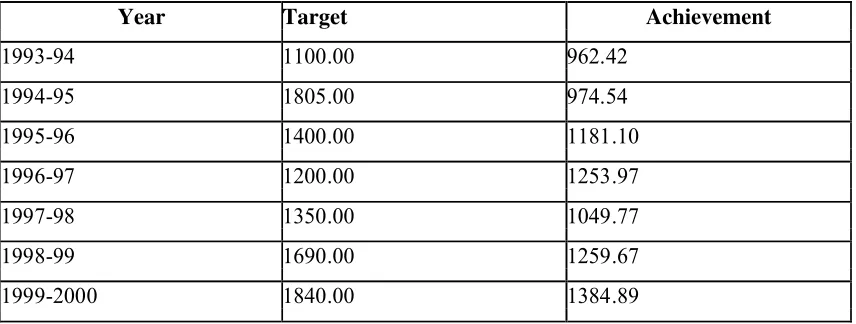
Table No- 5
Year Target Achievement
1993-94 1100.00 962.42
1994-95 1805.00 974.54
1995-96 1400.00 1181.10
1996-97 1200.00 1253.97
1997-98 1350.00 1049.77
1998-99 1690.00 1259.67
1999-2000 1840.00 1384.89
Source : Uttar Pradesh 2002
The Functioning on the Export front during the same period is as below in Table No-6
Table No-6
Year Target Achievement
1993-94 400.00 387.35
1994-95 1000.00 242.91
1995-96 500.00 287.03
1996-97 300.00 323.37
1997-98 400.00 222.33
1998-99 500.00 24.49
1999-2000 1500.00 56.49
2000-01 - 08.00
Source: Uttar Pradesh 2002
(vi) State Leather Development and Marketing Corporation Limited, Agra :
Formed on February 12, 1974 under the companies act ,the corporation conducts the
(a) sale of shoes and footwear manufactured with the latest techniques, (b) explores new markets for leather products manufactured by the existing units and (c) develops and popularizes new styles of foot-wear and new methods of shoe making.
constituted into an independent entity in July 1976. UPTRON constituted into an independent entity in July 1976. UPTRON has a authorized capital of Rs. 90 crore and a paid up capital of Rs.789.60 crore.
(viii) UPICA : Setup in 1952 as a high level body under the U.P. cooperative societies act 1912, UPICA was designed to consolidate the primary industrial weaving cooperative societies and lay down guidelines for production and marketing of handloom- woven cloth and cloth material. The number of member comities of UPICA at present, is 2399 while its total membership, all over state ,comprising weavers is 63,725. UPICA has been made the nodal agency for the construction of workshops cum residence for weaver community of Varanasi and Mirzapur.
(ix) NOIDA : NOIDA was established in 1976 and from the beginning it has held as its goal the speedy industrial development of state in sprit of healthy rivalry with nothing less than national capital itself – Delhi. A chunk of 985 hectares of land has been earmarked for entrepreneurs to set up their industry in U.P. According to initial projection the land should have been available to prospective alloties upto 2011.
(x) SIDA Jaunpur : The Sathariya industrial development was established in November 1989 under the section (3) of state government industrial development
act, 1974. The village Sathariya in Machchlishahar tehsil and another 37 adjoining villages have been notified as a area of activity of SIDA.
The Principal objective of SIDA is to acquire land in the notified areas to pave the way for industrial development by creating the necessary infrastructural facilities and making that land available t o prospective and promising entrepreneurs subsequently on legal terms.
(xi) Uttar Pradesh Small Scale Development Industries Corporation Limited Kanpur : Established in 1958 as a fully autonomous company by the state government , the corporation has been instrumental in providing all necessary help and guidance to small industrial units.
CONCLUSION
The U.P. government is resolved to change Uttar Pradesh into “Udyog Pradesh” and its policies in regard to export and minerals deserves a little more than casual notice. To attract the maximum capital investment in the state, non- resident Indians have been singled out of certain special concessions. Likewise to ensure private sector participation in major industrial
scale industries through private agencies , creation of the single – table system and technology mission are being employed as instruments of growth of important industrial groups in the state.
REFERENCES
1. Chobey S.K., Pendese N.G. and Shikla Narmdra, (2005), “Globalisation and its Impact on Indian Economy”, Adyayam publishers and distributors.
2. Economic Survey (2002-3), Government of India Ministry of Finance and company affairs, Economic decision.
3. Mathur J.S. (2004), “Uttar Pradesh Economy an Overview” , Southern Economist , pp 14-18.
4. M.V. Srinivasa Gowda (2004), “Industrial Development in Uttar Pradesh” , Southern Economist, pp 25-27.
5. Pandey A.P. (2002), “Development Banking in India (with special Reference to UPFC)” ,Ist edition Bharti Prakashan Varanasi, India.
6. Pandey A.P. (1999), “A Commentary on Development Banking in India”, Economic Challenger , Vol No .4 ,pp 41-44.
7. Pandey A.P.(2005), “Impact of Industrial Development on the Business of Financial Intermediaries in U.P.” conference volume of Uttar Pradesh Uttaranchal Economic Association, pp 233-242
8. Pandey A.P. and Prasad A.R.(2005), “ Uttar Pradesh State Finance Trends Sources and Challenges “, Uttar Pradesh Economic Association Conference Volume, pp 1-5
9. Rudera Dutt Sundaram and K.P.M. Sundaram (1999), Indian Economy 39th edition , S Chand and Company Ltd , New- Delhi , India.
10. Uttar Pradesh (2002), Information and Public Relation Department Uttar Pradesh State Government Report, India.
11. Vasant Desai, (1983),"Problems and Prospects of Small Scale Industries in India” , Himalaya Publishing House – Bombay.