Neuroscience Institute Dissertations Neuroscience Institute
Spring 4-11-2015
Mechanisms of the Coregulation of Multiple Ionic
Currents for the Control of Neuronal Activity
William Barnett
Follow this and additional works at:https://scholarworks.gsu.edu/neurosci_diss
This Dissertation is brought to you for free and open access by the Neuroscience Institute at ScholarWorks @ Georgia State University. It has been accepted for inclusion in Neuroscience Institute Dissertations by an authorized administrator of ScholarWorks @ Georgia State University. For more information, please [email protected].
Recommended Citation
Barnett, William, "Mechanisms of the Coregulation of Multiple Ionic Currents for the Control of Neuronal Activity." Dissertation, Georgia State University, 2015.
by
WILLIAM BARNETT
Under the Direction of Gennady Cymbalyuk, PhD
ABSTRACT
An open question in contemporary neuroscience is how neuromodulators coregulate
multiple conductances to maintain functional neuronal activity. Neuromodulators enact
changes to properties of biophysical characteristics, such as the maximal conductance or
voltage of half-activation of an ionic current, which determine the type and properties of
neuronal activity. We apply dynamical systems theory to study the changes to neuronal
ionic currents extends the scope of dynamic control on neuronal activity. Different aspects of
neuronal activity can be independently controlled by different currents. The coregulation of
multiple ionic currents provides precise control over the temporal characteristics of neuronal
activity. Compensatory changes in multiple ionic currents could be used to avoid dangerous
dynamics or maintain some aspect of neuronal activity. The coregulation of multiple ionic
currents can be used as bifurcation control to ensure robust dynamics or expand the range
of coexisting regimes. Multiple ionic currents could be involved in increasing the range
of dynamic control over neuronal activity. The coregulation of multiple ionic currents in
neuromodulation expands the range over which biophysical parameters support functional
activity.
by
WILLIAM BARNETT
A Dissertation Submitted in Partial Fulfillment of the Requirements for the Degree of
Doctor of Philosophy
in the College of Arts and Sciences
Georgia State University
by
WILLIAM BARNETT
Committee Chair: Gennady Cymbalyuk
Committee: Ronald Calabrese
Mukesh Dhamala
Donald Edwards
Remus Osan
Electronic Version Approved:
Office of Graduate Studies
College of Arts and Sciences
Georgia State University
DEDICATION
ACKNOWLEDGEMENTS
This dissertation work would not have been possible without the support of many people.
TABLE OF CONTENTS
ACKNOWLEDGEMENTS . . . v
LIST OF TABLES . . . ix
LIST OF FIGURES . . . x
PART 1 INTRODUCTION . . . 1
1.1 Neurons Are Dynamical Systems . . . 4
1.1.1 Spiking . . . 5
1.1.2 Dissertation Outline . . . 8
PART 2 A CODIMENSION-2 BIFURCATION CONTROLLING EN-DOGENOUS BURSTING ACTIVITY AND PULSE-TRIGGERED RESPONSES OF A NEURON MODEL . . . 11
2.1 Abstract . . . 11
2.2 Introduction . . . 12
2.3 Results . . . 15
2.3.1 Regimes of Activity . . . 15
2.3.2 The Inverse-Square-Root Laws Control Bursting Activity . . . 16
2.3.3 The Inverse-Square-Root Laws of Pulse Triggered Responses . . . 18
2.3.4 The Manifolds of Slow Motion . . . 19
2.3.5 Pattern-scaling in a Chain of Oscillators . . . 24
2.3.6 Control of Motor Pattern in an Insect Walking Central Pattern Gen-erator . . . 26
2.4 Discussion . . . 32
2.4.1 Bifurcation Theory and Control of Neuronal Activity . . . 36
2.4.3 Transient Response to Stimulus . . . 42
2.4.4 Bistability of Spiking and Silence . . . 44
2.4.5 Designing Artificial Neurons . . . 45
2.5 Methods . . . 45
2.6 Figure Legends . . . 49
PART 3 BISTABILITY OF SILENCE AND SEIZURE-LIKE BURST-ING . . . 65
3.1 Introduction . . . 65
3.2 Model . . . 67
3.3 Methods . . . 68
3.4 Results . . . 72
3.4.1 Pulse-Triggered Switch . . . 72
3.4.2 Range of Bistability . . . 80
3.5 Discussion . . . 85
3.6 Acknowledgements . . . 91
PART 4 THE COREGULATION OF THE NA/K PUMP AND THE H-CURRENT AS A MECHANISM FOR ROBUST NEU-ROMODULATION . . . 92
4.1 Methods . . . 94
4.2 Modeling the effects of stimulating the Na+/K+ pump current in eight experimental treatments . . . 97
4.3 The interaction of Na+/K+ pump current with h-current and slow Ca2+ current explains the effects induced by monensin . . . . 102
4.4 Coregulation of the maximal conductance of the h-current and the maximal pump current by myomodulin . . . 108
[image:10.612.74.554.61.702.2]PART 5 GENERAL DISCUSSION . . . 120
5.1 A codimension-2 bifurcation determines activity in a neuron model 121
5.2 Bistability of seizure-like bursting and silence . . . 122
5.3 The coregulation of multiple ionic currents in neuromodulation
exands the range of functional activity . . . 123
5.4 General Conclusions . . . 125
LIST OF TABLES
Table 1.1 Dynamical laws arising from specific bifurcations. . . 10
Table 2.1 Temporal characteristics of bursting for different parameter values in
region II . . . 63
Table 2.2 Measure of burst duration and latency to spiking in response to
inhi-bition from Figure 2.3 (A-C,E-G). . . 63
Table 2.3 Cycle period, duty cycle, and values for θK2 and θh. . . 63
Table 2.4 Parameter values for walking CPG. . . 63
Table 2.5 Synaptic connectivity of central pattern generator for insect walking.
. . . 64
Table 2.6 Summary of network activity. . . 64
LIST OF FIGURES
Figure 2.1 Tonic spiking, bursting, and silence are mapped onto the (θK2, θh)
bifurcation diagram . . . 50
Figure 2.2 Interburst interval and burst duration are scaled according to saddle-node bifurcations . . . 51
Figure 2.3 The inverse-square-root laws in transient responses triggered by a pulse of current for parameter values that support silent (region III) and tonic spiking (regionI) regimes . . . 52
Figure 2.4 The dependence of equilibria and periodic orbits on the parameter θK2 . . . 53
Figure 2.5 Structure of the manifolds of slow motion . . . 54
Figure 2.6 Diagram of the cornerstone bifurcation (CS) . . . 55
Figure 2.6 Diagram of the cornerstone bifurcation (CS) . . . 56
Figure 2.7 Scaling of the metachronal-wave pattern in chains of coupled endoge-nously bursting neurons . . . 57
Figure 2.8 Temporal characteristics of metachronal wave pattern across a range of cycle periods . . . 58
Figure 2.9 Connectivity of insect walking central pattern generator . . . 59
Figure 2.10 Activity of segmental oscillator . . . 60
Figure 2.11 Temporal characteristics of CPG interneurons as function of retractor θK2 . . . 61
Figure 2.12 Activity of three coupled segmental oscillators . . . 62
Figure 3.1 Bursting activity of the model . . . 72
Figure 3.2 The shaded regions represent sets of windows . . . 74
Figure 3.3 The evolution of window shape . . . 77
Figure 3.5 Examples of perturbation of bursting activity with mapped windows 79
Figure 3.6 Bifurcation diagrams of equilibria and bursting determining index of
propensity for multistability . . . 81
Figure 3.7 Two parameter bifurcation diagrams of oscillatory regimes and
equi-libria . . . 84
Figure 3.7 Two parameter bifurcation diagrams of oscillatory regimes and
equi-libria . . . 85
Figure 4.1 Simulated activity of the model including h-current, Na+/K+ pump
current, and intracellular Na+ concentration . . . . 115
Figure 4.1 Simulated activity of the model including h-current, Na+/K+ pump
current, and intracellular Na+ concentration . . . . 116
Figure 4.2 Simulated activity of the model including hCaS,mCaS, and ICaS . 117
Figure 4.2 Simulated activity of the model including hCaS,mCaS, and ICaS . 118
Figure 4.3 Map of coregulation of Imax
PART 1
INTRODUCTION
Central pattern generators control the motor activity of animals (Marder and Calabrese,
1996; Marder et al., 2005; Goudling, 2009) While some central pattern generators are well
studied, it is not well understood how the output of central pattern generators is regulated
to produce functional motor activity in animals through neuromodulation and homeostatic
mechanisms. Regulation of activity can happen at a cellular level or at a network level. It can
be important for one salient feature of the activity of a cell to be maintained or scaled while
another aspect of the activity changes. In the pyloric network of the spiny lobster, qualitative
aspects of activity are maintained despite the upregulation of the transient potassium current
by a compensatory upregulation of a hyperpolarization activated current (MacLean et al.,
2003). Similarly, a central pattern generator might maintain some aspect of its activity. For
example certain networks controlling motor output are able to maintain cycle phase over
a range of cycle periods: the networks controlling swim behavior in the lamprey (Wallen
and Williams, 1984), the swim motor pattern in the leech (Friesen and Pearce, 1993), and
the lobster pyloric rhythm (Hooper, 1997). Regulation of network and motor activity is a
fundamental aspect of neuromuscular control.
Invertebrates are useful subjects to study functional neuronal networks. Their networks
are smaller than mammalian networks. Individual cells perform the same specific function
from animal to animal, and these cells are identifiable across preparations. Moreover, a
number of model species, such as the medicinal leech, are well documented in the
litera-ture (Kristan et al., 2005). While the specific mechanisms underlying the function of these
networks may not be directly comparable to those found in functionally similar networks in
mammals, discoveries made in invertebrate networks can provide insight into mammalian
Neuromodulation allows a central pattern generator to produce a wider range of outputs
than its intrinsic properties might otherwise permit (Katz, 1995). Neuromodulation in the
leech heartbeat central pattern generator is a topic of contemporary study. Two modulators
that are particularly well studied are FMRFamide and myomodulin. The neuropeptide
FMRFamide is a critical modulator of cardiac systems that has been identified in the leech
(Kuhlman et al., 1985a,b; Li and Calabrese, 1987). FMRFamide acts on heart interneurons
by modulating intrinsic voltage-dependent ion channels (Simon et al., 1992; Nadim and
Calabrese, 1997). Myomodulin is a neuropeptide first identified in Aplysia and later found
in the leech (Cropper et al., 1987; Wang et al., 1998) Myomodulin modulates the activity of
the heart interneuron by altering characteristics of the hyperpolarization-activated current
and the Na+ / K+ pump current (Masino and Calabrese, 2002a; Tobin and Calabrese, 2005).
The ability to modulate multiple biophysical properties is a critical tool in an organisms
ability to adapt to its environment. The exact number of ion channels or the exact magnitude
of an ionic conductance in a specific neuron cannot be directly encoded into an animal’s genes.
Rather, there are mechanisms for activity-dependent and activity-independent homeostatis of
functional neuronal activity (MacLean et al., 2003, 2005; Schulz et al., 2006, 2007; Khorkova
and Golowasch, 2007; Abbott and LeMasson, 1993; Cao and Oertel, 2011). The correlation
of ionic conductances provides a simple mechanism to maintain a neuron’s role in a given
organism independent of its life history. The involvement of multiple conductances provides
flexibility in a dynamical sense, as well. A conductance of a specific ionic current may allow
a neuron to tune its activity within certain limits of functional activity, but the addition
of one or more neuromodulatory targets could modify the limits of functional activity. The
coregulation of multiple ionic conductances is a critical feature of homeostasis of functional
neuronal activity.
Neuromodulators change neuronal activity by acting on biophysical characteristics of
ion currents. These modifications to the neuron can change the properties of its activity,
which can be small, such as a change in firing frequency, or more substantial, such as a
Transitions between distinct regimes of activity are called bifurcations in this paradigm,
and bifurcations provide quantitative predictions of the dependence of activity on crucial
parameters.
Currents that are important to maintaining the functionality of oscillatory regimes
are good targets for neuromodulation. Small changes to the kinetics of these currents
can have large consequences for neuronal output. For example, the time scale of
inacti-vation of the slow Ca2+ determines the duration of the burst in the leech heart interneuron
and the heart interneuron half-center oscillator (Olypher et al., 2006). The conductance of
hyperpolarization-activated current changes the interburst interval and therefore determines
the duration of the burst in the opposing cell of the half-center oscillator (Sorensen et al.,
2004; Hill et al., 2001). In individual heart interneurons, the hyperpolarization-activated
current reinforces endogenous bursting activity (Tobin and Calabrese, 2005). The
synap-tic inhibition of the half-center oscillator motif can prevent loss of functionality despite the
introduction of competing non-functional regimes (Cymbalyuk et al., 2002; Marin et al.,
2013). These critical currents contribute to the robustness of the oscillatory pattern.
Ap-propriate regulation could enhance the functional role of the central pattern generator, but
inappropriate regulation could lead to the dysfunctional activity.
Rhythmic behaviors are controlled by devoted oscillatory neuronal networks: central
pattern generators (Wallen and Williams, 1984; Harris-Warrick and Flamm, 1987; Hooper
and Marder, 1987; Bal et al., 1988; Friesen and Pearce, 1993; Marder and Calabrese, 1996;
Marder and Bucher, 2001; Norris et al., 2007; Ramirez et al., 2011). Central pattern
gener-ators adjust their patterns according to motor tasks, sensory feedback, and environmental
conditions (Arbas and Calabrese, 1984; Wallen and Williams, 1984; Marder and Bucher,
2001; Smarandache et al., 2009). They comprise neurons from a spectrum of endogenous
properties varying from tonic spiking through bursting to silent neurons (Harris-Warrick
and Flamm, 1987; Hooper and Marder, 1987; Bal et al., 1988; Marder and Calabrese, 1996;
Marder and Bucher, 2001; Ramirez et al., 2011). These neurons can be sensitive to
Flamm, 1987; Hooper and Marder, 1987; Bal et al., 1988; Marder and Bucher, 2001). Neurons
like conditional oscillators can be found in either tonic spiking, bursting, or silent regimes,
when decoupled from a circuit (Harris-Warrick and Flamm, 1987; Hooper and Marder, 1987;
Bal et al., 1988; Marder and Bucher, 2001). Major open questions are concerned with the
determining the key cellular properties which are characteristic for neurons in central
pat-tern generators. Are there organizing principles of cellular dynamics which allow neurons to
produce precise patterns in an orchestrated fashion? Are there mechanisms which coordinate
dynamic properties of neurons to accomplish adaptation of motor behavior to continuously
changing conditions? We address these questions with dynamical systems theory.
1.1 Neurons Are Dynamical Systems
Bifurcation analysis provides theoretical guidelines and a powerful analytical framework
to tune the activity of neuronal models. A bifurcation is a qualitative change in the activity
of a dynamical system, such as a transition from silence to spiking. Bifurcation analysis
identifies general dynamical laws governing transitions between activity regimes in response
to changes in controlling parameters. By using these quantitative laws, the temporal
charac-teristics of a neuronal model can be tuned to reproduce the characcharac-teristics of experimentally
recorded activity by navigating the parameter space in the vicinity of bifurcations. In most of
the bifurcations described here, the general shape of the waveform–for example of the shape
of action potentials in a time series–is preserved, while a specific temporal characteristic
changes.
The knowledge of the bifurcations of a model neuron provides quantitative laws
govern-ing the temporal characteristics of spikgovern-ing activities. Neurons can be envisaged as nonlinear
dynamical systems. Bifurcation analysis has been applied to the study of spiking, bursting,
and chaotic neuronal systems (Rinzel, 1987; Guckenheimer et al., 1993, 1997; Rinzel and
Ermentrout, 1998; Ermentrout and Terman, 2010; Ghigliazza and Holmes, 2004; Rabinovich
et al., 2008). Biophysical parameters are used as controlling parameters, and changes in
Guck-enheimer et al., 1993, 1997; Shilnikov and Cymbalyuk, 2005; Shilnikov et al., 2005; Medvedev,
2006; Barnett and Cymbalyuk, 2014). The association of transitions between regimes of
neu-ronal activity with specific bifurcations gives predictions about the properties of stationary
and oscillatory solutions (Booth et al., 1997; Doiron et al., 2003; Shilnikov and Cymbalyuk,
2005; Shilnikov et al., 2005; Barnett and Cymbalyuk, 2014). This approach is applicable
for tuning the dynamics of neuronal activity–such as bursting, spiking, and rest states–with
biophysical parameters. We provide examples of four bifurcations that determine
quantita-tive characteristics of activity: the homoclinic bifurcation, the saddle-node bifurcation on
an invariant circle (for bursting and for tonic spiking), the blue sky catastrophe, and the
Andronov-Hopf bifurcation (Table 1.1). We present the dynamic laws generated by these
bifurcations in the context of spiking, bursting, and transient activity.
1.1.1 Spiking
Three bifurcations of closed periodic orbits are ubiquitously implicated in the control
of spiking activity. A saddle-node bifurcation on invariant circle (SNIC) and a homoclinic
bifurcation describe how the frequency of spiking depends on a controlling parameterα, e.g.
the injected current. A supercritical Andronov-Hopf bifurcation describes the dependence
of the amplitude of oscillations on the bifurcation parameter.
A SNIC occurs when an equilibrium possessing the properties of both a saddle and
a node–a saddle-node equilibrium–is born on a closed periodic orbit, and the eigenvectors
associated with the half-stable direction of the saddle-node equilibrium are tangent to the
periodic orbit. This bifurcation describes the transition of spiking into silence (Gutkin and
Ermentrout, 1998). At the critical value for bifurcation, α∗
, the saddle-node equilibrium
obstructs the spiking orbit. For values ofαthat support spiking and are close to α∗
, the
fre-quency of spiking activity is proportional to p|α−α∗
|. This bifurcation does not constrain
the amplitude of spiking. This scenario is an example the type I spiking scenario (Gutkin
and Ermentrout, 1998; Izhikevich, 2007b).
(Izhike-vich, 2007b). It occurs when an orbit is interrupted by the saddle; as α changes and
ap-proaches the critical value for bifurcation, α∗
, the spiking frequency decays according to
−1/ln(|α−α∗ |).
In a supercritical Andronov-Hopf bifurcation, a stable focus loses stability, and a stable
periodic orbit with zero amplitude and non-zero frequency is born. The frequency is inherited
from the resonant frequency of the focus. In subthreshold oscillations or spiking activity
as-sociated with this bifurcation, the amplitude of the orbit grows proportionally top
|α−α∗ |.
This scenario is an example of the type II spiking scenario (Gutkin and Ermentrout, 1998;
Izhikevich, 2007b; Rinzel and Ermentrout, 1998).
Bursting Four types of bifurcations are crucial for the control of temporal
charac-teristics in bursting activity: the SNIC for bursting, the blue sky catastrophe, cornerstone
bifurcation, and the Lukyanov-Shilnikov bifurcation.
In bursting activity, the SNIC describes the transition from bursting to silence (Booth
et al., 1997; Doiron et al., 2003; Barnett and Cymbalyuk, 2014). According to this
bifur-cation, the interburst interval grows smoothly and is proportional to 1/p|α−α∗
| as the
bifurcation parameter, α, approaches the critical valueα∗
. At the bifurcation, a saddle-node
equilibrium is born on the bursting orbit.
The blue sky catastrophe occurs when a saddle-node periodic orbit is born on the
manifold that governs spiking in a bursting neuron (Shilnikov and Cymbalyuk, 2005; Barnett
and Cymbalyuk, 2014). This bifurcation describes the transition from bursting to tonic
spiking. The burst duration grows smoothly and is proportional to 1/p|β−β∗
| as the
bifurcation parameter, β, approaches the critical value β∗
.
The cornerstone bifurcation satisfies the conditions of both the SNIC and the blue sky
catastrophe; it is a global codimension-2 bifurcation (Shilnikov and Turaev, 2000; Barnett
and Cymbalyuk, 2014). This bifurcation describes the independent control of interburst
interval and burst duration: one parameter, α, controls the transition from bursting to
to spiking as in the blue sky catastrophe. At the critical value for both parameters, (α∗
,
β∗
), there occurs both the saddle-node equilibrium and the saddle-node periodic orbit. In
this way, the duration of the interburst interval is controlled as in the SNIC, and the burst
duration is controlled as in the blue sky catastrophe.
The Lukyanov-Shilnikov bifurcation is a homoclinic bifurcation of a periodic orbit
(Lukyanov and Shilnikov, 1978). In bursting, this bifurcation occurs when the unstable
manifold of the saddle-orbit leads into the stable manifold of the orbit (Shilnikov et al.,
2005). The unstable manifold near the saddle-orbit determines the duration of each burst.
Near this bifurcation, bursting is commonly chaotic and on average, the burst duration grows
proportionally to−ln(|α−α∗
|) as the bifurcation parameter,α, approaches the critical value
α∗
.
Transient Activity Transient dynamics are critical for information processing
(Ra-binovich et al., 2008). The temporal characteristics of transient activity can similarly be
governed by bifurcations. Typically, temporal laws are associated with global bifurcations.
However, a local bifurcation can determine the timescale of transient neuronal responses to
external perturbations, such as a pulse of synaptic current.
The saddle-node bifurcation for periodic orbits can impose temporal laws on transient
spiking activity in an endogenously silent neuron (Roa et al., 2007). For values of the
bifurcation parameter α which support silence and are close to the birth of the spiking
regime atα∗
, the dynamics of perturbation-induced transient spiking activity are controlled
by the proximity (|α−α∗
|) to the bifurcation. Far from the bifurcation, a perturbation
may trigger a single action potential, but as the quantity |α−α∗
| becomes small, the same
perturbation induces an increasing number of spikes. The duration of this transient activity–
under the condition of an invariant external stimulus–is proportional to 1/p|α−α∗
|. A similar scenario is generated by the cornerstone bifurcation (Barnett and Cymbalyuk, 2014).
In the context of the tonically spiking neurons, the cornerstone bifurcation describes
saddle-node bifurcation for equilibria (Barnett and Cymbalyuk, 2014). The return to the spiking
state after inhibition is delayed if α is close in value to α∗
, and this delay is proportional to
1/p|α−α∗ |.
1.1.2 Dissertation Outline
This dissertation is organized into three main chapters. The common thread shared
among these three chapters and the theme that has informed my research is that
multi-ple ionic currents can be covaried to maintain or produce functional neuronal activity. I
use methods developed in the theory of dynamical systems to study how the simultaneous
regulation of multiple biophysical properties modulates neuronal activity.
The first chapter covers the description of a global codimension-2 bifurcation, its role
in the control of temporal characteristics of oscillatory activity, and how it coordinates the
coregulation of important membrane conductances. This so-called cornerstone bifurcation
generates a family of three dynamical mechanisms. These mechanisms are all executed by the
coordinated manipulation of the voltage of half-activation of a hyperpolarization-activated
current (−θh) and a non-inactivating potassium current (−θK2). The first mechanism
pro-vides control over temporal characteristics of endogenous bursting activity. In this case,
θK2 and θh are coordinated to independently control burst duration and interburst interval.
A second mechanism controls the duration of individual transient bursts in endogenously
silent neurons. In this mechanism, θh was used to tune the type of activity of the cell to
silence and θK2 was used to control the duration of the transient burst. A third mechanism
controls the duration of the latency to spiking after inhibition in endogenously spiking
neu-rons. In this mechanism, θK2 was used to set the cell into a spiking mode and θh was used
to control the duration of latency to spiking. As proof-of-principle concepts, we designed
two central pattern generators that used these mechanisms. The first example was a
cen-tral pattern generator that controlled crawling in the Drosophila larva. We coregulated the
hyperpolarization-activated current and the non-inactivating K+ current withθ
h andθK2 to
periods, and demonstrated that the intrinsic duty cycle of individual participant neurons
could determine the phase lag in the network. The second example was a central pattern
generator that controlled the timing of protraction and retraction for six-legged locomotion.
The network was composed of pairs of protractor and retractor interneurons. Protractor
in-terneurons were endogenously bursting, and retractor inin-terneurons were endogenously silent.
By controlling the transient bursts specifically in retractor interneurons, we demonstrated
control of the emergent gait and smooth transitions between two types of gait.
In the second chapter, we investigated the robustness of a bursting regime against
per-turbations in a model of a leech heart interneuron. This activity demonstrated bistability of
plateau-like bursting and silence. We developed a protocol to trigger a switch from a
burst-ing state to a silent state. By systematically varyburst-ing the start-time within the phase of the
burst and the amplitude and polarity of the perturbation, we mapped the basin of attraction
of the silent regime. We identified the dynamical transition crucial for the appearance of the
silent regime imposed by a subcritical Andronov-Hopf bifurcation. The propensity of the
neuron to bistability was defined as the difference in values of the leak conductance for which
the model supports bistability. We tracked the Andronov-Hopf bifurcation and the
termina-tion of the bursting regime while co-varying the leak conductance and each of the maximal
conductances of the voltage gated currents. This analysis revealed key conductances that
control the propensity of the neuron to bistability. We coregulated these conductances to
produce a model with a greatly increased range of bistability in the leak conductance.
In the third chapter, we investigated the dynamics of Na+/K+ pump current and how
coregulation controls the functional range of neuronal activity. In the leech heart
interneu-ron, the application of myomodulin, which inhibits the Na+/K+ pump current, decreases
the period of bursting activity. The application of monensin, which enhances the Na+/K+
pump current, also decreases the period of bursting activity. We developed a new canonical
model of the leech heart interneuron which included Na+ dynamics and the Na+/K+. In one
instantiation of the model, we reproduced changes to temporal characteristics due to
pump current, the slow Ca2+ pump current, and the hyperpolarization-activated current
interacted to determine burst characteristics. In another instantiation of the model, we
re-produced changes to temporal characteristics due to treatment with myomodulin and Cs+.
Finally, we investigated mechanisms wherein myomodulin coregulated the maximal
conduc-tance of the h-current and the Na+/K+ pump current to control the range of functional
activity.
Table (1.1). Dynamical laws arising from specific bifurcations. The bifurcation parameter
α takes its critical value for bifurcation at α∗
.
Bifurcation Dependence
Homoclinic Period ∝ −ln(|α−α∗
|)
SNIC Period ∝1/p
|α−α∗ |
Blue Sky Catastrophe Period∝1/p
|α−α∗ |
Andronov-Hopf Amplitude ∝p|α−α∗
PART 2
A CODIMENSION-2 BIFURCATION CONTROLLING ENDOGENOUS
BURSTING ACTIVITY AND PULSE-TRIGGERED RESPONSES OF A
NEURON MODEL
2.1 Abstract
The dynamics of individual neurons are crucial for producing functional activity in
neuronal networks. An open question is how temporal characteristics can be controlled in
bursting activity and in transient neuronal responses to synaptic input. Bifurcation theory
provides a framework to discover generic mechanisms addressing this question. We present a
family of mechanisms organized around a global codimension-2 bifurcation. The cornerstone
bifurcation is located at the intersection of the border between bursting and spiking and the
border between bursting and silence. These borders correspond to the blue sky catastrophe
bifurcation and the saddle-node bifurcation on an invariant circle (SNIC) curves,
respec-tively. The cornerstone bifurcation satisfies the conditions for both the blue sky catastrophe
and SNIC. The burst duration and interburst interval increase as the inverse of the square
root of the difference between the corresponding bifurcation parameter and its bifurcation
value. For a given set of burst duration and interburst interval, one can find the parameter
values supporting these temporal characteristics. The cornerstone bifurcation also
deter-mines the responses of silent and spiking neurons. In a silent neuron with parameters close
to the SNIC, a pulse of current triggers a single burst. In a spiking neuron with
parame-ters close to the blue sky catastrophe, a pulse of current temporarily silences the neuron.
These responses are stereotypical: the durations of the transient intervals–the duration of
the burst and the duration of latency to spiking–are governed by the inverse-square-root
laws. The mechanisms described here could be used to coordinate neuromuscular control in
metachronal-wave motor pattern exhibited in locomotion. This pattern is determined by the
phase relations of bursting neurons in a simple central pattern generator modeled by a chain
of oscillators.
2.2 Introduction
The control of temporal characteristics of functional neuronal activity depends on the
coregulation of multiple membrane conductances. The dynamics of individual neurons are
crucial for the functionality of neuronal networks. Precise timing and reliability of
tem-poral responses are critical for memory, pattern recognition, and especially motor control
(Rabinovich et al., 2008; Roa et al., 2007; Marder et al., 1996; Hooper et al., 2002;
Kopp-Scheinpflug et al., 2011; Meng et al., 2011; Ramirez et al., 2011; Norris et al., 2007; Hooper,
1997; Mouser et al., 2008). Functional bursting activity, latency to spiking, and transient
oscillatory activity are necessary components determining reliability and precise timing. For
example, transient spiking activity is critical for information representation and memory
(Roa et al., 2007; Marder et al., 1996; Doiron et al., 2003; Laing et al., 2003); precise
con-trol over delay to firing after inhibition is important for the detection of temporal patterns
(Hooper et al., 2002; Kopp-Scheinpflug et al., 2011; Meng et al., 2011); and bursting activity
is crucial for rhythmic motor functions including respiration, locomotion, and neurogenic
cardiac systems (Ramirez et al., 2011; Norris et al., 2007).
Rhythmic motor functions are executed by precisely coordinated oscillatory patterns of
contracting muscles. These functions require flexibility of rhythmic patterns to cope with
environmental conditions such as temperature, load, or the demand for speed of
locomo-tion. Accordingly, some rhythmic behaviors scale their pattern, maintaining phase relations
across a wide range of periods, for example, according to different speeds of locomotion.
Examples of pattern scaling behaviors include the pyloric rhythm in Crustacea, crayfish
swimmeret beating, the leech heartbeat, leech swimming, lamprey swimming, and
crawl-ing of the Drosophila larvae (Kristan et al., 1974; Arbas and Calabrese, 1984; Wallen and
Mulloney, 1998; Mouser et al., 2008; Suster and Bate, 2002; Fox et al., 2006; Norris et al.,
2007; Hughes and Thomas, 2007; Smarandache et al., 2009; Mullins et al., 2011; Pulver et al.,
2012).
Bifurcation theory explains how dynamical systems like neurons precisely change their
dynamics in response to the variation of a controlling parameter like neuromodulatory tone
or descending drive (Guckenheimer et al., 1997; Rabinovich et al., 2008; Hoppensteadt and
Izhikevich, 1997; Ermentrout, 1996; Teka et al., 2011; Ermentrout and Kopell, 1994a; Rinzel,
1987; Cymbalyuk et al., 2002; Malashchenko et al., 2011d,a; Rinzel, 1978b; Marder et al.,
1996; Roa et al., 2007; Meng et al., 2011; Ermentrout, 2004b; Jones et al., 2003; Booth et al.,
1997; Gutkin and Ermentrout, 1998; Laing et al., 2003; Doiron et al., 2003; Cymbalyuk
and Calabrese, 2001; Shilnikov and Cymbalyuk, 2005; Cymbalyuk and Shilnikov, 2005b;
Shilnikov et al., 2005; Ghosh et al., 2009; Izhikevich, 2000; Channell et al., 2007; Ghigliazza
and Holmes, 2004). A variety of network mechanisms producing specific temporal patterns
of activity have been previously studied (Kopell and Ermentrout, 1988; Cohen et al., 1992;
Ermentrout and Kopell, 1994b,a; Skinner and Mulloney, 1998; Hoppensteadt and Izhikevich,
1997; Hill et al., 2001; Jones et al., 2003; Mouser et al., 2008; Rabinovich et al., 2008; Varkonyi
et al., 2008; Kozlov et al., 2009; Popovych et al., 2011; Yanchuk et al., 2011; Soofi et al.,
2012).
Our study emphasizes the dynamics of single neurons as an organizing principle
under-lying pattern formation. We present a global codimension-2 bifurcation and assert that this
so-called cornerstone bifurcation can precisely control the regulation of temporal
character-istics in periodic and transient neuronal activity. We suggest that this bifurcation generates
a family of cellular mechanisms which can answer the aforementioned questions. These
mechanisms also explain the operation of conditional oscillators in parameter space near a
functional bursting regime.
In neurons, control over regimes of activity is ubiquitously executed through
neuromod-ulation. Potassium currents and hyperpolarization-activated currents are common targets
Klop-penburg et al., 2008; Rodgers et al., 2011b; Ikematsu et al., 2011; Amendola et al., 2012).
Among the usual targets of neuromodulation are the kinetic parameters controlling the
voltage dependence of conductances of ionic currents such as a non-inactivating potassium
current, IK2, and a hyperpolarization-activated current, Ih. IK2 is an outward current that
is activated during the burst and creates a mechanism controlling termination of the burst.
To serve this role, the activation variable of this current must be significantly slower than the
duration of a single spike. On the other hand,Ihis an inward current that is activated during
the silent phase of bursting activity, and it creates a mechanism controlling the duration of
the silent phase. The voltage of half-activation of IK2, −θK2, could control burst duration,
and the voltage of half-activation of Ih, −θh, could control the interburst interval. Here, we
present a model in which the dependence of burst duration and interburst interval on θK2
and θh can be quantitatively described by inverse-square-root laws.
Biophysically accurate neuronal models allow the utilization of well developed
tech-niques from bifurcation theory. In a model, bifurcations can predict the dependence of
temporal characteristics of oscillatory regimes near the bifurcation (Gutkin and Ermentrout,
1998; Booth et al., 1997; Doiron et al., 2003; Laing et al., 2003; Ghosh et al., 2009). In
type I spiking neuronal dynamics, a saddle-node bifurcation on an invariant circle (SNIC)
describes a transition from tonic spiking into silence; the interspike interval obeys the
inverse-square-root law imposed by the bifurcation. The period of spiking grows proportionally to
1/√α−α∗ where α∗
is the bifurcation value of the parameter α and α > α∗
. In our case,
the bifurcation parameters are either θK2 or θh. The blue sky catastrophe, a special case
of the saddle-node bifurcation for orbits, imposes the same inverse-square-root law on burst
duration (Shilnikov and Turaev, 2000; Shilnikov and Cymbalyuk, 2005). A saddle-node
bifur-cation for periodic orbits can control the transition from bursting into tonic spiking (Doiron
et al., 2003; Laing et al., 2003; Shilnikov and Cymbalyuk, 2005; Shilnikov et al., 1998,2001).
When the criteria for the SNIC and the blue sky catastrophe are simultaneously satisfied,
a global bifurcation of codimension-2 occurs (Shilnikov and Turaev, 2000; Shilnikov et al.,
the bifurcation parameters control burst duration and interburst interval, latency to spiking
in the response of a spiking neuron to inhibition, duration of a burst elicited by stimulation
of a silent neuron, and multistability of spiking and silence. We apply these mechanisms
to construct simple proof of principle models of central pattern generators (CPG)s. One of
these mechanisms describes the coregulation of two biophysical parameters in the vicinity of
the cornerstone bifurcation such that the duty cycle of bursting in a single cell is maintained
across a wide range of periods. Connected into a chain, such oscillators self-organize their
activity into a metachronal wave pattern, which is preserved against variation in period. We
present this model in regard to crawling behavior in Drosophila larvae.
2.3 Results
2.3.1 Regimes of Activity
We developed a generic low-dimensional Hodgkin-Huxley type neuronal model
stem-ming from a model of the leech heart interneuron under certain pharmacological conditions
(Cymbalyuk and Calabrese, 2001; Shilnikov and Cymbalyuk, 2005). In order to reduce the
mathematical complexity of the system, we simulated the activity of the interneuron in bath
with Co2+ and 4-aminopyridine (4-AP). Application of Co2+ blocks Ca2+ currents and the
synaptic current. Application of 4-AP blocks most of the K+ currents. The remaining
cur-rents in this model are the leak current, the non-inactivating potassium current, IK2, the
fast sodium current, IN a, and a constant polarizing current. Our model also includes the
hyperpolarization-activated current, Ih, which is present in this pharmacological scenario
but has not been previously represented in our reduced models. Intracellular recordings
in these conditions show slow seizure-like oscillations with periods that are tens of seconds
long (Angstadt and Friesen, 1991; Opdyke and Calabrese, 1994a). The slow variable in this
system is the activation of IK2, mK2; its time constant was 2 s. As such, the temporal
characteristics of these variables are instrumental in the dynamics of bursting activity. By
we observed the range of bursting activity and bifurcations between qualitatively distinct
regimes of neuronal activity. We investigated the effects of changes to the kinetics of IK2
and Ih.
The parameters−θK2 and −θh represent the voltages of half-activation of the variables
mK2andmh. We conducted an empirical investigation of the model by systematically varying
θK2andθh. The model exhibited a variety of regimes. Silence and tonic spiking corresponded
to equilibria and periodic orbits. Bursting activity was either periodic or weakly chaotic.
For low values of θK2 and θh (region I), the model exhibited tonic spiking (Fig 2.1A). For
high values of θK2 and low values of θh (region II), the model exhibited bursting activity
(Fig 2.1A). For high values ofθK2 andθh (region III), the model was silent (Fig 2.1A). For
low values ofθK2 and high values of θh (regionIV), the model exhibited bistability of tonic
spiking and silence (Fig 2.1A).
We determined the boundaries between bursting and tonic spiking and between bursting
and silence by integrating the system over a range of values for θh and θK2. Samples varied
from one another in the burst duration and the interburst interval (Table 2.1). The transition
from bursting to tonic spiking occurred near θK2 = -0.0105 V almost independently of θh
(Fig 2.1A). The transition from bursting to silence occurred near θh = 0.0413 V with weak
dependence on θK2 (Fig 2.1A). As the parameters were changed to approach the transition
from bursting to tonic spiking or from bursting to silence, the burst duration or interburst
interval increased, respectively. We described the changes in the bursting wave form by duty
cycle: the ratio of burst duration to cycle period. The duty cycle generally increased asθK2
orθh decreased (Fig 2.1A).
2.3.2 The Inverse-Square-Root Laws Control Bursting Activity
We associated saddle-node bifurcations of equilibria and periodic orbits with the
transi-tions between different regimes. The transitransi-tions between I and IV and betweenII and III
coincided with the saddle-node bifurcation for equilibria (Fig 2.1A, black curve). The borders
bifurcation for periodic orbits (Fig 2.1A, grey curve). The location of the codimension-2
bifurcation was interpolated as the intersection of the curves representing the saddle-node
bifurcation for equilibria and the saddle-node bifurcation for periodic orbits at ( θ∗
K2 =
-0.010505 V, θ∗
h = 0.041356538 V).
We show that the saddle-node bifurcations along the border between I and II and
be-tween II and III are a blue sky catastrophe and a SNIC, respectively, through a series of
curve fits and analysis of slow motion. We investigated temporal characteristics of bursting
near these bifurcation curves (Fig 2.2). The system was directly integrated for a series of
parameter values approaching the bifurcation values. As θh approached the saddle-node
bi-furcation for equilibria, the interburst interval grew in a fashion asymptotic to the parameter
value of bifurcation (Fig 2.2A-B). The parameter θK2 was similarly varied so as to approach
its critical value for the saddle-node bifurcation for periodic orbits. Samples of bursting
activity for values of θK2 successively closer to the bifurcation value showed an asymptotic
increase in the burst duration (Fig 2.2C-D).
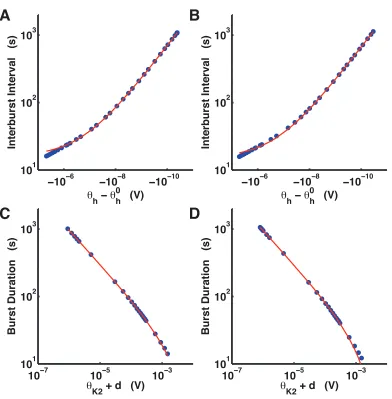
We performed curve fits to two slightly different expressions for burst duration and
interburst interval:
fK2(θK2) =b/√θK2+d+c, (2.1)
fh(θh) = b/ p
θ0
h−θh+c. (2.2)
The coefficientsb, c, andd were determined with an optimization routine (see Methods
for details). Curve fits for burst duration took the formfK2(θK2) (Eq. 2.1). Curve fits for the
interburst interval took the form fh(θh) (Eq. 2.2). The parameter θ0h was the value for the
saddle-node bifurcation. We performed curve fits for sixteen data sets – eight distinct data
sets for each of the two bifurcations. The dependence of the burst duration and interburst
interval onθK2 andθh fit well to the quantitative expressions in Eqs 2.1 and 2.2, respectively.
analytical prediction of 1/√α−α∗. As such, these results strongly suggested that the curves
depicted in the bifurcation diagram in Figure 2.1 represent a blue sky catastrophe on the
border of the transition from bursting (region II) to spiking (region I) and a SNIC on the
border of the transition from bursting (region II) to silence (regionIII). We also confirmed
these results for the value of the time constant of activation of the potassium current 0.9 s
used in the (Shilnikov and Cymbalyuk, 2005).
2.3.3 The Inverse-Square-Root Laws of Pulse Triggered Responses
For parameter values in regions I and III (Fig 2.1), tonic spiking and silence were
attracting regimes. However, a perturbation from the tonic spiking regime in I or the
rest state in III triggered transient activity that shared the inverse-square-root laws with
the corresponding characteristics of periodic bursting in region II (Fig 2.3). For example,
activity at parameter values in regionIII was quiescent, but a brief hyperpolarizing pulse of
appropriate duration and amplitude triggered a single burst (Fig 2.3 A-C). These individual
bursts closely resembled the characteristic waveforms of bursting activity observed in Region
II. We investigated this parameter space by observing pulse-triggered bursts at parameter
values such that θh was fixed at 0.0415 V and θK2 approached the value for the saddle-node
bifurcation for periodic orbits at the border between regionsIII andIV. AsθK2 approached
the value of the bifurcation, the burst duration of pulse triggered bursts grew (Table 2.2).
Even though there was no closed periodic orbit in region III, the phase point slowed down
as it passed near the ghost of the saddle-node periodic orbit. We performed a curve fit of
this data to the function fK2(θK2) (Eq. 2.1; Fig 2.3D).
We carried out a similar analysis for the border of the transition from regions I to IV.
When tonic spiking activity was perturbed with a hyperpolarizing pulse, the system spent
some time in a transient hyperpolarized silent state before returning to spiking activity. The
trajectory during this time interval resembled the trajectory during the interburst interval
of an endogenously bursting cell. We fixed θK2 at -0.0107 V, and we sampled region I for
latency to spiking grew (Table 2.2). As the parameterθh took values close to the saddle-node
bifurcation for equilibria, the phase point spent more and more time near the ghost of the
saddle-node equilibrium. We quantified the dependence of the latency to spiking on θh by
performing a curve fit to the function fh(θh) (Eq. 2.2a; Fig 2.3H).
2.3.4 The Manifolds of Slow Motion
This model exhibit bursting of square-wave type. The bursting phase is controlled by
the activation ofIK2. Over the course of the burst,mK2 incrementally grows with each spike.
Vice versa, mK2 controls the shape of each spike. The shape of each spike depends on the
value ofmK2, and the next increment ofmK2 depends on the shape of the spike. To account
for this mutual interaction and to formalize the progression of the burst towards termination,
we used slow-fast decomposition. This technique allows us to describe this process in terms
of the dynamics of one variable: the slow variable.
We considered the model as a slow-fast system. The variablemK2 was the slow
subsys-tem, and {V, hN a,mh} composed the fast subsystem. The magnitude ofmK2 controls rest
states (equilibria) and spiking (periodic orbits) of the fast subsystem. These equilibria and
periodic orbits are located on manifolds that could be determined by decoupling the slow-fast
system and reintroducing the slow variable as a parameter (Rinzel, 1987; Izhikevich, 2000).
Trajectories of the full system stay near these manifolds of slow motion (Fenichel, 1979;
Rinzel, 1987; Izhikevich, 2000). The slow motion manifold that determines periodic orbits
describes the breadth of specifications of spike shapes in the fast subsystem. The slow motion
manifold that determines the silent phase describes the characteristics of equilibria of the
fast subsystem. We used a more accurate approach, whereby we manipulated a parameter
of the slow variable (θK2) to compute the manifolds of slow motion in the full system
(Pon-tryagin and Rodygin, 1960; Cymbalyuk and Shilnikov, 2005b; Shilnikov and Cymbalyuk,
2005; Shilnikov et al., 2005). We performed slow-fast decomposition and determined the
slow motion manifolds to study the structure of the codimension-2 bifurcation. We applied
and Shilnikov, 2005b; Shilnikov and Cymbalyuk, 2005; Shilnikov et al., 2005). The stability
of the regimes in the full system was determined by bifurcation analysis.
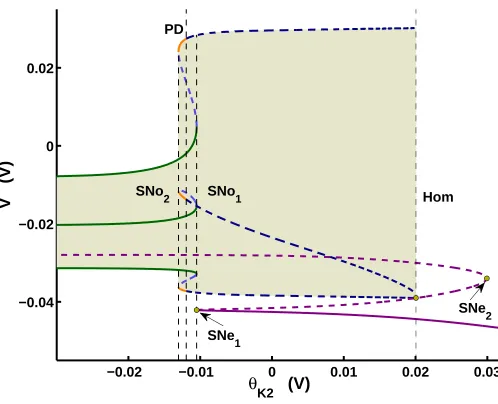
We identified the manifolds of slow motion by analyzing simple periodic orbits and
equilibria using the parameter θK2 as a continuation parameter. We produced a family of
orbits,Mo, by varyingθK2. Starting at a value (θK2 = -0.03V) where the system exhibited a
stable periodic orbit, we continued this orbit as it went through a series of bifurcations (Fig
2.4). It folded over twice at saddle-node bifurcations for periodic orbits, first losing stability
at SN o1 and then regaining stability at SN o2. Shortly after SN o2, the orbit lost stability
in a period doubling bifurcation P D. Also, we computed the slow manifold associated
with equilibria, Meq, in the fast subsystem (Fig 2.4). Starting at a value (θK2 = 0.04 V)
where the system exhibited a stable equilibrium, we continued the equilibrium as it went
through two saddle-node bifurcations for equilibria. It lost stability at SN e1, and folded
again at SN e2. The saddle-node bifurcations at SN o1 and SN e1, the two elements of the
codimension-2 bifurcation, occurred at the same parameter value. To further confirm that
these bifurcations are parts of the cornerstone bifurcation, we show that SN e1 and SN o1
occur on the corresponding slow motion manifolds of the full system.
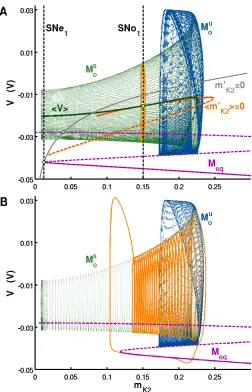
The orbits and equilibria portrayed in Figure 2.4 are orbits and equilibria of the full
system corresponding to different values of θK2. In addition to portraying these data sets
in terms of the bifurcation parameter (Fig 2.4), we examined each data set in the (mK2,
V) projection of the phase space (Fig 2.5) Shilnikov and Cymbalyuk (2005); Shilnikov et al.
(2005); Cymbalyuk and Shilnikov (2005b). In this projection, Mo and Meq corresponded to
orbits and equilibria in the fast subsystem. Equilibria of the full system are determined by
the intersection of the nullcline of the slow variable at a given value of θK2 and Meq. At
the critical value for the cornerstone bifurcation, there are two equilibria determined by this
analysis: one equilibrium is of the saddle-node type and the other equilibrium is unstable
(Fig 2.5A). SN e1 was located where the slow manifold, Meq, was tangent to the nullcline
of the slow variable (Fig 2.5A). Orbits of the full system are determined by the intersection
values of V and mK2 in Mo. The family of orbits, Mo, was separated into a stable manifold,
Ms
o, and an unstable manifold, Mou (Fig 2.5A). Our analysis reduced Mo to the average
coordinate of each orbit in Mo: (hmK2i, hVi). Additionally, we computed the average value
of the nullcline of mK2 for each orbit inMo: (hm
′
K2i= 0,hVi) (see Methods for definitions).
We compared the set (hmK2i, hVi) to (hm′K2i = 0, hVi) to determine the location of orbits
of the full system. SN o1 occurred on Mos where the average coordinates of orbits became
tangent to the average nullcline of orbits onMo (Fig 2.5A). These analyses show that SN o1
belongs toMs
o and SN e1 belongs toMeq.
This structure of the slow motion manifolds produces the dynamics of square-wave
bursting (Fig 2.5B). Our analysis describes the geometry of bursting and the structure of
the bifurcation. Bursting trajectories of the full system are located near these manifolds of
slow motion Fenichel (1979); Cymbalyuk and Shilnikov (2005b); Shilnikov and Cymbalyuk
(2005); Shilnikov et al. (2005). Let us describe the motion of the phase point on a bursting
trajectory in terms of a slow-fast system. During the burst, the phase point winds fast around
Ms
o withmK2slowly increasing. The burst terminates on the fold whereMosandMou coalesce.
This fold corresponds toSN o2, which is a saddle-node orbit in the fast subsystem. Following
the termination of the burst, the phase point quickly drops onto the stable segment of Meq
and follows it with mK2 slowly decreasing untilSN e1, which is a saddle-node bifurcation for
equilibria in the fast subsystem. The phase point quickly moves up, increasing in V, as the
system executes the first spike in a burst and then it is strongly attracted onto Ms
o for the
duration of the burst. During the interburst interval, the system follows Meq, and during
the burst, the system winds around Ms
o. The direction of these motions is determined by
the sign of the derivative of the slow variable (during the interburst interval) or the sign of
the averaged derivative of the slow variable (during the burst).
These slow motion manifolds also play a role in the generation of stereotyped transient
responses. In a square-wave bursting neuron, the onset of firing and the termination of the
burst occur as the system experienced a fast transition from one slow manifold to another.
dynamics: those that control the onset of firing and those that control the time course of
the burst. In a square-wave bursting neuron, the burst is represented as the winding of the
phase point around the slow-motion manifold for oscillations in the fast subsystem. Similarly,
the interburst interval is the period of quiescence that accompanies the slow passage of the
phase point over the manifold for equilibria in the fast subsystem. The isolation of these
features extends the significance of the slow-fast analysis in endogenously bursting neurons
to encompass transient activity in an otherwise silent or spiking cell.
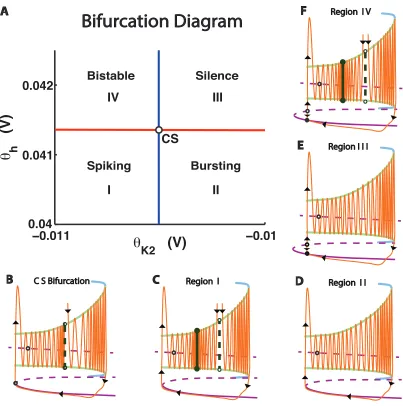
The parameter space that we analyzed is partitioned by two bifurcation curves: one
horizontal and one vertical (Fig 2.6). The horizontal curve is a saddle-node bifurcation for
equilibria (SN e1 in Fig 2.4). It divides the 2-D parameter space into two subspaces (red
curve in Fig 2.6A). At this bifurcation, a stable equilibrium disappears; the parameter space
above this curve supports the stable equilibrium. The vertical solid blue curve represents a
saddle-node bifurcation for periodic orbits (Fig 2.6A; SN o1 Fig 2.4). At this bifurcation, a
stable periodic orbit–representing tonic spiking–disappears; the parameter space to the left
of this curve supports tonic spiking.
The cornerstone bifurcation, which is located at the intersection of the two bifurcation
curves (red and blue solid curves), organizes bursting, spiking, and silent regimes (Fig 2.6A).
The bifurcations defining the borders of region II (SNIC and blue sky catastrophe) lead to
qualitative changes in the vector field which eliminate periodic bursting by obstructing the
passage of the phase point over one or both manifolds of slow motion (Fig 2.6A).
At the codimension-2 bifurcation point, the slow motion manifold determined by the
equilibria of the fast subsystem is obstructed by a saddle-node equilibrium, and the slow
manifold for spiking is obstructed by a saddle-node bifurcation for periodic orbits (Fig 2.6B).
Perturbations in the (θh,θK2) parameter space from the codimension-2 point lead to the
disappearance of the node equilibrium or simple periodic orbit or cause the
saddle-node orbit or equilibrium to split in two (Fig 2.6C-F).
In region I, a stable orbit and a saddle orbit were found on the slow manifold for
the only attracting regime in this region. Perturbations can reveal characteristics of the slow
manifold associated with the equilibrium of the fast subsystem. The phase point can spend
a significant amount of time in a quiescent state before firing resumes after the cessation of
an inhibitory perturbation (Fig 2.3E-G). This perturbation causes a fast transition of the
phase point from a stable orbit onto the the slow-motion manifold of equilibria for the fast
subsystem. The phase point followed the slow-motion manifold, and the neuron exhibited a
transient quiescence. For parameter values near the border between regions I and IV, the
phase point could spend a long time near the ghost of the saddle-node equilibrium before
the onset of firing.
In region II, both the manifolds of slow motion are unobstructed. This parameter
region corresponds to the endogenous bursting regime (Fig 2.6D). During a burst, the phase
point winds around the slow motion manifold for oscillations; during the interburst interval,
the phase point follows the slow motion manifold for equilibria in the fast subsystem.
In region III, a stable equilibrium obstructs the slow manifold for equilibria of the fast
subsystem (Fig 2.6E). The stable equilibrium is the only attracting regime in this region. A
perturbation can trigger a train of action potentials (Fig 2.3A-C). During a transient burst,
a fast transition occurred as the phase point moved from the stable equilibrium onto the
slow manifold that controls oscillating activity in the fast subsystem. The model neuron
executed a stereotyped burst as the phase point evolved across this manifold. Near the
border between regionsIII andIV, the phase point could spend a long time near the ghost
of the saddle-node orbit, producing a very long transient burst.
In region IV, there were stable and unstable orbits as well as stable and unstable
equilibria. As a result, tonic spiking co-existed with a silent regime, and perturbations could
elicit switches from one regime to another (Fig 2.6F).
The mechanisms controlling burst duration and interburst interval in region II
deter-mine a scheme of two-parameter coregulation that supports bursting with a given duty cycle
across a wide range of cycle periods. This scheme could explain the maintenance of phase
2.3.5 Pattern-scaling in a Chain of Oscillators
We applied a mechanism maintaining the duty cycle of endogenously bursting activity
to show scaling in a metachronal-wave locomotor pattern. We developed a basic model of a
central pattern generator for crawling of larvalDrosophila. Drosophila larvae crawl by means
of peristaltic contractions of the body. Posterior-to-anterior waves of peristaltic contraction
produce forward motion. The phase lag of motor activity in neighboring segments scales
proportionally to the period so that the phase relations between activity in neighboring
segments is maintained. This scaling occurs over a two-fold range of cycle periods (Pulver
et al., 2012). Activity in the nerve cord in isolated preparations occurs on the time scale
of tens of seconds (Fox et al., 2006; Hughes and Thomas, 2007). The phase delay from
segment-to-segment of segmental nerve cord activity is roughly 10 % of the cycle period
(Fox et al., 2006). We suggest that the scheme of coregulation controlling the duty cycle of
participating neurons could present a cellular mechanism for the metachronal-wave pattern
scaling. We modeled the metachronal-wave central pattern generator (CPG) as a chain of
coupled oscillatory neurons.
The network was assembled from five endogenously bursting neurons from regionII(Fig
2.1A). If these neurons receive an inhibitory pulse during the interburst interval, they respond
with a burst, and the activity is reset. This observation suggests that if these neurons are
coupled in a chain, they will trigger burst responses one after another as though in a domino
effect. We expect that this effect would be robust if the neurons were connected in a chain
such that the strength of inhibitory coupling is stronger in one direction than in the other.
This sequential propagation of excitation along a chain is referred to as a metachronal wave
which would travel in the direction of stronger coupling. With this organization of activity,
the phase delay is determined by burst duration. Thus by scaling the duty cycle, one can scale
the pattern of the metachronal wave. We manipulated the network by changing the values
of θK2 and θh to control the burst duration and interburst interval. We coordinated these
changes to maintain a constraint of 10 % duty cycle within 0.1 % tolerance for individual
a chain of coupled oscillators each with an intrinsic duty cycle of 10 % would produce a
metachronal wave with phase delay of 10 % at the period of the individual oscillators. With
this duty cycle, in order to produce rhythms faster than 68 s, we obtained parameter sets
with values ofθK2beyond the range depicted in Figure 2.1A. They are located so close to the
SNIC that they appear to sit on the curve (Fig 2.1A). We did not investigate whether the
SNIC extends beyond this range, yet we were able to obtain parameter sets that supported
activity with a duty cycle of 10 %.
The model is represented by a chain of identical bursting neurons with duty cycle 10 % as
described in Methods. To show pattern scaling, we investigated this model with parameters
of individual cells varied according to our coregulation scheme defined in Table 2.3. Network
activity self-organized into a metachronal-wave pattern following an interval of transient
activity in all ten instantiations (Fig 2.7). After the interval of transient activity, waves of
bursts propagated along the chain of oscillators from the most posterior cell (segment 7) in
the anterior direction. We quantified the time it took a network to reach a periodic state
by counting the number of cycles of the posterior cell before the transient activity subsided
and the propagating wave fully formed. In each instantiation of the network, the formation
of the metachronal wave occurred within two cycles of the bursting neuron in segment 7.
We characterized metachronal waves in the activity of each network instantiation by
the period and duty cycle of activity as well as the relative phase shift of bursting from
one segment to its nearest neighbor. We compared the temporal characteristics of network
bursting activity to those of activity produced by a single cell with the same values ofθK2 and
θh (Table 2.3). The period and duty cycle of bursting activity of a single cell and the network
matched well; these periods differed by less than 0.1 % and 3 %, respectively. The disparity
between the period of single-cell and network activity was greater for network instantiations
with larger period. In each network instantiation, the phase shift of the metachronal wave
exhibited some dependence on cycle period (Fig 2.8). For parameter values that produced
activity with lower periods, the phase shift tended to be greater than that predicted by the
activity with period 15.1 s and 21.0 s, the average relative phase between segments was 13.0
% and 13.2 %, respectively. For parameter values that produced activity with higher periods,
the phase shift tended to be close to 10 %. The instantiation of the network that produced
activity with period 85.1 s had an average relative phase shift of 10.5 %.
The cornerstone bifurcation controls periodicity through both burst duration and
in-terburst interval. By coregulating θK2 and θh, we vary the period of bursting while keeping
the duty cycle fixed. As instantiations of the network become closer to the critical
param-eter values for the cornerstone bifurcation, the period of activity increases according to the
inverse-square laws governing burst duration and interburst interval. Since duty cycle is
fixed over variation in period, the burst duration in this model increases via spike addition.
As such, the cycle period varies linearly with spike number (Fig 2.8).
The period of a metachronal wave was well approximated by the intrinsic period of
the individual oscillator on which that network instantiation was based. For parameter
sets that produced activity with higher periods of bursting, the temporal characteristics of
individual oscillators better predicted the temporal characteristics of network activity. The
metachronal-wave pattern was maintained over a five-fold change in the period of activity.
2.3.6 Control of Motor Pattern in an Insect Walking Central Pattern Generator
Insect locomotion presents a type of pattern adaptation in which the phase relations
of the pattern change with the speed of walking. Here, we apply the mechanism describing
the stereotypical burst responses of a silent neuron to explain these changes. We construct
a simple CPG model including silent neurons to produce appropriate adjustments to the
motor pattern. The changes to the dynamics of neurons through the variation of a single
parameter could be considered as response to neuromodulatory tone.
During locomotion, a cycle of leg motion is comprised of two intervals: protraction
(swing) and retraction (stance). In forward walking, the protraction of legs progresses
se-quentially one after the other from posterior to anterior. The duration of protraction is
each step (Wendler, 1965; Wilson, 1966; Graham, 1985). These recorded constraints
deter-mine phase relations in the metachronal wave gait over a range of speeds; the phase relations
are controlled by the duration of retraction. These temporal characteristics have been
re-ported in a fictive motor pattern induced by pilocarpine (Buschges et al., 1995; Bassler and
Buschges, 1998; Buschges et al., 2008). The central pattern generator that controlls insect
walking has not been described (Buschges et al., 1995; Bassler and Buschges, 1998; Buschges
et al., 2008; Daun-Gruhn, 2011). The burst duration of retractor motorneurons varies with
cycle period while the burst duration of protractor motoneurons is roughly invariant over
cycle period (Buschges et al., 1995). The neuronal mechanisms controlling the duration of
the retraction and the relative phases of motion between segments are not well understood.
We attempt to answer open questions in the study of locomotor systems: how is the
dura-tion of the retracdura-tion interval controlled, and how are the relative phases of modura-tion between
segments controlled?
To answer these questions, we developed a simple model that described the central
pat-tern generator controlling the motion of legs of a six-legged animal. One side of the network
contained six interneurons that were arranged into three coupled segmental oscillators. Each
oscillator described a CPG controlling a single leg in its segment. These segmental
oscilla-tors corresponded to the three thoracic segments. From anterior to posterior, these segments
are called the prothoracic, mesothoracic, and metathoracic segments. The segmental
oscil-lators were each made of two-cell mutually inhibitory networks (Fig 2.9). Here we describe
a mechanism where the stereotypical response of a silent neuron controls the duration of
retraction.
This network is relatively small, and the dynamics of each compenent neuron are well
described by our mechanisms. We constructed segmental oscillators composed of individual
cells with predictable activity. We controlled the duty cycle and phase of activity in single
segmental oscillators by varying θK2, and hence, controlling the burst duration in retractor
interneurons. Given our knowledge of these systems, we inituitively designed the