www.hydrol-earth-syst-sci.net/19/2639/2015/ doi:10.5194/hess-19-2639-2015
© Author(s) 2015. CC Attribution 3.0 License.
Technical Note: Approximate solution of transient drawdown
for constant-flux pumping at a partially penetrating well
in a radial two-zone confined aquifer
C.-S. Huang1, S.-Y. Yang2, and H.-D. Yeh1
1Institute of Environmental Engineering, National Chiao Tung University, Hsinchu, Taiwan 2Department of Civil Engineering, Vanung University, Chungli, Taiwan
Correspondence to: H.-D. Yeh ([email protected])
Received: 5 February 2015 – Published in Hydrol. Earth Syst. Sci. Discuss.: 4 March 2015 Accepted: 16 May 2015 – Published: 5 June 2015
Abstract. An aquifer consisting of a skin zone and a forma-tion zone is considered as a two-zone aquifer. Existing solu-tions for the problem of constant-flux pumping in a two-zone confined aquifer involve laborious calculation. This study de-velops a new approximate solution for the problem based on a mathematical model describing steady-state radial and vertical flows in a two-zone aquifer. Hydraulic parameters in these two zones can be different but are assumed homo-geneous in each zone. A partially penetrating well may be treated as the Neumann condition with a known flux along the screened part and zero flux along the unscreened part. The aquifer domain is finite with an outer circle boundary treated as the Dirichlet condition. The steady-state drawdown solution of the model is derived by the finite Fourier cosine transform. Then, an approximate transient solution is devel-oped by replacing the radius of the aquifer domain in the steady-state solution with an analytical expression for a di-mensionless time-dependent radius of influence. The approx-imate solution is capable of predicting good temporal draw-down distributions over the whole pumping period except at the early stage. A quantitative criterion for the validity of ne-glecting the vertical flow due to a partially penetrating well is also provided. Conventional models considering radial flow without the vertical component for the constant-flux pump-ing have good accuracy if satisfypump-ing the criterion.
1 Introduction
discussed. Wang and Yeh (2008) provided a quantitative cri-terion for the beginning time of the boundary effect on draw-down induced by the CFP and constant-head pumping. Yeh and Chang (2013) provided a comprehensive review on ana-lytical solutions for the CFP in unconfined and multilayered aquifer systems.
Drilling an aquifer to install a well may decrease or in-crease the permeability of the formation around the wellbore. The perturbed formation, called skin zone, extends from a few millimeters to several meters. A positive skin zone means that its permeability is lower than the original formation. On the other hand, a negative skin zone is of a higher per-meability than the original formation. Existing solutions ac-counting for the CFP in a two-zone confined aquifer con-sisting of the skin zone and formation zone are reviewed. Novakowski (1989) developed a semi-analytical solution of drawdown with the wellbore storage effect and investi-gated the effect of an infinitesimally thin skin on temporal drawdown curves. Hemker (1999) proposed an analytical– numerical solution describing pumping drawdown in a multi-layered aquifer system where the radial flow was analytically treated and the vertical one was handled by a finite difference method. The flux along the well screen was non-uniform through an infinitesimal thin skin, and the flow was subject to the wellbore storage effect. Kabala and El-Sayegh (2002) presented a semi-analytical solution for the transient flowme-ter test in a multilayered aquifer system where the radial flow was considered in each layer assuming no vertical flow com-ponent and uniform flux along the well screen. Predictions from the solution were compared with those from a numer-ical solution which relaxes those two assumptions. Yeh et al. (2003) obtained an analytical solution for pumping draw-down induced by a finite-radius well in a two-zone confined aquifer and discussed the error caused by neglecting the well radius. Chen and Chang (2006) developed a semi-analytical solution for the CFP on the basis of the Gram–Schmidt method to deal with the non-uniform skin effect represented by an arbitrary piecewise function of elevation. They indi-cated that flow near a pumping well is three dimensional due to the effect and away from the well is radial. Perina and Lee (2006) proposed a general well function for transient flow toward a partially penetrating well considering the well-bore storage effect and non-uniform flux between the screen and skin zone in a confined, unconfined, or leaky aquifer. Chiu et al. (2007) developed a semi-analytical solution for the CFP at a partially penetrating well in a two-zone confined aquifer. They indicated that the influence of the partial pen-etration on drawdown is more significant for a negative skin zone than a positive one. C. T. Wang et al. (2012) provided an analytical solution of drawdown for the CFP in a two-zone confined aquifer of finite extent with an outer boundary under the Dirichlet condition of zero drawdown. They also derived a large-time drawdown solution which reduces to the Thiem solution in the absence of the skin zone. X. Wang et al. (2012) presented a finite layer method (FLM) based on
Galerkin’s technique for simulating radial and vertical flows toward a partially penetrating well in a multilayered aquifer system. The FLM was verified by an analytical solution and finite difference solution.
It is informative to classify the above solutions into two groups, i.e., homogeneous aquifer and two-zone aquifer sys-tems in Table 1. The solutions in each group are categorized according to the well penetration, well radius, and wellbore storage.
At present, a time-domain analytical solution of drawdown for flow induced by the CFP at a finite-radius partially pene-trating well in a two-zone confined aquifer has not been de-veloped. The Laplace-domain result of the above-mentioned problem was presented by Chiu et al. (2007) resorting to a numerical inversion scheme called the Crump method. The application of their solution may therefore be inconvenient for those who are not familiar with numerical approaches. The purpose of this note is to develop a new approximate transient solution for the problem in a way similar to the work of Yang et al. (2014). A mathematical model for steady-state flow due to a partially penetrating well in a finite-extent two-zone confined aquifer is built. The flow equations de-scribing spatial drawdowns in the skin and formation zones are employed. The outer boundary of the aquifer is speci-fied as the Dirichlet condition of zero drawdown. The well is treated as the Neumann condition with a constant flux for the screened part and zero flux for the unscreened part. The steady-state solution of the model for drawdown is derived by the method of finite Fourier cosine transform. The approxi-mate transient solution of drawdown is then obtained on the basis of the steady-state solution and a time-dependent ra-dius of influence. The transient solution is in terms of simple series with advantages of fast convergence, simplicity, and good accuracy from a practical viewpoint. It can be used as a convenient tool to estimate temporal and spatial drawdown distributions for the constant-flux pumping and to explore physical insights into the flow behavior affected by hydroge-ological properties and aquifer configuration. The accuracy of the solution is investigated in comparison with the Chiu et al. (2007) solution. In addition, the condition of neglecting the effect of the vertical flow on temporal drawdown distri-butions is investigated.
2 Methodology
2.1 Mathematical model
un-Table 1. Categorization of the solutions for the constant-flux pumping in confined aquifers.
References Well Well Wellbore Remark penetration radius storage
Homogeneous aquifer
Theis (1935)a Fully Infinitesimal None Infinite aquifer Carslaw and Jaeger (1959, p. 328)a Fully Finite None Infinite aquifer
Carslaw and Jaeger (1959, p. 332)a Fully Finite None Finite aquifer with Dirichlet boundary Carslaw and Jaeger (1959, p. 335)a Fully Infinitesimal None Finite aquifer with Dirichlet boundary Hantush (1962)a Partially Infinitesimal None Infinite aquifer
Papadopulos and Cooper (1967)a Fully Finite Considered Infinite aquifer
Chen (1984)a Fully Infinitesimal None Finite aquifer with Dirichlet boundary Yang et al. (2006)a Partially Finite None Infinite aquifer
Two-zone aquifer
Novakowski (1989)b Fully Finite Considered Infinite aquifer
Hemker (1999)c,* Partially Finite Considered Multilayered aquifer with radial and vertical flows Kabala and El-Sayegh (2002)b Fully Finite Considered Multilayered aquifer with radial flow only Yeh et al. (2003)a Fully Finite None Infinite aquifer
Chen and Chang (2006)b,* Fully Finite Considered Non-uniform skin effect
Perina and Lee (2006)b Partially Finite Considered General well functions for three-kinds of aquifers Chiu et al. (2007)b Partially Finite None Infinite aquifer
C. T. Wang et al. (2012)a Fully Finite None Finite aquifer with Dirichlet boundary
X. Wang et al. (2012)a Partially Infinitesimal None Multilayered aquifer with radial and vertical flows
[image:3.612.49.551.86.352.2]a,bandcrepresent analytical, semi-analytical and analytical–numerical solutions, respectively.∗represents an infinitesimal thin skin zone.
Figure 1. A schematic diagram of the constant-flux pumping at a partially penetrating well in a cylinder two-zone confined aquifer with the
Dirichlet boundary. (The symbols of the variables are defined in Table 2.)
der the Dirichlet condition of s2=0 at r=R. The top and bottom confining beds are under the no-flow conditions of
∂si/∂z=0 wherei∈(1, 2). The effect of wellbore storage on aquifer drawdown is assumed ignorable. Note that this effect diminishes when t >2.5×10²rc2/T2, as mentioned in Papadopulos and Cooper (1967). In addition, Yeh and Chang (2013) also mentioned that this effect can be neglected for a well withrc≤0.25 m. A schematic diagram for the CFP problem is illustrated in Fig. 1.
The governing equations describing steady-state dimen-sionless drawdown distributions in the skin and formation zones are expressed, respectively, as
∂2s1
∂r2 +1
r ∂s1
∂r +α1 ∂2s1
∂z2
[image:3.612.131.468.381.555.2]∂2s2
∂r2 +1
r ∂s2
∂r +α2 ∂2s2
∂z2
=0 forrs≤r≤R, (2) whereα1andα2reflect the effect of aquifer anisotropy on dimensionless aquifer drawdown. The inner boundary desig-nated at the rim of the wellbore is under the Neumann condi-tion as
∂s1
∂r = − γ
ϕ(U (z−z1)−U (z−z2))
atr=1 and 0≤z≤1, (3)
whereU (·)is the unit step function. Equation (3) indicates that the flux is uniformly distributed over the screen. Two continuity conditions required atr=rsare
s1=s2atr=rs, (4)
and
∂s1
∂r =γ ∂s2
∂r atr=rs. (5)
2.2 Steady-state solution
A new solution derived by the application of the finite Fourier cosine transform to the model can be written as
s1(r, z)=ln R/rs+γln(rs/r)+ 2γ z2−z1
∞
X
n=1
F1(r, n)cos(nπ z)for 1≤r≤rs, (6)
and
s2(r, z)=ln(R/r)+ 2γ rs(z2−z1)
∞
X
n=1
F2(r, n)cos(nπ z)forrs≤r≤R, (7)
with
F1(r, n)=ω (ζ I0(λ1r)+ξ K0(λ1r)) / (λ1ψ ) , (8) F2(r, n)=ω K0 λ2RI0(λ2r)−I0 λ2RK0(λ2r)/ (λ1ψ ) , (9) ψ=λ1G(0,−1)H (1,−1)−γ λ2G(1,1)H (0,1), (10)
ζ =λ1K1(λ1rs) G(0,−1)+γ λ2K0(λ1rs) G(1,1), (11)
ξ =λ1I1(λ1rs) G(0,−1)−γ λ2I0(λ1rs) G(1,1), (12)
G(µ, c)=Iµ(λ2rs) K0 λ2R
+cKµ(λ2rs) I0 λ2R
, (13)
H (µ, c)=K1(λ1) Iµ(λ1rs)+cI1(λ1) Kµ(λ1rs) , (14) and
ω=(sin(z2π n)−sin(z1π n)) /(π n), (15) where λi=π n
√
αi, andIµ(·)andKµ(·)are the modified Bessel functions of the first and second kinds with orderµ, respectively. The detailed derivation of the solution is given in Appendix A.
2.3 Approximate transient solution
The inverse Laplace transform to Chiu et al. (2007) semi-analytical solution of drawdown leads to a time-domain re-sult for the CFP in a two-zone aquifer system; however, the resultant solution involves laborious calculations. We there-fore develop an approximate transient solution of drawdown for the CFP problem. The idea originated from the concept of a time-dependent diffusion layer for the solution of the diffusion equation in the field of electrochemistry (Fang et al., 2009). The approximate transient solution is obtained by replacing theRin the steady-state solution (i.e., Eqs. 6– 15) with a dimensionless time-dependent radius of influence
R(t ). The result is in terms of dimensionless time denoted as
s1(r, z, t )=ln R(t )/rs+γln(rs/r)+ 2γ z2−z1
∞
X
n=1
F1(r, t )cos(nπ z)for 1≤r≤rs, (16)
s2(r, z, t )=ln(R(t )/r)+ 2γ rs(z2−z1)
∞
X
n=1
F2(r, n, t )cos(nπ z)forrs≤r≤R, (17)
and
R(t )=1+ q
π t /1.4, (18)
where F1(r, n, t) and F2(r, n, t) obtained from Eqs. (8) and (9), respectively, with coefficientsψ,ζ,ξ, andG(µ,c) defined in Eqs. (10)–(13), respectively, are functions of di-mensionless time due to substitution of Eq. (18). The time-dependent radius of influence R(t ) was first assumed as
R(t )=1+pπ t /cwherecis a constant. By trial and error, we found that the drawdowns predicted by the approximate solution and Chiu et al. (2007) Laplace-domain solution with the Crump method agree well whencapproaches 1.4. A de-tailed discussion follows in Sect. 3.1. Notice that Eq. (18) is similar to an equation given in Yang et al. (2014, Eq. 25) but has a different coefficient value.
2.4 Special case 1: solution for CFP at fully penetrating well in a two-zone aquifer
Whenz1=0 andz2=1 (i.e.,z1=0 andz2=b) for the case of well full penetration, one can obtainω=0 according to Eq. (15). The simple series in Eqs. (16) and (17) then van-ishes, and the solution for temporal drawdown distributions subject to the skin effect reduces to
s1(r, t )=ln R(t )/rs+γln(rs/r)for 1≤r≤rs, (19) and
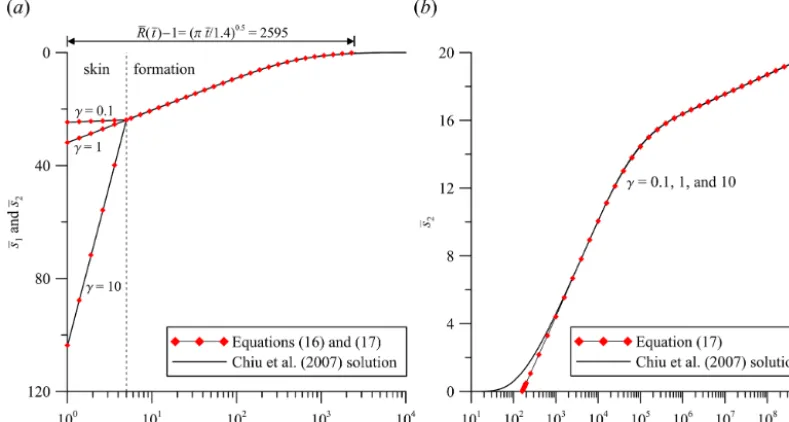
Figure 2. Predicted drawdowns by the Chiu et al. (2007) solution and the approximate solution, Eqs. (16) and (17), withγ=0.1, 1, and 10 for
(a) spatial distributions att=3×10⁶and (b) temporal distributions atr=20 withz=0.5,rs=5,z1=0.4,z2=0.6, andα1=α2=10−7.
Note that Eqs. (19) and (20) are independent ofz, indicating that groundwater flow is only horizontal.
2.5 Special case 2: solution for CFP at fully penetrating well in a homogeneous aquifer
When z1=0, z2=1, and γ=1 (i.e., z1=0, z2=b, and
Kr1=Kr2) for the case of a fully penetrating well in a
ho-mogeneous aquifer, Eqs. (16) and (17) yield
s(r, t )=ln(R(t )/r)for 1≤r≤R(t ), (21) which is indeed a dimensionless form of Thiem’s equation. Note that Eq. (21) can also be derived by substitutingγ=1 into Eq. (19).
3 Results and discussion
3.1 Accuracy of approximate solution
On the basis of the comparison of predictions from the ap-proximate solution and Chiu et al. (2007) Laplace-domain solution, we have concluded that the accuracy of the present solution depends only on dimensionless timetand radial dis-tancerand does not relate to other dimensionless parameters and space variable. Consider representative parameters and variables as follows:z=0.5,rs=5,z1=0.4,z2=0.6,α1=
α2=10−7, andγ=0.1 for positive skins, 1 for no skin and 10 for negative skins. Figure 2a shows the spatial drawdown distributions predicted by both solutions whent=3×10⁶. The figure indicates that both solutions agree very well on the drawdown within the time-dependent radius of influence rep-resented byR(t ). The drawdown curves ofγ=0.1, 1 and 10
in the formation zone merge together at and beyond the inter-face, i.e.,rs=5, because ofα1=α2. Figure 2b displays the temporal drawdown distributions predicted by both solutions for an observation well atr=20. This figure demonstrates that the drawdown curves also have a good match over the intermediate and late pumping periods. The discrepancy in dimensionless drawdown at the early period of 0≤t≤600 can be attributed to the absence of the time derivative term in both Eqs. (1) and (2). The drawdown dramatically increases att=160 as soon asR(t=160)=20. It seems reasonable to conclude that the approximate transient solution gives good predicted drawdown in an observation well over the entire pumping period except at an early time when the dynamic radius of influence reaches the well (i.e.,t∼=1.4(r−1)2/π
derived by substitutingR(t )=rinto Eq. (18) and rearrang-ing the result).
3.2 Vertical flow
The vertical flow induced by well partial penetration is strongly dependent on both dimensionless lumped parameters α1r2 and α2r2 (i.e., Kz1r
2/(K r1b
2) and
Kz2r
2/(K r2b
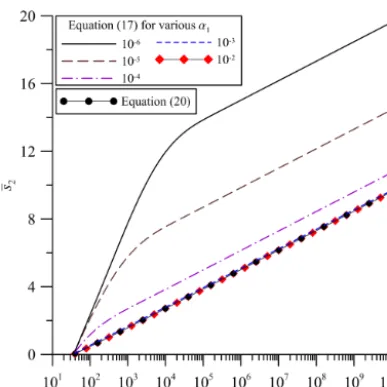
2), respectively). Figure 3 shows temporal drawdown distributions predicted by the approximate solu-tion, Eq. (17), forα1=α2ranging from 10−6to 10−2when
r=10,z=0.5,z1=0.4,z2=0.6,rs=5 andγ=0.1. Equa-tion (20) is the drawdown soluEqua-tion for the CFP at a fully penetrating well; therefore, the vertical flow is absent. When
obser-Figure 3. Temporal drawdown distributions predicted by the
approximate solution, Eq. (17), with r=10, z=0.5, z1=0.4, z2=0.6,rs=5,γ=0.1 and various values ofα1withα1=α2.
vation well vanishes whenα1r2≥1 andα2r2≥1, i.e.,b is small,ris large, and/or the values ofKz1/Kr1 andKz2/Kr2
are large. On the other hand, Eq. (20) underestimates the drawdown induced by the CFP at a partially penetrating well because the vertical flow prevails when α1r2<1 or
α2r2<1.
4 Concluding remarks
[image:6.612.71.265.65.259.2]Appendix A: Derivation of Eqs. (6) and (7)
The finite Fourier cosine transform is defined, in our nota-tion, as
ˆ si =
1 Z
0
sicos(nπ z)dz, (A1)
wherei∈(1, 2). The formula for the inverse transform is ex-pressed as
si= ˆsi(0)+2
∞
X
n=1 ˆ
si(n)cos(nπ z), (A2)
wheresˆi(n), a function ofn, is the solution in the transform domain. Replacingsi in Eq. (A1) by∂2si/∂z2and applying integration by parts twice yields
1
Z
0
∂2si
∂z2 cos(nπ z)dz=(−1) n∂si
∂z
z=1 − ∂si
∂z
z=0
−(nπ )2sˆi. (A3)
Applying the transform to Eqs. (1)–(5) on the basis of Eq. (A3) with∂si/∂z=0 results in the following equations:
∂2sˆ1
∂r2 +1
r ∂sˆ1
∂r −λ
2
1sˆ1=0 for 1≤r≤rs, (A4)
∂2sˆ2
∂r2 +1
r ∂sˆ2
∂r −λ
2
2sˆ2=0 forrs≤r≤R, (A5) ˆ
s2=0 atr=R, (A6)
∂sˆ1
∂r = −γ ω/ϕatr=1, (A7)
ˆ
s1= ˆs2atr=rs, (A8)
and
∂sˆ1
∂r =γ ∂sˆ2
∂r atr=rs. (A9)
The Fourier-domain solution of Eqs. (A4) and (A5) can be expressed as
ˆ
s1=c1I0(λ1r)+c2K0(λ1r) , (A10) and
ˆ
s2=c3I0(λ2r)+c4K0(λ2r) , (A11) whereI0(·)andK0(·)are the modified Bessel functions of the first and second kinds of order zero, respectively, and
c1,c2,c3andc4are undetermined coefficients. Substituting Eqs. (A10) and (A11) into Eqs. (A6)–(A9) and solving the four resultant equations leads to
(c1, c2, c3, c4)=
γ ζ ω ϕλ1ψ
, γ ξ ω ϕλ1ψ
,γ ωK0 λ2R
ϕrsλ1ψ
,−γ ωI0 λ2R
ϕrsλ1ψ
!
, (A12) whereψ,ζ andξ are defined in Eqs. (10)–(12), respectively. According to Eq. (A12), Eqs. (A10) and (A11) can be writ-ten, respectively, as
ˆ
s1(r, n)=γ F1(r, n)/ϕ, (A13)
and ˆ
s2(r, n)=γ F2(r, n)/ (ϕrs) , (A14)
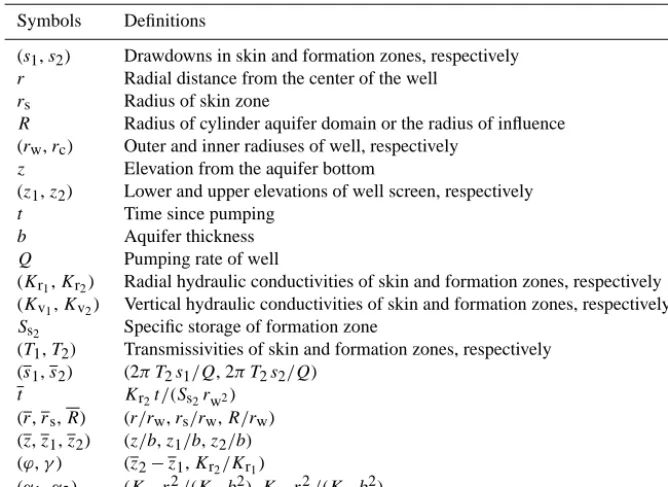
Table A1. Summary of symbols used in the text and their definitions.
Symbols Definitions
(s1,s2) Drawdowns in skin and formation zones, respectively r Radial distance from the center of the well
rs Radius of skin zone
R Radius of cylinder aquifer domain or the radius of influence (rw,rc) Outer and inner radiuses of well, respectively
z Elevation from the aquifer bottom
(z1,z2) Lower and upper elevations of well screen, respectively t Time since pumping
b Aquifer thickness Q Pumping rate of well
(Kr1,Kr2) Radial hydraulic conductivities of skin and formation zones, respectively
(Kv1,Kv2) Vertical hydraulic conductivities of skin and formation zones, respectively
Ss2 Specific storage of formation zone
(T1,T2) Transmissivities of skin and formation zones, respectively (s1,s2) (2π T2s1/Q, 2π T2s2/Q)
t Kr2t /(Ss2rw2)
(r,rs,R) (r/rw,rs/rw,R/rw) (z,z1,z2) (z/b,z1/b,z2/b) (ϕ,γ) (z2−z1,Kr2/Kr1)
(α1,α2) (Kz1r
2 w/(Kr1b
2),K z2r
2 w/(Kr2b
Acknowledgements. Research leading to this paper has been partially supported by the grants from the Taiwan Ministry of Science and Technology under the contract numbers NSC 102-2221-E-009-072-MY2 and MOST 103-2221-E-009-156.
Edited by: S. Attinger
References
Carslaw, H. S. and Jaeger, J. C.: Conduction of heat in solids, 2nd Edn., Oxford University Press, London, 1959.
Chen, C. S.: A reinvestigation of the analytical solution for draw-down distributions in a finite confined aquifer, Water Resour. Res., 20, 1466–1468, 1984.
Chen, C. S. and Chang, C. C.: Theoretical evaluation of non-uniform skin effect on aquifer response un-der constant rate pumping, J. Hydrol., 317, 190–201, doi:10.1016/j.jhydrol.2005.05.017, 2006
Chiu, P. Y., Yeh, H. D., and Yang, S. Y.: A new solution for a partially penetrating constant-rate pumping well with a finite-thickness skin, Int. J. Numer. Anal. Meth. Geomech., 31, 1659– 1674, doi:10.1002/nag.607, 2007.
Fang, Y. M., Sun, J. J., and Chen, G. N.: A simple approach to the solution of the diffusion equation at the microcylinder electrode – an inspiration from the film projector, Chem. Phys. Chem., 10, 2393–2396, doi:10.1002/cphc.200900404, 2009.
Hantush, M. S.: Aquifer tests on partially penetrating wells, Trans. Am. Soc. Civil Eng., 127, 284–308, 1962.
Hemker, C. J.: Transient well flow in layered aquifer systems: the uniform well-face drawdown solution, J. Hydrol., 225, 19–44, 1999.
Kabala, Z. J. and El-Sayegh, H. K.: Transient flowmeter test: semi-analytic crossflow model, Adv. Water Resour., 25, 103–121, 2002.
Novakowski, K. S.: A composite analytical model for analysis of pumping tests affected by wellbore storage and finite thickness skin, Water Resour. Res., 25, 1937–1946, 1989.
Papadopulos, I. S. and Cooper Jr., H. H.: Drawdown in a well of large diameter, Water Resour. Res., 3, 241–244, 1967.
Perina, T. and Lee, T. C.: General well function for pumping from a confined, leaky, unconfined aquifer, J. Hydrol., 317, 239–260, doi:10.1016/j.jhydrol.2005.05.020, 2006.
Theis, C. V.: The relation between the lowering of the piezometric surface and the rate and duration of discharge of a well using ground-water storage, Eos Trans. Am. Geophys. Union, 16, 519– 524, 1935.
Wang, C. T. and Yeh, H. D.: Obtaining the steady-state drawdown solutions of constant-head and constant-flux tests, Hydrol. Pro-cess., 22, 3456–3461, doi:10.1002/hyp.6950, 2008.
Wang, C. T., Yeh, H. D., and Tsai, C. S.: Transient draw-down solution for a constant pumping test in finite two-zone confined aquifers, Hydrol. Earth Syst. Sci., 16, 441–449, doi:10.5194/hess-16-441-2012, 2012.
Wang, X., Xu, J., and Cai, Z.: Finite layer method for flow in lay-ered radial two-zone aquifer systems, Ground Water, 50, 348– 354, doi:10.1111/j.1745-6584.2011.00849.x, 2012.
Yang, S. Y., Yeh, H. D., and Chiu, P. Y.: A closed form solution for constant flux pumping in a well under par-tial penetration condition, Water Resour. Res., 42, W05502, doi:10.1029/2004WR003889, 2006.
Yang, S. Y., Huang, C. S., Liu, C. H., and Yeh, H. D.: Approxi-mate solution for a transient hydraulic head distribution induced by a constant-head test at a partially penetrating well in a two-zone confined aquifer, J. Hydraul. Eng.-ASCE, 140, 04014030, doi:10.1061/(ASCE)HY.1943-7900.0000884, 2014.
Yeh, H. D. and Chang, Y. C.: Recent advances in mod-eling of well hydraulics, Adv. Water Resour., 51, 27–51, doi:10.1016/j.advwatres.2012.03.006, 2013.