Art and Design Theses Ernest G. Welch School of Art and Design
5-10-2014
Arts Integration: Models and Methods in Elementary Art
Arts Integration: Models and Methods in Elementary Art
Education
Education
BRIANA M. LONG
Georgia State University
Follow this and additional works at: https://scholarworks.gsu.edu/art_design_theses
Recommended Citation Recommended Citation
LONG, BRIANA M., "Arts Integration: Models and Methods in Elementary Art Education." Thesis, Georgia State University, 2014.
https://scholarworks.gsu.edu/art_design_theses/141
This Thesis is brought to you for free and open access by the Ernest G. Welch School of Art and Design at ScholarWorks @ Georgia State University. It has been accepted for inclusion in Art and Design Theses by an authorized administrator of ScholarWorks @ Georgia State University. For more information, please contact
by
BRIANA M. LONG
Under the Direction of Dr. Melanie Davenport
ABSTRACT
This thesis addresses the methods and models of current arts-integrated education
curric-ula and their basic frameworks. The review of the literature surveys information currently
avail-able on the subject of arts integration, focusing on applicavail-able models, theories, and the results of
specific educational applications. This study compares details from non-traditional models,
al-lowing other educators a glimpse of various arts integrated strategies that might be incorporated
into their own schools. A basic and modified arts integrated art education curriculum model is
suggested in order to encourage educators to create the most appropriate model for their
instruc-tion, ultimately allowing students to achieve higher level thinking and learning through the arts,
as well as cross-curriculum integration.
by
BRIANA M. LONG
A Thesis Submitted in Partial Fulfillment of the Requirements for the Degree of
Master of Art Education
in the College of Arts and Sciences
Georgia State University
Copyright by Briana Marie Long
by
BRIANA M. LONG
Committee Chair: Dr. Melanie Davenport
Committee: Dr. Melody Milbrandt
Dr. Kevin Hsieh
Electronic Version Approved:
Office of Graduate Studies
College of Arts and Sciences
Georgia State University
DEDICATION
I would like to dedicate this thesis to my family: my husband Jason A. Long and our son,
Nathan; both of whom have always gracefully supported my goals and aspirations and have
sure-ly felt my absence in this quest for knowledge. In addition, I would also dedicate this thesis to
my mother, who has enduringly encouraged my education inside and outside of the arts and who
has also been a partner during this process as she achieves her Master of Art Education as well.
Thank you all for your sacrifices. I look forward to spending more time with each of you, and I
ACKNOWLEDGEMENTS
I would like to take a moment to express my deepest thanks to Dr. Davenport, for her
support and encouragement while assisting me with the preparation of this thesis document and
the many emails, phone calls, and meetings, which never failed to leave me uplifted. I would
also like to thank the additional members of my committee: Dr. M. Milbrandt and Dr. K. Hsieh
for their commentary, commitment, and constructive criticism while reviewing this document.
Without these dedicated professionals, I would certainly not have had the remarkable experience
TABLE OF CONTENTS
ACKNOWLEDGEMENTS ... v
LIST OF TABLES ... 3
CHAPTER 1 INTRODUCTION………...4
Purpose of The Study ... 7
Definitions of Terms ... 8
CHAPTER 2 REVIEW OF THE LITERATURE ... 10
Arts Integration ... 10
Details of an Art Integration Framework ... 12
Student Success ... 14
Schools Which Integrate the Arts ... 16
Strengths ... 17
The Common Core ... 18
Teacher Retention ... 18
Dilemmas of the Model ... 20
Summary ... 22
CHAPTER 3 METHODOLOGY ... 25
Research Method ... 25
Research Questions ... 25
Timeline ... 26
Limitations ... 26
CHAPTER 4 CURRICULUM MODELS ... 28
Current Curriculum ... 28
A+ Schools ... 30
Higher Order Thinking Schools ... 32
Transforming Education Through the Arts Challenge ... 33
Bailey’s Elementary School for the Arts and Sciences ... 34
Pros Vs. Cons and What’s Missing? ... 37
The Important Aspects of Curriculum………....….…...38
Emergent Collaborations………39
CHAPTER 5 IMPLEMENTATION OF THE CURRICULUM …………....…...….42
Formation of a Modified Arts Integrated Curriculum………...…...…42
Validation………...………..……….43
Findings………...………...….………...44
Conclusions and Implications………....………...………...…………..46
APPENDICES...51
Appendix A...51
LIST OF TABLES
CHAPTER 1 INTRODUCTION
Alternative Perspective in Art Education
My initial introduction into teaching perhaps comes from a different perspective than
most art educators. I never attended public school, therefore I never had an art lesson from an art
educator who was obliged to work within certain public school frameworks. Most of my own art
education as a youth stemmed from varying private school establishments and from the direction
of my artist mother. That said it was heavily infused with the visual and performing arts, be it
traveling to art museums in faraway countries, participating in different forms of dance, or
inter-weaving art into my day-to-day academics. Though I experienced my share of the arts, it was
not in the traditional avenue which most students find themselves experiencing. Even later when
attending college, my undergraduate degree was not in Art Education, but rather in a design field
where I went on to work professionally for a number of years. By this time, I had my own small
son and my interests were certainly directed more towards the younger generation than they had
ever been previously. After much self-reflection, I decided that I missed being in an art studio
classroom, being in an environment suited to my family, and the undiluted creative process that
came with it. It was then that I decided to seek my art education certification in the
non-traditional way, through TAPP.
TAPP, though fast and furious, placed teachers in the classroom experience right away.
Through self-reflection and the support of a guiding Teaching Instructor, an educator will find
themselves on a fast track to somewhere (whether or not it is where you hope to be is
to-be-determined). I learned a great deal through this experience, and I learned it quickly. I learned
what worked for me, what worked for my Teaching Instructor, and what didn’t work for either of
suited me-and-my-needs then, I believe there was a slight disadvantage to this process for an art
educator: I still was unable to experience as much interaction from art educators themselves as I
would have liked. Consider; how many art educators are typically within one school? In an
American public school setting, especially at elementary and middle school levels, the answer is
usually just the one. Unlike a second grade team or a first grade team, there isn’t usually an art
team to banter back and forth with. It takes a while to build up those comfortable connections,
even to other art educators in your own district.
I found that my initial position as an art educator that my program didn’t have much
sup-port from parents or other teachers in the building. Community resources were scarce, 98 % of
my students were considered to be from a socio-economically disadvantaged background, and I
had bars on my classroom windows. On the bright side of stakeholders not taking much interest,
I was allowed the freedom to establish my own foundation for this school. I found in my
stu-dents some amazing talent and we eventually earned much recognition from the surrounding art
education world. I made the effort to establish connections in my community, which brought in
additional opportunities for my program and my students. This didn’t seem to impress many
other people within my own building or sway them one way or another, and it made me question
the ideals of the public school setting. If anything, this could be called my initial bias; that
pub-lic schools can’t provide the same level of art as a private school would and that all pubpub-lic
schools were the same. Up to this point, I had not experienced public school art education in any
other way and knew of no other variations. Remember, I had jumped into this with no prior
ex-perience. I remained in this environment for the next four years.
Finally, light was shed; a dawning if you will! I was recruited into another position, one
elementary fine arts magnet school whose mission was to integrate the arts into the every aspect
of a student’s education. It was actually a newer endeavor for my district, which found the
school site hosting a school-within-a-school since the year 2009. While a portion of the
tradi-tional students were non-magnet and districted to attend the school, the magnet program accepts
students via application process and operates on its own program. The application requires a
completed packet containing commitment/consent forms, photo/video permission forms, a copy
of the student’s report card, and two teacher recommendations (one from a fine arts teacher).
Students are also required to audition for a specific focus area teacher (music, dance, theater, or
visual arts) after the second grade, though younger students may select classes based on their
in-terest. Teaching strategies in this magnet curriculum, just like the traditional portion of the
school, are set according to state and national standards; however, strategies in the magnet
pro-gram are enhanced with interactive and hands-on opportunities through the arts; like script
writ-ing, ballet, guitar, arts in motion, scheduled guest artists, performance hours, arts related field
trips, etc. Parents, teachers, and students alike seem to share an enthusiastic excitement for
learning in this arts integrated environment.
From an art educator’s perspective, while I was once the sole art educator in my building,
I then found myself collaborating with a fine arts team containing two art educators, two music
specialists, a drama teacher, a dance teacher, and more. If my own background was
untradition-al, so were the aspirations of my new school. There are certainly obvious and initial differences
between the two schools I have been privileged enough to serve. From my perspective, some of
these included overall expectations of the student, as well as of the educators and the parents, in
that, I discovered that the objectives were very different within the same district between the
schools, and even between the programs, although the demographics are much the same.
Purpose of The Study
Many art educators, like me, who were certified through non-traditional methods, begin
their journey into the classroom with a limited view of potential art models and methods.
Hav-ing experienced the restrictions that I once felt in teachHav-ing and enterHav-ing into a very divergent
context within my own district has drawn me to compare the differences and similarities between
my two circumstances. While literature was available on the subject of arts-integration, much of
that literature focuses on definitions of the model and the theory of the arts-integration, and thus
provided less comparative detail.
I believed there was a need for this study, because as a beginning art educator I was
knowledgeable in my content and practice, but eventually discovered the roadblocks to
tradition-al art education frameworks. Where would I go from here in regard to my curriculum? I
inherit-ed no official curriculum, nothing written at all. Informal communication of what had been
taught up until this point is what I had to build upon. I needed a guiding light. When I first
sought answers in literature, I found little to assist me in developing my own arts-integrated art
education model. Thus, I sought further insight by examining in more detail other current arts
integrated programs, as well as in the observations and conversations in my new school, and in
consideration of the current art programs’ unofficial framework.
My aim was to discern what exemplary integrated schools might have to offer
arts-centered schools such as my own. I asked myself questions like: What are the differences
be-tween these experiences? Where could I take my inherited fine art magnet program from here?
have goals for art to play a more significant role in the education of children? Being thrust into
an environment of this nature had caused me to question what works and what doesn’t in
inte-grating art education.
I find it is not really a question of what a public school offers in juxtaposition to a private
school within the arts, but rather, what strengths can be found within the specific programs I
aimed to compare. When examining and comparing other situations--those I had found with an
arts-based curriculum-- I hoped I might learn strategies to grow my art program to its fullest
po-tential. After consulting the literature that had been produced on this topic, I have uncovered
some informative details in regard to what other models of arts education are typically available
and successful. The context of my research consisted of reviewing formal documents describing
the various models mentioned in art education, as well as other literature revealing what those in
the field have to say. Additionally, I have offered my own comparisons between the models I
have explored and experienced as a teacher in order to present a further in depth understanding
of arts integration. I believe we learn much from the successes and failures of others. I also
wish that by promoting and examining various models of art education and any findings, others
might become more knowledgeable in their own practice and their promotion of arts integration
curriculum.
Definitions of Terms
Gardner’s Theory of Multiple Intelligences: As will be discussed below, Howard
Gardner’s (1991) Theory of Multiple Intelligences can be defined as the identification of seven
distinct intelligences. Gardner, Professor of Psychology at Harvard University, believed that
people are intelligent in different ways. Those intelligences Gardener identifies are physical,
understand ourselves. He later added existential and naturalistic intelligences to his original list.
These new intelligences were formed through Gardner’s observations of those who were gifted,
idiot savants, typical children and adults, experts, etc. Intelligence exists in separate
develop-ment pathways and is susceptible to codification within a symbol system.
Arts Integrated Curriculum: An educational model that establishes creative learning.
This is not a setting where an art specialist is removed from the school, but rather where creative
learning and the arts are integrated in the methodology of other academic core subjects;
consid-ered as connecting ideas across disciplines to make them interdisciplinary (Stokrocki, 2005).
A+ Schools: An example of an arts integrated educational model known as the A+
Schools. Developed by the Oklahoma A+ Schools Network, this is the public school magnet’s
leading approach to education. What began as 14 schools has now grown to 70. The school
sys-tem is well known for its high integration of the arts “both in their own right and infused across
the curriculum” and explores instruction through use of multiple intelligences (Robelen, 2012, p.
10).
Common Core Standards: Standards emphasizing college and career readiness
current-ly being voluntaricurrent-ly adopted by varying States in North America (Robinson, 2013).
In the following literature review, I have looked more closely at several topics, including:
frameworks, details, and definitions of Arts Integration and what it means to our students. I have
also discussed the strengths and weaknesses which others have pointed out through their own
observations, in order to establish a foundation for my own records, observations, and reflections
CHAPTER 2 REVIEW OF THE LITERATURE
Many art teachers new to the classroom are initially focused on the fundamentals:
class-room management, lessons plans, and school environment/culture, to name a few. Once the
basic needs or foundations of their teaching practice have been met, a time arises where we can
further conceptualize the wants for our students and the programs that we could provide to them.
I had found myself at such a juncture. Because I believe we learn much from the successes and
failures of others, I sought to examine various models of art education literature concerning arts
integration, particularly to become more knowledgeable in my own practice of art education and
in my current journey of successfully implementing arts integrated instruction. Further, I wanted
to investigate literature regarding the effectiveness of an arts-integrated model, potential benefits
that might derive from this model in education, and especially, any strategies that seem to be
successful for students in such an environment. Additionally, I have noted any mentioned
frameworks, dilemmas, and strengths of such various programs, as well as any recognition
re-ceived by schools that are providing an arts-integrated curriculum. The literature review that
fol-lows examines insights on arts integration and models of art infusion, from which I derive key
concepts to weigh against my own experiences.
Arts Integration
To begin with, what counts as arts integration? Why is it important? Education as an
en-terprise must be adaptable, as students and society differ with each generation. Technology
to-day, specifically the Internet and the speedy transfer of information, has changed how students
learn. The more connections that they can make, the more they can solidify the larger ideas of
their educational experience. Arts integration makes this possible. Stokrocki (2005) defines
making them interdisciplinary” (p. 6). While she says that historically integration typically
re-volved around holidays or folk art, it was Winslow (1939) who argued that art could be enriching
to an entire curriculum if integrated.
In today’s society, as with each generation, teachers must reach out to a different
audi-ence accustomed to different modes of communication than they were taught. Lackey (2005)
provides an insightful description of visual arts integration as well as current trends outlining its
importance. She suggests that “a visual culture education is viewed as critical to the extent that it
involves examining power issues and tacit or taken for granted messages within our visual
cul-ture and consumer society” (p. 202). Students I currently teach have grown up in a world of
ev-er-expanding contact with diverse forms of visual culture.
Visual integration is necessary in the internet-friendly world that students find themselves
in today. It is only natural that we integrate visual mediums into their school day as well. Many
people have weighed in on what arts integration means to them and the values that they believe
arts education integration can bring. Lajevic (2013) offers a helpful definition for the term that
really resonates, stating “arts integration, a complicated term with no one universal meaning, can
be explored as a dynamic process of merging art with another discipline(s) in an attempt to open
up a space of inclusiveness in teaching, learning, and experiencing” (p. 42). This definition
of-fers an important key point: inclusiveness. We must understand that arts integration isn’t only
about the art classroom, but encompasses the entire building’s educational experience. Lajevic
(2013) continues that traditionally, students have typically learned through lecture, worksheet, or
memorization in a regular classroom, but that arts integration explores the same important key
concepts except with an exciting and innovative learning approach. There is a meaningful
Arts integration needs all classroom teachers at the school site embracing learning
through the arts. In an arts integration model, the art educator would be a go-to for insight on
creative instruction and offer support to the other teachers. Rather than the art class operating as
a separate entity, it is now functioning on a collaborative level. Robinson (2013) offers another
perspective on the definition on arts integration, supporting the collaborative cross-curricular
no-tion. She states that “arts integration can best be understood, because of the lack of consensus on
any one definition, as being defined by three categories: arts integration as learning through and
with the arts, arts integration as a curricular connection process, and arts integration as a
collabo-rative engagement” (p. 191). Smilan and Miraglia (2009) say that Authentic Arts Integration
(AAI) can be further defined as learning which is meaningfully connected “to art content and art
instruction” (p. 39). Further, AAI is the search and construction of multidimensional knowledge
where “students engage in real and tangible work involving critical thinking, art-based, and
prob-lem-based methodologies that are developed in collaborative efforts among teachers” (Smilan
and Miraglia, 2009, p. 40).
Details of an Art Integration Framework
What are the characteristics of an arts integrated framework? Surely, there must be some
sort of structure in place to create successful models or arts integration. In typical fashion, the
school faculty would function independently of each other, meaning that an art educator’s
class-room wouldn’t operate in collaboration with classclass-room teachers. Since art integration practice
isn’t as common as traditional means, it is necessary to examine what others might have found
on the topic of frameworks. Stokrocki (2005) says, “contemporary models include informal
in-tegration, cross-disciplinary or trans-disciplinary, and multicultural unit or course (Hobbs &
there are naturally other frameworks available, but that art teachers feel most familiar with
in-formal integration (relating other disciplines into their regular teaching). Stokrocki (2005) lists
that some approaches are “parallel-discipline, where teachers focus on an agreed theme within
different subjects.” Others are multidisciplinary where several disciplines investigate a theme.
Despite the multiple ways that the arts can be integrated into education, the most significant
por-tion to such models is the inclusion of the arts into academics or vise-versa; the creapor-tion of
meaningful instruction to incorporate multiple disciplines that enhances that particular educator’s
classroom.
Smilan and Miraglia (2009) report that arts integration is not a movement toward the
re-moval of art programs in schools, but rather an opportunity toward education reform where
stu-dent learning style and art programs can both be improved. Both in the traditional art education
classroom and in the reformed arts integration classroom, art is present. Rather than the art
teacher and classroom teacher working independently--as in a more traditional
framework--collaboration is encouraged, enhancing the possibilities of an authentic art integration model.
Robinson (2013) tells us arts integrations models should have high quality arts integration
involving a circular union strategy that promotes learning through and with the arts. She quotes
Bresler’s (1995) findings from a four year ethnographic study on arts integration from three
ele-mentary schools to have art integration models to be identified in to four integration styles: “the
subservient integration approach (most prevalent), the co-equal cognitive integration approach
(least prevalent), the affective integration approach, and the social integration approach”
(Robin-son, 2013, p. 192). Educators who used arts as an extra filler were considered to be using the
subservient approach while the co-equal cognitive approach required specific content knowledge
self-expression, complementing curriculum. She says that this approach toward social integration is
performance-based and used to increase parental participation through school plays or other
per-formances. These integration styles Robinson (2013) explains, are a few of the types of models
that might make up various arts integrated frameworks.
Student Success
Do we find that arts integrated models in education promote student achievement? While
we can examine anecdotal records that indicate benefits of arts integration, hard factual evidence
is more difficult to find and report. Findings by TETAC report in 2001 (Transforming Education
Through The Arts Challenge) found that “the arts could enrich learning environments, promote
integrated learning, and increase learning collaboration among school staff” (Smilan and
Mi-raglia, 2009, p.44). Robinson (2013) states that much research has been conducted on the arts
impact on student achievement, but that fewer studies are offered to examine effects of an arts
integrated model on student attainment. In fact, Robinson (2013) reports that after,
[a]n exhaustive search of electronic data-bases for meta-analyses on the impact of
the arts on students learning located seven studies (Vaughn and Winner 2000;
Winner and Cooper 2000; Vaughn 2000; Burger and Winner 2000; Butzlaff 2000;
Podlozny 2000; Hetland and Winner 2001). Out of these seven meta-analyses,
only one specifically examined the effects of arts integration. Furthermore, in the
one meta-analysis on arts integration, drama was the only art integrated.
(Robin-son, 2013, p. 192)
In that study, there was a significant statistical relationship evident between drama and oral and
written story recall, reading success on standardized tests, reading and writing; but there was no
six meta-analysis studies, researchers examined how the study of art relates to student learning.
Robinson (2013) recounts that Vaughn and Winner (2000) determined a strong relationship
be-tween SAT scores increasing with the increase of art classes. Winner and Cooper (2000) further
determined significant associations between art and academic conclusions in three correlational
meta-analyses though they did not establish a significant association. Robinson (2013) also
re-ports that Vaughn (2000) found a considerable relationship between the study of music and
stu-dent success in math. Burger and Winner (2000) report a small growth between visual arts and
reading readiness, but not reading improvement. Robinson (2013) notes that Butzlaff (2000)
found a strong connection between music and reading ability and performance. She also says
Hetland and Winner (2001) located substantial evidence for “listening to music and
spatial-temporal reasoning, learning to play music and spatial reasoning, and classroom drama and
ver-bal skills” (Robinson, 2006, p. 193). They also found links between learning to play music with
math and between dance and non-verbal reasoning; but these could not be generalized to new
studies. Robinson says that Hetland and Winner (2001), due to mixed feelings, want to remind
others that “although art programs make valuable contributions to academic outcomes, arts
edu-cation should not be justified based only on its contributions to non-arts academic outcomes”
(Robinson, 2013, p. 193). Consider that, from this statement we recognize that there is value in
integrating the arts with academics and that this may be beneficial through multiple means, not
simply academically. Once we have established that this evidence determines it so, we must also
appreciate that once we launch multiple connections for learners in the classroom, learners are
able to attain a deeper understanding of concept.
In her personal study, Robinson (2013) reports, “of the five studies on visual arts
positive effects (Andrzejszak & Trainin, 2006) and no studies reporting negative effects. These
findings suggest that visual art integration is a potentially positive practice in increasing
read-ing/math achievement, writing, and empathetic behaviors for disadvantaged students” (Robinson,
2013, p. 200). Additionally, in a study conducted by Chappell (2005), a connection was:
found between the art-integrated element and the improvements seen in students’
attitudes towards, interest in, and engagement with, as well as involvement in
vis-ual studies and other disciplinary inquiries. In fact, these intents and outcomes
are reciprocal. Because student’s attitudes toward, interests in, and engagement
with, as well as the involvement in visual arts studies improved, this shows the
arts-integrated element to be fundamental. (p. 39)
Chappell (2005) also noted that students were better equipped to synthesize inquiry knowledge
not only visually, but through writing and verbal avenues as well. It seems that this research
sup-ports a conclusion tying student success to the integration of the arts.
Schools Which Integrate the Arts
What are some specific, currently ongoing situations employing arts integration that
might serve as models? Though it is outside the scope of this study to identify every last one in
the US, let’s consider some well-known dynamic representations available for arts integration.
Smilan and Miraglia (2009) report various schools to be shifting in educational reform, as seen in
programs like Connecticut’s The Higher Order Thinking Schools (HOT) and Transforming
Edu-cation Through the Arts Challenge (TETAC). “The HOT schools students are encouraged to
seek, establish, and test connections, allow(ed) to synthesize relationships between ideas”
(Smi-lan and Miraglia, 2009, p.44). As for the TETAC, it was found that “the arts could enrich
(Smilan and Miraglia, 2009, p.44). These models use support from administration and
incorpo-rate the expertise of the art educator, classroom teacher, community stakeholders, parents,
cul-ture, and local teaching artists in order to collaborate an overall effective avenue of instruction.
Another school well known for their arts integration are the A+ Schools. This system is a
public school magnet’s leading approach to education by the Oklahoma A+ Schools Network,
which was modeled in 14 schools but now has grown to 70. The school system is well known
for its high integration of the arts “both in their own right and infused across the curriculum”
(Robelen, 2012, p. 10). The A+ approach was originally from North Carolina, first launched in
1995, where there are currently 40 active schools. Robelen (2012) states that A+ schools are
guided by eight essentials, including a heavy dose of the arts, collaboration between teachers,
explorations of the multiple intelligences, and experimental learning. Oklahoma’s A+ schools
focus more on “nurturing creativity in every learner” and is the arts integration model my current
school is considering (Robelen, 2012, p.11). The students they serve are a mixture of urban,
ru-ral, and suburban areas. Though most schools are public, some are also magnet, charter and
pri-vate. Robelen reports that funding is typically a struggle, but the models in Oklahoma use both
public and private dollars. The main drive behind these schools seems to be a desire to change, a
desire to improve, and a desire to reform education.
Strengths
What are the strengths of an arts integration classroom model? Smilan and Miraglia
(2009) find that the an arts integration model “supports simultaneous teaching and learning
fo-cused on experiences that lead to increased and assembled understandings in art as well as other
disciplines” (Smilan and Miraglia, 2009, p. 40). They consider art teachers capable of enhancing
multifaceted ways. Alternatively, in multidisciplinary, interdisciplinary, and cross-disciplinary
models, separate subject matters remain distinct, with content linking to a common theme. They
conclude that the “greater” objective should be mastery in each subject area, which arts
integra-tion allows the student to do by providing “real-world based organizing components related to
the learner, thus authenticating each individual’s experiences” (Smilan and Miraglia, 2009, p.40).
The Common Core
Authenticating individual experiences, we also know that not all children learn in one
way. That said, another strength that arts integration has to its credit, according to Stokrocki,
(2005) is conformity to Gardner’s (1991) Theory of Multiple Intelligences. Arts integration
pro-vides many solutions to meet students with their own individual needs. Robinson (2013)
sup-ports arts integrated education because a real world approach in “arts integration is an excellent
strategy for planning and teaching the Common Core standards," which emphasizes college and
career readiness, an initiative that most states are voluntarily adopting (Robinson, 2013, p. 192).
This allows a curriculum with rigorous instruction where students can make connections to
larg-er and lasting concepts. Anothlarg-er strength of this model is identified by Robinson (2009) as the
multiple means of assessing students. Robinson says the co-equal cognitive arts integration
framework creates 21st century learning skills, which are also supported by the Common Core.
As the Common Core is presently the government's solution to the many problems facing
educa-tion today, this is only yet another advantage to an arts integrated approach.
Teacher Retention
When considering teacher retention, what can be expected between an arts-integrated
model and a traditional setting; or is there even a difference? Jennifer H. Waddell identifies the
at-trition” (Waddell, 2010, p. 70). Statistically, Waddell (2010) reports that the teacher attrition
rate is one of greatest of all professions, twice as much as nurses and five times as much as
law-yers. The reason it is a problem is because Waddell also cites Wong’s (2003) findings. Wong
(2003) states that it takes between five and seven years to develop as an effective teacher and
that over half of the teachers leave before they are considered to be effective. This causes
stu-dents to encounter inexperienced teachers, which affects school reform and student achievement.
Additionally, Waddell (2010) mentions it also costs urban school districts millions of dollars
an-nually in attempts to identify, hire, and retain exceptional teachers. Reasons cited for teachers
leaving their profession are lack of support, lack of influence, low salaries, and challenging
working conditions, especially in urban situations. Knowing this, Waddell (2010) reports, has
still not helped slow down the flow of teacher attrition and such studies show that the programs,
which support new teachers with quality induction programs, have warm and open
administra-tion and are key factors in forming a culture of professional respect.
In respect to Waddell’s findings, teacher attrition depends upon the internal workings of
each school setting, and those differ depending on the individual environment; urban or not.
Even within the urban districts, a large county might offer a variety opportunities or challenges
for an educator. Therefore, if the school setting provides the necessary support in regard to
pro-fessional development and peer support, and we find that the discussed art integrated schools are
doing so; one could conclude that teacher attrition rate would be slower than that of an
educa-tional setting that did not. It is in the formation of a working school culture where teachers find
satisfaction, despite who or where they provide their knowledge.
Dilemmas of the Model
If there are strengths in an arts integration model, there must also be identifiable
weak-nesses. What limitations could be examined in a model such as this? Lajevic (2013) explains
that educators use too much of their own prior schooling methods and life experiences integrated
into their own style, rather than the innovative learning models needed;
much of a teacher’s understanding of arts integration is formed through formal
and informal education and experiences. This generation of educators did not
learn from the methods that we find current learners do best with. While most
traditional learning was teacher centered and in lecture format, we now strive to
create models of change for today’s student. Because each teacher’s schooling
and life experiences are different, understandings of arts integrations widely
dif-fer. (p. 50)
Lajevic (2013) believes that educators can fall back into the typical, comfortable routines,
those that are safe and recognizable and less effective. If the educator doesn’t know how to talk
about art or engage in the art making process; it impacts the level of instruction and connection
the student might have experienced. It is important to continue to push forward creatively and
allow students to step forward and shine in their productions. It is necessary to “move beyond”
what earlier encounters in education might have taught us, and enter into risk-taking where
un-certainty takes an important role in teaching and learning (p. 52).
Other authors weighing in on the limitations possibly occurring in an arts integration
model are Smilan and Miraglia (2009). They state that “problematic situations” are observed in
schools when classroom teachers are brought in to teach in arts integrated classrooms with;
re-placing or circumventing art teachers and the misapplications of well-intended art
integrated curricula. There are many artists who consider themselves teaching
artists, but would not assume the responsibilities of an art educator who is
certi-fied. These problematic situations are exacerbated by art teachers' understandable
reluctance to lead school wide art integration initiatives. (Smilan and Miraglia,
2009, p. 39)
They express that one possible explanation for this reluctance may be that most teachers need
clarification about what art integration might incorporate. They believe that true art integration
places visual arts at the heart of teaching and learning, while the professional providing the
class-room instruction must also be educated in the art of teaching art. Simply put, not everyone who
simply enjoys the visual arts is capable of teaching it. For example, offering art materials to
stu-dents is “a far cry from incorporating art concepts in the school curriculum with the objective of
exploration and the construction of learning through these materials” (Smilan and Miraglia,
2009, p. 42). Such educators must be provided with enough support to be able to identify any
possible weakness in their instruction and the ability to change their methods to benefit such
school reform. Alternatively, consider that visual art teachers might also be compelled to
inte-grated academic curriculums into their instruction as well. Should this be the case, professional
development would also be needed to support these cross curriculum connections.
Charland (2011) agrees, quoting Kindler (1987) that often “arts integration offerings are
grounded in common assumptions of their inherent value with little consideration given to
pre-existing structural, cultural, and dispositional barriers to teacher professional development that
may defeat program acceptance and persistence” (Charland, 2011, p. 2). He continues with his
faculty development. He also says that despite the many volumes of supportive statistics
pre-sented recommending the arts in schools, this does not mean that the benefits will continue. He
makes a distinction that “too frequently, art integration offerings are grounded in common
as-sumptions of their inherent value, with little consideration given to overcoming the pre-existing
structural, cultural, and dispositional barriers to teacher professional development that may
de-feat program assistance and persistence” (Charland, 2011, p.2). Charland warns that all
stake-holders and staff must be committed and supported to bringing about a successful and lasting arts
integrated model. Isn’t this the case though with all educational models, however? All
person-nel involved must be dedicated to the vision and mission that the school sets its sights toward.
Summary
Further research in arts integration is required in order to fully paint the picture of how
arts integration collaboration successfully happens. I felt I had yet to find much literature that
provided the fine details of what an arts integrated community experiences in comparison to one
another, which might have helped me to develop a detailed arts integrated curriculum framework
of my own. In addition to the development of such a framework, I hoped that from this study, I
further tease out what such models experience and strive for within their practice of arts
instruc-tion across the curriculum. In regard to this curriculum framework guide, the desire was to
pro-vide a concept of structural foundation rather than specific lesson plans, along with my
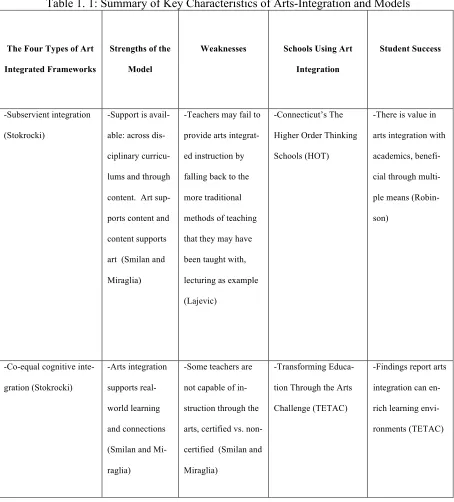
compari-sons. To facilitate my process of comparisons, I compiled the following chart of key points from
the literature. These are descriptive characteristics typically mentioned in my literature review
discussions of arts integration that I believe have assisted in focusing my inquiry. What is
need-ed, are further details regarding how various arts integrated educational opportunities operate,
Table 1. 1: Summary of Key Characteristics of Arts-Integration and Models
The Four Types of Art
Integrated Frameworks
Strengths of the
Model
Weaknesses Schools Using Art
Integration
Student Success
-Subservient integration
(Stokrocki)
-Support is
avail-able: across
dis-ciplinary
curricu-lums and through
content. Art
sup-ports content and
content supports
art (Smilan and
Miraglia)
-Teachers may fail to
provide arts
integrat-ed instruction by
falling back to the
more traditional
methods of teaching
that they may have
been taught with,
lecturing as example
(Lajevic)
-Connecticut’s The
Higher Order Thinking
Schools (HOT)
-There is value in
arts integration with
academics,
benefi-cial through
multi-ple means
(Robin-son)
-Co-equal cognitive
inte-gration (Stokrocki)
-Arts integration
supports
real-world learning
and connections
(Smilan and
Mi-raglia)
-Some teachers are
not capable of
in-struction through the
arts, certified vs.
non-certified (Smilan and
Miraglia)
-Transforming
Educa-tion Through the Arts
Challenge (TETAC)
-Findings report arts
integration can
en-rich learning
-Affective integration
approach (Stokrocki)
-Teachers are
able to enhance
experiences of the
student, because
they are typically
inventive (Smilan
and Miraglia)
-It can be difficult to
facilitate long-lasting
change in school
culture, such as
initi-ating arts integration
(Charland)
-A+ Schools -Students are
suc-cessful because they
are interested and
engaged with the
arts; studies show
arts integration to be
fundamental
(Chap-pell)
-Social integration
(Stokrocki)
-Mastery of
con-tent can be the
objective, due to
the connection to
material provided
-All staff and
stake-holders MUST be
committed for
suc-cess to happen
(Char-land)
-Students better
equipped to
synthe-size inquiry
knowledge not only
visually, but
through writing and
verbal avenues as
CHAPTER 3 METHODOLOGY
Research Method
The purpose of this study was to explore possible models and methods of arts integration
in education, while honing in on my past involvement and experience teaching. I hoped to
intro-duce other comparisons between the curriculum models, and to specifically develop my own
cur-riculum framework in order to guide my future teaching strategies. I sought to compare my
per-ceptions of these environments to understand more deeply from a teacher's perspective the
dif-ferences between an arts-integrated models, as well as examine published documents from other
arts integrated educational frameworks: frameworks, educational missions, resources, student
and teacher successes, discipline issues, student drive, and environmental differences are each
under consideration. I have reflected upon my findings and compared them to Table 1.1, while
considering any similarities or dissimilarities between the two school environments in order to
cluster my findings and relate them to my thesis questions. Through my curriculum construction
and self- reflections, I have also considered documents gathered during my experience
concern-ing arts integration practices, such as curricular materials from my schools, application
proce-dures, program expectations, and documentation of student learning or documents from other
arts integrated schools.
Research Questions
The questions that I have investigated in this study are:
What information could be learned from other currently operating arts-integrated frameworks to
expand my magnet fine arts curriculum?
1. What insights could I, as an art educator, offer to others in my field, based upon my own
2. What insights could I, as an art educator, offer to others in my field, based upon my own
ex-periences, regarding the benefits or challenges of an art-integration practice?
What insights could I, as an art educator, offer to others in my field, based upon my own
experi-ences, regarding the benefits or challenges of an art-integration practice?
Data Collection
As I sought to develop and implement my own magnet visual arts curriculum, the only
human participant in this study was myself. However, in the course of my responsibilities as an
art teacher, I have had ongoing conversations with other teachers, administrators, students, and
other stakeholders and my rendition of such events are included. These conversations will
pro-vide opportunities for me to reflect upon what I perceive others to be expressing. In addition to
these conversations, other sources of data included are curricular information, mission
state-ments, and various other administrative docustate-ments, itineraries, school website data, and staff
handouts. Documents were considered for their potential to shed light upon the activities and
priorities of an arts-integrated environment.
Timeline
The study of arts-integration took place during the 2013-2014 school year. I began
for-mulating this study around the beginning of August 7th, 2013 and anticipated finalizing my thesis
by the end of March 2014. The timeline of this study has been approximately 7 months.
Limitations
This study was limited to my own singular perspective teaching the fine arts between two
schools in one county of the Georgia Public School System, as well as my own perspective of
other arts integration models. Further limitations are restricted to what I observed and what I did
Be-cause my experiences involve collaborations with other educators and other educational
curricu-lums, I must acknowledge that their attitudes and portrayals also impact what I was able to
ac-complish, although they were not formal participants in my study. The experience of the
educa-tors within the building range from first year teachers to 25+ year veteran teachers; each having
their own experience with arts-integration practice. Documents collected from various websites
CHAPTER 4 CURRICULUM MODELS
Current Curriculum
My understanding of the current magnet curriculum, which I have inherited, is that there
is no formal structure in place, decreed as such by the school, district, or previous art instructor.
Though certainly there are high expectations from all stakeholders, and previous habitual
occur-rences that are expected to take place in this curriculum, its structure is not prescribed nor
man-dated. Prior conversations with the art educator who first headed this magnet program, in my
attempt to discern what was currently in place and what others might expect of me, revealed that
the visual art magnet program was flexible in nature and no set curriculum existed. Most of the
program’s development in future depends upon what I foresee for its future, but what do I
fore-see? Currently, my students rotate through my classroom, as well as through dance, theatre, and
music. They focus on one fine arts area specifically, and visits to that focus class happen more
frequently than a non-focus student. For example, one of my focus students would visit my
classroom in a regular rotation with their homeroom, but they would also see me on Friday in a
small group of their grade level peers. In the past, guest visual artists would conduct a class
about 16 times per year. This year, with the addition of myself to the team (an equivalent of two
art teachers) this guest artist number has dropped to 6 visits, per administrative directive, due to
having more art offered to students this year within the regular schedule. Visual art sketchbooks
had also been previously established in the visual art focus student’s program; this has also been
continued this year. However, due to the increased number of students in the program and the
expense of sketchbooks, I foresee that the current structure will need to be revised. One method
that might work in place of visual art sketchbooks is the new school-wide journaling program
I could use these journals as assigned sketching/writing integrated pieces and better yet, they
would be for every student in the magnet program and not just my art focus students! Moreover,
showcases for art student work has and is currently being held twice per year with each students
showing at least one to three pieces of artwork in each showcase. This year, I incorporated the
high school magnet jazz band to play during our fist showcase in hopes to establish lateral
col-laborative planning and mingling. I also invited school board level guests to interact with visual
art students. I do not believe either of these occurrences have previously been held.
I must carefully consider what has been devised in the past, so I can continually increase
the quality of my program. When the other art teacher and I collaborate, I enjoy the experience.
I can learn from her, and she can learn much from me; however, I do not want us to end up with
too similar a product. What difference would there be if we provided all the same projects for
display? Though we are different in our methods, we are alike in goals for our students.
Anoth-er addition to my program I attempt is a highAnoth-er profile with outside school displays and contests.
This is an area in which I had success at my previous school. Many of my previous students
have taken state level awards. The magnet schedule, however. does make these tasks more
diffi-cult to accomplish, as kids see more of their focus teacher than others and performance schedules
can take precedent.
Regarding what students study in the visual arts, though there were no prior lesson plans
available to examine, in conversation the previous magnet art teacher mentioned she simply
taught a grade level higher than what was expected of the student. My students also integrate
fine arts into their academics, and collaborative planning as well as technology integration within
this framework is highly encouraged. For example, in arts integrated academics, the fifth grade
genes. While teaching this, they also taught the students how to draw a self-portrait. I gave the
teachers my power point on step-by-step methods of facial proportion for self-portraits so they
could integrate the lesson effectively. Each of these foundations mentioned are currently in
place within my curriculum. Some items I have inherited and some items as for mentioned I
have added; now I seek knowledge as to what I might add to my current practices.
A+ Schools
The A+ Schools Program might be considered the largest and longest running arts based
educational program, mainly due to its reported success in school reform. Similar to my own
arts integrated school; their curriculum is based upon continuous teacher support to establish
their teachers with creative collaboration. Their instructors seek to create meaningful hands on
learning situations for their students and these contribute to the quality of A+ Schools
instruc-tion. Another characteristic of this program is arts integration and arts educainstruc-tion. Similar to my
current school setting, this program offers visual arts, drama, dance, music, and creative writing.
Students learn to collaborate with each other in a creative environment meant to support other
academic subjects, such as Math, Science, and Literacy. The emphasis is on real world
applica-tion, instilling curiosity in learning, and connecting ideas.
The student success data collected by A+ Schools displays positive results, but
they do not attribute this to just the arts integration component. Generally, the students do as
well or better than non-A+ students, and without the narrowing curriculum that occurs in
tradi-tional schools. The school wide curriculum offered at A+ schools, similar to my own, provides
student access to all disciplines, and all forms. In the case of my own school, we report positive
trends in academic student data similar to A+ schools; though like the A+ schools I personally
previ-ous CRCT data results, every grade level tested (third through the fifth grades) show an increase
of scores over that of the district as well as the state of Georgia. Why? I do believe that the arts
integration curricula we use at my school does display creative teaching strategies that challenge
and inspire students, but also I know that the students would not be in the program without
ac-ceptable scores, creative talent, and good behavior. Our audition requirements establish a report
card and recommendations to enter our program, and from what I have uncovered, A+ schools
does not require such items. There is additionally less distraction from learning within a
class-room because high expectations for student behavior are typically met with outstanding results
from the student. This is because, should a student acquire more than two written office
refer-rals, our policy is to discontinue the student from the program. There, perhaps, is the bias to our
program’s student successful results: students begin the program with proven high achievement
and continue with the support of parents who have contracted to offer mandatory participation.
Yes, this is a fabulous program with dedication from all involved, but the candidates
participat-ing have been screened and groomed accordparticipat-ingly.
As far as schedules for art teachers go, there isn’t one set schedule for all schools to
fol-low, but each site school decides their own. Collaborative planning is believed to be the key
process of the A+ schools, so most schedules do incorporate time within the day to allow such
planning. In the A+ Schools in North Carolina, for example, art teachers are responsible for their
daily curriculum based upon the NC State Essential Standards for the curriculum, and they are
expected to integrate non-arts and/or other arts standards in their classrooms; this is known as
2-way integration in the A+ schools. Homeroom teachers integrate the arts, and arts teachers are
meant to integrate academics. Generally, good behavior is shown in such models, and this is
their school. Unlike my school, there is no audition and entry requirement to the program. I find
this school model most interesting because my school is considering joining the A+ Schools
Network.
Higher Order Thinking Schools
The approach to Higher Order Thinking (HOT) Schools is a whole school education
ap-proach where assistance is provided to schools and teachers to reform the school's culture over a
six-year timeline; creating change in an environment is recognized to take time. The process is
to strengthen the arts, instill democracy, and integrate the arts. HOT’s mission is to inspire
edu-cation about and through the arts. Similar to the A+ curriculum, HOT seeks to incorporate
hands-on, child centered, arts integrated learning. In the arts centered environment, they feel that
increased creation of performance and response leads to improved behavior and increased
at-tendance and score achievement, similar to how A+ schools perceived their models. Also like
A+ Schools, there is allowance for individual schools to find their own niche. HOT schools
simply provide the framework where each participating school may grow individually. A
com-mon theme can also be seen in professional development, where parents and teachers alike are
invited to weeklong Summer Institutes that feature arts integration and community development.
Unique though is their Peer Partner Days; in-service professional development for art specialists
with classroom teachers and parents. An open dialog is encouraged for safe and respectful
communication; this can be established through trust and the creation of partnerships. This
cur-riculum however might focus even more on collaboration than the A+ Schools, because it has
many programs to embrace community as well as focusing more on teacher-art teacher
collabo-rations to strengthen its framework. Teachers and artists jointly design and teach the
is primarily planning and implementing events with one artist per two or three teachers within
said school.
Though my current fine arts magnet schools doesn’t typically focus on such intense
plan-ning with the art teacher involved in the classroom teacher’s plans, we do have school wide
col-laborations with Arts Now. (Arts Now is a group who seek to provide professional learning
initi-atives, where arts integration and instructional strategies collide and align with standards.) On
these days, our school set asides time to focus on arts integration throughout the school site and
attempts special lesson plans and collaborative planning efforts. This also seemingly resonates
with the HOT schools, where they provide students with opportunities for the entire schools are
enriched and thematic arts enrichment experiences. Similar to all the schools thus far considered
for their arts integrations models, HOT schools base the art education curricula on standards;
however, there is an emphasis not only on product but the process in which it was created. Arts
integrated schools also find opportunities for improvement, and struggle with the same issues
traditional schools do in their models. HOT schools report that scheduling issues, funding,
cur-ricular priorities, scheduling facilitators to assist with goals and planning, and simplifying year
end reporting all are areas for which their frameworks can be enhanced.
Transforming Education Through the Arts Challenge
Like most education models that practice integrating arts education into their curriculum,
TETAC aims to approach comprehensive education of learning in and through the arts. TETAC,
however, centers on instruction of artwork and assessment, and generates its content from four
foundational art disciplines (art history, art production, art criticism, and aesthetics (i.e. DBAE)
that contribute to the creation and understanding of art. A large national network of stakeholders
TETAC suggests that teachers should make sure objectives are truly outcomes for learning:
di-versity in the artwork, as well as the artists being studied, units centered on ideas or about works
of art, technology should enlist components for promotion of learning, and local museums and
artists should be utilized if available or appropriate. While some of these customs I may not
have previously considered, I will state that incorporating available museums and artists is
some-thing I do consider and do currently participate in an introductory state. My program currently
has 6 visits per year with the aim of inspiring students; from guest artists in varying mediums
visits to local museums and performances depending on availability. I do wonder if we are
ac-cessing all resources currently available, however.
In TETAC’s Unit format, they suggest introducing an idea or key concepts, following
with essential questions based on the human experience as well as another about art. TETAC
finds importance in the following format within their curriculum: overview, objectives,
materi-als, planning, background information, vocabulary, body of lesson, summary, assessment,
con-nections to other academics, and listing local state or national standards that the lesson
encom-passes. This seems to be fairly standard in format, except my lessons plans currently seem to
incorporate more detailed information beyond these mentioned, like the inclusion of
differentiat-ed instruction or how I am modeling the concept being learndifferentiat-ed. Thus far, I have notdifferentiat-ed that each
school model discussed depends upon national or state standards to reinforce the direction of
their lesson’s instruction. The inclusion of standards to validate and drive instruction is
general-ly central to instruction throughout public school education models.
Bailey’s Elementary School for the Arts and Sciences
In much of my research I found many alliances that supported policy change to enhance
series and workshops. However, I was seeking more putting-into-practice models. Then I came
across CETA, which is a little bit of both. CETA stands for Changing Education through the
Arts program and their collaboration with the Fairfax County School (Virginia) system began in
1999. Though it began with a smaller number in the Fairfax district has now expanded into
elev-en schools at last count. One such school participating in the Fairfax County School is Bailey’s
Elementary School for the Arts and Sciences. Bailey has been a magnet school for 21 years.
Their aim is to integrate technology and the arts in all areas of curriculum. Some enhancements
that this school offers to their arts enrichment program are Science and electronic music labs,
performing arts theater, museum-in-progress, a fine arts studio, as well as a strings program.
This school, similar to my own and unlike the other models presented, admits applicants
based on positive behaviors and then lottery. The art curriculum in Fairfax County Public
Schools is considered a core subject, and essential to all students. Their art curriculum is devised
into three stands: process, product, and understanding. Process incorporates idea development,
planning, material processes, and reflection. Product contains media, techniques, content,
sub-ject matter, craftsmanship, and presentation. Understanding is meant to bring students into
learn-ing art history, cultural context, criticism, art vocabulary, and aesthetics. Further, Fairfax and
therefore Bailey, have designed their art curriculum to develop content and skills in personal
ex-pression using art production, problem solving creatively, understanding the artist role in society,
history, and culture, and the technical processes. The art instruction is meant to provide a
chal-lenge to students, build upon their differences, and allow students to express themselves
positive-ly. After reviewing the many possible models and details identified in various arts integrated
schools, I find that CETA’s model is the most likely possibility for my own educational
In the broader spectrum, CETA, similar to other models, begins with hopes of long-term
change by providing constant support and education for teachers. Collaboration is a large part of
their plan, but unique to their program is that they allow their teachers to have a wide selection of
professional development options in arts integration for various level needs. Mentors can even
provide individual attention to assist in development of curriculum. Fairfax County Public
school curriculum, along with CETA, doubled staffing for visual arts and band teachers. They
also created additional arts instruction and allowed additional planning time for teachers. Early
release happens on Mondays to allow for even more planning time. Support is given to its arts
specialists to implement arts integration and intertwine them both.
The structure of a CETA school is yearlong courses, workshops for educators, curriculum
development, summer institutes, monthly in-school study group meetings, support with in-school
Art Coaches, and action-based research. This arts integration model incorporates visual art
vo-cabulary in its courses, encourages risk taking in classrooms, motivation for faculty and
integra-tion of the arts, and allows art teachers to take on leadership roles in schools as art content
ex-perts. CETA school models invite art specialists to lead educator workshops to build leadership
capacity in the arts teaching workforce. CETA schools demonstrated significant success
com-pared to the more traditional schools. CETA students displayed significant improvement in
non-arts subjects, and teachers showed increased desire to instruct with expected instructional
prac-tices. Similar to other arts integration models, CETA bases its curriculum context on local, state,
and national standards. They embrace instruction to favor the multiple intelligences as well as
differentiated instruction; which they believe gives framework to arts integration. In order to
improve instructional quality, CETA schools actively recruit teacher candidates nationally so that