Journal of Criminal Law and Criminology
Volume 62 | Issue 2
Article 5
1971
Student Comments
Follow this and additional works at:
https://scholarlycommons.law.northwestern.edu/jclc
Part of the
Criminal Law Commons
,
Criminology Commons
, and the
Criminology and Criminal
Justice Commons
This Comment is brought to you for free and open access by Northwestern University School of Law Scholarly Commons. It has been accepted for inclusion in Journal of Criminal Law and Criminology by an authorized editor of Northwestern University School of Law Scholarly Commons.
Recommended Citation
TH.E JouaRAL or CnminAL Lw, CnxnNOLOGYA AND POLICE Scxm ecE
Copyright @ 1971 by Northwestern University School of Law
Vol. 62, No. 2 Printed in U.S.A.
STUDENT COMMENTS
The following comments were written by students at Northwestern University School of Law. Contributors to the present issue are John L. Ropiequet, George I. Gdlman, Paul H. Duvall and John
P. Owen.
PRETRIAL DETENTION IN THE DISTRICT OF COLUMBIA:
A COMMON LAW APPROACH
Pretrial detention under the District of Colum-bia Court Reform and Criminal Procedure Act of 1970' marks an important break with 181 years of federal bail policy, which has remained virtually unchanged since the Judiciary Act of 1789.2
Much has been writtens on the constitutionality of this part of the controversial act because it appears to reverse the movement towards bail reform which resulted in the Federal Bail Reform Act of 1966.4 Since the pretrial detention law affords judges5 in the District of Columbia a procedure by which they may deny bail entirely to some defendants be-fore they come to trial, the law has evoked strong objections.6
Despite this criticism, there has been no careful analysis of how the eighth amendment excessive
I PuB. L. 91-358. Pretrial detention law to be codified
As D.C. CoDE, ENcYcL. ANN. §§ 23-1321-32 [here-inafter cited as D.C. CoDu].
2Compare the Judiciary Act of 1789, ch. 20, § 33,
1 Stat. 91, with FED. R. CGwu. P. 46 (Rule 46 is the successor to § 33 of the Act).
3 See Allington, Preventive Detention of the Accused
before Trial, 19 U. K"i. L. Rxv. 109 (1970); Borman,
The Selling of Preventive Detention 1970, 65 Nw. U. L. RFv. 879 (1971); Hickey, Preventive Detention and the
Crime of Being Dangerous, 58 GEO. L. Rzv. 287 (1969);
Hruska, Preventive Detention: the Constitution and the
Congress, 3 CaxiGnToN L. Rxv. 36 (1969); Mitchell,
'Bail Reform and the Constitutionality of Bail Reform,
55 VA. L. REv. 1223 (1969); Portman, "To Detain or
Not to Detain"-A Review of the Background, Current Proposals, and Debate on Preventive Detention, 10 SA=TA
CLARA LAw. 224 (1970); Tribe, An Ounce of Detention: Preventive Justice in the World of John Mitchell, 56 VA. L. REv. 371 (1970); Comment, Constitutional
Limita-tions on the CondiLimita-tions of Pretrial Detention, 79 YAME L.
3.
941 (1970); Comment, The Costs of PreventiveDeten-tion, 79 YAr L. J. 926 (1970); Comment, Preventive
Detention and the Proposed Amendments to the Bail Reform Act of 1966, 11 Wmr. & MARY L. REV. 525 (1969).
4 18 U.S.C. §§ 3141-52 (Supp. II, 1966).
'The term "judges," as used in this comment, in-chudes also United States Commissioners, magistrates, and all others who are qualified under applicable state or federal law to set bail.
6 See, e.g., Hickey, supra note 3; Portman, supra
note 3.
bail clause applies to pretrial detention.7 This clause states that "[e]xcessive bail shall not be re-quired." It is the only part of the Constitution which governs the granting or denying of bail. Since pretrial detention is the refusal to set bail for the accused, it is essential to determine the meaning of the excessive bail clause in order to test the constitutionality of the new pretrial detention law.
This comment will examine the meaning of the excessive bail clause in terms of the common law. Since the Supreme Court has never satisfactorily interpreted the clause, its interpretation requires a determination of its common law meaning. The common law limitations on denial of bail found in the excessive bail clause, as they existed when the clause was ratified, will be set forth. This comment will then demonstrate how the common law sur-rounding bail, as it presently exists under the eighth amendment, permits pretrial detention. The objections to the procedural aspects of pretrial detention will be considered and answered, and the limited applicability of pretrial detention will be noted.
THE BACxGROUND Or PRETRiAL DETENTION: THE
BAIL RFxoss AcT or 1966
Pretrial detention of dangerous offenders was presented to Congress in 1969 as part of President Nixon's "war on crime," to fulfill campaign prom-ises to halt the ever-rising crime rate.' Senate Bill 26009 was introduced as an amendment to the Bail
7
See, e.g., Allington, supra note 3, at 111-12;
Bor-man, supra note 3, at 901-03, 914-15.
' See statement of Sen. Hruska, a co-sponsor of S.
2600, 91st Cong., 1st Sess. (1969), on its introduction to the Senate, 115 CONG. Rlc. S7906 (daily ed. July 11, 1969). S. 2600 was made a part of S. 2601, 91st Cong.,
2d Sess. (1970).
PRETRTAL DETENTION
Reform Act of 1966, as applied to the District of Columbia, to allow
for legislative authorization to consider danger to the community in setting nonfinancial pretrial release conditions, to detain certain defendants found to be dangerous, to revoke the release of those defendants who violate release conditions and to punish those who commit crimes while released on bail with added penalties.10
The Bail Reform Act itself had established a policy of pretrial release for as many defendants as pos-sible on personal recognizance or on an unsecured personal appearance bond." Money bail was to be the judge's last resort as a condition which would assure appearance at trial. The act was meant to end the abuses of the money bail system, especially the unequal treatment of rich and poor and the high social cost of keeping thousands of people in jail before trial for long periods of time without just cause.0 2
'Id. at S7909 (letter of Atty. Gen. Mitchell to the
President of the Senate).
"Beyond release on personal recognizance or unse-cured appearance bond, conditions available, in order of stringency, are: 1) supervisory custody, 2) restric-tions on travel, association, or abode, 3) appearance bond with up to 10% refundable cash deposit with the court, 4) secured bail bond or deposit of cash with the court for the face amount, 5) any other condition rea-sonably necessary, including nighttime confinement.
18 U.S.C. §§ 3146 (a) (1)-(5) (Supp. II, 1966).
12 The purpose of the Bail Reform Act was
to assure that all persons, regardless of their finan-cial status, shall not needlessly be detained pend-ing their appearance to answer charges, to testify, or pending appeal, when detention serves neither the ends of justice nor the public interest.
H.R. REP. No. 1541,89th Cong., 2d Sess. 5 (1966). See S. REP. No. 750, 89th Cong., 1st Sess. 5 (1965).
The studies of the bail system which prompted the act emphasized the fact that nearly all defendants will come to trial whether released on bond, or on personal recognizance.
Early studies pointed out the wastefulness of detain-ing defendants unable to post bond, since a large num-ber of them were eventually nol-prossed, got suspended sentences, or minor sentences in the county jail. See, e.g., Morse & Beattie, Survey of the Administration of Criminal Justice in Oregon, 11 ORE. L. Rxv. 1 (supp. 1932), where the percentages in these categories were found to be 54.2%, 13.6%, and 24.1% respectively, leaving only 8.1% of all felony cases studied to be sen-tenced to the state penitentiary. Id. at 220. Later studies found large numbers of defendants unable to post relatively low bail bonds. See Foote, et al., Com-pelling Appearance in Court: Administration of Bail in Philadelphia, 102 U. PA. L. Rav. 1031 (1954); Roberts, et al., A Study of the Administration of Bail in New York City, 106 U. PA. L. REV. 685 (1958). In New York City, for example, 18% of those who had bail set at $500 could not post bail, 28% could not post bail at $1,000, and 45% could not post bail at $1,500. Roberts, supra, at 707; similar results in Foote, supra, at 1032-33.
With some misgivings," the federal district, courts implemented this policy, often goaded by, the circuit courts.4 However, any benefits from, the reform were quickly overshadowed by the sharply rising crime rates across the country, most noticeably, from the viewpoint of Congress at least, in the District of Columbia. Reports of con-tinued criminal conduct by those released on bail! created pressure for some sort of measure to confine, dangerous defendants before trial,5 since this could no longer be accomplished sub rosa by setting-exorbitant bail. The pretrial detention law met
The Manhattan Bail Project resulted from these studies in 1961. Funded by a private philanthropist, the project set up a bail agency which was to interview de-fendants after they were charged, in order to recom-mend the release of good bail risks to the court on per-sonal recognizance only. Ares, et al., The Manhattan Bail Project: an Interim Report on the Use of Pre-Triol Parole, 38 N.Y.U.L. Rnv. 67, 71-72 (1963). In contrast to the normal forfeiture rate of 3% of those released on bail, the Manhattan Bail Project releasees showed only a 1.6% rate of forfeiture. PRoE INGs or Tim
NA-TIONAL CONFERENcE ON BAIL AND CR iNAL JUsTIcE,
Interim Report xxil-miii (1965). These results prompted experiments by the federal government and a number of states. Id. at xx-xxi; PRocEEDINGs or TE INSTTUTE
ON THE OPERATION or PRETRIAL RELEASE PnogEcTs 9, (1966). A 3% overall forfeiture rate was achieved in a
similar project in the District of Columbia. R.
MOrLEUR, ET AL., BAIL R OIu IN THE NATION'S
CAPITAL 31 (1966). The results also contributed to the writing of the Bail Reform Act. Hearings on H.R. 3576, H.R. 3577, H.R. 3578, H.R. 5923, H.R. 6271, H.R. 6934, H.R. 10195 and S. 1357 Before Subcomm. No. 5 of the House Judiciary Comm., 89th Cong., 2d Sess., ser. 13, at 21-34, 41 (1966) (statements of Atty. Gen. Clark and James V. Bennett of the A.B.A.).
13nie States v. Melville, 306 F. Supp. 124
(S.D.N.Y. 1969). judge Frankel complained that he
had no choice but to reduce bail for five defendants ac-cused of several skyscraper bombings. The U.S. Com-missioner set bail at $100,000 to $300,000, which was reduced to $20,000 to $50,000. For the aftermath of this decision, see United States v. Melville, 309 F, Supp. 822; 309 F. Supp. 824 (S.D.N.Y. 1970); People v. Melville, 62 Misc.2d 366, 308 N.Y.S.2d 671 (N.Y.C. Crim. Ct. 1970).
14 Courts setting money bail, instead of releasing on personal recognizance, were reversed in United States v. Bronson, 433 F.2d 537 (D.C. Cir. 1970); United States v. Leathers, 412 F.2d 169 (D.C. Cir. 1969); Wood v. United States, 391 F.2d 981 (D.C. Cir. 1968); see Allen v. United States, 386 F.2d 634, 637 (1967) (dissenting opinion). But see id. at 634 (majority opin-ion) (There is no right to release on recognizance).
1" Mitchell, supra note 3, at 1236-37. While Sen. Hruska admitted that Atty. Gen. Mitchell's figures on the recidivism rate of those out on bail, up to 82% in one study he cited, may be overblown, any substantial rate is "cause for public and official concern." 115 CONG. REc. 87907 (daily ed. July 11, 1969). A more be-lievable figure is about 10%. Hickey, supra note 3, at 302-03; Portman, supra note 3, at 236. In his own arti-cle, however, the only figure Sen. HEruska cited was the 82% rate. Hruska, supra note 3, at 61.
COMMENT
this demand by allowing a judge to order detention without bail in carefully limited circumstances and under well-defined procedures.8
CONSTITUTIONALITY OF PRETRIAL DETENTION: ExcEssivE BAIL
The Supreme Court has dealt with the excessive bail clause infrequently, because the federal law regarding bail has been well-settled since the judiciary Act of 1789.17 Under the Act, everyone charged with a noncapital offense must be granted the right to release on bail. The federal courts have uniformly upheld that right.8 As a result, the Court has dealt with the excessive bail clause in only two cases, decided during the same term.
In Stack v. Boyle,19 very high bail was ordered for several defendants charged under the Smith Act based on the government's allegation that a Communist conspiracy existed such that they would flee the country upon command if set free on bail. Chief Justice Vinson, speaking for the Court, held that to protect the absolute right to bail before trial in noncapital cases and to preserve the presumption of innocence, only clear evidence could justify high bail.0
The Court vacated the district court's denial of applications for bail.21
Then in Carlson v. Landonn2 the Court refused to apply the protection of the excessive bail clause of 16There are a number of conditions which act as procedural safeguards. The judge may order pretrial detention only in cases of certain specified offenses. D.C. CODE §§ 23-1322(a)(1)-(3). He may order it only if "there is no condition or combination of conditions of release which will reasonably assure the safety of any other person or the community." § 23-1322(b)(2)(B). The hearing must be held immediately upon the de-fendant's being brought before the judge. § 23-1322 (c) (3). The defendant has a right to counsel. § 23-1322
(c) (4). His testimony may not be used at trial. § 23-1322
(c)(6). He has a right to immediate appeal of the de-tention order, which must be promptly determined. § 23-1324(b). If detained, he must be held separately from convicts "to the extent practicable." § 23-1321(h). He shall be released from detention "for limited periods of time to prepare defenses or for other proper reasons." § 23-1321(h) (2).
The text of the pretrial detention law may be found in 7 BNA Canr. L. REPTR. 3295-97 (1970).
17 See note 2 supra.
18 Note, Preventive Detention before Trial, 79 HARv.
L. REv. 1489 (1966).
19 342 U.S. 1 (1951).
20 Id. at 4-6. Justice Jackson, concurring, noted that
Congress, in FED. R. CaR. P. 46, had assumed the risk that some defendants will try to flee while out on bail, in furthering a policy of keeping people out of jail until being proven guilty. Id. at 8. He also condemned the trial court's bowing to government pressure and public opinion in setting such high bail. Id. at 10.
21Id. at 11.
2 342 U.S. 524 (1952).
the eighth amendment. This was a deportation case involving several alien Communists,2 who were held without bail by the Attorney General pending their deportation hearings. The five-man majority, per Justice Reed, held that Congress re-tained the right to grant the Attorney General power to refuse bail in such proceedings. The ma-jority alluded to the excessive bail clause in the English Bill of Rights of 1688 to show that Con-gress retained the power to define "the classes of cases in which bail shall be allowed." 24 That re-mained the power over bail rights which Parliament held at common law. The Court reasoned that this power was incorporated into the United States Constitution by the eighth amendment excessive bail clause, since it was practically the same as the
English clause.'5
In his dissent, Justice Black found that by the majority's conception of the eighth amendment,
[that] Amendment's ban on excessive bail means just about nothing.... Under this contention, the Eighth Amendment is a limitation upon judges only, for while a judge cannot constitutionally fix excessive bail, Congress can direct that people be held in jail without any right to bail at all .... The Amendment is thus reduced below the level of a pious admonition.2G
Justice Black contended that the excessive bail clause, as a part of the American Bill of Rights of 1789, was intended to give more protection than its counterpart in the English Bill of Rights of
1688.27
"3 Justice Black's description of the petitioners shows them to be distinctly ordinary, non-violent people. Id. at 549-51.
24 Id. at 545-46. The example cited was capital
of-fenses, where federal courts were given the discretion by Congress to deny bail through the Judiciary Act of 1789. Id. at 545 n. 45. See 1 Stat. 91 (now FED. R. CxRm. P. 46).
The majority's interpretation of the excessive bail clause in the English Bill of Rights, 1 W. & M., st. 2,
c. 1 (1688), is oversimplified at best. See note 32 infra
for Blackstone's summation of the effects of various acts of Parliament from the Statute of Westminster I, 3 Edw. 1, c. 15 (1275) to the Habeas Corpus Act, 31 Car. 2, c. 2 (1679). A more detailed development of the cate-gories which are bailable and nonbailable can be found
in A. HIGHmoRa, A DIGEST oF
=E
DoczRINE or BAIL 147-67 (1791). Today, only treason cannot be bailed bythe trial judge, though judges of the High Court can do so. Magistrates' Courts Act, 15 & 16 Geo. 6 & 1 Eliz. 2, c. 55, § 8 (1952).
25 342 U.S. at 545-46. The only difference is that the American clause is in mandatory language, while the English clause is precatory.
26 Id. at 556.
2Id. at 557.
]PRETRIAL DETENTION
Justice Burton, joining Justice Frankfurter's dissenting opinion, suggested that the eighth amendment necessarily implied a right to bail:
The Amendment cannot well mean that, on the one hand, it prohibits the denial of bail so excessive in amount as to be unattainable, yet, on the other hand, under like circumstances, it does not pro-hibit the denial of bail, which comes to the same thing.2
Stack v. Boyle did not define the phrase "exces-sive bail." Carlson v. Landon appeared to interpret it but in a sharply divided 5-4 decision. Further-more, a deportation hearing is not a criminal pro-ceeding so Carlson did not deal with the right to bailfpending a criminal trial. Rather, Carlson set forth two contradictory lines of dicta. The ma-jority held that Congress may set classes of offenses where bail is not mandatory. This was what Con-gress did in 1789 when it allowed judges to deny bail in capital cases. The minority asserted that the excessive bail clause would be but a "pious admoni-tion" 29 if so interpreted, since Congress could easily avoid the clause entirely by declaring offenses nonbailable. Therefore, the only way to make the clause an effective safeguard was to infer from it an absolute right to bail.
The majority's view does not prevent the danger which the minority foresaw. Yet the minority's view does not comport with the literal language of the clause. 'Excessive bail shall not be required" deals on its face only with the amount of bail set, if bail is set at all. Neither view rules criminal procedure, thereby necessitating use of the ordinary principles of constitutional construction to examine the meaning of "excessive bail" at common law.8' Such an examination will show that
2s Id. at 569.
29 Id. at 556.
3D By these principles, the United States Constitution
must be interpreted according to the common law. The interpretation of the constitution of the United States is necessarily influenced by the fact that its provisions are framed in the language of the Eng-lish common law, and are to be read in the light of its history. The code of constitutional and statu-tory construction which, therefore, is gradually formed by the judgments of this court ... has for its basis so much of the common law as may be im-plied in the subject, and constitutes a common law resting on national authority.
Smith v. Alabama, 124 U.S. 465, 478-79 (1888). See United States v. Wong Kim Ark, 169 U.S. 649 (1898). Erie R. Co. v. Tompkins, 304 U.S. 64, 78, cert. denied, 305 U.S. 637, reh. denied, 305 U.S. 673 (1938), specifi-cally excepts constitutional matters from the general rule that there is no "federal general common law." The English common law in its entirety was not
incor-bail may not be denied arbitrarily, but only for good cause.
At common law, English judges exercised broad discretion in granting or denying bail in various classes of cases, subject to the requirement of the English Bill of Rights that "excessive bail ought not to be required." 3 According to Blackstone, some offenses could not be bailed by the trial court; others could be bailed at the trial court's discre-tion; a third class of offenses had to be bailed in all cases.32 These classes depended on the seriousness of the offense and not on whether a capital offense was involved.
In our federal system, this judicial discretion was severely limited with the passage of the Judiciary Act of 1789. Section 33 of the Act" gave defendants an absolute privilege to claim pretrial bail in all noncapital cases. In a capital case, federal judges could grant or deny bail according to the circum-stances of the matter and the normal practice of the courts. Federal judges were and are apparently willing to grant bail to capital offenders if the de-fendant can establish good cause.2 ' The law has
porated into the Constitution, but was to be used by the American courts as far as it was applicable. Van Ness v. Pacard, 27 U.S. (2 Pet.) 137, 144 (1829); Wheaton v. Peters, 33 U.S. (8 Pet.) 591 (1834); Patterson v. Winn, 30 U.S. (5 Pet.) 233 (1831).
311 W. & M., st. 2, c. 1 (1688).
2 4 W. BLACKSTONE, CoMMENTARIEs ON T=E LAW Or ENGLAND *298-300 (Jones ed. 1916). The first class
contains: 1) treason, 2) murder, 3) manslaughter, if the guilt is clear, 4) prison-breaking, 5) outlawry, 6) ab-juring the realm, a self-banishing punishment, 7) ap-provers, those who have confessed guilt and implicated accomplices, 8) those taken in the act of felony, 9) arson, and 10) excommunicants. The second class contains: 1) known thieves, 2) all other felons, of bad character, and
3) accessories to felony, of bad character. The third
class contains: 1) manslaughter, if of good reputation, 2) felons, other than those above, and 3) accessories, other than those above.
Today, English trial judges have discretion to grant or deny bail in all cases except treason, where only judges of the High Court can grant bail. Magistrates' Courts Act, 15 & 16 Geo. 6 & 1 Eliz. 2, c. 55, §§ 7(2), 8 (1952). The judges were first given this power under the
Criminal Justice Administration Act, 7 Geo. 4, c. 64,
§ 34 (1826), which repealed all the old statutes collected
by Blackstone. See 1 J. STEPnEN, A HISTORY or THE
CinnN.A LAw OF ENGLAND 238-39 (1883).
23 1 Stat. 91.
34See, e.g., United States v. Jones, 26 F.Cas. 658 (No. 15,495) (C.C.D. Pa. 1813), where Justice Bushrod Washington admitted bail for a person charged with piracy and suffering from possible pneumonia: "The humanity of laws, not less than the feelings of the court, favour the liberation of the prisoner upon bail, under such circumstances." See United States v. Burr, 25 F.Cas. 55, 62 (No. 14,693) (C.C.D. Va. 1807), where Chief Justice Marshall refused to deny Aaron Burr ad-mission to bail despite a charge of treason. Lack of a specific arrest for treason and lack of a hearing on the
COMMENT
been made certain by the strict limitation on judicial discretion with regard to pretrial bail. Therefore, few federal cases have ever been decided on this issue."
There are several cases on the common law con-cerning bail under state law, however. These cases elucidate the common law as it exists under a con-stitutional excessive bail clause. Yet the cases arise only in a few states since most jurisdictions have an additional constitutional provision which guarantees a right to bail in noncapital cases. The states can be separated into two groups: 1) those which guarantee bail in all but capital cases and 2) states which only guarantee against the imposi-tion of excessive bail." The bail provisions in the
evidence sustaining the charge were listed by Marshall as the reasons for refusing to deny bail. See also United States ex rel. Covington v. Caparo, 297 F. Supp. 203
(S.D.N.Y. 1969); Wansley v. Wilkerson, 263 F. Supp.
54 (W.D. Va. 1967). But see Mastrian v. Hedman, 326
F.2d 708 (8th Cir. 1964); United States v. Rice, 192
F. 720 (C.C.S.D.N.Y. 1911).
5 Bail pending appeal is quite another matter, since
there has never been thought to be a right to it. There have been a number of cases dealing with what criteria ought to be used in granting or denying bail pending appeal. See, e.g., Rehman v. California, 85 S.Ct. 8 (Douglas, Circuit Justice, 1964); Williamson v. United States, 184 F.2d 280 (Jackson, Circuit Justice, 1950). The appeal bail rights of the poor have also come up. See Bandy v. United States, 81 S.Ct. 25 (Douglas, Cir-cuit Justice), reh. 81 S.Ct. 197 (Douglas, CirCir-cuit Justice, 1960), reh. 82 S.Ct. 11 (Douglas, Circuit justice), cert. denied, 368 U.S. 852 (1961), cert. denied, 369 U.S. 815, cert. denied, 369 U.S. 831 (1962).
36 Provisions in the first group:
1) Right to bail in all cases (one state): AL.ASK CODE
Cpui. P. § 12.30.010 (1970).
2) Right to bail, except capital offenses when the proof is evident or the presumption of guilt great (38 states): ALA. CoNsT. art. I, § 16; Apiz. CoNsT. art. II, § 22; Ax. CONST. art. II, § 8; CxAL. CONST. art. I, § 6; CoLo. CONST. art. II, § 19; CONN. CONST. art. I,
§
8; DEL. CoNsT. art. I, § 12; FLA. CONST. art. I,§
14; IDAHOCONsT. art. I,
§
6; IL. CONST. art. I,§
9; IowA CONST. art. I, § 12; KAN. CONsT. BiLL OP RIGHTS § 9; Ky. CoNsT.§
16; LA. CONST. art. I,§
12; M. CoNsT. art. I, § 10; MDu. ANN. CoDn Rule 777(a) (1970); Mnx. CONsT. art I, § 7; Miss. CONsT. art. 1Il, § 29; Mo. CONST. art. I,§
20; MONT. CONST. art. III,§
19; NEv. CONST. art. I,§
7; N.H. REv. STAT. ANN.§
597:1 (1970); N.J. CONST. art. I, § 11; N.M. CONST. art. II,§ 13; N.D. CoNsT. art. I, § 20; Oino CoNsT. art. I, § 9;
OKLA. CONsT. art. II, § 8; PA. CoNsT. art. I, § 14; S.C. CoNsT. art. I,
§
20; TENN. CONST. art. I, § 15; TEX.CONST. art. I,
§
11; UTAH CONST. art. I,§
8; VT. CONST. ch. 2,§
32; WASH. CoNsT. art. I,§
20; W. VA. CODE ANN. § 62-IC-1 et seq. (1970); Wis. CoNsT. art. I, § 8; Wyo. CoNsT. art. I, § 14.3) Right to bail, except for treason or murder (4 states): IND. CONST. art. I, § 17; MicH. CoNsT. art. I,
§
15; NEB. CONST. art. I, § 9; ORE. CONST. art. I,§
14. 4) Right to bail, except capital or life imprisonment offenses (one state): R.I. CoNsT. art. I, § 9.5) Right to bail, except life imprisonment without
first group resemble the language of article II of the Northwest Ordinance of 1787: "All persons shall be bailable, unless for capital offenses, where the proof shall be evident, or the presumption great." The bail provisions in the second group are based on the common law right to bail limited only by state constitutional provisions identical to that of the eighth amendment: "Excessive bail shall not be required." The District of Columbia properly belongs in the second group. Its constitution is the United States Constitution, and its bail provision is that of the eighth amendment.
Several state supreme courts within the second group have interpreted their excessive bail clauses according to the common law." Typical of these cases is People ex rel. Shapiro v. Keeper of City Prison." This case summed up the earlier New York cases to hold that the common law, as limited by the excessive bail clause in the New York con-stitution, does not guarantee a right to pretrial bail in any kind of criminal case.'9 The right to bail
parole offenses (one state): HAwAI REv. STAT. § 709-4
(1970).
Total in first group: 45 states. Provisions in the second group:
6) Right to bail for misdemeanors, otherwise by judicial discretion (3 states): GA. CODE AN. § 27-901 (1970); N.Y. CODE: Cimu. P. § 553 (MeKinney 1970); VA. CODE § 19.1-110 (1970). Georgia actually gives bail as a matter of right for noncapital cases, by case law. Reid v. Perkerson, 207 Ga. 27, 60 S.E.2d 151 (1950); New-some v. Scott, 151 Ga. 639, 107 S.E. 854 (1921). 7) Bail by judicial discretion for most cases (one state):
N.C. GEN. STAT. § 15-102 (1969).
8) Bail by judicial discretion for most cases, except
treason is nonbailable (one state): MAss. ANN. LAws
ch. 264, § 1, ch. 276, § 42 (1969). Massachusetts
appar-ently gives bail as a matter of right for all noncapital offenses, by case law. Commonwealth v. Baker, 343 Mass. 162, 177 N.E.2d 783 (1961).
Total in second group: 5 states. All states in the sec-ond group have excessive bail provisions: GA. CoNsT.
art. I, § 11; MAss. CONST. pt. 1, § 27; N.Y. CoNsT. art. I, § 5; N.C. CoNsT. art. I, § 14; VA. CoNsT. § 9.
From Comment, Bail: an Ancient Practice Reexa-mined, 70 YaleL.J. 966,977-78 (1961),updated and re-arranged.
'1Vanderford v. Brand, 126 Ga. 67, 54 S.E. 822 (1906); Fischer v. Ball, 212 Md. 517, 129 A.2d 822 (1957); Commonwealth v. Baker, 343 Mass. 162, 177 N.E.2d 783 (1961); People ex rel. Klein v. Kruger, 25 N.Y.2d 497, 255 N.E.2d 522, 307 N.Y.S.2d 207 (1969); People
e"
rel. Lobell v. McDonnell, 296 N.Y. 109, 71 N.E.2d 423 (1947); People exrel.
Shapiro v. Keeper of City Prison, 290 N.Y. 393, 49 N.E.2d 498 (1943). See discussions of the common law right to bail, as affected by their own constitutions in State v. Pett, 253 Minn. 429, 92 N.W.2d 205 (1958); State v. Konigsberg, 33N.J. 367, 164 A.2d 740 (1960).
'8290 N.Y. 393, 49 N.E.2d 498 (1943).
30Judge Desmond, who wrote the opinions in both Shapiro and Lobell, supra note 37, noted that New York's constitution was atypical because it had no
PRETRIAL DETENTION
extended to all misdemeanor cases by statute,40 but in all other cases bail was to be granted or denied ,according to judicial discretion. The court cau-tioned, however, that judicial discretion was far from absolute. Bail could not be denied arbitrarily for there was an excessive bail clause in the state constitution. There must be ample justification stated by the judge to deny bail and the denial must follow the ordinary practice of the courts of the state." In People ex rel. Lobell v. McDonell,4 the court listed factors to be considered by the judge: the nature of the offense, its penalty, the probabil-ity of the defendant's appearing at trial, his pecuniary and social condition, his general reputa-tion and the strength of the evidence against him.'s People ex rel. Klein v. Kruger" implied yet another condition-danger to the community.
In New York and in a few other states,4 5 the common law bail system survives because the ex-cessive bail provisions in their constitutions do not grant a right to bail. These states have adopted the common law generally and have not significantly changed the common law by statute as it relates to bail. The other states have either changed the common law by enacting constitutional provisions which guarantee a right to bail or achieved this
right-to-bail clause, only an excessive bail clause. Id. at 398, 49 N.E.2d at 500. Apparently, he forgot this when he wrote in 1952 that "most states" followed this type of discretionary rule. Desmond, Bail-Ancient and Modern, 1 Bu r. L. Rxv. 245, 247 (1952).4
0 N.Y. CoDE CRnw. P. § 553 (McKinney 1970). 41290 N.Y. at 398-99, 49 N.E.2d at 501.
296 N.Y. 109, 71 N.E.2d 423 (1947).
43
id. at 111, 71 N.E.2d at 425. Lobeil did more than
any English case did up to the time of Blackstone in listing the factors a judge may properly consider in ex-ercising his judicial discretion. For example, Highmore discussed in great detail the classes of offenses for which bail must be granted or denied, the power of the judge to grant or deny bail, and the strict penalties for a judge's abuse of his discretion, but he never said a word about how a judge should make his decision. See A.
HIGHmORE, A DIGEST Or T DocannE o BAIL
147-69,169-86,187-94 (1791).
44 25 N.Y.2d 497, 502 255 N.E.2d 552, 555-56, 307
N.Y.S.2d 207, 212 (19695. This hint was picked up by a trial judge to detain before trial a person charged with several skyscraper bombings. People v. Melville, 62 Misc.2d 366, 308 N.Y.S.2d 671, 678 (N.Y.C. CRim. CT. 1970). If not overruled, this case will become a prec-cedent for pretrial detention solely on the basis of danger to the community, at least as far as the common law of New York is concerned. But see United States v. Melville, 309 F. Supp. 824; 309 F. Supp. 822 (S.D.N.Y. 1970); 306 F. Supp. 124 (S.D.N.Y. 1969), where the district judges were struggling with the Bail Reform Act.
45See note 36 supra, paras. 6-8.
result by statute.46 The District of Columbia re-mains in the common law bail system category since the Federal Constitution nowhere specifically guarantees a right to bail. It only protects7 against against excessive bail. Although the judiciary Act of 1789 created a right to bail for all noncapital federal offenses, that statutory right can be altered without contravening the eighth amendment exces-sive bail clause. The District's pretrial detention law only returns to judges some of the discretion-ary power to deny bail that they held at common law in 1791 when the eighth amendment was ratified.48
41 See note 36 supra, paras. 1-5. Cf. Lessee of Levy v. McCarter, 31 U.S. (6 Pet.) 102 (1832), where justice Story held that the New York statute of descents had effectively repealed the statute of descents of William III. In New York, for example, there is a right to bail for all misdemeanors, by statute. People ex rel. Shapiro v. Keeper of City Prison, 290 N.Y. 393, 49 N.E.2d 498 (1943). In North Carolina, there was a provision in the constitution of 1776 guaranteeing the right to bail. This was left out of the 1868 constitution, which leaves the right to bail uncertain in that state. See State v. Hera-don, 107 N.C. 934, 12 S.E. 268 (1890).
4 ch. 20, § 33, 1 Stat. 91.
48An argument can be made that the United States Constitution, as a separate entity, the constitution of the District of Columbia, should be interpreted accord-ing to the District's common law. That common law was taken from Maryland by the Act of Feb. 27, 1801, ch. 15, § 1, 2 Stat. 103, which provides "that the laws of the state of Maryland, as they then existed, should be, and continue in force in that part of the [D]istrict which was ceded by that state." Lee v. Lee, 33 U.S. (8 Pet.) 44 (1834). The act is now codified as D.C. CoDE-§ 49-301 (1966).
The laws of Maryland included the common law of England, as it existed on July 4, 1776. Mm. CoNsT. DEcr.. RiGHTS art. 5. The common law was adopted subject to changes by the state legislature, but none were made until the codification of 1810. See Assoc. of Western Ry. v. Riss & Co., 320 F.2d 785 (D.C. Cir. 1963); Gertman v. Burdick, 123 F.2d 924 (D.C. Cir. 1941), cert. denied, 315 U.S. 824 (1942); Coomes v. Clements, 4 Harr. &
J. 480 (Md. 1819).
Maryland has not changed the common law rules of bail other than by an excessive bail clause in its consti-tution, so the courts there still have judicial discretion over bail. Fischer v. Ball, 212 Md. 517, 129 A.2d 822 (1957). Maryland rule of court 777, which guarantees a pretrial right to bail for all but capital offenses, does not have the force of a statute since it is only a judicial de-termination about the granting of bail. Id.
COMMENT
The early common law interpretation of the excessive bail clause is logically sound when it is viewed apart from recent interpretations by state courts. The interpretation suggested by the majority in Carlson v. Landon-that Congress could deny the right to bail to some categories of offenses-is untenable. This would allow the protection of the eighth amendment excessive bail clause to be emasculated by a statute
re-quiring denial of bail.49
To the minority of the Court, the above inter-pretation made no sense because it would reduce the excessive bail clause to a "pious admonition." 50 Therefore, they believed that an absolute right to bail must be inferred.,' Those adhering to the minority's interpretation rejected the idea that the excessive bail clause was obviously copied from the English Bill of Rights of 1688,5 but they could find no direct evidence that the authors of the American Bill of Rights thought there was any difference.P The Northwest Ordinance of 1787 and the judiciary Act of 1789 explicitly guarantee a right to bail. There is no good explanation why the eighth amendment, passed by Congress just a few days before it passed the judiciary Act, should be so vague in comparison on the subject of bail rights, if one is to infer fairly a right to bail from it.54
The common law approach to the interpretation
defer to the Maryland courts' determination of the common law. Watkins v. Rives, 125 F.2d 33 (D.C. Cir. 1941); In re PameU's Est., 275 F. Supp. 609 (D.D.C. 1967); Gerace v. Liberty Mut. Ins. Co., 264 F. Supp. 95 (D.D.C. 1966). The Maryland court's conclusion in Fischer v. Ball was that the excessive bail clause did not imply a right to bail in any kind of criminal case. As in the New York cases, see text accompanying notes 38-44 supra, it was cautioned that bail cannot be denied ar-bitrarily, but only in the exercise of sound judicial dis-cretion. The District's pretrial detention law only al-lows the exercise of such discretion when it says, "a judicialofficer may order pretrial detention." D.C. CoDF § 23-1322(a) (emphasis added).
49 Foote, The Coning Constitutimal Crisis in Bail, 113 U. PA. L. REv. 959, 969 (1965).
50 342 U.S. 524, 556. This view has been espoused in an incorrect dictum in Trimble v. Stone, 187 F. Supp. 483, 484 (D.D.C. 1960), dealing with bail rights of juveniles. The court cited a passage in Stack v. Boyle, 342 U.S. 1, 4 (1951), which spoke to the right to bail in noncapital cases under federal law. That federal law is found in the judiciary Act of 1789 and its successors, however. It is not in the eighth amendment.
' See 342 U.S. at 556.
62 Id. at 557.
63 Foote, supra note 49, at 989. Professor Foote ex-plains this only with general statements by the framers of the Bill of Rights that it was meant to give more protection than its English counterpart. Id. at 985-88.
"Id. at 971. See Note, supra note 18, at 1500.
of the excessive bail clause is not as extreme as either the majority or the minority position in Carlson v. Landon. Under modern conditions, while a judge supposedly has considerable discre-tion in deciding whether or not to grant bail, he may not deny bail without good cause.5 5 His discretion has been reduced as the common law on bail evolved. In New York, where there is enough reported case law to analyze the process of that evolution, there is a strong presumption in favor of granting bail,58 with a full hearing deemed necessary before bail may properly be denied 7
55 The common law approach has been dismissed as
a "widely-held interpretation which fails to give effec-tive protection even against judicial action, let alone possible legislative abuse." Foote, supra note 49, at 970. This is belied by the courts' practice. Id. at 979 n. 102, citing one of his bail studies, supra note 12, 106 U. PA. L. REv. at 697-98.
56 People ex rel. Shapiro v. Keeper of City Prison, 290 N.Y. 393, 49 N.E.2d 498 (1943).
7 People ex rel. Singer v. Corbett, 26 App. Div.2d
770,271 N.Y.S.2d 92 (1966); People v. Bach, 61 Misc.2d 630, 306 N.Y.S.2d 365 (Dutchess Co. Ct. 1970).
The early nineteenth century New York courts fol-lowed the common law as it was summarized in the eighteenth century. See 4 W. BiAc sTONE,
Cou-mENTARms oN TE LAw or ENGLAND *29&-300 (Jones ed. 1916); 1
J.
CErrr, CuanNAL LAw *93-99 (5th Amer. ed. 1847); 2 W. HAwxms, PLEAs or THE COWN ch. 15, § § 40 et seq., 80 (6th ed. 1788). The rule wasthat if it stands indifferent whether a person charged with a felony is guilty or not, he ought to be bailed; and that even in capital cases, where there is any circumstance to induce the court to suppose he may be innocent, they will bail; and that the judges will in general exercise the power of bailing in favor of a prisoner in every case not capital, though they will not exercise it when the prisoner is notoriously guilty, by his own con-fession or otherwise, without the existence of some special causes to induce it.
People v. Goodwin, 1 Wh. Cr. Cas. 434, 445-46 (N.Y. Sup. Ct. 1820). See Ex parte Tayloe, 5 Cow. 39 (N.Y. App. Div. 1825); People v. Dixon, 4 Park. Cr. Rep. 651 (N.Y. Sup. Ct. 1856); People v. Van Home, 8 Barb. 158 (N.Y. Sup. Ct. 1850); People v. Lohman, 2 Barb. 450 (N.Y. Sup. Ct. 1848). Interestingly, in the leading case, People v. Goodwin, the court was of the view that the fifth amendment protection against double jeopardy was applicable to the states, since the United States Constitution and its amendments were the supreme law of the land. People v. Goodwin, 1 Wh. Cr. Cas. 470 (N.Y. Sup. Ct. 1823).
There was a considerable softening of this position in the early twentieth century cases. See People ex rd. Shapiro v. Keeper of City Prison, 290 N.Y. 393, 49
N.E.2d 498 (1943); People ex rel. Shapiro v. Keeper of
City Prison, 265 App. Div. 474, 482, 39 N.Y.S.2d 526, 533 (1943) (dissenting opinion); Amer. Civil Liberties Union v. McAdoo, 229 App. Div. 511, 514, 242 N.Y.S.
696, 699 (1930) (dissenting opinion); People ex rel. Ackerson v. Warden of City Prison, 167 Misc. 475, 3
N.Y.S.2d 412 (Sup. Ct. 1937). But see People v. Mott, 97 Misc. 86, 162 N.Y.S. 272 (Sup. Ct. 1916); People v.
Ackerson, 166 Misc. 130, 1 N.Y.S.2d 427 (Kings Co. Ct.
1937).
PRETRIAL DETENTION
The major concern about the common law approach is the ability of the judges to exercise discretion properly. Justice Black in particular was motivated to infer a right to bail from the excessive bail clause because he distrusted the ability of trial judges to deny bail fairly in the McCarthy era." But it should be no more difficult for a trial judge to interpret the phrase "excessive bail" than it has been to interpret such phrases as "due process of law." Trial judges are charged with the duty of determining in the first instance exactly what amount of bail is or is not excessive. With the quick appeal guaranteed by the pretrial detention law, improper detention orders should receive prompt enough appellate determination to prevent injustice.59
CoNsnTIuTioNAniTY ol PI PjAr DETENTION: PRocmDuAL AsPEcTs
A number of objections to pretrial detention can be raised as possible violations of the pro-cedural guaranties of the fifth, sixth, and eighth amendments. Regarding the sixth amendment right to counsel, the District of Columbia pretrial detention law does provide for representation by counsel at the pretrial hearing." It also allows the defendant himself temporary release to help prepare his defense.61 But there are more subtle ways to hinder the preparation of a defense than flat denials of access to counsel. Placing counsel under the burden of talking with his client only in the inconvenient and uncomfortable confines of a county jail has a deleterious effect on his at-titude towards the client and the case.2 At the
61342 U.S. at 558. Justice Black is still concerned:
I realize that it is far easier to substitute individual judges' ideas of 'fairness' for the fairness prescribed
by the Constitution, but I shall not at any time
surrender my belief that that document itself should be our guide, not our own concept of what is fair, decent, and right.... As I have said time
and time again, I prefer to put my faith in the
written words of the Constitution itself, rather than to rely on the shifting, day-to-day standards of fairness of individual judges.
it; re Winship, 397 U.S. 358, 377-78 (1970) (dissenting
opinion).59
See D.C. CODE § 23-1324.
60
Id. § 23-1322(c) (4).
61 d. § 23-1321(h) (2) states, in part:
[Flor good cause shown, [the person detained] shall be released upon order of the judicial officer in the custody of the United States marshall or other appropriate person for limited periods of time to prepare defenses or for other proper rea-sons.
12Foote, The Coming Constitutional Crisis in Bail,
113 U. PA. L. Rxv. 1125, 1147 (1965); Portman, supra
note 3, at 248.
same time, the defendant might be discouraged by his lawyer's attitude and the atmosphere of the jail. When the accused is released to help with his defense, he is ordinarily placed in the custody of a United States marshal. There is, then, an oppor-tunity for official interference.6 Much will depend on whether the sixty-day limit on detention is short enough to obviate serious harm, and on what official attitudes are effected in temporarily releasing defendants.
There is a combined question of eighth amend-ment cruel and unusual punishamend-ment and fifth amendment due process in the pretrial imprison-ment itself. Imprisonimprison-ment for only sixty days is probably not cruel and unusual. Only when the length of time served is far out of proportion to the normal penalty have the courts found the fact of imprisonment to be cruel and unusual."
Whether any imprisonment before conviction, no matter how short, is a violation of due process of law depends upon a balancing of the rights of the acquitted detainees with the rights of society. Apparently, the period of pretrial detention will be deducted from the convicted detainee's sen-tence.15 The acquitted detainee can get no credit for time served, nor any other type of compensa-tion. Confinement of an innocent person has always been avoided by the courts.68 Hence, a
"Portman, supra note 3, at 247, poses the hypo-thetical of a black defendant, accompanied by two white policemen in uniform, looking for someone he knows only as "Charlie" in the midst of the black ghetto. Cf. United States ex tel. Hyde v. McMann,
263 F.2d 940 (2d Cir.), cert. denied sub nom. United
States ex tel. Hyde v. Lavallee, 360 U.S. 937 (1959) (defendant in custody of policeman, looking for a prostitute known as "Jo Ann" on lower west side of New York City).
, See Weems v. United States, 217 U.S. 349 (1910);
O'Neil v. Vermont, 144 U.S. 323, 337 (1892) (dissent-ing opinion of Field, J.); Kasper v. Brittain, 245 F.2d 92 (6th Cir. 1957). Cf. Dickey v. Florida, 398 U.S. 30 (1970) (8 years between indictment and trial yields cognizable claim under sixth amendment speedy trial clause); Smith v. Hooey, 393 U.S. 374 (1969) (6 years); Comment, The Convict's Right to a Speedy Trial, 61 J. CRn. L.C. & P.S. 352, 360 (1970).
65 18 U.S.C. § 3568 (Supp. 1, 1966), applied by former D.C. CODE § 23-909, which applied the whole Bail Reform Act to the District of Columbia, including § 3568. However, under the codification, §§ 23-901-08 are replaced by §§ 23-1301-08, § 23-909 is omitted, and §§ 23-1321-32 are applied to the District in lieu of
18 U.S.C. §§ 3141-52.
§
3568 has not been put into thenew codification anywhere, but ought to apply, absent a specific restriction in the District of Columbia Code, as a federal statute applicable to all federal jurisdic-tions.
66 Stack v. Boyle, 342 U.S. 1, 8 (1951) (concurring opinion); Hudson v. Parker, 156 U.S. 277 (1895); Ex parte Tayloe, 5 Cow. 39, 55 (N.Y. App. Div. 1825)
COMMENT
great deal will depend upon how carefully District of Columbia judges conduct pretrial detention hearings.
Another due process question is the reasonable-ness of the criteria the judge must consider at the pretrial detention hearing.7 Danger to specific persons" is a judicially established criterion for denying bail.6' Several Supreme Court justices have focused on yet another factor in dealing with applications for bail pending appeal30-- danger to
(concurring opinion). Blackstone, too, was concerned: [I]n this dubious interval between the commit-ment and trial, a prisoner ought to be used with the utmost humanity, and neither be loaded with needless fetters nor subjected to other hardships than such as are absolutely requisite for the pur-pose of confinement only.
4 BLACKSTONE, COMaENTARIES ON TaE LAW Or
ENGLAND *300 (Jones ed. 1916).
More recently, dealing with the District of Columbia Sexual Psychopath Act, Judge Bazelon has said that
when a determination of 'dangerousness' will result in a deprivation of liberty, no court can afford to ignore the very real constitutional problems sur-rounding incarceration predicated only upon a supposed propensity to commit criminal acts. Incarceration may not seem 'punishment' to the jailers, but it is punishment to the jailed. Incar-ceration for a mere propensity is punishment not for acts, but for status, and punishment for status is hardly favored in our society. (footnotes omitted).
Cross v. Harris, 418 F.2d 1095, 1101-02 (D.C. Cir. 1969).
Judge Burger (now Chief Justice) denied that this was purely preventive detention for anticipated con-duct alone, and warned against "substituting our own predilections concerning psychiatry" for the policy judgments of the legislature. Id. at 1109.67
There has been a great deal of discussion about the reasonableness of the classification of offenses in § 23-1322(a) which are subject to pretrial detention. Hickey, supra note 3, at 310-13; Mitchell, supra note 3, at 1235-37; Tribe, supra note 3, at 382-83. Once the limits of constitutional discretion under the ex-cessive bail clause are established, however, it is not the class of offense which is the constitutional problem, but how judicial discretion is exercised within that class. A judge cannot sweep the streets of all persons charged with a particular offense, but must analyze each case separately and withhold bail only for the best of reasons. Otherwise, he will be violating the ex-cessive bail clause of the eighth amendment. Uniformly high bail for a whole class of offenders was the vice condemned in Stack v. Boyle, 342 U.S. 1 (1951). See Carlson v. Landon, 342 U.S. 524, 558 (1952) (dissent-ing opinion of Frankfurter, J.).
r4D.C. CODE § 23-1322(b)(2)(B).
69 Fernandez v. United States, 81 S.Ct. 642 (Harlan, Circuit Justice, 1961) (threatening witnesses); United States v. Rice, 192 F. 720 (C.C.S.D.N.Y. 1911).7
0 Sellers v. United States, 89 S.Ct. 36 (Black,
Cir-cuit justice, 1968); Rehman v. California, 85 S.Ct. 8 (Douglas, Circuit justice, 1964); Carbo v. United States, 82 S.Ct. 662 (Douglas, Circuit Justice, 1962); Leigh v. United States, 82 S.Ct. 994 (Warren, Circuit Justice, 1962). But see Williamson v. United States,
184 F.2d 280, 282 (Jackson, Circuit Justice, 1950):
the community.1 Conceptually, both categories make good sense when added to the traditional criteria which aid the judge in deciding whether to release the defendant on bail.
Finding out whether a defendant is a danger to the community is not easy, however. Evidence of a defendant's direct threats to witnesses and others constitutes the obvious but exceptional case. Inveterate drug addicts, listed under § 23-1323, are not entirely free from compulsion, so that for them, Attorney General Mitchell's al-lusion to civil commitment is not as illogical as it sounds.72 For other offenders, pretrial detention is a matter of predicting the individual's future voluntary behavior. No psychological test yet devised reveals whether someone accused of armed bank robbery, for example, will repeat the crime or commit a different offense within a specified period of time.78 Limiting the application of pretrial detention to certain classes of offenses provides a judge no help in deciding which offenders in those classes are dangerous. While "the insight and experience of trial judges" 74 represents the predictive tool which criminologists lack, it is uncertain whether this tool will achieve "fun-damental fairness" 7
. in deciding which offender
is so dangerous to the community that he must be detained. This problem can be avoided only if pretrial detention is used sparingly, in the
Imprisonment to protect society from predicted but unconsummated offenses is so unprecedented in this country and so fraught with danger of ex-cesses that I am loath to resort to it, even as a dis-cretionary judicial technique to supplement con-viction of such offenses as those of which defend-ants stand convicted.
7
'D.C.
CODE§
23-1322(b)(2)(B).72
Mitchell, supra note 3, at 1233.
SStudnts of recidivism have tried to find out how to predict commission of future crimes, but most of their work has been on a statistical level of factor analysis for groups, rather than for individuals. See, e.g., Carney, Predicting Recidivism in a Medium Secur-ity Correctional Institution, 58 J. Cnms. L.C. & P.S. 338 (1967); Unkovic & Dursay, An Application of Con-figurational Analysis to the Recidivism of Juvenile De-linquent Behavior, 60 J. Cmm. L.C. & P.S. 340 (1969). But see Arnold, A Functional Explanation of Recidivism, 56 J. Cmm. L.C. & P.S. 59 (1965).
Sen. Hruska is not worried about the ability of trial judges to predict future behavior, since they have to make predictions when they suspend sentences, grant probation, or set bail. Hruska, supra note 3, at 53. Predicting that a person will not commit another crime after conviction and predicting that he will not try to flee trial are not the same, however, as trying to pre-dict that he will commit another crime within sixty days after indictment.7
4 Mitchell, supra note 3, at 1241. 7
5 Id. at 1242.
PRETRIAL DETENTION
clearest cases of danger to specific individuals or the general public. The requirement that there be "clear and convincing" evidence of danger7 6 may not be discriminating enough to fulfill due process, but evidence of danger beyond a reasonable doubt ought to be satisfactory.7
CONCLUSION
Pretrial detention does not violate the eighth amendment protection against excessive bail as that amendment is interpreted under the common law of the District of Columbia. All that the pre-trial detention law effects is a partial repeal of the federal statute rendering bail mandatory for defendants in noncapital cases. It simply grants judges a limited power to deny bail before trial, a power which they held under the common law before 1789. This result is similar to the situation which currently exists in the five states which allow considerable discretion to their judges in granting or denying bail."
While the law does not violate the excessive bail clause, some procedural difficulties may arise including interference with right to counsel and punishment before conviction based on predictions of future criminal conduct. None of these problems is an insuperable obstacle to finding pretrial detention constitutional on its face. Although a pretrial detention order is guaranteed immediate review by the appellate court,0 the order is to be "affirmed if it is supported by the proceedings below." 80 The trial courts will thus normally make the final determinations about detention for good or ill. It is possible that this quick appellate review could produce a backlog of cases, a backlog which might outlast the sixty-day detention period
76 D.C. CODE
§
23-1322(b) (2).77
Cf. In re Winship, 397 U.S. 358 (1970), where the
Supreme Court found the evidentiary standard of "beyond a reasonable doubt" to be constitutionally necessary at trial.
78 See note 36 supra, paras. 6-8.
79 D.C. CODE
§
23-1323(b).80 The detainee must be released after sixty days
unless the trial has started, or the defendant has de-layed it with motions other than continuances. Id.
§
23-1322(d)(1) (A). At least one of the law's backers in Congress displayed a willingness to limit appellate review:Another benefit of this proposal is that it will eliminate appellate review by the U.S. Court of Appeals. This Court of Appeals is notorious. Get-ting a conviction past judge Bazelon and Judge Wright is like passing a ship between Scylla and Charybdis.
116 CONG. REc. H1965 (daily ed., Mar. 19, 1970) (statement of Rep. Broyhill).
and render the appeal moot." It should not, however, be presumed beforehand that pretrial detention will be administered unconstitutionallyP
Pretrial detention, if used judiciously, should complement the changes in the bail system oc-casioned by the Bail Reform Act of 1966. Under the money bail system, trial judges could, and often did, set excessive bail to keep "dangerous" offenders in jail before trial.P After the Bail Reform Act became law, excessive bail was not so readily imposed because, with the setting of money bail the exceptional case, a high bail figure attracted more attention on appeal.84 Yet there was never any constitutional right to bail in all noncapital cases, nor was there any good reason why public safety, when actually endangered, could not be taken into account in determining pretrial release. Under the District of Columbia law, judges may now do openly what they have always done under the pretense of assuring appearance at trial.
As outlined herein, pretrial detention cannot be used constitutionally to rid the streets of possi-ble offenders. This may be contrary to the inten-tions of the authors of the law, who were searching for a change in the Bail Reform Act
to protect those innocent members of our society who might be victims of an accused criminal whose character and background showed high recidivist tendencies.5
Bail cannot be denied an accused on a mere sus-picion that he may commit another crime. There must be a clear and convincing showing that he is so dangerous to the community that no less stringent measure, such as supervised custody or nighttime confinement,6 will adequately protect
81
See note 36 supra, paras. 6-8.
8 The bail system has been used in the past for political ends, however, and it is possible that pretrial detention, especially if the sixty-day time limit is ever removed, could be used the same way against "sub-versives" and minorities. See R. GoLDPARB, RANsom: A CRITIQUE or TBE AwERIcAN BAtr. SYs=IE 49-81 (1965). Judge Crockett has vividly described the effects of racism on the bail system in an account of his con-troversial actions during mass arrests in Detroit in 1969. Crockett, A Black Judge Speaks, 53 J. Am. JVD. Soc'y. 360 (1970).
83 Hickey, supra note 3, at 288; Portman, so-pra note
3, at 226.
8 See, e.g., United States v. Melville, 306 F. Supp. 124 (S.D.N.Y. 1969).
85
Mitchell, Wiretapping and Pretrial Detention-Balancing the Rights of the Individual with the Rights of Society, 53 J. Am. Jon. Soc'r. 188, 191 (1969).8
GSee D.C. CODE § 23-1321(a).
COMMENT
society. While pretrial detention may be a useful tool for certain circumstances s7 it is not, if judi-ciously applied, the crime-fighting tool many of its proponents intended it to be.
7 For example, in the forty-one states whose
con-stitutions declare a right to bail, supra note 36 (Mary-land, New Hampshire, and West Virginia, in para. 2,
[Vol. 62
and Hawaii, in para. 5, grant this right only by statute), the abolition of the death penalty has been thought to guarantee a right to bail before trial for all offenders. State v. Pett, 253 Minn. 429, 92 N.W.2d 205 (1958); City of Sioux Falls v. Marshall, 48 S.D. 378, 204 N.W.
999 (1925). If the death penalty were abolished in the
THE Jot A or CaNorA LAw, CrnxNOvO y AND PLIc SCENCn
Copyright a01971 by Northwestern U~niversity School of Law
Vol. 62, No. 2 Pinted in U.S.A.
THE THREE-JUDGE COURT ACT OF 1910: PURPOSE,
PROCEDURE AND ALTERNATIVES
INTRODUCTION
In the Three-Judge Court Act of 1910, Congress provided for an extraordinary measure to safe-guard state legislation from hasty invalidation by federal judges.' In its present form as Section 2281 of the judicial Code, the measure provides that an injunction restraining the enforcement of a state statute on constitutional grounds can only be issued by a district court composed of three judges,2 The jurisdiction of the special court is determined by a single district judge from the allegations of the complaint.' If he is satisfied that a certain case is one for three judges, the district judge requests the chief judge of the circuit to appoint a circuit judge and another district judge to sit with the requesting judge as a three-judge court.4 Upon an
'Act of June 18, 1910, ch. 309, § 17, 36 Stat. 557. (The Act is formally referred to as the Mann-Elkins Bill.) The 1910 Act was not the first three-judge court measure provided by Congress. In 1903, Congress re-quired three-judge courts to be convened to hear anti-trust and railroad cases which were considered im-portant by the Attorney General. Act of Feb. 11, 1903, ch. 544 § 1, 32 Stat. 823. In 1906, Congress provided for a three-judge court to hear cases wherein orders of the Interstate Commerce Commission were attacked. Act of June 29, 1906, ch. 3591, § 5, 34 Stat. 592.
2 28 U.S.C. § 2281 (1964) provides:
An interlocutory or permanent injunction re-straining the enforcement, operation, or execution of any State statute by restraining the action of any officer of such State in the enforcement or ex-ecution of such statute or of an order made by an administrative board or commission acting under State statutes, shall not be granted by any district court or judge thereof upon the ground of the un-constitutionality of such statute unless the applica-tion therefor is heard and determined by a district court of three judges under section 2284 of this title.
'Erz parte Metropolitan Water Co., 220 U.S. 539
(1911).
4 28 U.S.C. § 2284 (1964) describes how the court is to be formed, and the function of each judge. The relevant parts of this Section provide:
In any action or proceeding required by Act of Congress to be heard and determined by a district court of three judges the composition and proce-dure of the court ... shall be as follows:
(1) The district judge to whom the application for injunction or other relief is presented shall con-stitute one member of such court. On the filing of the application, he shall immediately notify the chief judge of the circuit, who shall designate two other judges, at least one of whom shall be a circuit judge. Such judges shall serve as members of the
20.
order of the three-judge court which either grants or denies an interlocutory or permanent injunc-tion, direct appeal to the Supreme Court may be taken by any party.5
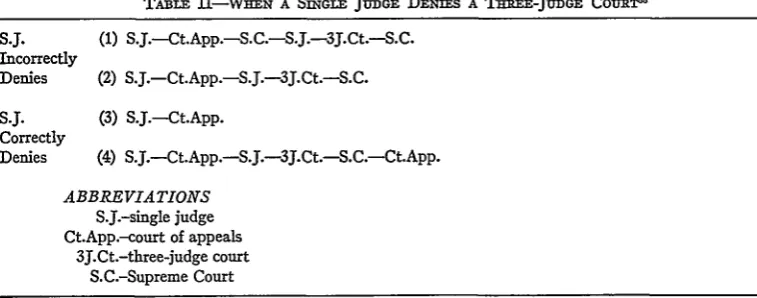
While dear in conception, the Three-judge Act has proven complex in application. The confusion stems from a long line of Supreme Court interpreta-tions of the Act which have had a negative effect on the Act's operation. Specifically, the Court has established numerous threshold prerequisites to the convening of a three-judge court which are both complex and unworkable. These standards have in turn made appeals from district courts more frequent. The appellate structure associated with the three-judge court, however, is inadequate to deal with such appeals. As a result, litigants often find themselves involved in time-consuming
and expensive appeals on the threshold question of whether or not they should be in a three-judge court. Notwithstanding these procedural problems, the Act has placed a strain on judicial resources by providing for direct appeal to the Supreme Court of a final decision of the statutory court, and, to a
court to hear and determine the action or pro-ceeding.
(3) In any such case in which an application for
an interlocutory injunction is made, the district judge to whom the application is made may, at any time, grant a temporary restraining order to vent irreparable damage. The order, unless pre-viously revoked by the district judge, shall remain in force only until the hearing and determination by the full court ....
(5) Any one of the three judges of the court may
perform all functions, conduct all proceedings ex-cept the trial, and enter all orders required or per-mitted by the rules of civil procedure. A single judge shall not appoint a master or order a refer-ence, or hear and determine any application for an interlocutory injunction or motion to vacate the same, or dismiss the action, or enter a summary or final judgment. The action of a single judge shall be reviewable by the full court at any time before
final hearing.
5 28 U.S.C. § 1253 (1964) provides: