Journal of Criminal Law and Criminology
Volume 59 | Issue 1
Article 15
1968
Investigative Process
James W. Osterburg
Follow this and additional works at:
https://scholarlycommons.law.northwestern.edu/jclc
Part of the
Criminal Law Commons,
Criminology Commons, and the
Criminology and Criminal
Justice Commons
This Criminology is brought to you for free and open access by Northwestern University School of Law Scholarly Commons. It has been accepted for inclusion in Journal of Criminal Law and Criminology by an authorized editor of Northwestern University School of Law Scholarly Commons.
Recommended Citation
THE JOURNAL OF CRiMINAL LAW, CRIfINOLOGY AND POLICE SCIENCE
Copyright @ 1968 by Northwestern University School of Law
Vol. 59, No. 1
Printed in U.S.A.
THE INVESTIGATIVE PROCESS
JAMES W. OSTERBURG
James W. Osterburg is currently a Visiting Professor, School of Criminology, University of Cali-fornia, Berkeley. Professor Osterburg has served on the faculty of the Department of Police Adminis-tration, Indiana University, Bloomington, for several years. He is a retired member of the New York Police Departmentandis active in various professional organizations, including the American Academy of Forensic Sciences of which he is currently a member of the Executive Committee. This paper was presented in the spring of 1967 at a Symposium on Law Enforcement Science at Illinois Institute of Technology, Chicago.-EnrroR.
The simplest view of criminal investigation is offered by suggesting that when answers to the questions-who, what, when, where, how, and why-are obtained the investigation is well launched, if not completed. A more sophisticated concept recognizes similarities between criminal investigation and the study of history. Both in-volve an inquiry into events of the past, a time differential being one of the greatest differences between them. An even more general concept views all methods of inquiry as having some elements in common; however, each discipline develops special investigative procedures which are particularly suited to it.
There are only a few textbooks that are barely suitable for use in an introductory college course on criminal investigation. Indeed the literature of the field in general is quite scant; almost all of the books written in recent times are included in the references (1-5).
INVESTIGATION AS A PROCESS FOR
THE STUDY OF THE PAST
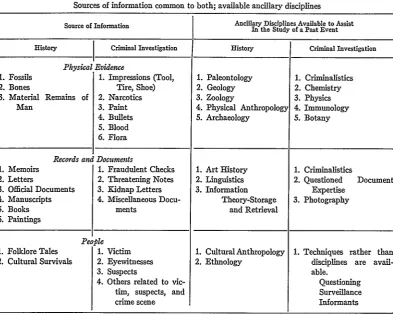
The general sources of information open to in-vestigators concerned with a past event are: physical evidence, records and documents, and people. The disparity between the developed disciplines available to the historian as contrasted with the criminal investigator is significant. It sug-gests the need for a considerable increase in the support of much more academic study of criminal investigative methodology. Table 1 is perhaps the simplest means to illustrate the difference.
The contrast in sophistication of the theoretical and methodological aids available to the historian with those at the disposal of the detective suggests that considerable effort is needed to raise criminal investigation from the level of a crude craft to that of a professional discipline. The reasons why this has not occurred sooner are legion, but the most important is that practitioners themselves have never demanded that the necessary resources be made available. An ostensibly ever-rising crime
rate, the United States Supreme Court, and a Presidential Crime Commission have brought this problem into perspective. The First National Symposium on Law Enforcement Science and Technology held in March 1967 at the Illinois Institute of Technology in Chicago was a partial response to the now recognized need for a general improvement in law enforcement practice.
Before proceeding with a description of the var-ious aspects of criminal investigation some mention must be made of constitutional restrictions which, in the United States, are imposed on the process. These limitations restrict the use of certain pro-cedures and hence make the process operate at less than peak efficiency. In a democracy, this is a price that must be paid because other values--such as man's inherent dignity-are given higher priority. Mention will be made later in this paper on the effects of certain decisions on the particular phase of the process under consideration. This will be done to indicate the effects of legal requirements especially on the application of science to the criminal investigative process.
PHYSICAL EVIDENCE
There are two distinct aspects to physical evi-dence: crime scene search, and the examination of the evidence in a crime laboratory. The literature of Criminalistics (6-13) is much more advanced than the general literature of criminal investiga-tion.
Crime Scene Search. The crime scene search is
THE INVESTIGATIVE PROCESS
TABLE 1
HISTORY AND CRIMINAL INVESTIGATION AS METHODS OF STUDY OF PAST EVENTS
Sources of information common to both; available ancillary disciplines Source of Information Ancillary Disciplines Available to Assist
In the Study of a Past Event
History Criminal Investigation History Criminal Investigation
Physical Evidence
1. Fossils 1. Impressions (Tool, 1. Paleontology 1. Criminalistics 2. Bones Tire, Shoe) 2. Geology 2. Chemistry 3. Material Remains of 2. Narcotics 3. Zoology 3. Physics
Man 3. Paint 4. Physical Anthropology 4. Immunology 4. Bullets 5. Archaeology 5. Botany
5. Blood 6. Flora
Records and Documents
1. Memoirs 1. Fraudulent Checks 1. Art History 1. Criminalistics
2. Letters 2. Threatening Notes 2. Linguistics 2. Questioned Document 3. Official Documents 3. Kidnap Letters 3. Information Expertise
4. Manuscripts 4. Miscellaneous Docu- Theory-Storage 3. Photography
5. Books meats and Retrieval
6. Paintings
People
1. Folklore Tales 1. Victim 1. Cultural Anthropology 1. Techniques rather than 2. Cultural Survivals 2. Eyewitnesses 2. Ethnology disciplines are
avail-3. Suspects able.
4. Others related to vic- Questioning tim, suspects, and Surveillance
crime scene Informants
criminal has entered a building in some uncommon manner. If several such burglaries are investigated they may be grouped together through recognition of the "M.O." Thus, various clues from associated crimes might be pooled to identify the criminal or to provide information for planning surveillance strategy and tactics in order to apprehend him during some future attempt at a similar crime. While this aspect of crime scene search must be mentioned, if has produced a somewhat limited return under present operating conditions.
Role of the Crime Laboratory. The examination
of the crime scene for physical evidence is usually one of the first steps in the investigative process. To be successful the detective must have an under-standing of the crime laboratory and its limita-tions; he must be taught to recognize not only common types of crime scene evidence but also that which is not obvious; he must, in addition, be very familiar with the requirements of the scientist, as well as those of the lawyer, in the collection and preservation of clue materials.
Physical evidence-blood, paint chips, tool impressions, bullets, fingerprints, heroin, alcoholic beverages, and so on-is examined in a crime laboratory. This discussion of the role of the lab-oratory is given from the viewpoint of the field detective and not from that of the laboratory ex-pert. The last two examples of physical evidence-heroin and alcoholic beverages-are typical of substances submitted for analysis. A few confirma-tory tests are often all that are required to establish the nature of the substance. Classical "wet" chem-istry or instrumental analyses suffice to answer promptly the general form of inquiry, viz., "This white powder is alleged to contain heroin. It is re-quested that the powder be analyzed." In most cases the allegation is correct, and analysis is quite simple. The other extreme is the problem of iden-tification of a general unknown. Fortunately, this later problem does not arise too often and may never be solved if the quantity of evidence is limited in amount.
One of the basic tasks of the crime laboratory is
[image:3.431.19.413.62.377.2]JAMES W. OSTERBURG
the identification of substances. Quite frequently this is contraband, or materials otherwise regu-lated by law. A chemist's testimony is required to establish that a necessary "element" (as ethyl alcohol or heroin) is present in order to comply with the definition of the particular crime. When all of the elements of the crime are established, the commission of a crime has been established. The laboratory has shown only that a crime has been committed but not that a particular person has committed it. Personal observations of a police officer or an eyewitness provide the evidence neces-sary to identify the perpetrator.
When the crime laboratory, through the exami-nation of physical evidence, establishes a connec-tion between the crime scene or victim and the criminal it has achieved another of its major pur-poses. The term associative evidence is applied to those physical traces which, through laboratory examination and evaluation, are shown to be in one-to-one correspondence.
The development of associative evidence is accomplished most often by a comparison of crime scene evidence with test evidence related to the criminal. Thus, a crime bullet is shown to have been fired by a suspect's gun by comparison with a bullet deliberately fired through the suspected gun. Similarly a crime scene impression is related to a tool, tire, or shoe by making a comparison exemplar with the suspected implement.
The formidable obstacle to obtaining comparison standards imposed by the Mapp (14) and the Miranda decisions (15) will only be alluded to here as a problem. This is worthy in itself of a dialogue between scientists, civil libertarians, and lawyers. Indeed, the fundamental division between the needs of science for known standards and the limitations unwittingly placed upon their collection must be reconciled if science is to make any great contribution to the administration of justice.
Some mention must be made of the fact that a laboratory finding can be most useful during interrogation. One of the necessary conditions in obtaining a confession is the realization by the suspect that evidence is available against him. Clue materials which may be examined in his presence are particularly valuable, especially if the result is visible--as the development of a fingerprint, a color change in a chemical test, or a photograph showing any associative evidence developed in the case.
Another exceedingly important role the labora-tory plays in the investigative process is the
exon-eration of the innocent through the examination and evaluation of physical evidence. The measure of personal and institutional satisfaction is un-bounded when a possible miscarriage of justice is prevented.
RECORDS AS A SOURCE OF INZORMATION
The use of records in law enforcement is treated largely from the administrative point of view in the scant literature of the field with almost no consid-eration given to their use as an investigative aid. What has been written is largely useless for the obvious application of computer technology to this problem. Some creative, exploratory thinking in this area has been undertaken by the staff of the New York State Intelligence and Information System.
To be of greatest value to the investigative process, records must be thought of as stored in-formation which is there to be retrieved by the im-aginative investigator. Thus, whether files are maintained expressly for criminal investigative purposes or exist as a necessary concomitant to good business practice, stored information may serve in the following ways:
To follow-up or provide new leads. To identify the perpetrator.
To trace and locate a suspect or criminal. To recover stolen or lost property.
Follow-up or Provide New Leads. The laundry
and dry cleaner mark file and the fraudulent check file, if properly maintained, are examples of law enforcement information useful for follow-up purposes. The state automobile license plate file is an example of a governmental file maintained for one purpose but nevertheless useful for follow-up; however, this file could be more useful for police purposes if, for example, the color of the car was required to be provided on the registration form. This is an example of how some files presently operated in various other agencies of government could be made more useful for law enforcement and at almost no cost.
The many directories compiled by the telephone companies, both for public and intracompany usage, are especially helpful for follow-up purposes. The pawn broker file is a good example to illus-trate how new leads are provided. In addition to a handwriting specimen, i.e., a signature on the pawn slip, a personal description of the person who pledged a stolen article may sometimes be ob-tained. At times the behavior of the individual seeking to pawn an item is so suspicious, or the
THE INVESTIGATIVE PROCESS
item is recognized as probably stolen, that the shop owner surreptitiously telephones the local police, meanwhile detaining the customer on some pretext. The city directory, although a private publication and therefore not available for every city, is a source of additional information on the residential and business community. Quite often this directory is used in connection with partial information ob-tained verbally from some other person who was contacted during the investigation.
Identify the Perpetrator. The criminal
photo-graph file (or the rogues' gallery as it is sometimes called) and the modus operandi file are probably as successful as any files maintained for identification purposes. The two files are often in the same quarters and supplement each other. The latent fingerprint file enjoys very limited success in the identification of criminals on the basis of finger-prints alone. When computer technology addresses itself to the problem of fingerprint identity instead of fingerprint classification, a breakthrough of major importance may occur. The problem is formidable and may require that the storage of single fingerprints in a computer be accomplished first.
Trace and Locate a Suspect or Criminal. When
the identity of a criminal is known but he (or a suspect) is absent from his usual places of abode, work, and recreation, the investigator is faced with a problem of tracing and locating that person. The basis of this effort is the knowledge that people are gregarious and that they tend to flee to places familiar to them. Thus, the police in those areas can be alerted to be on the lookout; the transfer of any school records of a child may be used to trace the parent; relatives or friends may be placed under surveillance-these are some measures that may be taken to trace and locate a person after flight. Since in general most people require some con-tinuity in their business pursuits (and in the use of public utilities), business records are often quite useful for tracing purposes. In especially important cases, wanted circulars and posters may be dis-tributed.
Although this is a discussion of the use of records in tracing missing persons, mention was made of surveillance and the use of posters. This illustrates some of the difficulties in describing investigation as a process. It would certainly be misleading merely to describe the use of records for this pur-pose. The mere mention of each technique at the appropriate place later in the discussion might re-sult in some lack of appreciation that several
ap-proaches to the solution of the problem are in the process simultaneously. There are many other places in this treatment of investigative procedure where similar comments would be in order; how-ever, having made the point once, we shall pass over it in the future for the sake of economy if not to avoid tedium.
Recover Stolen or Lost Property. The major
prob-lem in accomplishing this objective is to make cer-tain that the complainant's description of the property coincides with its description when it comes under police cognizance either directly or through a pawn shop. Through carefully structured forms this problem is readily solved. Computers are also obviously useful. Their large memory and the considered selection of property discriminants makes possible the operation of a system over a much wider area than was heretofore possible. Thus traveling a hundred miles or crossing a state line to pawn a stolen article will not preclude the possibility of detection if the law enforcement com-puter systems are interfaced.
Data Surveillance. It is perhaps as appropriate at
this point as anywhere in the paper to comment on some concern already being shown over the in. trusion of privacy by computers. Westin has made a most succinct statement of both sides in this issue (16):
"... if society were to follow the
JAMES W. OSTERBURG
family history, and predicted promotion levels. Other central dossiers might deal with health, civic activity, and criminal records. Every person could have a personal identification number, and computer scanning of a card-holder's fingerprint or voiceprint would serve to control assumption of another's identity number. These computer transaction systems and central record files of the future could bring enormous benefits to mankind-in the form of planning, efficiency, and social control. Unless the issue of privacy is in the forefront of the planning and administration of such future computer systems, however, the possibilities of data surveillance over the individual in 1984 could be chilling... "
"A few thoughtful spokesmen, including some within the computer community, have begun to raise questions about safeguarding privacy and liberty in the age of the electronic dossier. But, so far, these voices have been a small cautionary note in the larger rousing chorus of computer designers and users who are pressing for integrated, freely circulating information systems. Serious as the problem of physical surveillance devices is in the 1960's and promises to be in the 1970's, it may be dwarfed completely by the surveillance of individual and group life that unlimited use of electronic data systems could bring to Ameri-can life in the next decade."
While this may seem a departure from a de-scription of the investigative process, it is nec-essary for many suggestions will undoubtedly be made at this conference concerning the use of com-puters to improve investigative efficiency. It is wise to recognize that there are values other than effectiveness that must be considered. Political scientists, lawyers, and civil libertarians must be brought into the dialogue promptly.
PEOPLE AS A SOURCE OF INFORMATION
The victim of a crime or an eyewitness to it are obvious sources of information; less obvious but nonetheless valuable at times are informants (17) and relatives or associates of suspects. Of course considerable effort is involved in obtaining infor-mation from informants. They need to be culti-vated constantly if any dividends are to result. Surveillance of a suspect or his associates is another source of information; however surveillance of any degree of sophistication requires a commitment of resources in men and vehicles that only the larger and better equipped departments can afford.
Questioning. A distinction is made between
interviewing and interrogation. While both have much in common, the essential difference is perhaps best suggested by the words: antipathy, uncoop-erativeness, hostility. Thus victims and eye-witnesses are interviewed; suspects and criminals are interrogated. The Miranda decision rendered by the United States Supreme Court (18) has established a set of guidelines governing the ques-tioning of persons under detention when the aim is obtaining incriminating information. Predictions concerning the impact of these rules range from "disaster" by the police to "forced innovative im-provement" in the entire investigative process by civil libertarians.
Information from people ranges from confessions, through dues of value for follow-up purposes, to details of no value to the investigator. In the post-Miranda era confessions are likely to be fewer in number and more skill and specialization will be required to obtain them. It remains to be seen whether or not follow-up dues are affected by Miranda through application of the "fruit of the poisonous tree doctrine." For example, can a weapon mentioned in an illegal confession be used as evidence in its own right if the source through which it was located was the confession? Presum-ably the Court will rule on this in the future. Of course follow-up dues provided through interview-ing are unaffected by Miranda.
Investigative behavior involving a follow-up due may result in:
Checking or hunting through a record file. Talking with other people.
Searching for physical evidence.
Additional follow-up continues until all leads are exhausted and no more are forthcoming or the perpetrator's identity has been established. The "mix" of physical evidence, records, and question-ing that spells success obviously differs from case to case.
Personal Descriptions. The victim or eyewitness
to a crime is often able to describe the criminal. The problem of transferring this information to other law enforcement personnel or to the public at large has been attempted in three ways: portrait parle or a printed verbal description of the physical characteristics and clothing of the criminal, use of a police artist to capture the likeness, and use of a mechanical device to combine a limited choice of salient features-forehead, hairline, eyebrows, eyes, nose, mouth, chin, ears, and so on.
THE INVESTIGATIVE PROCESS
infinite variety of feature nuances to capture the Gestalt image; mechanical recording is more limited in reproducing the likeness but more rapid transmission of image data is possible. The use of electronic data processing to retrieve images of possible suspects from a file is an obvious applica-tion of computer technology to investigaapplica-tion. A significant expenditure of funds to build such a file, the need for more research and development, and the training of users of the file to acquire the proper imput information are some of the obstacles to current widespread use of this technique.
Surveillance. Surveillance, referred to earlier in
this paper, may be described as the unobtrusive -observation of a person, place, or thing. A "person" is usually a suspect or a relative or friend of a suspect; however, any individual is a potential subject of. a surveillance if there are reasonable grounds to believe that discreet observance of his
activity might provide significant information. Examples of "places" include liquor stores, supermarkets, banks, drug stores, or other places where transactions are largely in cash, or where contraband such as narcotics is available. Resi-dences and places of business hardly need mention. Indeed any place may become sufficiently inter-esting to place it under surveillance.
"Things" which are worth watching secretly in-.dude: automobiles, the ransom dropped at a designated spot, and the fruits or instruments of a ,rime which were hidden immediately after its ,commission. In the latter situation, their discovery is made through other investigative procedure without the knowledge of the perpetrator.
Surveillance has a dual function in police work. One facet serves the investigative role; the other fulfils the preventive function. The objectives of surveillance, expressed concisely, are:
To locate a suspect.
To obtain detailed information concerning the nature and scope of a suspect's activities. To prevent the commission of a crime. There is a temptation to discuss surveillance as though it is an independent investigative tech-nique. It is, of course, seldom so. For example, information acquired through legitimate wire-tapping or interviewing often supplements and confirms facts developed through surveillance. Investigative techniques complement each other. The successful detective is the one who knows how to season his efforts with the proper amount of each.
Activities of a Suspect. An investigator needs
details of the nature and scope of a suspect's
ac-tivities for the following reasons:
To obtain evidence necessary to establish probable cause for a search warrant orarrest. To identify the associates of a suspect and to infer from their observed behavior, as a group, any criminal intentions or plans they may have.
To obtain information for the interrogation of a suspect.
Behavior of Suspect and Associates.
There
may come a point in an investigation where it seems unlikely that a sufficient amount of evidence will be produced to establish guilt of a suspect beyond a reasonable doubt; however, by using his judgment and perhaps information from other sources, the investigator may have substantial grounds for be-lieving the person is engaged in criminal activity. Under these circumstances the suspect may be placed under surveillance. If an efficient, profes-sional criminal is involved, considerable manpower and equipment are required. While with some luck there may be a quick, satisfactory outcome, it is more likely that weeks or even months will be re-quired before results are achieved.Information for Interrogatian. Horowitz (19)
has analyzed the conditions necessary to obtain a confession. Of these there are two which may be assisted by information obtained through surveil-lance. The necessary, but by themselves insuffi-cient, conditions referred to require the suspect to believe that:
Evidence against him is available;
Forces inimical to his interest are being em-ployed with maximum effort.
The detailed, personal facts that a thorough surveillance puts at the disposal of an investigator can be devastating if used adroitly during an interrogation. Revealing, at an auspicious mo-ment, some inconsequential detail about a person's behavior can lead him to believe his life is an open book to the police. After a few such clever uses of information, and if the other necessary conditions outlined by Horowitz have been met, an admission or confession may result. For an innocent person, of course, the internal pressure of guilt knowledge is not coupled with the other requisites for con-fession, and so none is likely to be obtained. Con-firmation of the confession by checking details ad-mitted to by the subject must be followed through diligently.
The decision to invest significant surveillance resources and the stage in the process where such a decision is made are dependent upon many factors: other priority needs, availability of a surveillance
JAMES W. OSTERBURG
team, and other investigative developments as the case progresses. The economist's concept of "tradeoff" is applicable in arriving at a decision whether to continue the surveillance or not.
I Technology has produced sophisticated
elec-tronic equipment that is useful for surveillance purposes. If such devices are not to be outlawed completely it behooves the law enforcement frater-nity to pay heed to the clear message transmitted in the Westin paper (20). Certainly some safe-guards are necessary. A colloquy with those con-cerned with the invasion of privacy would be profitable. Until this discord is solved it will be hazardous to build the investigative process on the assumption that this source of information will be legally available for long in the future. The prob-lem should be met head on rather than by covert usage and an "ostrich head-in-the-sand" approach.
Motives. Crimes may be divided into two classes
from the standpoint of motive. Crimes such as robbery, rape, and burglary have "universal" motives which are of little value in furthering the investigation. Other crimes may have "particu-larized motives", for example, homicide, arson, and assault. In these crimes, when the motive is dis-covered, the relationship between victim and criminal may be deduced. The high clearance rate for homicide is based, at least in part, on this logic. Experience is helpful in ferreting out the particular motive for a crime. In some crimes a determination of who has benefited from its commission is sug-gestive as to motive; in others it is through adroit interviewing that the motive may be learned.
CRDmUN INvESTIGATION-ART OR SCIENCE It is convenient to view investigation as part of a continuum with the left-hand limit representing the "art" aspects and the right-hand limit the "sci-ence" aspects of the process. Also some people are better endowed naturally with the attributes of a "good" detective.'
Intelligence
Curiosity and imagination
Keen observation and retentive memory Knowledge of life and people
Technical "know-how" Perseverance
Freedom from bias and prejudice Honesty and courage
Sensitivity, discretion, and tact. Physical fitness and neat appearance Report writing ability.
1
As developed in class discussion with police officers and regular academic students.
Others less gifted may nevertheless become ac-ceptable investigators if the elements of investiga-tion are reduced to procedures and principles that are teachable. The rapidity and efficiency of this accomplishment will determine our future ability to educate and train investigators.
At the present time we are at at undefined point somewhere along the continuum and, hopefully, we are moving toward the science end of the spec-trum. However, criminal investigation is not yet a process that can be characterized in steps or by precepts which, when followed, will unerringly lead to a solution of a crime. It can be perhaps better compared to cooking-the ingredients are the same for all chefs; but what they do to and with them, how they add and blend the items, how much heat (or energy) they apply-these are the factors which make the difference between a routine and an exceptional outcome, success or failure.
REFERENCES
1. O'HAXA, C. E., FUDmAMNALS Or CRIMINAL
INvESTIGATION, Thomas, 1956.
2. DiENsTEIN, W., TEcHmcs roR Tu.
CRnM
I-VESTIGATOR, Thomas, 1952.
3. SoDDN , H. AND O'CONNELL,
J. J.,
MODERN CRIINAL INVESTIGATION, 5th ed., rev. by C. E. O'Hara, Funk & Wagnalls, 1962.4. FrrzGERALD, M. J., HANDBOOK OF CRIMINAL INVESTIGATION, Greenberg, 1951.
5. GRoss, H., AND JACKSON, R. L.,
CRmINAL
IN-VESTIGATION, 5th ed., Sweet & Maxwell, Ltd., 1962.6. KIRK, P. L., Cn INVEsTrATION, Intersdence, 1953.
7. NicKOLs, L. C., THE SciNxTrIc INVEsTIGATION or CRIME, Butterworth, 1956.
8. O'HARA, C. E., Am OSTERBuRG, J. W., AN
INTRO-DUCTION TO CRIMINAIaSTICS, Macmillan, 1949.
9. SVENSSON, A., AND WENDEL, 0., TEcnNiQuEs or
CGnE SCENE INVESTIGATION, 2nd rev. Amer. ed., Ed. J. D. Nicol, Elsevier, 1965.
10.
TuRNER, R. F., FORENSIC SCIENCE ANDLABoRA-TORY TECENICS, Thomas, 1949.
11.
GLAisTER, J., MEDICAL JURISPRUDENCE ANDToxCOLOGY, 9th ed., Williams & Wilkins, 1950.
12. GoxzOLEs, T. A., VANCE, M., HELPERN, M., AND
UMBERGER, C. J., LEGAL MEDICINE, PATHOLOGY
AND TOXICOLOGY, 2nd ed., Appleton-Century-Crofts, 1954.
13. GRADWoHL, R. B. H., LEGAL MEDICINE, Mosby,
1954.
14. Mapp v. Ohio, 376 U.S. 643 (1961) 15. Miranda v. Arizona, 384 U.S. 436 (1966)
16. WESTIN, A. F., SCIENCE, PRIVACY, AND FREEDOM:
IssuEs AD PROPOSALS POR T=E 1970's. Part I-The Current Impace of Surveillance on Privacy,
CoLumBiA LAW REV., 66, 1003 (1966). At p.
1013-1014.
17. HARNEY, M. AND CROSS, J. C., TE INFORMER IN
LAw ENFORCEMENT, Thomas, 1960.
18. Miranda, loc. cit.
19. Honowrrz, M., Psychology of Confession, J. CRIM. LAW, CRIINAL., AND POL. Scr., 47, 197
(1956).
20. Westin, op. cit.