Well-being Matters:
A Social Report for Ireland
Volume I
no. 119 october 2009
W
ell-be
in
g M
att
ers
: A
So
cia
l R
ep
ort
fo
r Ir
ela
nd
V
olu
m
e I
Economic
and
Social
Description of Terms of Reference and Structure of the Council* 1. The functions of the National Economic and Social Council are to
analyse and report to the Taoiseach on strategic issues relating to the efficient development of the economy, the achievement of social justice, and the development of a strategic framework for the conduct of relations and the negotiation of agreements between the Government and the social partners.
2. The Council can consider these matters either on its own initiative or at the request of the Government.
3. The reports of the Council are submitted to the Government, and laid before each House of the Oireachtas prior to publishing.
4. The membership of the Council comprises a chairperson and a deputy chairperson, appointed by the Taoiseach and;
p Five persons nominated by agricultural and farming organisations;
p Five persons nominated by business and employers’ organisations;
p Five persons nominated by the Irish Congress of Trade Unions;
p Five persons nominated by community and voluntary organisations;
p Five public servants, of whom at least one represents the Taoiseach, and one the Minister for Finance;
p Five persons possessing knowledge, experience and skills which the Taoiseach considers relevant to the functions of the Council; and
p One person nominated by Environmental Pillar.
5. Other Government Departments are granted the right of audience at Council meetings if warranted by the Council‘s agenda, subject to the right of the Chairperson to regulate the numbers attending.
6. The term of office of members is for three years. Casual vacancies are filled by the Government or by the nominating body as appropriate.
7. The Council regulates its own procedures and business.
Well-being Matters
A Social Report for Ireland
Volume I
Published by the National Economic and Social Council
Copies of this Report may be obtained from
The National Economic and Social Council, 16 Parnell Square, Dublin 1
Membership of the National Economic and Social Council
Chairperson
Mr. Dermot McCarthy
Secretary-General, Department of the Taoiseach and Secretary to the Government
Deputy Chairperson Ms. Mary Doyle
Assistant Secretary,
Department of the Taoiseach
Government Nominees Dr. Seán Barrett Prof. Elizabeth Meehan Mr. David Doyle
Secretary General, Department of Finance
Mr. Sean Gorman
Secretary General,
Department of Enterprise, Trade and Employment
Ms. Bernadette Lacey
Secretary General, Department of Social and Family Affairs
Ms. Geraldine Tallon
Secretary General,
Department of Environment, Heritage and Local Government
Ms. Brigid McManus
Secretary General, Department of Education and Science
Nominated by Business and Employers Organisations Mr. Turlough O’Sullivan
IBEC
Mr. Danny McCoy
IBEC
Mr. Tom Parlon
CIF
Ms. Siobhán Masterson
IBEC
Mr. John Dunne
CCI
Nominated by the Irish Congress of Trade Unions Mr. David Begg
ICTU
Ms. Sally-Anne Kinahan
ICTU
Mr. Manus O’Riordan
SIPTU
Mr. Peter McLoone
IMPACT
Mr. Jack O’Connor
SIPTU
Nominated by Agricultural and Farming Organisations Mr. Seamus O’Donohoe
ICOS
Mr. Ciaran Dolan
ICMSA
Mr. Edmond Connolly
Macra na Feirme
Mr. Pat Smith
IFA
Mr. Eddie Punch
ICSA
Nominated by Community and Voluntary Organisations Fr. Seán Healy
CORI
Mr. Seamus Boland
Irish Rural Link
Ms. Bríd O’Brien
INOU
Ms. Orla O‘Connor
National Women‘s Council
Mr. John Dolan
DFI
Nominated by the Environment Pillar Mr. Oisín Coghlan
Friends of the Earth
Secretariat
Dr. Rory O’ Donnell
Director
Dr. John Sweeney
Senior Social Policy Analyst
Ms. Helen Johnston
Senior Social Policy Analyst
Dr. Larry O’Connell
Senior Economist
Mr. Noel Cahill
Economist
Dr. Claire Finn
Economist
Dr. Barry Vaughan
Policy Analyst
Ms. Catherine O’Brien Ms. Tracy Curran Ms. Sheila Clarke
Mr. Con Lucey
Retired June 2009 Ms. Camille LoftusCommunity Platform
Resigned June 2009
Mr. Colm Markey
Macra na Feirme
Resigned March 2009
Mr. Michael Berkery
IFA
Table of Contents
List of Tables v
List of Figures v
Abbreviations viii
Preface ix
Acknowledgements x
Executive Summary xiii
Volume I
part i
Thinking about Well-being
Chapter 1
Why Well-being Matters
1.1 Well-being – what is it? 3
1.2 The Relevance of Well-being in Ireland Today 7
1.3 Risks to Well-being 8
1.4 The Role of Public Policy in Supporting Well-being 10 1.5 The Contribution and Structure of this Report 13
Chapter 2
Understanding Well-being
2.1 Introduction 15
2.2 Beyond GDP 16
2.3 Understanding Social Progress 19
2.4 Adopting a Well-being Approach 21
2.5 The Concept of Well-being used in this Report 29 2.6 Measuring Well-being and the Role of Social Indicators 32 2.7 A Framework for Assessing Well-being in Ireland 34
part ii
Reporting Well-being in Ireland
Chapter 3
Expressing Well-being through Social Reporting
3.1 Introduction 45
3.2 International Experience of Social Reporting 45
3.3 Aspects of Social Reporting 47
3.4 Social Reporting in Ireland 50
3.5 Aim and Direction for a NESC Social Report on Well-being 51
3.6 Well-being, Policy and Monitoring 52
Chapter 4
An Overview Picture of Well-being in Ireland
4.1 Introduction 61
4.2 Demographic Changes 63
4.3 Economic Resources 72
4.4 Work and Participation 79
4.5 Relationships and Care 88
4.6 Community and Environment 95
4.7 Health 104
4.8 Democracy and Values 116
4.9 Summary Overview 128
part iii
Recasting Well-being in Ireland
Chapter 5
Ireland’s Well-being at a Time of Change
5.1 Why a Concern with Well-being 137
5.2 Well-being – What is it? 138
5.3 Application of Well-being in this Report 140
5.4 Summary of Key Well-being Trends 142
5.5 Relevance of Well-being in a Recession 149
5.6 Well-being Implications 150
5.7 Policy Directions 153
5.8 Policy Implementation 161
5.9 Policy Monitoring 163
5.10 Looking to the Future 164
List of Tables
Table 2.1 Framework for the Assessment of Well-being 35
Table 4.1 Framework of Well-being Indicators 62
Table 5.1 Well-being Test 156
List of Figures
(Ireland unless specified)Figure 1.1 Well-being, Public Policy and Monitoring 12
Figure 2.1 Income and Happiness 17
Figure 2.2 Happiness and Real Income per Capita in the
United States,1973-2004 18
Figure 2.3 Social Quality Concepts 20
Figure 2.4 Schematic Representation of Well-being 22 Figure 2.5 Conceptual Understanding of Well-being 30
Figure 3.1 The Developmental Welfare State 54
Figure 3.2 Social Indicators in the Policy Cycle 56
Figure 4.1 Population Change 1986-2006 63
Figure 4.2 Migration and Natural Increase, 1998-2007 64 Figure 4.3 Irish and Non-Irish Nationals, 1996, 2002, 2006 65 Figure 4.4 Age Structure of the Population: 1996, 2002, 2006 67 Figure 4.5 Population Change by Province, 1996-2006 68 Figure 4.6 Population Change by County in Ireland, 2002-2006 69 Figure 4.7 Couples under 65, Changes in Employment Status,
1994-2000 73
Figure 4.8 Income Inequality, OECD Comparisons 74
Figure 4.9 Poverty in Ireland, 1998-2007 77
Figure 4.10 Persons who Experienced Debt Problems Arising from Ordinary Living Expenses by
Household Composition, 2003 & 2006 78
Figure 4.11 Unemployment in Ireland, 1988-2008 80
Figure 4.12 Employment in Ireland for Persons Aged 15-64,
1988-2008 81
Figure 4.13 Percentage of the Population aged 15 and over whose Full-time Education has Ceased Holding
Figure 4.14 Men and Women aged 15-64 in Employment Classified
by Highest Level of Education Attained, 2002 and 2008 84 Figure 4.15 Time Use Structure of Women and Men Aged 20-74,
Selected European Countries 86
Figure 4.16 Marital Status in Ireland, 1996-2006 88 Figure 4.17 Household Composition in Ireland, 1996-2006 90 Figure 4.18 Numbers of People aged 65 and over Living Alone,
1998-2007 92
Figure 4.19 Carers by Number of Hours per Week of Unpaid
Help Provided, 2006 93
Figure 4.20 Dwelling Unit Completions in Ireland, 1988-2008 95 Figure 4.21 House Price Index, Number of Housing Loans Paid
and Average Value of Mortgages in Ireland, 1997-2009 96
Figure 4.22 Housing Need in Ireland, 2002, 2005, 2008 97 Figure 4.23 Percentage of Respondents Reporting Regularly
Attending one or more Community Activities,
by Gender, Age and Social Class, 2007 100
Figure 4.24 Greenhouse Gas Emissions in Ireland: 1997-2006 101 Figure 4.25 Percentage of People who Travel 25km and over
to Work, 2006 102
Figure 4.26 Municipal Waste Generated: Selected European
Comparisons, 2006 103
Figure 4.27 Life Expectancy at Birth, 1985-2007 105 Figure 4.28 Healthy Life Years at Birth by Gender, European
Countries, 2006 106
Figure 4.29 Percentage of Respondents Rating their Health as ‘Excellent’ or ‘Very Good’, by Age, Gender and
Social Class, 2007 107
Figure 4.30 Percentage of Persons on How Easy or Difficult it is to Reach and Gain Access to Hospitals in Ireland
and the EU 27, 2007 108
Figure 4.34 Percentage of Respondents Consuming the Recommended Number of Daily Servings
From each Shelf of the Food Pyramid, 2007 113
Figure 4.35 Proportion of the Population Reporting Themselves
as Overweight or Obese in Ireland, 1998, 2002, 2007 114
Figure 4.36 Trust in National Political Institutions, 2006-2008 116 Figure 4.37 Percentage Agreeing that Corruption is a Major
Problem in their Country, European Comparisons,
Selected Countries, 2007 117
Figure 4.38 Percentage Voter Turn out in Dáil elections, 1987-2007 118 Figure 4.39 ‘Which of these statements comes closest to your beliefs?’,
Ireland and the EU, 2005 119
Figure 4.40 Sense of Fulfilment, European Comparisons, 2007 120 Figure 4.41 Recorded Incidents per 1,000 Population, 2003-2006 121 Figure 4.42 Victims of Crime by Age Group, 1998-2006 122 Figure 4.43 Men and Women Aged 18 and over
by How Safe they Feel, 2006 123
Figure 4.44 Gender Pay Gap, Ireland and the EU, 1997-2006 125 Figure 4.45 Percentage of Female Representatives in National
Parliaments, 2003-2007 126
Figure 4.46 Discrimination among Ethnic Minorities, 2004 127 Figure 5.1 Conceptual Understanding of Well-Being 140 Figure 5.2 Well-being, Public Policy and Monitoring 141
Appendix A The 23 High Level Goals from Towards 2016 171
Abbreviations
BMI
Body Mass Index CORI
Conference of Religious of Ireland CSO Central Statistics Office DWS Developmental Welfare State EPA Environmental Protection Agency ESRI
Economic and Social Research Institute EU
European Union EU-SILC
EU Survey on Income and Living Conditions GDP Gross Domestic Product GNP Gross National Product GNH Gross National Happiness GPI Genuine Progress Indicator HDI Human Development Index HSE Health Services Executive IOM International Organisation for Migration MAP Measuring Austrialia’s Progress MDGs Millennium Development Goals MEA Millennium Ecosystem Assessment NDS National Disability Survey NEF New Economics Foundation NESC National Economic and Social Council NESF
National Economic and Social Forum NCAOP
National Council on Ageing and Older People OECD Organisation for Economic Co-operation and Development OFCE Observatorie Français des Conjonctures Economiques PLC Post Leaving Certificate QNHS Quarterly National Household Survey SDT Self-Determination Theory SESAME
System of Economic and Social
Accounting Matrices and Extenstions SGSES
Steering Group on Social and Equality Statistics
SIDOs
Sports Inclusion Disability Officers SLAN
Survey of Lifestyles, Attitudes and Nutrition TILDA
Preface
The idea of a social report was first suggested by NESC in 1977. At that time it was envisaged that a social report could highlight social problems making possible more informed judgements about national priorities. By providing insights into the progress of different measures of national well-being a social report could assist in the evaluation of what state programmes are achieving. More recently, following a recommendation by the National Statistics Board, the government requested that NESC take a lead role in the preparation and production of an overall social report. This report seeks to fulfil that request, based on the original ideas.
Internationally, there is increasing interest in, and analysis of, human well-being and the economic, social, environmental and psychological factors that contribute to it. Current thinking suggests that to measure social progress and national well-being we need something more than GDP. This report explores some of the thinking on these matters and derives a well-being framework to measure social progress in Ireland.
The framework developed focuses on six ‘domains’ of life which seem to be important aspects of a person’s overall well-being. Indicators to monitor progress are derived from these domains. The domains and indicators could be assembled in a number of different ways, but have been presented in this report in a way which reflects our understanding of well-being and corresponds with current Irish policy goals. This initial framework can be further developed and, with the availability of better data, can be linked more directly to policy outcomes. When this work was initiated in late 2007 Ireland was still in a period of economic growth and a ten year policy framework had just been agreed (Towards 2016). The subsequent onset of the economic crisis provided a challenging context for the drafting of the report. This crisis has brought into sharp focus the risks to well-being. The report recognises this changing context and its impact on social outcomes, even though these impacts may not be fully captured in the data available so far.
Acknowledgements
The Council and Secretariat wish to acknowledge the assistance and contribution of a number of individuals and organisations in the preparation of this report. From the outset the engagement of individual Council members has helped to design, steer and inform the document. In particular, the Secretariat would like to acknowledge the contribution of Council members who provided detailed comments, verbally and in writing, and who directed the Secretariat towards data sources and relevant research. The Secretariat would especially like to acknowledge the contribution of those who attended the workshop on the life cycle chapters.
Throughout the drafting of the report a wide range of organisations and individuals engaged with the work through discussion, making valuable suggestions and commenting on drafts. We are grateful for their contributions, while retaining full responsibility for how we have used and interpreted the material.
Introduction
The purpose of this report is to analyse and interpret key social trends to inform social policy and well-being in Ireland. The approach adopted reflects the public mood in seeking to know the societal outcomes of the economic boom years and how we should design our policies for the future. The report provides material for reflection and some pointers towards future policy directions.
The focus is on individuals and their capabilities, how they relate with those around them (families, communities) and on their role within the wider societal system (economic, social and cultural systems). The work acknowledges the diversity of the population and the challenge of a developmental approach to unlocking the potential of each individual. This focus is very much in line with the current policy framework Towards 2016 which adopts a life cycle approach, placing the citizen at the centre of social policy.
Why Well-being?
The report adopts a well-being approach for a number of reasons:
i. Something more than GDP is required to measure social progress;
ii. Because of the central role of people in economic and social progress;
iii. Because people care about their well-being and are increasingly reflecting on what contributes to it; and
iv. To assist in monitoring the impact of policy actions on policy outcomes.
What is Well-being?
In applying this definition, we focus on six domains of well-being, on which a certain amount of data are available, as follows:
s Economic resources;
s Work and participation;
s Rrelationships and care;
s Community and environment;
s Health; and
s Democracy and values.
All of these domains of a person’s life are important for their well-being and are interconnected. The emphasis given to each may depend on an individual’s particular circumstances or the situation in which they find themselves. People’s well-being is also affected by comparing themselves with those around them and by the values set in wider society. Throughout their life course the domains of well-being of an individual may change.
The relationship between individual and collective well-being is important but hard to define. This is so, in part, because the nature and context of each individual’s well-being involves a unique combination of the six domains of well-being used in the report. An implication of this perspective is that individual and collective well-being are constructed and re-constructed in processes that include individual reflection and social interaction.
Well-being Trends
Key Demographic Trends
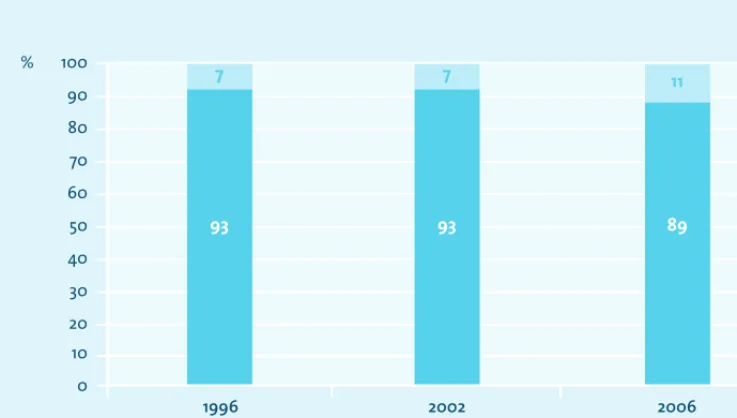
Population levels in Ireland have reached an all-time high and the population is more diverse than it has ever been. This diversity is most noticeable in relation to an increasing ethnic mix with some 11 per cent of the population in 2006 being non-Irish nationals deriving from 188 different countries. There is also diversity in relation to family status and employment status, with a wide range of family types and various working arrangements. Ireland has a relatively youthful population with just under one quarter of the population under 18 years of age. Eleven per cent of the population in 2006 was over 65 but this is set to increase in future, with a proportionate increase in the over 80s. Just under ten per cent of the population are classified as disabled, defined as having a long lasting condition or difficulty with certain activities.
Key Trends in Relation to Economic Resources
some people experiencing large and sudden drops in their incomes while others have seen a more gradual reduction. Some sub-groups of the population remained vulnerable to poverty throughout the nineties and early 2000s, including lone parents, people who were unemployed, and people with a long term illness or disability.
Key Trends in Relation to Work and Participation
Participation in meaningful activity contributes to human flourishing and well-being. Paid employment is one of the main expressions of participation and there was unprecedented employment growth in Ireland from the mid 1990s to 2007. Unemployment, however, is one of the most damaging influences on individual and societal well-being. Unemployment has been increasing at an alarming rate recently after falling to an all-time low. The scale of the increase in unemployment is placing challenges on social welfare, employment, training and education services, as well as being detrimental to well-being. In addition, modern demands have led to some conflicts of work-life balance, especially for women. Work in the home, voluntary work in the community, and in the provision of services, can also make an important contribution to individual and societal well-being.
Educationally, we are more qualified than ever before. Nevertheless, about ten per cent of young people still leave school early, with a related problem of low levels of literacy. Participation in life-long learning is relatively low. Ireland’s early childhood care and development infrastructure is still comparatively underdeveloped and is one area of critical importance for the future of our children, our society and our economy.
Key Trends in Relation to Relationships and Care
Relationships are central to people’s well-being. Relationship breakdown and bereavement can be especially detrimental to people’s well-being, with conflictual relationships having a particularly devastating effect on children. Encouragingly, however, there is evidence of increasing stability in relationships with a growth in the numbers getting married, including second marriages, and an increase in cohabitation. Nevertheless, lone parents and older people living alone now make up substantial proportions of our households. These household types are more vulnerable to poverty, social isolation and loneliness. An important relationship issue is the provision of care, for both the care giver and the care receiver. Much care in Ireland is provided by and to family members on an unpaid basis, with many carers, who are mostly women, combining caring roles with paid employment or unpaid responsibilities in the home. The importance of care, both unpaid and paid, and its impact on the well-being of individuals and society is now coming into sharper focus.
Key Trends in Relation to the Community and Environment
The community and environment within which people live have an important bearing on their well-being. The increase in privately owned houses (with large increases in house prices and large mortgages) were features of the boom years. So was the difficulty of access to affordable and social housing with many households in need of housing; the numbers on local authority housing waiting lists increased during the years of economic growth.
need it, and volunteering and community participation does not seem to be in decline. In relation to the wider environment Ireland has a high level of greenhouse gas emissions and we generate a high level of waste per head. In addition, Ireland is one of the most car dependent countries in Europe, with a need to improve provision of public transport.
Key Trends in Relation to Health
The health of the population overall is improving, as reflected in increased longevity and the majority of people stating that they perceive their health to be good. Even so, there has been an increase in chronic illness and in mental ill health. People’s health is affected by the socio-economic conditions in which they live and work and by their behaviours. Physical activity is seen as beneficial to health and it is encouraging that the level of physical activity in Ireland has increased. Nevertheless, one fifth of the population remain inactive. More than half of adults in Ireland are now recorded as being overweight or obese, putting their health at risk. Tobacco use is a risk to health, yet one third of adults smoke. Excess consumption of alcohol is also detrimental to the health and well-being of the individuals involved, their families and wider society, and in Ireland we have high rates of heavy drinking compared to EU averages.
Some sub-groups of the population are more at risk of poor health than others and have less access to treatments and services. These include people with lower educational levels, lower incomes and who are unskilled. The demands on our health service are likely to increase as budgetary reductions are sought and needs are likely to increase at a time of economic recession. These demands highlight the challenge of reforming how we deliver health care to make it fairer and more effective.
Key Trends in Relation to Democracy and Values
People’s well-being is affected by the values they hold and the values of the society within which they live. Access to information and transparency is an important dimension of exercising democracy. In relation to accessing information, Ireland remains below European averages in access to the internet, especially for older people. Declining levels of trust in national and other institutions have been accentuated by the financial crisis, coinciding with a perceived lack of fairness in our society.
Trust is also damaged by crime and fear of crime, bullying, domestic violence, neglect and abuse. There has been an increase in recorded crime, with a majority of the population believing crime to be a very serious problem in Ireland. One quarter of young people in Ireland report that they have been bullied. There is an increasing awareness of the risk of poor treatment, neglect and abuse among vulnerable sections of the population.
progress in reducing the gender pay gap. With regard to the expression of cultural identity, people of a non-Irish, non-white ethnic background and members of the Traveller community experience higher levels of discrimination than the majority Irish population. This evidence suggests that we need to keep effective means of promoting rights, equality and interculturalism under review, with a view to its further development.
Relevance of these Social Trends for Individual and Collective Well-Being
This overview of well-being in Ireland displays positive trends for many people. Given the complex relation between individual and collective well-being we recognise that, by and large, this is an aggregate judgement. The continuation of serious social deficits qualifies any aggregate judgement to a significant degree. So, even where the overall trends suggest that the well-being of Irish society increased there were risks to individuals’ well-being. A substantial minority of the population continue to live on low incomes which put them at risk of poverty; the childcare and early education infrastructures remain underdeveloped and piecemeal, with implications for child, family, economic and social well-being; some people have difficulty accessing employment for a number of reasons; many people are living with chronic illness and/or mental illness, and there are difficulties accessing a poorly functioning health system. Many people with disabilities continue to experience disadvantages; and there is a growing awareness of the need to integrate immigrants into our communities, given our developing cultural diversity.
Additional risks associated with modern society are summarised as: the challenges of balancing paid employment and family/caring responsibilities; lacking the skills necessary to access a job or having skills and training which are now obsolete; having an inadequate or insecure income or pension; and unsatisfactory and unreliable service provision. It has been argued that modern society brings with it ‘discontinuities’ in family and working lives, which can entail insecurities and vulnerabilities. These ‘discontinuities’ require a different type of engagement with the institutions of the state than heretofore – greater flexibility, differentiated routes and pathways, activation on the part of the state and of citizens, and a shift towards a supportive state, with agreed standards and greater regulation.
Relevance of Well-being in a Recession
Recessionary Risks to Well-being
tensions emerging in communities with potential increases in crime and racism; the impact of these events on physical and mental health, along with a curtailment in some health and social services; a lack of confidence and trust in some national institutions, a perceived lack of fairness, and an erosion of the equality and rights infrastructure.
Impact of the Recession on Well-being
Well-being is affected by economic upturns and downturns. A shock to one domain of our well-being may have an impact on another domain. For example, loss of a job and income can affect our relationships and health. These impacts can affect people in different ways depending on their circumstances. Depending on how we, as individuals and as a society, deal with these adversities can make a major difference to our longer term well-being. Some of the factors identified which can make a difference include using our capabilities, having a sense of purpose, engagement in meaningful activity, the support of family and friends, having trust in our institutions and having a sense of hope. Public policy and institutions have a vital role in providing the conditions to support individual and collective well-being and in making available tailored supports to people experiencing particular risks and vulnerabilities. Resilience in individuals needs to be paralleled at societal level by resilience in institutions to enable them to be able to adapt to the changed and challenging circumstances, as they strive to deliver an adequate level and standard of service with reduced resources.
Ireland’s Well-being at a Time of Change
A Developmental Approach
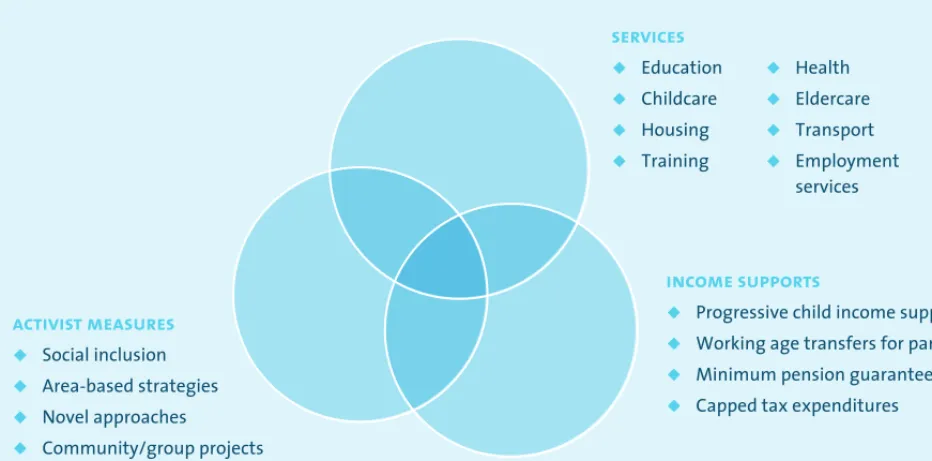
A developmental welfare state, denoted by three overlapping areas of welfare state activity – services, income supports and activist measures, is a 21st century public policy framework well suited to supporting individual well-being. The developmental welfare state recognises that people are citizens first and foremost, but are heterogeneous citizens with a changing mix of needs, capabilities and circumstances. In advocating ‘tailored universalism’ as an approach, the developmental welfare state implies that: a) services and supports, such as education and health, are available to everyone; but that b) for people with certain needs, and in certain circumstances, additional payments and entitlements to services are tailored to meet their needs. These tailored services address the specific barriers which prevent people from realising their potential.
or constrained circumstances and could lead to higher long term costs to the state and to society more generally. The prioritisation of the implementation of these goals has to take place in the context of the financial stabilisation measures being put in place by the Government.
This analysis leads us to question the model of development we have used in the past. While this model led to unprecedented economic growth it has left social deficits in its wake and seems limited in its capacity to address the challenges facing Ireland in the current recession or to shape our future society. Thus, the way we state some of our high level goals could be modified, for example:
s From growth of total GNP to GNP per head to sustainable growth;
s From income growth to a more equal distribution of income;
s From absolute job creation to overall employment rate to participation rate;
s From discrete and targeted programmes for disadvantaged groups to responsive,
flexible, person-centred, and tailored publicly funded services;
s From an exclusive focus on income to a balance between income and better
provision of accessible, affordable quality services;
s From developer-led developments to planned and sustainable communities;
s From housing completions to occupancy rates;
s From ‘survival of the fittest’ to a more egalitarian society.
Well-being Implications
There are a number of lessons which have emerged from the review of well-being, summarised as follows:
s At the most fundamental level having a level of income to meet basic needs
matters. This level of income is contingent both on the standard of living in the society within which one is living, as well as the distribution of income, as people compare their income levels with those around them. It is also known that while loss of income can lead to a reduction in well-being in the short-term, people do readjust to their new financial circumstances.
s The fundamental elements which contribute to long-term well-being include
participation in meaningful activity, along with affectionate and caring relationships, a secure, safe and attractive environment, good social relations, and good health.
s Context matters and the situations within which people find themselves can
This knowledge of well-being provides us with some key pointers in responding to the economic recession. First, it would suggest that we should try to ensure that as many people as possible are meaningfully engaged. In the context of job losses and rapidly increasing unemployment this is a significant challenge.
Secondly, it is important to bear in mind people’s basic need for an adequate income. Not only does this point to the need to ensure that people have an income which is adequate to prevent poverty, but now it also means recognising that some people have experienced large falls in their income and/or savings which will put them in situations of financial hardship.
Thirdly, it is relevant to reflect on the impact of social comparisons on well-being. A situation where everyone is experiencing a drop in income would seem to have a lesser effect on well-being, so long as basic needs are met, than a situation where only some people experience income reduction.
Fourthly, we should be able to learn from the past in planning for the future. For example, we may think differently about the desirability of fast economic growth, rather than deep or enduring prosperity. We may focus more on intensive rather than extensive growth and place a higher priority on sharing of gains and losses. We may take the view that future prosperity is best secured by moving away from a growth economy towards a more economically, socially and environmentally sustainable model of development. We may seek a more equal society based on the evidence that more equal societies tend to have lower levels of poverty and higher levels of social cohesion.
In this context, it is pertinent to raise certain questions. Three key questions are posed:
s How do we pursue both individual and collective well-being and make them
mutually supportive?
s What is our vision of Ireland in ten years time?
s What is the appropriate institutional response?
Well-being Test
Well-being Criteria Description
Capability A focus on what an individual can do with a view to developing capabilities Agency Respect for the capacity of individuals to make decisions about their lives Purpose Recognising the importance of having a sense of purpose by encouraging
and supporting people to engage in meaningful activity
Social interaction The recognition that we operate in the context of a set of relationships – family, community and wider society
Common good As individuals and as societies we do better in more equal and fairer societies Sustainability We live in a finite world and have to use our resources wisely now and
Well-being Test
In seeking to do things differently it is helpful to have underpinning principles or criteria driving the reforms. A ‘well-being test’ is suggested based on a developmental perspective.
s By focusing on capability we are paying attention to what an individual can do
rather than what they cannot do. Thus, we would focus on the developmental potential of all people from an early age – pre-education, through the education system and into life-long learning.
s Agency is an important component of well-being. In empowering people
and taking into account their views, appropriate and tailored services can be provided, with the individual also taking responsibility for their needs, in conjunction with service providers.
s Having a purpose in life is a motivating factor which acknowledges people’s
contribution, whether this is in paid work, household work, care work or voluntary work.
s People are social beings characterised by their relationships and interactions
with others – within families, within communities, and within institutions. While public policy recognises this dimension of people’s lives in many of its programmes and initiatives it is helpful to take this wider context into consideration in the nurturing of children, in the sharing of responsibilities and in finding optimal work-life balances.
s There is merit in putting a higher value on the common good through ensuring
a more equal provision of services, a greater sharing of responsibilities and a greater sense of solidarity.
s A more sustainable approach recognises that we live in a world with finite
resources that we need to use wisely now and for the future.
Policy Priorities
A number of policy priorities emerge from the review of well-being trends, and subsequently in the context of the economic recession.
Immediate priorities are:
s The need to address unemployment through diverse and intensive activation
measures;
s The provision of financial supports, including pension reform; and
s The transformation of institutions and improved accountability.
As well as the immediate priorities outlined above, attention needs to remain focused on:
s Early childhood care and education;
s Life-long learning;
s Supports to accommodate working and other activities, especially caring;
s Building sustainable integrated communities; and
s Promoting better health, including addressing adverse economic and
social conditions.
Policy Implementation
There is a profound challenge to give traction to the developmental welfare state to deliver the policy priorities and the actions associated with the high level goals in Towards 2016. The recession is putting a strain on the public services with budget reductions, staffing restrictions and reductions in take home pay. Despite the more limited resources the challenge is to reorganise and restructure institutions to meet the new challenges of supporting people. Those working in the policy arena and in the delivery of programmes and services, the community and voluntary sector, and service users, hold the knowledge and expertise to meet these challenges. They must be enabled to deliver a reform agenda by having a clear vision of the type of society we are working towards as well as systems which support new ways of doing things.
Policy Monitoring
Structure of the Report Well-being Matters
The report Well-being Matters comprises 4 parts in 2 volumes. Volume I comprises 3 parts.Part I, Thinking about Well-being, contains two chapters. Chapter 1 explains why well-being matters. Chapter 2 reviews the well-being literature to arrive at an understanding of well-being which is used throughout the report.
Part II, Reporting Well-being, also contains two chapters: Chapter 3 on expressing well-being through social reporting, and Chapter 4 which provides an overview of well-being trends in Ireland over the last ten to twenty years.
Part III, Recasting Well-being in Ireland, contains one chapter which recaps on the approach to being used throughout the report, summarises the key well-being trends, sets out the well-well-being implications and suggests a number of policy directions.
The recession has clearly impacted on economic and social progress and on people’s well-being in the last year. The impact of the recession is considered where data have become available, and is dealt with more specifically in Chapters 1 and 5.
Volume II comprises 1 part.
Part IV, Charting Well-being in the Policy Framework contains four chapters, each relating to a life cycle stage as set out in the policy framework document Towards 2016: children, people of working age, older people and people with disabilities. Each of the four chapters explores meanings of well-being in relation to the particular population group, documents key well-being trends, relates these to the policy framework and comments on policy directions, data and indicator gaps.
part i
The Provision of Social
and Affordable Housing
6
Why Well-being Matters
This social report for Ireland is situated within a well-being framework. Its purpose is to analyse and interpret key social trends to inform social policy and well-being in Ireland. The well-being approach adopted reflects the current public mood in seeking to know what we achieved in the boom years and how we should design our economic, social and environmental policies for the future. The report provides material for reflection and provides some pointers towards future policy directions.
1.1 Well-being – What is it?
Much has been written about well-being in recent years. What is it and what can it bring to our understanding of social progress? When asked about their well-being people cite things like their family relationships, their financial situation, work, their community and friends, good health, and personal and political freedoms.1
In relation to the well-being of society and social progress, while people believe economic growth is important, other factors like democracy, equality and social justice, the quality of public services, low poverty levels and work-life balance also rank highly.2
People are central to economic and social progress. This is recognised by NESC (2005a: xxiii) that ‘in a globalised world, the strength of Ireland’s economy and of its society will rest on the same foundation – the human qualities of the people who participate in them’. In its recent report on an integrated response to the economic crisis one of the most important factors identified is the need to ‘engage the ability and energy of the Irish people’ (NESC, 2009:ix). Hence the wisdom of focussing on the well-being of our people.
Well-being in this report is understood as a positive physical, social and mental state. It requires that basic needs are met, that individuals have a sense of purpose, that they feel able to achieve important goals, to participate in society and to live lives they value and have reason to value. Well-being is enhanced by conditions that include financial and personal security, meaningful and rewarding work, supportive personal relationships, strong and inclusive communities, good health, a healthy and attractive environment, and values of democracy and social justice.
1. From the U.S. Social Survey cited in Layard, (2005a: 63).
An important role of public policy is to bring about these conditions by placing the individual at the centre of policy development and delivery, by assessing the risks facing him/her, and ensuring the supports are available to him/her to address those risks, at key stages in his/her life.
The understanding of well-being used in this report is underpinned by a diverse literature on the subject (reviewed in Chapter 2). This literature has two related components. The first is that based on conceptual understandings of ‘human flourishing’ which incorporates the idea that well-being is about having a sense of purpose in life, participation in civic life, having friends, loving and being loved. The second component is derived from empirical social science and is based on the premise that we need something more than GDP as an indicator of progress. There are two particular limitations of GDP as a measure of social progress or social well-being: first, it is clearly a one-dimensional indicator that ignores many dimensions that have long been recognised as essential; second, it is an additive measure (national GDP is the sum of different incomes) and, therefore, ignores the many complexities in the relation between individual well-being and collective well-being. A wide range of social indicators and associated approaches have been suggested as alternatives to GDP (see Chapter 3 of this report).
The limitations of GDP/GNP as a measure of social progress have been aptly captured by the words of Robert Kennedy in 1968:
The Gross National Product counts air pollution and cigarette advertising, and ... the destruction of the redwood and the loss of our natural wonder in chaotic sprawl ... Yet [it] does not allow for the health of our children, the quality of their education, or the joy of their play ... the beauty of our poetry or the strength of our marriages ... it measures everything, in short, except that which makes life worthwhile (cited in NEF, 2009: 2).
A review of the literature and evidence reveals a number of fundamental elements to an individual’s well-being. For practical purposes we have to focus on aspects of well-being we have data on. These can be summarised as: economic resources, work/ participation, relationships/care, community/environment, health, and democracy/ values. These are referred to as the six domains of well-being throughout the report. They are briefly explained here, with a more detailed justification and description in Chapter 2. While these domains strongly reflect key insights in thinking on well-being, we recognise they do not capture certain aspects of that body of wisdom. In particular, they do not fully reflect aesthetic and spiritual dimensions of well-being.
Domains of well-being
s Economic resources s Community / environment
s Work / participation s Health
A certain level of income is required to meet people’s basic needs. Income and material goods are also important elements of social comparison, where income is associated with status, power and worth, so that its distribution and its value in society impact on an individual’s well-being. Conversely, poverty, financial stress and financial insecurity have negative effects on well-being. The distribution of income also impacts on well-being, with high levels of income inequality associated with higher levels of poverty, illiteracy, divorce, crime, obesity and ill-health. A fundamental component of well-being which enables individuals to flourish is the development and utilisation of capabilities through participation in work and education. Unemployment at an individual level and at a societal level has a damaging impact on well-being. At an individual level unemployment does not only mean a loss of, or low, income. It also undermines self-respect and social relationships. Loss of a job has a particularly devastating effect. A high unemployment rate in an area can lead to an overall sense of worthlessness. Employment and being engaged in meaningful activity has the opposite effect, not only providing income but contributing to a sense of purpose, providing social interaction and the status associated with having a job. Participation in education can lead to fulfilment in and of itself, but also builds human capability by giving people more opportunities in life.
We are essentially social beings so that the quality and stability of relationships are a central element of people’s well-being. Loving, secure and consensual relationships have a positive effect on well-being. Conversely, the loss of a partner through separation, divorce or widowhood has a detrimental effect. Conflictual relationships have a destructive impact on well-being, with particularly devastating effects on children. An aspect of relationships is the provision and receipt of care. The quality of the care and supports available can have an important bearing on well-being, for both the care giver and the care receiver.
Accommodation is one of the basic needs for human well-being. In a modern society appropriate accommodation in a sustainable and integrated community and a safe, secure and attractive environment play an important part in people’s overall well-being. The environment is increasingly recognised as an aspect in the quality of social and individual life. We depend on the environment to provide basic needs such as safe water, clean air, fresh food and a habitable climate, and to absorb the pollution and waste resulting from human activity. We look for high quality neighbourhoods and access to the diversity of nature for our enjoyment and as a positive influence on health. Community development and participation, social networks and volunteering have a positive impact on well-being.
Holding personal beliefs, whether through religion or otherwise, contributes to individual well-being. The quality of government and public institutions, people’s involvement in a democratic society and peace are significant features of both individual and societal well-being. Crime, and fear of crime, undermine community connections. At societal level, a belief in a ‘common good’ has been shown to contribute to the overall well-being of society, requiring trust in institutions, recognition of rights and responsibilities, empathy with others and values of citizenship.
Longstanding and recent evidence would suggest that all of these domains of a person’s life are important for their well-being. The emphasis given to each may depend on an individual’s particular circumstances or the situation in which they find themselves. Most individuals live in a family (or have family connections), in a community which is part of the wider society, environment and economy. These elements of a person’s life are interconnected. People’s well-being is also affected by comparing themselves with those around them and by the values set in wider society.
The relationship between individual and collective well-being has always been seen as important, but the nature of the relationship has been hard to characterise. Throughout history successive efforts to characterise the connections between individual and collective well-being have turned out to be contestable and in need of revision. Indeed, in Western thought many believe that the search for an invariant or universally compelling account of individual and societal well-being is difficult to achieve. This is so, in part, because the nature and context of each individual’s being involves a unique combination of the six domains of well-being discussed above. An implication of this perspective is that individual and collective well-being are constructed and re-constructed in processes that include individual reflection and social interaction. The analysis and pursuit of well-being in this context of individual difference and value pluralism has important implications for the way in which we think about the role of public policy. Specifically, it implies that public policy should aim to secure and provide three kinds of ‘goods’: sufficient freedom for each individual to pursue their idea of the good life; a degree of order and uniformity, to protect both the individual and the common good; and a range of public and private goods tailored to individual needs.
There is also a temporal dimension to well-being. Throughout their life course the domains of well-being of an individual may change as well as the interaction between them. This dimension of well-being is alluded to in the report through the use of a life cycle approach, although longitudinal data are required to chart this temporal dimension. As conditions and context change over time these will also influence the six domains of well-being and their balance within any individual.
1.2 The Relevance of Well-being in Ireland Today
Ireland experienced unprecedented economic growth from the mid-1990s to 2007, albeit with a period of slower growth in the early 2000s. This resulted in a growth in jobs, growth in income and wealth, as well as a new-found confidence at both individual and societal level. Despite these mainly positive developments, social deficits remain with a significant minority of our population experiencing poverty and other disadvantages.
The situation in 2009 is one of shock at the speed of the economic downturn. NESC has identified the main reasons for the downturn as the ending of the Irish housing and construction boom, the ending of a period of strong growth in which Ireland lost competitiveness, and as a result of an international recession (NESC, 2009). The consequence is an economic recession in Ireland with loss of jobs, reductions in income, and a loss of confidence. The loss of individual and collective confidence is fuelled by fear of losing one’s job and /or one’s house, having redundant skills or expertise and doubts about fairness in our society.
These trends bring into sharp focus the interactions between individual and societal well-being. Aggregate trends can cloud the heterogeneity of individual or collective experiences which impact on well-being. The complex relations between individual and collective well-being become even more relevant and more obvious in a recession context, as discussed below and throughout the report.
The empirical evidence suggests that the effects of recession on well-being are complex. Taking one example, American sociologists Tausig and Fenwick (1999) analysed the effects of economic recession on the aggregate well-being of workers who experienced the 1974/75 recession in the USA. They found increased levels of distress and dissatisfaction, driven by changes in job characteristics – increased job demands, increasingly inadequate pay and experiences of unemployment. In relation to the current recession, the American Gallup-Healthways Well-being Index tracks health and well-being in the USA. It classifies people as ‘thriving’, ‘struggling’ or ‘suffering’.3 The percentage of Americans saying they were
‘suffering’ increased from 3.3 per cent in February 2008 to 4.7 per cent in February 2009. The percentage ‘thriving’ declined from 51 to 42 per cent and the percentage ‘struggling’ increased from 46 to 53 per cent over the same time period. Business owners and those in management, followed by those in clerical positions, sales and professional jobs saw the largest shifts from ‘thriving’ to ‘struggling’. However, it was those in the lowest income groups whose well-being declined the most, reflected in a substantive increase in ‘suffering’ for this group.
Commentary on the trends in the US notes that while the lowest income groups have been hardest hit by the contraction of the economy the well-being of the affluent, as well as the poor, has deteriorated greatly in the current economic downturn. The commentary concludes that having a job will continue to be one of the most important well-being determinants in 2009, but that ‘leaders may have more impact on the well-being of citizens than in any year in recent history. Our research has found that two of the qualities that people look for in leaders are hope and stability. Leaders with the capacity to engage their people in the long-term future of their organisation will have the highest probability of having a resilient workforce that holds its own during the down times’ (Harter, 2009).
We know from the well-being literature that resilience is a component of our make-up which can be harnessed, given supportive conditions. This understanding derives from the notion of human flourishing which embodies autonomy, self-determination, interest and engagement, aspiration and motivation, and whether people have a sense of meaning, direction or purpose in life. Resilience can be advanced through the acknowledgement and development of people’s capabilities. These capabilities can be enhanced by public policy, at the same time as public policy can be informed by participatory democracy. This two-way relationship is central (Sen, 1999: 18). People live and operate in a world of institutions (the market, the democratic system, the public distribution system, civil society, the media), so that people’s opportunities and well-being depend not only on what institutions exist, but on how they function, which in turn is influenced by the prevailing values in society. As well as individuals showing resilience, institutions need to demonstrate resilience in the changed and challenging circumstances, and to be able to adapt to be ‘fit for purpose’.
In order to harness the positive aspects of well-being it is necessary to identify and address the risks.
1.3 Risks to Well-being
In a review of well-being in Ireland over the last two decades (Chapter 4), the domains of well-being displayed positive trends for many people—in relation to improved income, increased work opportunities, higher educational qualifications, stronger relationships, participation in communities, improved health outcomes, and stronger equality and rights frameworks. A similar conclusion was reached by ESRI researchers in their book Best of Times? The Social Impact of the Celtic Tiger (Fahey et al., 2007). Given the complex relation between individual and collective well-being we recognise that, by and large, this is an aggregate judgement. A strong upward trend in a wide range of indicators allows us to gloss over the many difficulties in making inferences about collective well-being from the (mostly) individual data of the sort used in this report. Even in that context, the continuation of serious social deficits qualifies any aggregate judgement to a significant degree.
risk of poverty; childcare and early education infrastructures are still relatively underdeveloped and piecemeal, with implications for child, family, social and economic well-being; some people have found it difficult to access employment for a number of reasons, in particular lone parents, people with a long standing illness or disability, and people who are long-term unemployed; there are many people who are living with chronic illnesses or mental illness, and who have difficulties accessing a poorly functioning health system. Many people with disabilities continue to experience disadvantages and there is a growing awareness of the need to integrate immigrants into our communities, given our developing cultural diversity. Indicators of social disadvantage such as low income, low education, and being unemployed are all associated with poorer mental health (Barry et al., 2009). Higher levels of income inequality have been found to be linked to a higher prevalence of mental illness, violence, drugs, obesity and lack of community life (Wilkinson and Pickett, 2009).
In addition to these social deficits, social risks have been identified as a result of economic and social changes associated with the transition to what some social scientists call ‘a post-industrial society’. Four processes demonstrate this transition (Taylor-Gooby, 2004):
i. A move by large numbers of women into paid work, at the same time as a fall in the proportion of men who are economically active;
ii. An increase in the absolute and relative numbers of older people, which has implications for welfare state pensions, social care and the health services;
iii. Labour market changes which have strengthened the link between education and employment; and
iv. An expansion of private services.
These ‘post-industrial social risks’ tend to affect particular sub-groups of the population. These vulnerable groups are likely to experience needs in three areas:
a) In relation to family and gender roles (balancing paid work and family responsibilities, especially childcare, and being called on to care for a frail elderly relative or becoming frail themselves and lacking family support);
b) In relation to labour market changes (lacking the skills necessary to gain access to an adequately paid and secure job, or having skills and training which have become obsolete and being unable to upgrade them through life-long learning); and
c) In relation to welfare state changes (because of private provision that supplies an insecure or inadequate pension or unsatisfactory services).
In addition to the social deficits which were evident even in a period of economic growth, and the social risks which have emerged in the move to a post-industrial society, further risks have become apparent as a result of the economic recession. For many, these recessionary risks include: sharp and unexpected reductions in income, depletions in savings, having to manage on a lower income, finding it difficult to pay the rent or mortgage, and dealing with debt; job loss, fear of job loss, a deterioration in working conditions, or if unemployed limited opportunities for employment, and/or having redundant skills; the worry of unemployment and/ or financial stress impacting on relationships with partners, family and friends, curtailments in service provision making care arrangements more precarious; tensions emerging in communities with potential increases in crime and racism; the impact of these events on physical and mental health, along with a curtailment in some health and social services; a lack of confidence and trust in some national institutions, a perceived lack of fairness, and an erosion of the equality and rights infrastructure.
Environmental constraints are emerging as serious risks to future well-being. These include the threat of dangerous climate change from greenhouse gas emissions, and energy dependence on finite fossil fuels. The Millenium Ecosystem Assessment (MEA) found that sixty per cent of the ecosystem services we depend on for our well-being are being degraded or used unsustainably, largely to meet rapidly growing demands for food, fresh water, timber, fibre and fuel. While this degradation has contributed to substantial net gains in human well-being and economic development over the last fifty years, the MEA has concluded that it has exacerbated poverty for some groups of people and unless addressed will substantially diminish the benefits that future generations obtain from ecosystems (MEA, 2005: 1). Meanwhile, the Irish Environmental Protection Agency has identified mounting challenges for Ireland in the areas of water quality, car dependency, waste generation, biodiversity and greenhouse gas emissions that, unless overcome, will pose increasing risks to individual and collective well-being (EPA, 2008).
1.4 The Role of Public Policy in Supporting Well-being
The developmental welfare state (proposed by NESC in 2005, and subsequently re-articulated, in part, in Towards 2016) sets out a vision of how public policy could be reformed to provide adequate social services to people and to support people at risk. A developmental welfare state supports a ‘tailored universalism’ approach where mainstream service providers adjust their services to accommodate the diversity of users. A developmental welfare state proposes the integration of services, income supports and activist measures underpinned by co-ordinated government actions and adherence to explicit and agreed standards. A developmental welfare state envisages flexibility of approach, treating individuals with dignity, utilising individuals’ and communities’ talents and creativity, and providing a vision of society based on social solidarity. It recognises the complementarity of economic and social policy where a well functioning society can stimulate the economy and a well functioning economy supports a successful society.
Implementation of policy through a developmental welfare state approach provides an ongoing challenge. People live and work in an institutional environment and it is primarily institutions that connect individual well-being to collective well-being or fail to do so. Public service institutions play a central role in the provision of services, and recent reports on public sector reform (OECD, 2008; Government of Ireland 2008a and 2008b) set out proposals for transforming the public service with a focus on being citizen-centred and performance-focused. These proposals sit well with the implementation of the developmental welfare state. Thus, institutions share a responsibility for addressing social deficits and the risks to individual and collective well-being imposed by the recession. This shared responsibility will require resilience, adaptability and new ways of working together for the common good.
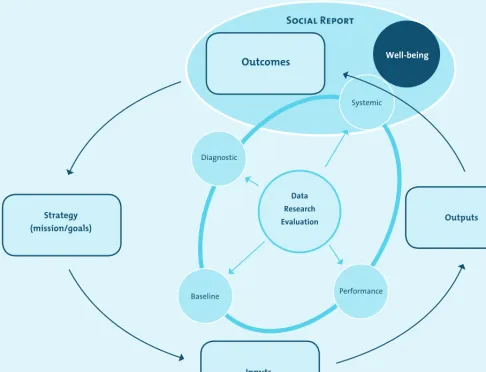
Policy monitoring, as part of the performance focus, is strongly recommended in current proposals for public service reform and is also very much a dimension of social reporting. Understandings of well-being can inform the policy process, both in terms of the indicators used for measurement and in the policy goals and outcomes sought. Social indicators (diagnostic, baseline, performance and systemic) can inform strategy, inputs, outputs and outcomes.4 The input of users of services and
practitioners working at local level, in conjunction with collation of information by institutions at the centre, is also central in informing us of the outcomes of policy and how they can be improved. Policy monitoring issues are dealt with in more detail in Chapter 3 in Part II of this report.
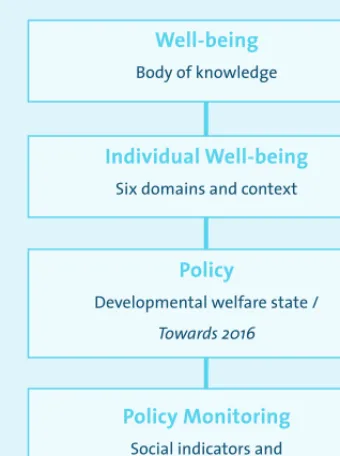
The thrust of these ideas can be summarised in Figure 1.1. In summary, the body of knowledge on well-being refers to the literature on well-being which is reviewed in Chapter 2 of this report. It leads us to the conceptual understanding of well-being employed in the report and to the development of a well-being framework.
The individual well-being box in Figure 1.1 represents the application of the six domains of well-being employed throughout this report. The nature and context of each individual’s well-being involves a unique combination of the six domains. While elements of well-being are innate within each individual these are influenced by the context within which individuals exist and the opportunities they have to develop and utilise their capabilities. The institutional environment, including the prevailing values and norms, is part of this context.
Public policy has a role by placing the individual at the centre of policy development and delivery and addressing the risks faced by the individual. The developmental welfare state promotes such an approach to social policy, and elements of this approach are re-articulated, in part, in the Towards 2016 policy framework. Policy monitoring implies the use of social indicators to document well-being trends and to assess the outputs and outcomes of policy interventions.
Well-being Body of knowledge
Individual Well-being Six domains and context
Policy
Developmental welfare state /
Towards 2016
[image:40.637.154.324.135.363.2]Policy Monitoring Social indicators and performance dialogue
1.5 The Contribution and Structure of this Report
The purpose of this report is to explore and document well-being in Ireland. The report provides a new lens through which to observe domains of individual and collective well-being, the risks to well-being and policy responses across the life cycle. The next chapter rehearses some of the discourses on well-being and presents a well-being framework, which is subsequently employed throughout the remainder of the report.
Part II provides an overview of well-being in Ireland in the recent past. Chapter 3 explains why the Council has engaged in this work, the various approaches that have been used elsewhere and the policy context in which this work is being presented. Chapter 4 uses the well-being framework developed in Chapter 2 to present key trends for Ireland over the last ten to twenty years in the areas of: economic resources; work/participation; relationships/care; community/ environment; health; and democracy/values.
Part III provides a summary of the key well-being trends across the six domains of well-being used in this report. The impact of the recession is considered, along with well-being implications and policy directions, including a ‘well-being test’. Preliminary consideration is also given to the development of improved systems of policy monitoring.