Journal of Criminal Law and Criminology
Volume 71
Issue 4
Winter
Article 20
Winter 1980
Measuring the Severity of Self-Reported
Delinquency: The Development of a Seriousness
Scale
Richard P. Kern
William D. Bales
Follow this and additional works at:
https://scholarlycommons.law.northwestern.edu/jclc
Part of the
Criminal Law Commons
,
Criminology Commons
, and the
Criminology and Criminal
Justice Commons
This Criminology is brought to you for free and open access by Northwestern University School of Law Scholarly Commons. It has been accepted for inclusion in Journal of Criminal Law and Criminology by an authorized editor of Northwestern University School of Law Scholarly Commons.
Recommended Citation
THE JOURNAL OF CRIMINAL LAW & CRIMIN.OGY Vol. 71, No. 4
Copyright © 1980 by Northwstern Univerity School oflaw 'rinlrd in U.S. A.
MEASURING THE SEVERITY OF SELF-REPORTED DELINQUENCY: THE
DEVELOPMENT OF A SERIOUSNESS SCALE*
RICHARD P. KERN** AND WILLIAM D. BALES***
INTRODUCTION
The inherent problems in utilizing official statis-tics to measure delinquency have been recognized for quite some time.' The many criticisms of official statistics have stimulated the development of sev-eral new methods of measurement. One of the most popular of these is the self-report technique.2
The reliability and validity of self-reports in measuring deviancy remains an open issue with considerable contradictory findings.' Although uti-lization of the method has increased dramatically, it has enjoyed little technical development.4 A review of the delinquency indices using
informa-* The authors would like to express their gratitude to
Gordon Waldo for his assistance in this research. Thanks
are also extended to Linda Anderson and Raymond Paternoster for commenting on an earlier draft of this article.
** Research Associate with the Office of the State Courts Administrator, Florida Supreme Court; Ph. D. Candidate, M.S., School of Criminology, Florida State University; B.A., King's College, Pennsylvania.
*** Research Associate with the Office of the State Courts Administrator, Florida Supreme Court; Ph.D. Candidate, M.S., B.S., School of Criminology, Florida State University.
I See, e.g., Beattie, Criminal Statistics in the United States,
51 J. CRiM. L.C. & P.S. 49 (1960); Robison, Critical View of the Uniform Crime Reports, 64 Miech. L. REv. 1031 (1966); Wolfgang, Uniform Crime Reports: A Critical Appraisal, Il1
U. PA. L. REV. 708 (1963).
2 Farrington, Self-Reports of Deviant Behavior: Predictive
and Stable?, 64 J. CRIM. L. & C. 99 (1973). 3
W. Bales, Self-Report Measures: Valid and Reliable? (June 1978) (unpublished thesis in Florida State Univer-sity Library).
'The primary concern of this research was to investi-gate the feasibility of increasing the reliability and valid-ity of the results obtained from self-report measures. Although recognizing their importance, it is not within the scope of this article to address the other methodolog-ical issues which relate more speci~fmethodolog-ically to the actual
design and administration of self-report inventories. For
a further discussion of these latter issues see R. I lotms &
R. SPARKS, KEY ISSUF. IN CRIMINOLOGY (1970);
Farring-ton, supra note 2.
" An index measure combines several items or neasures of an attribute or behavior. The result is a composite score for each respondent indicating the relative degree
to which they possess the characteristic under meatsure, or engage in the behavior considered.
tion gathered from self-reports reveals a
predomi-nance of simplistic and primitive measures of de-viant behavior. Many of these indices, although rectifying some of the deficiencies of official statis-tics, focus primarily upon the variety and fre-quency of delinquent activity and ignore important qualitative characteristics of deviant acts.'
Quantitatike measures are quite useful in
judg-ing initial distinctions between individuals, but
they are incapable of finely discriminating between individuals who are essentially different in the attribute under scrutiny. Thus, in order to arrive at more accurate measurement discriminations in deviant behavior researchers must address the qualitative dimension of offense severity. This ar-ticle examines empirically the feasibility of devel-oping a measure of offense severity readily appli-cable to a delinquency index of self-reported de-viant behavior.
STATEMENT OF THE PROBLEM
In their pioneering work, The Measurement of De-linquency, Sellin and Wolfgang postulated that in measuring the qualitative nature of a criminal act exclusive reliance upon the generic label of an offense (e.g., "murder," "assault") is improper be-cause it contains no relevant data on the degree of
actual harm done to society.7 Because most
self-report questionnaires and interview schedules phrase their offense items with an emphasis exclu-sively upon the generic legal label of an offense, the direct applicability of the Sellin-Wolfgang
6 Kelley & Winslow, Seriousness of Delinquent Behaviour:
An Alternative Perspective, 10 BRIT. J. CRIM. 124 (1970). 7The system they developed for "scoring" criminal events requires that particular information on the crime be gathered (i.e., extent of injtry, theft, or damage). Thus, in order for the Sellin-Wolgang index to be accu-rately applied within any setting, the data collector nst
obtain with specificity the information needed to score t
criminal event. This need for the congruence between the
separate, but related, tasks of tmcasurement-data collec-tion and the scoring process (e.g., assigning ofseriousness weights)-is a point which cannot be overly em)hasized. T. SRit.IN & M. WOI.Ft-:AN(;, THE MEANIntiEMENT OF
KERN AND BALES
work to such instruments appears limited." Exam-ining the component of offense severity as expli-cated by Sellin and Wolfgang would require spe-cifically phrasing each offense item to include var-ied aggravating circumstances. Greater specificity in offense items logically will result in fewer ad-missions because of the reduced range of behaviors encompassed within a particular offense descrip-tion.9 Furthermore, the additional probing by an interviewer for details surrounding criminal acts likely will create respondent suspicion concerning the researcher's intent which in turn may result in less veracity on future items. In cases of longitudi-nal delinquency studies, which require a time two measure of self-reported delinquency, the respon-dent's lack of perceived confidentiality decreases the probability of subjects taking part in the latter portions of the study. Finally, the time and effort required to collect such information from large samples of individuals renders employment of de-tailed offense descriptions impractical. Recogniz-ing that present self-report instruments ignore an important ingredient of measurement,' the
follow-8 See, e.g., Erickson, The Changing Relationship Between
Official and Self-Reported Measures of Delinquency. An Explo-ratory-Predictive Study, 63 J. CRIM. L.C. & P.S. 388 (1972); Hindelang, With a Little Help From Their Friends: Group Participation in Reported Delinquent Behaviour, 16 BRIT. J.
CRIM. 109 (1976). Gold, in particular, found this to be the case when he recognized his inability to directly apply Sellin and Wolfgang's severity weights to offense infor-mation gathered in a manner unsuitable to their sophis-ticated scoring technique. Gold, Undetected Delinquent
Be-havior, 13 J. RESEARCH CRIME & I)EINQIENCY 90 (1966).
9The existence of infrequent admissions on particular offense items becomes problematic when data analysis involves an examination of relationships between rele-vant variables and the incidence of particular delinquent acts. For example, cross-tabulations generated between independent variables and rarely admitted delinquency items are uninterpretable due to the low N sizes contained within some of the individual cells. Thus, the researcher is left with two undesirable options: 1) make cautious inferences and assertions from the results, or 2) confine the analysis to only those offenses which generated stiffi-cient responses. The choice of this latter alternative might confine the inquiry to an analysis of admitted offense behaviors which are of a trivial nature.
Though the desire for a seriousness of offense mnea-sure readily applicable to most self-reported delinquency indices has been oftentimes noted, the literature reveals relatively few efforts to attain such an end. Methodolog-ical problems, specifMethodolog-ically the absence ofempirMethodolog-ical scaling devices, have served to cast severe doubts upon the reliability and validity of the offense seriousness values derived from these studies. See Christie, Andenaes & Skirbeck, A Study of Self-Reported Crime, in 1 SCANDINAVIAN STUDIES IN CRIMINOLOGY 86 (Karl 0. Christianson ed.
1965); Erickson & Empey, Court Records, Undetected
Delin-quency and Decision-Making, 54 J. CRIM. L.C. & P.S. 467
ing study seeks to construct a scale of offense seriousness enabling consideration of relative per-ceived seriousness of generically phrased delin-quent acts.
METHODOLOGY
Certainly no objective criteria beyond personal judgment exists for evaluating the relative serious-ness of crimes; yet, there are objective techniques of measurement capable of relating two different types of psychological scales which have been ap-plied to such non-physical data as judged serious-ness of crimes." The development of the tool used in this study to measure the perceived seriousness of offenses originates in the psychophysical litera-ture.
12
Consistent with the work of Sellin and Wolfgang, this study utilized two types of scales to measure perceived offense seriousness-category and mag-nitude scales.13 The category scale, used frequently in criminological research, has fixed lower and upper limits (e.g., one to eleven) with each division representing equal distance between points.14
The magnitude estimation technique, on the other hand, contains no established or fixed upper limit and any value greater than zero is deemed a pos-sible response.'1 As Figlio has explained, the cate-gory scale involves asking subjects to circle the number from one to eleven (least to most serious) best representing the perceived seriousness of the particular offense. The magnitude scale involves asking the subject to select any number adequately representing the seriousness of that particular of-fense description. Although easy to understand, the category scale is numerically constraining. The magnitude scale is more abstract than the category
(1963); Farrington, supra note 2, at 106; Heise, Norms and Individual Patterns in Student Deviancy, 16 Soc. PROB. 78
(1968); Hindelang, supra note 8, at 117-20.
" T. SELLIN & M. WOLFGANG, supra note 7, at 237. 12 See, e.g., Galanter, The Direct Measurement of Utility and Subjective Probability, 75 AM. J. PsYcH. 208 (1962); Helm,
Messick & Turner, Psychological Model for Relating
Discrim-ination and Magnitude Estimation Scales, 68 PSYCH. REv. 167
(1961); Stevens, On the Psychophysical Law, 64 PsYcH. REV. 153 (1957); Stevens & Galanter, Ratio Scales and Category
Scales for a Dozen Perceptual Continua, 54 J. ExPER. PSYCH. 377 (1957).
13 T. SELLIN & M. WOLFGANG, supra note 7.
14 Thurstone, The Method of Paired Comparisons for Social
Values, 21 J. ARNORM. SOC. PSYCH. 384 (1927).
'5 The magnitude technique essentially amounts to a continuous ratio scale whereby subjects evaluate the mag-nitude of stimuli by assigning to such stimuli scores that reflect points on a psychological scale. The categorical technique of assigning scores to a stimulus involves the construction of a rank-ordered continuum of stimuli.
MEASURING SEVERITY OF SEI.LF-REPORTEI) DELINQUENCY
scale but it does not suffer from numerical con-straints.'6 In order to use both scaling procedures, two types of questionnaires were constructed. The generically phrased offense items included within these instruments were those frequently found on self-report instruments administered by other re-searchers to teenagers, with additional items in-cluded to provide a continuum of offense types ranging from trivial to most serious. In establishing criteria for inclusion of an offense element within their inquiry, Sellin and Wolfgang selectively omit-ted consideration of both victimless and public order offenses primarily because of the low fre-quency with which such acts are reported to law enforcement agencies.'7 The nature of the self-re-port technique, however, permits to some extent gauging this "dark figure" of crime. Since this study seeks to create severity scale values for offense information collected from self-report question-naires or interviews, it was felt that victimless and public order offenses should then be considered.
The brief, unambiguous description of each of-fense focused upon the commission of a deviant act (legal offense label)."' Aside from a reference to the
16 Figlio, The Seriousness of Offenses, An Evaluation by
Offenders and Nonoffenders, 66 J. CRIM. L. & C. 189 (1975). Within the magnitude technique there are an infinite amount of discrimination points available for use in judging a phenomenon, with each judgment being a ratio of some standard item positioned at the outset. Any item may be assigned the position of standard item (i.e., "modulus") as well as any number since it is used merely as a base. See T. SELLIN & M. WOLFGANG, supra note 7, at
248.
17 T. SELLIN & M. WOLFGANG, CONSTRUCTING AN INDEX
OF DELINQUENCY: A MANUAL 67 (1963).
18 Consistent with a belief in the necessary congruence of the manner in which the offense information is gath-ered and then scaled for offense severity, the offense descriptions presented to the scaling judges must be phrased in a generic fashion identical to the manner in
which they are phrased within the self-report schedule. The offense descriptions prdsented to the respondents involved in this research effort include: "the offender (a juvenile) ... 1) drinks liquor while under age, 2) steals or shoplifts something worth $100 to $1000, 3) damages someone else's property, 4) cheats in school, 5) takes part in an armed robbery, 6) uses drugs other than marijuana, 7) steals or shoplifts something worth more than $1000, 8) drives an automobile while under the influence of alcohol or drugs, 9) takes part in a rape, 10) smsiokes marijuana or hashish, 11) assaults someone with a weapon, 12) sells drugs, 13) runs away from home, 14) steals or shoplifts something worth $10 to $100, 15) commits a murder, 16) steals or shoplifts something worth less than $10, 17) breaks into a locked building (other than his/her own home), 18) takes part in an unarmed robbery, 19) skips school, 20) takes or uses someone else's ear without permission (this offense was chosen as the modulus and assigned a value of 10 for those using the magnitude technique).
offender as a juvenile, the descriptions did not mention any other extraneous elements associated with the act (i.e., offense and victim descriptions). To control for possible unknown response biases such as a queuing effect,9 offense items were ran-domized into different rank orderings, which re-sulted in six questionnaires (three categorical and three magnitude) containing varied offense se-quencing.
The selection of judges was guided by prior literature and convenience. Various empirical analyses investigating the utilization of disparate social groupings in rating the seriousness of offenses has yielded results which indicate that considerable consensus exists across such groupings as to what constitutes seriousness.20 Many authors have con-sidered these findings sound evidence that offense seriousness is a consensual phenomenon.2' This inquiry used a sample of judges comprised of 172 undergraduate criminology students: n I = 85 (cat-egorical); n2 = 87 (magnitude). Although this study's sample selection is vulnerable to criticism on many grounds, previous research sustains the adequacy of the sample for the task to be per-formed.22
ANALYSIS
A principal objective of this research was to establish the feasibility of applying scaling devices, validated and successfully applied in many other research settings, to generically phrased criminal
19 A queuing effect is the possibility of bias that origi-nates from a particular sequential ordering of question-naire/interview items or events. The relative perceived seriousness evaluations of an offense item may be biased by a directly preceding offense description. For instance, seriousness ratings of the item "damage property" may vary depending upon whether it was immediately pre-ceded by the offense item involving "murder" as opposed to the offense item involving "smoking marijuana."
20 T. SELLIN & M. WOLFGANG, supra note 7; Figlio, supra
note 16; Kelly & Winslow, supra note 6; Thomas, Cage & Foster, Public Opinion on Criminal Law and Legal Sanctions: An Examination of Two Conceptual Models, 67 J. CRIM. L. & C. 110 (1976).
21 Lesieur and Lehman are two authors who provide
opposite views on this matter. Lesieur & Lehman,
Re-measuring Delinquency. A Replication and Critique, 15 BRIT. J.
CRIM. 69 (1975).
KERN AND BALES
TABLE I
MEAN RANK VALUES AND RANK ORDERING OF OFFENSE SERIOUSNESS EVALUATIONS (N = 162)
Mean Rank of Cate-Rank Offense Item gorical Seriousness
Values (ni = 81)
1. Murder 18.88
2. Rape 18.16
3. Armed Robbery 16.75
4. Assault/Weapon 16.33
5. Larceny (>$1000) 14.35
6. Unarmed Robbery 13.26
7. Sell Drugs 12.54
8. Other Drug Use 11.30
9. Breaking & Entering 11.26
10. Damage Property I 1.07
11. Drive/Influence 10.83
12. Larceny ($100-41000) 10.54
13. Larceny ($10-1001 9.69
14. Steal Car 9.08
15. Larceny (<$10) 5.15
16. Marijuana Use 4.79
17. Cheat in School 4.70
18. Runaway 4.51
19. Drink Liquor 4.19
20. Skip School 2.62
Kendall's Coefficient of Concordance (W) = .727 Chi Square = 1119.13 (p < .001)
offense items.2* It was therefore necessary initially to assess the internal consistency of the sample's responses. To this end, cases containing missing
data were eliminated as were cases in which it was clear that respondents had misunderstood the task
(e.g., rated all offenses with values less than the standard score on the magnitude instruments). Likewise discarded were cases giving higher values
to a larceny item with a lower dollar amount than to a larceny item with a higher dollar amount.
2 4
The degree of internal consistency was measured
by using Kendall's coefficient of concordance (W).
Table I reveals that a significant W statistic is generated for both category and magnitude scaling techniques. These findings indicate the judges
ap-plied similar standards in the rank ordering of the offenses, and thus provide sound evidence for the internal consistency of the two scales.s2
2 Stevens, A Metric for the Social Consensus, 151 Sot. 530
(1966).
2A These two initial reliability checks resulted in the elimination of ten respondents from the original sample.
2 Sellin and Wolfgang plotted and compared scores of
sample sub-groups to determine such consistency. This technique, under the circumstances, does not indicate the desired information. Sellin and Wolfgang's efforts to test for agreement between groups does not give any indication
Mean Rank of Mag-Rank Offense Item nitude Seriousness
Values (n2 = 81)
1. Murder 19.63
2. Rape 18.41
3. Armed Robbery 16.83
4. Assault/Weapon 16.44
5. Unarmed Robbery 13.87
6. Larceny (>81000) 13.70
7. Sell Drugs 12.93
8. Breaking & Entering 11.90
9. Drive/Influence I 1.10
10. l)amage Property 10.43
11. Larceny (81 10-S 1010) 10.41 12. Larceny ($10-$100) 10.25
13. Other Drug Use 9.69
14. Steal Car 8.22
15. Larceny (<$ 10) 6.68
16. Marijuana Use 4.58
17. Runaway 4.18
18. Cheat in School 4.08
19. Drink Liquor 3.98
20. Skip School 2.70
Kendall's Coefficient of Concordance (W) = .761 Chi Square = 1170.66 (p < .001)
An empirical analysis was then conducted to demonstrate both the nature of the measured phe-nomenon and the success of applying the scaling
technique. Each of these issues was investigated
with reference to a general psychophysical law relating subjective magnitude to stimulus
magni-tude. As Stevens stated, "the law is simply that
equal stimulus ratios produce equal subjective ra-tios."26 Numerous experimental findings support
this law but limit its application to continua
termed "prothetic."2 7 This type of continua in-cludes such phenomena as heaviness, loudness, and brightness. Discrimination between different inten-sities or levels of these phenomena is based on an
additive process in which "excitation is added to excitation at the physiological .level."24 In contrast,
whether there is agreement within each group of judges. Given that one does find consistency in ratings within groups of judges, there currently exist only exploratory and unestablished statistical techniques which can effec-tively test for evidence of rater agreement between groups of judges. T. SELLIN & M. WOLFGANG, supra note 7, at
268; Hollander & Sethuraman, Testing Agreement Be-tween Two Groups of Judges (Air Force Office of Scien-tific Research, Technical Report No. 2 1977).
26 Stevens, supra note 12, at 153. 27id.
2 Stevens & Galanter, supra note 12, at 377.
a substitutive process at the physiological level controls sensory discrimination in phenomena in-cluded in so-called "metathetic" continua, such as pitch or position. Stevens and Galanter note that "the distinction between class I (prothetic) and class II (metathetic) is something like the tradi-tional distinction between sensory intensity and sensory quality.., quantity vs. kind."'a9
The results of both the categorical and magni-tude methods were directly compared in order to determine the type of continua (metathetic or prothetic) under study in this instance. Plotting the mean categorical scores against the geometric
mean30 magnitude values obtained from an
eval-uation of the severity of generically phrased offense items yields a concave downward trend which Stevens suggests is typical of prothetic continua
2id. at 378.
3o The geometric mean has been found to be an
opti-mal method of averaging the magnitude scores since, despite the various numerical ranges utilized by each respondent, no normalizing of the data is needed. The geometric mean is equal to the nth root of the product of the scores on the magnitude scale;
GM = RFx -xx.
This measure of central tendency, commonly used for ratio measures, can more easily be computed by summing the base 10 logarithms of each magnitude score, dividing by the number of scores, and then taking the base 10 antilog of this arithmetic mean. This formula is written as:
GM = Antilog
[
(o
l gxI + log
xs
+ --lO
gxn)There has been some confusion in the literature reporting attempts to replicate the study conducted by Sellin and Wolfgang in terms of how to compute the geometric mean of the magnitude scores, which partially explains why some efforts have led to results inconsistent with their findings. For example, Hsu claims the formula used to compute the geometric mean is: GM = nX1X2X ....
Xn where X represents the scores given by the raters. Not surprisingly, her mean magnitude scores differ by as much as 390 points (for murder) from those computed by Sellin and Wolfgang. Wiatrowski appears to have made a computational error in deriving a geometric mean value for each offense rated by his respondents. He computed the arithmetic mean of the magnitude measure for each offense description, determined the base 10 logarithm of each value, and then derived the geometric mean by taking the antilog of each logarithm value. The problem lies in the fact that he failed to take the loga-rithm of each score, compute an aloga-rithmetic mean, then compute the geometric mean by deriving the antilog of
this value. Hsu, Cultural and Sexual Differences in the
Judge-ment of Criminal Offenses: A Replication Studv of the Measure-ment of Delinquency, 64J. CRIM. L. & C. 348 (1973); Stevens, supra note 23, at 531; M. Wiatrowski, supra note 22, at
51-52.
(see Figure 1). Stevens writes: "on prothetic con-tinua the partition scale (categorical) is practically always non-linear relative to the magnitude scale
... the curvature of the category scale is usually
intermediate between linear and logarithmic.",'3 Stevens notes that the true relationship between scales on prothetic continua as measured by both direct magnitude estimation and Thurstone's cat-egorical technique is essentially logarithmic. Thus, "this relation provides a test that can be applied to nonmetric continua, such as seriousness of crimes,
in order to determine the nature of the continua."3 2
Should such a test verify the logarithmic relation-ship between scales created from nonmetric stimuli, added confidence attaches to the validity of the measurement outcome.
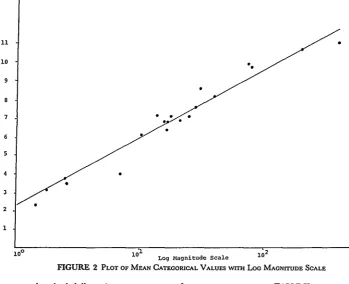
Figure 2 examines the relationship between these two scales when transformed into semilogarithmic coordinates. As Figure 2 demonstrates, this trans-formation effectively linearizes the relationship be-tween the scales, and thereby confirms their loga-rithmic relationship. Similar findings led Sellin and Wolfgang to conclude that crime severity of offense "events" could be successfully measured psychophysically.u
Despite forewarnings that the employment of unspecific, generic crime descriptions for scaling offense severity would foster variable perceptions within each respondent (a factor which purport-edly renders such a scaling effort futile), these findings reveal the operation of perceptual discrim-ination processes required of subjects in studies similar to Sellin and Wolfgang's.Y Specifically, the relationship between the categorical and magni-tude scales reveal that the manner in which re-spondents subjectively discriminated between the stimuli presented (generic offense items) is similar to the psychophysical process of evaluating differ-ent levels of intensities in physical objects such as heaviness. Thus, the results of this inquiry extend the applicability of psychophysical scaling proper-ties to offense severity reflected in generic offense labels. The importance of this finding is that using crime seriousness values derived from this
proce-31 Stevens, supra note 23, at 532.
2 id.
3 T. SELLIN & M. WOLFGANG, supra note 7, at 261-62.
34 These findings are contrary to those reported by Silvey who found a lack of consistency as to the relative offense seriousness evaluations when such behaviors were phrased in a general fashion. The study conducted by
Silvey is reported in Rose, Concerning the Measurement of
KERN AND BALES
1 1
I 4, 1 I ___ _ _ _ _ __ _ _ _ _ _ _
1
0 10
20 30 40 50 60 70 80 90 100 200 300 420Geometric Mean Magnitude Offense Seriousness Scores
FIGURE 1 MEAN GEOMETRIC MAGNITUDE OFFENSE SERIOUSNESS SCORES PLOTrED AGAINST CORRESPONDIlIG MEAN
CATEGORICAL OFFENSE SERIOUSNESS SCORES
dure in self-reported delinquency measures will enhance the reliability of the results.
DISCUSSION
Table II presents both the mean categorical scores and geometric mean magnitude scores for the twenty generically phrased offense items. De-spite the direct logarithmic relationship between these two sets of score values, it would appwar that the magnitude scale values are the more appropri-ate offense severity scores for inclusion in a delih-quency index.-S This technique of deriving final
offense seriousness scores differs from the procedure
employed by Sellin and Wolfgang in the final
version of their scale. These researchers used
origi-nally computed geometric mean magnitude values
to derive an additive algorithm which provided
5 This choice is justified because the scale values
ob-tained from the magnitude technique reflect a product of the rater, rather than the experimenter (as is the case in the categorical method). Also, the magnitude technique provides raters with the availability of a greater latitude
in numerical range with which to fix responses. See T. SELLIN & M. WOLFGANG, supra note 7, at 271-73.
final scale values. Yet, as Turner has recently com-mented, "the most impressive part of Sellin and Wolfgang's work is the .scoring derived from the
basic silhouettes themselves and not the particular
additive version that they impose on it.",36
Further-more, Sellin and Wolfgang employed certain of-fense silhouettes specifying particular dollar amounts stolen (e.g., $5, $20, $100) to derive a power function for the amount of money stolen. They derived the score values for offenses involving monetary loss from this power function.3"7
It was inappropriate to develop a power function for money values in this study because no specific money values existed within the generic offense descriptions presented to the respondents. Con-sistent with the aforementioned belief that specific-ity in offense phrasing in self-report surveys may precipitate problems, the offense descrip .ions used in this inquiry contained phrases representing property values within monetary ranges such as
3 Turner, in T. SELLIN & M. WOLFGANG, TNE MEA-SUREMENT OF DELINQUENCY iX, 3 7 (2d ed. 1978).
T. SELLIN & M4. WOLFGANG, supra note 7, at 284-87.
[image:7.454.35.421.27.327.2]11
W10
g 0
u
9
0
-H
7
S6
0 5
4 4
05
'5
., 3
r
d 2
100 Log Mag
FIGURE 2 PLOT OF MEAN CATEGORI
ten to one hundred dollars. As a consequence of this technique, it was impossible to derive a power function for monetary values.S
Initial inspection of the final geometric mean magnitude values presented in Table II provides evidence of the "face validity" of these findings.
3 9
For instance, subjects perceived all the violent per-sonal crimes (murder, rape, etc.) as more serious than all property, public order, or victimless of-fenses. Of interest is the fact that weapon usage doubles the perceivecd seriousness rating of the offense, robbery.
As expected, the "status" offenses evaluated
3 Id.
'1 For mathematical simplicity, Sellin and Wolfgang divided all derived values by a lowest score to arrive at final scale values. Such a procedure was deemed unnec-essary herein since it would result in almost equivalent values to the original seriousness scale scores. This would occur because the divisor, the value for marijuana, is 1.03. Additionally, rather than apply an arbitrary round-ing rule to the final scale values, we have allowed, as Rose suggests, the score values to take decimals. This procedure could possibly increase the sensitivity of any index created from such values. See Rose, The Merits of an
Index of Crime of the Kind Devised by Sellin and Wolfgang, 7
THE INDEX OF CRIME-SOME FURTHER
STUDIES-COL-LECTED STUDIES IN CRIMINOLOGY 44 (Council of Europe
1970),
nitude Scale
CAL VALUES WITH LOG MAGNITUDE SCALE
TABLE II
MEAN CATEGORICAL AND GEOMETRIC MEAN MAGNITUDE SERIOUSNESS VALUES FOR ALL OFFENSE ITEMS
(N= 162)
Geometric
Mean Ma
Categorical Man Offense Item Seriousness Magnitude
Values Seriousness
Values
(ni = 81) (n2 = 81)
Skip School 2.19 1.36
Cheat in School 3.54 2.43
Runaway 3.42 2.52
Larceny (<S10) 3.85 6.76
Larceny ($10-4100) 6.25 16.41
Larceny ($100-1000) 6.73 16.56
Larceny (>$1000) 8.53 30.55
Liquor Use 3.03 1.75
Marijuana Use 3.58 1.03
Other Drug Use 7.02 13.58
Sell Drugs 7.54 27.67
Drive Under Influence 6.82 20.56
Steal a Car 5.88 10.00
Damage Property 7.03 17.91
Breaking & Entering 7.04 24.49
Unarmed Robbery 8.12 38.99
Armed Robbery 9.78 75.51
Assault with a Weapon 9.68 76.56
Rape 10.56 195.88
[image:8.454.36.386.52.336.2]KERN AND BALES
within the survey instrument are all perceived as being of minor relative importance. Examination of these scale values also indicates that marijuana use is perceived as being the least serious act. Given the increased usage and acceptance of marijuana, the finding of its perceived minor severity is no surprise. Marijuana use, however, is perceived as even less serious than delinquent acts such as skip-ping school, cheating in school, and running away from home. This result may be a function of the relatively high degree of exposure to, or use of, marijuana by the particular sample respondents utilized.
Although generally the scale values of offenses involving monetary loss exhibit a discrimination between severity of acts based upon the monetary amounts involved, subjects failed to finely discrim-inate between larceny "$I0 to $100" and larceny "$100 to $1000." The latter item's lack of a rela-tively specific monetary frame of reference may account for this lack of discrimination. In contrast to items such as larceny "less than $10" and larceny "$10 to $100," the item larceny of "$100 to $1000, would seem to provide a greater opportunity for respondents to create an arbitrary reference point when evaluating its perceived severity.
Finally, results for status offenses of skipping school and running away from home mirror those of Galvin who found the latter offense to be per-ceived as more serious. ° This finding initially would appear inconsequential considering the low relative scale values of these acts; however, since they are among those acts most often admitted on self-report inventories, their relative weights may accrue added significance in the construction of a delinquency index.
The derived seriousness scale (magnitude) can now be applied to a self-reported delinquency in-dex in any number of ways. Historically, the ad-missions on a number of self-report items have been combined by several means to obtain index scores reflecting each respondent's involvement in illegal behavior. Summing the number of different offenses admitted, regardless of the number of times the behavior occurred, can indicate the va-riety of delinquent acts committed. A serious prob-lem with such a variety index is the inability to differentiate individuals who only admit to trivial behaviors from those who only admit to serious behaviors. The application of the derived serious-ness weights to each admitted offense would
en-4 Galvin, The Seriousness of Offenses: An Evaluation of
Children and Adolescents, in QUANTITATIVE STUDIES IN
CRIM-INOLOGY 48 (Wellford ed. 1978).
hance the discriminatory capability of such a de-linquency index (i.e., a "variety-serious" index).
If the data collection instrument allows, an index comprised of the total number of admitted behav-iors can be computed by summing the frequency of admissions over all items. The existence of an extremely large number of admissions to very mi-nor violations, however, undermines the reliability of this technique by creating misleading variations in derived index scores.41 Such a "variety-fre-quency" delinquency index would assign a higher status of delinquency to individuals involved in a large number of trivial behaviors than to those youths admitting only more serious acts but with less persistence. The application of an appropriate seriousness weight to each admitted offense would enhance the reliability of this index measure by providing the discrimination necessary to distin-guish among individuals possessing conceptually distinct delinquent pasts.
The problematic effects of extreme distortions in index scores also can be approached by collapsing the frequencies of each offense item into a quartile distribution. A value (ranging from 0 to 4) indica-tive of one's relaindica-tive involvement in a delinquent activity would be assigned to each admitted act based upon the quartile which contains their fre-quency count for a given item. Therefore, the value of zero would indicate no admissions, while a score of one would be assigned to individuals whose involvement in a delinquent activity places them in the lower twenty-fifth percentile of the total distribution of their peers' involvement in the be-havior. Under this scoring scheme, the seriousness weight of each admitted act could be multiplied by the appropriate frequency quartile value, thereby providing this nMeasure with the capacity
41 Extreme variations in index scores can be attributed
to the use of a recall period (on the self-report instrument) so broad that respondents seriously overestimate their involvement in particular delinquencies. To address this difficulty, a researcher can administer a self-report inven-tory designed to gather information only on activities from one's recent past (e.g., the last six months). The temporal specificity provided by a limited recall period would avoid huge distortions in index scores as well as increase the relative accuracy of the derived measure. R. HOOD & R. SPARKS, supra note 4, at 69; Farrington, supra
note 2. It might also be argued that variable recall periods be provided on a self-report inventory on the assumption that a respondent's memory would be more accurate with regard to more serious offenses. Therefore, a recall period ranging from three to six months might be used for offenses of a less serious nature while a longer period of one year could be employed for the acts perceived to be of a more serious nature. The seriousness scale presented herein would aid one in the design of such an instrument.
to make qualitative distinctions among delinquent youth.
In sum, there are a number of ways to incorpo-rate the derived seriousness weights into a numer-ical index to account for variations in the qualita-tive nature of self-reported delinquency.
SUMMARY & CONCLUSION
Measurement problems continue to plague crim-inologists in their pursuit of performing sound methodological inquiries. The self-report inventory provides a viable alternative to official statistics for measuring delinquency. Yet, because the self-re-port technique frequently fails to collect informa-tion pertaining to qualitative dimensions of the deviant act, delinquency indices created from such data are often inaccurate.
Because of the specificity it requires, the research effort of Sellin and Wolfgang,4" designed to gauge
qualitative aspects of offense severity, is almost useless to the researcher confronted with self-report data collected from generically phrased offense
items.
This study adopted scaling techniques developed within the field of psychophysics and applied them to the evaluation of relative perceived seriousness of generically phrased offense items. The study established empirically that the offense severity scale values were obtained by discrimination pro-cesses similar to those occurring in sensory psycho-physics. Such an outcome would appear to high-light the validity of the scale results. Because the derived severity scale values are readily applicable to data collected from most self-report instruments, this study's findings extend to the very core of delinquency research.
Several areas of concern for the direction of future research deserve close scrutiny in developing more valid and reliable self-reported delinquency indices. One particular area deserving attention is the selection of offense items for inclusion within the severity scale. Along these lines, efforts can be made to refine the monetary values presented within particular offense descriptions. The present study underscores the importance of monetary range selections. A range of money values too large may create ambiguity and inhibit the discrimina-tory capabilities of judges. A monetary range too narrow causes the problems that specificity in de-scribed offense acts generates with self-report data. Further, a considerable amount of literature dis-cusses the type of sample to be utilized in the task
42
T. SELLIN & M. WOLFGANG, supra note 7.
of judging offense severity.43 The choice of judges
employed within this inquiry was premised more on practical than theoretical concerns. Where fea-sible, future research should test the results of this study with varied samples reflecting different cross-sections of the populace. A suggested methodolog-ical innovation would be using judges who both respond to a self-report inventory and evaluate the relative seriousness of all acts appearing on the instrument. This procedure would enable empiri-cal determination of whether a respondent's per-ceived seriousness evaluations of particular items are influenced by his admitted involvement in the act.4
Finally, as previously noted, there are many ways to apply these severity scores within an index of delinquent behavior. The qualitative attribute offered within the offense severity scores may pres-ent no better a measurempres-ent alternative than a simple variety count of admitted offenses. Re-searchers should strive for the techfiique best mea-suring delinquency and should seek to develop procedures for judging the overall measurement adequacies of delinquency indices.
These efforts may proceed by investigating the self-reported delinquency of various groups of youths who can be assumed to differ both quanti-tatively and qualiquanti-tatively in their delinquent be-havior (e.g., institutionalized youth, community-diverted youth, and high school youth). After c n-structing several indices of self-reported delinquent behavior (taking into consideration the many com-binations of variety, frequency, and severity), an analytic tool, such as discriminant function analy-sis, may be applied to the data in order to statisti-cally gauge the ability of each measurement index to correctly classify the affiliation of group mem-bers. Presumably, the index which most accurately predicts group membership would be most valid. One may recognize this technique of index choice as a form of concurrent validity ("known-group validation").
43 Wolfgang, On Devising a Crime Index, 7 THE INDEX OF
CRIME-SoME FURTHER STUDIES-COLLECTED STUDIES IN
CRIMINOLOGY 55 (Council of Europe 1970).
4 Hepburn adopted such a procedure in an attempt to gauge the relative seriousness of self-reported delin-quency; however, he made no effort to determine the validity or reliability of the derived seriousness scale scores. In addition, no assessment was made regarding the extent of possible variance in seriousness evaluations which might be attributed to the respondent's relative involvement in past delinquency. Hepburn, Testing Alter-native Models of Delinquency Causation, 67