The OISIN framework:
Ontology Interoperability in support of
Semantic Interoperability
A thesis submitted to the
University of Dublin, Trinity College
for the degree of
Doctor of Philosophy
Declan O’Sullivan
Knowledge and Data Engineering Group, Department of Computer Science,
Trinity College, Dublin
Declaration
I, the undersigned, declare that this work has not been previously submitted as an exercise for a degree at this or any other University, and that, unless otherwise stated, it is entirely my own work.
Permission to lend or copy
I, the undersigned, agree that the Trinity College Library may lend or copy this thesis upon request.
ACKNOWLEDGEMENTS
I would like to thank my supervisor Vincent Wade for agreeing to supervise my research, for his unflagging support and insightful contributions. I would also like to thank Jane Grimson for first nurturing my interest in research so many years ago. My thanks to Dave Lewis, Owen Conlan and all in the KDEG research group for the great collaboration and friendship. In addition, thanks to Elaine Hanley for the proof reading/feedback and James Reilly for his help with my statistical analysis.
I would like to especially thank Diane Birnie for her absolute belief, constant encouragement, unwavering support and the many sacrifices. A special word of thanks to my brother Ciaran for his unfailing confidence, and continued interest in this research.
Finally, thanks are due to my two sons, Oisín and Eoin, for being wonderful reminders that there is more to life than research!
ABSTRACT
TABLE OF CONTENTS
ACKNOWLEDGEMENTS ... III
ABSTRACT ... IV
TABLE OF CONTENTS ...V
TABLE OF FIGURES... IX
TABLE OF TABLES...XII
ABBREVIATIONS ... XIV
1 INTRODUCTION...1
1.1 MOTIVATION...1
1.2 OBJECTIVE AND GOALS...4
1.3 CONTRIBUTION...5
1.4 TECHNICAL OVERVIEW...6
1.4.1 Technical Approach ...6
1.4.2 Thesis Overview ...7
2 BACKGROUND – SEMANTIC INTEROPERABILITY ...9
3 STATE OF THE ART – ONTOLOGY MAPPING ...15
3.1 “VISITING LECTURER” SCENARIO...15
3.2 OVERVIEW OF ONTOLOGY MAPPING...17
3.2.1 Characterising Ontology Mismatches ...18
3.2.2 Mapping discovery...21
3.2.3 Mapping Documentation and Interpretation ...28
3.3 KEY REQUIREMENTS...30
3.3.1 Key Framework Challenges ...30
3.3.2 Key Framework Requirements ...32
3.4 SELECTED STATE OF THE ART SYSTEMS...34
3.4.1 MAFRA ...35
3.4.2 COMA++ ...39
3.4.3 INRIA ontology alignment format...42
3.4.4 Protégé and PROMPT/Anchor ...44
3.5 KEY REQUIREMENTS AND SELECTED STATE OF THE ART SYSTEMS...47
3.6 IMPLEMENTATION TECHNOLOGIES...50
4 DESIGN ...52
4.1 GENESIS OF THE PHASES...52
4.2.1 Characterisation Phase Activities...58
4.2.2 Mapping Phase Activities ...65
4.2.3 Execution Phase Activities ...68
4.2.4 Management Phase Activities ...71
5 TOOL IMPLEMENTATION ...73
5.1 THE OISIN APPLICATIONS...73
5.1.1 Information Model ...78
5.1.2 Implementation technologies...78
5.1.3 Discover Ontologies – OisinDO application ...79
5.1.4 Characterise Modelling – part of OisinIO application ...82
5.1.5 Characterise Semantics – part of OisinIO application ...88
5.1.6 Decide to Match, Select and Apply Match Algorithms – OisinMO application ...90
5.1.7 Characterise Amenability – OisinSummarise application ...98
5.1.8 Decide to Map – OisinDTM Application(s) ...99
5.1.9 Identify Committed Mappings – OisinAC application(s) ...107
5.1.10 Undertake Commitment Analysis – OisinMA application(s) ...110
5.1.11 Interpret Mappings – OisinSMU service...117
5.2 GRAPHICAL USER INTERFACE WALK THROUGH FOR ANCHOR CAPTURE...120
5.2.1 OisinAC-semi-v1 walk through and workflow ...120
5.2.2 OisinAC-semi-v2 ...126
6 EVALUATION...128
6.1 INTRODUCTION...128
6.2 DECIDE TO MAP ACTIVITY EXPERIMENT...131
6.2.1 Overview...131
6.2.2 Decisions based on examining Ontology directly...133
6.2.3 Decisions based on OISIN generated information ...137
6.2.4 Analysis of Experiment Results ...147
6.3 COMMITTED MAPPING ACTIVITIES EXPERIMENT...151
6.3.1 Overview...152
6.3.2 Mappings with support from Protégé/PROMPT tool ...155
6.3.3 Difficulties Questionnaire ...157
6.3.4 Mappings using the OISIN tools ...159
6.3.5 Mappings Analysis ...161
6.3.6 OISIN tools usability analysis ...163
6.3.7 Discussion and Findings ...169
7 TRIAL AND RELATED WORK ...172
7.1 INTRODUCTION...172
7.2.1 Overview...172
7.2.2 Applications...173
7.2.3 Trial Setup ...177
7.2.4 Results...178
7.3 COMPARISON OF OISIN TO RELATED WORK...183
8 CONCLUSIONS ...186
8.1 OBJECTIVES...186
8.2 CONTRIBUTION...193
8.3 FUTURE WORK...195
8.3.1 Extended OisIN (EOIN)...195
8.3.2 Management Phase Activities ...196
8.3.3 New application areas ...196
8.4 FINAL REMARKS...197
BIBLIOGRAPHY ...198
GLOSSARY ...214
APPENDICES...215
APPENDIX A. TECHNOLOGIES... A-1
1. IPSI-XQ...A-1 2. Jena ...A-3 3. Wordnet/JWNL ...A-4 4. SWOOGLE...A-6
APPENDIX B. UML SPECIFICATION OF OISIN ONTOLOGY MAPPING PROCESS ....B-1
1. Use Case Diagram ...B-1 2. Activity Diagrams...B-4 3. Extensible Information Model ...B-12
APPENDIX C. XML DTDS... C-1
11. WNET.dtd – WordNet analysis statistics ...C-5
APPENDIX D. DECIDE TO MAP EXPERIMENT ... D-1
1. Decision Sheet ... D-1 2. Excel Spreadsheet for AB Mapping ... D-2 3. Decision Guidance Sheet ... D-6 4. Task Questionnaire ... D-7 5. MINITAB analysis output ... D-8
APPENDIX E. MAPPING EXPERIMENT...E-1
1. First Task Questionnaire ...E-1 2. Second Task Questionnaire ...E-3
APPENDIX F. SMU TRIAL...F-1
TABLE OF FIGURES
Figure 3-1: Partial is-a hierarchies of scenario ontologies ... 16
Figure 3.2: Classification of Ontology Mismatches (Klein 2001)... 19
Figure 3-3: Classification of schema-based matching approaches (Shvaiko and Euzenat 2004)... 23
Figure 3-4: Overview of MAFRA conceptual framework (Maedche et al. 2002)... 36
Figure 3-5: MAFRA plug-in architecture (Silva and Rocha 2003) ... 38
Figure 3-6: Overview of COMA++ Architecture (Aumueller et al. 2005) ... 40
Figure 3-7: Overview of iterations in COMA++ Execution Engine (Aumueller et al. 2005) ... 40
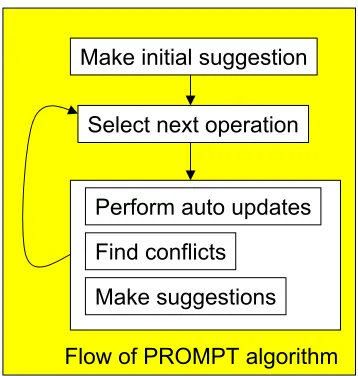
Figure 3-8: PROMPT algorithm overview ... 45
Figure 3-9: Example of anchor paths ... 45
Figure 4-1: Summary UML Activity diagram for OISIN process ... 57
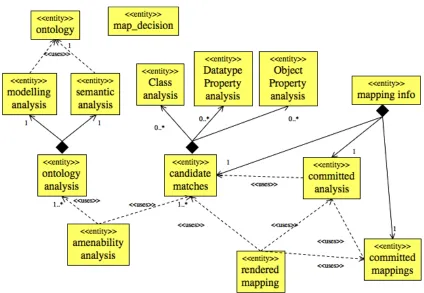
Figure 4-2: UML Class Diagram for extensible information model of OISIN ... 58
Figure 5-1: UML package diagram for OISIN applications... 74
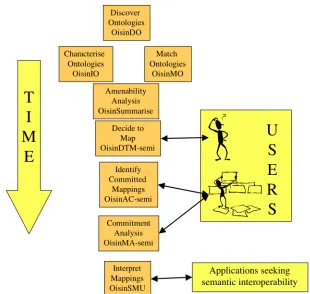
Figure 5-2: OISIN applications/process relationship ... 75
Figure 5-3: Overview of tools for first implementation deployment ... 77
Figure 5-4: UML Sequence Diagram between Oisin applications/IPSI interface/Information Model ... 79
Figure 5-5: UML class diagram for ontology entity ... 80
Figure 5-6: UML Class diagram for Modelling Analysis ... 83
Figure 5-7: Snippet of Detect Pattern XQuery... 84
Figure 5-8: Snippet of Ontology Shape XQuery... 86
Figure 5-9: UML Class Diagram for Semantic Analysis ... 89
Figure 5-10: UML Class Diagram for Candidate Matches... 91
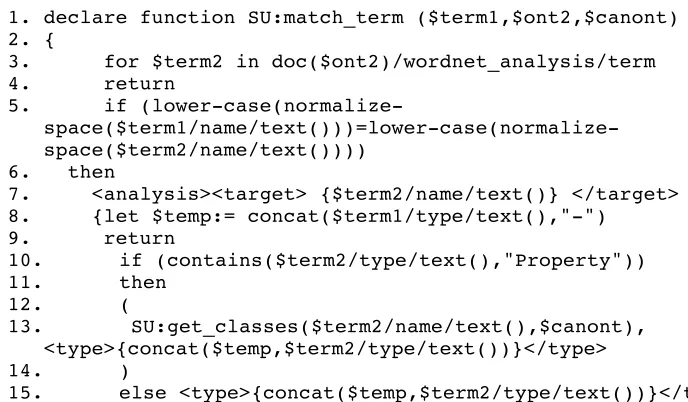
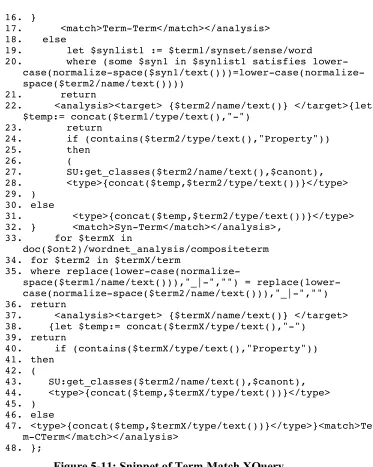
Figure 5-11: Snippet of Term Match XQuery ... 94
Figure 5-12: Example of XML for a class match... 95
Figure 5-13: Example of XML for a property match ... 96
Figure 5-14: Example page 1 of OisinDTM excel spreadsheet ...100
Figure 5-15: Example page 2 of OisinDTM excel spreadsheet ...101
Figure 5-16: Example page 3 of OisinDTM excel spreadsheet ...102
Figure 5-18: Snippet of OisinDTM-auto XQuery...105
Figure 5-19: UML Class Diagram for OisinAC-semi-v1 application...108
Figure 5-20: Snippet of XQuery to retrieve all anchor paths...112
Figure 5-21: Example of ontology structural mismatch...112
Figure 5-22: Snippet of XQuery to implement anchor analysis ...114
Figure 5-23: UML Class Diagram for Committed Analysis ...115
Figure 5-24: Example OisinMA window presenting Mapping Analysis ...116
Figure 5-25: Snippet of OisinSMU application XQuery...119
Figure 5-26: Main window of OisinAC-semi application...120
Figure 5-27: Overview of toolbar of OisinAC-semi ...121
Figure 5-28: Overview of Anchor Capture Panel ...122
Figure 5-29: Example of Mapping Details window...123
Figure 5-30: Anchor Capture Workflow ...125
Figure 5-31: OisinAC-semi-v2 screenshot ...126
Figure 6-1: Chart of Results for Protégé supported decisions ...136
Figure 6-2: Chart of Results for spreadsheet supported decisions ...141
Figure 6-3: Chart of Results for guidance supported decisions ...144
Figure 6-4: Overall comparison of decisions...147
Figure 6-5: ANOVA analysis ...149
Figure 6-6: Experiment mapping DTD ...155
Figure 6-7: Analysis of Incorrect Mappings created...161
Figure 6-8: Analysis of Gold Mappings missed ...162
Figure 6-9: Analysis of performance of groups in undertaking ontology mapping...163
Figure 6-10: Opinions on OISIN Mapping Tools usability...167
Figure 7-1: XQuery used to invoke OisinSMU ...177
Figure 7-2: Breakdown of Mapping Information kept for Class related terms ...180
Figure 7-3: Breakdown of Mapping Information kept for Property related terms ....180
TABLE OF TABLES
Table 3-1: Comparison of Selected SOA systems wrt key requirements... 48
Table 5-1: XQuery functions developed... 78
Table 6-1: Overview of Experiment Ontologies...131
Table 6-2: Gold-standard mapping decisions ...132
Table 6-3: Summary of Decision Sheets for Protégé supported Students 1 to 5...134
Table 6-4: Summary of Decision Sheets for Protégé supported Students 6 to 10 ...135
Table 6-5: Overview of OISIN generated Excel spreadsheet ...138
Table 6-6: Summary of Decision Sheets for spreadsheet supported Students 1 to 5.139 Table 6-7: Summary of Decision Sheets for spreadsheet supported students 6 to 10 ...140
Table 6-8: Decisions made with guidance sheet ...143
Table 6-9: Opinions on Confidence in decisions and Difficulty of decision making 145 Table 6-10: Opinions on guidance ...145
Table 6-11: Opinions on unhelpful guidance or information ...146
Table 6-12: Suggested improvements to guidance and information...147
Table 6-13: Gold-standard mappings for AB and CD ontology pairs...154
Table 6-14: AB ontology mappings created manually by experiment groups ...156
Table 6-15: CD ontology mappings created manually by experiment groups ...157
Table 6-16: Summary of mapping task difficulties experienced by experiment groups ...158
Table 6-17: Group comments about usefulness of Protégé/Anchor-PROMPT...159
Table 6-18: AB ontology mappings created by experiment groups using OISIN ...160
Table 6-19: CD ontology mappings created by experiment groups using OISIN ...160
Table 6-20: Opinions on usefulness of OISIN tools for ontology mapping...164
Table 6-21: Opinions on whether OISIN alleviated difficulties ...165
Table 6-22: Opinions on OISIN versus Protégé/Anchor-PROMPT ...166
Table 6-23: Opinions for what parts of mapping task OISIN tools useful...168
Table 6-24: Hours spent on each mapping task ...169
Table 7-1: Terms extracted from Student XML instance documents ...174
Table 7-2: Summary of Student Applications...175
ABBREVIATIONS
API Application Programmers Interface
CORBA Common Object Request Broker Architecture
DAML DARPA Agent Markup Language
DCOM Distributed Component Object Model
DOM Document Object Model
DTD Document Type Definition
EOIN Extended OisIN
ER Entity Relationship
eTOM electronic Telecoms Operation Map
HTML Hypertext Markup Language
IDL Interface Definition Language
JDBC Java Database Connectivity
JWNL Java WordNet Library
ODBC Object Database Connectivity
ODP Open Distributed Processing
OIL Ontology Inference Layer
OISIN Ontology Interoperability for Semantic INteroperability
OMG Open Management Group
OWL Web Ontology Language
OWL-S Web Services Ontology Language
P2P Peer to Peer
RDF Resource Description Framework
RDFS Resource Description Framework Schema
RMI Remote Method Invocation
RUP Rational Unified Process
SAX Simple API for XML
SQL Structured Query Language
SWRL Semantic Web Rule Language
TMF Telecommunications Management Forum
UDDI Universal Description, Discovery and Integration
UML Unified Modelling Language
URI Uniform Resource Identifier
W3C World Wide Web Consortium
WSDL Web Services Description Language
WSMO Web Services Modelling Ontology
XML eXtensible Markup Language
1 INTRODUCTION
1.1 Motivation
The rapid rise in the usage and sophistication of web content and services has led to the desire to make such content and services more discoverable and usable by applications at runtime. A key problem in meeting this desire is how to expose the semantics (meaning) of the web content or web service interfaces in a manner that is widely interpretable by applications. Significant progress has been made in addressing this problem over the last number of years, with proposals to express the semantics of information and web service interfaces using languages based on XML, the eXtensible Markup Language (XML 2000). However a more difficult problem remains arising from the different modelling of semantics. This problem relates to how to achieve mappings between the different semantic models used in the semantic descriptions. Different semantic models arise due to the natural human diversity involved in modelling a domain. Semantic models are normally created from a particular perspective and for different purposes. The motivation for this thesis was to identify a practical process for the creation of such semantic model mappings to support semantic interoperability between applications.
Early attempts to achieve the exposure of semantics through the use of the XML based languages Resource Description Framework (RDF 2004) and Resource Description Framework Schema (RDFS 2004) have had some success. However these approaches have been limited in their basic expressivity and in their ability to express mappings between different semantic models. To overcome these deficiencies, ontologies are increasingly being used as the means to express semantics.
An ontology can range from the simple notion of a taxonomy (knowledge with minimal parent/child structure) to a thesaurus (words and synonyms) to a conceptual model (with more complex knowledge) to a logical theory (with very rich, complex, consistent and meaningful knowledge) (Daconta et al. 2003).
Ontological engineering (borrowing from formal ontology and logic in philosophy and formal semantics in linguistics) addresses the problem of encoding declarative knowledge in a modular, reusable fashion by creating both foundational knowledge theories and domain theories. (Obrst and Liu 2003).
In recent years, the application of ontologies to the web has been encapsulated in the vision of the “semantic web”, where it is envisaged that ontologies can be used to improve existing web based applications or enable new uses of the internet (Berners-Lee 2001). Example use cases (OWL 2004a) range from navigating and searching web portals, through to enabling ubiquitous computing by supporting interoperability under “un-choreographed” conditions.
The promise of ontologies is in the sharing of an understanding of a domain that can be communicated between people and application systems (Fensel 2003). However, as seen in the Gruber definition, ontologies are defined from a particular perspective.
Whether it is a personal ontology, designed to support individual’s needs and preferences, or an ontology created by a particular company to reflect that company’s views on their industry, such ontologies will have biases and necessarily subjective features. If that individual or company needs to exchange information and knowledge with other individuals or organisations, there will be a need to map between multiple ontologies either at inter-personal, intra-organisational or inter-intra-organisational levels (Hameed et al. 2004).
to semantic expressiveness of the Web Services Description Language WSDL (WSDL 2001), in terms of interface definition, and the Universal Description, Discovery and Integration UDDI service (UDDI 2003) in terms of service discovery. Thus the annotation of web services through the use of ontologies represents progress on the issue. Realistically however, an annotation of any one web service will take place from a particular perspective and using a particular selection of ontologies. Thus there is still a need to reconcile these different perspectives so that combined use of the ontologies can be achieved when composing or sequencing web services drawn from several sources together. Ontology mappings are seen as the way in which such reconciliation and combination can be enabled.
Other example use cases for ontology mapping could include (Euzenat et al. 2004): ontology driven data querying, where ontology mappings help decompose queries and combine responses; E-commerce catalogue matching, where mappings could allow for comparison of supply and demand catalogues; Personal Information Delivery, where mappings between a personal ontology, representing interests, and information service ontologies, representing available information streams, could be used to personalise information delivery.
Given the potential importance of such ontology mappings to organisations in areas such as web service composition, E-commerce catalogue matching and ontology based data integration, the question arises as to how to generate these mappings. Naturally organisations would prefer such mappings to be created as part of some engineered process rather than as a result of ad hoc activities.
However none of the current solutions provide practical support for an organisation for the entire lifecycle of ontology mapping. The reason for this could be that agreement on what is a full ontology mapping lifecycle has not yet emerged. In this thesis
however, we define the scope of the ontology mapping lifecycle as: a characterisation
phase encompassing characterisation activities which discover ontologies for mapping, analyse the difficulties that may be involved in undertaking a mapping, and generate
the candidate matches between the ontologies; a mapping phase covering the mapping
applications; and a management phase responsible for the ongoing maintenance and management of the mappings once deployed. The majority of state of the art systems concentrate on the generation of matches and mapping identification aspects alone (Noy 2004), although for most systems these two tasks are tightly bound together. In this thesis a clear distinction is maintained between candidate match generation and
mapping determination. The reason for this is that with the dynamic and ad hoc nature
of some of the expected use cases, there is an increasing need for applications themselves to determine the mappings that are relevant to them based on direct examination of the candidate match information. In contrast, current ontology mapping systems are focused on the identification of mappings from the perspective of an expert user or (rarely) an expert application.
1.2 Objective and Goals
This thesis identifies the activities, information artefacts, heuristics and guidance required to support a practical ontology mapping process, and examines how they can be coordinated and sequenced in the ontology mapping process.
In order to investigate this research question, three objectives were derived:
1. Research and identify models and processes that support ontology mapping;
2. Develop an integrated set of process and software tools to support practical
ontology mapping;
3. Evaluate the use and benefit of the process and the software tools developed
to generate ontology mappings, and demonstrate the usage of the generated mapping information artefacts at runtime to support semantic interoperability between applications.
This thesis proposes a framework comprising an ontology mapping process supported by software tools. The process consists of activities, information artefacts, heuristics
and guidance. The framework is called OISIN (standing for Ontology Interoperability
It should be noted that the emphasis is placed on examining what are the key activities and software tools needed for the ontology mapping lifecycle, and not on any one activity. In particular, this thesis does not propose new ontology schema matching algorithms.
1.3 Contribution
The first contribution of the thesis is the development of a technology-neutral specification, expressed using the Unified Modelling Language - UML (UML 2004), for the ontology mapping process. The process supports a full ontology mapping lifecycle and features characterisation activities that identify how amenable two ontologies are for mapping. Such characterisation activities are currently lacking in the state of the art. In addition, the process supports a continuum of deployment strategies from all activities being undertaken at design time right through to all activities being undertaken at runtime. Furthermore, this process can be specialised to many different use cases and situations within an organisation. Finally, the same process can be used in use cases where the determination of what constitutes a mapping is to be undertaken by an expert user, or where the determination of what constitutes a mapping is to be undertaken by an application itself.
1.4 Technical Overview
This section presents the technical approach taken in the investigation of the thesis and provides an overview of how the thesis report is structured.
1.4.1 Technical Approach
An initial study of the state of the art of systems in the areas of ontology alignment and ontology integration was conducted, with particular focus on the role ontology mapping had to play and the approaches used to address ontology mapping. This literature review was supplemented by a case study based approach to investigating the practical aspects of ontology mapping. This involved the identification of two ontologies with overlapping domains, their manual mapping and the use of the mapping information identified to drive the runtime exchange of information between two systems. The literature and case based investigations helped in the formation of an understanding of the issues involved in the ontology mapping area including the strengths and the deficiencies of current approaches.
Based on the state of the art analysis and experience gained through the case study, an ontology mapping process and supporting software tools were designed. A framework approach was adopted. This allowed for some of the desired practical characteristics of the ontology mapping process to be placed as requirements upon the framework. For example, flexible deployment of the process is achieved through the specification of the ontology mapping process in UML and through careful design of the process activities. This specification has been designed to be extensible. Eight software tools were developed to support the ontology mapping process. These software tools were implemented using a combination of eXtensible Markup Language (XML) based technologies, Java and third party libraries.
class. The results from the experiments were analysed using Microsoft Excel and MINITAB software. The analysis supports the claim that the use of the OISIN framework brings important benefits in mapping between ontologies.
1.4.2 Thesis Overview
Chapter Two provides background on what is semantic interoperability and how it differs from system, syntactic, and structural interoperability. The chapter also presents the role of ontologies in representing semantics.
Chapter Three first overviews a scenario and two ontologies that will be used for example purposes in chapters three and four. A state of the art review in ontology mapping is then described. The chapter then presents the key framework requirements that need to be addressed in order to support a practical ontology mapping process. A selected set of ontology mapping systems are described and reviewed with respect to the framework requirements. Finally an overview of the technologies used in the implementation is provided, with a description of these technologies being presented in Appendix A.
Chapter Four presents the design of the ontology mapping process. A summary of the process is provided including descriptions of the overall activity diagram, presentation of the activities and information artefacts. Each activity is described in relation to the motivation for the activity and the difficulties in implementing the activity. The detailed UML specification for the process is included in Appendix B.
Chapter Five describes the implementation of the automatic and semi-automatic software tools that have been developed for use in the ontology mapping process. The Document Type Definitions (DTDs) for the XML information artefacts used in the implementation is included in Appendix C.
Chapter Seven describes the trial that was undertaken to demonstrate the use at runtime of the mapping information generated by the ontology mapping process. The results and findings from the trial are discussed. Appendix F includes supporting information. This chapter also presents a comparison of the proposed framework with related work.
2 BACKGROUND – SEMANTIC INTEROPERABILITY
This chapter investigates the definition of semantic interoperability and how it is different from system, syntactic, and structural interoperability. The chapter also describes the role of ontologies in representing semantics.
Interoperability has been a basic requirement for modern information systems since the
mid-1970s and progressively different levels of interoperability have been addressed.
These different levels of interoperability are necessary to reflect different levels of heterogeneity in computer systems that have arisen due to natural technological differences of hardware, operating systems, communication systems and application software. Sheth provides an excellent classification of the heterogeneity involved and the consequent levels of interoperability (Sheth 1999). In this classification, differences in hardware (instruction sets, data representation and so on) and differences in operating systems (file systems, inter-process communication mechanisms etc.) are
termed Platform Heterogeneity. Differences of basic implementation of information
services such as databases (different data models, concurrency control capabilities etc.)
are termed Information System Heterogeneity. Sheth then introduces the term
System Heterogeneity to cover both Information System and Platform heterogeneity.
Three levels of Information System Heterogeneity are also proposed. Syntactic
Heterogeneity concerns the differences in data representation or format. Structural Heterogeneity corresponds to the differences in the modelling of the information from
a schema/structure perspective. Semantic Heterogeneity covers the differences in
semantic interpretation of information. The meaning of semantic interpretation and how semantics are represented are addressed later in this section.
Late 1970s to late 1980s
System interoperability was the first focus in the late 1970s and early 1980s, when the scope of interoperability spanned a handful of interconnected computers and databases, and the communication infrastructures were typically proprietary (e.g. IBM’s Systems Network Architecture (SNA)) implementing a two-tier architecture. Research into how information system heterogeneity could be overcome was primarily driven by projects in the distributed, multi-database and federated database areas (Oszu and Valduriez 1999). During this time both a clearer understanding of how to handle data modelled using different database data models (e.g. network, object oriented and relational), and techniques for schema integration emerged. In addition techniques related to how data across different systems could be managed (e.g. distributed locking and two phase commit protocol) were introduced.
Late 1980s to late 1990s – Database and Middleware Communities
From the late 1980s to the late 1990s, the scope of interoperability for an organisation widened to tens of systems on a Local Area Network (LAN) and towards the end of this period to encompass systems on the internet. The three-tier client server architecture also became popular. System interoperability was further progressed
through the acceptance of TCP/IP1 as a standard for networking, the emergence of de
facto distributed computing standards in support of application interoperability (i.e. Remote Method Invocation (RMI), Common Object Request Broker Architecture (CORBA) and Distributed Component Object Model (DCOM)) and the adoption of common database connectivity APIs (e.g. Object Database Connectivity (ODBC) and Java Database Connectivity (JDBC)). The emphasis in this period shifted to achieving syntactic and structural interoperability. In terms of syntax, the Hypertext Markup Language (HTML) was confirmed as the standard for web page representation and Moving Pictures Experts Group (MPEG) for pixel-level representation of image information. In terms of promoting interoperability of how information is structured, ANSI’s Structured Query Language (SQL) and the Entity Relationship (ER) model supported the exchange of schema information in relational databases, Object Management Group (OMG) UML supported interchange of design information in object systems and OMG’s Interface Definition Language (IDL) for the interchange of
information about how application interfaces were represented. In addition, with the requirement for storage of other kinds of data (e.g. images, audio, video) the use of metadata became more prevalent.
Metadata is usually defined as “data about data”. It can capture information that does
or does not depend on the content of the asset, called respectively content-dependent
metadata (e.g. size of a document) and content-independent metadata (e.g.
modification date of a document). Content-descriptive metadata can describe the
contents of an asset (e.g. describing the flavour of a wine in association with a picture of the wine bottle). Domain-independent metadata can capture information that is
present independent of a domain (e.g. HTML). Finally domain-specific metadata is
described in a manner specific to a domain of information (e.g. population size from the census domain).
Such metadata has been used to support the integration of information systems. In the distributed database environment the ideas of a System Catalog and Auxiliary Databases were introduced. The System Catalog contained metadata about an individual database and an Auxiliary Database was used to represent metadata related to the differences between databases (e.g. type conversion information). In the middleware community the Open Distributed Processing group’s ODP Trader (ODP 1993) was introduced to contain metadata about what distributed application services were deployed in a network. This Trader acted like a “yellow pages” server allowing humans or software systems to search for applications that would fulfil expressed service characteristics or needs. Some elements of this functionality were incorporated into the Interface Repository service, when it was introduced by the CORBA community to store metadata about application interfaces distributed across a CORBA based network.
Late 1980s to late 1990s – Artificial Intelligence Community
In parallel, in the 1980s up to the late 1990s, the Artificial Intelligence community endeavoured to progress the encoding of declarative (that is non-procedural, human confirmable) domain knowledge in a modular and reusable fashion through the creation of ontologies (Obsrt and Liu 2003).
Normally as humans we assign symbols to things/concepts. The same symbol can invoke in our mind different things/concepts. Depending on the mental model/context used, the interpretation of that symbol will result in a different concept/meaning being invoked. This symbol/model/concept relationship is known as the “meaning triangle” (Ogden and Richards 1946). Thus the idea behind an ontology2 is to capture in a computer interpretable manner a part of our mental models about specific domains such that when a symbol and a reference to an ontology that contains that symbol is presented to an application, the application can interpret the intended meaning of that symbol. Semantic interpretation is the mapping between some structured subset of data and a model of some set of objects in a domain with respect to the intended meaning of those objects and the relationships between those objects (Daconta et al. 2003). Thus the goal of semantic interoperability is to ensure that consistent semantic interpretation of the same information is achieved across systems.
The need for a new sub-discipline in knowledge representation focusing on ontology engineering was partially in response to the deficiencies in mainstream knowledge based techniques such as expert systems that relied on knowledge being represented at the same level with little scope for reuse. As discussed in chapter one, ontological engineering addresses the problem of encoding declarative knowledge in a modular, reusable fashion by creating both foundational knowledge theories and domain theories. (Obrst and Liu 2003).
Great advances were made in the development of ontological engineering techniques during this period (Corcho and Gomez-Perez 2000). In addition ontological approaches that could aid information integration were demonstrated (Wache et al. 2001). However, very little focus was placed on how to represent ontologies in a neutral form
that would enable their exchange between systems. An example of one such initiative is DARPA’s Knowledge Sharing Effort (Neches et al. 1991).
Late 1990s to date
During 1996, XML (XML 2000) was introduced by the World Wide Web Consortium (W3C). XML quickly established itself as a popular way to overcome syntactic and structural interoperability problems between parties that agreed on using a set of tags, XML schemas (XMLSchema 2004) or XML DTDs (XML 2000).
The database community has quickly embraced XML with the introduction of new languages for querying and updating XML data (that is XQuery (XQuery 2005) and XUpdate (XUpdate 2000) respectively). In addition, relational databases have been XML-enabled to store/retrieve XML data and databases specifically tailored for handling XML data (so called “native XML databases”) have begun to emerge. Similarly, the middleware community have started to represent interfaces to web services using XML by means of WSDL.
To date such basic XML technologies have been demonstrated to be successful in well understood/static information exchange environments. However, the use of basic XML technologies are inappropriate for systems that want to interchange information in dynamic environments due to their innate inability to represent semantics (Cui et al. 2002).
Thus XML is providing one point of convergence between the database, middleware and Artificial Intelligence communities. The opportunity exists, for semantic interoperability of distributed and diverse data based applications and web service based applications, to be addressed through the use of ontologies and XML technologies.
However, before the use of ontologies to enable semantic interoperability becomes a mainstream technology, a myriad of issues still need to be addressed. These include (Chetbotko et al. 2004, Benjamin et al. 2002):
• engineering solutions for the development of ontologies, including provision of
editing and collaboration tools;
• ontology mapping, alignment and merging;
• annotation of information resources using ontologies;
• ontology based information retrieval.
3 STATE OF THE ART – ONTOLOGY MAPPING
As discussed in chapter two, Semantic Interoperability is not a new problem. The potential of ontologies is for the encoding of an understanding of a domain that can be exchanged between people and application systems. However ontologies are defined from a particular perspective, leading to multiple ontologies. As seen in chapter one, there are several use cases where multiple ontologies need to be accessed from several applications. Ontology mappings could provide a common platform from which multiple ontologies could be accessed to allow for the achievement of consistent semantic interpretation across multiple diverse applications, thereby supporting semantic interoperability.
This chapter presents the state of the art in ontology mapping. Section 3.1 introduces a “visiting lecturer” scenario and two ontologies that will be used as examples throughout chapters three and four. Section 3.2 provides an overview of the main research areas in ontology mapping of relevance to this thesis. Section 3.3 describes the key requirements that need to be addressed by a framework in order to make ontology mapping practical. Section 3.4 describes a representative selection of systems and reviews them in the light of the requirements. Section 3.5 provides a summary of how the selected state of the art systems address the requirements. Finally, Section 3.6 provides an overview of the technologies chosen to underpin the implementation described in chapter five.
3.1 “Visiting Lecturer” scenario
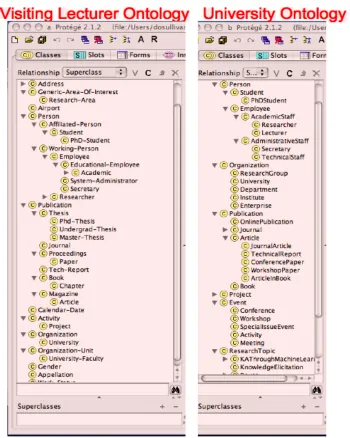
or rework his/her computing environment. This requires that a mapping is created between the visiting lecturer’s ontology representing his/her concepts and the ontology of the university. For this scenario the ontology used for the visiting lecturer is that created by the University of Aberdeen (Aberdeen 2003) and the university ontology is represented by the ontology created by the University of Manchester (Manchester 2003). Screenshots from the ontology browsing tool Protégé (cf. section 3.4.4) of the is-a3 hierarchy of each ontology is presented side by side in Figure 3-1. This is only a partial view (due to space considerations) but it shows the main classes and super/sub class relationships that will be referenced in the following sections.
Figure 3-1: Partial is-a hierarchies of scenario ontologies
3.2 Overview of Ontology Mapping
In order to generate ontology mappings, various matching techniques need to be applied to the ontologies. As discussed by Shvaiko and Euzenat (Shvaiko and Euzenat 2004), it is generally accepted that although there is a difference between ontology matching and general schema-matching4, the techniques developed for each can be mutually beneficial. Schema-matching is a general problem in many applications today, such as system integration, e-business, data warehousing and the semantic web. For this discussion a schema is defined to be a set of elements connected by some
structure (Rahm and Bernstein 2001). Although the element formats, expressiveness and structure of the schemas may differ in each of these domains (relational schema, XML schema, OWL and so on), the motivation behind the matching process is the same, that is, to discover correspondences between elements in each of the schemas
and document these correspondences using a mapping expression (Rahm and Bernstein
2001). This mapping expression can range over simple equivalences and complex correspondences. An example of a simple correspondence in the scenario is where
Paper in the visiting lecturer ontology could be considered equivalent to
ConferencePaper in the university ontology. An example of a complex
correspondence would be that the has-page-numbers property of the visiting lecturer
ontology is equivalent to the lastPage property minus the firstPage property of the
university ontology.
The most comprehensive survey of ontology mapping systems over recent years has been developed by Kalfoglou and Schorlemmer who have surveyed the ontology mapping area under the headings: frameworks, methods and tools, translators, mediators, techniques, experience reports, theoretical frameworks, surveys, and examples (Kalfoglou and Schorlemmer 2003). Kalfoglou and Schorlemmer also clarify the terminology that claims to be relevant in the literature (alignment, merging, articulation, fusion, integration, and so on). The view of ontology mapping in this thesis aligns with the Kalfoglou and Schorlemmer view. In particular, ontology
mapping is defined as the task of relating the vocabulary of two ontologies that share
the same domain of discourse in such a way that the structure of ontological signatures
and their intended interpretations are respected (Kalfoglou and Schorlemmer 2003). The authors proceed to show that ontology mapping, as well as being an activity in its own right, can also be considered a sub activity of both ontology merging/integration and ontology alignment activities. Ontology merging/integration is an activity where a new ontology is created from one or more ontologies. Ontology alignment is where two or more ontologies are altered to bring them mutually consistent and coherent.
The state of the art in this section is presented under headings which align with the core of the ontology mapping lifecycle introduced in chapter one, that is: Characterising Ontology Mismatches (section 3.2.1); Mapping Discovery (section 3.2.2); Mapping Documentation and Interpretation (section 3.2.3).
3.2.1 Characterising Ontology Mismatches
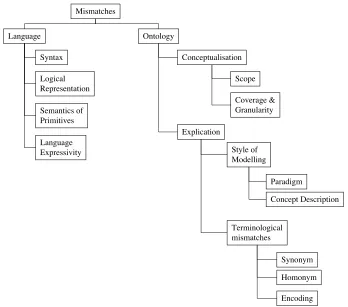
Mismatches between ontologies are the key type of problems that hinder the combined use of independently developed ontologies (Klein 2001). Klein builds upon previous work (Kitakami et al. 1996, Visser et al. 1997, Wiederhold 1998, Grosso et al. 1998, Bowers and Delacambre 2000) in order to construct a broad classification for ontology mismatches shown in Figure 3-2.
Language
Mismatches
Ontology
Syntax
Logical Representation
Semantics of Primitives
Language Expressivity
Conceptualisation
Explication
Scope
Coverage & Granularity
Paradigm
Concept Description Style of
Modelling
Terminological mismatches
Synonym
Homonym
[image:35.595.122.470.69.376.2]Encoding
Figure 3.2: Classification of Ontology Mismatches (Klein 2001)
The “ontology level” distinguishes the differences in the way the domain of ontologies are modelled and is subdivided into conceptualisation and explication mismatches. “Conceptualisation Mismatches” relate to the difference in the way a domain is interpreted and is subdivided into Scope and Model coverage and granularity. A Scope mismatch is where two classes may seem to represent the same concept but are modelled differently. In the scenario for example, the contact details of the
PhdStudent class in the university is modelled using properties email, phone, fax
whereas in the ontology used by the visiting lecturer the contact details of a
Phd-Student is simply a has-room-number property. A model coverage and granularity
mismatch is where ontologies may appear to be modelling part of the same domain but at a different level of depth and detail. In the scenario, in the university ontology a
ResearchTopic is decomposed into a large number of subclasses (e.g. Knowledge
Elicitation, Knowledge Management etc.), whereas in the ontology used by the
visiting lecturer all research topics are modeled as instances of a single
Research-Area class. “Explication Mismatches” represent a difference in the way the
is represented) and Concept description mismatches. An example of a common concept description mismatch is where classes are modelled differently in an is-a
hierarchy. In our scenario, a Secretary is modeled as a subclass of
AdminstrativeStaff/Employee/Person in the university ontology and as a subclass
of Employee/Working-Person/Person in the visiting lecturer’s ontology. Terminological mismatches cover Synonyms (same concept different name) and Homonyms (different concept same name). An example of a synonym in the scenario is ConferencePaper in the university ontology and Paper in the visiting lecturer
ontology. An example of a homonym in the scenario relates to the name Activity. In
the university ontology an activity it is a type of Event, whereas in the visiting lecturer ontology it has a broader meaning as can be seen by its subclass Project. Finally encoding mismatches occur where values are in different formats (e.g. European versus US dates). An example in the scenario would be where the year property of a publication in the university ontology is represented as an integer and the
has-publication-date property in the visiting lecturer ontology is an instance of a
calendar date object.
As recognised by Klein, the application of such classifications for ontologies is non-trivial and relies on human expertise to recognise ontology mismatches. For this reason, the incorporation of an activity to characterise ontology mismatches into ontology mapping systems has been rare. An exception is the KRAFT system (Gray et al. 1997) where an activity is explicitly incorporated in the system to apply an ontology mismatch classification (Visser et al. 1997) to the two ontologies. In the KRAFT system this is a manual activity. It is stated that the purpose of the activity is the early identification of the complexity that will be involved in deriving mappings. However details of how the various mismatches contribute to a complexity calculation are not described in KRAFT published literature.
Analysis
manually applied. In addition, it would make more sense if the identifier of the mismatch problem would propose a mapping solution at the same time given the detailed nature of some of the mismatch classifiers. Furthermore, it is clear that a mapping complexity calculation should not just be based on the mismatches between the ontologies but rather should also take account of other factors such as ontology quality.
In contrast, in the proposed OISIN framework the focus in the early parts of an ontology mapping lifecycle is on generally characterising how amenable ontologies are for mapping and characterising the potential matches, rather than characterising the ontology mismatches involved.
In summary, whereas there exists the means to express ontology mismatches, there remains the need for research into methods that will enable the semi-automatic or automatic characterisation of ontologies amenability for mapping.
3.2.2 Mapping discovery
Most research effort over the last number of years has concentrated on the identification of candidate matches of elements in schemas, which can then be analysed in order to determine what mappings should be expressed. For this reason, in this section the state of the art is discussed in two parts, match generation and derivation of mappings.
Match Generation
Rahm and Bernstein have introduced a taxonomy that allows the classification of techniques and approaches that have been used in schema-matching (Rahm and Bernstein 2001). Briefly the main classification criteria for individual matchers is described here:
• “Schema-based only” matchers only consider schema information, not instance
data.
o Element level matching determines the matching elements in the other
matches). Thus based on linguistic approaches, in the scenario Article in the visiting lecturer ontology would have candidate matches of
JournalArticle, ArticleinBook and Article in the university
ontology. Based on constraint approaches any properties that have
integer as a data type in one ontology would have a candidate match with properties with integer as the data type in the other ontology.
o Structure level matchers attempt to match combinations of elements that
appear together in a structure (e.g. columns grouped together in a table or classes related via an is-a hierarchy). For example in the scenario,
Person/Student/PhDStudent of university ontology would
structurally match with
Person/Affiliated-Person/Student/PhD-Student since the linguistically matched elements appear in the same
is-a order.
• Instance/contents level matchers examine the instances/contents of the actual data of the two systems in order to deduce possible correspondences. In particular, information retrieval techniques (such as Latent Semantic Indexing (Dumais et al. 1996) or co-active intelligence (Truran et al. 2005)) popular in the classification of information on the web are candidate techniques in this class of matchers.
• Hybrid matchers integrate several individual matchers based on a fixed
workflow to determine match candidates. For example a common pattern would be to start with a linguistic matcher and then pass candidate matches through constraint and/or structural matchers for further analysis. More flexibly, composite matchers combine the results of independently executed individual matchers in a workflow that is determined by the user.
example, in the scenario each of the Organisation subclasses of the university ontology would all match to the Organisation class of the visiting lecturer through a “is more specific than” relationship.
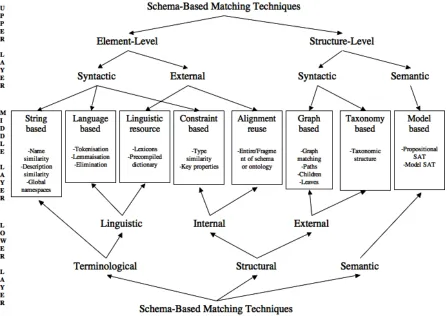
[image:39.595.90.537.219.535.2]Shvaiko and Euzenat propose a three layer classification (see Figure 3-3) for “schema-based only” matching techniques comprising of: upper layer, middle layer and lower layer.
Figure 3-3: Classification of schema-based matching approaches (Shvaiko and Euzenat 2004)
middle layer presents classes of matching techniques based on how the input is interpreted. The lower layer is concerned with classifying the type of data considered by a particular matching algorithm. Terminological matching algorithms consider string data, structural algorithms consider structure data and semantic algorithms considers semantic data.
Particular focus is placed in this section on the middle layer, as this provides a useful way to overview the state of the art in matching techniques. The matching techniques at the middle layer are:
1. String based techniques (e.g. prefix, suffix, edit distance and n-gram tests) match names and name descriptions of ontology entities; In the scenario for
example, a suffix test would identify telephone and phone as a match because
the first string ends with the second one.
2. Language based techniques are based on Natural Language Processing
techniques such as tokenisation (i.e. where names of entities are parsed into tokens), lemmatisation (i.e. finding base forms of names), and elimination (i.e. words that do not add meaning are discarded). In the scenario for example,
PhDStudent and Phd-Student would match due to matching of significant
tokens of Phd and Student.
3. Constraint based techniques concern internal constraints applied to the
definition of entities such as types, cardinalities of attributes and keys. In the
scenario, the studentnumber property would have a candidate match of every
property in the other ontology that had type integer and had a cardinality of
exactly one. This would match most identifier properties such as employee_id.
4. Linguistic resource techniques are those where lexicons or thesauri are used to
match words based on linguistic relations between them (e.g. synonym). For
example, Journal of the university ontology would have a synonym match
with Magazine of the visiting lecturer ontology.
5. Alignment reuse techniques are those which exploit matches previously
and Groh 2001) where text classification is used to measure the probability that two concepts (one from a repository ontology and one from a user’s personal view of documents of interest) are corresponding. In OMEN (Mitra et al. 2004) a Bayesian network is constructed using meta-rules that capture the influence of the ontology structure and semantics of the ontology relations. The network is then trained using pre-existing mappings.
6. Graph based techniques consider the inputs as labelled graphs and undertake a
similarity comparison. The intuition is that if two nodes from the inputs are similar then their neighbours will be similar too. For example, the Artemis (Castano et al. 2001) system calculates the name, structural and global affinity coefficients of two schemas by exploiting a common thesaurus.
7. Taxonomy based techniques consider the inputs as graphs and in particular
exploits the is-a relationships. For example, the Anchor-PROMPT algorithm (Noy and Musen 2001) takes the two ontologies and a set of anchor-pairs of related terms and then analyses the ontologies limited by the anchors in order to determine the terms that frequently appear in similar positions on similar paths. Another example is the Naïve Ontology Mapping (NOM) system (Ehrig and Sure 2004) that exploits information about super/sub concepts and super/sub properties of an ontology.
8. Model based algorithms handle the input based on semantic interpretation
typically through propositional satisfiability (SAT) or description logics (DL) techniques. For example, S-Match (Giunchiglia et al. 2004) takes two graphs as input and returns semantic relations (equivalence, more general, less general, mismatch, overlapping) between corresponding nodes as output.
It should be noted that the matching technique classification assigned to the example systems mentioned in the preceding discussion are not exclusive.
Typically most ontology mapping systems will adopt some form of
APFEL (deBruijn et al. 2005a), QOM (Ehrig and Staab 2004), and CUPID (Madhavan et al. 2001). COMA (Do and Rahm 2002) is an example of a composite system based on a user specified combination of matchers.
Analysis
In the proposed OISIN framework, it is assumed that in the future a number of different matchers can be selected for application to a particular ontology mapping set, based on the characteristics of the ontologies. This assumes that the metadata necessary to characterise the applicability of match algorithms in different situations will be possible to document. However, whereas a lot of excellent matching algorithms have emerged over the last number of years, the implementations of these have typically been tied to particular system architectures. It is assumed that this situation will change and that the availability of independent matchers will be enabled through the adoption of a common format for exchange of matching results. Such a common format may be based on a format like the INRIA format discussed later in section 3.4.3. However, a key challenge that would still remain would be how to characterise the applicability of individual matchers for different situations. Even in papers describing composite systems where the user is enabled to choose which matcher to apply, no detail has been provided as to what metadata annotates these matchers to support the user in making their decision. In addition most evaluations of the matchers concentrate primarily on the functional aspects of the systems (such as accuracy of matches) rather than evaluation of applicability to different use cases.
Derivation of mappings
that semi-automatic techniques for creating mappings from ontology matching information will continue to dominate (Uschold and Gruninger 2004).
Mapping detection has primarily relied to date on a human user with some graphical user interface examining the matching information that has been generated. In systems such as COMA++ (cf. section 3.4.2) and SWOOP (Kalyanpur et al. 2004) the focus has been placed on providing graphical support for the presentation of matching information and point and click creation of mappings. In addition COMA++ provides the opportunity for the user to browse mappings created from other mapping process sessions. However, typically such systems do not provide explicit user support for identifying mappings. In other systems such as Protégé the user is led through decisions for mappings based on the iterative algorithm Anchor-PROMPT (cf. section 3.4.4). More recently, the idea of capturing and documenting ontology mapping patterns has been proposed (deBruijn et al. 2005b). The idea is to guide the developer of an ontology mapping in the construction of ontology mappings using patterns of mappings that are common. The pattern template includes Name, Problem, Context and Solution headings similar to software development patterns. A number of such patterns have been identified. For example the pattern SubClass mapping describes the problem where a class in one ontology is a subclass of a class in a second ontology but there is no way of expressing the additional properties of the subclass. The solution
suggested in the pattern is to establish a unidirectional mapping from a more specific
class in one ontology to a broader class in another ontology. The relation is broadened to allow class expressions in addition to merely class names (deBruijn et al. 2005b). The pattern approach has potential to be encoded in the graphical support provided to a user, as well as being encoded directly in an automated tool. Mapping discovery could also be achieved through the sharing/learning of mappings from peers. Some initial research on this aspect with respect to a peer-to-peer framework for the sharing of SWRL - Semantic Web Rule Language (SWRL 2004) expressed mappings has demonstrated that this method of discovery holds promise (Conroy 2005).
Analysis
been used (from the use of icons, through the use of graphs), no literature could be found on the effectiveness of the different presentation types. This underlines the common assumption that exists that a good presentation in itself is sufficient to enable users to identify mappings. Although this thesis makes the same assumption, it is done with the full realisation that further research into this area is required in order to better support the real world deployment of ontology mapping systems. In a similar way there is an assumption behind the Protégé’s Anchor-Prompt approach and the deBruijjn et al. approach on ontology patterns, that leading the user in the detection of mappings from candidate matches is what is required. However, again no user studies are available to support this position as yet. Thus further research is also required into what kind of mapping detection support would be desirable.
3.2.3 Mapping Documentation and Interpretation
Mappings between elements in schemas are usually expressed as pairs of related entities in some mapping format that is normally output as a separate document. The advantage of a separate document for the mappings is that mappings can be managed independently of the ontologies.
All the systems discussed in section 3.2.2 output mappings in a proprietary format typically aligned with the technology used by the matching system. This is one reason why direct comparison of ontology mapping tools has been a difficult exercise (Noy and Musen 2002). For example, the OntoMerge system (Dou et al. 2002) uses bridging axioms written in first order logic language to express the translation rules between the concepts in the ontologies, and then runs a theorem prover optimised for ontology translation over the ontologies and the axioms. Another example is the MAFRA system (Maedche et al. 2002) that includes a formal representation to specify the mappings. The formalism that is used to describe the Semantic Bridges is based on an ontology specified in DAML+OIL, called the Semantic Bridging Ontology (SBO).
EON contest (EON 2004). In order to participate, the entrant systems needed to adapt their output to a given mapping format. Systems from Lockheed Martin, AT&T, Teknowledge, INRIA and University of Karlsruhe took part in the I3CON contest. Systems from Stanford University Fujitsu, INRIA, University of Montreal and University of Karlsruhe took part in the EON contest. Experience from these contests proved positive (Euzenat 2004b) and led to the development of the INRIA ontology alignment format (Euzenat 2005a), which is discussed further in Section 3.4.3. The format can also be rendered into different formats (SWRL, OWL etc.) for the purposes of interpretation. In contrast deBruijn et al. have proposed a generic mapping language that must be grounded in a declarative logical language and thus requires a reasoner. Initial groundings to OWL (Description Logic-based language) and WSML-Flight (a Logic Programming-based language) have been developed.
Analysis
It is useful that the research community has begun over the last year to address the issue of a common way to specify the results of matching algorithms and/or mapping systems. Unfortunately it is too early to determine whether one of the two prominent contenders (that is from INRIA and from deBruijn et al.) will emerge as the basis of a standard format or whether another will be proposed. The advantage of the INRIA format is that it can be used for representing results of match algorithms and results of mappings, which can be rendered into different mapping languages. The advantage of the deBruijn et al. format is that it has a formal basis. What is clear is that further and wider evaluation of the formats are required and that several issues remain to be addressed. One such issue is the manner in which strength/similarity/confidence in a match or mapping should be expressed. This is particularly important when combining the results of matchers from different vendors together or when sharing mappings between systems. Another issue that needs to be explored is whether a match or a mapping can be annotated with information that indicates whether or not the match/mapping is valid for particular application contexts.
3.3 Key Requirements
It was decided to adopt a framework approach to the development of the process and software tools required to support practical ontology mapping. The desire that ontology mapping should be practical, led to a number of challenges and requirements being placed on the framework. Section 3.3.1 describes the key framework challenges and Section 3.3.2 presents the derived requirements.
3.3.1 Key Framework Challenges
Although significant progress has been made in the research community in developing some of the technologies needed for mapping systems, the current challenges have to do with deploying such systems in the real world (Doan et al. 2004).
The first challenge is the provision of a framework that supports all parts of the ontology mapping lifecycle (Maedche et al. 2002). A framework consists of process and tools. Such a framework is necessary in order to enable organisations to situate the ontology mapping process within their organisational processes and to aid communication with contributors of solutions with respect to supporting the process. For example, the Unified Process (UP) is a framework defined to support the development of software systems (Jacobson et al. 1999). The artefacts produced and consumed in its process conform to the UML standards (UML 2004). This allows for tools from a variety of vendors to be used in different parts of its process. Another example can be seen in the telecommunications domain, where the availability of the eTOM reference framework (TMF 2005a) for management has provided a valuable reference framework for network management processes for telecom operators to use and for software vendors to use as a reference for implementation, as seen in a variety of success stories (TMF 2005b).
A second challenge is to make the framework adaptable and extensible. No two
included. In addition, the framework needs to support the selection of whether each activity is manual, semi-automatic or automatic (Uschold and Gruninger 2004). Take for example the use cases of the Information Systems, Marketing and Training departments of an organisation. The Information Systems department might use ontologies in the definition of an enterprise data model to aid integration of systems. In this case, the characterisation activities may not exist (as there is no choice but to undertake the mapping) and the mapping and deployment activities are likely to be semi-automatic. The marketing department might use ontologies in the design of the organisation’s website providing a portal to their products. In this case, the process mapping between the website ontology and the ontologies used by the product organisation is likely to be fully automatic. The Training department might want to leverage learning resources from the web for integration into corporate training system. In this case the characterisation activities are likely to be automatic, as there would be very precise criteria/policies of eligibility that can be encoded, but the mapping activities would need to be semi-automatic.
In addition, it should be possible to substitute tools and algorithms in the framework. Tools that support semi-automation of activities need to be substitutable as different users will choose different tools depending on the balance that is required between, for example, labour saving versus mapping accuracy (Uschold and Gruninger 2004). Algorithms will need to be substitutable to support deployment in different scenarios (Euzenat 2004a, Do and Rahm 2002). For example in a telecommunications operator organisation, a wide range of different matching tools may need to be available. A general purpose ontology matcher could support web site maintenance. However a task specific matcher would be required to undertake matching of network management information models as linguistic and structural matchers alone have been shown to be inadequate in providing useful candidate matches (Keeney et al. 2005).
A third challenge is to enable the framework to create relevant mappings. Just as an