Flow Past an Exponentially Accelerated Infinite
Vertical Plate and Temperature with Variable Mass
Diffusion
K.K. Asogwa
Department of Mathematics Usmanu Danfodiyo University,P.M.B 2138 Sokoto, Nigeria.
I. J. Uwanta
Department of Mathematics Usmanu Danfodiyo University,P.M.B 2138 Sokoto, Nigeria
A.A. Aliero
Department of BiologicalSciences
Usmanu Danfodiyo University, P.M.B 2138 Sokoto, Nigeria
ABSTRACT
An exact solution of flow past an exponentially accelerated infinite vertical plate and temperature has been presented in the presence of variable mass diffusion. The dimensionless governing equations are solved using Laplace transform technique. The velocity, temperature, and concentration profiles are studied for different physical parameters like radiation parameter R, accelerating parameter a, thermal Grashof number Gr, mass Grashof number Gc, chemical reaction parameter K, Prandtl number Pr, Schmidt number Sc and time t. It is observed that the velocity increases with increase in Gc, Gr, R, a, Pr, Sc and t. It is also observed that temperature rise with increasing t, a, R while concentration increases with increasing t.
General Terms
Asogwa et. al.Keywords
Accelerated, vertical plate, radiation, chemical reaction heat transfer, variable mass diffusion
1.
INTRODUCTION
Mixed heat and mass transfer plays vital roles, in nuclear reactors, space craft design, design of chemical processing equipment, pollution of the environment, formation and dispersion of fog and moisture of agricultural fields. Soundalgekar [19] presented an exact solution to the flow of a viscous fluid past an impulsively started infinite isothermal vertical plate. The solution was derived by the Laplace-transform technique and the effects of heating or cooling of the plate on the flow field were discussed Singh and Naveen Kumar [20] studied free convection effects on flow past an exponentially accelerated vertical plate. Gupta et al. [8] studied free convection on flow past an linearly accelerated vertical plate in the presence of viscous dissipative heat using perturbation method. Chamkha [5] studied the effects of heat absorption and thermal radiation on heat transfer in a fluid particle flow past a surface in the presence of a gravity field. Muthucumaraswamy and Valliamal [16] considered first order chemical reaction on exponentially accelerated isothermal vertical plate with mass diffusion, the dimensionless governing equations are solved using laplace-transform technique. Chandrakala [3] considered analytically thermal radiation effects on moving infinite vertical plate with uniform heat flux. Muthucumaraswamy et al. [15] studied the unsteady flow past an accelerated infinite vertical plate with variable temperature and uniform mass diffusion. Basanth Jha
and Ravindra Prasad [1] examined Free convection and mass transfer effects on the flow past an accelerated vertical plate with heat source. Das et al. [6] studied radiation effects on flow past an impulsively started vertical infinite plate. Mass transfer effects on the flow past an exponentially accelerated vertical plate with constant heat flux were considered by Basanth et al. [2]. Muthucumaraswamy et al. [13] recently worked on heat transfer effects on flow past an exponentially accelerated vertical plate with variable temperature. Deka and Neog [7] investigated unsteady MHD flow past a vertical oscillating plate with thermal radiation and variable mass diffusion. Mazumdar and Deka [10] considered MHD flow past an impulsively started infinite vertical plate in presence of thermal radiation. Chandrakala and Bhaskar [4] studied the effects of heat transfer on flow past an exponentially accelerated vertical plate with uniform heat flux. Rajesh and Vijaya [17] presented radiation and mass transfer effects on MHD free convection flow past an exponentially accelerated vertical plate with variable temperature. Muthucumaraswamy and Ganesan [12] analysed the unsteady flow past an impulsively started vertical plate with heat and mass transfer. Ramana et al. [18] considered the effect of critical parameters of MHD flow over a moving isothermal vertical plate with variable mass diffusion. Muthucumaraswamy et al. [14] worked on the diffusion and Heat transfer effects on exponentially accelerated vertical plate with variable temperature. Jha et al. [9] investigated mass transfer effects on the flow past an exponentially accelerated vertical plate with constant heat flux. Muthucumaraswamy [11] studied the interaction of thermal radiation on vertical oscillating plate with variable temperature and mass diffusion.
and the level of concentration near the plate is raised linearly with time. Then under the usual Boussinesq’s approximation the unsteady flow equations aremomentum equation, energy equation, and mass equation respectively.
*
22
u
u
g
T T
g
C
C
t
y
(1)
2 2 r p
q
T
T
C
k
t
y
y
(2)
2
* 2
C C
D K C
t y
(3)
where u is the velocity of the fluid, T is the fluid temperature,
'
C
is the concentration, g is gravitational constant,
and*
are the thermal expansions of fluid and concentration ,t
is the time, ρ is the fluid density,C
pis the specific heat capacity, v is the viscosity of the fluid, k is the thermal conductivity,D
is the diffusion term,K
*is chemical reaction parameterand
q
r is the radiative heat flux.In this research work the mathematical formulation has chemical reaction, rate of radiation heat flux which are not included in the work of Muthucumaraswamy et. al. [15] and difference in the boundary conditions for velocity, concentration and temperature. By Rosseland approximation, we assume that the temperature differences within the flow are such that
T
*4may be expressed as a linear function of the temperatureT
*. This is accomplished by expanding Taylor series aboutT
d*neglecting higher order terms.The initial and boundary conditions are;
0
* * *
0
0 : , , 0
0, 0, 0
at at
t
t u u e T T T T e C C C C Bt y
u T C as y
(4)
Where 1 2 3 0
u
B
,
Bis a constant
The thermal radiation heat flux gradient may be expressed as follows
*4 *4
4
'
r
q
a
T
T
y
(5)
Where qr is the radiative heat flux, a is the absorption
coefficient of the fluid and
𝜎
*Is the Stefan-Boltzmann constant. We assumed that the temperature differences withinthe flow are sufficiently small such that
T
*4 may be expressed as a linear function of the temperature. Expanding*4
T
aboutT
* in a Taylor’s series and neglecting higher orderterms, we have*4 *3 * *4
4
3
T
T T
T
(6)
By using equation (5) and (6).equation (2) reduces to * 3 2 2 2 2 16 3 d p R T
T k T T
t C y a y
(7)
On introducing the following non-dimensional quantities
1 1 2 3 3 0 0 1 2 3 0 * 0 0 * 3 , , , , 4Pr p, , d
R
u u
u
U t t Y y
u
T T C C
C
T T C C
g T T g C C
Gr Gc
u u
C T
Sc R
k D ka
(8)
Substituting the non-dimensional quantities of equation (8) into (1) to (4),leads to
2 2
U U
Gr GcC
t
y
(9)
2 2
1
t
y
(10)
2 2
1
C C
KC
t Sc y
(11)
Where
3Pr
3 4
R
, Gr is the thermal Grashof number , Gcis the mass Grashof number, Sc is the Schmidt number, Pr is the Prandtl number and R is the radiation parameter
The initial and boundary conditions reduce:
0,
0,
0,
,
0
0 :
,
,
0
0,
0,
0
at at
U
C
for all
y t
t
U
e
e C
t
at
y
U
C
as
y
(12)
3. SOLUTION TO THE PROBLEM
2 2 2 22
2
ScKt ScKt ScKt ScKtt
C y
e
erfc
Sc
Kt e
erfc
Sc
Kt
tSc
e
erfc
Sc
Kt e
erfc
Sc
Kt
K
(13
2
2
,
2
at
at at
e
y t
e
erfc
at e
erfc
at
(14)
2
2
,
2
at
at at
e
U y t
e
erfc
at
e
erfc
at
2
2
2
2
1
at at at aterfc
Gre
e
erfc
at
e
erfc
at
a
e
2 at 2 at
e erfc at e erfc at
2
(
)
at
erfc
e
2 2 22
2
2
1 2
2
1
Gc
e
erfc
dt
erfc
d
Sc
2 2dt dt dt
e
e
erfc
dt
e
erfc
dt
2 ScKt 2 ScKt
e
erfc
Sc
Kt
e
erfc
Sc
Kt
2 ScKt 2 ScKt
dt e
erfc
Sc
Kt
e
erfc
Sc
Kt
2 22
ScKt SckttSc
e
erfc
Sc
Kt
e
erfc
Sc
Kt
K
2 2bt Scbt Scbt
e e
erfc
Sc
bt e
erfc
Sc
bt
(15)
where
,
2
y
t
1
kSc
d
and b
d
K
Sc
The nusselt number for temperature field is obtain when y=0 as
02
at at at ye
aerfc at
e
aerfc
at
e
t
t
(16)
The Sherwood number for concentration field is obtain when y=0 as
02
Kt Kt y Kt Ktt
Sc
Sc
C
ScKerfc Kt
e
ScKerfc
Kt
e
t
t
Sc
Sc
ScK
ScKerfc
Kt
e
ScKerfc Kt
e
t
t
(17)
The skin friction gives
02
2
2
at at at ye
U
aerfc at
e
aerfc
at
e
t
t
2
2
1 2
2
1
at
at at
at
Gre
aerfc at
e
aerfc
at
e
a
t
t
e
t
at
ataerfc at
e
aerfc
at
e
t
t
1
2
att e
21
1
2
2
2
2
2
2
1
dt dt dt
Gc
dt
e
derfc dt
e
derfc dt
e
d Sc
t
t
t
Sc
Kt
Sc
KtScKerfc Kt
e
ScKerfc
Kt
e
t
t
dt
Sc
Kt
Sc
KtScKerfc
Kt
e
ScKerfc
Kt
e
t
t
Sc
Kt
Sc
KtScK
ScKerfc
Kt
e
ScKerfc Kt
e
t
t
bt
Sc
btSc
bte
Scberfc
bt
e
Scberfc
bt
e
t
t
(18)
4.
RESULTS AND DISCUSSION
The problem of flow past an exponentially accelerated infinite vertical plate and temperature with variable mass diffusion has been formulated, analysed and solved analytically. In order to point out the effects of physical parameters namely; Accelerating parameter a, thermal Grashof number Gr, mass Grashof number Gc, Prandtl number Pr, Schmidt number Sc, time t, radiation parameter R, and chemical reaction parameter K. on the flow patterns, the computation of the flow fields are carried out. The value of the Prandtl number Pr is chosen to represent air (Pr = 0.71). The value of Schmidt number is chosen to represent water vapour (Sc = 0.6). The values of velocity, temperature and concentration are obtained for the physical parameters as mention.
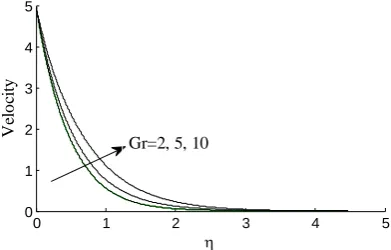
number (Sc = 0.16, 0.22, 0.3, 0.6) is presented in figure 1. The trend shows that the velocity increases with increasing Schmidt number. The effect of velocity for different values of time (t = 0.2, 0.4, 0.6, 0.8) is also presented in figure 2. It is then observed that the velocity increases with increasing values of time. The effect of velocity profiles again have been studied for different values of thermal Grashof number (Gr = 2, 5, 10) and mass Grashof number (Gc = 3, 5, 10) is studied and then presented in figure 3 and 4 respectively. The results are here observed that the increase in the values of velocity increases with increasing values of Gr and Gc respectively.
[image:4.595.59.263.204.341.2]Figure 1 Velocity profiles for different values of Sc
Figure 2 Velocity profiles for different values of t
[image:4.595.321.521.302.610.2]The velocity profiles for different values of thermal Grashof number (Gr = 2, 5, 10) is seen in Figure 3 It is observed that velocity increases with increasing Gr. The velocity profiles for different values of mass Grashof number (Gc =3, 5, 10) is presented in Figure 4. It is observed that velocity increases with increasing Gc.
Figure 3 velocity profiles for different values of Gr
Figure 4 Velocity profiles for different values of Gc
[image:4.595.320.523.312.461.2]The velocity profiles for different values of accelerating parameter (a = 0.2, 2, 5, 10) is seen in Figure 5. It is observed that velocity increases with increasing a. The velocity profiles for different values of radiation parameter (R =2, 5, 10, 20) is presented in Figure 6. It is observed that velocity increases with increasing R
Figure 5 Velocity profiles for different values of a
Figure 6 Velocity profiles for different values of R
The velocity profiles for different values of Prandtl number (Pr = 0.71, 0.85, 1, 7) is seen in Figure 7. It is observed that velocity increases with decreasing Pr. The velocity profiles for different values of chemical reaction parameter (K= 0.2, 0.4, 0.6, 0.8) is presented in Figure 8. It is observed that velocity increases with decreasing K
0 1 2 3 4 5
0 5 10 15
V
el
o
ci
ty
Sc=0.16, 0.22, 0.3, 0.6
0 2 4 6 8 10
0 10 20 30 40 50 60
V
el
o
ci
ty
t=0.2, 0.4, 0.6, 0.8
0 1 2 3 4 5
0 1 2 3 4 5
V
el
o
ci
ty
Gr=2, 5, 10
0 1 2 3 4 5
0 2 4 6 8 10
V
el
o
ci
ty
Gc=3, 5, 10
0 1 2 3 4 5
0 2 4 6 8 10
V
el
o
ci
ty
a = 0.2, 2, 5, 10
0 1 2 3 4 5
0 1 2 3 4
V
el
o
ci
ty
[image:4.595.62.264.348.478.2] [image:4.595.65.261.585.710.2]Figure 7 Velocity profiles for different valuesof Pr
Figure 8 Velocity profiles for different values of K
[image:5.595.66.262.238.367.2]The temperature profiles has been studied and presented in figure 9 to 12. The effect of temperature for different values of time (t = 0.2, 0.6, 1, 2) is presented in Figure 9 It shows that temperature rises with increasing t. The temperature profiles for different values Prandtl number (Pr = 0.71, 0.85, 1, 7) is presented in figure 10 It is observed that increases in Prandtl number Pr decreases the temperature.
Figure 9 Temperature profiles for different values of t
Figure 10 Temperature profiles for different values of Pr
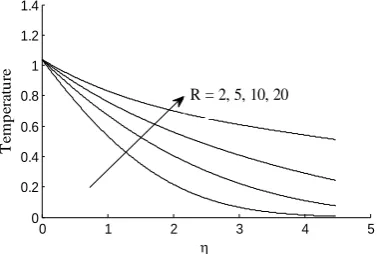
[image:5.595.320.523.318.443.2]The temperature profiles for different values of accelerating parameter (a = 0.2, 0.5, 0.8, 2) is presented in Figure 11 It shows that temperature rises with increasing a. The temperature profiles for different values radiation parameter (R = 2, 5, 10, 20) is presented figure 12 It is observed that temperature increases with increasing R
Figure 11 Temperature profiles for different values of a
Figure 12 Temperature profiles for different values of R
The concentration profiles has been studied and presented in figure 13 to 15
The effect of concentration for different values of time (t = 0.2, 0.4, 0.6, 0.8) is presented in Figure 13. It is observed that concentration increases with increasing t. The concentration profiles for different values of Schmidt number (Sc = 0.16, 0.22, 0.3, 0.6) is presented in Figure 14. It is observed that the concentration increase with increasing Sc. The effect of concentration for different values of chemical reaction parameter (K=0.2, 0.5, 2, 5) is presented in Figure 15. It is observed that the concentration increases with a decrease in the values of K.
0 1 2 3 4 5
0 1 2 3 4
V
el
o
ci
ty
Pr= 0.71, 0.85, 1, 7
0 1 2 3 4 5
0 1 2 3 4
V
el
o
ci
ty
Pr= 0.71, 0.85, 1, 7
0 5 10 15
0 0.5 1 1.5
T
em
p
er
at
u
re
t=0.2, 0.6, 1, 2
0 1 2 3 4 5
0 0.5 1 1.5
T
em
p
er
at
u
re
Pr=0.71, 0.85, 1, 7
0 1 2 3 4 5
0 0.5 1 1.5
T
em
p
er
at
u
re
a = 0.2, 0.5, 0.8, 2
0 1 2 3 4 5
0 0.2 0.4 0.6 0.8 1 1.2 1.4
T
em
p
er
at
u
re
[image:5.595.322.511.479.606.2] [image:5.595.57.264.501.644.2]Figure 13 Concentration profiles for different values of t
Figure 14 Concentration profiles for different values of Sc
Figure 15 Concentration profiles for different values of K
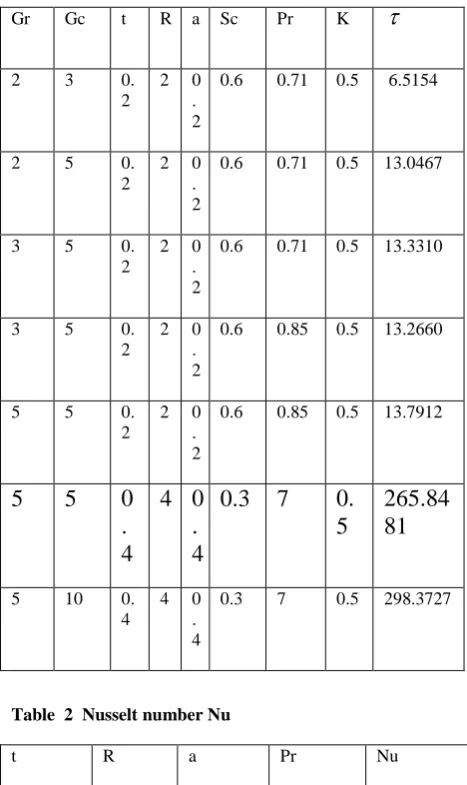
Tables 1 to 3 gives the Skin friction, Nusselt number and Sherwood number respectively.
Table 1 shows the effect of physical parameters Gr, Gc, R, a, t, Sc and Pr on the skin friction.its observed that the shear stress increases when Gr, Gc, R, a, t, Sc and Pr increases. Table 2 represents the variation of physical parameters Pr,a,t,R on the nusselt number which determines the rate of heat transfer.its observed that rate of heat transfer increases when R, a, t, Pr increases.
[image:6.595.58.264.94.232.2]Table 3 gives the effect of physical parameters Sc, K and t on the Sherwood number.its observed that mass transfer increases when K ,t,Sc increases
Table 1 Skin friction
Gr Gc t R a Sc Pr K
2 3 0.
2 2 0
. 2
0.6 0.71 0.5 6.5154
2 5 0.
2 2 0
. 2
0.6 0.71 0.5 13.0467
3 5 0.
2 2 0
. 2
0.6 0.71 0.5 13.3310
3 5 0.
2 2 0
. 2
0.6 0.85 0.5 13.2660
5 5 0.
2 2 0
. 2
0.6 0.85 0.5 13.7912
5
5
0
.
4
4 0
.
4
0.3 7
0.
5
265.84
81
5 10 0.
4 4 0
. 4
[image:6.595.57.264.265.382.2]0.3 7 0.5 298.3727
Table 2 Nusselt number Nu
t R a Pr Nu
0.2 2 0.2 0.71 -0.6008
0.2 2 0.4 0.71 -0.6489
0.2 2 0.4 0.85 -0.7100
0.2 5 0.2 0.85 -0.4155
0.2 5 0.2 0.85 -0.4546
Table 3 Sherwood number Sh
Sc K t Sh
0.16 0.5 0.2 0.0670
0.22 0.5 0.2 0.0997
0.3 0.5 0.2 0.1447
0.6 1 0.2 0.5272
0 2 4 6 8 10
0 0.2 0.4 0.6 0.8
C
o
n
ce
n
tr
at
io
n
t = 0.2, 0.4, 0.6, 0.8
0 1 2 3 4 5
0 0.05 0.1 0.15 0.2
C
o
n
ce
n
tr
at
io
n
Sc=0.16, 0.22, 0.3, 0.6
0 1 2 3 4 5
0 0.05 0.1 0.15 0.2
C
o
n
ce
n
tr
at
io
n
K=0.2, 0.5, 2, 5
[image:6.595.56.262.445.578.2]5.
SUMMARY AND CONCLUSION
Flow past an exponentially accelerated infinite vertical plate and temperature with variable mass diffusion has been studied. The dimensional governing equations are solved by Laplace transform technique. The effect of different parameters like accelerating parameter, radiation parameter, chemical reaction parameter, Schmidt number, Prandtl number, mass Grashof number, thermal Grashof number, and time are presented graphically. It is observed that velocity profile increases with increasing parameter namely R, t, Gc, Gr and a while Sc, Pr and K decreases with increasing velocity. It also observed that temperature rise with increasing t, a, R while Pr decreases with increasing temperature. The concentration profiles increases with increasing t while Sc and K decreases with increase in concentration6.
REFERENCES
[1] Basanth Kumar Jha and Ravindra Prasad (1990). Free convection and mass transfer effects on the flow past an accelerated vertical plate with heat source, Mechanics Research Communications, Vol. 17, Pp. 143-148. [2] Basanth Kumar Jha, Ravindra Prasad, Surendra Raj
(1991). Mass transfer effects on the flow past an exponentially accelerated vertical plate with constant heat flux, Astrophysics and Space Science, Vol. 181, Pp. 125-134.
[3] Chandrakala P. (2010). Thermal Radiation effects on moving infinite vertical plate with uniform heat flux, International Journal of dynamics fluids, Vol. 1. Pp.
49-55.
[4] Chandrakala P. and Bhaskar P.(2011). Effects of heat transfer on flow past an exponentially accelerated vertical plate with uniform heat flux, International Journal of dynamics fluids, Vol. 7(1), Pp. 9-16
[5] Chamkha A.J (2000). Effects of heat absorption and thermal radiation on heat transfer in a fluid particle flow past a surface in the presence of a gravity field, International Journal thermal sciences, Vol. 39, Pp. 605-615.
[6] Das, U.N.,Deka R.K. and Soundalgekar V.M (1996). Radiation effects on flow past an impulsively started vertical infinite plate, Journal of Theoretical Mechanics, Vol. 1, Pp. 111-115
[7] Deka R.K and Neog B.C (2009). Unsteady MHD flow past a vertical oscillating platewith thermal radiation and variable mass diffusion, Chamchuri Journal of Mathematics, Vol. 1(2), Pp. 79-92
[8] Gupta A.S, Pop I. and Sounldalgekar V.M (1979). Free convective effects on the flow past an accelerated vertical plate in an incompressible dissipative fluid, Rev. Roum. Science and Applied Technology, Vol. 24, Pp. 561-568
[9] Jha B.K.,Prasad R. and Rai S.(1991). Mass transfer effects on the flow past an exponentially accelerated vertical plate with constantheat flux, Astrophysics and Space Science, Vol. 181, Pp.125-134
[10]Mazumdar M.K and Deka R.K (2007). MHD flow past an impulsively started infinite vertical plate in presence of thermal radiation, Romanian Journal of Physics, Vol. 52(5-6), Pp. 529-535
[11]Muthucumaraswamy R.(2006). The interaction of thermal radiation on vertical oscillating plate with variable temperature and mass diffusion, Theoretical Applied Mechanics, Vol. 33(2), Pp. 107-121
[12]Muthucumaraswamy R. and Ganesan P.(1998). Unsteady flow past an impulsively started vertical plate with heat and mass transfer, Heat and Mass Transfer, Vol. 34, Pp. 187-193
[13]Muthucumaraswamy R.,Sathappan K.E and Nataragan R.(2008). Heat transfer effects on flow past an exponentially accelerated vertical plate with variable temperature, Theoretical Applied Mechanics, Vol. 35(4) , Pp. 323-333
[14]Muthucumaraswamy R.,Sathappan K.E and Nataragan R.(2010). Diffusion and Heat transfer effects on exponentially accelerated vertical plate with variable temperature, Theoretical Applied Mechanics, Vol. 14(1), Pp. 73-77
[15]Muthucumaraswamy R.,Sundar Raj M. and Subramanian VSA (2009). Unsteady flow past an accelerated infinite vertical plate with variable temperature and mass diffusion, International Journal of Applied Mathematics and Mechanics, Vol. 5(6), Pp. 51-56
[16]Muthucumaraswamy R. and Valliamal V. (2009). First order chemical reaction on exponentially accelerated isothermal vertical plate with mass diffusion, International Journal of Engineering, TUME VII, fascicule I (ISSN 1584-2665).
[17]Rajesh V. and Vijaya Kumar V. (2009). Radiation and mass transfer effects on MHD free convection flow past an exponentially accelerated vertical plate with variable temperature, ARPN Journal of Engineering and Applied Sciences, Vol. 4(6), (ISSN 1819-6608).
[18]Ramana Reddy G.,Ramana Murthy V. and Bhaskar Reddy N.(2010). Effect of critical parameters of MHD flow over a moving isothermal vertical plate with variable mass diffusion. International Journal of dynamics fluids, Vol. 5, Pp. 205-214
[19]Soundalgekar V.M (1977). Free convection effects on the stokes problem for an infinite vertical plate, ASME Journal of Heat Transfer, Vol. 99, Pp. 499-501.