Modularity and Delayed Product
Differentiation in Assemble-to-order
Systems: Analysis and Extensions from a
Complexity Perspective
Blecker, Thorsten and Abdelkafi, Nizar
Haburg University of Technology
2005
Online at
https://mpra.ub.uni-muenchen.de/5286/
1
in Assemble-to-order Systems:
Analysis and Extensions from
a Complexity Perspective
Thorsten Blecker, Nizar Abdelkafi
Abstract
The paper assumes a product design around modular architectures and discusses the suitability of the principle of delayed product differentiation in assemble-to-order environments. We demonstrate that this principle does not enable one to make optimal decisions concerning how variety should proliferate in the assembly process. Therefore, we propose to complement this principle in that we additionally consider the variety induced complexity throughout the assembly process. The weighted Shannon entropy is proposed as a measure for the evaluation of this complexity. Our results show that the delayed product differentiation principle is reliable when the selection probabilities of module variants at each assembly stage are equal and the pace at which value is added in the whole assembly process is constant. Otherwise, the proposed measure provides different results. Furthermore, the entropy measure provides interesting clues concerning eventual reversals of assembly sequences and supports decisions regarding what modules in an assembly stage could be substituted by a common module.
Introduction
Assemble-to-order is a business model whereby final product variants are not assembled until customer order arrives. It can be considered as one form of practicing mass customization because the products are individualized out of components, which are held in a generic form. If these components can be combined in very different ways, a large product variety would be triggered, thereby increasing the complexity of operations. The negative effects of product variety and complexity on both efficiency and responsiveness are well-known and have already been discussed by many authors (e.g. Blecker et al. 2005). To alleviate the negative impacts of variety and complexity, postponement and delayed product differentiation are proposed as suitable strategies.
In this paper, we assume a modular product architecture, which means that product variations are obtained by mixing and matching a set of modules with well defined interfaces. This assumption can be seen from two different perspectives with respect to the principle of delayed product differentiation. In effect, we can interpret both concepts to be related to each other and consider delayed differentiation as a natural consequence of the use of modules. This interpretation is justified in that modules are held at a generic form and that their assignment to different variations is deferred until concrete demand is available. However, we can view delayed product differentiation from anther perspective, which aims at minimizing variety proliferation
throughout the process of final assembly. This perspective focuses on keeping the number of different subassemblies in the process at a low level. In our discussion, we especially deal with the second interpretation. We will show that this interpretation can lead to suboptimal results in assembly-to-order environments. Therefore, it should be complemented by a second principle which is called the principle of minimum variety-induced complexity.
The next section provides a short literature review on modularity, postponement, delayed product differentiation, and complexity. In section 3, we deal with the insufficiencies of the delayed product differentiation principle in assemble-to-order systems. In section 4 we introduce the principle of minimum variety induced complexity and present its theoretical background. We also explore its application in a two-stage assembly process. Finally, section 5 concludes and presents directions for future research.
2 Literature Review
2.1 Modularity
In the technical literature, there are numerous definitions of the term “modularity”, of which we quote some selected ones. Schilling (2003, p. 172) defines modularity “… as a general systems concept: it is a continuum describing the degree to which a system’s components can be separated and recombined, and it refers both to the tightness of coupling between components and the degree to which the “rules” of the system architecture enable (or prohibit) the mixing and matching of components”. Whereas Schilling considers modularity in the general case without restrictions concerning the kind of system, Baldwin/Clark particularly focus on products and processes. They define modularity as “building a complex product or process from smaller subsystems that can be designed independently yet function together as a whole” (Baldwin/Clark 2003, p.149). In the context of product architectures, Ulrich (2003, p. 121) points out that “[a] modular architecture includes a one-to-one mapping from functional elements in the function structure to the physical components of the product, and specifies de-coupled interfaces between components”. For the purpose of our work, we define modularity as an attribute of the product system that characterizes the ability to mix and match independent and interchangeable product building blocks with standardized interfaces in order to create product variants. The bijective mapping between functional elements and physical building blocks is preferable and refers to an extreme and ideal form of modularity.
academia and practice, especially when it is to discuss mass customization and assemble-to-order.
2.2 Delayed Product Differentiation and Postponement
Postponement is originally introduced by Alderson (1950) as a concept that reduces risk and uncertainty costs. Bucklin (1965) makes the distinction between three types of postponement, which are time, place, and form postponement. Time postponement refers to the delay of forward shipment of goods, whereas place postponement aims at maintaining goods at central locations in the channel. Form postponement is related to the differentiation of the product itself. Zinn/Bowersox (1988) define four types of form postponement, which are labeling, packaging, assembly and manufacturing postponement.
Within the context of the supply chain, van Hoek (2001, p. 161) defines postponement “… as an organizational concept whereby some of the activities in the supply chain are not performed until customer orders are received. Companies can then finalize the output in accordance with customer preferences and even customize their products”. Christopher (2005, p. 134) refers to postponement “…as the process by which the commitment of a product to its final form or location is delayed for as long as possible.” In our work, since we will focus on the product and its assembly process, we are not concerned with time and place postponements which are of value when it is to consider the whole supply chain. Therefore, our interest will be only given to form postponement which is in accordance with the delayed product differentiation principle. The main objective of this principle is to delay downstream the activities that are responsible for providing the product an identity according to customer specifications. Theoretically, delayed differentiation involves two parts in the value chain. The first part is production-driven (push system), whereas the second part is customer-driven (pull system). The point in the value chain that separates between both systems is generally called the decoupling point1. Lampel/Mintzberg (1996) provides a continuum of strategies concerning the degree of customization and possible locations of this point. Their framework combines customization and standardization whereby the degree of customization decreases as the decoupling point moves downstream in the value chain.
Many authors argue that deferring the stage at which products assume their unique identities considerably reduces the negative impacts of variety on manufacturing performance (e.g. Lee/Tang 1997). Consequently, redesign activities with the objective of delaying product differentiation lead to the achievement of large product variety at low costs. This also is necessary in order to make mass customization work efficiently. In addition, delayed product differentiation is regarded as an important principle for the reduction of complexity in operations. Since we intend to discuss the suitability of this principle in assemble-to-order environments from a complexity perspective, it is necessary to define at first what we understand under the term “complexity”. Therefore, the main purpose of the next section is not to explain the potential of modularity or delayed differentiation in reducing complexity but to provide a suitable definition of complexity to be used throughout this paper.
2.3 Complexity
Complexity is a widely discussed topic in many research fields in science. There are also many attempts to provide a universal and generally admitted definition of complexity. However, a single and generally accepted definition does not exist. Therefore, it is suitable to define complexity in the context of our research field. Since this work can be assigned both to business
1
administration and engineering management, we retain two definitions that are frequently used to deal with research topics in these fields. The first definition describes complexity as an attribute of a system (system theoretical approach). The second one considers complexity as the entropy of a system. In the following, we shall briefly discuss both approaches:
• Complexity from a system theoretical approach:
A system consists of elements or parts (objects, systems of lower order, subsystems) which are connected to each other through relations. To assess complexity, the system elements and relations should be evaluated according to three variables which are: the number, diversity, and states’ variety. In effect, the higher the number of the system elements and their relations, the less straightforward is the system, thus resulting in higher complexity. It is noteworthy that the addition of an element to the system leads to a disproportionate increase of the potential relations between the system elements. On the other hand, diversity refers to the homogeneity or heterogeneity of the elements and their relations. It is obvious that the less homogeneous (more heterogeneous) the system elements are, the higher is the system complexity. The third variable which is the states’ variety evaluates the instability of the system and indicates its dynamical behavior in the course of time. In other words, as the number and types of the system elements and relations tend to change rapidly, the complexity of the system gets higher.(e.g. Ashby 1957, Bertalanffy 1976). We can notice that the system theoretical approach does not provide only one measure that assesses complexity. It is rather based on many dimensions, which constitutes, in fact, its major drawback.
• Complexity as the entropy of a system
Complexity, uncertainty and information are linked to each other. In effect, in order to reduce the complexity of a system, we can simplify it by allowing some degree of uncertainty in its description. This information loss that is necessary for reducing the complexity of the system to a manageable level is expressed in uncertainty (Klir/Folger 1988). As uncertainty grows, the system is more complex since more information is required to describe and monitor each of its states (Sivadasan et al. 2005). In this context, a suitable measure of the uncertainty of a system is the entropy that is introduced by Shannon (1948). In his seminal work, Shannon posed the question: “Can we find a measure of how much “choice” is involved in the selection of the event or how uncertain we are of the outcome?” Then, Shannon (1948) has set forth the following properties to be satisfied by the function H( p 1,..., p n ) where p 1,..., p n are the probabilities of occurrence of events1 ,...,n :
1. H should be continuous in pi .
1
2. If all pi are equal, pi = , then H should be a monotonic increasing function of n . With
n
equally likely events there is more choice, or uncertainty, when there are more possible events.
3. If a choice can be broken down into successive choices, the original H should be the weighted sum of the individual values of H .
Shannon (1948) has demonstrated that the only function that is satisfying the three above
n
assumptions is of the form: H = − K
∑
p ilogp i whereby the constant K merely amounts to achoice of a unit of measure. Then Shannon defined entropy of the set of probabilities p1,..., pn
n
as H = −
∑
p ilog p i .i= 1
Thus, the value of uncertainty and subsequently complexity of a system taking n states with probabilities p1,..., pn can be measured by the entropy function. Due to property 2, the higher the
number of states the system can take and the more likely these states tend to occur with the same probability, the higher is the complexity of the system. Intuitively, Feynman (1991) describes the notion of entropy as a measure of disorder that is the number of ways by which the insides of a system (e.g. gas molecules) can be arranged, while from outside it looks the same. As the number of microstates (insides) assigned to a specific macro-state (outside) increases, disorder and subsequently complexity increases. The main advantage of entropy is that it provides a quantitative measure for complexity. We will use entropy later on to evaluate the variety induced complexity in assemble-to-order systems.
3 Problem Description
3.1 Delayed Product Differentiation Principle – An Example
Sub-process1
1 motherboard
Sub-process 2
1 hard disc
Sub-process 3
2 processors
Sub-process 4
3 working memories
Sub-process 5
3 sound cards
Sub-process 6
4 graphic cards
Sub-process1
1 motherboard
Sub-process 2
1 hard disc
Sub-process 3
2 processors
Sub-process 4
3 working memories
Sub-process 5
3 sound cards
Sub-process 6
4 graphic cards
Variety Proliferation (VP)
VP=1 VP=2 VP=6 VP=18 VP=72 Variety Proliferation (VP)
VP=1 VP=2 VP=6 VP=18 VP=72
SP1
SP1 SP2SP2 SP3SP3 SP4SP4 SP5SP5 SP6SP6 Sub-ProcessesSub-Processes (SP) (SP) Assembly Sequence:
Assembly Sequence: SPSP11;;SPSP22;;SPSP33;;SPSP44;;SPSP55;;SPSP66
Figure1: Optimal variety proliferation of a PC assembly process according to the delayed product differentiation principle
Note that the curve outlining the increase of variety in figure 2 is plotted according to a logarithmic scale in order to enable the representation of a high number of variations. By sequencing the assembly process as it is shown above, it is possible to achieve the lowest variety proliferation. In effect, sub-process 2 triggers no increase of the number of variants in the process since only one hard disc can be assembled to the motherboard. At sub-process 3, two types of processors can be built on the sub-assembly that is made out of the motherboard and hard disc. Mixing and matching modules to each other at the different sub-processes would trigger six possible sub-assembly variations at sub-process 4, 18 possible variations at sub-process 5 and 72 possible variants at the last sub-process. Thus, the flexibility that is ensured by modular product architectures can bring about an exponential increase of variety during the assembly process.
3.2 Insufficiencies of the Delayed Product Differentiation Principle
VP=4 VP=3 VP=6 VP=6 VP=12 VP=24 VP=18 VP=72 Variety Proliferation (VP) Variety Proliferation (VP) VP=4 VP=3 VP=6 VP=6 VP=12 VP=24 VP=18 VP=72 Sub-Processes (SP)
SP1 SP2 SP6 SP5 SP3 SP4
SP1 SP4 SP3 SP2 SP5 SP6
; ; ; ; ; ; ; ; ; ; VP=1 VP=1 Assembly process 1 Assembly process 2 Sub-Processes (SP)
SP1 SP2 SP6 SP5 SP3 SP4
SP1 SP4 SP3 SP2 SP5 SP6
; ; ; ; ;
; ; ; ; ;
SP1 SP2 SP6 SP5 SP3 SP4
SP1 SP4 SP3 SP2 SP5 SP6
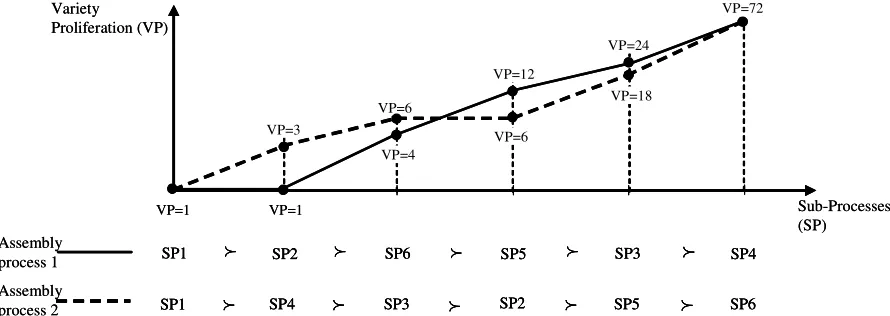
[image:8.595.92.537.72.230.2]; ; ; ; ; ; ; ; ; ; ; ; ; ; ; ; ; ; ; ; VP=1 VP=1 Assembly process 1 Assembly process 2
Figure 2: Variety proliferation according to two different PC assembly sequences
By means of this simple example, we demonstrate that due to the modularity of products, the delayed product differentiation principle is not sufficient to make optimal decisions concerning the sequence that optimizes variety proliferation. It is worth noting that the problem described may not be available when products are not developed on the basis of modules. In the absence of modularity, mixing and matching components to configure different product variants can be restrained because of incompatible interfaces. As a result, variety proliferation can be strongly constrained and alternative assembly sequences may not be available. In this case, only product redesigns would generate delayed variety proliferation. However, since we intend to examine the relationships between delayed differentiation and modularity in the case of assemble-to-order and mass customization, it is legitimate to assume that the product modularity condition is satisfied.
4 A Necessary Complement to the Delayed Product Differentiation
Principle in an Assemble-To-Order Environment
In this section, we propose to provide a complement to the principle of delayed product differentiation. The main objective is to find the principle(s) that should be additionally taken into account in order to well found decisions concerning variety proliferation. Note that we do not disapprove the principle of delayed differentiation but we have to look for other principles that should be considered in situations when this principle does not support optimal decision making. To achieve this goal, we have to examine at first the reasons that make delayed differentiation insufficient to handle the problem of variety proliferation in assemble-to-order environments.
4.1 Reasons Explaining the Insufficiencies of the Delayed Product Differentiation Principle in an Assemble- To-Order Environment
can be also seen in the decrease of production planning and scheduling complexity, fewer quality problems, lower purchasing costs, etc.
However, inventories in an assemble-to-order system may be held at the module level but not at the finished product level. It is possible to generate reliable forecasts of the aggregate demand of modules, while postponing final assembly until customer order arrives. Consequently, responsiveness is improved in that delivery times only depend on the assembly lead time, number and work content of waiting orders and shipment time to the customer. It follows that many configurations of the assembly process may involve the same level of inventory at the module level. Therefore, the immediate advantage that results from delayed product differentiation in a push system may not be available in a pull system, thereby making the comparison between two or more assembly sequences difficult as it is shown in section 3.
Recapitulating, the principle of delayed product differentiation can be sufficient in a make-to-stock environment because it reduces the negative impacts of inventories. However, in assemble-to-order systems based on modular product architectures, an additional principle is required. In this context, it is worth noting that the main objective is not to minimize variety proliferation in itself but to optimize performance. An assemble-to-order system is said to be performing well if it provides customers with the required variety2, while still achieving costs’ efficiency and responsiveness. The system performance is however, negatively affected by the complexity that is induced by variety. Martin/Ishii (1996, 1997) determine three indexes for the measurement of what they call “variety complexity”: the commonality index, differentiation index, and setup index. The commonality index evaluates the extent to which final products use common components. The differentiation index measures the degree to which variety with high added value and long assembly times proliferates at the end of the process. The setup index compares setup costs to product costs. All three indexes consider the number of variants involved at each assembly stage. It follows because of the reasons explained above that they are of little suitability in assemble-to-order systems. Furthermore, the development of these indexes is not based on an accurate definition of what complexity should be.
We agree with Martin/Ishii (1996, 1997) that the variety induced complexity should be amplified if components or modules with long assembly times and high added values are assembled at the beginning of the process. However, the real complexity effects of variety should be captured by a third variable which is the probability that a module variant would be selected by customers. This variable also enables one to estimate the impacts of commonality and setups. In effect, as the preferences of customers get increasingly polarized along a subset of module variants, the commonality of final products with respect to this subset increases. In addition, the stability of the process flow depends on the number of module variants and their corresponding selection probabilities. Thus, if we succeed in developing a single measure that is based on a precise definition of complexity and that takes the selection probabilities, added values, and assembly lead times into account, it would suitable for the evaluation of the variety induced complexity. In the next section, we propose to develop such a measure on the basis of the concept of entropy.
4.2 Model Description and Complexity Measure
For the description of the model, we need the following notations:
n Number of processes in the whole assembly process
j Index of the processes or modules
k Index of the module variants that can be assembled at a process j
In this work we are not concerned with the determination of optimal final variety from the customer perspective. This variety is supposed to be given and fulfilled through different module combinations.
Mj The module family that can be assembled at process j
Mjk A module variant that can be assembled at process j where Mj =
{
M jk}
k = 1,..,nj
Tjk Assembly time of the module variant Mjk
nj Total number of module variants that can be assembled at process j
vjk Value added due to the assembly of module variant k at process j
pjk Probability of selection of module variant Mjk
nj n
Furthermore, define Tj =
∑
p jkTjk the average assembly time at process j and T =∑
Tj thek = 1 j = 1
nj
average assembly time of the final products. Similarly, let Vj =
∑
p jkv jk be the average valuek = 1
n
added at process j and V =
∑
Vj the average value added in the final products.j = 1
In order to define a complexity measure at each process j, we will make use of the weighted Shannon entropy that is defined as (Klir/Folger 1988):
H ( p ( x ), w ( / x ) x ≈ X )= −
∑
w ( x ) p ( x ) log 2 p ( x )x≈ X
)
( ( ) are weights that are associated
where p x are probabilities defined on a finite set X and w x
)
( ( ) are nonnegative and finite real
with p x . Note that it is only assumed that weights w x numbers.
In the following, we suppose that the assembly lead times of module variants M jk / k = 1 ,..,n j at
process j are equal, thereby resulting in Tjk = Tj for k = 1 ,..,n j . In other words, it is assumed that the assembly times do not depend on the module variant, but rather on the process (or the module family). This assumption can be justified by the main property of modular products saying that the module interfaces inside a module family Mj are standardized.
Define wjk =δ α j jk where
• αjk =
v jk
is a coefficient that compares the value added v jk of module M jk to the
V
average value added V in the final products.
n
∑
Tii= j
• δ j = is the portion of time that a module Mjk spends in the process in comparison
T
to the total lead time required to assemble a final product.
n
∑
Ti Thus, the expression of wjk is: wjk = vjk i= jV T
The weighted Shannon entropy measure of process j is defined as follows:
nj n nj
Hj = −
∑
wjk p jk log2 p jk = − 1∑
Ti∑
vjk pjk log2 p jkThe total entropy of the whole assembly process is the sum of the entropies generated by each process j:
n n n nj
H =
∑
Hj = − 1∑∑∑
T vjkpjk log2 p jkj = 1 VT j = 1 i= j k = 1
i
On the basis of the total entropy measure, it is possible to evaluate alternative assembly sequences. The optimal sequence is the one with the lowest variety induced complexity value. Note that we did not consider assembly constraints, which may make the implementation of the optimal solution impossible. However, the entropy measure does not lose its value, since it enables one to choose the next best solution which is the sequence with the next lowest variety induced complexity value. Such a measure can be also seen as the driver that initiates design changes on the product level in order to reduce variety induced complexity of the assembly process. Therefore, it can be seen as a measure that evaluates Design For Assembly (DFA) efforts.
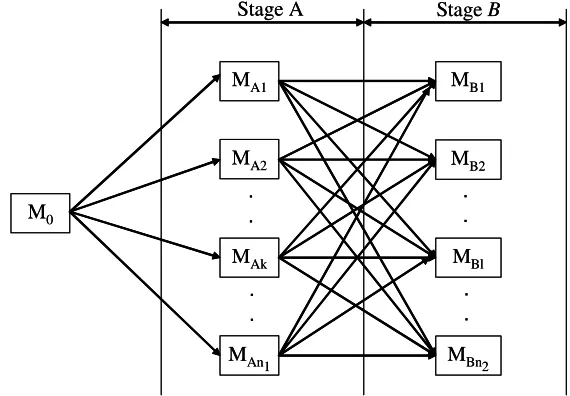
4.3 Exploration of the Complexity Measure for a Two-Stage Assembly Process In order to illustrate the application of the complexity measure and to gain insights when the delayed product differentiation principle may provide good results and when it fails, we consider an assembly process consisting of two assembly stages A and B. At stage A, n1 module variants can be assembled on a basic component. At stage B; there are n2 module variants that can be built on the sub-assemblies coming through stage A. Thus, each final product consists of the basic module; a module variant from stage A and a module variant from stage B (Figure 3). Recall that the delayed differentiation principle suggests placing stage A prior to stage B if
n1 φ n2.
Stage A Stage B
MA1
MA2
MAn1
MB1
MB2
MBn2 MAk MBl
. .
. .
. .
. . M0
Stage A StageB
MA1
MA2
MAn1
MB1
MB2
MBn2 MAk MBl
. .
. .
. .
[image:11.595.133.418.445.643.2]. . M0
Figure 3: Two-stage assembly process
The total weighted entropies of the sequence A-B and sequence B-A are provided by the following expressions:
1 n1 n2
H A− B = −
∑
vAk p log2 p −TB
∑
vBk pBk log2 pBk
V k = 1 Ak
Ak
1 n2 n1
H B− A = −
∑
vBk p log2 p −TA
∑
vAk pBk log2 pAkV k = 1 Bk
Bk
VT k = 1
In order to compare H A− B and HB− A , we compute the difference HA− B − HB− A
n1 n2
H A− B − HB− A = − 1 TB
∑
vAk p log + 1 TA
∑
vBk p log2 p T
V k = 1
Ak 2 pAk
V T k = 1
Bk Bk
Now, we shall study the function HA− B − HB− A in some particular cases:
1 • Case 1:
(
vAk)
k = 1 ,..,n = VA ,(
vBk)
k = 1 ,..,n = VB ,(
pAk)
k = 1 ,..,n = PA =n
1
1
,
(
pBk)
k = 1 ,..,n2 = PB =1 2 1 n
2
This case corresponds to equal added values and equal selection probabilities of module variants at the same assembly stage.
TA Thus, HA− B − H =
V V
A T
T
B
log2 n1 −
VB
log
B− A 2 n2
V T
H A− B φ HB− A ⇔ V T A
log2 n1
φ B
log 2 n2 V A T B
Without loss of generality, let VB = vVA and TB = tTA , where v > 0and t > 0 , thus
H A− B φ HB− A ⇔ log2 n1
φ v
log 2 n2 t
v Suppose = 1.
t
For1 φ n1 φ n2 , we have0 φ log2 n1 φ log n .This gives log 2 n1
φ 1 ⇔ HA− B φ HB− A .
2
log 2 n2
Subsequently, sequence A-B is preferred to sequence B-A due to lower variety induced complexity. Note that the delayed product differentiation principle also suggests placing A prior to B. In effect, this principle would provide similar results to those suggested by the minimum variety induced complexity principle if the selection probabilities of module variants at each assembly stage are the same and the rates at which value is added in the course of time at each process are equal.
v
However, note that in the case when ∞ 1, sequence A-B is preferred to sequence B-A if and t
v / t v
n2
only if n1 φ
( )
. For example, if = 1 .5and n2 = 3 then sequence A-B should be chosen ift
5 . 1
• Case 2:
(
v Ak k =)
1 ,..,n = VA ,(
v Bk)
k = 1 ,..,n = VB1 2
In order to be able to study the effects of the selection probabilities on the assembly sequence, we suppose that the module variants assembled at one stage have the same added values. Thus, we obtain
n1 n2
VA TB
HA− B − HB− A = −
∑
p log2 pAk +VB TA
∑
p log2 pBkV T k = 1
Ak
V T k = 1
Bk
n1
∑
p Ak log2 pAkk = 1 B
HA− B − HB− A φ 0 ⇔ n
2 φ
T V A
= v
A
∑
p log2 p V T B t Bk Bkk = 1
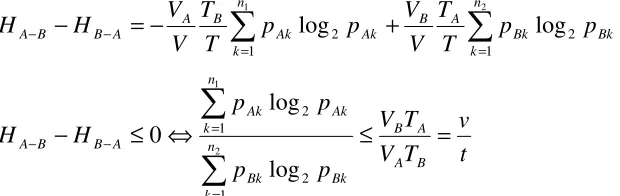
This means that sequence A-B is preferred to sequence B-A if and only if the quotient of the Shannon entropies is less than the quotient of the rate by which value is added at stage B over the rate by which value is added at stage A.
v
In order to determine the optimal assembly sequence if = 1, it is sufficient to compare both t
n2 n1
Shannon entropies HA = −
∑
p Ak log2 p Ak and HB = −∑
p Bk log2 pBk k = 1 k = 1Now, in order to gain more insights, suppose that at each stage, only two module variants are
assembled, which means that n1 = n2 = 2 . Thus,
v
HA− B − HB− A φ 0 ⇔ f ( pA1, pA2, ) = H ( p A1 , 1− p A1 ) − vH ( p B1 , 1− p B1) φ 0 , where
t t
H ( p A1 , 1− p A1 ) = − p A1 log2 pA1 − ( 1− p A1) log 2 ( 1− p A1 ) ,and
[image:13.595.54.364.159.257.2]H ( p B1 , 1− p B1 ) = − p B1 log2 pB1 − ( 1− p B1) log 2 ( 1− pB 2)
Figure 4 depicts the binary Shannon entropy3 weighted by different values of v / t . One can notice that if p A1 = pB1 (subsequently pA2 = p B 2 ), then the value of ( v / t ) determines the
configuration of the assembly sequence. In effect, if (v / t) > 1, then placing assembly stage A
first will result in lower complexity. However, if (v / t) < 1, then stage B should be placed prior to
A. In the case when p A1 ∞ p B1 , the assembly sequence depends on the values of each variable, v
namely pA1, p A2and . t
v 1 2
Solving the equation H ( p B1 , 1− p B1) = 1 provides two solutions pB1 and pB1. In effect, if
t
1 2
(v / t) = 1 .15, pB1 → 0 ,3 and pB1 → 0 . It follows that for ,7 pB1 ≈
[
0 .3,0.7]
, we have vH ( p B1 , 1− p B1) > 1 (see figure 4). Since � pA 1≈
[ ]
0 the values that are taken by the binary ,1 t3
Shannon entropy H ( p A1 , 1− p A1) are usually less than or equal to 1 v
H ( p A1 , 1−p A1 ) −vH ( p B1 , 1− p B1) <0 . Note that when τ σ (This corresponds to the case
t t
2
when the pace at which value is built up at stage B is very high), p1 B1 τ0 and pB1 τ1, in other
1 , 0
words �pA1 ≈
[ ]
we will have HA−B −HB−A φ0 . It follows that if the value added at stage B is very high, stage A should usually be placed before stage B regardless of which selection probabilities of module variants are involved.1 2
[image:14.595.114.523.240.570.2]In the case when p A1 ≈
]
0 ,p B1[
and p A1 ≈]
p B1 , 1[
, the results cannot be generalized and the decision about the assembly process configuration depends on the values taken by each variable.Figure 4: Weighted Shannon entropies for different values of (v/t)
• Case 3: General case:
In the general case, stage assembly A should be placed before assembly stage B if and only if
n1
H A− B −H B− A φ 0⇔
v v
n Bk k
Ak
2
1
∑
∑
=p p
Bk Ak
log log
2 2
p p
Bk Ak
φ
t
1
k = 1
variety induced complexity, we suppose again that n 1 = n2 = 2 . In addition, let vA2 =Δ vA1 and
vB 2 =Γ vB1 . Subsequently,
0
HA− B − HB− A φ ⇔
− p log2 pA1 − − p ) log ( 1− p ) φ − 1 vB1
{
p log2 p + − p ) log ( 1− p )
}
Δ ( 1 Γ ( 1
A1 A1 2 A1 B1 B1 B1 2 B1
t vA1
To illustrate the effects of assembling module variants with very different added values at one stage, we ascertain the selection probabilities. p A1 = pB1 = 1/ 2 . From this, it follows that the condition to be satisfied in order to justify placing stage A before B is:1 +Δ φ 1 vB1 .
1 +Γ t vA1
Consequently, the presence of cost intensive module variants drives the placement of the corresponding stage to the end of the assembly process.
Now, we will examine the effects of commonality on the variety induced complexity in the assembly process. Commonality refers to the multiple uses of a few module variants across several product variations. When n 1 = n2 = 2 , the substitution of both module variants at one stage by a single module increases commonality. We shall therefore study the impacts of commonality on the variety induced complexity.
Suppose that through a redesign of the product, we replace both module variants MA1 and that are assembled at stage A by a single module M . In this case, a functional congestion
MA2 A
of the new module is necessary since it should perform both functions of MA1 and MA2. Therefore, it can generally be assumed that v A >vA1 and vA > vA2 . However, vA < vA1 + vA2
because the substitution of two module variants by a common module avoids the duplication of components or interfaces. Consequently, the variety induced complexity that is triggered at stage
A is reduced to 0 since the probability of selection of module M A is equal to 1. Thus variety induced complexity in the assembly process is equal to the complexity brought about by the
second stage and subsequently (H ) = − TB
(vB1 pB1 log 2 pB1 + vB 2 pB2 log2 pB 2 ) . Note that
A− B 1
VT
the entropy measure does not capture the increase of added value of the common module. In effect, the weighted Shannon entropy introduced at section 4.2 only measures complexity that is triggered by variety.
On the other hand, suppose commonality is introduced at stage B so that M B1and MB2 are both replaced by module M B with vB > vB1, vB >vB 2 and vB < vB1 + vB2 . Thus, the total variety
1
induced complexity is (H A− B ) 2 = − (vA1 pA1 log 2 pA1 + vA2 pA2 log 2 pA2 ) . It is clear that when V
there are no assembly sequence constraints, it is more adequate to place the assembly of the common component at the first stage. This also corresponds to the results that would be suggested by the delayed product differentiation principle. However, the minimum variety induced complexity principle provides an additional result. In effect, it suggests introducing the common module at the stage with higher weighted Shannon complexity. This way, the total variety induced complexity can be minimized.
Now consider the case when assembly sequence constraints oblige placing stage A prior to stage
common module should be introduced due e.g. to design team capacity constraints. The delayed product differentiation principle would propose to introduce commonality at stage A. But the variety induced complexity principle suggests comparing both quantities (H A−B )1 and (H A−B )2 . This provides
1 (H ) − (H ) = − TB
(vB1 pB1 log 2 pB1 + vB 2 p log2 pB2) + (vA1 pA1 log 2 pA1 +
A−B 1 A−B 2
VT B 2 V
p log2 p vA2 A2 A2)
Thus, if (H A−B )1 − (H A−B )2 < 0 , it is more adequate to introduce the common module at stage
A. However, if (H A−B )1 − (H A−B )2 > 0 , then it is better to place commonality at the next stage. Note that in the case when (H A−B )1 − (H A−B )2 = 0 , the delayed product differentiation principle should be applied, thereby resulting in the placement of stage A first.
5 Summary and Conclusions
In this paper, we have presented the insufficiencies of the delayed product differentiation principle. By means of a simple example from the computer industry in which the degree of product modularity is very high, we have demonstrated that this principle cannot support optimal decisions concerning how variety should proliferate throughout the assembly process. Furthermore, we have dealt with the potential problems that may be triggered by the application of this principle in assemble-to-order environments. To fill this gap, the minimum variety induced complexity principle is introduced. It is a complement to the first principle and builds upon the weighed Shannon entropy. The proposed measure evaluates the complexity due to the proliferation of product variety throughout the assembly process. The variety induced complexity depends on three main variables, namely the selection probabilities, value added and assembly time of each module variant.
The results that are attained during the discussion of the two stage assembly process can be generalized for an n-stage process in the following way:
• If the selection probabilities of module variants in each stage are equal and the pace at which value is added throughout the assembly process is fairly constant, then both principles would lead to the same result. Therefore, it is adequate to delay the proliferation of variety toward the end of the process.
• If an assembly stage involves an exponential increase of the rate at which value is added, this stage should be placed at the end of the process regardless of the selection probabilities.
• In an assemble-to-order environment, if the selection probabilities of the module variants are very different and the paces at which value is added are very variable, it is necessary to configure the assembly process in such a way that the total value of complexity is kept at a minimum level.
is a function that increases in the assembly lead time. The higher the number of assembly stages after the first variety proliferation, the higher the variety induced complexity.
• The decision about which module variants should be eventually substituted by a common module can be supported by the entropy measure. The alternative that strongly decreases complexity has to be chosen.
An implicit assumption of our model is that the selection probabilities are independent, which means that the selection of a module variant at one stage does not influence the selection probabilities at subsequent stages. Therefore, this work can be extended by relaxing this assumption. In order to achieve this goal, we have to consider the Shannon entropy defined for conditional probabilities. This way, we can examine the effect of the so-called “blocking” (Maroni 2001) in order to reduce variety induced complexity. Blocking refers to a variety steering action that restrains the mixing and matching possibilities of module variants. It can be described by the following rule: “If module variant 1 is selected, then select module variant 2”. In terms of probabilities, this would mean that the conditional selection probability of module variant 2 knowing that module variant 1 has already been chosen is equal to one.
Furthermore, the proposed model assumes must-modules at each assembly stage. In other words, each module family must be represented by one module variant in each product variation. Subsequently, the model does not consider the impacts of options (can-modules) on the variety induced complexity. Each assembly stage in which option variants are assembled would involve two distinct probabilities. The first probability is about the event whether options from that assembly stage would be selected at all. The second one is the conditional probability that an option variant would be chosen knowing that the first event has occurred. This extension will enable us to study the complexity effects of options and to quantitatively measure the advantage of some variety steering actions, e.g. the packaging of options.
References
Alderson, Wroe (1950): Marketing efficiency and the principle of postponement, Cost and Profit Outlook, Vol. 3, pp. 15-18.
Ashby, Ross, W. (1957): An Introduction to cybernetics, 2nd Edition, London: Chapman & Hall LTD 1957.
Baldwin, Carliss Y. / Clark, Kim B. (2003a): Managing in an Age of Modularity, in: Raghu Garud / Arun Kumaraswamy / Richard N. Langlois (Eds.): Managing in the Modular Age – Architectures, Networks, and Organizations, Malden et al.: Blackwell Publishing 2003, pp. 149-171.
Bertalanffy, Ludwig V. (1976): General Systems Theory, Revised Edition, New York: George Braziller 1976.
Blecker, Thorsten / Friedrich, Gerhard / Kaluza, Bernd / Abdelkafi, Nizar / Kreutler, Gerold (2005): Information and Management Systems for Product Customization, Boston et al.: Springer, 2005.
Bucklin, Louis P. (1965): Postponement, speculation and the Structure of Distribution Channels, Journal of marketing research, Vol. 2, No. 1, pp. 26-31.
Duray, Rebecca / Ward, Peter T. / Milligan, Glenn W. / Berry, William L. (2000): Approaches to mass customization: configurations and empirical validation, Journal of Operations Management, Vol. 18, No. 6, pp. 605-625.
Ericsson, Anna / Erixon, Gunnar (1999): Controlling Design Variants: Modular Product Plat-forms, Dearborn / Michigan: Society of Manufacturing Engineers 1999.
Feynman, Richard P. (1991): Vorlesungen über Physik, vol. 1, München / Wien: Oldenburg 1991.
Garud, Raghu / Kumaraswamy, Arun (2003): Technological and Organizational Designs for Realizing Economies of Substitution, in: Raghu Garud / Arun Kumaraswamy / Richard N. Langlois (Eds.): Managing in the Modular Age – Architectures, Networks, and
Organizations, Malden et al.: Blackwell Publishing 2003, pp. 45-77.
Klir, George J. / Folger, Tina A. (1988): Fuzzy Sets, Uncertainty, and Information, New Jersey: Prentice Hall, Englewood Cliffs 1988.
Lampel, Joseph / Mintzberg, Henry (1996): Customizing Customization, Sloan Management Review, Vol. 38, No. 1, pp. 21-30.
Lee, Hau L. (1996): Effective Inventory and Service Management through Product and Process Redesign, Operations Research, Vol. 44, No. 1, pp. 151-159.
Lee, Hau, L. / Tang, Christopher S. (1997): Modelling the Costs and Benefits of Delayed product Differentiation, Management Science, Vol. 43, No. 1, pp. 40-53
Maroni, Dirk (2001): Produktionsplanung und -steuerung bei Variantenfertigung, Frankfurt am Main et al.: Peter Lang 2001.
Martin, Mark V. / Ishii, Kosuke (1996): Design For Variety: A Methodology For Understanding the Costs of Product Proliferation, Proceedings of The 1996 ASME Design Engineering Technical Conferences and Computers in Engineering Conference, California, August 18-22, 1996, URL: http://mml.stanford.edu/Research/Papers/1996/
1996.ASME.DTM.Martin/1996.ASME.DTM.Martin.pdf (Retrieval: April 01, 2005).
Martin, Mark V. / Ishii, Kosuke (1997): Design For Variety: Development of Complexity Indices and Design Charts, Proceedings of DETC’97, 1997 ASME Design Engineering Technical Conferences, Sacramento, September 14-17, 1997, URL:
http://mml.stanford.edu/Research/Papers/1997/1997.ASME.DFM.Martin/1997.ASME.DF M.Martin.pdf (Retrieval: April 01, 2005).
Pine II, B. Joseph (1993): Mass Customization: The New Frontier in Business Competition, Boston, Massachusetts: Harvard Business School Press 1993.
Schilling, Melissa A. (2003): Toward a General Modular Systems Theory and its Application to Interfirm Product Modularity, in: Raghu Garud / Arun Kumaraswamy / Richard N.
Langlois (Eds.): Managing in the Modular Age – Architectures, Networks, and Organizations, Malden et al.: Blackwell Publishing 2003, pp. 172-214.
Shannon, Claude E. (1948): A Mathematical Theory of Communication, The Bell System Technical Journal, Vol. 27, pp. 379-423.
Sharman, G. (1984): The rediscovery of logistics. Harvard Business Review, Vol. 62, No. 5, pp. 119-126.
Ulrich, Karl (1995): The role of product architecture in the manufacturing firm, Research Policy, Vol. 24, No. 3, pp. 419-440.
Van Hoek, Remko I. (1997): Postponed manufacturing: a case study in the food supply chain,
Supply Chain Management, Vol. 2, No. 2, pp. 63-75.
Van Hoek, Remko I. (2001): The rediscovery of postponement a literature review and directions for research, Journal of Operations Management, Vol. 19, No. 2, pp. 161-184.