© 2018, IRJET | Impact Factor value: 6.171 | ISO 9001:2008 Certified Journal | Page 2729
NUMERICAL ANALYSIS ON CD NOZZLE USED FOR BLAST DIFFUSING
SHIBU AUGUSTINE
1, ABHISHEK TK
2, AKASH VINCENT
3, ELVIN MANOJ
4, JOMY CJ
5, LIKHIL JOSEPH
6.
1
Assistant professor, Department of mechanical engineering, Malabar College of engineering and technology,
Pallur P.O.679532, Thrissur, India.
2,3,4,5,6
UG Scholars (Bachelor of Technology), Department of Mechanical Engineering, Malabar College of engineering
and technology, Pallur P.O.679532, Thrissur, India.
---***---
Abstract
-
Explosions are of various kinds; this field has beenalways an interesting area for researchers and scientists. Many studies and analysis both experimental and numerical had been conducted by various researches in order to increase and decrease the effects of explosion. Many studies are conducted to control the effect of explosion and to prevent the explosion and its damage. This paper aims to reduce the effect of explosion using pressure waves, by creating high pressure covering few distances racially from epicenter. For this high pressure shock waves are used. Analysis is done on mitigating the effect of explosion and possible ways to prevent explosion are taken in to consideration. Numerical analysis on blast diffuser using CD nozzle is analyzed using ANSYS Fluent software vr.15. Pressure based modelling is carried out and k-ωmodel is used since turbulence is to be analyzed. Transient and time variant condition is assumed. Atm. Pressure of 1 bar and blast pressure of 10 bar is considered.
Keywords
- Pressurewaves, k-ωmodel, transient model,CD nozzle
I. INTRODUCTION
Normally we associate an explosion with a loud noise and loud bang and destruction of things from the place of the explosion by destruction. There is total damage in at the place and therefore, all of us are used to connect the word as we say explosions with a loud noise and disruption of things at the place wherein the explosion.
A rapid increase in volume and release of energy in an extreme manner formulates an explotion, usually with generation of high temperature and the release of gases. Supersonic explosions created by high explosive are known as detonations and travel via supersonic shock waves. Subsonic explosion is created by low explosive through a slower burning process known as deflagration.
Explosive force is released in direction perpendicular to the surface of the explosive. If a land mine is in ground during explosion, the direction of blast will be 180° in contrast the explosive forces are focused to produce a greater local effect.
This particular paper looks at what causes an explosion, what are the different types of explosion and being disruptive in
nature. This paper also tries to mitigate the effect of the explosions and try to see whether institute some steps to prevent some of the explosions.
II. LITERATURE REVIEW
Kutter & Fairhurst [1] analytically and experimentally studied the fracture process in the zone immediately around the borehole by separating the two principal blast forces. This was done to clarify the respective roles of stress wave and gas pressure in the fragmentation of an underground blast. Through a pulse generated by an underwater spark discharge the explosion wave can be simulated by and the expanding combustion products by pressurized oil. The various influence of boundary conditions, i.e. pre-existing fractures, static stress field, and close free surface, on the wave and gas-generated fracture pattern, was investigated in detail. The stress field generated by the pressurized gas in this star-cracked cavity was shown much more similar to that of a pressurized and un cracked equivalent cavity and its diameter is equal to that of the fractured zone. A wide area is therefore stressed by the gas; mad consequently considerable extension of crack can be expected.
This paper presents an attempt to consider, in simplified fashion than the combined effects of both strain wave and gas pressure and their interactions. The study also points out that the pre-existing fractures grow to larger lengths than new ones and cause a fracture-free zone in their immediate vicinity. The growth of crack prefers in the direction of maximum principal stress of the superimposed stress fields. The cracks that pointing towards the free surface are larger than the ones pointing away from it. It was found that the width of the radially fractured zone depends not only on the tensile strength and wave velocity of the rock, the input pressure and the detonation velocity of the explosive, but to a large degree also on the extent of energy absorption in the rock mass
© 2018, IRJET | Impact Factor value: 6.171 | ISO 9001:2008 Certified Journal | Page 2730 Menter [2] presented two new versions of the
k-ωtwo-equation turbulence model. In this, a new Baseline (BSL) model was designed to obtain observation similar to that of the k-ω model of Wilcox, but without its strong dependency on arbitrary free stream values. The BSL model is identical to the Wilcox model in the inner 50% of the boundary layer. But it changes gradually to the high Reynolds number Jones-Launder k - e model (in a k - w formulation) towards the boundary-layer edge.
Three k–ω turbulence models using linear and nonlinear eddy-viscosity formulations are implemented in an implicit multi grid method by Park & Kwan [3] and its detailed techniques of implementation are presented and discussed. Here freezing and limiting strategies are applied to improve robustness and convergence of the multigrid method. The paper first tested Wilcox k–ω, k–ω shear-stress transport, and Wilcox–Durbin+ (WD+) models for flat-plate flow, and it was found that the results are in good agreement with the empirical correlations. In this work, the compressible Navier– Stokes equations and the k–ω turbulence equations are considered.
Few boundary conditions are applied in these studies. The usual without slip condition (k =0 on the wall) is given for k on wall boundaries. The non-dimensional pressure-gradient parameter βT is constant in equilibrium boundary layers. The
new model employs the explicit algebraic Reynolds-stress model (EARSM) developed by Wallin and Johanssonas the constitutive relation between the turbulent stress tensor and the mean-velocity gradient. The new scale-determining model is based on the k–ω formulation. This analysis is a very useful tool providing understanding of anomalies occurring with many k–ω models near the edges of turbulent flows. These constraints were very useful in the calibration process. This is owing to two reasons. First, the EARSM constitutive model has a wider range of applicability than the linear Boussinesq relation, which is used in most of the other k–ω models. Second, a relatively wide base of different flows was used in the calibration. However, the new model as well as the reference models predicted a too symmetric slat wake. The proposed new k–ω EARSM model is a promising model to be employed in practical computational fluid dynamics (CFD) working aerodynamic design and analysis
Based on the combustion, explosions and air dynamics and related theory etc. Aihua.et.al. [5] presents the mathematical model of explosion of gas in detail, combined with the gas explosion transmission mechanism. The paper makes a research on two wave-three area structure of gas explosion and the energy change rule of the array face of flame wave and the array face of precursor wave, with the fluid dynamics analysis Fluent software.
Jassim & Awad [6] conducted numerical investigation of nozzle shape effect on shock wave in natural gas processing. Since the traditional means are sophisticated in design, continue lacking robust and poor in efficiency, a supersonic nozzle has been introduced as an alternative means to meet such demands. A 3-Dimentional Convergent-Divergent Nozzle can be simulated using commercial Code for pressure ratio (NPR) varies from 1.2 to 2. Six various shapes of nozzle are numerically examined to locate the position of shock wave as such spot could be considered as a benchmark of particle separation. Rectangle, hexagonal, pentagon, circular, elliptical and triangle nozzles are simulated using the Fluent Code with all have same cross-sectional area. From the results from CFD Simulation, however, show that geometry of nozzle influences the flow structures which including location of shock wave. The analysis on CFD will predicts the shock appearance when p01/pa>1.2 for almost all geometry and locates at the lower
area ratio (Ae/At). The results from simulation showed that
shock wave in Elliptical nozzle has the farthest distance from the throat among the others at relatively small NPR. A Reynolds averaged Navier-Stokes equation with k-ε equation turbulence is used to predict shock position in symmetric 3-D nozzle.
The finite volume solver, FLUENT 6.3.26, is used to obtain the numerical solution of the three-dimensional compressible Navier–Stokes (RANS) equations in connection with (kε)turbulence model equation. The discretized equations, along with the initial condition and boundary conditions, were solved using the segregated solution method, in which the conservation of mass and momentum were solved sequentially and a pressure correction equation (SIMPLE Scheme) was used to ensure the conservation of momentum and the conservation of mass (continuity equation). Utilizing supersonic nozzle for this purpose has showed a positive impact on the separation technology due to simplicity in designing, cost effective in manufacturing, and feasibility in maintenance. The research in this work focus mainly on employing CFD commercial software to study the influence of nozzle shape on the shockwave location since such location impacts the turbulence of the flow that eventually forces small particles to move towards the nozzle wall. Hence, improves the collection efficiency. The numerical results show that nozzle shape is slightly changed with the shape of the nozzle. Elliptical nozzle predicts shockwave a bit later than other shapes for specific NPR. However, at high NPR hexagon nozzle is the one among the rest whose shock location becomes the farthest from the nozzle throat.
© 2018, IRJET | Impact Factor value: 6.171 | ISO 9001:2008 Certified Journal | Page 2731 It is analyzed and presented in this research work. NPR value
is taken as parameter to analyze the effect. In this work CD nozzle is designed for a design point and simulated for different NPR values at different inlet and ambient pressures. It is studied for shockwave effects and their influence over downstream flow temperature. Temperature is increased in downstream of the shock wave
III. DESIGN AND ANALYSIS
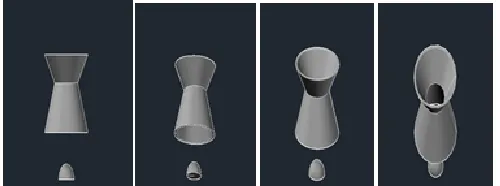
[image:3.612.332.561.271.423.2]Energy equation is the basis of the analysis. This is a pressure based analysis, where shock wave of certain pressure is used to control the effect of explosion from a blast diffuser.
Fig 1.Basic Model
Shockwave is produced using a C-D nozzle at required pressure to control or prevent the explosion from blast diffuser. Here time variation and transient flow is assumed in the analysis. k-e model cannot be used because it can only be used for pure turbulence consideration. In order to consider laminar flow condition occurring in between the turbulence k-ω model is used. Blast pressure of 10 bar is used
Fig2. Blast model CAD
IV. EVALUATION
In the numerical analysis, shock wave produced by the nozzle is used to reduce the pressure and effect of the explosion created by the blast body. Analysis is done using nozzle with and without slit. When slit is provided to the nozzle wall loss occurs at a high level. So in order to reduce the loss due to slit double wall slit is used. Outer section of nozzle is provided with wall having similar slits.
Nozzle without slit
The fig 3,show the analysis of effect of explosion pressure when shock wave produced by nozzle is used. It analyzes nozzle without slit. Nozzle is kept at different distance from the blast body and the effect is analyzed.
[image:3.612.42.292.557.650.2]5cm
Fig 3. Nozzle without slit
From the fig 3, it is clear that nozzle effects the explosion pressure and reduces its effects. It can be seen that the explosion pressure which is high around the blast body which is shown by red area reduces near the nozzle and it is shown with the green area. It can also beanalyzed that with increase in the distance of nozzle from the blast body the effect due to explosion also increases. Here the explosion area increases when the nozzle is away from the blast body. The pressure concentrated on the small explosion area is more than the pressure concentrated when nozzle distance increases. In this case without split the impulsive force action on the nozzle wall is very high. It can damage the nozzle. So to reduce the impulsive force split nozzle is used.
Nozzle with double wall slit
© 2018, IRJET | Impact Factor value: 6.171 | ISO 9001:2008 Certified Journal | Page 2732 in case of without slit nozzle is obtained. The explosion zone
goes on decreases and it is minimum near the nozzle. The nozzle mitigates the effect and the region surrounding nozzle has minimum effect of explosion and it is shown with the blue area. Although results are similar the double slit wall protect the nozzle by reducing the impulsive force acting on it.
[image:4.612.325.565.73.241.2]5cm
Fig 4. Nozzle with double slit
3D Model for 7.5 cm
The distance from nozzle to the blast body is taken has 7.5cm and its 3D model is analyzed. The effect of nozzle on explosion can be clearly visible in this 3D view. The explosion zone goes on decreasing and its effect is strong only at the blast body. The blue and green zone indicates the minimum effect of the blast pressure.
Fig 5.3D model
Single slit wall 7.5 cm
[image:4.612.61.272.156.314.2]Analysis was also conducted for a single slit wall. Here slit is provided in the walls of nozzle and another wall without nozzle is provided. The results are similar as in the above cases. The values obtained and the explosion zones obtained are similar.
Fig 6. Single slit wall
3D pressure plot for nozzle without slit
The fig 5, shows the 3D pressure plot for nozzle without slit. The maximum pressure is found as 10 bar at nozzle distance 0. This ground pressure decreases with increase in distance of the nozzle. Since increase in distance of nozzle from blast body decreases the explosion zone, pressure concentrated in that area increases.
Graphical representation of results
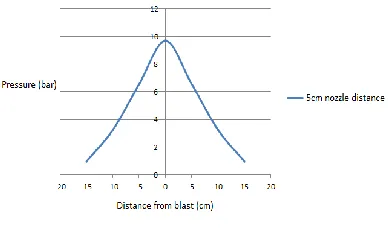
The graphical representation of ground pressure concentrated with change in distance from blast or blast radius is analyzed. The analysis is done for various distance of the nozzle from blast body is taken as 5cm, 7.5cm and 10cm
Fig 7. pressure vs. distance (5cm)
[image:4.612.69.261.452.594.2] [image:4.612.352.546.457.572.2]© 2018, IRJET | Impact Factor value: 6.171 | ISO 9001:2008 Certified Journal | Page 2733 In the fig 8, also similar result is obtained. Here the distance of
[image:5.612.348.553.93.203.2]the nozzle from the blast body is fixed at 7.5 cm. The pressure concentrated is maximum when blast distance is 0 and vice versa. When the blast zone moves away from the point of blast, the effect reduces and pressure reduces. This is easily seen in the 3D model shown in fig 5.
Fig 8. pressure vs. distance (7.5cm)
The fig 9, also shows similar result. Here the distance of nozzle from blast body is fixed at a distance of 10cm in this figure and the result is as similar as in the above mentioned cases.
Fig 9. pressurevs. distance (10cm)
[image:5.612.63.275.167.283.2]The comparison graph shown below shows the pressure concentration with change in blast distance or blast radius for nozzle distance from blast body fixed at 5cm, 7.5cm, & 10cm. it can be seen that the result is almost similar. Only slight differences can be seen in the graphs. When distance of the nozzle increases the explosion zone also increases. The explosion zone is minimum when distance of nozzle is less. Since the explosion zone increases when the distance of nozzle from the blast body increases the pressure concentration is slightly more for 10cm nozzle distance than 7.5 & 5cm.
Fig 10. graph comparison
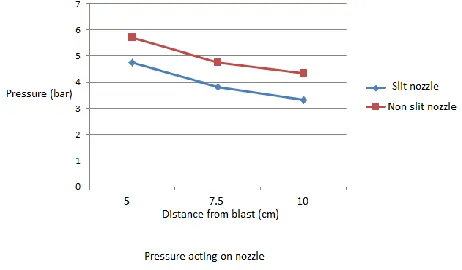
The graph 11, shows the comparison between the pressure acting on a slit nozzle and nozzle without slit. Pressure vs. Blast radius graph is analyzed. Distance of nozzle from blast body is taken at 5cm, 7.5cm and 10 cm. It can be seen that pressure acting due to the explosion is much more in a non-slit nozzle than at a slit nozzle. So a slit nozzle is more effective in controlling an explosion than a non-slit nozzle. Slit nozzle also protect the nozzle wall from the impulsive force of the explosion.
Fig 11.pressure acting on nozzle comparison
V. CONCLUSION
[image:5.612.327.558.356.491.2] [image:5.612.52.278.367.495.2]© 2018, IRJET | Impact Factor value: 6.171 | ISO 9001:2008 Certified Journal | Page 2734 decreasing when the blast radius increases. A better and
alternate impact protection than nozzle can be used to reduce the effect of explosion. D3O is one such impact protection.D3O (also"D3o") is a energy absorbing material consisting polyurethane.
ACKNOWLEDGMENT
We owe a debt of deepest gratitude to our guide Mr.Shibu Augustine, Department of Mechanical Engineering, Malabar College of Engineering and Technology, Thrissur, whose support, stimulating suggestions and constant encouragement proved decisive in shaping up of this thesis paper work.
REFERENCES
[1]Kutter & Fairhurst, “ON THE FRACTURE PROCESS IN BLASTING”, (1970), Int. Y. Rock Mech. Mln. Scl. Vol. 8, pp. 181-202. PergamonPrcu 1971. Printed in Great Britain.
[2]Florian R. Menter, “Improved Two-Equation k-ωTurbulence Models for Aerodynamic Flows”, (1992), NASA Technical Memorandum 103975.
[3]Park & Kwon, “Implementation of k–ω Turbulence journal of Latest Trends in Engineering and Technology (IJLTET), Models in an Implicit Multigrid Method”, AIAA JOURNAL Vol. 42, No. 7, July 2004.
[4]AnttiHellsten, “New Advanced k–ω Turbulence Model for High-Lift Aerodynamics”, (2005),AIAA JOURNAL Vol. 43, No. 9, September 2005.
[5]Yan Aihua, NieBaisheng,Dai Linchao, “Numerical Simulation on the Gas Explosion Propagation Related to Roadway”, (2011), Procedia Engineering 26 (2011) 1563 – 1570 Published by Elsevier Ltd.
[6]Jassim and Awad, “Numerical Investigation of Nozzle Shape Effect on Shock Wave in Natural Gas Processing”, (2013) International Journal of Chemical and Molecular Engineering Vol:7, No:6, 2013.