Munich Personal RePEc Archive
An Analysis of Iran’s Third Five-Year
Development Plan in the
Post-Revolution Era (2000-2005)
Valadkhani, Abbas
UNE Business School, University of New England
2001
Online at
https://mpra.ub.uni-muenchen.de/50386/
An Analysis of Iran’s Third Five-Year Development Plan
in the Post-Revolution Era (2000-2005)
By
Abbas Valadkhani,
Department of Economics,
Center of Full Employment and Equity
The University of Newcastle,
2308 NSW Australia
Email: [email protected]
Abstract1
The major objective of this paper is to provide a succinct and critical review of Iran’s Third Five-Year Development Plan (2000/01-2004/05, fiscal year ending March 20). After highlighting the salient features of the Iranian economy and a brief explanation of the previous two development plans, this paper discusses the extent to which the specified macroeconomic objectives of the third plan are achievable. It is argued that there are a number of practical inconsistencies and structural problems in this plan like its predecessors that stifle the long-run economic development. More specifically the constitution, which is beyond the government control, should be appropriately amended to allow the badly needed structural reforms in the Iranian economy prior to launching any development plan.
1. Introduction
Like many other developing economies, Iran suffers from several economic problems, including high rates of inflation and unemployment, a meager growth in real GDP, a substantial rent-seeking behavior, income inequality, long-run macroeconomic imbalances in the form of foreign indebtedness and large trade and public sector deficits. From an historical perspective, in the context of the Iranian economy, these economic problems result from both the government's economic mismanagement and a number of non-economic factors.
The non-economic or external factors are associated with the upheavals consequential to the 1979 Islamic Revolution, the destructive eight-year war with Iraq (1980-1988), the freezing of the country's foreign assets, a volatile international oil market, and economic sanctions. Discussion of these factors is beyond the scope of this study but the interested reader can see Pesaran (1992, 1995) and Amuzegar (1992, 2000) for concise discussions of these issues.
However, to some extent, the prevailing economic malaise in Iran is associated with, and/or intensified, by inappropriate economic policies. Iran has more than a half century of planning history but it seems that the recent five-year development plan (2000-2005), which
is the third plan after the 1979 revolution and the eighth plan since mid 1940s, like its predecessors, do also suffer from significant inconsistencies.
The objective of this paper is to provide a succinct and critical review of Iran’s Third Five-Year Development Plan (2000-2005). The paper is structured as follows. Section 2 provides an overview of the salient characteristics of the Iranian economy from an historical perspective. Section 3 discusses briefly the first two development plans implemented after the 1979 revolution. Section 4 concentrates on the third development plan. In this section a descriptive approach is adopted to examine the extent to which the specified macro targets of this plan are attainable.
2. An Overview of the Iranian Economy
According to the Central Bank (2000) of Iran, the total population of Iran was estimated at 62.8 million in 1999. The annual population growth was approximately 4.2 per cent, 2.5 per cent and 1.6 per cent for 1979, 1988 and 1999, respectively. To some extent, the relatively large population growth rates during 1970s and 1980s can be attributed to the influx of approximately two million Afghan and one million Iraqi refugees (Karshenas and Pesaran, 1995). However, a decrease in population growth after 1986 reveals the effects of the intensive family planning and population control policies.
Moreover, internal migration from rural to urban areas remains a persistent cause for concern because from 1959 to 2000 the percentage of the population classified as "urban" decelerated from 32.9 per cent (Vakil, 1973) to 64 per cent (Management and Planning Organisation, MPO, 2000). This urban drift was fuelled by the failure of land reform, as well as the growing gap between the quality of life in rural and urban areas. The unemployment rate in 1969 was as low as 6 per cent (Rad-Serecht, 1979) and in 1999 it was estimated to be as high as 16.2 per cent (MPO, 2000).
per US dollar in the early 1980s to 1400 rials in 1989. Because of the growing gap between the official rate and the black market rate, in 1993 the government devalued the rial to 1750 per US dollar in an attempt to restore an equilibrium in the foreign exchange market and foster non-oil exports. Notwithstanding the fact that Iran used a multiple-exchange-rate system in the allocation of scarce hard currency earnings, this system was unsuccessful. According to Farzin (1995) at one time during the war the number of exchange rates applicable to various categories of imports and exports exceeded seven. The gap between the black market and the "government floating rate" was 930 rials per US dollar in December 1994 (Pesaran, 1995). The Iranian currency depreciated almost as much as the consumer price index has risen during the last three decades. A US dollar could buy approximately 70 rials in 1972 but on 19 Aug 2001 it was exchanged for 7970 rials, a depreciation of 114-fold for the Iranian currency.
The main reason for the deterioration in the value of the rial is the monetisation of enormous budget deficit during and after the Iraqi war. It should be mentioned that, to some extent, psychological and socio-political factors have also played an undeniable role.
The growing gap between the government official and black market exchange rates directed scarce resources to unproductive sectors. The profitability of the trade sector, particularly small-scale trade such as sidewalk and small vendors, stimulated rent-seeking activities at the expense of goods-producing sectors. The currency devaluation policies also coerced economic agents, particularly the government and semi-government enterprises, into having an enormous demand for money. In other words, with depreciation domestic currency, people, including the government and semi-government enterprises, demand more money to cover their foreign transactions.
It seems that there exists a vicious cycle in which a high inflation devalues the rial and a negligibly valued rial aggravates inflation. There are some empirical studies which have elucidated this cycle, for example Dadkhah (1987) and Bahmani-Oskooee (1993).
More specifically, Dadkhah (1987, 1988) considers different potential explanations of Iran’s inflation including the quantity theory of money, New Classical theory, cost-push and structuralist.2 He employs Granger causality tests and clarifies that in Iran inflation has
been a monetary phenomenon. In other words, the monetisation of the government budget deficit has played a major role in increasing money supply and hence inflation. In addition, he believes there are two other important sources which contribute to inflation.
The first source pertains to the cost-push theory. Under inflationary circumstances labor unions feel that real wages decrease, thus they demand higher nominal wages. The capitalists respond to this increase in nominal wages by raising prices. As a result of this ongoing procedure, inflation will be accelerated. However, labor unions do not have a determining role in the Iranian economy and it appears that labor unrest was not the cause of inflation, but a response to it (Dadkhah 1988). The second important cause of inflation is associated with devaluation and import price increases.
In Iran, like many other developing countries, the domestic manufacturing industries heavily depend upon the importation of some intermediate goods so as to keep the wheels of production turning. Given the nature of Iranian imports of intermediate goods and its magnitude which is 50 per cent of total imports during the last four decades, the demand for some imports are inelastic with respect to price, and hence devaluation has little, if any, effect on quantities purchased. As a result of the devaluation of the rial, the cost of imports in domestic currency, and consequently inflation, increased. Furthermore, "devaluation increases the value, in domestic currency, of international reserves held by the Central (or national) Bank, raising the credit side of its balance sheet. This increase is often balanced by increasing money in circulation on the debit side" (Dadkhah, 1988: 12).
In sum, Dadkhah (1988) concludes that monetary expansion to finance the budget deficit was the dominant cause of inflation in Iran. Labor strikes, devaluation of the domestic currency and import price increases only exacerbated passively the inflationary process.
of government debt to the Central Bank. The effect of this process is that the Central Bank injects more money into the economy. In 1993 when the government devalued the local currency, most of domestic importers (mainly public enterprises) did not have sufficient fund, consequently the government created a special account under the heading of “foreign exchange reserve account” (Hesabeh Zakhireh Taahodateh Arzi) to financially assist importers. In fact the creation of this account understates the amount of the annual public budget deficit by public and semi public enterprises. The balance of this account is also referred to as the “shadow or semi-fiscal budget” deficit.
The government budget deficit is financed predominantly through borrowing from the Central Bank and the relative importance of other methods of deficit financing, such as external borrowing and open market operations, has been negligible till 1993. It is noteworthy, however, that external debt has increased sharply since the end of the war, particularly after the 1993 exchange rate unification policy. According to Dadkhah (1996), during the war period (1980-1988) the average ratio of external debt to GNP was 4.2 per cent, whereas this ratio averaged 16.8 per cent in the post-war (stabilization) period. In other words, total external debt increased from $US 4.5 billion in 1980 to $US 22.3 billion in 1995, a five-fold increase, thanks to Rafsanjani’s administration. Short-term external borrowing constituted about 61 per cent of Iran's total foreign debt during the period 1980-1995. It is useful to note that Iran had to spend one fifth of total export revenue servicing her foreign debt in 1995 (Dadkhah, 1996).
As mentioned earlier, the monetisation of the government debt to the Central Bank as well as the increased demand for credits by the semi-government enterprises are among the most important causes of this huge rise in liquidity. This, in turn, resulted in very high inflation rates, particularly in the 1989-1997 period.
It is argued that the income elasticity of the demand for money has decreased since the 1979 revolution. This means "the same rate of expansion in private sector liquidity is likely to have more inflationary consequences after than before the revolution" (Pesaran, 1995: 5). This decline in income elasticity is also a manifestation of an inefficient banking system. As a result, a huge liquidity in circulation, which could have been used in productive activities through a well-functioning financial and banking system, increased the rate of inflation. The growth of the consumer price index in 1995 reached an unprecedented rate of approximately 50 per cent.
Given the adverse impacts of inflation on the poor, the government paid a significant amount of subsidies to protect the low income groups of population. However, Lautenschlager (1986) argues that only the rich urban dwellers benefit from subsidies for imported consumer goods. On the other hand, Karshenas and Pesaran (1995) suggest that the existence of subsidies, as income supplements to households, is essential. They assert that these subsidies mitigated the inflationary pressures on the vulnerable strata, particularly after the 1993 exchange rate unification policy. In this respect, they mention that an efficient and equitable system of taxation can be a complementary sound policy. According to Behdad (www.merip.org/pins/pin57.html) between 1996 and 2000 the government has doubled its subsidy. The removal of the implicit subsidies on energy carriers such as diesel fuel, gasoline, fuel oil, kerosene, natural gas and electricity, is also another important issue that President Khatami has made several attempts to address it but each time the conservative party opposed to this vital economic policy. If the government could remove implicit subsidies and replace them by targeted or explicit subsidies, the poor would be much better off. The removal of implicit subsidies could also increase energy efficiency and market transparency and mitigate the long distorted relative prices in the economy, not to mention its environmental impacts. People in Tehran with a population of 11 millions (including its suburbs) had to wear special masks due to air pollution in winter 1999. When the author was in Tehran in 1999 schools were closed for a couple of days due to air pollution. The national radio requested the elderly people to stay at home, private car holders were banned to bring their cars in city center.
are a number of public enterprises and foundations which are totally exempt from any types of taxes and/or regular auditing. The taxation system in Iran is such that “big potential taxpayers” can easily avoid paying their tax, whereas “small but productive taxpayers” are taxed too much. The total government tax (including direct and indirect taxes) ratio to GDP was around 6.2 per cent in 1999 (Central Bank, 2000), which compared to other compatible developing countries is very low.
In addition, inefficient industries or revolutionary foundations have been supported by means of exorbitantly high tariffs, low-interest credits from the banking system and the unbridled supply of petrodollars. These industries could not exist without government protection. Rather than providing shelter behind the tariff protection barrier, an alternative policy would be to expose such industries or organizations to the international competitive environment so as to develop competitive capacity. With excessive government support they have remained internationally uncompetitive. Some of these industries or institutions import raw materials and intermediate goods at an artificially over-valued exchange rate. Then, after some limited manufacturing processes they set prices for their finished products on the basis of the black market exchange rate (Farzin, 1995). Given such industrialization policies, it becomes clear that petrodollars accruing to the government are potential targets for rent-seeking activities. For relevant discussions of rent-rent-seeking see Krueger (1974) and Bhagwati (1987).
By providing investment funds, the oil and gas sector should pave the way to establish a platform for strengthening those sectors which can be substituted for the oil sector in the long run as a mainstay of the economy. In other words, oil export earnings can play three vital roles in the Iranian economy: "provision of foreign exchange, addition to national savings, and contribution to government revenues" (Karshenas and Pesaran, 1995: 95). However, according to past experience, the oil sector financed inefficient and inward-looking manufacturing industries, protected by high tariff barriers or supported on sociopolitical grounds. Therefore, instead of diversification and rapid growth of non-oil exports, the oil sector aggravated the economic reliance on imports.
3. The First Two Development Plans After the 1979 Revolution
Since 1979 Islamic Revolution, the Iranian government has implemented two Five-Year Development Plans to tackle the current economic woes. The First Five-Year Development Plan covering the period 1989/90-1993/94 (fiscal year ending March 20), aimed at developing infrastructure, curtailing inflation, removing a number of nontariff trade barriers, lowering income tax rates, privatizing public enterprises, reconstruction of the war zones, liberalizing the exchange system, pursuing an equal distribution of income, creating employment for the youth., etc,.
During the first five-year plan (1988-1993), GDP grew at an average annual rate of 7.3 per cent, which was slightly less than the targeted rate of 8.1 per cent (MBO, 1990). A large part of the growth achieved during the first half of the plan was as a result of the utilization of previously unused capital. The degree of capital utilization was about 40 per cent at the end of the 1980s (Amuzegar, 1992: 420). This is the main reason as to why economic growth demonstrated a lackluster performance towards the end of the plan. Furthermore, during this plan, the importation of goods and services exhibited a substantial rise from $US 13 billion in 1989 to $US 31 billion in 1992 (Pesaran, 1995). Therefore, it can be argued that high growth in the first three years of this plan is largely attributable to the increased imports. However in the last year of the plan, when the exchange unification policy was launched, total exports did not keep pace with the increased demand for imports. Consequently, Iran had some difficulties with respect to the repayment of her external debt, which was estimated to be $US 23.4 billion, in 1993 (Dadkhah, 1996). Under such circumstances, the government decided to adopt an import "compression" policy which led to the curtailment of imports from $US 23.3 billion in 1992-93 to $US 19.3 billion in 1993-94. Despite the pursuit of the import restriction policy and the increase in non-oil exports, the current account remained in "the red" with over $US 4.2 billion current account deficit (MPO, 2000).
bracket, consumed about 59 per cent of total urban expenditure. In 1991 the expenditure share of the lowest 40 per cent of the population was 13.43 per cent, whereas that of the upper 20 per cent of the population was 50 per cent (Valadkhani, 1997). These data clearly indicate that this plan has not been successful in reducing income inequality either.
The plan was financed mainly through expansionary fiscal policy, but when world oil prices dropped the government resorted to external borrowing and as a result Iran’s short-term foreign debt increased significantly. President Hashemi-Rafsanjani set ambitious targets in relation to his reconstruction programs but he had no appreciation of the intricacies of Iran’s economy and failed to observe volatile oil revenue and this led to a growing stock of foreign payment arrears. Overestimation of government revenue and/or underestimation of expenditure, placed the government in a critical situation during the plan period. In 1989 the budget deficit was so large as to represent an unprecedented rate of 51 per cent of total expenditure. This ratio was reduced to 6.7 per cent in 1993 (Nourbakhsh, 1993). A cursory look at the general government budget indicates that the sale of foreign currencies by the Central Bank in the black market played a major role in this achievement!
The Second Five Year Development Plan (1994/95-1999/2000) more or less followed the broad liberalization policies of the first plan. Since there was not any under-utilized production capacity six years after the end of Iraqi war, the economy continued to grow at a very slow pace despite a significant rise in oil prices during the first three years of the second plan. The average annual growth of GDP during this plan was 3.1 per cent, which was lower than the targeted rate of 5.5 per cent. Macroeconomic instability and declining growth rates forced the government to postpone badly needed structural reforms. However, because of the lack of a systematic insight into the complicated structure of the economy, the performance of these plans has not been satisfactory.
sufficient to enhance the misery index (the summation of the inflation rate and unemployment rate). The current economic state is characterized by widespread rent-seeking behavior, administratively mandated grid of financial rates of return and credit allocations for inefficient revolutionary foundations and the state-owned enterprises, extensive implicit subsidies of petroleum products, and multiple exchange rates. The second plan also failed in the elimination of subsidies, the privatisation of state-owned enterprises, and the exchange rate unification policy. The second plan increased Iran’s foreign debt to $30 billion and President Khatami inherited an oil-dependent and inflation-ridden economy from Rafsanjani on May 23, 1997 in a surprise landslide victory.
4. The Third Five Year Development (2000/01-2004/05)
The major objectives of the third plan are: 1) greater transparency in the macroeconomic system and regulatory frameworks; 2) budget reforms; 3) tax reforms; 4) downsizing of the government’s role in economic activities and privatization of government enterprises; * Promotion of the private sector; 5) dismantling of monopolies and promoting of
competition and; 6) establishment of a comprehensive social safety net to protect the most vulnerable groups. However, unlike the previous two plans, the most important concern of the third plan was growing unemployment among youth. Before we discuss and analyse this plan lets ask the following question: why all of sudden unemployment became such an important issue?
is predicted that over the next five years on average every year between 750,000 to 800,000 people will be seeking jobs but if the economy continues like its past five years, each year approximately half a million people will be added to the total unemployed population.
President Khatami is well aware of this critical issue and its socioeconomic consequences. When he presented the Rehabilitation Plan he was of this view that “the Iranian economy was sick, it was sick in production, sick in distribution and sick in consumption”. Therefore he launched the National Rehabilitation Plan in August 1998, which underpinned the third plan.
According to the third plan, GDP should grow at least 6 per cent per annum in order to keep the rate of unemployment constant. Real GDP at factor price on average grew only 3.1 per cent per annum over the last five years of 1994-1999 and 3.2 per cent during the last decade (1991-2000) in which Iran exported $US 150.5 billion (MPO, 2000). How does the government want to double GDP growth during the next five years? During 1996-2000 on average the number of employment opportunities created was only about 300000 jobs per annum but in this plan the government aims to create 750000 annually. What has been changed in the economy which can materialize these objectives?
The third plan expects the private investment to grow at 8.5 per cent while the private sector in Iran’s constitution has been treated as “residuals”. Article 44 of Iran’s constitution states that:
“The economy of the Islamic Republic of Iran is to consist of three sectors: state, cooperative, and private, and is to be based on systematic and sound planning. The state sector is to include all large-scale and mother industries, foreign trade, major minerals,
banking, insurance, power generation, dams, and large-scale irrigation networks, radio and television, post, telegraph and telephone services, aviation, shipping, roads, railroads and the like; all these will be publicly owned and administered by the State. The cooperative sector is to include cooperative companies and enterprises concerned with
regulations and conditions governing their operation, will be specified by law”(source:
http://www.uni-wuerzburg.de/law/ir00000_.html#A044_)
It is interesting to note that from 1979 to 1993 there was no official authority in charge of the cooperative sector. How could the constitution designate a series of economic activities for the cooperative sector before 1993? After appointing a new Minister (Vazir-e Ta-avon) in 1993, it became clear that the cooperative sector is also state-generated rather than self-generating. Thus, the role of government can too be traced back to the cooperative sector.
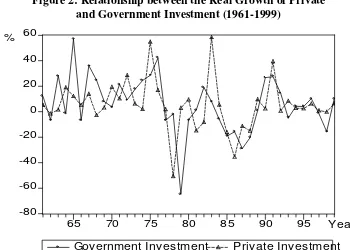
The past trend of investment related variables shows that the reversal of the present conditions without the prudent constitutional amendments and cataclysmic changes in the state’s attitude toward a free enterprise system is enormously difficult, if not impossible. The annual average share of private investment in GDP did not change much from the period 1959-1979 to the period 1980-1999. On average, this share was around 11 percent in both pre- and post-revolutionary eras. As Figure 1 clearly shows over a long-term period (1959-1999) the share of private investment in GDP shows a very moderate increase after the 1988 Iraqi war but it can be stated that during the last 4 decades this share has been fluctuating around a mean of 11 per cent, whereas private consumption has shown an overall upward trend in the post-revolutionary period [Time series data on the variables presented in Figures 1 to 4 are extracted from Tabibian et al. (1997) and the Central Bank (2000) of Iran]. It is interesting to note that since 1983 the share of the private sector investment has been always higher than that of the government sector due to a significant drop in oil exports. During 1983-1999 private investment constituted about 58 percent of total investment.
government expenditure is allocated for current expenditure, which seems to have a negligible impact on economic growth (Valadkhani, 1997, 1998).
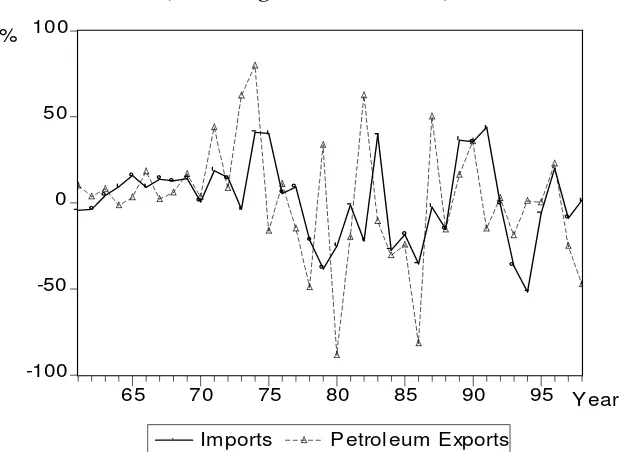
Figure 3 reveals that there is a high correlation between total investment and the import of capital and intermediate goods. Since over the last 40 years import of consumer goods makes up on average only 13 per cent of total imports, it is clear that any constraint on imports will have a negative effect on investment growth and thereby on economic growth. The import of capital goods to the Iranian economy is determined predominantly by government capital expenditure (Lautenschlager, 1986: 38). The Iranian government controls imports via quantitative restrictions such as import licenses, quotas, and government distribution centers. In other words, the government has complete control over both international trade and international capital flows. Since domestic saving will not be sufficient to generate an annual GDP growth of at least 6 per cent, the government needs to rely on external saving and running current account deficit during the course of plan, unless oil prices increase significantly like what happened in the first year (2000-2001), the targeted figures will not be achieved. Note that total external debt (including future interest payment and opened LC accounts) in 1999 was $US 20.7 billion and according to the Central Bank of Iran, over the period 2000-2004 the government must pay about $US 9.6 dollar of its external debt. Now if the required investment in the plan is financed via foreign sources, the pressure on current account would be unbearable. See Figure 3 for the relationship between real growth of total investment and actual growth of imports (including only capital and intermediate goods).
circumstances fewer funds would be left for the tradable and goods-producing sectors. For example, the average share of the Agriculture sector, with a high forward linkage, decreased from 8.2 per cent of total gross investment in the period 1965-1972 to 6.9 per cent in the 1989-1995 period.
It is argued in the third plan that the revitalization of the Tehran Stock Exchange can provide the opportunity for public participation in the socio-economic development by channeling public savings to investment and prevent the potential liquidity shortages in private business activities. Now the question is that what do we mean by private economic activities? As mentioned earlier according to Iranian constitution all large-scale and major industries, energy and mineral resources, large-scale irrigation networks, telecommunication services (telephone, radio and television), means of transportation (aviation, shipping and railroads), foreign trade, banking and insurance, must be publicly owned and administered by the state. The Iranian constitution has not considered a major role for the private sector. In addition to the revitalization of the Tehran Stock Exchange, the constitution needs to be appropriately amended to accommodate the economy’s pressing needs and address the issues associated with globalization. The government should overcome the following impediments in order to attract domestic or foreign investors in productive activities: unnecessary restrictions, crippling "red tape," excessive duties on imports, and lingering negative posture toward capital, and capitalist investors.
Given the constitutional restrictions and political considerations, we cannot expect the Tehran Stock Exchange to make a miracle. The ratio of total sum stock exchange transactions to GDP for the year 2000 is still 1.6 per cent (Hamshahri, 16 August, 2001), even though the cash yield of the shares was as high as 17% (Hamshahri, March 17, 2001).
Floating of the rial and attracting $10 billion in oil, gas, and petrochemicals investment are the other quantitative objectives of the government in the third plan. It is expected that with implementation of 12 contracts, the capacity of crude oil production can reach 4.5 million barrels per day by the end of 2005 (Hamshahri, 31 July, 2001). But the implementation of these contracts has been postponed due to the lack of political consensus as well as the inflexibility of Iranian constitution. In November 1999, for example, the "Council of Guardians" rejected a bill which would have exempted foreign companies in an offshore free-trade zone from threats of nationalization. It is interesting to note that the stock of crude oil in Iran is estimated to be around 500 billion barrels but 80% of potential oil reserve is beyond exploration. Iranian Oil Minister Mr Zangeneh in an interview with Dow Johns International News (Aug 17 2001) has recently expressed his hope to increase foreign investment in Iran’s hydrocarbon sector to $24 billion from $12 billion over the course of the plan.
and gas revenue in the total government public revenues increased from 27% in 1999 to 52% in 2000. According to MPO (2000) the unemployment rate at the same time increased from 15% to 15.3%. In fact this indicates that although a rise in oil revenue can lead to higher GDP growth, it will not be a panacea to have an equi-proportionate impact on unemployment, particularly when an unofficial figure estimates the unemployment rate to be at 30 per cent in 2000 (Xinhua News Agency, June 14, 2001). Khatami was lucky that oil prices increased markedly since gloomy days of 1998, otherwise none of the plan objectives would have been conceivable. To be more specific, when the government oil revenue is around $24 billion (well above the targeted value in the plan), linking all positive outcomes to the plan performance can be regarded as a very opportunistic view.
According to the Head of Management and Planning Organization, Mr Aref, one of the objectives of the third plan was to create 504000 jobs in 2000 but in practice only 430000 jobs were created (Hamshahri, 31 July, 2001). As the impact of oil revenue boost dwindles, sustaining high GDP growth rates will be more and more difficult especially when it is expected that in the current year 4000 billion rials of the total government revenue can not be collected (Hamshahri, 31 July, 2001).
Petroleum price rises in 2000-2001 enabled the government to allocate up to $7.5 billion to the Oil Surplus Fund, a stabilization fund under the third plan, where all oil revenues above a certain level are channeled. The fund was designed to negate extreme fluctuations in international oil prices, to promote exports and to create employment. This was a very good initiative not to waste the unexpected windfall on short-term consumption, but rather to accumulate cash reserves under the supervision of the Central Bank with long-term objectives. This fund was also used by the government to interfere in the foreign exchange market and stabilize the exchange rate. As a result the domestic currency could appreciate from 9040 rial per US$ on 19 August 1999 to 7970 rials on 19 Aug 2001. Further, due to increasing inflow of petrodollars, Iran's trade balance has been positive at $10.6 billion during the first nine months of the year (March to December 2000) and foreign currency reserves exceeded US$ 10 billion.
Figure 1: The Percentage Share of Private investment, government Investment and Private Consumption in GDP (1959-1999)
0 20 40 60 80
60 65 70 75 80 85 90 95
Private Consumption G overnment Investment Private Investment
%
Year
Figure 2: Relationship between the Real Growth of Private and Government Investment (1961-1999)
-80 -60 -40 -20 0 20 40 60
65 70 75 80 85 90 95
Government Inv estment Private Inv es tment
%
[image:20.595.119.469.427.677.2]Figure 3: Real Growth of Total Investment and Total Imports (Excluding Consumer Goods)-1961-1998
-60 -40 -20 0 20 40 60
65 70 75 80 85 90 95
Investment Imports
Figure 4: Real Growth of Petroleum Exports and Imports (Excluding Consumer Goods)
-100 -50 0 50 100
65 70 75 80 85 90 95
Imports Petroleum Exports
%
[image:21.595.144.454.431.657.2]5. Conclusion
In this paper a brief overview of the Iranian economy from an historical perspective is presented. Although Iran has more than a half century of planning history, it seems that the recent five-year development plan (2000-2005), which is the third plan after the 1979 revolution and the eighth plan since mid 1940s, like its predecessors, is plagued with many inconsistencies. After all these years, for producers, Iran’s labour law is still regarded as a nagging nuisance. The constitution does not allow the private sector to play an active role in the economy and this is in stark contrast with the high growth rates set in the third plan for private sector investment. The inefficient government sector (with inappropriate size of two-thirds of GDP) is bursting with under-paid employees. President Khatami with his idea of “civil society” cannot succeed within the bounds of the present constitution and without overhauling labor law and a comprehensive tax reform which does not discriminate among monopolistic bonyads and non-bonyad economic activities. Undoubtedly President Khatami has identified these important problems but creating 750,000 jobs per annum is an enormous task which cannot be fulfilled without amending the constitution. The first year performance of the third plan shows that the economy may grow at 5.8 per cent as a results of rising oil prices and/or ongoing economic reforms but without addressing major predicaments which are deeply rooted in the Iranian economy, sustainable long-term growth and prosperity will be easier said than done. The government has recently taken a few important steps in the right direction such as setting up the first non-government bank, and establishing the Oil Surplus Fund to neutralize extreme fluctuations in international oil prices, but more needs to be done.
Reference
Amuzegar, J. (1992), "The Iranian economy before and after the revolution", Middle East Journal, 46(3): 413-25.
Amuzegar, J. (2000), A Perspective on Iran’s Post-Revolution Political Economy, A lecture delivered at Foundation for Iranian Studies, March 24, Bethesda (http://www.fis-iran.org/amuzegar.htm).
Bhagwati, J.N. (1987), "Directly unproductive profit-seeking (DUP) activities", in The New Palgrave Dictionary of Economics, Eatwell, J. et al. (eds.), Vol. 1, Macmillan, London: 845-7.
Central Bank (2000), Nemagarhayeh Eghtesadi (Economic Indicators) No. 20, Department of Economic Accounts, Tehran (in Persian).
Dadkhah, K.M. (1987), "The inflationary process of the Iranian economy: a rejoinder",
International Journal of Middle East Studies, 19: 388-91.
Dadkhah, K.M. (1988), "The oil nationalization movement, the British boycott and the Iranian economy:1951-1953", in Essays on the Economic History of the Middle East, Kedourie, F. and Haim, S.G. (eds.), Frank Cass, London: 104-131.
Dadkhah, K.M. (1996), "Iran and the global financial markets: direct foreign investment versus international borrowing", Conference on Iran and Emerging Global Order, 28-31 March, Coventry University, Coventry.
Farzin, Y.H. (1995), "Foreign exchange reform in Iran: badly designed, badly managed",
World Development, 23(6): 987-1001.
Ghasimi, M.R. (1992), "The Iranian economy after the revolution: an economic appraisal of the five-year plan", International Journal of Middle East Studies, 24: 599-614.
Karbassian, A. (2000), Islamic revolution and the management of the Iranian economy, Social Research, 67(2): 621-41.
Karshenas, M. and Pesaran, H. (1995), "Economic reform and the reconstruction of the Iranian economy", Middle East Journal, 49(1): 89-111.
Krueger, A.O. (1974), "Political economy of the rent-seeking society", American Economic Review, 64(3): 291-303.
Lautenschlager, W. (1986), "The effect of an overvalued exchange rate on the Iranian economy", 1979-84, International Journal of Middle East Studies, 18: 31-52.
Management and Planning Organization (1994), The Documents of Second-Five-Year Plan for Economic, Social and Cultural Development of The Islamic Republic of Iran (1994-1998), Vol. 11, Plan and Budget Organization, Tehran (in Persian).
Management and Planning Organization (2000), Majmooeh Amari (Statistical Database ), Macroeconomic Bureau, Tehran (in Persian).
Nourbakhsh, M. (1993), Summary Proceeding of the Meeting of the Board of Governors: Annual Meeting, International Monetary Fund, Washington, D.C: 156-8.
Pesaran, M.H. (1992), "The Iranian foreign exchange policy and the black market for dollar", Middle East Studies, 24: 101-25.
Pesaran, M.H. (1995), "Planning and macroeconomic stabilization in Iran", DAE Working Papers Amalgamated Series No. 9508, Department of Applied Economics, Cambridge University, Cambridge.
Rad-Serecht, F. (1979), "Technology and industrialization: reflections on the Iranian experience", in Appropriate technology for third world development, Robinson, A. (ed.), The International Economic Association, Tehran: 190-6.
Tabibian, M. Rashidi M, and Sadighi, K (1997), Pre-Data process System (PDS), A Database Software developed at the Institute for Research and Economic Development, Tehran.
Vakil, F. (1977), "Iran's basic macroeconomic problems: a twenty year horizon", Economic Development and Culture Change, 25(4): 713-29.
Valadkhani, A. (1997), A Macroeconometric Model for the Iranian Economy, A PhD thesis submitted to the Department of Economics, The University of Queensland, Brisbane