N A N O E X P R E S S
Open Access
3,4-Dichlorophenoxyacetate interleaved into
anionic clay for controlled release formulation of
a new environmentally friendly agrochemical
Sheikh Ahmad Izaddin Sheikh Mohd Ghazali
1, Mohd Zobir Hussein
2and Siti Halimah Sarijo
1*Abstract
A new layered organic–inorganic nanohybrid material, zinc-aluminum-3,4-dicholorophenoxyacetate (N3,4-D) in which an agrochemical, 3,4-dichlorophenoxyacetic acid (3,4-D), is intercalated into zinc-aluminum-layered double hydroxide (ZAL), was synthesized by coprecipitation method. A well-ordered nanomaterial was formed with a percentage loading of 53.5% (w/w). Due to the inclusion of 3,4-D, basal spacing expanded from 8.9 Å in ZAL to 18.7 Å in N3,4-D. The Fourier transform infrared study shows that the absorption bands of the resulting nanohybrid composed of both the 3,4-D and ZAL further confirmed the intercalation episode. Thermal analysis shows that ZAL host enhances the thermal stability of 3,4-D. Controlled-release experiment shows that the release of 3,4-D in the aqueous media is in the order of phosphate > carbonate > sulfate > chloride. These studies demonstrate the successful intercalation of the 3,4-D and its controlled release property in various aqueous media.
Keywords:Nanohybrid; 3, 4-Dichlorophenoxyacetic acid; Layered double hydroxide; Anionic clay
Background
In modern agriculture, various agrochemicals such as pesticides, herbicides, and plant regulators are widely used for effective pest management and ensuring optimum crop yield. Most herbicide formulations deliver the bulk of the active agents in an immediately available form that can be readily released to the environment [1]. For highly soluble pesticides, these formulations may result in great pesticide losses shortly after application before the mole-cules have time to diffuse into soil aggregates and reach adsorption sites in soil colloids [2]. This phenomenon leads to pesticide residues in the food chain, and this, in turn, has adverse effects in humans including carcino-genic, mutacarcino-genic, and teratogenic effects [3].
Contamination of pesticides through volatilization, leaching, runoff, and the persistence of agrochemicals in aqueous media has become a concerning environmental issue [4,5]. In addition, agrochemicals are highly toxic to wildlife (especially mammals) and other organisms and can remain in the aquatic environment for a long time [6]. Much effort
was done focusing on ways to reduce the usage of exces-sive agrochemicals by the development of less hazardous formulations, such as controlled release formulations, in which only a part of the active ingredient is in an immedi-ately available form and the bulk of the herbicide is sorbed in an inert support [1,7]. This strategy is advantageous since it allows the gradual release of agrochemicals over time, besides preventing instant loss of agrochemicals through volatilization, leaching, and runoff [8]. Moreover, it requires less energy and manpower than the conven-tional methods, leading to decreased nontarget effect and increased safety for agrochemical applicators [9,10].
Clay has become one of the popular materials as a host of herbicides due to its unique properties such as high specific surface areas associated with their small particle size and ubiquitous occurrence in most soil and sediment environment [11-17]. One of the classes in the clay family is layered double hydroxide (LDH) or the so-called hydrotalcite-like compounds (HTs). This special material can be used as support in controlled-release for-mulations and has been proposed as the ideal solution to environmental problems caused by agrochemicals. LDHs or HTs are brucite-like layered materials with the general formula [MII1−xMIIIX(OH)2]x+(Am−)x/n·mH2O, where MII * Correspondence:[email protected]
1
Faculty of Applied Science, Universiti Teknologi MARA, Shah Alam, Selangor 40450, Malaysia
Full list of author information is available at the end of the article
and MIII are divalent and trivalent cations, respectively, and Xn−is the interlayer anion, which balances the posi-tive charge generated by the presence of MIII in the layers. The layer charge is determined by the molar ratio
x = MIII/(MIII + MII) which can vary between 0.2 and 0.4 [18]. LDHs have attracted the attention of the in-dustry and academia because of their anion-exchange capability [19], low cost, ease of preparation, environ-mental compatibility (especially in agricultural applica-tion), and potential use in pharmaceuticals, detergents, and food additives [20].
3,4-Dichlorophenoxy acetic acid (3,4-D) (Figure 1) is an organic anion used widely in modern agriculture to control weeds in paddy field and wheat and corn plan-tations [21].
In this study, the intercalation of 3,4-dichlorophenoxyacetic acid into the interlamellae of zinc-aluminum-layered double hydroxide (ZAL) was accomplished by a simple direct self-assembly method for the formation of a new organic– inorganic nanohybrid material. The physicochemical prop-erties and the controlled release of the agrochemical were investigated and discussed.
Methods
All chemicals used in this synthesis were obtained from various chemical suppliers and used without further purifi-cation. Zinc nitrate (Zn(NO3)2·6H2O, 98%, ChemPurPiekary Slaskie, Poland) and aluminum nitrate (Al(NO3)3·9H2O, 98%, ChemPurPiekary Slaskie, Poland) were used as the sources of cations while 3,4-dichlorophenoxy acetic acid (C9H9ClO3, 95%, Sigma-Aldrich Corporation, St. Louis, MO, USA) was used as the starting material of the guest anion. All solutions were prepared using deionized water.
Synthesis of materials
The synthesis of Zn-Al-3,4D nanocomposites was performed by self-assembly method from a mixed aqueous solution of 0.1 M Zn(NO3)2·6H2O and 0.025 M Al(N03)3·9H2O at various concentrations of 3,4D ranging from 0.0035 to 0.5 M. NaOH (2 M) was then added to the mixture with vigorous stirring under nitrogen atmosphere at a constant pH of 7.5 ± 0.02. The precipitate was aged for
18 h in an oil bath shaker at 70°C, filtered, thoroughly washed, and dried in a vacuum oven at 70°C. The resulting nanocomposite was finely ground, kept in a sample bottle, and stored in a vacuum desiccator for further use and characterization. A similar procedure was performed for the preparation of ZAL except the addition of 3,4D.
Characterization
[image:2.595.306.538.278.707.2]Powder X-ray diffraction (PXRD) patterns were re-corded on a Rigaku model Ultima IV powderλ diffract-ometer (Rigaku Corporation, Tokyo, Japan) using filtered Cu-Kαradiation (λ= 1.540562 Å) at 40 kV, 20 mA, and 2° min−1. Fourier transform infrared (FTIR) spectra were recorded using a PerkinElmer ×1,725 spectrophotometer
Figure 1Molecular structure of 3,4-dichlorophenoxy acetic acid.
Intens
ity/arbitr
ary
un
its
2 /degrees 18.7 Å
0.3 M
0.1 M
0.035 M 0.5 M
27.7 Å 9.32 Å
ZAL 18.8 Å
24.8 Å
8.9 Å
[image:2.595.58.291.608.714.2]15
30
45
60
(PerkinElmer, Waltham, MA, USA) in the range of 400 to 4,000 cm−1. Finely ground 1% samples in KBr powder were compressed to obtain a pellet, and the pellet was then used to obtain the IR spectra. Thermogravimetric and differential thermogravimetric analyses (TGA/DTG) were carried out using a Mettler Toledo TGA/SDTA851 thermogravimetric analyzer (Mettler Toledo Inc., Columbus,
OH, USA) with a heating rate of 10°C min−1 between
35°C and 1,000°C, under a nitrogen flow rate of 50 ml min−1. The elemental analysis was performed using a CHNS analyzer (model CHNS-932, LECO Corporation, St. Joseph, MI, USA) together with inductively coupled plasma atomic
emission spectrometry using a PerkinElmer spectrophotom-eter (model Optima 2000DV) under standard condition.
Results and discussion
Powder X-ray diffraction
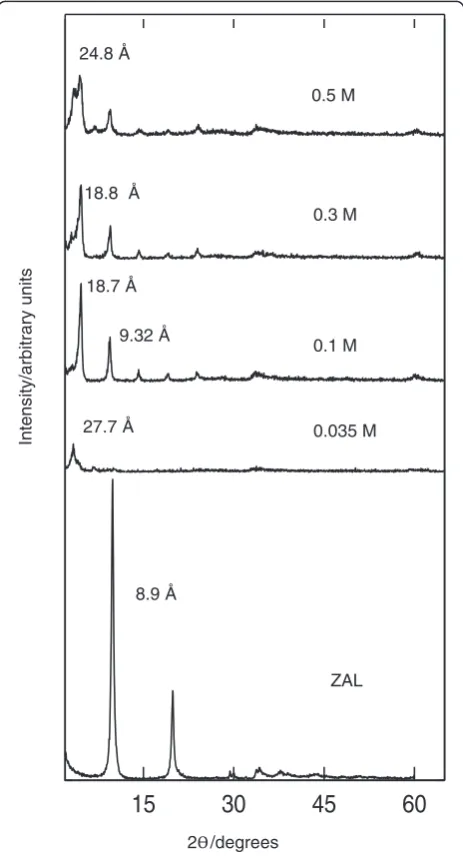
Figure 2 shows the PXRD patterns of the ZAL and its nanohybrid material, zinc-aluminum-3,4-dicholorophenoxy-acetate (N3,4-D), prepared using various concentrations of 3,4-D from 0.0035 to 0.5 M. As shown in the figure, the basal spacing of ZAL, which contains nitrate ion as the counter anion in the interlayer, was recorded to be 8.9 Å which is in a good agreement with the sum of the thickness of the anion, NO3− (4.1 Å), and the brucite-like layer (4.8 Å) [22]. The increasing basal spacing from 8.9 to 24.8 Å in the resulting nanocomposite, N3,4-D, was due to the inclusion of the new anion 3,4-D, which is bigger than nitrate, into the interlamellae space. This shows that 3,4-D has higher affinity toward ZAL com-pared to the counter anion (nitrate). When the concen-tration of 3,4-D was increased from 0.3 to 0.5 M, we observed that the reflection peaks at around 2θ = 0.4° became broad especially for 003 reflections showing a mix phase of the material due to the 3,4-D absorbed on the surface of ZAL. The best well-ordered nanocomposite was synthesized with 0.1 M which produced a sharp, symmetric, high-intensity peak, especially for 003 and 006 reflection peaks. This sample was then chosen for further characterization.
FTIR spectroscopy
The FTIR spectra for ZAL (Figure 3 (curve a)) showed a broad and strong band in the range of 3,200 to 3,600 cm−1 centered at 3,454 cm−1which is due to the O-H stretching vibration of the inorganic layers and interlayer water mol-ecules. Another common wave number for the LDH-like material is a band at 1,637 cm−1which is assigned to the bending vibration of interlayer water molecules. For ZAL, a strong absorption centered at 1,378 cm−1is assigned to the nitrate stretching vibration. A band in the lower wave number region corresponds to the lattice vibration mode such as the translation of Zn-OH at 611 cm−1and
the vibration of OH-Zn-Al-OH at 427 cm−1 [23]. The
FTIR spectrum of pure 3,4-D shows a broad band at 3,459 cm−1, which is attributed to the O-H stretching
vibration. A band at 1,713 cm−1 is due to the C=O
stretching. Bands at 1,469 and 1,400 cm−1are attributed to the stretching vibration of aromatic ring C=C. Bands
834.40 1426.89 1595.10
861.68
1469.93 1736 3459
3454
Wavelength (cm-1)
c
b
a
1000
2000
3000
4000
% trans
m
ittance (a.u
.)
611 1378
1637
[image:3.595.57.291.88.456.2]1279.78 1228.56 3435.63
[image:3.595.63.541.675.725.2]Figure 3FTIR spectra of ZAL (a), pure 3,4-D (b), and N3,4-D nanocomposite (c).
Table 1 Basal spacing and chemical composition of Zn/Al-LDH (LDH) and its nanohybrid (N3,4-D)
Sample d(Å) Zn/Al ratio Mole fraction (xAl)
N(%) C(%) Aniona (%w/w)
BET surface area
(m2g−1) BJH desorption pore volume(cm3g−1) BET average porediameter (Å)
LDH 8.9 3.64 0.210 3.1 - - 1.3 0.024 127
N3,4-D 18.7 3.70 0.233 - 23.24 53.5 3.0 1.240 66.67
a
at 1,288 and 1,219 cm−1 are due to the symmetric and asymmetric stretching modes of C-O-C, respectively. A sharp band at 861 cm−1is attributed to C-Cl stretching [24]. The FTIR spectra for the nanocomposite (N3,4-D)
show a broad absorption band at around 3,400 cm−1
which arises from the stretching mode of OH groups in the brucite-like layer and/or physisorbed water. A band at 1,595 cm−1 is attributed to the carboxylate functional group of the intercalated 3,4 D anion. A band at 1,426 cm−1can be attributed to the C=C bond vibration of the aromatic group. A band at 1,220 cm−1 corresponds to asymmetric and symmetric vibrations of C-O-C, respectively.
Elemental analysis
Table 1 shows the elemental and organic content of ZAL and N3,4-D nanocomposites. As shown in Table 1, the
molar ratio of Zn to Al in both ZAL and N3,4-D is 3.6 and 3.7, respectively, which is close to the initial value of the Zn to Al ratio in the mother liquor. The ZAL contains about 3.1% (w/w) nitrogen which is in agreement with the presence of a strong, sharp band at 1,378 cm−1in the FTIR spectrum that corresponds to the nitrate group in ZAL. The percentage of 3,4-D intercalated into the interlayer of ZAL is 53.5% (w/w), estimated from the carbon content of about 23.2% (w/w), indicating that intercalation of 3,4-D has actually taken place.
The surface area and porosity of ZAL and N3,4-D obtained by the nitrogen adsorption-desorption method are given in Table 1. The successful intercalation has increased the Brunauer-Emmett-Teller (BET) surface area from 1.3 m2 g−1 in ZAL to 3.0 m2 g−1 in N3,4-D. The change in pore texture with larger width, as a result of the modification by the intercalation of 3,4-D into the
(a) (b)
N3,4-D
N3,4-D
ZAL
V
o
lume a
d
sor
b
e
d/cm
3g
-1
at
STP
Relative pressure (p/po)
0 200 400 600
0 0.2 0.4 0.6 0.8 1.0 0
0.025 0.050 0.075 0.100 0.125
500 1000 1500
Pore diamter/Å
Pore vo
lu
me/cm
3g
-1
[image:4.595.60.540.89.274.2]ZAL
Figure 4Nitrogen adsorption-desorption isotherms of ZAL and their nanohybrids (N3,4-D) (a) and pore size distribution (b).
[image:4.595.58.538.538.721.2](a) (b)
ZAL interlayer, which is in agreement with the expansion of basal spacing from the resulting nanohybrid (Figure 1) is thought to be the reason.
Surface properties
The nitrogen adsorption-desorption isotherms (Figure 4) for ZAL and N3,4-D show Type IV material in the IUPAC classification, indicating a mesopore type of material. The adsorption branch of the hysteresis loop for the N3,4-D is wider than the one for LDH, indicating a different pore texture. This can be related to the expansion of basal spacing when nitrate is replaced by 3,4-D during the formation of the nanocomposite.
Figure 4b shows the Barret-Joyner-Halenda (BJH) desorp-tion pore size distribudesorp-tion for 3,4-D and its nanohybrid (N3,4-D). The summary of pore volume and pore diameter
is given in Table 1. A sharp peak at 200.5 Å and a low-intensity sharp peak at 600.9 Å can be observed. On the other hand, LDH also showed a sharp peak at around 400 Å, and the pore size of LDH is lower compared to that of N3,4-D (Table 1). This may have resulted from the formation of interstitial pores between the crystallite, different particle sizes, morphology, and aggregation during the formation of the nanohybrid. The surface morphology of N3,4-D (Figure 5b) shows an agglomer-ate, porous, granular structure of N3,4-D compared to the nonporous morphology of ZAL (Figure 5a).
Thermal analysis
The TGA-DTG profiles of ZAL, pure 3,4-D, and N3,4-D nanocomposites are shown in Figure 6. The TGA-DTG curves of N3,4-D reveal four weight losses occurring at 116.9°C, 219.1°C, 417.2°C, and 963.2°C that amounted 4.38%, 3.25%, 47.0%, and 19.7%, respectively. The first weight loss is due to the removal of surface-physisorbed water molecules, and the second stage is attributed to the removal of the interlayer anion and dehydroxylation of the hydroxyl layer. The third weight loss at 417.2°C corresponds to the major decomposition of the organic moiety in the interlayer of the nanohybrid, leaving only a relatively less volatile metal oxide. The weight loss of 6.7% that occurred at around 963.2°C is due to the decomposition of the more stable compound of the inorganic layered composition of the nanohybrid by combustion reaction [25]. The decomposition temperature for pure 3,4-D is 270.1°C, but the thermal stability of 3,4-D
99.6% 270.1°C
60 70 80 90 100 110
200 400 600 800 1000-0.0006 -0.0004 -0.0002 0 -30
-20 -10 0 10
0 200 400 600 800 1000 -25 25 75 125
60 70 80 90 100 110
0 200 400 600 800 1000
- 2.0 -1.5 -1.0 -0.5 0 0.5 (c)
(b)
(a)
Weight
percen
tage
%
Derivat
ive (
w
/w
%)
d
)
4.38% 116.9°C
3.25% 219.1°C
19.67% 963.2°C
47.0% 417.2°C
120.7 C (6.7%)
230.1 C (25.4%)
[image:5.595.57.291.291.702.2]Temperature (°C)
Figure 6TGA-DTA thermograms of ZAL (a), pure 3,4-D (b), and N3,4-D nanocomposite (c).
Anion release
(%
)
Time / min Na3PO4
Na2CO3
Na2SO4
NaCl
0 20 40 60 80
[image:5.595.304.539.467.704.2]0 1000 2000 3000
Figure 7Release profiles of 3,4-D from N3,4-D into 0.005 M
First Order
0 0.02 0.04 0.06
0 1000 2000 3000 0
1 2 3
0 20 40
0 0.25 0.50 0.75 1.00 1.25
0 20 40
0 0.2 0.4 0.6
0 20 40
0 0.25 0.50 0.75 1.00 1.25
0 20 40 60
0 0.2 0.4 0.6 0.8
0 1000 2000 3000
0 0.05 0.10 0.15
0 1000 2000 3000
0 20 40 60
0 1000 2000 3000
0 15 30 45 60 75
0 1000 2000 3000
0 50 100 150
0 1000 2000 3000
0 20 40 60 80
0 1000 2000 3000 0
0.25 0.50 0.75 1.00 1.25
0 20 40 60
Parabilic Difussion
Pseudo Second Order
time / min
-log
(1
-C)
t / C
t
C
t/ C
eq
time / t
0.5time / min
Na3PO4 Na3PO4 Na3PO4
r2=0.549 r2=0.39 r2
=1.00
Na2CO3
r2=0.621
Na2CO3
r2=0.738
Na2CO3
r2=0.99
r2=0.336 r2=0.494 r2
=0.959 NaCl
NaCl NaCl
Na2SO4
Na2SO4
Na2SO4
[image:6.595.61.540.89.692.2]r2=0.228 r2=0.340 r2=0.999
is greatly improved after intercalation between the LDH layer which is 417.2°C, implying that ZAL can be used as an alternative inorganic matrix for storing an active organic moiety with better thermal stability.
Release profile of the 3,4-D into various aqueous solutions
Release profiles of 3,4-D from the nanohybrid composite, N3,4-D, into various aqueous solutions, sodium phos-phate, sodium carbonate, sodium sulfate, and sodium chloride (0.005 M), are shown in Figure 7.
The accumulated release of 3,4-D into various aqueous solutions containing phosphate, carbonate, sulfate, and chloride anions increased with contact time. The release of the 3,4-D from the nanohybrid was fast for the first 200 min, followed by a slower one subsequently before rea-ching the saturated release at approximately 300 and 500 min for PO43−and Cl−and CO32−and SO42−, respectively.
Saturated release of the anions is in the order of phosphate > carbonate > sulfate > chloride with percent-ages of saturated release of 75%, 40%, 27%, and 11%, respectively. The highest saturated release of 3,4-D in the PO43− aqueous solution is due to the high charge density of the anion (PO43−), whereas the lowest saturated release of 3,4-D was in the aqueous solution containing Cl−. This shows that the saturated release for the aqueous media toward the anion encapsulates in LDH agreed with the previous work by Miyata et al. [26]. This result sug-gests that the charge density of the anion to be ex-changed with 3,4-D plays a vital role in determining the saturated release of the 3,4-D from the nanohybrid into the aqueous media.
Kinetic release
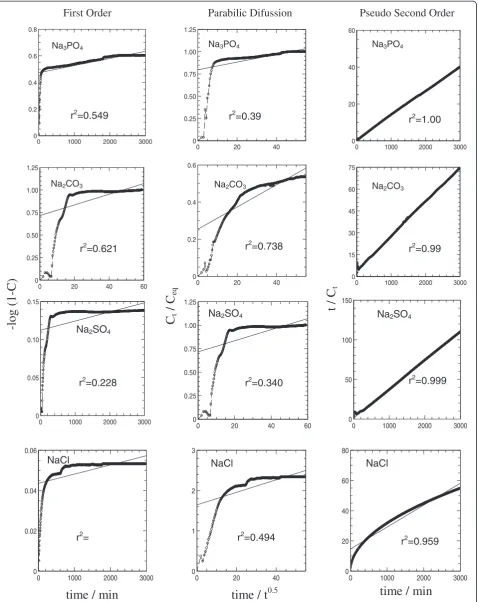
For quantitative analysis, the data from the release study were fitted into zeroth-order (Equation 1), first-order (Equation 2), parabolic diffusion (Equation 3), and pseudo-second-order kinetic models (Equation 4). The equations are given as follows:
Ct ¼ktþc ð1Þ
−log 1ð −CtÞ ¼ktþc ð2Þ
Ct=Ceq¼cþkt0:5 ð3Þ
t=Ct¼1=k2C2eqþð1=qeÞt ð4Þ
Figure 8 shows the release profiles of 3,4-D fitted to the first-order, parabolic diffusion, and pseudo-second-order kinetic models. The corresponding rate constant,
k, together with regression value, r2, obtained from the fittings is summarized in Table 2. The release of 3,4-D into SO42−, CO32−, PO43−, and Cl− aqueous solutions was formed to follow the pseudo-second-order kinetic models withr2close to 1. Thet½values, the time it takes for the concentration of 3,4-D to be at half of the accumu-lated saturated release, were found to be 39, 56, 74, and 78 min for 3,4-D release in phosphate, carbonate, sulfate, and chloride aqueous solutions, respectively. Thet½values are in the order of phosphate < carbonate < sulfate < chloride which followed the release rate of the organic moieties in the aqueous solution mentioned above, as t½is inversely proportional to the release rate [27].
Conclusions
A herbicide compound, 3,4-D, was successfully interca-lated into the layer of ZAL for the formation of a new organic–inorganic hybrid nanocomposite, N3,4-D, which shows a potential to be used as a controlled-release for-mulation in agrochemicals. The interlayer spacing of LDH increased from 8.9 to 18.72 Å in the N3,4-D due to the inclusion of 3,4-D into the Zn-Al-LDH interlayer space. Release of 3,4-D from the Zn-Al-layered inorganic host follows pseudo-second-order kinetic models with regres-sion values of 0.959 to 1. This study suggests the possibil-ity of zinc-aluminum-layered double hydroxide to be used as a carrier host for 3,4-D for the generation of environ-mentally friendly agrochemicals.
Competing interests
The authors declare that they have no competing interests.
Authors’contributions
[image:7.595.57.539.100.183.2]SAISMG wrote the paper, performed the experiments, and analyzed the data. MZH and SHS conceived the study, participated in the design and coordination of the scientific team, and assisted in drafting the manuscript. All authors read and approved the final manuscript.
Table 2 Rate constant, half time, and correlation coefficient (r2) value
Aqueous solution (0.005 M)
Zeroth-orderr2 First-orderr2 Parabolic diffusion Pseudo-second-order (3,000 min) (3,000 min) r2 k(×10−3) c r2 t1/2(min)k(×10−
4
) c
Na3PO4 0.315 0.549 0.390 15.50 0.797 1.000 39 2.458 0.698
Na2CO3 0.567 0.621 0.738 5.99 0.254 0.999 66 2.424 0.391
Na2SO4 0.215 0.228 0.340 4.32 0.717 0.999 74 2.235 1.360
NaCl 0.322 0.336 0.494 5.90 1.640 0.959 78 2.146 1.470
Acknowledgements
This research was funded by the Ministry of Higher Education Malaysia (MOHE) under the Fundamental Research Grant Scheme (FRGS) grant no. 600RMI/ST/FRGS/FST (194/2010).
Author details
1Faculty of Applied Science, Universiti Teknologi MARA, Shah Alam, Selangor 40450, Malaysia.2Material Synthesis and Characterization Laboratory (MSCL), Institute of Advanced Technology (ITMA), Universiti Putra Malaysia, 43400 UPM, Serdang, Selangor, Malaysia.
Received: 9 April 2013 Accepted: 25 July 2013 Published: 23 August 2013
References
1. Johnson RM, Pepperman AB:Release of atrazine and alachlor from clay-oxamide controlled release formulations.Pestic Sci1998,53:233–240. 2. Gish TJ, Scoppet MJ, Helling CS, Schirmohammadi A, Schenecher MM, Wing RE:
Transport comparison of technical grade and starch-encapsulated atrazine.
Trans ASAE2011,34:1738–17444.
3. Srivastava B, Patanjali PK, Basu V, Jhelum DD:Adsorbents for pesticide uptake from contaminated water: a review.J Sci Ind Res2009,68:839–850. 4. Derylo-Marczewska AM, ABlachnio W, Marczewski B, Tarasiuk:Adsorption of selected herbicides from aqueous solutions on activated carbon.J Therm Anal Calorim2010,101:785–794.
5. Modabber Ahmed K, Choong-Lyeal C, Dong-Hoon L, Man P, Bu-Kug L, Jong-Yoon L, Jyung-Choi:Synthesis and properties of mecoprop-intercalated layered double hydroxide.J Phys Chem Solids2007,68:1591–1597.
6. Shukla G, Kumar A, Bhanti M, Joseph PE, Taneja A:Organochlorine pesticide contamination of ground water in the city of Hyderabad.
Environ Int2006,32:244–247.
7. Fernandez-Perez M, Gonzalez-Pradas E, Urene Amate MD, Wilkins RM, Lindrup I:Controlled release of imidacloprid from a lignin matrix: water release kinetics and soil mobility study.J Agric Food Chem1998,46:3828–3834. 8. Otero R, Fernández JM, Ulibarri MA, Celis R, Bruna F:Adsorption of non-ionic
pesticideS-metolachlor on layered double hydroxides intercalated with dodecylsulfate and tetradecanedioate anions.Applied Clay Science2012,
65:75–79.
9. Celis R, Hermosín MC, Cornejo J, Carrizosa MJ:Clay-herbicide complexes to retard picloram leaching in soil.Int J Environ Anal Chem2002,82:503–517. 10. Gerstl Z, Nasser A, Mingelgrin U:Controlled release of pesticides into soils from clay-polymer formulations.J Agric Food Chem1998,46:3797–3802. 11. Hermosin MC, Calderon MJ, Aguer JP, Cornejo J:Organoclays for controlled
release of the herbicide fenuron.Pest Manag Sci2001,57:803–809. 12. Unadabeytia T, Nir S, Rubin B:Organo-clay formulations of the
hydrophobic herbicide norflurazon yield reduced leaching.J Agric Food Chem2000,48:4767–4773.
13. Celis R, Koskinen WC, Hermosin MC, Ulibarri MA, Cornejo J:Triadimefon interactions with organoclays and organohydrotalcites.Soil Sci Soc Am J 2000,64:36–43.
14. Carrizosa MJ, Koskinen WC, Hermosin MC, Cornejo J:Organomestites as sorbent and carrier if the herbicide bentazone.Sci Total Environ2000,
247:285–293.
15. Carrizosa MJ, Koskinen WC, Hermosin MC, Cornejo J:Dicamba adsorption-desorption on organoclays.Appl Clay Sci2001,18:223–231. 16. Lagaly G:Pesticide-clay interactions and formulations.Appl Clay Sci2001,
8:265–275.
17. Nennemann A, Mishael Y, Nir S, Rubin B, Polubesova T, Bergaya F, Van Damme H, Lagaly G:Clay-based formulations of metolachlor with reduced leaching.
Appl Clay Sci2001,18:265–275.
18. Costantino U, Nocchetti M, Sisani M, Vivani R:Recent progress in the synthesis and application of organically modified hydrotalcites.
Zeitschrift fur Kristallograhie2009,224:273–281.
19. Cavani F, Trifiro F, Vaccari A:Hydrotalcite-type anionic clays: preparation, properties and applications.Catal Today1991,11:173–301.
20. Gaini LE, Lakrami M, Sebbar E, Meghea A, Bakasse M:Removal of indigo carmine dye from water to Mg-Al-CO3-calcined layered double
hydroxides.J Hazard Mater2009,161:627–632.
21. Smith G, Kennard CHL, White ALH:(3,4-Dichlorohenoxy)acetic acid.Acta Crystal 1981,B37:1454–1455.
22. Khan AI, Ragavan A, Fong B, Markland C, O'Brien M, Dunbar TG, Williams GR, O'Hare D:Recent developments in the use of layered double hydroxide as host material for the storage and triggered release of functional anions.Ind Eng Chem Res2009,48:10196–10205.
23. Feng Y, Duan X, Evans DG, Wang Y, Li D:Synthesis and characterization of a UV absorbent intercalates Zn-Al layered double hydroxide.Polym Degrad Stab2006,91:789–794.
24. Hussein MZ, Sarijo SH, Yahya AH, Zainal Z:The effect of pH on the formation of host-guest type material: zinc-aluminum-layered double hydroxide-4-chlorophenoxy acetic acid acetate nanocomposite.Phys Stat Sol (C)2007,4:611–613.
25. Hussein MZ, Zainal Z, Yahaya A, Loo HK:Nanocomposite based controlled release formulation of an herbicide, 2,4-dichlorophenoxyacetate encapsulated in zinc-aluminium-layered double hydroxide.Sci Technol Adv Mater2005,6:956–962.
26. Miyata S:Anion-exchange properties of hydrotalcite-like compounds.
Clays Clay Mineral1983,31:305–311.
27. Sarijo SH, Hussein MZ, Yahya A, Zainal Z:Effect of incoming and outgoing exchangeable anions on the release kinetics of phenoxyherbicides nanohybrid.Clays Clay Miner1983,31:305–311.
doi:10.1186/1556-276X-8-362
Cite this article as:Ghazaliet al.:3,4-Dichlorophenoxyacetate
interleaved into anionic clay for controlled release formulation of a new environmentally friendly agrochemical.Nanoscale Research Letters
20138:362.
Submit your manuscript to a
journal and benefi t from:
7Convenient online submission
7Rigorous peer review
7Immediate publication on acceptance
7Open access: articles freely available online
7High visibility within the fi eld
7Retaining the copyright to your article