BIROn - Birkbeck Institutional Research Online
Rodgers, Scott (2018) Digitizing localism: anticipating, assembling and
animating a ‘space’ for UK hyperlocal media production.
International
Journal of Cultural Studies 21 (1), pp. 73-89. ISSN 1367-8779.
Downloaded from:
Usage Guidelines:
Please refer to usage guidelines at or alternatively
Digitizing localism: Anticipating, assembling and animating a ‘space’ for UK hyperlocal
media production
Scott Rodgers
Birkbeck, University of London
NOTE: Accepted for publication in International Journal of Cultural Studies, cite with
permission only
Author note:
Scott Rodgers is Senior Lecturer in Media Theory at Birkbeck, University of London. His research specialises in the relationships of media and cities and the geographies of
communication.
Correspondence for this article should be addressed to:
Dr Scott Rodgers
Department of Film, Media and Cultural Studies Birkbeck, University of London
43 Gordon Square, Bloomsbury, London, WC1H 0PD United Kingdom
Digitizing localism: Anticipating, assembling and animating a ‘space’ for UK hyperlocal
media production
Abstract:
This paper presents an unconventional view of media production, not as the direct production of media content or forms, but the cultivation of spaces for media production taking place
elsewhere. I draw on a close analysis of Destination Local, a program of UK charity Nesta, which focused on the implications of location-based technologies for the emergent field of ‘hyperlocal’ media. Although the first round of the program – the focus in this paper – funded 10
experimental projects alongside extensive research, my argument is that Destination Local was less a matter of enabling specific place-based hyperlocal media outlets. Rather, it was an attempt to anticipate, assemble and animate a broader UK hyperlocal media ‘space’, composed of both technical ecologies (e.g. data, devices, platforms, standards) and practical fields (e.g. journalism, software development, local government, community activism). This space, I argue, was
anchored to a largely implicit political discourse of localism.
Key words:
The shot, initially out of focus, sharpens to reveal Maida Vale station, a London Underground stop. A woman leaving the station is shown deftly retrieving her smart phone. An upbeat acoustic guitar score begins, soon joined by harmonica. She lifts the phone to eye level, and the view cuts to an augmented reality app, seen through a point of view shot. Noticing a shuttered shop, she uses the app to call up information about a planning application for a new supermarket at the site. Then, within the same app environment, she goes on to explore a series of social media and user-generated contributions related to the planning application: on Twitter, on YouTube, in blogs, and through council petitions. It seems to be precisely the sort of app that might appeal to attentive house and flat owners living in this comfortable London suburb.
LocalSay, the name of the mobile app presented in the video, was the result of a public-private partnership between London’s Westminster City Council and a Soho-based digital media
company, who styled themselves as ‘the perfect mix of bureaucrats and creatives’.1 It was one of 10 projects selected in the first round of Destination Local, a funding program of UK charity Nesta that explored the ‘next generation of local media services’. Like all of the other successful projects, LocalSay was an experiment with location-based media, meaning technologies or platforms for which geospatial location or data is functionally central (cf. Gordon and de Souza e Silva, 2011; Wilken, 2012). And like all the other successful projects, indeed all 165 eligible submissions, its application included a YouTube video, something later set into the streamed time-line architecture of Nesta’s Destination Local website.2 Not all of the videos are as
content to various business and interaction models.
By design or acquiescence, all of these successful projects have also situated themselves under the banner of hyperlocal media, since this was the name used by Nesta within its Destination Local program. Hyperlocal media refers to an ambitious future for local media in a
‘post-newspaper age’ (see Kennedy, 2013; cf. Anderson, 2013), emerging in a context of considerable
cultural anxieties about the state of local media (see Neilsen, 2015). Although the term has many meanings, hyperlocal media generally refers to new and usually digitized forms of media
oriented to ‘very local’ areas, which furthermore are often seen as an alternative to more
established local media outlets. Given the precarious nature of most hyperlocal publications, existing research tends to carry a normative edge, and indeed is sometimes authored by scholars who are also hyperlocal practitioners. As a result, the extant literature has tended to focus on: the task of devising a workable definition for hyperlocal media (Metzgar et al., 2011); the size, structure and business models of its outlets (Harte et al., 2016; van Kerkhoven and Bakker, 2014; Kurpuis et al., 2010); the personal and professional identities of its practitioners (Chadha, 2015); its journalistic styles and characteristic practices (Paulussen and D’heer, 2013; Williams et al.,
2015); and its potential for filling a perceived democratic deficit (Barnett and Townend, 2015; Hargreaves and Hartley, 2015). As Hess and Waller (2016) point out, there are very few analyses which consider hyperlocal media as an emergent cultural formation. While their own response is to theorize hyperlocal media production as a marginalized news subculture, here I would like to explore Nesta’s Destination Local program as a provisional attempt to cultivate a larger cultural
Destination Local’s first round projects were, in themselves, instances of media production
understood conventionally: they were publications or platforms with relatively discrete
audiences, users, publics or markets in view. In this paper, however, I argue that we should also understand the Destination Local program itself as a form of media production, if in a more unconventional sense. Within computational and networked culture, media production takes on an expanded meaning. Contemporary media production unfolds amidst weakened medium specificity (Manovich, 2001), proliferating algorithmic agency (Kitchin and Dodge, 2011; Mackenzie, 2006) and the rise of large-scale, commercialized ‘connective’ platforms and
services such as Google, Apple and Facebook (van Dijck, 2013). Not only do such developments bring about the often-cited blurring of media production and consumption (Bruns, 2008; Jenkins 2006). They also suggest that the production of media content and forms is increasingly layered and dispersed, or less easy to ‘pin down’ at particular time-spaces. This is because a whole series of technical protocols, tools, standards, platforms and applications now very often precede and at least partly determine the conditions of possibility for media production activities situated
elsewhere (cf. Kallinkos et al., 2013: 397-398). Programs such as Nesta’s Destination Local embody a new kind of informational philanthropy (cf. Lewis, 2012) attempting to strategically curate and build knowledge around the translocal media production spaces emerging through computational culture.
‘virtual’. As Graham et al. (2012: 465-466) suggest, however, three successive developments
have moved both academic theory and the Internet industry away from this virtual/physical dichotomy: first, the rise of mobile Internet connectivity, particularly though smartphones; second, the expansion of ‘authorship’, not only via user-generated contributions but also
volunteered geographic information; and third, the development of the ‘geoweb’, which refers especially to the automated coding of web content to specific geographic locations. Taken together, these trends have led to digital environments which are increasingly geo-referenced, and more often experienced as ‘augmented’ or ‘mixed’ rather than virtual realities (see Aurigi and De Cindo, 2008; Benford and Giannachi, 2011; de Waal, 2014; Gordon and de Souza e Silva, 2011; Kitchin and Dodge, 2011). In this context, journalistic media – with which hyperlocal media are strongly aligned – are not just potentially ‘local’ in their content, but intrinsically infused with time-space attributes, affordances and infrastructures (Goggin et al., 2015; Schmitz Weiss, 2015; Sheller, 2015).
However, while the digitization of location has emerged in part through a proliferation of countless locational tools, standards, platforms, applications, and so on, it would be a mistake to reduce this broader phenomenon to purely technical conditions of possibility. The digitization of location is also increasingly a matter of concern for social and political life. Just as there is growing public awareness of such previously-technical subjects as algorithms (Beer, 2016) or interoperable ‘connective’ platforms (van Dijck, 2013), there has also been a rising fascination
with the problems and possibilities of locative media (see Wilken, 2012). As Wilson (2012) notes, so-called location-based services have emerged first and foremost out of the quite
a keen subject of discussion, debate, research and development. And, in turn, we are now seeing an ever-widening range of experiments with mobile media and locational platforms by various public and third-sector bodies aimed at enhanced engagement, participation and governance (e.g. Iveson, 2011).
were deployed in multi-stakeholder discussions around the expansion of US low-power FM radio bears some resemblances to the case I will examine of Destination Local. Her argument is that localism gained traction as a ‘boundary object’. It is a conceptually malleable notion, working across several communities of practice that might otherwise express different interests. Yet it is sufficiently robust to carry some degree of singular force or meaning. Through
Destination Local, I contend that similar processes were at play. However, it is not through the term localism itself that digitized location and localism were put into a tentative convergence, but rather the notion of hyperlocal media.
emerged as an anchoring concept. Finally, I suggest that the emphasis Destination Local placed on experimentation and publicity over actual project success indicates an orientation to
animating – both in the sense of bringing to life and giving the appearance of movement – rather
than merely reflecting this provisional hyperlocal space. I conclude that the example of Destination Local illuminates an expanded sense of media production spaces as they consist within computational and networked culture. Yet it also invites, I argue, some critical questions around the convergence implicitly invoked between the digitization of location and discourses of localism.
Destination Local as media production space
‘We never work alone’ and similar phrases are often articulated by Nesta staff, and seen in the charity’s public documentation. The first round of Destination Local funding – amounting to £1
million in total – was launched in April 2012 through a partnership between Nesta and the UK government’s Technology Strategy Board, which funded a further 10 projects to complement Nesta’s.3
The overall program set out to ‘identify the technologies, business models, content opportunities and challenges for a successful hyperlocal media sector in the UK’.4 Technology Strategy Board, later renamed Innovate UK, oriented to and inhabited a somewhat contrasting world to Nesta. Its projected future for local media was technology builds and platforms; as an organization, it was seen as a home for engineers, software developers and technology
entrepreneurs. Nesta, by contrast, envisioned local media using a language of public engagement and ‘social value’; it was (and is) more a home for practitioners of media, the creative industries
Despite differences in emphasis, both sides of the program were clearly predicated on the ‘enabling’ potential of location-based technologies. Damian Radcliffe – who authored an
extensive report on UK hyperlocal media (Radcliffe, 2012) released in conjunction with the first round funding announcement, and participated in the subsequent project selection – put it this way:
I think [Nesta’s] perspective was that technology is creating an opportunity here, but the economics are so frightening for people that no one’s going to invest or do something … so … we need to act as a catalyst for that sector, in terms of investment, experimentation, research and evidence base.
The ‘frightened’ people were usually framed as traditional news organizations, and especially established local print media groups, worried about the substantial financial losses a significant move into location-based digital platforms might bring about. Yet the historical trajectory of Nesta itself is important, giving some context to the organization for which hyperlocal media was specified as an ‘opportunity’.
Destination Local was launched in the same year that Nesta became a fully independent charity, focused on ‘innovation’ and ‘capacity building’ in the areas of economic growth, public services
and the creative industries. While its funding base continued to be a £250 million UK lottery endowment, Nesta ceased its status as a public body – dropping its previous longer name of National Endowment for Science, Technology and the Arts. However, by this juncture, Nesta had already completed a long transformation from its early focus on funding individuals, towards a focus on project-based funding, commissioning research and public dissemination. This
media as an almost extrinsic domain of activities, the future of which can be envisioned and acted on with a degree of disinterested interest. For an organization like Nesta, new location-based technologies presented a unique and potentially catalytic opportunity encompassing several of the charity’s areas of activity.
An implicit discourse of localism was clearly present in the literature surrounding Destination Local. Yet when this broader context was raised with some respondents, they tended to bring the discussion back to the specific opportunity presented by technological transformations:
We were obviously aware of [discourse or debates related to localism], but we didn’t directly target it. So, we were interested in very local content that was relevant to a specific geographical location, and that the services that we supported were geotagged. It was geotagged content, and that was pretty much what we were interested in. (Deborah Fox, former Destination Local Program Manager, Nesta)
If hyperlocal media is an emergent form of hybridizing media – a field in which older and newer media logics ‘blend, overlap, intermesh, and coevolve’ (Chadwick, 2103: 4) – it is perhaps unsurprising to see a discursive prioritization of the work performed by discrete technologies or forms. But this explicit prioritization of locative technology depended on a view of such
technologies as self-evidently worthwhile and of social value. In other words, Nesta’s Destination Local program also invoked and venerated an implicit commitment to localism.
Anticipating digitized location
mainstream concern, an unavoidable and everyday presence seen in the proliferation of smartphones, geotagged content and all manner of location-based services. Destination Local was premised first and foremost on the anticipated future expansion of location-based media in the specific, relatively undeveloped realm of hyperlocal media production. In technology studies, ‘anticipation’ is often conceptualized as a particular mode of thought. It involves discursively
and performatively foregrounding the future – expected, possible, desired – in the present (Kinsley, 2011: 232). Future-oriented discursive abstractions related to digitized location (e.g. the Internet of Things, augmented reality, smart cities, etc) constitute generative expectations (see Borup et al., 2006) because, across a dispersed field of actors, they make possible shared orientations to the future (cf. Messeri and Vertesi, 2015).
Such shared orientations, however, do not necessarily consist of groupthink. They just as often act as horizons for problematization, or for the discussion of alternative futures (Kinsley, 2011: 238-239). Destination Local’s anticipation of digitized location as the primary background infrastructure for local media was evidently shared by many dispersed hyperlocal media practitioners. However, the implications of this new background infrastructure were also a source of anxieties. For commercial location-based platforms (e.g. Foursquare, Uber,
places acquired meaning or substance via an accumulated history of material and symbolic cues (cf. Suttles, 1984). So even as such hyperlocal practitioners partook in an anticipatory discourse of digitized location, it remained unclear how they might leverage such standardized locational infrastructures, while still maintaining their more ‘rooted’ local orientations.
Within round one of Destination Local, many project leaders sought to navigate this newer terrain by allocating some of their funding to software developers, usually to acquire outside expertise and build a location-based app or service of some kind. But according to program staff and some of the project leaders with whom I spoke, it quickly became clear that merely building a smartphone app, for example, was no panacea. The deeper issue was reckoning with the complex, layered ecosystems of existing platforms and services such as Google, Facebook, YouTube and Twitter. Not only do these platforms already circulate and order substantial amounts of geospatial content and information, they are relatively indifferent to, or unaware of, the specific needs of small hyperlocal media practitioners. One acute issue, for example, was how hyperlocal content appears through search, dominated by Google:
… that’s … one of the policy areas that we’re looking at. There has to be better facilitation of surfacing very local content. And Google themselves unofficially, when we’ve spoken to them before, have said that they’re not very good at very local, probably because there’s no money in it. But, they also see that on such a granular level, they’re not very good at facilitating that information. If it was just a case of organic SEO, then fine, that’s down to the hyperlocal publishers to be able to keyword properly. But the fact that more and more real estate on, especially your first search page, comes up with sponsored content, most hyperlocals can’t afford to buy Google ads, you know, that’s where the problems start to come in. (Kathryn Geels, Destination Local Program Manager, Nesta)
(e.g. SEO, social media analytics). Working against Google or Facebook was scarcely an option (van Dijck, 2013), but working with or across them was difficult also, since their algorithmic architectures and associated business models were not necessarily geared to – and were even possibly in conflict with – hyperlocal publishing.
Assembling a hyperlocal field
Nesta is at the centre of this space, encouraging innovation and building knowledge for this nascent (and otherwise fragmented) sector.4
Discussions and debates around the notion of hyperlocal frequently return to the meaning of the term itself. Some scholars have sought to construct a working definition (Metzgar et al., 2011); others have suggested that it is precisely the term’s vague metonymy which allows its use to
flourish (see Barnett and Townend, 2015: 336-337). Nesta itself proposed what it described as a loose definition in its early Here and Now report (‘Online news or content services pertaining to a town, village, single postcode or other small, geographically defined community’ – see
Radcliffe, 2012: 9). Yet in conversations with Destination Local’s managers and consultants, and in my analysis of program documentation, ‘hyperlocal’ seemed to be deployed to speak not of various local places, but a single space. This is seen, for example, in the above quote from Jon Kingsbury, former Director of Nesta’s Creative Economy Program.
Times, Newsquest or Gannett, as well as the dominant social media platforms such as Facebook and Twitter. This ambiguity is further compounded by the likelihood that, in my estimation, the notion of a hyperlocal space first appeared in Radcliffe’s Here and Now report as well. This may simply point to the term ‘hyperlocal space’ as Nesta-speak – something that was articulated primarily by those closely involved in Destination Local. However, the added ambiguity of a hyperlocal space suggests a reflexive awareness of, and importantly stakes in, hyperlocal media as a field, in the sense implied by Pierre Bourdieu (e.g. 2005). This means that hyperlocal media refers not just to a type of media producer or publication, connected to specific named localities, but also to a more dispersed field of hyperlocal media: a ‘space’ to which agents both act and react.
It’s a bit like Melrose Place, you know, it’s quite incestuous in terms of, you go to one event and you’re always going to see people at that event, or you get asked to speak on a panel, and you’ve got the same kind of ‘in’ crowd who are always asked to speak on panels and things like that. Which is nice, in terms of, it kind of makes this voice; there’s lots of people who are pretty much on the same ground, people in the kind of strategic space. (Kathryn Geels, Destination Local Program Manager, Nesta)
Kathryn’s use of ‘strategic’ also reminds us, of course, that Nesta and its Destination Local
program didn’t just inhabit this UK hyperlocal space, but embodied a conspicuously active orientation towards its assembly, under quite specific technical conditions of possibility.
Nevertheless, in its outward presentation, Destination Local was largely projected towards individual hyperlocal media producers, rather than the above-described field space. For such producers, it promised a more established or coherent hyperlocal media sector. Most
contemporary UK media named hyperlocal are one-person operations. Typically former
journalists, sometimes holding down another job, they often don’t have the time to connect with others like themselves. They often lack the expertise in advertising, or media entrepreneurship, to experiment with business models. And they often lack the technical knowledge to, for
instance, conceive of an app, or properly scrutinise web analytics. A better-developed hyperlocal space was seen not only as a new means for information-sharing between isolated media
hyperlocal media practices emerged out of a kind of field proximity: many of those involved in Destination Local as project leaders had backgrounds in newspaper journalism, often having worked at the titles of large-scale media groups. In these ways, Destination Local in part expressed the often fraught interactions between journalistic and computational cultures (cf. Rodgers, 2015).
Animating hyperlocal futures
The 10 small, locally focused projects funded by Nesta in the first round of Destination Local were deliberately selected as a portfolio of experiments. First and foremost, the projects were intended to provide insight into, and showcase, different implementations of software platforms, locational data and mobile devices, alongside various modes of content creation and audience interaction. But they also exhibited contrasting business models, varied attempts at different institutional partnerships, and diverse geographies – deliberative including both urban and rural localities, and representing all four nations of the UK. Without necessarily suggesting that the program’s first round was wasteful or profligate, Damian Radcliffe described its orientation as, ‘for want of a better way of putting it, throw[ing] some money at a range of different things …
unsuccessfully to get a software developer to deliver an app prototype, subsequently struggled to return their unspent funding; Nesta had apparently not anticipated money being refunded.
As we have explored already, the Destination Local program was founded on an anticipatory discourse of digitized location, on which it sought to assemble a UK hyperlocal field. What is clear is that the program did not seek to achieve this primarily through success in its funded projects. Rather, it sought to do so by animating the UK hyperlocal media space, in its current and possible forms. I use ‘animating’ here in the general sense, to bring to life (a frequent usage
in cultural geography, e.g. Rose and Wylie, 2006; Vannini, 2015), but also in the more specific sense, to create the appearance of movement. The funded experiments themselves were primarily an attempt to bring to life possible uses of location-based technologies for hyperlocal media. But closely connected with this bringing to life was setting the experiments into apparent motion, as case studies within Nesta’s public engagement activities. Consider this account by Keir McIver, one of the funded project leaders, regarding his two-minute YouTube proposal video:
So, basically, they said, ‘fill in this big ten page form’, or whatever, but really, ‘what we’re going to judge you on is your YouTube video.’ Because to be honest, my application was terrible; it was just ... because it was all done in that last night, and it was all just quite quick. I put a bit of effort into the YouTube video, and I hope that’s maybe what swung it.
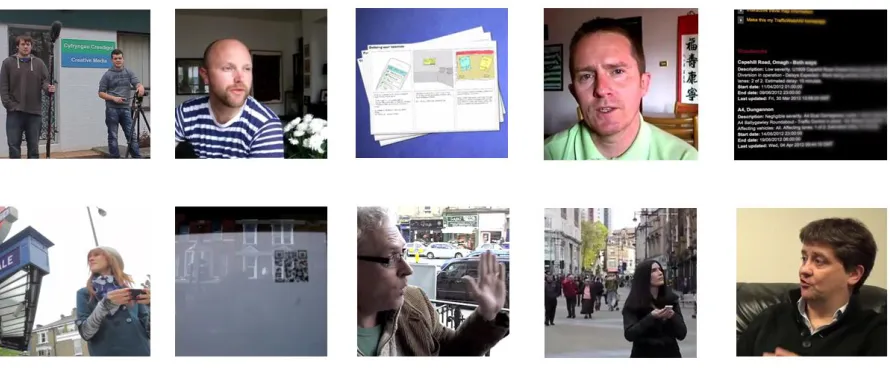
On first glance, most of the submitted videos (e.g. see Figure 1, also footnote 2) appear as, at best, distinctly low-budget versions of the slicker kind produced by organizations such as Microsoft to portray anticipated technological futures. In general, these are not professionally produced videos and, in part, were required in order to present a threshold, testing the
possible technological futures.
[FIGURE 1 ABOUT HERE]
While project proposers were initially addressing Nesta’s first round selection panel, following project selection Nesta redeployed the videos within their broader engagement activities, positioning them in such a way that they addressed a more dispersed and indefinite public. This redeployment took place through a core element of Destination Local’s engagement activities: its
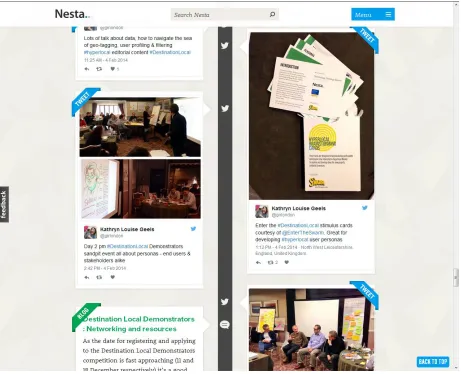
program website (see Figure 2). Like other project websites under the nesta.org.uk domain, Destination Local’s web presence was built around a fairly unique architecture. Aside from
minimal program information set along the top of the page, its content was entirely organized along a vertical, streamed timeline. Pinned to the timeline were bits of content, such as project videos, blog posts, tweeted images of events, research reports, and media releases extending across the program’s two rounds, and various related initiatives and partnerships5.
[FIGURE 2 ABOUT HERE]
Superficially, this public engagement format might be seen as merely gestural: it had the right sort of social media ‘feel’; it was responsive to mobile reading; it spread content across
platforms; and so on. The stream architecture, however, also set into motion a certain
concatenation of texts, sounds, images and moving images, arguably supporting a certain kind of public temporality (see Warner, 2002: 67). As Berry (forthcoming) argues, streamed
culture, structuring an orientation to and anticipation of future data flows. Destination Local’s project website, of course, is scarcely comparable with a streamed media platform such as Twitter, with its enormous data flows. What is important about the Nesta website’s basic information architecture however is how, in the case of Destination Local, it underscored and perhaps went beyond the program’s invocation of anticipatory discourses of digitized location – projecting a future and making it present (cf. Kinsley, 2011). In its temporal structure and logic, the Nesta website’s streamed public engagement portal in and of itself performed a kind of
ambient, unfolding present-future for an emergent hyperlocal media space.
Discussion and conclusions
‘Locals are localized. Places are placed.’ (Latour, 2005: 195)
The above quotation from Latour cautions against a perhaps instinctive recourse when we are presented with any kind of self-evidently ‘local’ activity: we tacitly imagine that site of activity to be local in an originary sense, as that from which all the agency emanates. Localities,
however, are not originary nor pre-given. They are the result ‘of all the other local interactions distributed elsewhere in time and space, which have been brought to bear on the scene through the relays of various non-human actors’ (Latour, 2005: 194). In some respects this is well understood in the local media literature. Local UK newspapers have for some time been seen as promulgating an ‘illusory’ localism (see Franklin, 2005), since they are so often the product of
experiment with far more emergent technologies and techniques. It was, in other words, a more provisional effort at the ‘production of locality’ (cf. Appadurai, 1995; Postill, 2011), made
through establishing new configurations between technology and various fields of practice.
Destination Local can be seen, then, as an unconventional form of media production first in how it anticipated such new configurations of technology and practical fields. Within the program, location-based technologies operated as a ‘sociotechnical projectory’ (Messeri and Vertesi, 2015), meaning a composite of posited end-points with the potential to organize a range of dispersed actors around a shared narrative. However, as Kinsley (2011: 238-239) argues, projected futures in technology research and development do not necessarily mean the imposition a disciplinary program. Anticipatory discourses are often politically generative, operating as horizons of problem identification, or against which alternatives can be discussed and proposed. Within Destination Local, the anticipation of digitized location as the self-evident backbone of future local media revealed, as I discussed, tensions between culturally inflected place-orientations of local media producers and the more placeless spatial functionalities of location-based platforms.
But Destination Local amounted to a form of media production not just by anticipating emergent local media technologies. It also actively partook in the assembly of a production field. As I suggested, this involves conceiving of hyperlocal media as not only a diverse collection of ‘very local’ media producers, but a field space of researchers, policy-makers, entrepreneurs,
journalism, inter-local associations of community reporters might be the initial ‘seeds of a different news infrastructure’. Destination Local’s frequent invocation of a UK hyperlocal ‘space’ seemed to aspirationally chime in with such hopes, positing something akin to this
inter-local infrastructure. However, as I will return to momentarily, the emphasis on and even fetishization of location-based technologies per se simultaneously indicates a strength and a blind spot.
The primary mode through which Destination Local went about anticipating and assembling this emergent media production space was by ‘animating’ it: bringing the UK hyperlocal space to life, or giving the appearance of motion, by emphasizing experimentation, public engagement and information sharing. As Mark Pearson, Destination Local’s Ofcom secondee, told me, this orientation is‘very much at the heart of Nesta’s DNA’. Given its history as a public body, it is unsurprising that a charity like Nesta would emphasize publicness. Yet more is at play here than a general orientation to openness and sharing. Experimentation, research and communication are effectively the principal means through which a philanthropic organization like Nesta can
It is in this context that we can return critically to the normative backdrop of Destination Local: an implicit veneration of localism. As noted earlier, it was striking how, in this research, it was rare to hear any explicitly political discussion of locality. Instead, localism was indirectly invoked by reference to hyperlocal media as a type of media production, and then with a strong emphasis on the possibilities of location-based technologies. In one sense, this indirect emphasis on localism through technology might be commended. At a moment when algorithmic power is often seen as unavoidable and unchangeable, a program such as Destination Local is an example of organized social awareness and action in relation to geographically dispersed and
technologically layered ecosystems typically associated with nonhuman computational agency (see Beer, 2016; Couldry et al., 2016). All the same, in analysing such advocacy for
References
Anderson CW. (2013) Rebuilding the news: Metropolitan journalism in the digital age, Philadelphia: Temple University Press.
Appadurai A. (1995) The production of locality. In: Fardon R (ed) Counterworks: Managing the diversity of knowledge, London: Routledge, 208-229
Aurigi A and De Cindio F. (2008) Augmented urban spaces: Articulating the physical and electronic city. Farnham: Ashgate.
Barnett S and Townend J. (2015) Plurality, policy and the local: Can hyperlocals fill the gap? Journalism Practice 9: 332-349.
Beer D. (2017) The social power of algorithms. Information, Communication and Society 20(1): 1-13.
Benford S and Giannachi G. (2011) Performing mixed reality. Cambridge, MA: MIT Press.
Barreneche C and Wilken R. (2015) Platform specificity and the politics of location data extraction. European Journal of Cultural Studies 18(4-5): 497–513.
Berry DM. (forthcoming) Phenomenological approaches to the computal: Some reflections on computation.In: Markham T and Rodgers S (eds) Conditions of mediation:
Phenomenological perspectives on media. New York: Peter Lang.
Borup M, Brown N, Konrad K and van Lente H. (2006) The sociology of expectations in science and technology. Technology Analysis and Strategic Management 18: 285-298.
Bourdieu P. (2005) The political field, the social science field, and the journalistic field. In: Benson R and Neveu E (eds) Bourdieu and the journalistic field. Cambridge: Polity Press, 29-47.
of political space. Environment and Planning D: Society and Space 32: 642-657. Braman S. (2007) The ideal v. the real in media localism: Regulatory implications.
Communication Law and Policy 12: 231-278.
Bruns A. (2008) Blogs, Wikipedia, Second life, and beyond: From production to produsage, New York: Peter Lang.
Calabrese A. (2001) Why localism? Communication technology and the shifting scale of political community. In: Shepherd G and Rothenbuhler E (eds) Communication and community. Mahwah, NJ: Lawrence Erlbaum Publishers, 251-270.
Chadha M. (2015) What I am versus what I do: Work and identity negotiation in hyperlocal news startups. Journalism Practice: 1-18.
Chadwick A. (2013) The hybrid media system: Politics and power, Oxford: Oxford University Press.
Couldry N, Fotopoulou A and Dickens L. (2016) Real social analytics: A contribution towards a phenomenology of a digital world. British Journal of Sociology 67: 118-137.
de Waal M. (2014) The city as interface: How new media are changing the city, Rotterdam: nai010.
Dickens L, Couldry N and Fotopoulou A. (2015) News in the community? Investigating
emerging inter-local spaces of news production/consumption. Journalism Studies 16: 97-114.
Dunbar-Hester C. (2013) What's local? Localism as a discursive boundary object in low-power radio policymaking. Communication, Culture & Critique 6: 502-524.
Goggin G, Martin F and Dwyer T. (2015) Locative news: Mobile media, place informatics, and digital news. Journalism Studies 16: 41-59.
Gordon E and de Souza e Silva A. (2011) Net locality: Why location matters in a networked world, Chichester: Wiley-Blackwell.
Graham M, Zook M and Boulton A. (2013) Augmented reality in urban places: Contested
content and the duplicity of code. Transactions of the Institute of British Geographers 38: 464-479.
Greenslade R and Barnett S. (2014) Can charity save the local press? British Journalism Review 25: 62-66.
Hargreaves I and Hartley J. (2016) The creative citizen unbound: How social media and DIY culture contribute to democracy, communities and the creative economy. Bristol: Policy
Press.
Harte D, Turner J and Williams A. (2016) Discourses of enterprise in hyperlocal community news in the UK. Journalism Practice 10: 233-250.
Hess K and Waller L. (2015) Hip to be hyper: The subculture of excessively local news. Digital Journalism 4: 1-18.
Iveson K. (2011) Mobile media and the strategies of urban citizenship: Control,
responsibilization, politicization. In: Foth M, Forlano L, Satchell C, et al. (eds) From social butterfly to engaged citizen: Urban informatics, social media, ubiquitous
computing, and mobile technology to support citizen engagement. Cambridge, MA: MIT
Press, 55-70.
Kallinikos J, Hasselbladh H and Marton A. (2013) Governing social practice: Technology and institutional change. Theory and Society 42: 395-421.
Kennedy D. (2013) The wired city: Reimagining journalism and civic life in the post-newspaper age, Boston: University of Massachusetts Press.
Kinsley S. (2010) Representing ‘things to come’: Feeling the visions of future technologies.
Environment and Planning A 42: 2771-2790.
Kinsley S. (2011) Anticipating ubiquitous computing: Logics to forecast technological futures. Geoforum 42: 231-240.
Kitchin R and Dodge M. (2011) Code/space: Software and everyday life, Cambridge, MA: MIT Press.
Kurpius DD, Metzgar ET and Rowley KM. (2010) Sustaining hyperlocal media: In search of funding models. Journalism Studies 11: 359-376.
Latour B. (2005) Reassembling the social. Oxford: Oxford University Press
Lewis SC. (2012) From journalism to information: The transformation of the Knight Foundation and news innovation. Mass Communication and Society 15: 309-334.
Mackenzie A. (2006) Cutting code: Software and sociality. New York: Peter Lang. Manovich L. (2001) The language of new media, Cambridge, MA: MIT Press.
Messeri L and Vertesi J. The greatest missions never flown: Anticipatory discourse and the ‘projectory’ in technological communities. Technology and Culture 56: 54-85.
Metzgar ET, Kurpius DD and Rowley KM. (2011) Defining hyperlocal media: Proposing a framework for discussion. New Media & Society: 1461444810385095.
Taurus & Co.
Paulussen S and D'heer E. (2013) Using citizens for community journalism: Findings from a hyperlocal media project. Journalism Practice 7: 588-603.
Postill J. (2011) Localizing the Internet. New York: Berghahn.
Radcliffe D. (2012) Here and now: UK hyperlocal media today. Report for Nesta. 29 March 2012.
Rodgers S. (2015) Foreign objects? Web content management systems, journalistic cultures and the ontology of software. Journalism: Theory, Practice and Criticism 16: 10-26.
Rose M and Wylie J. (2006) Animating landscape. Environment and Planning D: Society and Space 24: 475-479.
Schmitz Weiss A. (2015) Place-based knowledge in the twenty-first century: The creation of spatial journalism. Digital Journalism 3: 116-131.
Sheller M. (2015) News now: Interface, ambience, flow, and the disruptive spatio-temporalities of mobile news media. Journalism Studies 16: 12-26.
Suttles, GD. (1985) The cumulative texture of local urban culture. American Journal of Sociology 90: 283-304.
van Dijck J. (2013) The culture of connectivity: A critical history of social media: Oxford University Press.
van Kerkhoven M and Bakker P. (2014) The hyperlocal in practice: Innovation, creativity and diversity. Digital Journalism 2: 296-309.
Vannini P. (2015) Non-representational ethnography: New ways of animating lifeworlds. Cultural Geographies 22: 317-327.
Wilken R. (2012) Locative media: From specialized preoccupation to mainstream fascination. Convergence: The International Journal of Research into New Media Technologies 18:
243.
Williams A, Goodwin M and Cloke P. (2014) Neoliberalism, Big Society, and progressive localism. Environment and Planning A 46: 2798-2815.
Williams A, Harte D and Turner J. (2015) The Value of UK hyperlocal community news:
Findings from a content analysis, an online survey and interviews with producers. Digital Journalism 3: 680-703.
Wills J. (2016) Locating localism: Statecraft, citizenship and democracy. Bristol: Policy Press. Wilson MW. (2012) Location-based services, conspicuous mobility, and the location-aware
Notes
1. See: http://www.nesta.org.uk/blog/lamppost-your-smartphone-building-community-app-21st-century (accessed 17 November 2016)
2. See: http://www.nesta.org.uk/project/destination-local (accessed 17 November 2016). Nesta also created a public YouTube channel that made available all 165 submitted proposal videos (some have since been removed):
https://www.youtube.com/playlist?list=PL7A01B36FE5352BD3&feature=plcp (accessed 17 November 2016)
3. Nesta’s funding also included contributions from Creative Scotland, the Welsh Government and Creative England. In addition, the Destination Local programme included partnerships involving in-kind contributions from organizations such as Mozilla, Talk About Local, Ofcom, The Guardian, The BBC and The Media Trust.
4. See: http://www.nesta.org.uk/news/million-pound-boost-develop-uk-hyperlocal-media-sector (accessed 17 November 2016)
5. See: http://www.nesta.org.uk/blog/uk-hyperlocal-media-its-time-we-all-worked-together (accessed 17 November 2016)