BIROn - Birkbeck Institutional Research Online
Walters, Richard and Gregory, L.C. and Wedmore, L.N.J. and Craig, T.J. and
McCaffrey, K. and Wilkinson, M. and Chen, J. and Lie, Z. and Elliott, J.R.
and Goodall, H. and Iezzi, Francesco and Livio, F. and Michetti, A.M. and
Roberts, Gerald P. and Vittori, E. (2018) Dual control of fault intersections
on stop-start rupture in the 2016 Central Italy seismic sequence. Earth and
Planetary Science Letters 500 , pp. 1-14. ISSN 0012-821X.
Downloaded from:
Usage Guidelines:
Please refer to usage guidelines at
or alternatively
Earth and Planetary Science Letters 500 (2018) 1–14
Contents lists available atScienceDirect
Earth
and
Planetary
Science
Letters
www.elsevier.com/locate/epsl
Dual
control
of
fault
intersections
on
stop-start
rupture
in
the
2016
Central
Italy
seismic
sequence
R.J. Walters
a,
∗
,
L.C. Gregory
b,
L.N.J. Wedmore
b,
1,
T.J. Craig
b,
K. McCaffrey
c,
M. Wilkinson
d,
J. Chen
e, Z. Li
e,
J.R. Elliott
b,
H. Goodall
b, F. Iezzi
f,
F. Livio
g,
A.M. Michetti
g,
G. Roberts
f,
E. Vittori
haCOMET,DepartmentofEarthSciences,DurhamUniversity,Durham,UK bCOMET,SchoolofEarth&Environment,UniversityofLeeds,Leeds,UK cDepartmentofEarthSciences,DurhamUniversity,Durham,UK
dGeospatialResearchLtd.,DepartmentofEarthSciences,DurhamUniversity,Durham,UK eCOMET,SchoolofEngineering,NewcastleUniversity,Newcastle,UK
fDepartmentofEarthandPlanetarySciences,Birkbeck,UniversityofLondon,London,UK gDipartimentodiScienzaeAltatecnologia,UniversitàdegliStudidell’Insubria,Como,Italy hServizioGeologicod’Italia,ISPRA,Rome,Italy
a
r
t
i
c
l
e
i
n
f
o
a
b
s
t
r
a
c
t
Articlehistory:
Received21February2018 Receivedinrevisedform23July2018 Accepted29July2018
Availableonline9August2018 Editor:J.-P.Avouac
Keywords: earthquakes InSAR
seismicsequence faultsegmentation fluiddiffusion
Large continental earthquakes necessarily involve failure of multiple faults or segments. But these same critically-stressed systems sometimes fail in drawn-out sequences of smaller earthquakes over days or years instead. These two modes of failure have vastly different implications for seismic hazard and it is not known why fault systems sometimes fail in one mode or the other, or what controls the termination and reinitiation of slip in protracted seismic sequences. A paucity of modern observations of seismic sequences has hampered our understanding to-date, but a series of three Mw>6 earthquakes from August to November 2016 in Central Italy represents a uniquely well-observed example. Here we exploit a wealth of geodetic, seismological and field data to understand the spatio-temporal evolution of the sequence. Our results suggest that intersections between major and subsidiary faults controlled the extent and termination of rupture in each event in the sequence, and that fluid diffusion, channelled along these same fault intersections, may have also determined the timing of rupture reinitiation. This dual control of subsurface structure on the stop-start rupture in seismic sequences may be common; future efforts should focus on investigating its prevalence.
©2018 The Author(s). Published by Elsevier B.V. This is an open access article under the CC BY license (http://creativecommons.org/licenses/by/4.0/).
1. Introduction
In regions of distributed continentalfaulting, networksof ac-tivefaultsarecommonlysegmentedonlengthscalesof10–25km, approximately equal to the seismogenic thickness of the Earth’s crust (Scholz, 1997; Stock and Smith, 2000; Klinger, 2010). This intrinsicmaximumfault size limitsthe magnitudeofcontinental earthquakesthatruptureasingle faultorsegmentto
<
Mw∼
6–7 (Pachecoetal., 1992; Triep andSykes,1997), depending onlocal seismogenicthickness andfault geometry. Therefore,large conti-nentalearthquakesabovethisthreshold(Scholz,1997) suchasthe 2010M7.2El Mayor–Cucapah,Mexico, 2016M7.8Kaikoura, New*
Correspondingauthor.E-mailaddress:[email protected](R.J. Walters).
1 Nowat:COMET,SchoolofEarthSciences,UniversityofBristol,Bristol,UK.
Zealand, and 1980 M6.9 Irpinia, Italy events (Wei et al., 2011; Hamlingetal.,2017; WestawayandJackson, 1987) necessarily in-volve failure ofmultiple faults orsegments. Multi-fault failure in seismic sequences, spanning a longer period of hours to years, is also common, with static stress transfer invoked as the ma-jor cause forthisspatio-temporal clustering oflarge earthquakes withinasmallfractionoftheirestimatedrecurrenceintervals(e.g. Hubertetal.,1996; KingandCocco,2001; Wedmoreetal.,2017).
Both large earthquakes and seismic sequences require that all component faults are near-critically stressed,a condition that is thought likely to occur commonly in nature through stress-synchronisation offaults (Scholz,2010). In addition, recentwork suggests that as in seismic sequences, the final magnitude of a multi-fault earthquake cannot be predicted from the initial rup-tureprocess(Weietal., 2011).Thissimilarityininitialconditions means that multi-faultearthquakes andseismic sequences begin in thesame wayanddiffer accordingto when rupturestops:
ei-https://doi.org/10.1016/j.epsl.2018.07.043
Fig. 1.Overviewofepicentralregionandfaultgeometryusedinthisstudy.(a)Regionaltectonicmap,showingmappedactivenormalfaults(magenta,modifiedfromRoberts andMichetti,2004),up-dipsurfaceprojectionofmodelfaultsdisplayedinFigs.6–9(colouredtomatch(c)andFigs.3,4and6),andbodywavefocalmechanismsforeach earthquake(seeFig.2).Whitedashedlineshowsinferredeast-dippingfaultfromFig.7,andrelocatedaftershocksfromChiaraluceetal. (2017) areshowninblack.Locations ofshort-baselineGNSSinstrumentsareshownbybluetriangles.BlackboxshowsextentofFig.3c.(b)Regionalmapshowingthelocationof(a)anddirectionofregional crustalextension.(c)3Dcartoonofmodelfaultgeometryadoptedinthisstudy.Thickcolouredlinesshowthesurfaceprojectionofeachfaultandcorrespondtothecoloured faultsin(a)andFigs.3,4and6.(Forinterpretationofthecoloursinthisfigureandotherfigures,thereaderisreferredtothewebversionofthisarticle.)
therdynamic andstaticstress transfer causecascadingfailure of multiplecritically-stressed faults orrupture isarrested before all thesefaults have failed. In thelatter casethe start ofrupture in subsequent subevents determines the temporal evolution of the seismic sequence.Large earthquakes andseismic sequences have vastly different implications for seismic hazard: high hazard in a single event, or moderatehazard spanning years orpotentially decades. Butour understanding of what controlswhether multi-faultruptureoccursoverdaystoyearsorinseconds,andofwhat controls the spatio-temporal evolution of seismic sequences, has beenseverelylimitedbyapaucityofhigh-resolutionobservations ofmodernseismicsequences.
Combined analysisofgeodetic andseismological datacan im-agestop-start rupturebehaviour andaddress these questions,by disentangling the spatial pattern and temporal evolution of slip inseismicsequences athighresolution.Asequence of3 Mw
>
6 earthquakesfromAugustto November2016intheCentral Apen-ninemountains,Italy(Fig.1)presentsararechancetoinvestigate aseismicsequencewithmoderndatasetsandhereweexploitseis-mologicalandfieldobservations,aswellasgeodeticdata,toimage the kinematicsofthesequence,andtounderstandstructuraland dynamic controlson itsevolution. Ourresultssuggest that struc-tural complexity, namely the intersections between two sets of obliquefaults,mayhaveplayedanimportantdualroleinthe Cen-tralItalyseismicsequence:firstbylimitingtheextentofindividual rupturesandsecondby channellingfluidflowandcontrollingthe timingofsubsequentfailurethroughoutthesequence.
2. Seismologicalconstraintonearthquakesourcemechanisms
R.J. Walters et al. / Earth and Planetary Science Letters 500 (2018) 1–14 3
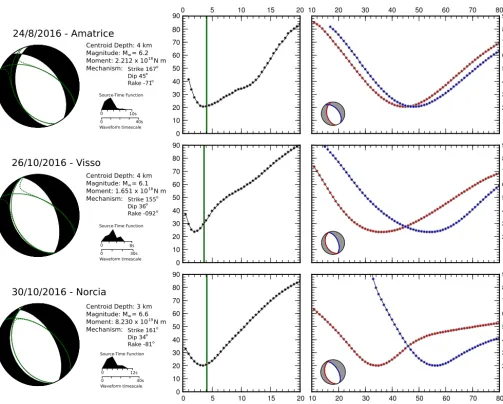
Fig. 2.Summaryofseismologicalresults.Leftcolumnshowsthebest-fitseismologicalfocalmechanism(black)determinedusingMT5softwarepackage(Zwicketal.,1994). ForeachoftheAmatrice,Visso,andNorciaearthquakes,thecompositegeodeticmechanismfromthegeodeticsolutionisshown,asboththefullmomenttensor(dashed greenline)andbestdoublecouple(solidgreenline).Best-fitseismologicalmechanismparametersandsourcetimefunctionarealsogiven.Centralpanelsshowdepth-misfit curves.Eachpointonthecurveisdeterminedbyfixingthecentroiddepthtothegivenvalue,andinvertingthewaveformdatatodeterminethebestfitmechanismand source-timefunctionatthatdepth.Verticalgreenbarsshowthecentroidforthegeodetically-derivedslipdistributionsshowninFig.6fortheAmatrice,VissoandNorcia earthquakes,forcomparison.Rightpanelsshowdip-misfitplots.Oneach,redindicatestheSW-dippingplane,bluetheNE-dippingplane.Waveformsandbest-fitsynthetics foreachearthquakeareshowninSupplementaryFigs. S1–S3.
Foreachofthesethreeearthquakes,weinvertteleseismic long-periodbodywavesforthebest-fitfocalmechanism(Fig.2, Supple-mentaryFigs. S1–S3).Wetreateachearthquakeasafinite-duration point-source centroid, with a moment-release function parame-terised by a series of 1 s triangular elements. We invert P and
S H waveformstodeterminethemoment-ratefunction,acentroid depth,totalmomentandafocalmechanism(strike,dip,rake), us-ingaleast-squaresapproach(e.g.seeWaltersetal.,2009).
WeestimateaseismologicalMwof6.2,6.1and6.6forthe Am-atrice,VissoandNorciaearthquakes respectively,andfindsimilar normal-faultingmechanismsonNNW–SSE strikingfaults foreach event. Our seismological results suggest shallow centroid depths of
∼
4 km and relatively shallow dips for all three earthquakes (<
∼
45◦fortheVissoandNorciaearthquakes,<
∼
50◦forthe Ama-triceearthquake;Fig.2).Thecentroiddepthsestimatedhereagree wellwithprevious seismological estimates(e.g.,Chiaraluce etal., 2017; Pizzi et al., 2017). All these seismological results are con-sistent inindicating that the majorityof momentrelease is con-centrated within the upper∼
8 km of the crust, with centroids from3–6kmdepthforallthreeofthelargestevents.Comparisonbetween thefocal mechanismsestimated here, and the compos-ite focal mechanisms resultingfrom finite-fault inversionof near source data shows a good agreement in strike and dip, with a slight (
∼
10◦) difference in rake that likely results from collaps-ingadistributedpatternofslipacrossseveralfaultsintoasimple compositemechanism(Pizzietal.,2017).3. Fieldmeasurementofsurfaceruptures
Thenormalfaulting mechanismfromourseismological results is consistent with the NE–SW extension that characterises the Apennine mountain belt (D’Agostino et al., 2011, Fig. 1b). The earthquakesoccurredintheregionoftheSW-dippingLagaandMt. Vettore(hereafterreferred to as‘Vettore’) normalfaults.Ofthese twomajorfaults,theLagafaultwasthoughttohavelastruptured in a major earthquake in 1639 A.D. (Rovida et al., 2016), whilst theVettorefaultwasonlyknowntobeactivefrompalaeoseismic investigations(GaladiniandGalli,2003).
the compilation of measurements collated by the openEMERGEO internationalworkinggroup(Civicoetal.,2018).Measurementsof throw,heave,netslipandslipvectortogetherwithfaultstrikeand dip were collected in the region of the Vettore and Laga faults, using a handheld compass clinometer anda ruler. Forthe Ama-triceearthquake,measurements were collected overthe1 month following the earthquake. For the Visso earthquake, due to the shorttime betweenthisevent andthe subsequent Norcia earth-quake, the identification and mapping of the ruptures is likely incompleteandwewereonlyabletocollectmeasurementsofthe slip.
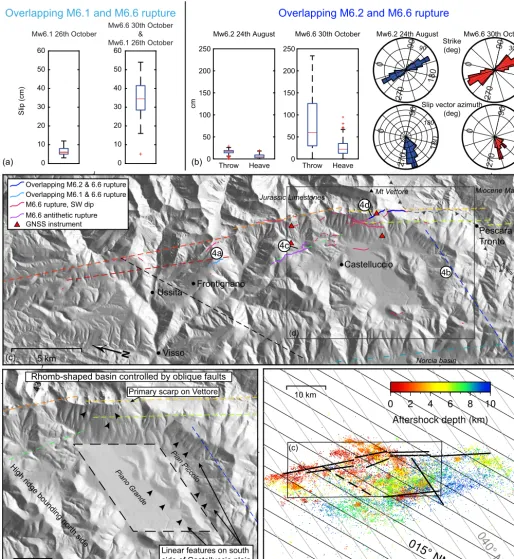
The Amatrice and Visso earthquakes each generated semi-continuoussurface ruptureswith
∼
10–20cmsliponpre-existing bedrock scarps, towards the southern and northern ends of the mappedVettorefaultrespectively(Figs.3,4).Incontrast,the Nor-cia earthquake ruptured portions of the Vettore fault along its entire length, generating offsets up to 2.3 m along the central portionsofthe fault,andre-rupturing someofthe samesections that failed in the earlier earthquakes (Figs. 3, 4). These sections re-rupturedwiththesamekinematicsbutapproximatelyan order ofmagnitude greater slip. During the Norcia earthquake, numer-ous smaller faults in the hangingwall of the Vettore fault were alsoactivated,includingmetre-scaledisplacementofanantithetic structure∼
2kmSWofthemainfault (Fig.4c).Thesefield mea-surementsareconsistentwithourseismologicalsolutionsandthe regionalextensiondirection.4. Geodeticestimationofslipinthesequence
4.1. Geodeticdatasets
We measurethe surface displacements during theseismic se-quence with eighteen separate geodetic datasets: one regional GNSS dataset for each of the three earthquakes (INGV, 2016a, 2016b),oneshort-baselineGNSSdatasetfortheNorciaearthquake (Wilkinson et al., 2017) and fourteen InSAR datasets from the Sentinel-1 andALOS-2 satellites,each constraining the coseismic displacement fields from one or more of the three earthquakes (Fig.5g,SupplementaryFig. S4).
We processed Sentinel-1 Synthetic Aperture Radar interfero-grams using the GAMMA software package (http://www.gamma -rs.ch) andunwrappedthem usingthe MCF algorithm(Costantini, 1998). ALOS-2 interferograms were generated using the JPL/Cal-tech/Stanford ISCE package (https://winsar.unavco.org/isce.html) and unwrapped using the SNAPHU method (Chen and Zebker, 2002). Orbital effects were corrected using precise orbits from the European and Japanese Space Agencies respectively, and to-pographic effects were removed using 1-arcsec topographic data from the Shuttle Radar Topographic Mission (Farr et al., 2007). Unwrapping errors were manually checked and corrected. Inter-ferograms were resampled in preparation for modelling using a nesteduniform sampling approach (e.g. Floyd etal., 2016), with higherdensity in thenearfield and lower density inthe farfield, to obtain about 1500 line-of-sight data-points per interferogram (SupplementaryFig. S4).
4.2. Modelfaultgeometry
In order to relate our geodetic measurements of surface dis-placement to slip on faults in the subsurface, we first define a simplified array ofnine rectangular modelfaults (Fig. 1a, c, Sup-plementaryTable1). Thislevel ofcomplexity insource geometry is commonly required for geodetic modelling of multi-segment, moderate-magnitude events like the Norcia earthquake (e.g. the S. Napa,CaliforniaandDarfield,NZearthquakes;Floydetal.,2016; Elliott et al., 2012), and requires that fault geometries are fixed
prior to inversion, often on the basis of additional geological or geophysicalconstraints.FortheCentralItalyseismicsequence,we use a wealth of such additional information to define fault ge-ometriesatthesurfaceandatdepth,including:1)discontinuities and low-coherence regions in our InSAR data (e.g. Fig. 5a, c,e), which are commonly indicative of surface or near-surface fault-ing; 2) our field mapping of surface ruptures (Fig. 3; Civico et al., 2018);3) relocatedaftershock clouds(Chiaraluce etal., 2017; e.g. Supplementary Fig. S5) and;4) our body-wavefocal mecha-nisms.
Ourmodelgeometryprimarilyconsistsoffourmajorfault seg-ments:threesegmentsforthemainVettorefault,andoneforthe northern Laga fault. The locations, strikes and dips ofthese four faultsarewellconstrainedbytheabovedatasets.
We placethree additionalminorfaultswithin thehangingwall of the Vettore fault; one antithetic and two synthetic (Fig. 1c). These minor faults are necessary to explain important near-fault complexity both in the geodetic displacements for the Norcia earthquake (e.g.theregion betweenthecentral Vettorefaultand the minor antithetic fault in Fig. 5c) and the complex array of decimetricsurface ruptureswe mappedinthefield (Fig.3). Tests showingthe increasedlocalmisfitto thesedatawhen theminor faults are each removed from the model are shown in Supple-mentaryFigs. S13–S24andsummarisedinSupplementaryTable2. Wenote thatwhilstthegeodeticandfield dataconstrainthe sur-face locationofthesethreefaults andslipintheshallow subsur-face,thegeodeticdataareinsensitivetotheirgeometryatdepths greaterthan1–2kmduetostrongtrade-offswithsliponthemain Vettorefault.
Twomorefaultsrepresent:a12-kmlongENEdippingstructure antithetic to the Vettore fault that we call the Norcia Antithetic fault; andaNE–SW striking14-km longnormalfault wecall the Pian Piccolo fault that cross-cuts the Castelluccio plain between the Vettorefault andNorciafault systemto theSW (Figs.1,3c). Theintersectionsbetweenmodelfaultsatdeptharesupportedby alignments ofrelocated aftershocks(fromChiaraluce etal., 2017) when projectedontoourmodelfault planes(Figs.6,7). ThePian Piccolofaultisrequiredtoexplain astrongNE–SWalignedsignal intheInSAR datathatcoversthe Norciaearthquake(e.g.Fig.5e). In addition,thelocation andstrikeofthisfault are supportedby thegeomorphologyoftheCastelluccio plain(Fig.3d),previous ge-ologicalmapping(ColtortiandFarabollini,1995) andby relocated aftershocks (Fig.7), thelatterofwhich alsoconstrains thedipat
R.J. Walters et al. / Earth and Planetary Science Letters 500 (2018) 1–14 5
Fig. 4.Fieldphotosofoverlappingfaultruptures(a,d)andsynthetic(b)andantithetic(c)ruptures.SymbolsarethesameasinFig.3,andphotolocationsareshownon Fig.3c.
4.3. Inversionfordistributionofslipinthesequence
Each of the nine model faults are discretised into patches
∼
1 kmalongstrike×
1kmindepth(SupplementaryTable1).We solveforthedistributionofslipacrossthisfaultarrayduringfour discreteintervals:threecoseismicintervalsassociatedwitheachof thethreeM>
6 earthquakesandonepostseismicintervalthat fol-lowstheAmatriceearthquake andprecedes theVissoearthquake (Fig.5g,redstarsandarrow).Wejointlyinvertallgeodeticdatafor slipintheseintervalsfollowingthemethodemployedbyFloydet al. (2016). Surface displacements are modelled as resulting from slip on rectangular dislocations in an elastic half-space (Okada, 1985), withshear modulus3.23e10anda Poisson’sratio of0.25. Wesolvefortwocomponentsofslipforeachfaultpatchtoallow spatially-varyingrake,withanon-negativeconstraintonthe inver-sion.We also force slip tobe zeroon certain maskedregions of ourmodelduringthefirstthreetimeintervals(hashedregionson Fig.6).Thisisfortworeasons:topreventfittingofnoisein geode-ticdataawayfromtheearthquakeofinterest,andtopreventhigh sliponshallowmodel patchesthat havelow temporalresolution (see below) and for which field mapping revealed no significant slipintherelevanttimeinterval.RelativetotheInSARdata,theregionalandshort-baselineGNSS dataareweighted byfactorsof30and6respectively,totakeinto accountboththerelativevarianceofthedifferentdatasetsandthe much largernumber ofInSAR measurements. GNSS uncertainties are those givenas formal uncertainties, and InSAR covarianceis estimated for each dataset by fitting an exponential function to the1D radial autocovariancefroma non-deformingregionofthe data(e.g.Funningetal.,2005).Wetestedvariationsintherelative weightings,andhigherweightingsoftheInSAR dataledto degra-dationinthefittotheGNSSdatawithoutsignificantimprovement to the fit to theInSAR, essentially overfittingnoise in the InSAR (SupplementaryFig. S11).
We regularise our inversion using a Laplacian smoothing cri-terion, andchoose a smoothingfactor that representsa compro-mise between smoothnessof the solution and goodness-of-fitto the geodetic data (Supplementary Fig. S12). Whilst changing the smoothingfactorwithinreasonableboundschangesthepeak mag-nitudeofslip,itdoesnotaffectthespatialpatternofslip.
We estimate uncertainties on our geodetic slip distributions usinga MonteCarlo approach,(e.g.Funning etal., 2005,
Supple-mentaryFig. S6),andestimatethespatialandtemporalresolution of our slip model using a resolution spike test (Du etal., 1992; SupplementaryFigs. S7and S8).
4.4. Recovereddistributionofslip
Therecoveredslipdistributionsforthethreecoseismicintervals are shown in Fig. 6, along withcomposite geodetic focal mech-anisms. We compare these focal mechanisms to our body-wave solutions in Fig. 2, and find that the total moment release, the centroid depth,andthegeometryof theSW-dippingnodalplane matchextremelywellinallcases.Theslipvector(andhence auxil-iaryplane)intheseismologicalsolutionsshowssomediscrepancy with the composite geodetic moment tensors, with the geodetic solutionsineachcaseincorporatingaslightobliquecomponentto themomenttensor,comparedwiththealmostpure dip-slip seis-mologicalmomenttensors.Fig.6showsthatslipisconfinedtothe top
∼
6kmofthecrust inallevents,whichsupportstheshallow,<
4kmcentroiddepthsfromourbody-wavesolutions.In addition,the magnitudeandlocation ofslipin thetop km ofthemodelagreeswellwithourindependentestimatesfromthe field(Figs.6,3),whichwetakeasvalidationofourchoiceofmodel geometry,giventhecomplexityofthemappednetworkofsurface ruptures.
R.J. Walters et al. / Earth and Planetary Science Letters 500 (2018) 1–14 7
Fig. 5.(a)–(f)Observed(left)andpredicted(right)InSARline-of-sightdisplacementsforvariouscombinationsofearthquakes(see(g)),fromALOS-2andSentinel-1data. Warmcoloursshowmotionawayfromthesatellite,andfringesshow
∼
11cmand2.8cmcontoursofdisplacementforALOS-2andSentinel-1imagesrespectively.Solid linesshowsurfaceprojectionofmodelfaults–thosecolouredpinkindicatemodelfaultswithnon-zeroslipduringtheintervalspannedbytheInSARdata.Blackdashed lineindicatesinferredeast-dippingfaultfromFig.7.(g)Geodeticdatacoverageusedinthisstudy.Redstarsanddashedlinesshoweachearthquake,anddouble-headed arrowindicatespostseismicinterval.Greycirclesshowshort-baseline(SB)andregional(INGV)GNSSdatasets,andgreybarsshowInSARdatasets,indicatingtheirtemporal coverage.Darkgreybarsshowtheexampledatasetsdisplayedinpanels(a),(c)and(e).similartotwoadditionalfaults proposedbyChelonietal. (2017). OurPianPiccolo faulthasasimilar striketothemodelfault that Cheloni et al. (2017) infer to be a reactivation of the Sibillini Thrust, butinourmodelthisoblique structure hasasteeper dip andprojectstothesurface
∼
2kmfurthertotheN(Fig.3c). How-ever,despite thesedifferences indetail, both ourstudies recover thesameobliquesenseofsliponthesetwoantitheticandoblique structures.Differencesbetweenourresultsandthosefromprevious stud-iesariseduetoseveralfactors.Aswellasdifferencesingeometry ofthemajorfaults,ourinversiontechnique(Floydetal.,2016),has enabledustojointlyinvertallgeodeticdatasetsthroughoutthe se-quenceformutlipleslipeventsonasinglefaultgeometry,
R.J. Walters et al. / Earth and Planetary Science Letters 500 (2018) 1–14 9
Fig. 7.AftershockpatternsboundingmajorepisodesofslipontheVettore–Lagafaultsystem.(a)AftershocksaftertheAmatriceearthquakebutbeforetheVissoearthquake (fromChiaraluceetal.,2017),projectedalongahorizontalvectorwithazimuth015◦ontotheVettoreandLagamodelfaults.Colourshowsthedistancetheaftershockhas beenprojectedontothefault.BlackcontoursshowslipintheAmatriceandVissoearthquakes,pinkcontoursshow1.3and2.3mslipcontoursintheNorciaearthquake. ThicksolidblacklinesshowintersectionofmodelfaultsasinFig.6.Dashedblacklineshowsinferredeast-dippingfault(dashedfaultinFig.1a,c),andpurpledashedline showsminorinferredNW-dippingfault.(b)Sameas(a)butwithallseismicityfromChiaraluceetal. (2017),notjusteventsbeforetheVissoearthquake.Greysolidline showspredictedintersectionofSibilliniThrustusingthegeometryfromPizzietal. (2017),whilstgreydashedlineshowstheequivalentfromChelonietal. (2017).(c)Same as(a)butaftershocksareinsteadprojectedalonganazimuthof040◦.NotethatsincethisprojectionazimuthissimilartothestrikeofthePianPiccolofault,aftershocks ofdifferentprojectiondistanceallcollapsetoanarrowregionaroundthisfault,whereasaftershocksfortheeast-dippingfault(dashedblackline)aresmearedout.This situationisreversedforpanel(a),wheretheprojectionazimuthisinsteadclosertothestrikeontheeast-dippingfault.
5. Discussion
5.1.Whydoesrupturestop?
TheclearspatialinterdependenceofslipfromthethreeM
>
6 earthquakes on the Vettore and Laga faults (Fig. 7) has been used to suggest that structural complexity along the main Vet-torefault strand mayhave influenced evolution ofthe sequence, with previous studies focusing on the termination of the Am-atrice earthquake (Chiaraluce et al., 2017; Cheloni et al., 2017; Pizzietal., 2017; Mildon etal., 2017).Here we useour new re-sults to investigate thisidea further andpropose that the inter-sectionof severalobliqueandpotentially seismogenicfaultswith theLaga–Vettore systemhalted ruptureforeach earthquakeinthesequence, therefore determining their respective magnitudes and
preventingcascadingruptureinasingleearthquakeof Mw 6.7or larger.
Active normal faults in the central Apennines are relatively young,having initiated within the past 2–3million yr, andas a result the faults are segmented with lengths generally
<
20 km (e.g.RobertsandMichetti,2004).Boundariesbetween neighbour-ing faultsegments areknown to commonlyarrest through-going ruptureinearthquakes(e.g.BiasiandWesnousky,2016).Theprimary structural trendin theregion ofthe 2016 earth-quakesequencerelatestothemainNW–SEstrikingnormalfaults. However, there is also a secondary oblique structural trend rep-resented by NNE–SSW to NE–SW striking faults, many of which are currently active as normal faults, that either formed in the current extensional tectonic phase or are reactivated thrusts
as-sociated with the previous compressional regime (e.g. Pizzi and Galadini,2009; ColtortiandFarabollini,1995; Civicoetal., 2017). Thesehavebeensuggestedtoactasstructuralbarrierstorupture onthemainNW–SE strikingnormalfaultsthey crosscutor inter-sect(e.g.PizziandGaladini,2009),byforcingsegmentboundaries onthemajorfaults.
We note linear features along this NNE–NE regional trend in boththerelocatedaftershocks(Chiaraluceetal.,2017,Fig.3e)and geomorphologyoftheVettorebasin(Fig.3c,d).ThePianoGrande basin is rhomb shaped and bounded to the north and south by topographicridgesstrikingapproximately040◦(NE–SW).Thereare alsosharpchangesinslopeobservedatthenorthernandsouthern sidesofthePianoGrandeandPianPiccolobasins,suggestingthat oblique faults mayhavesome control on the morphologyof this elevated plain (Fig. 3d). Thisis supported by previous geological mappingwhichhasidentifiednormalfaultsboundingthesebasins tothenorthandsouth(ColtortiandFarabollini,1995).
Therelocatedaftershocksshowpredominantalignmentalonga similar, butslightlydifferentNNE–SSW 015◦ trend (Fig. 3e). Pro-jectingaftershocksoftheAmatriceearthquakeontothemodel Vet-torefaultalongNNEorNEtrends,wefindlineationsofaftershocks separate the hypocentres and major rupture extents of all three earthquakes (Fig. 7a, c). Theseaftershock alignments predatethe Visso and Norciaearthquakes, so we interpret them as intersec-tions betweentheobliquefaults andthemain Vettore–Lagafault system.
Fig. 8.CoulombstresschangeontheVettore–LagafaultsystemcalculatedpriortotheVissoearthquake(a),priortotheNorciaearthquake(b)andfollowingtheNorcia earthquake(c).Warmcoloursindicatefaultregionsthathavebeenbroughtclosertofailure,coolcoloursindicateregionstakenfurtherfromfailure.Whitestarsrepresent thehypocentres forthethreemainearthquakesasinFig.6.
theAmatriceearthquakeisboundedcloselybytheintersectionof theNWdippingPianPiccolonormal-obliquefaultwiththeVettore fault (Fig. 6a). Slip is needed on a structure with this geometry toexplain thesurfacedisplacement duringtheNorciaearthquake (e.g.Fig.5e)andweseeevidenceforitfromrelocatedaftershocks (Chiaraluceetal.,2017,Figs.6a,7c)andinthelarge-scale geomor-phologyof the PianoGrande basin, as discussed above (Fig. 3d). The presence ofa specific fault in thislocation fromthe surface geologyisdebated(ColtortiandFarabollini,1995; Pierantonietal., 2013), but we also note that some oblique faults in this region are poorly expressedat thesurface andmay onlybe revealed at depth by geophysical surveys(Civico et al., 2017). Some authors havesuggested that the Sibillini Thrust, witha similar geometry toour PianPiccolo faultbut amuch shallowerdip (Fig. 3c,Pizzi andGaladini, 2009), is instead responsible forhalting the north-wardsruptureoftheAmatriceearthquake(Chiaraluceetal.,2017; Chelonietal., 2017; Pizzi etal., 2017). Wefavourour interpreta-tion of a steep structural barrier at depth over a shallowly dip-ping planar barrier(e.g. Cheloniet al., 2017, Fig.7b dashedgrey line)on thebasis oftheaftershock data,the geomorphologyand ournewSentinel-1interferograms.However,ourPianPiccolofault may well join with a steepened (
∼
40◦ dipping) lateral ramp of the Sibillini Thrust at depth (e.g. Pizzi et al., 2017, Fig. 7b solid grey line)and thesetwo scenarios are likely indistinguishable in ourdata.Ineithercase,thekeyinterpretation remainsthesame: a similar steep structure is inferred to have stopped northwards ruptureoftheAmatriceearthquake.Similarly,slipintheVissoearthquakeiscloselyboundedup-dip andatits abruptsouthern terminationby twolineations of after-shocks,whichweproposerepresentanunnamedfaultwithstrike NNEanddip
∼
55◦totheeast(dashedwhitelineonFig.1,dashed blacklineonFigs.3,5,7,9b)andapossiblesmallconjugatefault withapparentdiptotheNW(Fig.7,dashedpurpleline).These same suggested oblique faults also appear to constrain theoverallpatternofmajorslipintheNorciaearthquake(Fig.7a, b).Thestructuralcontrolhereistwofold:asbeforethefaultsmay directly act asbarriersto rupture,butinaddition thelimitations theyplaceonslipinthetwopreviouseventsleavesstressshadows (Fig. 8b),whichalsoact toconstraintheslipinthislastevent. In particularwe suggest thisindirectstructuralcontrol plays an im-portantroleforthesouthern-terminationofmajorslipinthe Nor-ciaearthquake;thePianPiccolofaultappearstohavenotstopped ruptureduringtheNorciaearthquakeandtheslipmaximainthis eventinsteadterminatesagainsttheslipmaximaofthe Amatrice earthquake,whichactsasastress-shadow(Figs.8b,7).
Onalargerscale,itappearsthattheintersectionoftheNorcia Antithetic fault with the Vettore–Laga systemmay also have re-strictedslipinallthreeearthquakestoshallowdepthsof
<
∼
6km. If thissequenceruptured onlythe shallowerhalfof theVettore– Lagasystemin∼
12–15kmthickseismogeniccrust(Chiarabbaand DeGori,2016),thiscouldsuggestthatthedeeperportion(depths>
6km)ofthefaultsystemisabletofailindependently,and cross-cuttingstructuresmayresultindepthsegmentation(e.g.Elliottet al.,2011)aswellasalong-strikesegmentationofseismicslip.5.2. Whydoesrupturestartagain?
previ-R.J. Walters et al. / Earth and Planetary Science Letters 500 (2018) 1–14 11
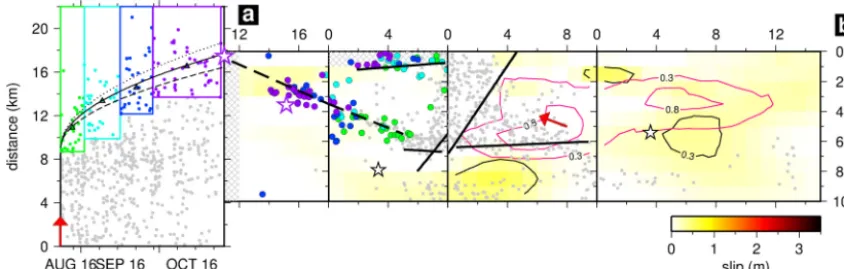
Fig. 9.Spatio-temporalevolutionofaftershocksontheVettore faultbeforetheVissoearthquake.(a)Timeevolutionofaftershocks.Aftershocksfollowing theAmatrice earthquake(Chiaraluceetal.,2017) areplottedingreyshowingdistanceintheVettorefaultplaneinthedirectionoftheredarrowin(b).Thecolouredboxescontainthe mostdistant20%ofaftershocksforprogressivetime-periods,andthetrianglesshowthemediandistancewithineachbox.ThestarshowsthelocationandtimeoftheVisso hypocentre,andtheblackdotted,solidanddashedcurvescorrespondtodiffusivemodelswith f=0.18 andK=4.8,3.8and2.8m2/srespectively.(b)Postseismicslip
estimatedfromourgeodeticmodelontheVettore–Lagafaultsystem,shownasinFig.6.Theredarrowshowsthedirectioninwhichdistanceiscalculatedin(a),andthe colouredaftershockscorrespondtothoseshownin(a).IntersectionsofmodelandinferredfaultsareshownasblacksolidanddashedlinesasinFig.7.
ouslypublished slipdistributionforthe2009L’Aquilaearthquake (Waltersetal.,2009).Coulombstresschange(
CFF)isdefinedas:
CFF
=
τ
+
μ
σ
nwhere
τ
isthechangeinshearstress,σ
n ischangeinnormal stressandμ
istheeffectivecoefficientoffriction.Stresschanges wereresolvedinthedirectionofslipofeachfaultpatch.Wherea faultpatchdidnotslipinoneofthetimeintervals,stresschanges were resolved onto a rake of−
90◦. Coulomb stress change cal-culations were performed using the Coulomb 3.2 software (Lin andStein, 2004) and a value of 0.4was used forμ
, with elas-ticparameterskeptthesameasforourgeodeticandseismological inversions.TheNorcia hypocentre was broughtcloserto failure by 1.7
±
0.18MPaby allprevious events,andgiventhe shortinterval be-tween the Visso and Norcia earthquakes, it is likely that static stress interactions broughtthe Norciahypocentre to thebrink of failure,precipitatingitsrupture4dayslater.The Visso hypocentre was brought closer to failure by 1.2
±
0.55 MPa by the Amatrice earthquake and subsequent afterslip (Fig.8a). Static stresstransfer alonemight beable toexplain the two-month delay between the Amatrice and Visso earthquakes, with delayed failure triggered by a rate-and-state frictional re-sponse(e.g.Krolletal.,2017).However,wealsofindanorthwards progressionofaftershocksalongtheVettorefaultduringthesetwo months, which reaches the Visso hypocentre at the time of the earthquake(Fig.9a,b).Northwardsaftershockmigrationand trig-geringwasinferredtobeassociatedwithfluiddiffusionfollowing thetwo largestprevious earthquakes in thisregion (Milleretal., 2004; Malagninietal., 2012),sowethereforealsoinvestigatethis possibilityinthefollowingsection.5.2.1. Temporalmigrationofaftershocks
In order to investigate the spatio-temporal pattern of after-shocks in the interval between the Amatrice and Visso earth-quakes,wetaketheearthquakesinthisinterval,projectedontothe Vettore–Laga modelfault (Fig. 7a) andfirst apply a time-varying filter to remove earthquakes with magnitude below the magni-tudeofcompleteness(estimatedusingthegoodness-of-fitmethod, Fig. S5inChiaraluceetal.,2017).
Wecalculatethedistancefromthelocationofpeakslipinthe Amatriceearthquaketoallaftershockstothenorth,intheplaneof themodelVettorefaultandinadirectionapproximately perpen-diculartotheintersectionofthePianPiccolofaultwiththisplane. Thisis also approximately parallel to (and directed updip along) theeastwarddippinglineationofaftershocksseeninFig.7a.
We plotthisdistanceversus the timing ofaftershocks follow-ing the Amatrice earthquake in Fig. 9a. We split these data into four successive time-intervals, each containing 150 earthquakes, andfind the 20% ‘most-distant’aftershocks foreach interval. We consider these earthquakes to representthe leading-edge of any aftershockpropagation,andseeacleartemporaltrend.Weseeno such pattern ifwe repeat the analysis to thesouth. This up-dip, northwards-only trend resembles that seen in studies following thenearby2009L’Aquilaearthquake(Malagninietal.,2012). Plot-tedspatiallyonthefaultplane(Fig.9b),theaftershocksappearto be propagating along the minor antithetic fault that ruptured in theNorciaearthquake,andtheeastwarddippingstructurethatwe infer acted as a barrier to rupture in the Visso earthquake. This aftershock migrationreachestheVisso hypocentreatthe approx-imate time of the earthquake (Fig. 9a, b), suggesting a possible underlyingtriggeringmechanismfortheVissoearthquake.
Northwardsaftershockmigrationfollowingthetwolargest pre-vious earthquakes in this region was suggested to be driven by diffusion of over-pressured fluids from the region of mainshock rupture (Milleret al., 2004; Malagnini et al., 2012). We find the temporalevolutionofaftershocksisalsoconsistentwithasimilar process. If we plotthe median distanceof the20% subset of af-tershocksforeachtimeinterval,thesepointsareconsistentwitha diffusive-like temporal trend (Fig. 9a). We consider a simple 1D model of a steady-state source of overpressured pore fluid that diffuses along the fault plane followingthe Amatrice earthquake (equation (8)in Malagnini et al., 2012). Ifaftershocks were trig-geredwhenthepressureincreasedbyafraction f ofthedifference betweentheoverpressuredsourceandthebackgroundhydrostatic pressure,thentheaftershocksequenceshouldpropagateaccording to:
x
=
2erfc−1(
f)
√
K twhere x is distance,t is time, K is diffusivity and erfc−1 is the inversecomplementary errorfunction. Varying f and K,we find thatforwardmodelswithK varyingbetween2.8and4.8m2/sand
f
=
0.
18,correspondingtoan 18%increaseinpressureabove the background,reasonablyfitthedata(Fig.9a).Supplemen-tary Fig. S6), and, in addition, aseismic-slip driven migration is typicallyovertwoordersofmagnitudefasterthantheratesfound here(RolandandMcGuire,2009).Wehighlightthatmoredetailed analysisofadditionalgeodetic datashouldbe undertakentofully ruleoutthisalternativehypothesis:slipinthepostseismic interval hashighuncertainty hereasit isconstrained by three interfero-gramsonly,allofwhichalsoincludecoseismicsignals(Fig.5g).
Ifwe do considerthis process asdriven by diffusionof pore-pressure CO2 orwater along thefault intersections,then we can estimatea permeabilityfortheseregionsusingourdiffusivity es-timatesandequation (3)inTownendandZoback (2000), keeping thesamevaluesforlithologicalandfluid parameterssuggestedin Malagninietal. (2012).Weobtainavalueof2.4to4.1
×
10−14m2, whichisconsistentwithfracturedbedrocklimestoneandprevious estimatesoffluidpermeabilitiesalongnearbyfaults(Townendand Zoback,2000;Milleretal.,2004; Malagninietal.,2012).Irrespective of its exact nature, we suggest that the process drivingthenorthwardspropagationinaftershockactivitythrough time brought theVettore fault significantly closerto failure asit traversedthe
∼
12kmtowardstheVissohypocentreoveran inter-valofapproximately twomonths. However,thisdiffusive process evidentlydidnottriggerfailureoftheinterveningNorciasegment. Wesuggestthatiftheprocesswasfluid-drivenandconstrainedto thefaultintersections,itcouldhavebypassedtheNorcia hypocen-tre (Fig. 9b). This may explain why the seismic activity in the sequencejumpedfromthesouthern tonorthernendsofthe Vet-torefaultbeforefinallyrupturingthecentralsection.5.3. Implicationsformulti-faultfailure,seismicsequencesandseismic hazard
Structuralcomplexity infaultnetworks(including gaps,bends, stepoversandintersectionsbetweenfaults)sometimesappearsto halt rupturepropagation during earthquakes andsometimes per-mits through-going rupture, allowing large multi-segment earth-quakes(e.g.Biasi andWesnousky, 2016).However, whilst numer-ical models of dynamic rupture support this role of structural barriers (e.g. Oglesby, 2008), palaeoseismological records cannot determinetherelativeimportanceofthesefeaturesinhaltingreal earthquake ruptures, withrespect to the effects ofthe unknown distributionofpre-earthquakestressacrossfaultnetworks.
OurresultsfromtheCentralItalyseismicsequenceprovide im-portantreal-worldconstraintonthisproblem,simplybecausewe can considerthe sequence asa failed multi-segmentearthquake. As the different fault segments in our case were necessarily all near-criticallystressedatthebeginningofthesequence,ourstudy clearly demonstrates the importance of pre-existing structure in stoppingsmallearthquakes frombecominglarger ones. Sincethe staticstressesinvolvedineventualtriggering ofthe Norcia earth-quakearesignificantlysmallerthanstressesatthecracktipduring dynamic rupture, it is likely that the Laga–Vettore fault system would haveruptured in a single large earthquake if pre-existing structure had not arrested slip. However, it is also important to notethatdespitethisclearstructuralcontrolformostofthe seis-mic sequence, the Norcia earthquake appears to have ruptured througha barrierthathaltedtheAmatrice earthquake.Ourstudy thereforehighlights thatstructuralbarriers appearto play avital butenigmaticrole indetermining whethera largeearthquake or aseismicsequenceoccursonasegmented,criticallystressedfault system.
Ourresultsalsosuggestthatthesesamestructuralbarriersmay have controlled the order and timing of earthquakes throughout the subsequent seismic sequence. We suggest that not only did the migration of pressure-driven fluids determine the temporal delay between theAmatrice and Visso earthquakes, butthat the channelling of fluidsalong fault intersections caused the
‘out-of-sequence’ failure of the northernVettore fault before the central portion.
Fluid-drivenmigratingclustersofseismicity are thoughttobe acommontectonicprocessacrossarangeoftectonicregimesand environments(VidaleandShearer,2006),withfluidspreferentially migrating alongrelatively high-permeability faults,and triggering seismicity duetoincreasedpore-pressure.Thisprocessislikelyto be morecommoninnormal-faultingregionssuch asCentralItaly (Chen etal., 2012) than in other tectonic environments, andhas beenproposedtoplayarole inotherrecentseismicsequencesin theregion(e.g.Milleretal.,2004).
Channellingoffluidsalong faultintersectionsisalsoto be ex-pected.Significant variabilityinpermeabilityislikelyeven across a single fault plane, and fault step-overs and transfer zones, in-tersecting oblique and antithetic faults are all thought to act as higher-permeabilityconduits (Sibson, 1996), focussing flow in these regions that are typically highly fractured and critically stressed in the long-term. This is supported by an investigation of over200geothermal systemsin thewestern US(Faulds etal., 2011);over50%ofsuchsitesarelocatedonstructuralcomplexities in aregion ofactive normalfaulting. Conversely,only 6% ofsites are located in mid-segments or at the point of maximum long-termdisplacementonmajorfaults,implyinglow-permeabilities in theseregions,possiblyduetothicklayersofclaygouge.Thismay alsoexplainwhymigratingfluidsbypassedtheregionoftheNorcia earthquakehypocentre,whichwas locatedinafaultmid-segment awayfromtheinferredhigh-permeabilityfaultintersections.
We suggest herethatintersecting structuresin faultnetworks mayplayanimportantdualroleincontrollingthemodeand tim-ingofmulti-segmentfailure:firstactingasbarrierstoruptureand determining whethermultiple segments fail together as one big earthquakeorseparatelyasseveral;andsecondincontrollingthe timing andorder ofsubsequentearthquakes iffailure doesoccur inaprotractedseismicsequence.
Finally,weshouldalsoconsiderthepossibilitythatthesesame processesoperateonmuchlargerspatio-temporalscales.The2016 CentralItalyseismicsequencemaybepartofamulti-decadal se-quenceofclusteredseismicactivityalongwithnearbyearthquakes in 1997and2009(Salvi etal., 2000; Walters etal., 2009).It has beensuggestedthatpreviousdecadal‘superseismicsequences’ oc-curredintheApenninesinthe15thand18thcenturies(Chiarabba etal.,2011; Wedmoreetal.,2017).Wethereforemayneedto re-consider traditional concepts of the earthquake cycle, to include protracted coseismic periods that span decades rather than sec-onds.
6. Conclusions
The 2016Central Italyearthquake sequence highlightsthe in-fluence that structural complexity in fault systems may have in controllingandsegmentingtheruptureofcritically-stressedfaults, particularly in continental fault networks. Intersecting faults can act to limit rupture,but itis unclear underwhat conditionsthis willoccur,andourresultsreinforcetherecentsuggestionthatthe final magnitude of a complex-rupture earthquake cannot be de-termineduntilrupturehasstopped(Weietal., 2011).Inaddition, thesesamestructuralbarriersmayplayadualrole,alsocontrolling thetimingoffailureinseismicsequencesbychannelling pressure-drivenfluidflowalongfaultplanes.
El-R.J. Walters et al. / Earth and Planetary Science Letters 500 (2018) 1–14 13
Mayor Cucapah, the fault network failed as a single earthquake, whereasinCentralItaly, failureoccurredsequentiallyoverseveral months.Inbothcases,complexity offaultstructure iskeyto un-derstandingthepatternandevolutionofseismicstrainrelease.
A better understanding of the factors that may halt rupture, andthe range of dynamic processes that may lead to cascading rupture over timescales ranging from seconds to years is criti-calforimprovingour abilitytopredict whetherfaultswill failin large, complex, earthquakes, or in temporally-distributed seismic sequences ofmultiple large events – two endmember scenarios withverydifferentimplicationsforseismichazard.
Acknowledgements
This work was partly supported by NERC Urgency grant NE/P018858/1 andthrough the NERC Centre for the Observation and Modelling of Earthquakes, Volcanoes and Tectonics (COMET, grant come30001). Sentinel-1 interferograms are a derived work ofCopernicusdata,subjecttotheESAuseanddistribution condi-tions. We thankJAXA for providing ALOS-2PALSARdata forthis studyin theframework ofALOSResearchprogram(PI No.1358). TJCthankstheRoyalCommissionfortheExhibitionof1851for fi-nancialsupportthroughaResearchFellowship.JREisfundedbya RoyalSocietyUniversityResearchFellowship UF150282.Most fig-ureswere madeusing thepublic domain Generic Mapping Tools (WesselandSmith,1998). WethankLauroChiaraluceforsharing hisrelocatedaftershockcatalogue,INGVandNicolaD’Agostinofor sharing the GNSS coseismic displacement data, and Anna Maria Blumetti,LucaGuerrieri,PiodiManna,ValerioComerci, Luigi Pic-cardi, Francesca Ferrario, Zoe Mildon and Joanna Faure Walker for their assistance in the field. We thank Simon Matthias, Ste-fanNielsenforhelpfuldiscussionsandcommentswhichimproved thismanuscript, aswell asAndyNicol and threeanonymous re-viewersfortheirhelpfulandconstructivereviews.
Appendix A. Supplementarymaterial
Supplementarymaterialrelatedtothisarticlecanbefound on-lineathttps://doi.org/10.1016/j.epsl.2018.07.043.
References
Biasi,G.P.,Wesnousky, S.G.,2016. Steps andgaps ingroundruptures:empirical boundsonrupturepropagation.Bull.Seismol.Soc.Am. 106(3),1110–1124. Cheloni,D.,DeNovellis,V.,Albano,M.,Antonioli,A.,Anzidei,M.,Atzori,S.,Avallone,
A.,Bignami,C., Bonano,M., Calcaterra,S., Castaldo, R.,et al.,2017. Geodetic modelofthe2016CentralItalyearthquakesequenceinferredfromInSARand GPSdata.Geophys.Res.Lett. 44,6778–6787.
Chen,C.W.,Zebker,H.A., 2002. Phase unwrapping for largeSAR interferograms: statisticalsegmentationandgeneralizednetworkmodels.IEEETrans.Geosci. Re-moteSens. 40,1709–1719.
Chen,X.,Shearer,P.M.,Abercrombie,R.E.,2012.Spatialmigrationofearthquakes withinseismicclustersinsouthern California:evidenceforfluid diffusion.J. Geophys.Res. 117(B4).
Chiarabba,C.,DeGori,P.,2016.TheseismogenicthicknessinItaly:constraintson potentialmagnitudeandseismichazard.TerraNova 28,402–408.
Chiarabba,C.,DeGori,P.,Amato,A.,2011.Doearthquakestormsrepeatinthe Apen-ninesofItaly?TerraNova 23,300–306.
Chiaraluce,L.,DiStefano,R.,Tinti,E.,Scognamiglio, L.,Michele,M.,Casarotti, E., Cattaneo,M.,DeGori,P.,Chiarabba,C.,Monachesi,G.,Lombardi,A.,2017.The 2016centralItalyseismicsequence:afirstlookatthemainshocks,aftershocks, andsourcemodels.Seismol.Res.Lett. 88,757–771.
Civico,R.,Sapia,V.,DiGiulio,G.,Villani,F.,Pucci,S.,Baccheschi,P.,Amoroso,S., Can-tore,L.,DiNaccio,D.,Hailemikael,S.,Smedile,A.,2017.Geometryandevolution ofafault-controlled QuaternarybasinbymeansofTDEM andsingle-station ambientvibrationsurveys:theexampleofthe2009L’Aquilaearthquakearea, centralItaly.J.Geophys.Res. 122,2236–2259.
Civico,R.,Pucci,S.,Villani,F.,Pizzimenti,L.,DeMartini,P.M.,Nappi,R.,Open EMER-GEOWorkingGroup,2018.Surfacerupturesfollowingthe30October2016Mw 6.5Norciaearthquake,centralItaly.J.Maps 14(2),151–160.
Coltorti,M.,Farabollini,P.,1995.QuaternaryevolutionoftheCastellucciodiNorcia basin(Umbro-MarcheanApennines,centralItaly).Quaternario 8(1),149–166.
Costantini,M.A.,1998.Novelphaseunwrappingmethodbasedonnetwork program-ming.IEEETrans.Geosci.RemoteSens. 36,813–821.
D’Agostino,N.,Mantenuto,S.,D’Anastasio,E.,Giuliani,R.,Mattone,M.,Calcaterra,S., Gambino,P.,Bonci,L.,2011.Evidenceforlocalizedactiveextensioninthe cen-tralApennines(Italy)fromglobalpositioningsystemobservations.Geology 39, 291–294.
Du,Y.,Aydin,A.,Segall,P.,1992.Comparisonofvariousinversiontechniquesas appliedtothedeterminationofageophysicaldeformationmodelforthe1983 BorahPeakearthquake.Bull.Seismol.Soc.Am. 82,1840–1866.
Elliott,J.R.,Parsons,B.,Jackson,J.A.,Shan,X.,Sloan,R.A.,Walker,R.T.,2011.Depth segmentationoftheseismogeniccontinentalcrust:the2008and2009Qaidam earthquakes.Geophys.Res.Lett. 38,L06305.
Elliott,J.R.,Nissen,E.K.,England,P.C.,Jackson,J.A.,Lamb,S.,Li,Z.,Oehlers,M., Par-sons,B.,2012.Slipinthe2010–2011Canterburyearthquakes,NewZealand.J. Geophys.Res. 117(B3).
Farr,T.G.,Rosen,P.A.,Caro,E.,Crippen,R.,Duren,R.,Hensley,S.,Kobrick,M.,Paller, M.,Rodriguez,E.,Roth,L.,Seal,D.,2007.Theshuttleradartopographymission. Rev.Geophys. 45.
Faulds,J.E.,Hinz,N.H.,Coolbaugh,M.F.,Cashman,P.H.,Kratt,C.,Dering,G.,Edwards, J.,Mayhew,B.,McLachlan,H.,2011.Assessmentoffavorablestructuralsettings ofgeothermalsystemsintheGreatBasin,westernUSA.Trans.,Geotherm. Re-sour.Counc. 35,777–783.
Floyd,M.A.,Walters,R.J.,Elliott,J.R.,Funning,G.J.,Svarc,J.L.,Murray,J.R.,Hooper, A.J.,Larsen,Y.,Marinkovic,P.,Bürgmann,R.,Johanson,I.A.,2016.Spatial varia-tionsinfaultfrictionrelatedtolithologyfromruptureandafterslipofthe2014 SouthNapa,Californiaearthquake.Geophys.Res.Lett. 43(13),6808–6816. Funning,G.J.,Parsons,B.,Wright,T.J.,Jackson,J.A.,Fielding,E.J.,2005.Surface
dis-placements and sourceparametersofthe 2003Bam(Iran) earthquake from Envisatadvancedsyntheticapertureradarimagery.J.Geophys.Res. 110(B9). Galadini,F.,Galli,P.,2003.PaleoseismologyofsilentfaultsintheCentralApennines
(Italy):theMt.VettoreandLagaMts.faults.Ann.Geophys. 46,5.
Hamling,I.J.,Hreinsdóttir,S., Clark,K.,Elliott,J.,Liang,C.,Fielding, E.,Litchfield, N.,Villamor,P.,Wallace,L.,Wright,T.J.,D’Anastasio, E.,et al.,2017.Complex multifaultruptureduringthe2016Mw7.8Kaik ¯ouraearthquake,NewZealand. Science 356,7194.
Hubert,A.,King,G.,Armijo,R.,Meyer,B.,Papanastasiou,D.,1996.Faultre-activation, stressinteractionandrupturepropagationofthe1981Corinthearthquake se-quence.EarthPlanet.Sci.Lett. 142,573–585.
INGVWorkinggroup, GPS Geodesy (GPSdataand data analysiscenter), 2016a. PreliminaryCo-seismicDisplacementsfortheAugust24,2016ML6,Amatrice (CentralItaly)EarthquakefromtheAnalysisofContinuousGPSStations. Zen-odo.http://doi.org/10.5281/zenodo.61355.
INGVWorkinggroup,GPSGeodesy(GPSdataanddataanalysiscenter),2016b. Pre-liminaryCo-seismicDisplacementsfortheOctober26(Mw5.9)andOctober30 (Mw6.5)CentralItalyEarthquakesfromtheAnalysisofGPSStations.Zenodo. http://doi.org/10.5281/zenodo.167959.
King,G.C.P.,Cocco,M.,2001.Faultinteractionbyelasticstresschanges:newclues fromearthquakesequences.Adv.Geophys. 44,I–VIII.
King,G.C.,Stein,R.S.,Lin,J.,1994.Staticstresschangesandthetriggeringof earth-quakes.Bull.Seismol.Soc.Am. 84,935–953.
Klinger,Y.,2010.Relationbetweencontinentalstrike-slipearthquakesegmentation andthicknessofthecrust.J.Geophys.Res. 115,B07306.
Kroll,K.A.,Richards-Dinger,K.B.,Dieterich,J.H.,Cochran,E.S.,2017.Delayed seismic-ityratechangescontrolledbystaticstresstransfer.J.Geophys.Res.
Lin,J.,Stein,R.S.,2004.Stresstriggeringinthrustandsubductionearthquakesand stressinteraction betweenthe southernSanAndreasand nearbythrustand strike-slipfaults.J.Geophys.Res. 109.
Malagnini,L.,Lucente,F.P.,DeGori,P.,Akinci,A.,Munafo,I.,2012.Controlofpore fluidpressurediffusiononfaultfailuremode:insightsfromthe2009L’Aquila seismicsequence.J.Geophys.Res. 117(B5).
Mildon, Z.K., Roberts,G.P., Walker, J.P.F.,Iezzi, F.,2017. Coulomb stresstransfer and faultinteraction overmillenniaon non-planaractivenormal faults:the Mw6.5–5.0seismicsequenceof2016–2017,centralItaly.Geophys.J.Int. 210, 1206–1218.
Miller,S.A.,Collettini,C.,Chiaraluce, L.,Cocco,M.,2004.Aftershocksdrivenbya high-pressureCO2sourceatdepth.Nature 427,724–728.
Oglesby,D.,2008.Ruptureterminationandjumponparalleloffsetfaults.Bull. Seis-mol.Soc.Am. 98(1),440–447.
Okada,Y.,1985.Surfacedeformationduetoshearandtensilefaultsinahalf-space. Bull.Seismol.Soc.Am. 75,1135–1154.
Pacheco,J.F.,Scholz,C.H.,Sykes,L.R.,1992.Changesinfrequency-sizerelationship fromsmalltolargeearthquakes.Nature 355,71–73.
Pierantoni,P.,Deiana,G.,Galdenzi,S.,2013.Stratigraphicandstructuralfeaturesof theSibillini Mountains(UmbriaMarcheApennines,Italy).Ital. J.Geosci. 132, 497–520.
Pizzi,A.,Galadini,F.,2009.Pre-existingcross-structuresandactivefault segmenta-tioninthenorthern-centralApennines(Italy).Tectonophysics 476,304–319. Pizzi,A.,DiDomenica,A.,Galloviˇc,F.,Luzi,L.,Puglia,R.,2017.Faultsegmentation
Roberts,G.P.,Michetti,A.M.,2004.Spatialandtemporalvariationsingrowthrates alongactivenormalfaultsystems:anexamplefromtheLazio–Abruzzo Apen-nines,centralItaly.J.Struct.Geol. 26,339–376.
Roland,E.,McGuire,J.J.,2009.Earthquakeswarmsontransformfaults.Geophys.J. Int. 178(3),1677–1690.
Ross,Z.E.,Rollins,C., Cochran,E.S.,Hauksson, E.,Avouac,J.P.,Ben-Zion,Y.,2017. Aftershocksdrivenbyafterslipand fluidpressure sweepingthrougha fault-fracturemesh.Geophys.Res.Lett. 44(16),8260–8267.
Rovida, A., Locati, M., Camassi, R., Lolli, B., Gasperini, P. (Eds.), 2016. CPTI15, the2015VersionoftheParametricCatalogueofItalianEarthquakes. Istituto NazionalediGeofisicaeVulcanologia.
Salvi,S.,Stramondo,S.,Cocco,M.,Tesauro,M.,Hunstad,I.,Anzidei,M.,Briole,P., Baldi,P.,Sansosti,E.,Fornaro,G.,Lanari,R.,Galvani,A.,2000.Modeling coseis-micdisplacementsresultingfromSARinterferometryand GPSmeasurements duringthe1997Umbria–Marcheseismicsequence.J.Seismol. 4,479–499. Scholz,C.H.,1997.Sizedistributionsforlargeandsmallearthquakes.Bull.Seismol.
Soc.Am. 87,1074–1077.
Scholz,C.H.,2010.Largeearthquaketriggering,clustering,andthesynchronization offaults.Bull.Seismol.Soc.Am. 100,901–909.
Sibson,R.H.,1996.Structuralpermeabilityoffluid-drivenfault-fracturemeshes.J. Struct.Geol. 18(8),1031–1042.
Stock,C., Smith,E.G.C.,2000.Evidencefor differentscalingofearthquakesource parametersforlargeearthquakesdependingonfaultingmechanism.Geophys.J. Int. 143,157–162.
Tarquini, S., Isola,I., Favalli, M., Mazzarini,F., Bisson,M., Pareschi,M.T., Boschi, E.,2007. TINITALY/01:anewTriangularIrregularNetworkofItaly.Ann. Geo-phys. 50,407–425.
Tinti,E.,Scognamiglio, L.,Michelini, A.,Cocco,M., 2016. Slip heterogeneityand directivityoftheML6.0,2016,Amatriceearthquakeestimatedwithrapid finite-faultinversion.Geophys.Res.Lett. 43(10),10745–10752.
Townend,J.,Zoback,M.D.,2000.Howfaultingkeepsthecruststrong.Geology 28, 399–402.
Triep,E.G.,Sykes,L.R.,1997.Frequencyofoccurrenceofmoderatetogreat earth-quakesinintracontinentalregions:implications for changesinstress, earth-quakeprediction,andhazardsassessments.J.Geophys.Res. 102,9923–9948. Vidale,J.E.,Shearer,P.M.,2006.Asurveyof71earthquakeburstsacrosssouthern
California:exploringtheroleofporefluidpressurefluctuationsandaseismic slipasdrivers.J.Geophys.Res. 111(B5).
Walters,R.J.,Elliott,J.R.,D’Agostino,N.,England,P.C.,Hunstad,I.,Jackson,J.A., Par-sons,B.,Phillips,R.J.,Roberts,G.,2009.The2009L’Aquilaearthquake(central Italy):asourcemechanismandimplicationsforseismichazard.Geophys.Res. Lett. 36,L17312.
Wedmore,L.N.J.,FaureWalker,J.P.,Roberts,G.P.,Sammonds,P.R.,McCaffrey,K.J.W., Cowie, P.A.,2017. A667-yearrecordofco-seismicandinterseismicCoulomb stresschangesincentralItalyrevealstheroleoffaultinteractionincontrolling irregularearthquakerecurrenceintervals.J.Geophys.Res. 122,5691–5711. Wei,S.,Fielding,E.,Leprince,S.,Sladen,A.,Avouac,J-P.,Helmberger,D.,Hauksson,
E.,Chu,R.,Simons,M.,Hudnut,K.,Herring,T.,Briggs,R.,2011.Superficial sim-plicityofthe2010ElMayor–CucapahearthquakeofBajaCaliforniainMexico. Nat.Geosci. 4,615–618.
Wessel,P.,Smith,W.H.,1998.New,improvedversionofGenericMappingTools re-leased.Eos 79,579.
Westaway,R.,Jackson,J.,1987.Theearthquakeof1980November23inCampania– Basilicata(southernItaly).Geophys.J.Int. 90,375–443.
Wilkinson,M.W.,McCaffrey,K.J.,Jones,R.R.,Roberts,G.P.,Holdsworth,R.E.,Gregory, L.C.,Walters,R.J.,Wedmore,L.,Goodall,H.,Iezzi,F.,2017.Near-fieldfaultslip ofthe2016VettoreMw6.6earthquake(CentralItaly)measuredusinglow-cost GNSS.Sci.Rep. 7,4612.
Xu,G.,Xu,C.,Wen,Y.,Jiang,G.,2017.Sourceparametersofthe2016–2017Central ItalyearthquakesequencefromtheSentinel-1,ALOS-2andGPSdata.Remote Sens. 9(11),1182.