Placencia, Maria Elena and Lower, A. (2017) Compliments and compliment
responses. In: Hoffmann, C. and Bublitz, W. (eds.) Pragmatics of Social
Media. Handbooks of Pragmatics (HOPS) 11. Berlin, Germany: De Gruyter,
pp. 633-660. ISBN 9783110431070. (In Press)
Downloaded from:
Usage Guidelines:
Please refer to usage guidelines at or alternatively
María Elena Placencia and Amanda Lower
Abstract
Compliments and the responses that they elicit have been widely studied in face-to-face interactions. Researchers are now turning to digital contexts, particularly social media, where complimenting is a widespread occurrence. This chapter gives an overview of the current state of the art of compliment and compliment response studies on social media. After a brief exploration of the background of compliment studies in face-to-face interaction, we provide a working definition of compliments. We then examine studies to date of complimenting behavior on social media, highlighting similarities and differences, and any emerging trends. Next, methodological and ethical considerations are explored in this relatively new area of study. Finally, we comment on directions that future research could take.
1. Introduction and background
This chapter focuses on research on complimenting behavior in social media. Complimenting is a commonplace social practice in many languages and sociocultural contexts. For the past four decades, it has received a great deal of attention in pragmatics research in relation to face-to-face interaction (cf. Chen 2010). Developments in technology and computer-mediated communication with web 2.0 capabilities in particular have in recent years opened up new spaces for the study of complimenting behavior (and other social practices) online. Indeed, complimenting and the related ‘likeing’ (or equivalent) action (cf. Maíz-Arévalo, Ch. 22, this volume) in response to posting pictures on different social networking sites (SNSs) seem to have become pervasive features of online social interaction. Pictures, as suggested by Placencia and Lower (2013: 618) with respect to Facebook, act as a kind of summons (Schegloff [1968]1972) inviting a response that can take the form of a ‘like’ and/or of a comment which can be a compliment. Emergent research (Section 3), while still incipient, is beginning to uncover the ways in which complimenting behavior has been adapted to suit the online medium of interaction and the ways some features of technology are exerting influence on its realization. Traditional frameworks of analysis are having to be adjusted to account for new phenomena in complimenting behavior online.
Pomerantz (1978), in turn, attempted to explain from a conversation analytic perspective how Americans go about responding to compliments in relation to a system of preferences (e.g. preference for agreement over disagreement and acceptance over rejection). Agreeing with a compliment runs counter to the constraint that speakers are faced with of avoiding self-praise. Speakers thus need to employ a number of strategies to deal with this type of constraint. One of them is agreeing with, but down-grading, the compliment. Pomerantz’s work has served as the basis for various taxonomies that have been applied to numerous languages and sociocultural contexts, Herbert’s (1986, 1990) and Holmes’s (1986) being the most influential ones. However, the new forms of communication offered by social media, with features such as multimodality, asynchronous communication, and anonymity in some contexts, appear to be altering the way compliments are responded to online (if at all), with factors linked to the medium and technology influencing complimenting response behavior (see section 3.2).
Finally, with respect to politeness theory, the interpersonal function of compliments highlighted in Brown and Levinson’s (1987[1978]) model (cf. Graham, Ch. 17, this volume), and other works has been and continues to be a topic of interest in the characterization of complimenting behavior. According to Brown and Levinson, for example, compliments appear to constitute a type of positive politeness strategy aimed at attending to people’s needs for approval and appreciation. Compliments fit nicely under their category, “claim ‘common ground’ (1987[1978]: 102); however, Brown and Levinson note that they can also constitute face-threatening acts in certain contexts (1987[1978]: 66). Authors such as Kerbrat-Orecchioni (1997) regard compliments as intrinsically face-flattering, while Sifianou (2001: 297) suggests considering them as gifts and, as such, links them to offers and Brown and Levinson’s (1987: 102) strategy ‘give gifts to H (goods, sympathy, understanding, cooperation)’. Jaworksi (1995: 75), on the other hand, highlights an instrumental function of compliments whereas Wolfson (1983: 91) emphasizes their solidarity-creating/maintaining function. However, she also acknowledges the multifunctionality of compliments. Identifying the functions of compliments in social media is an undertaking that is beginning to surface too (see Section 3.1).
Additionally, under the influence of more recent politeness theories such as Locher and Watts (2005), appropriateness in complimenting behavior online is a research topic that is gaining interest. What is emerging is that norms from face-to-face contexts do not necessarily apply online (Section 3). A discursive struggle (Watts 2003) about what is considered appropriate behavior can be observed in some social media interactions and discussions. For example, a debate that has surfaced on Twitter in recent years relates to the acceptability of re-tweeting the compliments a person receives. For some it is a form of bragging that is unacceptable and should be sanctioned, but others disagree (cf. Kiefer Lee 21 Aug 2012; Herstand 20 Aug. 2013). Additionally, from time to time, Twitter is one of the battlegrounds for debates on gender practices and sexism behind complimenting behavior in social networking sites and professional sites such as LinkedIn (see, for example, Proudman 2015).
Complimenting behavior has also been examined from the perspective of other research traditions, in addition to the ones considered above. They include corpus linguistics (Jucker et al. 2008); ethnopragmatics (cf. Wierzbicka 1991; Goddard and Wierzbicka 2014); relevance theory (cf. Ruhi and Doğan 2001) and variational pragmatics (cf. Schneider 1999). With one or two exceptions, works from these perspectives have not had as much influence on research on compliments online as the classic works mentioned above.
compliments. Methodological and ethical issues are considered in Section 4. Finally, in Section 5, some conclusions are provided and prospects for the future are sketched out.
2. Compliments: A working definition
We adopt a broad definition of compliments as expressions of positive evaluation (Wolfson 1981: 120) that attribute credit to the addressee (Holmes 1986: 492). Prototypical expressions of positive evaluation examined in research on complimenting behavior are of the verbal type (e.g. “I really like your new kitchen!”). However, this notion has been more recently extended to cover other phenomena such as appreciatory sounds (Golato 2011) or (de)gustatory expressions (Gardner 2001), like mmmh, commonly used as compliments in assessments of food and drink in face-to-face interaction in some sociocultural contexts. Along the same lines, it is being extended to cover online phenomena such as the use of ‘like’ on Facebook (cf. Placencia and Lower 2013) or equivalent functions (see Section 3) and visual means of communication such as emojis (cf. Placencia 2015).
The definition of compliments as expressions of positive evaluation may seem straightforward; however, determining what is a ‘positive evaluation’ can be problematic. Implicit compliments may go unnoticed, as it can be difficult to identify them (cf. Boyle 2000, Sifianou 2001, Maíz-Arévalo 2012). On the other hand, what appears to be a direct compliment in terms of its structure and lexis may not function as such in a given context. In face-to-face interaction compliments typically form part of an adjacency pair; as such, the response or second pair-part can help the analyst determine whether a given utterance was interpreted as a compliment or not. However, this is not a tool that analysts can rely on in the examination of compliments on SNSs like Facebook given that the absence of a reply on these sites is not an uncommon phenomenon (see Section 3). Likewise, in the examination of face-to-face interaction, prosodic features can come to the aid of the analyst. In online interaction, these features are absent; however, the use of ‘prosodic spellings’ (Androutsopoulos 2000: 521) such as capital letters and multiple exclamation marks as well as emoticons (cf. Yus 2005), for example, can provide clues about how a given utterance should be interpreted in an online context. Co-occurring verbal forms such as interjections, address terms and expressions of affection can perform the same function both online and offline (see Blum-Kulka, House, and Kasper 1989 and their notion of supportive moves). There are times, nonetheless, when the value of certain utterances cannot be established as, for example, when the utterances in question relate to in-group jokes or other in-group usage.
Yet another difficulty is that in some contexts it may not be easy to distinguish compliments from other related communicative actions such as congratulations, with which they share a pragmatic space (Jucker and Taavitsainen 2000: 92). In most characterizations of illocutionary verbs, compliments are classified under the category of expressives (Searle 1976), alongside congratulations, apologies, and so forth (cf. Vanderveken 1990; Haverkate 1994). Interestingly though, for Bach and Harnish (1979), for example, compliments constitute a subcategory of congratulations, which, in turn, correspond to their category of acknowledgements – acts that express “certain feelings toward the hearer” (1979: 51).
“[t]here is always a subjective element in interpretation” and that “it is the context that is the deciding factor”. In other words, careful attention needs to be paid to the local context of the interaction, the nature of the activity in which the compliment is embedded, and the co-text. The socio-cultural context needs to be taken into account too since what is positive for one group may not be for another (see also below), and there may even be variation across socio-cultural groups in terms of “what counts as a compliment” (Wolfson 1981: 117). For instance, Achugar (2002) examined how piropos, or compliments with an amorous or sexual tone, were interpreted by older and younger Uruguayan women of the same socio-economic background. On the whole she found that more older women, compared to younger ones, interpreted piropos as positive evaluations.
3. Research on complimenting behavior in social media
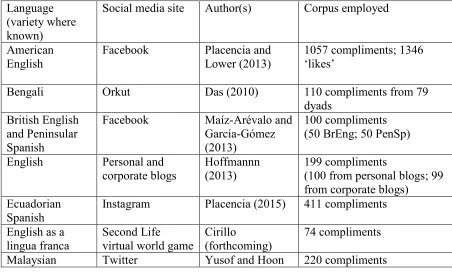
As pointed out in the introduction, there is a dearth of research on complimenting behavior in social media. With respect to compliments, as can be seen in Table 1 below, works available examine compliments on Facebook among Americans (Placencia and Lower 2013) and Spaniards (Maíz-Arévalo and García-Gómez 2013); on Orkut, among Bengalis (Das 2010); on Instagram, among Ecuadorians (Placencia 2015); in a virtual region within Second Life (SL)1 where English is used as a lingua franca (Cirillo forthcoming); on Twitter among Malaysians (Yusof and Hoon 2014), and in blogs (Hoffmann 2013).2
Table 1: Studies on compliments available, presented according to language (variety) examined and site, with basic details of the corpus employed
Language (variety where known)
Social media site Author(s) Corpus employed
American English
Facebook Placencia and Lower (2013)
1057 compliments; 1346 ‘likes’
Bengali Orkut Das (2010) 110 compliments from 79
dyads British English
and Peninsular Spanish
Facebook Maíz-Arévalo and García-Gómez (2013)
100 compliments (50 BrEng; 50 PenSp)
English Personal and
corporate blogs
Hoffmannn (2013)
199 compliments
(100 from personal blogs; 99 from corporate blogs)
Ecuadorian Spanish
Instagram Placencia (2015) 411 compliments
English as a lingua franca
Second Life virtual world game
Cirillo
(forthcoming)
74 compliments
Malaysian Twitter Yusof and Hoon 220 compliments
1Virtual worlds like SL may not be immediately associated with social media. They seem to constitute a hybrid category in that they provide a ‘community’ space for socialization among SL members, albeit interaction is through digital personas in the form of avatars, with elements of gaming.
[image:5.595.66.518.417.692.2]English (2014)
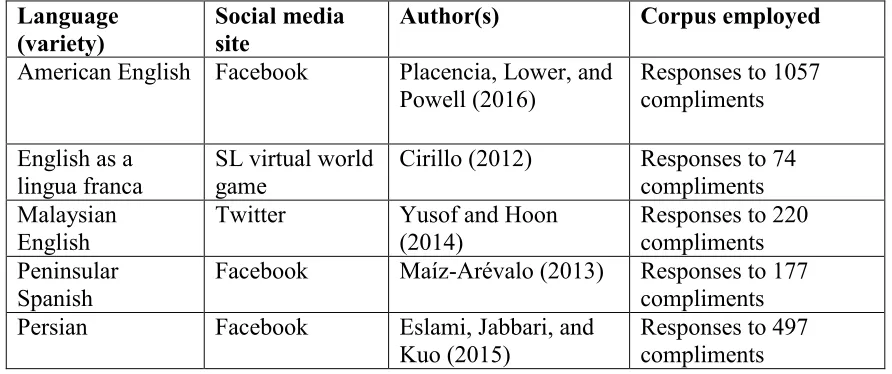
[image:6.595.64.510.275.462.2]Concerning compliment responses (Table 2), Placencia, Lower, and Powell (2016) examine interactions on Facebook among Americans. Maíz-Arévalo (2013) also looks at Facebook interactions but among Spaniards, whereas Eslami, Jabbari, and Kuo (2015) analyze interactions in Persian among Iranian users of Facebook. Yusuf and Hoon (2014), mentioned above, look at responses to compliments in Malaysian English on Twitter. Finally, Cirillo (2012) looks at compliment responses in SL, with her study seemingly constituting the first attempt to look at complimenting behavior in a virtual environment.
Table 2: Studies on compliment responses available, presented according to language (variety) examined and site, with brief details of the corpus employed
Language (variety)
Social media site
Author(s) Corpus employed
American English Facebook Placencia, Lower, and Powell (2016)
Responses to 1057 compliments
English as a lingua franca
SL virtual world game
Cirillo (2012) Responses to 74 compliments Malaysian
English
Twitter Yusof and Hoon
(2014)
Responses to 220 compliments Peninsular
Spanish Facebook Maíz-Arévalo (2013) Responses to 177 compliments Persian Facebook Eslami, Jabbari, and
Kuo (2015) Responses to 497 compliments
In the following sections we look at some features of complimenting behavior across studies, sketching out commonalities and general patterns, as well as pointing out some differences in approach or results.
3.1 Some features of compliment realization in social media
Most authors examining compliment realization in social media take as a baseline results from classic studies such as Manes and Wolfson (1981) on American English (see Section 1) or Holmes (1986) on New Zealand English, exploring potential variation regarding the structure of compliments, topics and functions of compliments, who compliments and so forth. Characteristics of the medium and/or situational and other factors that appear to have an impact on the realization of compliments in socio-digital environments are also considered in the different studies available.
The structure of compliments
1. NP {is/looks} (really) ADJ (53.6%)3
2. I (really) {like/love} NP (16.1%) 3. PRO is (really) (a) ADJ NP (14.9%) 4. You V (a) (really) ADJ NP (3.3%) 5. You V (NP) (really) ADV (2.7%) 6. You have (a) (really) ADJ NP (2.4%) 7. What (a) ADJ NP! (1.6%)
8. ADJ NP! (1.6%) 9. Isn’t NP ADJ! (1.0%)
(Adapted from Manes and Wolfson 1981: 121)
This finding led scholars to examine the formulaicity of compliments initially in face-to-face contexts and online in recent years. Most of Manes and Wolfson’s (1981) patterns have been found in social media studies, with some similarities but also differences in frequency of use. For example, Hoffmann (2013), who analyzed explicit compliments in two types of blogs, found instances of patterns 1-8 in personal blogs, and 1-4 and 6-9 in corporate blogs. In turn, Placencia and Lower (2013) found patterns 1-4 and 7-8 in their Facebook corpus corresponding to direct compliments in American English. Concerning frequency of use, in both studies and, like in Manes and Wolfson’s (1981) work, patterns 1 and 2 were the most frequently employed. On the other hand, Manes and Wolfson’s pattern 8, a reduced form, was found to be more frequently used by both Hoffmann (2013) and Placencia and Lower (2013). Additionally, in both studies a new category for another reduced form was put forward: (ADV) ADJ (+PP) (Hoffmann 2013: 349), and HOW ADJ! (Placencia and Lower 2013: 631).
Moreover, Placencia and Lower introduced subtypes of some of Manes and Wolfson’s (1981) categories. This was in order to accommodate elliptical forms that amounted to a variation on the original category. These authors attribute the (higher) occurrence of these elliptical forms to the informal, written medium of Facebook. Furthermore, Placencia and Lower identified indirect realizations of compliments, that is, compliments that require going through an inferencing process to be understood as such. They also tallied Facebook ‘likes’ as a subset of compliments, albeit with their own characteristics. On account of the word like, they suggest that ‘likes’ can be regarded as direct compliments. However, they also note that these are opaque forms in that what is being liked is often not clear (e.g. Is it the content of the photo or the photographic skills of the user? The photo’s composition? etc.). In any case, ‘likes’ were found to occur more frequently than compliments, possibly because they provide “a simpler way to connect with others” (2013: 15); they are more impersonal and thus less committal, and yet, they still serve an important interactional function (see below).
Reduced forms also appear in Cirillo’s (forthcoming) study on complimenting behavior in SL: while Manes and Wolfson’s (1981) pattern 1 above was also the most common in Cirillo’s study, it was followed by pattern 8 and not pattern 2. The author highlights the nature of the chat in SL as requiring short formulations. She observes that SL users “pay compliments to satisfy a social function, but they do it with minimum effort” (forthcoming: 10). Interestingly, Cirillo found 15 additional complimenting patterns. She explains this heterogeneity in relation to the population of SL users, which can be quite diverse in terms of gender, age, nationality, etc.
In examining complimenting behavior in languages other than English, classifications developed for English may not necessarily be (entirely) suitable. Maíz-Arévalo and
3 NP = noun phrase; really = any intensifier; ADJ = adjective; PRO = you and demonstrative pronouns; V =
Gómez (2013) use a different classification to describe the structure of explicit compliments in their contrastive study of complimenting behavior on Facebook between speakers of British English and Peninsular Spanish. They identified three main types of constructions: exclamative, declarative, and elliptical (2013: 743). The authors assert that these syntactic forms have inherent meaning. Specifically, exclamative sentences are expressions of a speaker’s emotions, and declarative sentences convey an expression of fact. Elliptical forms, on the other hand, involve a “co-construction process,” which “helps strengthen the rapport and solidarity between both interlocutors” (2013: 752). The three categories are further divided into topics covered, the form taken, and what they refer to as the “mental intent” in complimenting (2013: 743). Their results show that Spanish participants gave exclamative compliments more frequently than British participants and that those compliments covered physical beauty and intelligence, while the British exclamative compliments tended toward admiration for possessions. In terms of declarative compliments, they found that full declarative compliments on appearance occurred more frequently in the British group, and full declarative compliments on personality occurred more frequently in the Spanish group. Concerning elliptical compliments, the Spanish participants were found to use ellipsis more frequently to evaluate appearance, while the British participants used ellipsis more frequently to evaluate possessions.
Placencia (2015) also employs a somewhat different classification for her study of compliments among Ecuadorian teenage girls on solo shots on Instagram. As in Placencia and Fuentes Rodríguez (2013), she identifies six main verbal compliment categories. The first five apply to direct realizations: exclamations with qué, declaratives with an evaluative noun/verb/adjective, elliptical forms, interjections, and (semi-) fixed expressions. The sixth category corresponds to indirect / implicit compliments with no fixed syntactic structure (see also Placencia and Lower 2013). The first three of the direct categories are roughly similar to Maíz-Arévalo and García-Gómez’s (2013) (see above). Placencia proposes two additional types to account for nonverbal and hybrid realizations of compliments, reflecting the use of multimodality: pictorial compliments realized by emojis4 occurring on their own (e.g. for ‘princess’ or for ‘perfect’) (2015: 12) or in combination with other emojis, and hashtags which state the positive evaluation in the hashtag (e.g. Dany #salesbienguapa tu ‘Dany #youlookgorgeous’) (2015: 10) and link the recipient with multiple (sometimes hundreds of thousands) images with the same hashtag thus offering amplified, polyphonic compliments. Elliptical forms in Placencia’s study constitute the most frequently employed category, unlike Placencia and Lower (2013), for example. Placencia tentatively suggests that this result could be related to the age of the Instagram users in her study. Exclamations with qué and declaratives are the second and third most frequently employed categories in Placencia’s study. With respect to indirect / implicit forms (2015: 10), they include, for example, the use of irony. Placencia (2015: 14) also considers the use of internal modification such as prosodic spellings (Androutsopoulos 2000) and external modification or supportive moves (cf. Blum-Kulka, House, and Kasper 1989; Placencia and Lower 2013) that can take the form of interjections and emojis, for example.
Interestingly, reduced verbal forms for compliments observed in online interaction were present already in face-to-face interaction more than 30 years ago (cf. Wolfson and Manes 1981). What seems to have changed is the range of reduced forms available and their
frequency of use. However, caution is needed in drawing comparisons with results from old studies. For example, reduced forms highlighted in online studies may also be more common in current face-to-face interaction than they were 30 years ago.
Topics of compliments
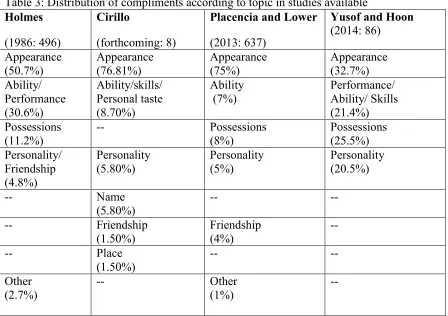
[image:9.595.68.516.298.614.2]According to Manes (1983), topics of compliments reflect cultural values. She observes that “people compliment one another time after time on the same things: personal appearance, new acquisitions, good work” (1983: 98). These are objects or actions “which any member of the speech community will recognize as positive” (1983: 98). Manes, however, does not provide specific figures for the three main categories that she describes for American English compliments: appearance, possessions and ability/skills. Holmes (1986), on the other hand, does with reference to New Zealand English, offering a baseline for subsequent studies. Table 3 below lists Holmes’s categories and results as well as the categories and results described in social media studies available.5
Table 3: Distribution of compliments according to topic in studies available Holmes
(1986: 496)
Cirillo
(forthcoming: 8)
Placencia and Lower
(2013: 637)
Yusof and Hoon (2014: 86) Appearance (50.7%) Appearance (76.81%) Appearance (75%) Appearance (32.7%) Ability/ Performance (30.6%) Ability/skills/ Personal taste (8.70%) Ability (7%) Performance/ Ability/ Skills (21.4%) Possessions (11.2%)
-- Possessions
(8%) Possessions (25.5%) Personality/ Friendship (4.8%) Personality (5.80%) Personality (5%) Personality (20.5%)
-- Name
(5.80%)
-- --
-- Friendship
(1.50%)
Friendship (4%)
--
-- Place
(1.50%)
-- --
Other
(2.7%) -- Other (1%) --
As this table shows, similar topics are the object of complimenting in social media and face-to-face interaction according to Holmes (1986), albeit with some variation in frequency of occurrence and in relation to site. Appearance is clearly the most frequent compliment topic across studies, followed by possessions in Placencia and Lower (2013) and Yusof and Hoon (2014). Possessions is not a relevant category in Cirillo’s (forthcoming) study where the appearance of avatars, including their clothing is the main object of praise.
Personality is complimented on across all studies, but stands out particularly in Yusof and Hoon (2014) where celebrities, well known offline, are the recipients of compliments.
A difficulty in comparisons on compliment topics is that authors may group some topics differently. For example, Holmes (1986) combines personality and friendship under one category, whereas Cirillo (forthcoming) and Placencia and Lower (2013) keep them as separate categories. Even the same label may not cover the same aspects. For instance, Placencia and Lower (2013: 637) classify compliments on the appearance of children and pets under appearance and not under possessions as in other schemes.
Functions of compliments
Wolfson and Manes (1980: 391) identified both discourse and social functions of compliments. Compliments can be employed, for example, to initiate a conversation or to change the topic of conversation. Socially, compliments are used as a means of establishing or reaffirming common ground (1980: 395), creating “a sense of rapport” (1980: 397), or as “social lubricants” (Wolfson 1983: 89), in lieu of greetings or preceding criticism. These authors propose that the formulaic nature of compliments is tied to their solidarity-creating/reaffirming function in that compliments need to be easily recognized to be able to fulfill this function more easily. They also note negative uses of compliments that may involve “direct manipulation” (Manes 1983: 97) in order to encourage a particular desired behavior (see also Holmes 1988 and Jaworski 1995).
Studies on compliments in social media also report on a range of discourse and social functions that verbal compliments appear to fulfill. In the context of SL interactions, Cirillo (forthcoming: 8) claims that compliments “function mainly as conversation starters, attracting other users’ attention” and “getting into their good books.” She underlines their rapport-building function in a context “where words are at the very basis of every relation” (forthcoming: 8).
Placencia and Lower (2013) suggest that when a user posts a photograph on Facebook, it acts as a sort of summons, inviting a response (see Section 1). In this context, they regard the main function of compliments as that of “keeping the communication channel open” and “affirming and strengthening relationships” (2013: 639), though they also observe that compliments constitute one of the means of constructing “the kind of mundane, friendly conversation” that Wolfson and Manes (1980: 397) refer to (2013: 640) in their study of compliments in face-to-face interaction.
Yusof and Hoon (2014: 85) identified various functions of compliments to celebrities on Twitter. Express[ing] admiration is the most salient one, followed by establish[ing] solidarity. It is not clear though how these two categories can be distinguished easily from each other. Other minor functions that they describe include open[ing] conversation, reinforc[ing] desired behavior, and soften[ing] a tight situation (2014: 85).
Hoffmann (2013) on the other hand finds that compliments appear to play different functions in personal as opposed to corporate blogs. In the former, their function as social lubricants (2013: 351) as well as attention grabbers and conversations starters (2013: 352) seems to stand out. In corporate blogs, other functions can be discerned: compliments as disclaimers that mitigate commentators’ criticism, a “persuasive use of compliments for some personal gain,” and non-authentic comments with “an excess of explicit personal compliments to boost the online reputation of the blogger” (2013: 352).
approval “of the hearer, his/her comments, possessions, taste or skills, etc.” They propose viewing them as a subset of compliments (see above), and, on the whole, as “a kind of phatic affirmation, after Malinowski’s (1972[1923]) notion of phatic communion” (2013: 639) through which interpersonal bonds are created or strengthened.
With respect to emoticons and emojis, both Placencia and Lower (2013), as well as Placencia (2015) observe their use as supportive moves (Blum-Kulka, House and Kasper 1989), that is, as moves that accompany verbal compliments, reinforcing them. Placencia and Lower (2013: 635) point out that emoticons help clarify “that the compliment was well intended in case the recipient has a doubt about the complimenter’s intentions” (2013: 636). This interpretation is in line with Dresner and Herring’s (2010: 255) observation that emoticons function as “indications of the illocutionary force of the textual utterances that they accompany” (see also Section 3.2). Placencia (2015) observes that, generally speaking, the emojis employed by the teenagers in her Instagram corpus appear to intensify the compliments as well as display creativity and often add a touch of playfulness. Finally, as pointed out above, Placencia (2015) highlights the use of stand-alone emojis that function as pictorial compliments.
Compliments and gender
Wolfson’s (1983: 92) tentative claim that women appear to give compliments more frequently than men do is corroborated by Placencia and Lower’s (2013) study. While their corpus contained only compliments received by females, they analyzed compliments given by both sexes. Women gave the majority of compliments (91.1%), a pattern that is repeated in the use of the ‘like’ function: 84.1% of ‘likes’ in the study were made by women (2013: 637).
Wolfson (1983: 92) also claimed that women appear to receive compliments more than men. Yusof and Hoon’s (2014: 86) results corroborate this claim: from the 220 compliments in their Twitter compliments, 159 were addressed to women and 61 to men. Finally, with respect to the topic of compliments, Manes (1983: 98) observed that compliments on appearance “typically involve women as speakers or addressees”. Yusof and Hoon’s (2014: 86) finding that compliments on appearance were produced more frequently by females compared with males (37.1% vs. 21.3%) is along the same line as Manes’s claim. All in all, the impact of gender as a macro social factor on complimenting behavior in social media is an area deserving more attention in future studies (see also Section 1). This should include examining not only who compliments whom and on what, but also compliment formulation and functions in same sex and cross-gender interactions.
Compliments and social distance
to acquaintances. Das suggests that this may be because intimate friends give compliments to each other through other media; unmarked compliments then become appropriate between intimate friends. He also suggests that although unmarked compliments are by nature less intense than intensified compliments, they are still compliments, and it is logical that people would give more compliments to people with whom they share a closer relationship. The influence of microsocial factors such as social distance in complimenting behavior in social media, as in Das’s (2010) study, is another area that merits further exploration. Its importance surfaces in Placencia, Lower and Powell (2016) in relation to compliment responses (see below).
3.2. Features of compliment responses in social media
Along with studies of compliments on social media, studies of responses to those compliments are also emerging. The few studies available suggest that it is a rich, burgeoning area that presents researchers with unique issues to address, related in some cases to the affordances and limitations of technology. These issues include: how to classify compliment responses online, whether a response is relevant, how users respond to compliments with social-media features only, and how social media-specific features are used to respond to compliments.
Taxonomies of compliment responses
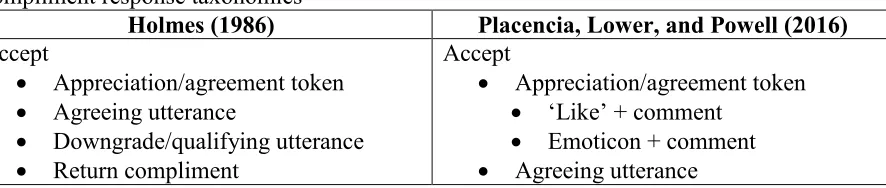
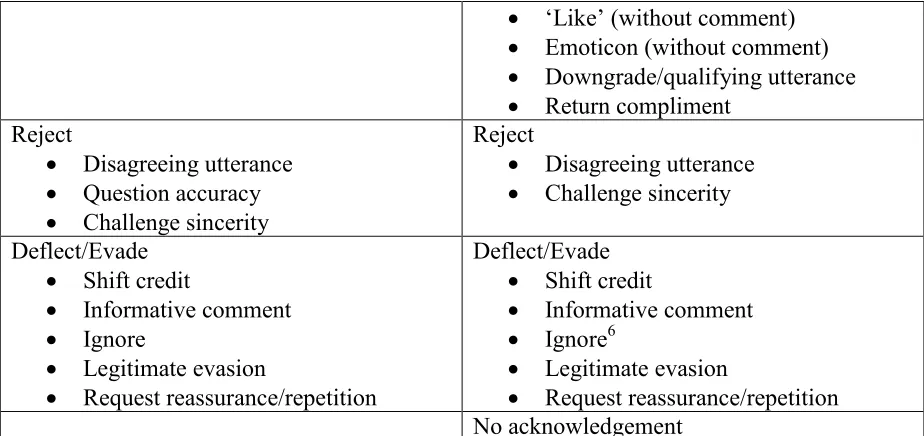
As in studies on compliment responses in a face-to-face setting, researchers of compliment responses on social media look for the taxonomy or scheme that can best account for the responses in their studies. The two most frequently used taxonomies in face-to-face interactions, Holmes (1986) and Herbert (1986, 1990), have been used by researchers of compliment responses on social media. At present, the number of studies following Holmes (1986) and Herbert (1986, 1990) seems to be fairly evenly split: Placencia, Lower, and Powell (2016) and Maíz-Arévalo (2013) adopt Holmes (1986), with Eslami, Jabbari, and Kuo (2015) also adopting Holmes (1986) via Maíz-Arévalo (2013), while Cirillo (2012), and Yusof and Hoon (2014) follow Herbert (1990). However, grouping studies into either followers of Holmes (1986) or Herbert (1986, 1990) is not so straightforward: these face-to-face taxonomies are adopted to varying degrees by different authors. As shown in Tables 4, 5, and 6, below, the authors that follow Holmes’s (1986) taxonomy have modified it in order to fit their data, and applying an existing taxonomy to new data collected over new mediums is open to interpretation. Therefore, different researchers have fitted similar data differently into the same taxonomy. Italics in the tables below denote departures from Holmes’s original taxonomy. What stands out is that Holmes’s original global strategies (accept, reject, evade/deflect) are present in all of the modified versions. The differences arise in where to place the affordances of social media technology, particularly how to classify the ‘like’ function and emoticons.
Table 4: Comparison of Holmes (1986) and Placencia, Lower, and Powell (2016) compliment response taxonomies
Holmes (1986) Placencia, Lower, and Powell (2016) Accept
Appreciation/agreement token
Agreeing utterance
Downgrade/qualifying utterance
Return compliment
Accept
Appreciation/agreement token
‘Like’ + comment
Emoticon + comment
[image:12.595.82.525.675.769.2] ‘Like’ (without comment)
Emoticon (without comment)
Downgrade/qualifying utterance
Return compliment Reject
Disagreeing utterance
Question accuracy
Challenge sincerity
Reject
Disagreeing utterance
Challenge sincerity
Deflect/Evade
Shift credit
Informative comment
Ignore
Legitimate evasion
Request reassurance/repetition
Deflect/Evade
Shift credit
Informative comment
Ignore6
Legitimate evasion
[image:13.595.67.529.72.290.2] Request reassurance/repetition No acknowledgement
Table 5: Maíz-Arévalo’s (2013) taxonomy of compliment responses
Explicit (written) response Implicit response No response Accept
Appreciation
Agreement
Downgrade
Enhance
Return
Reject
Question accuracy
Challenge sincerity
Evade
Shift credit
Informative comment
Ignore
Emoticons ‘Like’ function
Table 6: Eslami, Jabbari, and Kuo’s (2015) taxonomy of compliment responses
Response No response
Verbal
Accept
Reject
Evade
Combination
Non-verbal
‘Like’
‘Like’ + emoticon
Emoticon
As the tables above demonstrate, compliment response taxonomies diverge on the classification of new methods of responding to compliments. In other words, unique elements of digital communication, such as ‘likes’ and emoticons, are being handled in different ways. For example, while Placencia, Lower, and Powell (2016) focus on the value of response utterances, including ‘likes’ and emoticons as communicating acceptance, rejection or deflection/evasion, Maíz-Arévalo (2013) re-categorizes these three main global response strategies as explicit, and proposes the category of implicit for ‘likes’ and emoticons. A difficulty with this distinction is that verbal responses can also be formulated by implicit means, just like compliments (see above); that is, restricting the category of ‘implicit’ to
6Ignoring a compliment is replying to a compliment with a comment, which neither relates to the compliment
[image:13.595.66.520.328.453.2]‘likes’ and ‘emoticons’ is problematic. Also, Maíz-Arévalo’s categorization implies that it not possible to attribute any value at all to responses that take the form of a ‘like’ or an emoticon in relation to Holmes’s global strategies. For Placencia, Lower, and Powell (2016), ‘like’ constitutes a positive evaluation even if conveyed in a vague way, thus suggesting acceptance of the compliment. This interpretation was confirmed by a group of college Facebook users that they interviewed. Placencia, Lower, and Powell (2016: 358) are of the view that ‘like’ could reasonably be interpreted as a token of appreciation or an agreement. They interpreted emoticons such as smileys in a similar way (see also below).
Cirillo (2012) uses a slightly modified version of Herbert’s (1986) taxonomy. She breaks down Herbert’s (1986) categories into further sub-categories. For instance, in the case of comment history, she distinguishes between agreeing responses that are strictly comment history and those that are a combination of comment history plus some other strategy (2012: 49). She also identifies a new, non-agreement strategy that is not separately classified in Holmes’s (1986) study, namely irony (2012: 50).
Yusof and Hoon (2014) also use Herbert’s taxonomy, though not its 1986 version, but the modified 1990 version. They note that some types of responses occurring in face-to-face interaction are not present in their corpus: they found no incidences of praise upgrade, qualification, or requests for more information. These absences seem to be explainable by the corpus examined: in Yusof and Hoon’s (2014) study, the corpus consists of interactions with celebrities. It is unsurprising that celebrities, as public figures, did not attempt to upgrade their compliments, nor did they qualify or request more information about compliments received. This satisfies modesty impositions, which may be even more important for public figures.
Frequency and distribution of compliment responses
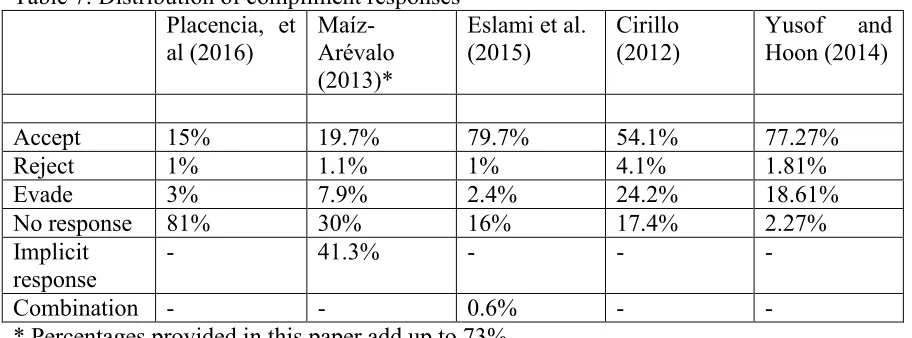
[image:14.595.66.522.523.692.2]What is striking when comparing results across studies is that there appear to be very few similarities. The only discernible similarity is that reject constitutes the least observed response across the five studies available (see Table 7). Evade is the second least used strategy across works, except for Cirillo’s (2012) study, where no response occurred less frequently than evade.
Table 7: Distribution of compliment responses Placencia, et
al (2016)
Maíz-Arévalo (2013)*
Eslami et al. (2015)
Cirillo (2012)
Yusof and Hoon (2014)
Accept 15% 19.7% 79.7% 54.1% 77.27%
Reject 1% 1.1% 1% 4.1% 1.81%
Evade 3% 7.9% 2.4% 24.2% 18.61%
No response 81% 30% 16% 17.4% 2.27%
Implicit response
- 41.3% - - -
Combination - - 0.6% - -
* Percentages provided in this paper add up to 73%.
Spanish speakers (only 30%), or Yusof and Hoon’s (2014) study of responses by Malaysian celebrities on Twitter (2.27%). Concerning the latter, the low figure may be explained by taking into account that celebrities may feel obliged to respond to fans as otherwise they may be perceived as conceited or ungrateful. With respect to the other two studies, there could be a gender element impacting on response behavior: Placencia, Lower, and Powell (2016) only focus on responses by a group of women whereas Maíz-Arévalo (2013) looks at responses from both males and females. It could also be attributed to cultural differences although this would need further exploration; however, one cannot discount the fact that the use of different data collection methodologies may have also had an impact on the results. In any case, Placencia, Lower, and Powell’s (2016) results above are in line with their interview data findings that suggest that a lack of response is generally not seen as problematic by college Facebook users in their study and that responses may even be viewed negatively in some contexts.
Concerning the rest of the categories, and given the variation in classifications used, it is more difficult to make direct comparisons. Nonetheless, Eslami, Jabbari, and Kuo’s (2015) and Maíz-Arévalo’s (2013) results, both on Facebook but in different sociocultural contexts, are comparable as the former largely based their categorization on the latter. It is striking that Eslami, Jabbari, and Kuo’s study shows a much higher rate of acceptance than Maíz-Arévelo’s (79.7% vs. 19.7%). It is possible that a good part of Maíz-Arevalo’s responses under the category of implicit (i.e., 41.3%) could be interpreted as representing acceptance. This seems a likely explanation of the difference. Eslami, Jabbari, and Kuo (2015) classify instances of the ‘like’ function alone, or in combination with emoticons, as an acceptance of a compliment (2015: 255–256). As such, Maíz-Arévalo’s figure for acceptance could possibly be (much) higher. Overall, these results show the need for further studies on compliment responses and for further discussion on how medium-specific elements such as ‘likes’ (see also below) should be interpreted and classified. This requires the use of a combination of methods.
Social media-specific forms of compliment response
As mentioned above, social media provides tools for responding to compliments that are not part of face-to-face interactions: emoticons and the ‘like’ function. How to interpret these affordances of social media technology 2is up for debate. As pointed out in the previous section, Dresner and Herring (2010) highlight the supportive function of emoticons. The studies discussed above demonstrate it is often the case that emoticons accompany a compliment or a compliment response, thus lending credibility to Dresner and Herring’s (2010) interpretation. Dresner and Herring (2010) assert that stand-alone emoticons can either be classified as “expressions of emotion that map iconically onto body movements, such as smiling or frowning,” or they can be considered as performances of illocutionary acts (2010: 258). These authors seem to suggest that meaning can be assigned to emoticons. This is precisely what Placencia, Lower, and Powell (2016) propose through their interpretation of stand-alone emoticons such as smileys as compliment acceptance tokens. Therefore, there does not appear to be the need to create another global category to be added to Holmes’s (1986) taxonomy.
(see Tables 5 and 6, above). In brief, it seems that the intention behind the use of emoticons in responding to compliments on Facebook is open to greater debate and exploration.
Another method of interacting on social media that generates debate is the ‘like’ function (see 3.1 and also Maíz-Arévalo, Ch. 22, this volume). Placencia and Lower (2013) suggest that using the ‘like’ function displays the ‘liker’s’ approval or appreciation of the recipient. With respect to responses, Placencia, Lower, and Powell (2016) interpret the ‘like’ function as a form of compliment acceptance, as ‘liking’ something is a positive evaluation of the object being assessed (2016: 348). Even though motivations behind the use of the ‘like’ function can be vague, Placencia, Lower, and Powell (2016) place its use as a response to a compliment on Facebook in the compliment acceptance category. Maíz-Arévalo (2013) gives Facebook’s ‘like’ function its own place in her taxonomy; however, she does not classify it as an acceptance, but as an implicit response or a non-verbal response. At the same time, Maíz-Arévalo seems to recognize its value as an acceptance token: she asserts that the use of ‘like’ on its own, in response to a compliment, is a polite acknowledgement of the compliment and a demonstration of appreciation (2013: 64). As such it is unclear why this use of ‘like’ was not classified by this author as a type of acceptance strategy. Similarly, Eslami, Jabbari, and Kuo (2015) seem to show some ambiguity in their categorization of ‘like’. As Maíz-Arévalo (2013), they classify clicking ‘like’ together with emoticons as nonverbal strategies (2015: 254), which stand in contrast with the category of verbal strategies (i.e., accept, reject, evade or a combination of any of these three). On the other hand, Eslami, Jabbari, and Kuo (2015: 256) assert that when used alone or when combined with emoticons, ‘like’ is a form of compliment acceptance. In fact, ‘like’ appears unambiguously as an acceptance strategy in their discussion of acceptance sub-strategies according to gender (2015: 258).
4. Methodological, ethical and other issues in the study of complimenting behavior in social media
As with any area of research, methodological and ethical issues must be taken into account and given proper attention, together with practical considerations. This is especially relevant in social media research, as it is a relatively new area of study, and there are not tried and true medium-specific methods for researchers to fall back on. Thus far, the majority of studies seem to involve a form of participant observation that takes researchers into the realm of digital ethnography (see Section 3 above).
A key methodological challenge is in developing a corpus. Leaving ethical matters aside (see below), it may seem simple, given that the interactions unfold in written form, i.e., it’s all there, waiting to be downloaded and analyzed. The question then is how and how much. The answer is closely linked to the research questions addressed. However, there are practical considerations to be made that impact on the research. How does a researcher extract data from a social media platform, and, once extracted, where does the data go for analysis? If the data is copied and pasted manually from a social media platform, this process is extremely time-consuming (cf. Placencia and Lower 2013) and ultimately restricts the amount of data available for analysis, simply due to time constraints.
photographic data as well. This causes practical problems as photographs take up vast amounts of storage space on a computer. Additionally, ethical issues may be raised about the storage of photographs unless informed consent is obtained, as participants may have reservations about identifying data potentially being leaked if not stored properly, or identifying data being shared with other researchers or used for other purposes in the future.
Given the vast amount of data available on social media, where does a researcher draw boundaries for a given study? This is a difficulty highlighted by Hine (2009), among others. For example, when conducting research on Facebook, a researcher must decide how many participants to extract data from, and an end date. Facebook users constantly upload new photographs, and other users constantly make comments on photos. Researchers could be updating their data indefinitely unless they draw clear boundaries for data extraction. On the other hand, if too little data is extracted from too few participants, the data is not a very representative sample of a larger population. This is also a concern when data is extracted from one person’s social network. Randomly selecting participants from one social network goes some way to remedying this potential pitfall.
Once a researcher has determined how to extract data from social media, and how much data to extract, the researcher has to decide how to organize this data into a meaningful and useful corpus. This is something that is usually not considered or mentioned in published research. Placencia and Lower (2013) copied and pasted word data into an Excel spread sheet. This did not include photographs but rather a brief description of each photograph in the sample. The advantage of Excel was that it made the data easy to organize and search. It was also relatively simple to use macros in order to extract counts of various occurrences of data from the spreadsheet. The disadvantage of this method is that if researchers want to see the context (i.e., photographs and co-text in some cases) and desire to use the data later for other purposes, it is possible that some examples may have to be discarded because the original context has disappeared from the social media platform.
If a researcher does devise a way to extract a large corpus from social media, how then should the analysis proceed? For example, what kinds of searches should be made? This is a problem similar to that described by Jucker et al. (2008), who attempt to use automated methods to extract occurrences of various syntactic patterns of compliments from a large corpus. This is a dilemma for analyzing social media as well, and is exacerbated due to the huge amount of orthographic variation (including spelling mistakes as well as intentional spelling alterations) found on social media. Social media users often do not conform to orthographic and other writing conventions. This makes automated analysis nearly impossible. The most accurate way to analyze this sort of data is manually, which can be extremely time consuming. Jucker et al. (2008) advocate a combined quantitative and qualitative analysis when working with large corpora, but, due to the wide variation of language usage on social media, automated quantitative analysis may not yield significant results. The need to analyze data manually no doubt restricts a researcher’s ability to deal with large quantities of data.
inferencing as there is no element in the utterance that conveys a positive semantic load (see Section 3). On the other hand, for Kerbrat-Orecchioni (1994) direct compliments are those that have to do directly with the hearer whereas indirect ones are those that have to do with a third person, closely associated with the hearer. This last distinction may derive from a mention that Manes and Wolfson (1981) make of indirect forms that they do not develop further: indirect compliments are those that are “overtly addressed to one person but actually compliment another party who is present” (Manes and Wolfson 1981: 122). They go on to say that it is often the complimentee, and not the addressee, the person who replies to what seems to be an overheard compliment. Kerbrat-Orecchioni, like Holmes (1986), uses the terms explicit and implicit to refer to Blum-Kulka, House, and Kasper’s (1989) notions of direct and indirect speech acts. A third use of the notion of (in)direct compliments is mentioned by Hoffmann (2013: 346) with reference to Yuan (2001): the complimenter quotes a second person who compliments a third party. These are cases where the “speaker and complimenter are not one and the same person” (2013: 346).
Likewise, with respect to compliment responses, Placencia, Lower, and Powell (2016: 344) note that returning a compliment is considered an acceptance by Holmes (1986),
whereas Herbert (1990) classifies this strategy under ‘other interpretations’. Similar
observations can be made about emerging categorizations of certain compliment (response) phenomena online. For example, Maíz-Arévalo (2013) regards the ‘like’ function as a nonverbal strategy, whereas Placencia and Lower (2013) view it as a hybrid form given that it contains the word ‘like’ which carries a positive semantic load; they therefore propose considering it as a subset of compliments, albeit with its own peculiarities (see above).
In addition to adapted methodological approaches required by research in social media, ethical considerations must be considered afresh with this new medium. The
Association of Internet Researchers (AoIR), an academic association that promotes scholarly Internet research, has published a set of guidelines (originally published in 2002, updated in 2012) on conducting Internet research. According to the AoIR, the following are the main considerations for researchers in Internet-related contexts: 1) how the context is defined and conceptualized; 2) how the context is being accessed; 3) who is involved in the study; 4) what is the primary object of the study; 5) how the data is being managed, stored, and represented; 6) how the texts/persons/data are being studied; 7) how the findings are presented; 8) what are the potential harms or risks associated with the study; 9) what the potential benefit of the study are; 10) how does the researcher recognize the autonomy of others and acknowledging that they are of equal worth to the researcher and should be treated so; and 11) what particular issues might arise around the issue of minors or vulnerable
persons. With respect to the first consideration – the definition and conceptualization of the context – a further question is what ethical expectations, particularly privacy considerations, do users attach to the venue in which they are interacting. The AoIR further explains that individuals’ expectations of privacy are constantly changing, given the context. Therefore, expectations of privacy by users might differ across social media platforms, meaning researchers need to be aware and must take into account the fluid and flexible nature of privacy; it’s not a one size fits all approach.
5. Conclusions and prospects for the future
certain similarities as well as some differences, the latter largely linked to the medium of interaction and technological affordances and constraints of the different media. The influence of the medium can be seen, for example, in the higher use of elliptical formulations of compliments on SNSs than in face-to-face contexts, the use of prosodic spellings (Androtouplos 2000) and other devices of “textual deformation” (Yus Ramos 2011) for emphasis or other purposes, as well as visual means that include emojis and hybrid forms such as the ‘like’ function and hashtags. It can also be seen in the occurrence of non-response, rather unthinkable in face-to-face contexts (cf. Valdés and Pino 1981). All in all, the results that are emerging suggest that some new norms of appropriateness are developing to suit the online medium. On the other hand, situational and social factors, like in face-to-face interaction, also continue to play a role. For instance, non-technical characteristics of a site such as the goals pursued by a given site’s creator as in Hoffmann’s (2013) study on personal and corporate blogs can have an impact on complimenting behavior. Likewise, macrosocial factors, such as gender (cf. Yusof and Hoon 2014), and age (cf. Placencia 2015) also appear to play a role. It is not surprising to find that particular patterns described for face-to-face interaction (e.g. women receiving and offering more compliments than men, with compliments on appearance standing out) have carried over to online contexts, and now appear to include ‘likes’ too. They reflect deep-seated values and behaviors that simply appear to be replicated in interactions mediated by new technologies.
Finally, methodologically, researchers are having to complement observation of behavior online with other methods such as interviews and focus group discussions in order to not only understand certain uses of emojis, for example, but also to access users’ perceptions of appropriateness and gain insight into the different social and situational factors that influence complimenting behavior online.
Concerning prospects for the future, with developments in technology and social media, new or altered spaces for the study of complimenting behavior will continue to emerge. Researchers need to be flexible and change with the platforms available for research in order to fully exploit research possibilities. In this respect, while it is paramount to be respectful of subjects’ autonomy and privacy, the pendulum can swing too far in the direction of over-cautiousness if approval for social media research is too difficult to obtain. Social media is an increasing part of our lives and thus needs to be encouraged and supported, and old research norms should not be forced where they do not fit. Also, research in the area so far has represented good attempts at navigating a new course through unchartered territory and we can only see it improving. Researchers need to use each other as resources, to learn and build on past works, and to address areas in past research that perhaps left a bit to be desired, specifically in terms of rigorousness of methodology.
would be interesting to explore. An interdisciplinary approach will be required to address some of them.
Finally, while research in face-to-face contexts has shown cultural variability in both compliment and compliment response behavior, a potential area of exploration is the extent to which social media, with both enabling and constraining features that shape up interaction online, is resulting in more homogenous complimenting behavior. With respect to
compliment responses, the non-response referred to above is found across studies, although the rate of incidence of this category varies rather drastically across works. An increased tendency towards agreement/acceptance of compliments surfaces in Eslami, Jabbari, and Kuo’s (2015). The factors influencing these results still need to be teased out: does it have to do with the methodology employed, and/or the degree of social distance between users, and/or the age of the participants and their sociocultural background?
References
Achugar, Mariana 2002 Piropos: Cambios en la valoración del grado de cortesía de una práctica discursiva. In: María Elena Placencia and Diana Bravo (eds.), Actos de habla y cortesía en español,175–192. Munich: Lincom Europa.
Androutsopoulos, Janis K. 2000 Non-standard spellings in media texts: The case of German fanzines. Journal of Sociolinguistics 4: 514–533.
Bach, Kent and Robert M. Harnish 1979 Linguistic Communication and Speech Acts. Cambridge, Mass. / London: M.I.T. Press.
Black, Pamela J., Melissa Wollis, Michael Woodworth and Jeffrey T. Hancock 2015 A linguistic analysis of grooming strategies of online child sex offenders: Implications for our understanding of predatory sexual behavior in an increasingly computer-mediated world. Child Abuse & Neglect 44: 140–149.
Blum-Kulka, Shoshana, Juliane House and Gabriele Kasper 1989 The CCSARP coding manual. In: Shoshana Blum-Kulka, Juliane House and Gabriele Kasper (eds.), Cross-cultural Pragmatics: Requests and Apologies, 273–294. Norwood, NJ: Ablex.
Boyle, Ronald 2000 "You’ve worked with Elizabeth Taylor!": Phatic functions and implicit compliments. Applied Linguistics 21: 26–46.
Brown, Penelope and Stephen C. Levinson 1987[1978] Politeness: Some Universals in Language Usage. Cambridge: Cambridge University Press.
Chen, Rong 2010 Compliment and compliment response research: A cross-cultural survey. In: Anna Trosborg (ed.), Pragmatics across Languages and Cultures, Handbooks of Pragmatics, Volume7, 79–101. Berlin/Boston: de Gruyter.
Cirillo, Valeria 2012 The pragmatics of virtual environments. Compliment responses in Second Life. Lingue e Linguaggi 7: 37–58.
Das, Anupam 2010 Linguistic politeness and interpersonal ties among Bengalis on the social network site Orkut: the Bulge Theory revisited. Unpublished doctoral thesis. Indiana: Indiana University.
Dresner, Eli and Susan C. Herring 2010 Functions of the Nonverbal in CMC: Emoticons and Illocutionary Force. Communication Theory 20: 249–268.
Eslami, Zohreh R, Nasser Jabbari and Li-Jen Kuo 2015 Compliment response behaviour on Facebook: A study with Iranian Facebook Users. International Review of Pragmatics 7: 244–277.
Gardner, Rod 2001 When Listeners Talk: Response Tokens and Listener Stance Amsterdam/Philadelphia: John Benjamins.
Golato, Andrea 2011 Appreciatory sounds and expressions of embodied pleasure used as compliments. In: Gisle Andersen and Karin Aijmer (eds.), Pragmatics of Society, Hanbooks of Pragmatics, Volume5, 361–392. Berlin: de Gruyter.
Haverkate, Henk 1994 La cortesía verbal: estudio pragmalingüístico. Madrid: Gredos.
Herbert, Robert K. 1986 Say "Thank You"-or something. American Speech 61(1): 76– 88.
Herbert, Robert K. 1990 Sex-based differences in compliment behavior. Language in Society: 19(2): 201–224.
Herstand, Ari 20 Aug, 2013 Why retwitting compliments is not bragging. Ari's take. Available at http://aristake.com/?post=84. Accessed: 10 December 2015.
Hine, Christine 2009 How can qualitative internet researchers define the boundaries of their projects? In: Annette N. Markham and Nancy K. Baym (eds.), Internet Inquiry: Conversations about Method, 1–20. Los Angeles: Sage.
Hoffmann, Christian 2013 E(-lectronic) schmoozing? A cross-generic study of compliments in blog comments. In: Katrin Röder and Ilse Wischer (eds.), Anglistentag Potsdam 2012. Proceedings, 341–357. Trier: Wissenschaftlicher Verlag Trier.
Holmes, Janet 1986 Compliments and compliment responses in New Zealand English Anthropological Linguistics 28: 485–508.
Holmes, Janet 1988 Paying compliments: A sex-preferential politeness strategy. Journal of Pragmatics 12: 445–465.
Hymes, Dell 1972 [1964] Toward ethnographies of communication: The analysis of communicative events. In: P.P. Giglioli (ed.), Language and Social Context, 21–43. Harmondsworth, Middlesex: Penguin.
Jucker, Andreas H., Gerold Schneider, Irma Taavitsainen and Barb Breustedt 2008 Fishing for compliments. In: Andreas H. Jucker and Irma Taavitsainen (eds.), Speech Acts in the History of English, 273–294. Amsterdam/Philadelphia: John Benjamins.
Kerbrat-Orecchioni, Catherine 1994 Les interactions verbales. Variations culturelles et échanges rituels. Volume 3. Paris: Armand Colin.
Kerbrat-Orecchioni, Catherine 1997 A multilevel approach in the study of talk-in-interaction. Pragmatics 7: 1–20.
Kiefer Lee, Kate 21 Aug 2012 Retweeting compliments: Yea or nay? Forbes (Tech). Available at: http://www.forbes.com/sites/katelee/2012/08/21/retweeting-compliments-yay-or-nay/. Accessed: 10 December 2015.
Leech, Geoffrey N. 1983 Principles of Pragmatics. London: Longman.
Locher, Miriam A. and Richard J. Watts 2005. Politeness theory and relational work. Journal of Politeness Research 1: 9–33.
Maíz-Arévalo, Carmen 2012 “Was that a compliment?” Implicit compliments in English and Spanish. Journal of Pragmatics 44: 980–996.
Maíz-Arévalo, Carmen 2013 “Just click 'Like'”: Computer-mediated responses to Spanish compliments. Journal of Pragmatics 51: 47–67.
Maíz-Arévalo, Carmen and Antonio García-Gómez 2013 “You look terrific!” Social evaluation and relationships in online compliments. Discourse Studies 15: 735–760.
Malinowski, Bronislaw 1972 [1923] Phatic communion. In: John Laver and Sandy Hutcheson (eds.) Communication in Face-to-Face Interaction 146–152. Harmondsworth, Middlesex: Penguin.
Manes, Joan 1983 Compliments: A mirror of cultural values. In: Nessa Wolfson and Elliot Judd (eds.), Sociolinguistics and Language Acquisition, 96–102. Rowley, Mass: Newbury House.
Manes, Joan and Nessa Wolfson 1981 The compliment formula. In: Florian Coulmas (ed.), Conversational Routine: Explorations in Standardised Communication Situations and Prepatterned Speech, 115–132. The Hague: Mouton.
Oxford Dictionaries 2016 Oxford University Press. Available at: http://www.oxforddictionaries.com/. Accessed: 10 April 2016.
Placencia, María Elena and Catalina Fuentes Rodríguez 2013 Cumplidos de mujeres universitarias en Quito y Sevilla: un estudio de variación pragmática regional. Pragmática Sociocultural. Revista Internacional sobre Lingüística del Español 1: 100–134.
Placencia, María Elena and Amanda Lower 2013 Your kids are stinking cute.
Complimenting behavior on Facebook among family and friends. Intercultural Pragmatics 10: 617–646.
Placencia, María Elena, Amanda Lower and Hebe Powell 2016 Complimenting behaviour on Facebook: The case of compliment responses in American English. Pragmatics and Society 7: 339–365.
Pomerantz, Anita 1978 Compliment responses: Notes on the co-operation of multiple constraints. In: Jim Schenkein (ed.), Studies in the Organization of Conversational
Interaction, 79–112. New York: Academic Press.
Proudman, Charlotte 2015 How many women @LinkedIn are contacted re physical appearance rather than prof skills? Available at:
https://twitter.com/crproudman/status/640934811381706752?lang=en-gb. Accessed: 10 December 2015.
Schegloff, Emanuel A. [1968]1972 Sequencing in conversational openings. In: John Laver and Sandy Hutcheson (eds.), Communication in Face-to-Face Interaction, 374–405. Harmondsworth, Middlesex: Penguin.
Schneider, Klaus P. 1999 Compliment responses across cultures. In: Maria Wysocka (ed.), On Language in Theory and Practice: In Honour of Janusz Arabski on the Occasion of His 60th Birthday. Volume 1: Language Theory and Language Use, 162–172. Katowice: Wydawnictwo Uniwersytetu Ślᶏskiego.
Searle, John R. 1975 Indirect speech acts. In: Peter Cole and Jerry L. Morgan (eds.), Syntax and Semantics 3: Speech Acts, 59–82. New York: Academic Press.
Searle, John R. 1976 A classification of illocutionary acts. Language in Society 5: 1– 23.
Sifianou, Maria 2001 “Oh! How appropriate!” Compliments and politeness. In: Arın Bayraktaroğlu and Maria Sifianou (eds.), Linguistic Politeness across Boundaries: The Case of Greek and Turkish, 391–430. Amsterdam/Philadelphia: John Benjamins.
Valdés, Guadalupe and Cecilia Pino 1981 Muy a tus órdenes: Compliment responses among Mexican-American bilinguals. Language in Society 10: 53–72.
Vanderveken, Daniel (with Kenneth MacQueen) 1990 Semantic analysis of English performative verbs. In: Daniel Vanderveken, Meaning and Speech Acts, Volume 1: Principles of Language Use, 166–219. Cambridge: Cambridge University Press. [The presentation of this entry is tricky. It is not an edited volume, but the chapter in question appears as written 'with' K. Macqueen).
Wolfson, Nessa 1981 Compliments in cross-cultural perspective. TESOL Quarterly 15: 117–124.
Wolfson, Nessa 1983 An empirically based analysis of complimenting in American English. In: Nessa Wolfson and Elliot Judd (eds.), Sociolinguistics and Language
Acquisition, 82–95. Rowley, Mass.: Newbury House.
Wolfson, Nessa and Joan Manes 1980 The compliment as a social strategy. Papers in Linguistics: International Journal of Human Communication 13: 391–410.
Yuan, Yi 2001 An inquiry into empirical pragmatics data-gathering methods: written DCTs, oral DCTs, field notes, and natural conversations. Journal of Pragmatics 33: 271–292.
Yus Ramos, Francisco 2005 Attitudes and emotions through written text: The case of textual deformation in Internet chat rooms. Pragmalingüística 13: 147–174.
Yus Ramos, Francisco 2011 Cyberpragmatics: Internet-mediated Communication in Context. Amsterdam/Philadelphia: John Benjamins.