Distributed Estimation and Control in Networked Systems
Thesis by
Vijay Gupta
In Partial Fulfillment of the Requirements for the Degree of
Doctor of Philosophy
California Institute of Technology Pasadena, California
2006
c
2006
Acknowledgements
Mere words cannot express the gratitude I owe to all the people who have made it possible for me to write this dissertation. Prof. Richard Murray, with his unquenchable enthusiasm and infectious spirit of hard work, has been a great advisor all along. Your ability to see the big picture and your emphasis on being aware of where one wants to go have been invaluable. Prof. Babak Hassibi not only taught me the fundamentals of estimation theory but also helped me broaden my horizons beyond the particular control/estimation problem I was considering. Your technical virtuosity and emphasis on the details have always amazed and inspired me.
The greatest joy of my academic life at Caltech was being able to collaborate with many brilliant people. Sometimes we were successful in solving the problem we set out for and sometimes not, but it was always a great learning experience. Prof. Cedric Langbort, now at UIUC, reignited my interest in distributed control and was an invaluable resource as we started traversing the path of robustness in multi-agent systems. Amir Farajidana not only collaborated with me on many problems, but was also on a constant lookout to prevent me from floating wild incorrect conjectures. Prof. Joao Hespanha, UCSB, was instrumental in my getting interested in the area of estimation over networks. Tim Chung and I spent many afternoons immersed in multi-sensor problems and he was a willing resource for any problem that I wanted to talk about. Demetri Spanos, with his ability to cut to the chase, was particularly helpful when I was formulating my initial ideas on the problem of information processing for estimation. Prof. Leonard Schulman was always ready to share his amazingly clear and insightful thoughts on any problem that I wanted to discuss. I would also like to thank Prof. Massimo Franceschetti, UCSD, and Dr. David Jeffcoat, AFRL, for their contribution to my rich academic experience at Caltech.
would be more appropriate than simply listing your names here.
Abstract
Rapid advances in information processing, communication and sensing technologies have enabled more and more devices to be provided with embedded processors, networking capabilities and sen-sors. For the field of estimation and control, it is now possible to consider an architecture in which many simple components communicate and cooperate to achieve a joint team goal. This distributed (or networked) architecture promises much in terms of performance, reliability and simplicity of design; however, at the same time, it requires extending the traditional theories of control, commu-nication and computation and, in fact, looking at a unified picture of the three fields. A systematic theory of how to design distributed systems is currently lacking.
This dissertation takes the first steps towards understanding the effects of imperfect information flow in distributed systems from an estimation and control perspective and coming up with new design principles to counter these effects. Designing networked systems is difficult because such systems challenge two basic assumptions of traditional control theory - presence of a central node with access to all the information about the system and perfect transmission of information among components. We formulate and solve many problems that deal with the removal of one, or both, of these assumptions. The chief idea explored in this dissertation is the joint design of information flow and the control law. While traditional control design has concentrated on calculating the optimal control input by assuming a particular information flow between the components, our approach seeks to synthesize the optimal information flow along with the optimal control law that satisfies the constraints of the information flow. Thus besides the question of ‘What should an agent do?’, the questions of ‘Whom should an agent talk to?’, ‘What should an agent communicate?’, ‘When should an agent communicate?’ and so on also have to be answered. The design of the information flow
represents an important degree of freedom available to the system designer that has hitherto largely been ignored. As we demonstrate in the dissertation, the joint design of information flow and the optimal control input satisfying the constraints of that information flow yields large improvements in performance over simply trying to fit traditional design theories on distributed systems.
numerical issues plaguing the other approaches proposed in the literature. We then provide and analyze a model to understand the issue of designing the topology according to which the agents interact. The results are very surprising since there are cases when allowing communication to happen between two agents may, in fact, be detrimental to the performance.
We then move on to consider the effects of communication channels on control performance. To counter such effects, we propose the idea of encoding information for the purpose of estimation and control prior to transmission. Although information theoretic techniques are not possible in our problem, we are able to solve for a recursive yet optimal encoder / decoder structure in many cases. This information flow design oriented approach has unique advantages such as being optimal for any packet drop pattern, being able to include the effect of known but random delays easily, letting us escape the limits set by reliability for transmission of data across a network by using intermediate nodes as ‘repeaters’ similar to a digital communication network and so on.
We finally take a look at combining the effects of multiple sources of information and communi-cation channels on estimation and control. We look at a distributed estimation problem in which, at every time step, only a subset out of many sensors can transmit information to the estimator. This is also a representative resource allocation problem. We propose the idea of stochastic commu-nication patterns that allows us to include the effects of commucommu-nication channels explicitly during system design. Thus, instead of tree-search based algorithms proposed in the literature, we provide stochastic scheduling algorithms that can take into account the random packet drop effect of the channels. We also consider a distributed control problem with switching topologies and solve for the optimal controller. The tools that we develop are applicable to many other scenarios and we demonstrate some of them in the dissertation.
Contents
Acknowledgements iii
Abstract v
1 Introduction 1
1.1 Contributions of the Thesis . . . 6
1.2 Organization of the Thesis . . . 8
2 Distributed Estimation and Control in Formations of Dynamic Agents 12 2.1 Introduction . . . 13
2.2 Mathematical Preliminaries and Notation . . . 17
2.3 Problem Formulation . . . 20
2.3.1 Stabilizability . . . 21
2.3.2 Designing the Control Law . . . 22
2.4 The Optimal Constrained Control Law . . . 22
2.4.1 A Preliminary Result . . . 23
2.4.2 The Optimal Control Law . . . 25
2.4.3 A Sub-optimal Control Law . . . 28
2.5 Examples . . . 31
2.6 Cost Functions and Value of a Graph . . . 36
2.7 Efficiency of a Graph . . . 39
2.7.1 Clique Graphs and the Efficient Graph . . . 39
2.7.2 Pricing Edges . . . 43
2.8 Examples . . . 46
2.9 Discussion . . . 48
3 Countering Communication Channel Effects in Estimation and Control 67
3.1 Introduction . . . 68
3.2 The Packet Erasure Channel Model . . . 76
3.3 Problem Formulation and Preliminary Results . . . 79
3.3.1 Problem Setup . . . 79
3.3.2 A Separation Principle . . . 82
3.4 Single Sensor, Single Channel . . . 85
3.4.1 The Kalman Filter . . . 86
3.4.2 Optimal Information Processing Algorithm . . . 87
3.4.3 Analysis of the Proposed Algorithm . . . 90
3.4.3.1 Stability Analysis . . . 90
3.4.3.2 Performance Analysis . . . 92
3.4.4 Examples . . . 94
3.5 Single Sensor, Network of Arbitrary Topology . . . 96
3.5.1 Mathematical Notation . . . 97
3.5.2 Optimal Encoding and Decoding . . . 98
3.5.3 Stability Analysis . . . 103
3.5.4 Performance Analysis . . . 111
3.5.5 Examples . . . 119
3.5.6 Correlated erasure events . . . 123
3.5.7 Synthesis of a Network . . . 125
3.5.8 Unicast Networks . . . 126
3.6 Multiple Sensors . . . 127
3.6.1 Optimal Information Transmission Algorithm . . . 128
3.6.2 Analysis of the Proposed Algorithm . . . 132
3.6.3 Example . . . 133
3.6.4 Extensions . . . 134
3.7 Discussion . . . 135
Appendix A Effect of Quantization on the Performance at High Rates . . . 135
Appendix B Control of Jump Linear Markov Systems with Markov State Estimation . 147 4 Distributed Estimation and Control in Presence of Stochastically Failing Chan-nels 159 4.1 Introduction . . . 160
4.2 Estimation in Presence of a Stochastic Sensor Schedule . . . 163
4.2.2 Sensors Chosen Independently from one Time Step to the Next . . . 166
4.2.2.1 Upper Bound . . . 167
4.2.2.2 Lower Bound . . . 168
4.2.3 Sensors Chosen According to a Markov Chain . . . 172
4.2.3.1 Upper Bound . . . 172
4.2.3.2 Lower Bound . . . 174
4.3 Stochastic Sensor Scheduling . . . 175
4.3.1 Deterministic Scheduling Algorithms . . . 175
4.3.1.1 The Sliding Window Algorithm . . . 176
4.3.1.2 The Thresholding Algorithm . . . 177
4.3.2 A Stochastic Scheduling Algorithm . . . 178
4.3.2.1 Sensors chosen in an i.i.d. manner . . . 178
4.3.2.2 Sensors chosen according to a Markov chain . . . 181
4.3.3 Examples . . . 182
4.4 Encoding Information at the Sensor End . . . 188
4.5 Distributed Control with Packet Losses . . . 190
4.5.1 Problem Formulation . . . 191
4.5.2 Analysis . . . 193
4.5.2.1 The Markov Chain Model . . . 193
4.5.2.2 A Closer Look at the Cost Function . . . 194
4.5.2.3 Stability and Performance Analysis . . . 198
4.6 Discussion . . . 199
Appendix A Dynamic Sensor Coverage . . . 200
Appendix B Multiple Description Coding for Estimation over Communication Links . . 211
5 Perspectives and Future Directions 219 5.1 Directions Considered in the Dissertation . . . 220
5.1.1 Distributed Estimation and Control . . . 220
5.1.2 Control in Presence of Communication Channels . . . 221
5.1.3 Distributed Estimation and Control with Imperfect Links . . . 224
5.2 Some More Open Problems . . . 225
5.2.1 Asynchronous Systems . . . 225
5.2.2 Robustness to Agent Loss . . . 226
List of Figures
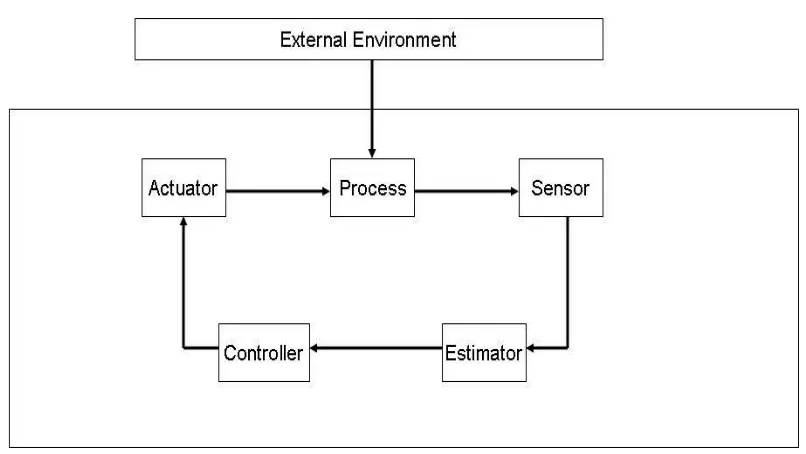
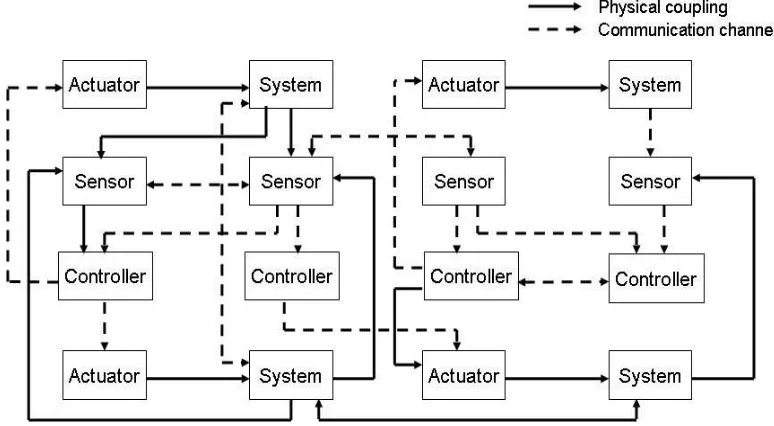
1.1 A basic control loop architecture. . . 2 1.2 A possible control architecture for networked / distributed systems. . . 3
2.1 Some examples of graphs. All but (ii) are clique graphs. . . 18 2.2 Comparison of the performance of the optimal and of the sub-optimal algorithm. The
loss in performance due to the sub-optimal algorithm is not huge. . . 33 2.3 Variation of the steady state cost as delay is introduced in the system. The sub-optimal
algorithm is robust to delays. . . 34 2.4 As the communication radius is increased, the cost obtained by the finite horizon
sub-optimal control law goes down. . . 35 2.5 As the communication radius is increased, loss in performance due to the sub-optimal
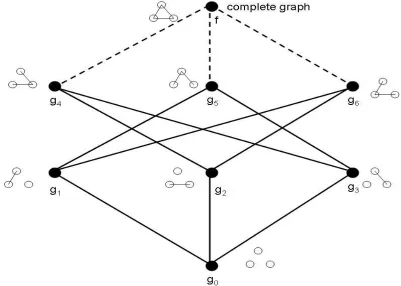
algorithm decreases. . . 36 2.6 Comparison of the value of the graphs for the partially ordered set of all graphs on 3
vertices. . . 47 2.7 As the communication radius is increased, the cost goes down: the infinite horizon case. 57 2.8 Cost achieved with all the graphs on 5 nodes. Not all topologies with same number of
edges are equally good. . . 58 2.9 Improvement in performance with our algorithm compared to the one proposed in [146]. 64 2.10 Performance loss if the proposed decentralized method instead of the exhaustive search
optimization. . . 65 2.11 Sensor maneuvers in the roboflag patrolling problem considered in the text. The dotted
lines represent the tracks made by the sensors. . . 66
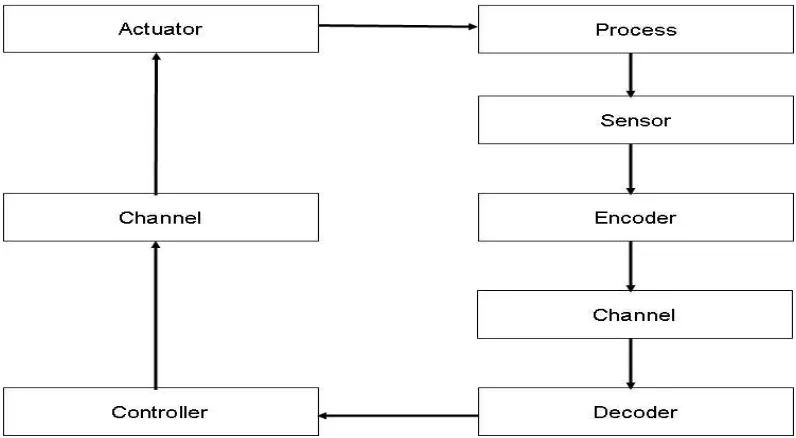
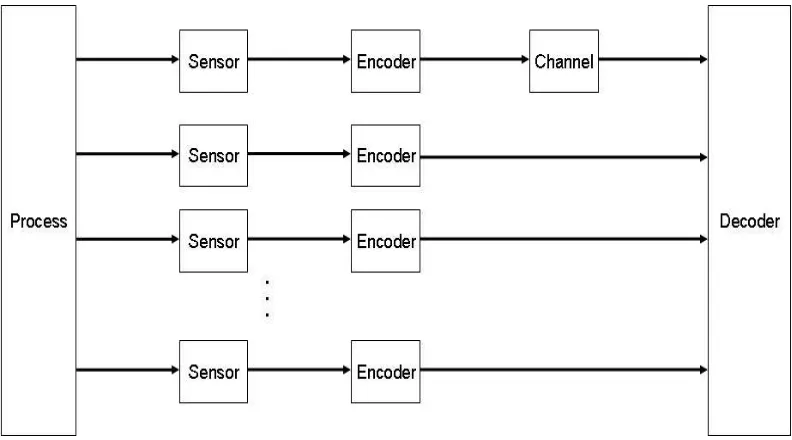
3.1 The architecture of a packet-based control loop. The links are unreliable and unpre-dictably drops packets. Most of the works in the literature look at the case of a single sensor transmitting information over a single channel. . . 70 3.2 A common design for control over packet-based links. The compensator aims at
3.3 The structure of our optimal LQG control solution. . . 71
3.4 The structure of our optimal LQG control solution for the multiple-sensor case. . . 73
3.5 Structure of the joint estimation problem. . . 74
3.6 The classical Gilbert-Elliot channel model. . . 78
3.7 The set-up of the control across communication networks problem. Later in the chapter we also look at a channel present between the controller and the actuator. . . 79
3.8 Problem setup for Section 3.4: A single sensor transmitting over a single link. . . 86
3.9 Comparison of performance of our algorithm with that obtained if no encoding was done (Ling and Lemmon algorithm). . . 95
3.10 Comparison of performance for an estimation task when the measurement matrix is invertible. . . 96
3.11 Problem setup for Section 3.5: Single sensor transmitting over a network of arbitrary topology. Every node in the network is able to communicate, and usually has similar memory and processing capabilities as the encoder at the sensor that is generating the measurements. . . 97
3.12 Example of a network of combination of parallel and serial links . . . 117
3.13 Simulated and theoretical results for a line network. . . 120
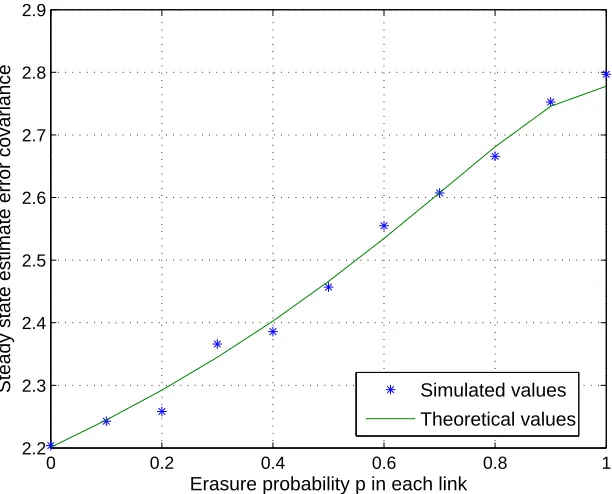
3.14 Simulated and theoretical results for a parallel network. . . 120
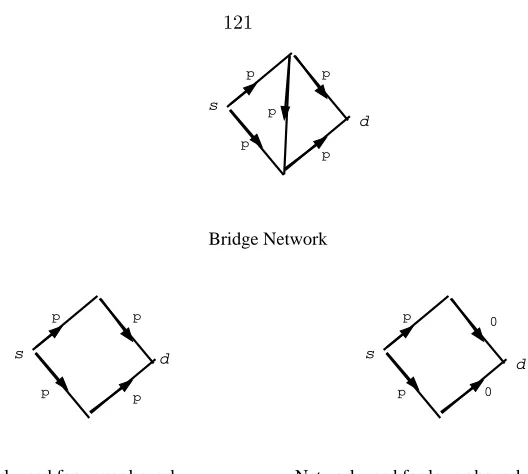
3.15 Bridge network and the networks used for calculating lower and upper bounds. . . 121
3.16 Simulated values and theoretical bounds for the bridge network. . . 122
3.17 Simulated difference in performance of an algorithm in which no encoding is done and our optimal algorithm for a series connection ofnlinks. . . 122
3.18 Loss in performance as a function of packet drop probability fornlinks in series. . . . 123
3.19 Estimation using information from multiple sensors. Only one sensor transmits over an imperfect communication link. . . 128
3.20 Comparison of performance for various algorithms for the two sensor case. . . 134
3.21 A system in which a quantizer quantizes the state and transmits it across a digital channel. . . 136
3.22 Comparison of performance of approximations for uniform quantizer calculated using our approach with simulation results. . . 145
3.23 Comparison of performance of approximations presented in the text for logarithmic quantizer with simulation results. . . 146
3.24 Comparison of the performance of the dynamic quantizer with the lower bound. . . . 146
4.1 Structure of the sensor scheduling problem. . . 164
4.2 The tree structure defined by the various possible choices of sensor schedules, illustrated for the case of 2 sensors. . . 176
4.3 Sensor switching helps to bring the cost down. . . 183
4.4 Spread of the error covariance when the optimal probability distribution is used. . . . 184
4.5 Optimal probability of use of sensor 1 as sensor 2 gets noisier. . . 185
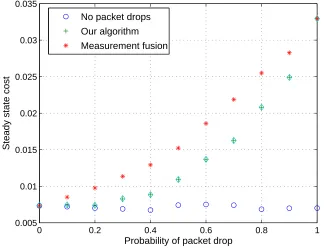
4.6 Optimal probability of use of sensor 1 varies if the channel is dropping packets. . . 186
4.7 The lower bound may not be very tight. . . 187
4.8 Minimum number of UAVs required as a function of the number of pursuers. . . 188
4.9 Spread of the steady state expected error covariance. . . 210
4.10 Probability of using the sensor at the fourth point as a function of the packet drop probability. . . 210
4.11 Lower bound on the number of sensors required. . . 211
4.12 Mean values of error covariance for various number of descriptions in the MD code but using the same rate . . . 218
Chapter 1
Introduction
In its traditional avatar, control theory deals with the following problem. As shown in Figure 1.1, consider a dynamical process whose state needs to be controlled; for instance, a mobile robot which needs to follow a given trajectory. The state of the dynamical process (e.g., the position and velocity of the robot) is observed by a sensor that generates possibly noisy measurements. The measurements are processed by an estimator that generates an estimate of the state of the process. This estimate is fed to a controller that aims at minimizing some cost function. In the mobile robot example, this can correspond to, say, deviation from a reference trajectory. The controller generates a control input that is applied to the process through an actuator. Over the last century or so, control theory has made spectacular advances both in understanding the underlying mathematical tools as well as in applying this model to many different problems and generating technological advances.
However, the very success of this model has meant that the many assumptions inherent in the above block-diagram are often forgotten. As an example, one can spell out such assumptions as
• measurements are generated periodically by the sensor and transmitted to the estimator;
• the estimator and controller are able to process all the data that is generated;
• all the components run on the same clock;
and many others. At the heart of most of these features is the implicit assumption that almost unlimited amounts of information can be communicated and processed by the system components. In most traditional control systems, this assumption largely held true. However, it is still somewhat surprising that more efforts have not been made to characterize and counter the effects of limited and imperfect communication sharing and processing, especially given the fact that, at its heart, control theory is aninformationscience. The basic motif of feedback loop has as its underlying philosophy the use of information about the system to counter the effect of uncertainty in the environment1.
1
Figure 1.1: A basic control loop architecture.
In recent years, a compelling need has arisen to understand the effects of information flow on estimation and control more fully. Technological advances in hardware and software over the past few decades have enabled cheap and small, yet powerful, communication and computation devices. This development, in turn, has made it possible to envisage systems in which multiple simple components cooperate to achieve a joint team goal. One can imagine three possible design architectures for such multi-agentsystems:
1. Every component may be asked to share all its information with every other component in a reliable fashion and all agents provided with ample computation power to process all this information to make (the same) globally optimal decisions. Even though multiple physical components may be present, this is still an example of a single agent system as far as the design is concerned. There is a rich theory already available to design such systems (modulo computational issues). We will refer to this architecture as a centralized system architecture. A simple example would be a group of aircrafts tasked with flying in a formation while either being allowed to communicate as much information as they desire with every other aircraft or communicating this information to a central ground unit that sends back the control inputs that they need to apply.
Figure 1.2: A possible control architecture for networked / distributed systems.
of such systems reduces to design of multiple single agent systems. An example would be a group of aircrafts tasked with monitoring a region for threats where every aircraft generates its trajectory as if it is the only aircraft present.
3. Every component may be allowed to share information with some other components. Thus, the components try to coordinate their behavior by transmitting some of their information (and possibly plans) to some other components. We will refer to this approach as a cooperative, networked or distributed system architecture. An example might be a group of aircrafts asked to achieve a common heading with every aircraft being allowed to observe the headings of the aircrafts only in its immediate vicinity2.
The distributed system architecture, were it to work, is very powerful since it allows the design of the individual units or components to be much simpler, while not compromising too much on the performance. Additional benefits include increased robustness to component loss, increased flexibility in that the components can be reconfigured for many different tasks and so on. However, the design of such systems challenges the assumption of information flow being unrestricted and reliable, that, as mentioned above, is at the heart of the traditional systems and control theory.
A typical design diagram for a networked system is shown in Figure 1.2. Such systems consist of the same components as a conventional system — dynamic processes, sensors, controllers etc. — but there are many of them. Thus, there are many processes that need to be controlled. Their states are being sensed by many sensors. There is no one-to-one correspondence between processes and sensors. Many sensors might observe the same process and sensors may even switch from one
2
process to another. The sensors may share information among themselves and also transmit it to the controllers. There might be many controllers with varying information and goals. A simple example is an air traffic control situation where the controller in the control tower can observe all the aircrafts but cannot micro-manage each one of them. On the other hand, the controller on-board the aircraft has limited information but has access to the actuators on-board the aircraft. All the components need to cooperate to achieve a team goal or to optimize a joint cost function and each entity can communicate with some other entities. The aspect of information as a central currency in the system is underlined by many new features that these systems present:
1. Information richness: Because of so many sensors being present and entities transmitting information to each other, the system as a whole is information rich. At the same time, however, every component has access to a different information set (or has a different world-view).
2. Information sharing: Since they need to cooperate, the components have to reach some level of agreement and hence they need to communicate and share information. Because of the information-rich aspect, sharing of all the information is not feasible. If indeed all informa-tion could be shared among all the components, the situainforma-tion would revert to a centralized architecture.
3. Presence of imperfect communication links: Information sharing needs to be carried out over imperfect communication channels that have numerous limitations. As an example, such links may erase information stochastically, corrupt it, introduce random delays and so on.
4. Limited information processing capability: Components have limited information processing capabilities. Because of the huge amount of information being generated, components may need to decide which information to access and process at any time step.
These assumptions introduce information flow as both an enabler and a constraint in the system design. It is the sharing of information that allows components to cooperate and achieve better performance than that achieved by completely decentralized systems. However, the information flow is not perfect. There is too much information being generated so that all of it cannot be communicated or processed (information overload for the system); at the same time, components may not have access to the information they need to make globally optimal decisions because of constraints on the information flow (information paucity for the decision makers). These features are, by and large, not tackled in traditional systems and control theory and thus the design of such networked systems is quite different from conventional system design.
procedures at the moment tend to be ad hoc and do not allow us to make intelligent choices through an understanding of the inherent trade-offs and capabilities of the system. This dissertation provides a new approach and new design principles to address some of the issues that are faced while designing networked systems from an estimation and control perspective.
Besides the motive stated above, studying control and estimation problems in networked systems is useful for another reason. Since networked systems coupleflowandprocessingof information with its use to estimate and control dynamic processes, a theory for such systems can be expected to unify concepts from information and communication theory, distributed and parallel computation as well as estimation and control theory. In other words, by focusing on areas at the intersection of traditionally separately studied fields of communication, computation and control, networked systems can shed additional insight into all these fields.
As an instance, traditionally, information theory has grappled with the problem (as enunciated by Shannon [176]) of ‘reproducing at one point either exactly or approximately a message selected at another point.’ While this field has had fascinating success in dealing with that question, it is also useful to recall a central assumption often made in it. Once again, to quote Shannon, ‘Frequently the messages have meaning ... these semantic aspects of communication are irrelevant to the engineering problem.’ This divorce of meaning of information from the reward obtained by transmitting it allows us to treat all information content alike. Furthermore, it allows long periods of use of a communication channel and renders long delays irrelevant as long as the information is communicated. If we have to study the complexities that arise because of coupling between the flow of information and its use to estimate or control dynamical processes, we clearly cannot use results based on information theory in an off-the-shelf manner. As a simple instance, the same message may lose its value drastically if it is communicated to the controller with delay. This issue was eloquently raised by Witsenhausen [203] who used the term ‘information pattern’ to denote the flow of information between various components3 and pointed out that the minimum cost achievable
in a problem depends upon the prevailing information pattern. Thus, he suggested, information should be measured by its effect on optimal cost. This idea is a major extension of the traditional information theory, but is crucial if we want to fully grasp the interplay between information and dynamical systems. Networked control problems provide a natural source of problems in which such interplay happens.
Similarly, the fields of parallel processing and distributed computation have made amazing progress in dealing with problems such as speeding up computation by intelligently dividing it into operations that can be done concurrently by different processors or in calculation of functions of data held by many different processors. However, often these theories also make assumptions about all processors having access to a common memory unit or all processors being connected such that
3
every processor can communicate with any other processor. Networked systems not only lack such features, they also pose problems of dynamics at the component level. Thus, components need to make decisions given whatever information they have without waiting for the coordination algorithm to finish. Traditional methods from parallel processing and distributed computation too need to be extended to fully understand the nexus between computation and control.
Thus, networked systems provide a playground where the traditional assumptions of communi-cation, computation and control are challenged. Any progress made in understanding the analysis and synthesis of such systems would then necessarily expand our knowledge about all these fields. In this dissertation, we take a control and estimation oriented viewpoint and address some of the problems associated with the information flow.
1.1
Contributions of the Thesis
From the control and estimation perspective that we take in this dissertation, there are two reasons why including the effects of information flow makes the problem of designing a distributed system difficult.
1. Information is now diffused throughout the system. Different components have access to different information sets and must base their decisions on them. There might be heterogeneous processing capabilities as well. Since the decisions aim at optimizing ajointcost function, they have to be coordinated. Coordinating decisions when a central authority is lacking and the various decision makers have access to different information sets is a difficult and open problem. 2. Information flow is also now subject to the vagaries of communication channels. Thus, in-formation may be lost, delayed or otherwise corrupted. How to use the received inin-formation optimally, as well as how to choose what information to transmit are open problems. These issues can have an immense effect on the estimation or control performance of the system. In this dissertation, we take first steps towards attacking both these problems. We give specific contributions of each chapter in the corresponding introduction section later. Let us, however, briefly summarize the intellectual thrusts of the dissertation here.
besides the question of ‘What should an agent do?’, the questions of ‘Whom should an agent talk to?’, ‘What should an agent communicate?’, ‘When should an agent communicate?’ and so on also
have to be answered. Of course, the information flow has to be designed within the constraints imposed by the environment, in particular, the effects introduced by the communication channel. However, the design of the information flow still represents an important degree of freedom available to the system designer that has hitherto largely been ignored. As we will demonstrate, the joint design of information flow and the optimal control input satisfying that information flow will yield large improvements in the system performance.
We begin in Chapter 2 by focussing on the diffuse nature of information in the system. We tackle two chief problems:
1. Given an information flow that specifies the topology according to which the components communicate, what is the optimal control / decision policy to be followed by the components? This is the question of ‘What should an agent do?’
2. How do we design the topology? This is the question of ‘Whom should an agent communicate with?’
Design of the optimal control law for arbitrary information flows is known to be NP hard [21, 159]. Thus, we are only able to provide numerical algorithms for the first problem. However, our algorithms involve solving linear equations only and hence avoid the convergence problems associated with other methods that exist in the literature. To be able to design the topology and the information flow, we need notions of value of an information flow. Such measures are highly non-additive and yield counter-intuitive results. We adopt a model where every communication edge that allows information to be shared between two components comes at an additional cost. While we prove that the recent results in the literature about loss of stability by adding new edges [59] are outcomes of the particular control law that those works assume (meaning that if the optimal control law is used, all information flow patterns have the same stabilizability properties), we also show that under this model, there are cases when adding edges isharmfulfor performance for any positive value of edge cost. In some other cases, we provide conditions on the edge cost that make adding or deleting edges beneficial. These results suggest that we need to take the folk-lore of ‘cooperation is always better’ with a pinch of salt.
can be borrowed, thetechniquesfrom information theory are not applicable directly, because of the assumptions about delays and multiple uses of the channel mentioned already. For many cases, we develop encoding and decoding algorithms that satisfy the constraints imposed by networked control systems and are optimal for the purpose of estimation and control. Our approach differs drastically from the existing viewpoint of control theory, which assumes fixed and given transmission quantities and yields huge improvements both in terms of stability margins and performance. It also allows us to draw an analogy between the problem of transmitting information for control and digital communication. Thus, we can use any component that is relaying information in a similar manner as a repeater in digital communication to fight the degradation in the performance due to channels. In Chapter 4, we begin to bring both the aspects together. We consider systems that involve both a large number of components as well as communication over imperfect channels. We begin by focussing on the problem of presence of multiple access channels that allow only one component to communicate its information at every time step. To answer the question of ‘Which agent communi-cates when?’, we propose the idea of stochastic communication patterns that allow us to explicitly
include the effect of communication channels during system design. We illustrate the use of such communication patterns in a distributed estimation problem and in a problem of distributed control with switching topologies. This approach also allows us to escape the curse of dimensionality, that will afflict us for systems comprising of multiple components in any resource allocation problem, if we use optimization procedures (such as tree search) that have been proposed in the literature.
Finally, in Chapter 5, we identify the next set of problems that need to be attacked and present some initial results on a few of these problems. For instance, we introduce the notion of robustness for networked systems. The notion is different from the usual concept of robustness in control theory which deals with imperfect knowledge of the process model. Although some features are common between the two notions, it is also different from the usual model of agent failure used in distributed computation. This is on account of the dynamics present in our problem as well as because of constraints on the information flow that we assume. We analyze some control algorithms proposed in the literature and show that this concept needs to be considered during the system / algorithm design.
1.2
Organization of the Thesis
we attack the problem on both the fronts. The approach we follow is a joint design of the control law and the information flow.
We begin in Chapter 2 by focusing on the first question. We consider the problem of distributed control of a formation of several dynamic agents4that need to cooperate with each other to minimize
a joint cost function. The formation has a specified topology that determines the set of agents with which an agent can exchange information. Communication effects are largely ignored in this chapter with a communication link, if present, being modeled as perfect. In Section 2.4, we present a synthesis algorithm for the control law that minimizes a quadratic cost function for a finite time horizon case. The problem is known to be NP-hard in general, and hence we are able to present only a sub-optimal algorithm. However, the algorithm is interesting because it involves solving only a set of linear equations and hence is free from convergence issues plaguing other numerical approaches considered in the literature. This takes us to the question of role of the topology in distributed control in Section 2.6. We pose the question of jointly designing the topology and the control law to be followed by the agents. Obviously, if edges can be added at no extra cost, the optimal topology would be one in which every agent can communicate with every other agent. However, adding more edges may impose an additional cost to the system by, e.g., entailing more communication. We propose and analyze a new model for determining the influence of interconnection topology in distributed control. The results are surprising, as there are cases when adding any edge is detrimental for any link cost that is positive. In some other cases, we have a linear matrix inequality to find the link cost at which it ceases to be beneficial to add an extra edge. The chapter has two appendices in which we discuss related problems. In the first appendix, we discuss an alternative synthesis algorithm for the distributed control problem that is suitable for the infinite horizon version of the problem. In the second appendix, we discuss a distributed estimation problem. We consider the problem of active sensing using mobile sensor nodes that are jointly estimating the state of a dynamic target as a sensor network and provide a gradient search-based distributed algorithm for controlling their motion.
In Chapter 3, we shift gears to focus on the effects of communication channels on estimation and control. In most of the work presented in this dissertation, we model a communication channel using the packet erasure model. This model is discussed briefly at the beginning of the chapter in Section 3.2. The novelty in our approach is to pose the problem as an information transmission problem. This perspective of jointly designing the quantity to be transmitted along with the control law that uses this quantity optimally allows us to solve the Linear Quadratic Gaussian (LQG) problem in the face of packet drops. As the first step, in Section 3.3.2, we extend the familiar LQG separation principle to this problem. This principle allows us to solve the LQG control problem
4
using a standard LQR state-feedback design along with an algorithm for propagating and using the information across the unreliable links. For many cases, we then provide such information processing algorithms that are recursive, yet optimal. Our design has many nice properties such as not assuming any statistical model of the packet drop events and being able to handle packet delays among others. Further, the solution is appealing from a practical point of view because it can be implemented as a small modification of an existing LQG control design. In Section 3.4, we consider the case of a single sensor transmitting information across a single link. In Section 3.5, we consider the problem of estimation across an arbitrary network of packet erasure channels. We propose the optimal information transmission algorithm and analyze its stability and performance. In Section 3.6, we extend the result to the case of multiple sensors with only one sensor transmitting over a packet erasure channel. We see that a na¨ıve extension of the algorithm for a single sensor is not optimal. We provide an alternative algorithm that is optimal and analyze its properties. In the first appendix of the chapter, we consider quantization as another effect that communication channels may introduce. While stability of the plant under quantization strategies has been looked at, the performance of a control loop under quantization is largely ignored in the literature. We look at the performance aspects under the high rate assumption. In the second appendix, we look at random delays introduced by the channel.
In Chapter 4, we consider some problems that have aspects of both distributed estimation / control and communication links present. We begin by considering the situation when only one (or a subset) out of multiple sensors can take a measurement at every time step and communicate it over a packet erasure channel to an estimator. In keeping with our philosophy throughout the dissertation, we not only design the optimal estimator that utilizes the measurements available to it, but also look at the problem of constructing the optimal schedule for the sensors to communicate. We propose a stochastic selection strategy that, unlike the standard tree-based methods proposed in the literature, is explicitly able to take into account the packet dropping nature of the channel. We then consider a control problem in which the topologies are switching stochastically. This can model, e.g., stochastic information loss due to communication links. We solve for the optimal control law and analyze the performance of the system under it. The tools that we develop in the chapter are useful in various other problems. As an example, in the first appendix, we apply them to another resource allocation problem. We show how our algorithm can be used for the problem of sensor coverage in which multiple mobile sensors need to cover a geographical area. In the second appendix, we apply the tools to the problem of using Multiple Description (MD) coding to transmit data over a channel to improve control performance.
Chapter 2
Distributed Estimation and
Control in Formations of Dynamic
Agents
This chapter deals with the problem of distributed estimation and control when there are many dynamic agents present. If agents share information among each other according to some topology, both the questions of optimal control law for a given topology (‘What should an agent do?’) and how to design the topology (‘Whom should an agent talk to?’) become important. We look at these questions in this chapter. The work presented in this chapter has partly appeared in [35, 82, 85, 123]. The chapter is organized as follows. We begin by introducing the problem and presenting the relevant prior work in Section 2.1. In Section 2.2, we present the notation we are going to use. Then, in Section 2.3, we set up the constrained controller synthesis problem. In Section 2.4, we present our solution to this problem for the finite horizon case. We present both an optimal but computationally intensive solution and a simpler sub-optimal solution. Section 2.5 contains some examples to illustrate the concepts and the algorithm. In Section 2.6, we move on to the problem of determining the influence of the topology of the graph. We first define the associated notions of value of a graph and our cost function model. Then, in Section 2.7, we analyze this model and present our results. Section 2.8 presents a short numerical example to explain our results. The first appendix presents an algorithm for synthesizing a sub-optimal controller to minimize an infinite-horizon LQ cost. In Appendix B, we consider the problem of distributed sensor motion control for estimation.
Contributions
The main contributions of the chapter are now summarized.
solving linear equations and hence are free from the numerical issues about convergence that afflict other approaches proposed in the literature.
2. We formally pose the problem of evaluating the role of topology in distributed control. We present a model for the problem and present initial analytic results. For instance, we prove that under certain assumptions, the optimal control topology according to our criterion is the fully decentralized one. We also present linear matrix inequalities (LMIs) to calculate the ‘critical prices’ at which it becomes detrimental to add new edges to an existing topology. 3. We present a simple gradient search based algorithm for the infinite-horizon version of the
distributed control problem. Using the special structure of the problem, we are able to get rid of the problem of choosing the initial guess point prevalent in similar approaches proposed in the literature. Also, we prove the interesting result that a formation is controllable and/or stabilizable for any given information topology if and only if all the individual agents are controllable and/or stabilizable using their own inputs.
4. For the distributed target tracking problem, we propose a simple distributed algorithm for planning the motion of sensors in a network to achieve significantly better estimates of the target state.
2.1
Introduction
One of the major challenges in the problem of estimation and control of networked systems is the absence of a central controller that has access to information from all the agents and uses this information to compute the control signals that the agents should use. Presence of an information flow network so that an agent is allowed information only about some other agents to calculate its control input introduces fundamentally new features into the problem. The topology of the information flow can have many effects. On one hand, it may introduce instability if the information being fed through the network adds on constructively to the disturbance at a node [60]; on the other, for cooperative goals, it leads to a better performance than if agents do not share information.
results were expanded by Ren and Beard in [165]. A general framework for analysis of stability of interconnected systems where the topology can potentially be time-varying was presented in [81]. The effect of changing topology for the special case of consensus problems was also considered in [157].
However, most of the work in the literature, so far, has centered on stability analysis of the formation assuming certain control laws in place. A more general question is that of synthesis of the control law to be used by the agents in such a formation, such that some joint cost function is optimized. The defining feature of the problem is that while the cost function involves all the individual agents in the formation, the pre-specified topology of the formation imposes constraints on the form of the control law by limiting the information available to various agents at any time. Thus, it is not realistic to assume that an agent would know the state of all the other agents in the formation at any given time and be able to use it to calculate the control input. These features make the problem a distributed control problem with arbitrary information flow patterns, which is, in general, much harder to solve than the traditional optimal control problem.
Research in distributed control has a long history (see, e.g., [53]). Witsenhausen, in his seminal work [202, 203], showed that under distributed information constraints, a linear controller is not optimal in general and also that the cost function need not be convex in the controller variables. A discrete equivalent of Witsenhausen’s counter-example was given in [21, 159] where it was also shown that the problem of finding a stabilizing controller under information pattern constraints is NP-complete. For particular information structures, the problem has been solved. Witsenhausen himself in [203] identified some cases where the standard LQG theory can be applied, and hence, the optimal controller is linear. Another important early contribution in this direction was the work of Ho and Chu [99], who looked at this problem in the context of team decision theory. That work identified a class of information patterns called partially nested structures under which the optimal controller is linear. Roughly speaking, under a partially nested structure, if the decision that controllerAmakes can affect the decision made by another controller B, then the controllerB should have access to all the information that controllerAhas access to. Another information pattern for which the optimal controller is known to be linear is the one-step delayed information sharing pattern in which every controller has, at the current time, access to all the previously implemented control values and all the observations made by any other agent in the system through and including the previous time, and its own observations through the current time. Recursive solutions for this problem were provided for a quadratic cost by Sandell and Athans in [171], for an exponential cost by Fan et al. in [58] and forH2,H∞ andL1 costs by Voulgaris in [195]. For some other tractable
a property called quadratic invariance and showed it to be necessary and sufficient for optimal distributed controllers to be synthesized efficiently via, e.g., convex programming.
Since the problem of synthesizing optimal distributed controllers for arbitrary information pat-terns is NP-hard, an alternative research thrust has been to synthesize sub-optimal controllers. Langbort et al. [122] presented sufficient LMI conditions that can be used for synthesizing a sub-optimal distributed controller. A convex programming approach to develop a sub-sub-optimal controller for theH2 performance criterion was considered in [45]. Receding horizon control for the problem
has been explored, e.g., by Dunbar and Murray in [52] and by Keviczky in [115]. A different ap-proach was inspired by the design of reduced-order controllers (see, e.g., [127]). This apap-proach was used to obtain gradient descent based numerical algorithms for solving the optimal structured linear controller with an arbitrary number of free parameters for the infinite horizon case in many works, some examples being [181, 199]. In [82], this algorithm was explored for the case of vehicle forma-tions and, in particular, it was proven that in this case, it is always possible to choose a feasible initial point. We will present this algorithm in Appendix A of the chapter. A similar algorithm can be applied to the finite horizon problem, as described by Anderson and Moore in [2], but the computational difficulties were pointed out by Kleinman et al. in [116]. Bemporad et al. in [14] considered the constrained LQR problem and came up with a numerical algorithm for the optimal piecewise affine controller. The algorithm was extended to the case of infinite-time horizon in [74]. A good survey of the attempts to solve the related fixed order and static output feedback problems can be found in [20, 44, 184] and the references therein.
In addition, we prove the interesting result that the information topology can neither help nor hinder controllability and stabilizability in the sense that a necessary and sufficient condition for any formation to be stable (controllable) is that each individual agent be stable (re. controllable) using its own inputs. This puts into perspective the recent results about a formation potentially being destabilized by addition of edges [59].
Evaluating the optimal controller for a given topology leads us naturally to the following question: ‘Are there topologies that are more ‘efficient’ than others for distributed control?’ The intercon-nection topology of the agents fixes the form of the control law and hence has a huge effect on the cost that the system has to suffer. In some applications (e.g., a power distribution network), an interconnection topology may already exist and the controller has to conform to this topology that has been decideda priori. However, if decentralization is not viewed as an external constraint, then both the topology and the controller have to be designed at the same time. For example, when de-ciding between a leader-follower and a fully decentralized architecture for cooperating multi-vehicle systems, the choice of the information pattern is an integral part of the control design process. Thus, it makes sense to find the minimal (with respect to some appropriate cost function) topology needed to achieve a particular control goal. Obviously, if there is no cost of adding a new communication link between two agents, the minimum cost will be achieved when the topology entails every agent communicating with every other agent. We present a model for evaluating the effect of topology in which we explicitly account for the cost of communication by making one of the weight matrices in the classical LQR cost function topology-dependent. This allows us to explore the trade-off between better control performance and higher communication cost incurred.
Similar questions have been asked forstaticagents in the theory of organizational efficiency and information cost, e.g., see Marschak and Radner [138]. However, the questions about efficiency of decision architectures has largely been ignored in the control literature. We are aware only of the following recent attempt at finding a minimal control interconnection structure. In [180], the authors show that when constructing a distributed controller from a set of observer-based controllers using different and parallel observations, the star interconnection topology is minimal, in the sense that the resulting control design problem has the minimal number of free parameters needed to ensure closed-loop stability. The model that we present has similarities to ideas in the field of Games over Networks (see, e.g., [106, 148]) and allows us to make rigorous statements regarding the optimal topology. For instance, we see that there are cases in which adding edges can actually be harmful from the view of the optimal cost. We also provide some conditions under which values of two graphs can be compared.
in [199]. However, we come up with stronger results by utilizing the structure of the problem. More importantly, we come up with a way to obtain the initial guess for the numerical algorithm, which was identified as the major problem in [199].
In the second appendix, we consider a distributed estimation problem. We consider the problem of controlling the motion of mobile sensor nodes that are jointly estimating the state of a dynamic target as a sensor network. Attempts have been made over the years to solve the problem of optimal motion control of sensors in various contexts. However, most of the optimal motion-planning and control techniques tend to be application-specific, e.g., [96, 151]. Particularly relevant to our area of interest in estimation/tracking and distributed sensing applications is the work of Mukai and Ishikawa [146, 147] who proposed a suboptimal centralized algorithm using the determinant of the estimated error covariance as a cost function. However, most of the approaches proposed in the literature assume that only one sensor’s motion needs to be controlled. For systems where multiple sensors are present, a central computation device is assumed to be present that calculates the optimal trajectories of the sensors. In networked systems, where the number of sensing nodes may be large, it is obvious that this assumption needs to be relaxed. We propose a gradient search-based decentralized algorithm that demonstrates the benefits of distributed sensing. We also extend the algorithm to the task of tracking multiple targets and minimize the estimated error by forming sub-teams of the sensors appropriately.
2.2
Mathematical Preliminaries and Notation
By a network of interconnected dynamic agents, we mean a system of dynamically uncoupled agents in which every agent can use the information from a prescribed set of other agents (called its neighbors) for calculating its control input. The flow of information is thus described by identifying the set of neighbors for each agent and is referred to as the information flow topology. Consider a network ofN agents. Together with the information flow topology, the network can be represented by a graph G. Unless stated otherwise, in this chapter, we will be interested only in undirected graphs. The node set of the graph is denoted byV ={vi}Ni=1 such that each agenticorresponds to
a vertex vi . The link (or edge) set E ⊆ V × V comprises of edges such that the edge e = (vi, vj)
models the communication link between nodevi and nodevj. The set of neighbors of the nodevi is
defined by
Ni={vj|(vi, vj)∈ E}.
Thus, it corresponds to the set of all those nodes with which the node vi can communicate. The
degree of a node vi is the cardinality of the setNi. We refer to the agents variously as vertices or
we say that the graphgis a subgraph ofg0 and denote it bygg0. Equivalently we can say thatg0 is a supergraph ofg and writeg0 g. A clique graph [91] is one each of whose subcomponents is a complete subgraph. Some examples and counter-examples of clique graphs are given in Figure 2.1.
Figure 2.1: Some examples of graphs. All but (ii) are clique graphs.
Consider a graph with N nodes. Theadjacency matrix (see, e.g., [18] for more details) denoted byAis a square matrix of sizeN×N, defined as follows
Aij =
1 (vi, vj) ∈ E
0 otherwise.
If we denote the degree of node vi byOi, then the degree matrix denoted byD is defined to be a
square matrix of sizeN×N, such that
Dij =
Oi i=j
0 otherwise.
We define theLaplacianof a graph by the relation L=D − A. Consider the system evolving according to
x(k+ 1) =Ax(k).
We say that the system is (asymptotically) stable, or thatAis (asymptotically) stable, ifAhas all its eigenvalues on or inside (strictly inside) the unit circle and all the eigenvalues on the unit circle are simple. A positive (semi-)definite matrix is a symmetric matrix with all eigenvalues (non-negative) strictly positive. For two matricesAandB, we write A≥B ifA−B is positive semi-definite.
covariance matrix is always a positive semi-definite matrix.
The trace of a square matrix X, denoted by trace(X), is defined as the sum of its diagonal elements. The trace is also the sum of the eigenvalues of X. The trace operator satisfies the following properties (assumeX,Y andZ to be compatible matrices;v is a column vector).
1. trace(X+Y) = trace(X) + trace(Y). 2. trace(XY Z) = trace(ZXY).
3. E[vTW v] =E[trace(W vvT)].
In the last equation if W is a constant matrix, the right hand side can be further rewritten as trace(W E[vvT]).
For an m×n matrixX = [xij], the operation vec(X) results in an mn×1 column vector with
elements
vec(X) = x11 x21 .. . xm1
x12 .. . xmn .
The operation A⊗B denotes the Kronecker product (also called the direct product) between two matricesAandB (see [121] for details). It can be shown that for suitably dimensioned matricesA, X andB,
vec(AXB) = BT ⊗Avec(X). (2.1)
LetA,P andQbe real matrices. The equation
P =ATP A+Q,
is called the discrete algebraic Lyapunov equation (DALE) if Qis symmetric. We will refer it as the Lyapunov equation in the following. We now summarize some results about the solutions of Lyapunov equation. For more details, see [64]. The Lyapunov equation has a unique solution P if and only if no eigenvalue ofAis the reciprocal of an eigenvalue ofAT. If this condition is satisfied,
the uniqueP is Hermitian. Furthermore, if A is asymptotically stable, then the unique Hermitian P is given by
P = ∞ X
k=0
IfAis stable andQis positive definite (or semi-definite), thenP is unique, symmetric and positive definite (or semi-definite).
2.3
Problem Formulation
Consider a formation ofN agents, in which thei-th agent evolves according to the equation
xi(k+ 1) = ¯Axi(k) + ¯Bui(k) +wi(k),
where the control inputui(k) is given by
ui(k) =Fi,1(k)xi(k) +
X
j∈Ni
Fij,2(k) (xi(k)−xj(k)).
The state of the i-th agent is given byxi(k)∈Rn and ui(k)∈Rm denotes its control input. The
form in which the control law is stated depends only on the relative state of the out-neighbors of agenti. However, because of the presence of the matrixFi,1(k), it is clear that this is not a limiting
assumption. Assume that the noises wi(k)’s are zero-mean, Gaussian and white. On stacking the
statesxi of all the agents, we can obtain the system state vectorx, whose evolution is described by
x(k+ 1) = (I⊗A)x(k) + (I¯ ⊗B)u(k) +¯ w(k) (2.2) u(k) = (diag (Fi,1(k)) +Lgen(k))x(k),
whereIis the identity matrix of suitable dimensions and diag (Fi,1(k)) is a block diagonal matrix with
Fi,1(k)’s along the diagonal and zero matrices elsewhere. The vectorsu(k) and w(k) are obtained
by stacking the control laws and the noises for the individual agents, respectively. Lgen(k) is a
generalization of the Laplacian matrix of the graph and is formed as follows. Create the adjacency matrixAfor the network. Then, replace each unity element that is at the (i, j)-th place by−Fij,2(k).
Replace the diagonal element in thei-th row by a matrix which is the sum of the matricesFi1,1(k),
Fi2,1(k),· · ·,Fi(i−1)(k),Fi(i+1)(k),· · ·,FiN,1(k). The rest of the zero elements are replaced by zero
matrices of appropriate dimensions. Note that the topological constraints on the form of control law are inherent in the structure ofLgen(k).
In this chapter, we will assume that the topology of the network is known at any time step, although it may be time-varying. We ignore issues such as quantization error and message loss when agents communicate over the links. Note that if all the agents are not identical, relations similar to (2.2) can easily be obtained. The matricesI⊗A¯andI⊗B¯ will be replaced by block diagonal matrices diag( ¯Ai) and diag( ¯Bi), but other details remain similar. We begin by discussing the questions of
2.3.1
Stabilizability
Two questions arise immediately:
• Is it possible to stabilize a formation using information from other vehicles when the vehicles are individually not stable? In other words, if a vehicle is unstable, can the formation be stabilized by the exchange of information between different agents?
• Are some topologies inherently unstable in that even if the agents are stable, the information flow will always make it impossible to stabilize the formation?
We note the following result.
Proposition 2.1 Consider a formation of interconnected dynamic agents as defined in Section 2.2.
1. A formation is controllable if and only if each individual agent is controllable.
2. A formation is stabilizable if and only if each individual agent is stabilizable.
Proof We use the notation introduced above. Let the matrix ¯Ahave dimensions n×nand there be N agents in the formation. As can be seen from (2.2), for controllability of the formation, we want the matrixM1 to have ranknN [118], where
M1=
h
I⊗B¯ (I⊗A)(I¯ ⊗B)¯ (I⊗A)¯ 2(I
⊗B)¯ · · · (I⊗A)¯ nN−1(I
⊗B¯) i
.
Using the standard property of Kronecker product
(a⊗b)(c⊗d) =ac⊗bd,
we can rewriteM1as
M1=
h
I⊗B¯ (I⊗A¯B)¯ (I⊗A¯2B)¯
· · · (I⊗A¯nN−1B)¯ i.
This matrix has ranknN if and only if the following matrix has rankn.
M2=
h ¯
B A¯B¯ A¯2B¯
· · · A¯nN−1B¯ i.
Since ¯Ahas dimensionsn×n, the equivalent condition is that the matrix
M3=
h ¯
B A¯B¯ A¯2B¯ · · · A¯n−1B¯ i
,
be rankn. ButM3being ranknis simply the condition for the individual agent being controllable.
the first part. The second part also follows from the above proof. The subspace not spanned by the columns ofM1is stable if and only if the subspace not spanned by the columns ofM3is stable.
Note that although we have proved the theorem for the case of identical agent dynamics, the theorem holds for the case of agent dynamics being different as well. The terms I⊗Φ and I⊗Γ would be replaced by block diagonal matrices but the condition for the controllability matrix of the formation having rank nN would still reduce to the condition that the controllability matrix of each agent have rankn.
2.3.2
Designing the Control Law
From (2.2), it can be seen that the problem of designing a control law that satisfies some topological constraints is equivalent to solving the control design problem for the system
x(k+ 1) = I⊗A¯x(k) + I⊗B¯u(k) +w(k) (2.3) u(k) = F(k)x(k),
with the additional constraint thatF(k) should have those elements as 0 which correspond to zero entries in theLgen(k) of the interconnection topology formed as above. F(k) can then readily be
cast in the form diag(Fi,1(k))+Lgen(k) and the matricesFi,1(k) andFij,2(k) obtained. Constraining
the controlF(k) to have some elements zero forces us to consider only those matrices that live in a particular sub-space of the vector space of all matrices with the same dimensions asF(k).
2.4
The Optimal Constrained Control Law
DenoteA=I⊗A¯ andB=I⊗B¯ and rewrite (2.3) as
x(k+ 1) = Ax(k) +Bu(k) +w(k) (2.4) u(k) = F(k)x(k),
where the initial condition x(0) is random and is Gaussian with zero-mean and covariance R(0). The noisew(k) is also random white zero-mean Gaussian with covarianceRw. We wish to minimize
the quadratic cost function
JT =E
" T
X
k=0
xT(k)Qx(k) +uT(k)Ru(k)
#
+ExT(T+ 1)Pc(T+ 1)x(T+ 1), (2.5)
to additionally constrain the control law to lie within a space spanned by the basis vectors {Θj,
j= 1,2, . . . , p}. Thus, the problem is to find a control law of the form
F(k) =
p
X
j=1
αj(k)Θj, (2.6)
whereαj(k)’s are scalars, that minimizes the cost function (2.5).
Remarks
1. The optimal constrained control law would not, in general, be the projection of the optimal control law on to the sub-space we are interested in. This is reminiscent of the fact that the optimal causal estimate for a random variable is not the same as the projection of the general optimal estimate on to the causal sub-space [112].
2. Requiring a priori that the controller be linear might be a non-trivial assumption. However, this commonly made assumption allows us to derive tractable algorithms for solving the problem and leads to sharper results.
2.4.1
A Preliminary Result
In this subsection we prove an intermediate result that we will use later. We begin with the following fact.
Lemma 2.2 SupposeW is a positive semi-definite matrix andP(K)denotes a matrix-valued func-tion of the matrix argumentK. IfP(K)> P(K0), then trace(P(K)W)≥trace(P(K0)W).
Proof Since P(K)> P(K0), we have P(K)−P(K0)>0. AlsoW is positive semi-definite, thus
W12 is defined. Hence, we note that
traceWT2 (P(K)−P(K
0))W
1 2
≥ 0
⇒trace ((P(K)−P(K0))W) ≥ 0.
But this means trace (P(K)W)≥trace (P(K0)W), which proves the assertion.
Proposition 2.3 Consider the cost function
C=E
K1Y1−X1
K2Y2−X2
.. .
KlYl−Xl
T W
K1Y1−X1
K2Y2−X2
.. .
KlYl−Xl
,
where Ki’s are arbitrary matrices while Yi’s and Xi’s are vectors of suitable dimensions such that
the cost functionC is well-defined. Suppose thatW is a symmetric positive-definite matrix that can be written in the form
W =
W1,1 W1,2 · · · W1,l
W2,1 · · · W2,l
..
. . .. ...
Wl,1 Wl,2 . . . Wl,l
,
where the blocksWi,j are of appropriate sizes so that the productXiTWi,jXj is well defined. Finally
assume that all diagonal blocksWi,i’s are positive definite. Then, the optimalKi’s minimizing the
cost functionC are given by the solution to the coupled matrix equations
Kj =Wj,j−1
X
i
Wj,iRXiYj−
X
i6=j
Wj,iKiRYiYj
R−Y1
j, ∀j = 1,2,· · · , l,
whereRYiYj =E
YiYjT
andRXiYj =E
XiYjT
.
Proof For each j, we can write the terms in the cost functionC that depend on the matrixKj as
Cj = trace KjRYjK
T
j Wj,j−KjΨ−ΨTKjT
, where Ψ = X i
RYjXiWi,j−
X
i6=j
RYjYiK
T i Wi,j
.
Kj needs to be chosen so as to minimizeCj. The minimization is of the form
min
X trace XAX
whereB is positive definite and hence invertible. This can be rewritten as
min
X trace XAX
TB+XC+CTXT
= min
X trace XAX
TB+XCB−1B+CTXTBB−1
= min
X trace XAX
TB+XCB−1B+B−1CTXTB
= min
X trace XAX
T +XCB−1+B−1CTXTB.
Now we use lemma 2.2. Thus, our problem reduces to that of determiningX such thatXAXT +
XCB−1+B−1CTXT is minimized. We complete the squares to write
XAXT+XCB−1+B−1CTXT = X+B−1CTA−1A X+B−1CTA−1T
−B−1CTA−1C.
Thus, the minimizing X is seen to be given by −B−1CTA−1. Applying this fact to our original
problem of determiningKj, we see that
Kj =Wj,j−1
X
i
Wj,iRXiYj −
X
i6=j
Wj,iKiRYiYj
R−Yj1.
Note that for calculation of the Kj’s, we can use the identity (2.1). For each Kj we obtain the
relation
vec(Kj) = vec Wj,j−1
X
i
Wj,iRXiYj
!
−X
i6=j
RYiYjR
−1
Yj
T
⊗ Wj,j−1Wj,i
vec(Ki)
.
We have one such equation for each Kj, j = 1, . . . , n. These equations can readily be solved to
obtain the values of vec(Kj) and, in turn, the matrices Kj can be determined.
2.4.2
The Optimal Control Law
From (2.5) we see that the cost function to be minimized is
JT =E
" T
X
k=0
uT(k)Ru(k) + T
X
k=0
x(k)Qx(k) #
+ExT(T+ 1)Pc(T+ 1)x(T+ 1).
Using the equation (obtained from (2.4))
x(k) =Akx(0) +
k−1
X
j=0
AjBu(k−1−j) +
k−1
X
j=0
and the fact that the noisew(k) is white and zero-mean allows us to rewrite the cost function as
JT =EΓTFΓ + ΓTGΛ + ΛTGTΓ + ΛTHΛ, (2.7)
In the above equation
Γ =h x(0)T w(0)T w(1)T
· · · w(T)T iT
is the vector of all the random variables involved. Similarly,
Λ =h uT
0 uT1 · · · uTT
iT
is the control vector that is the optimization variable. Finally, the matricesF,GandHare functions of the known matricesA,B, R,QandPc(T+ 1). The control vector Λ is constrained to be of the
form Λ = u(0) u(1) .. . u(T) = F(0)x(0) F(1)x(1) .. . F(T)x(T)
where the matrices F(i)’s have some pre-specified elements zero because of the imposed topology. In particular, if we write
F(i)x(i) =
F1(i)x(i)
F2(i)x(i)
.. . FN(i)x(i)
whereFj(i) is the control law applied by thej-th agent at time stepi, then those elements ofFj(i)
that correspond to the elements in the state vectorx(i) that thej-th agent does not have access to are zero. We can pull the constraints into the state vector and write
Fj(i)x(i) =Kj(i)yj(i),
where Kj(i) is now a matrix free of any constraints on its elements. The vectoryj(i) is a stacked