N A N O I D E A
Open Access
Fabrication of Optical Switching Patterns
with Structural Colored Microfibers
Geon Hwee Kim
1, Taechang An
2*and Geunbae Lim
1*Abstract
Structural color was generated using electrospinning and hydrothermal growth of zinc oxide (ZnO). An aligned seed layer was prepared by electrospinning, and the hydrothermal growth time control was adjusted to generate various structural colors. The structural color changed according to the angle of the incident light. When the light was parallel to the direction of the aligned nanofibers, no pattern was observed. This pattern is referred to as an “optical switching pattern.”Replication using polydimethylsiloxane (PDMS) also enabled the generation of structural colors; this is an attractive approach for mass production. Additionally, the process is quite tunable because additional syntheses and etching can be performed after the patterns have been fabricated.
Keywords:Electrospinning, Hydrothermal growth, Nanostructure, Structural color, ZnO
Background
Structural color has many advantages over pigment (chem-ical) color. For example, it may be eco-friendly and does not suffer from photochemical degradation. Also, because the color changes according to the observing angle, it is possible to produce various patterns that cannot be pro-duced with conventional pigment colors. These attributes have rendered structural colors of great interest to the tex-tiles, paints, cosmetics, security, and sensors [1–7]. A var-iety of coloring principles explain the expression of structural color, and recent studies have shown that zinc oxide (ZnO) nanostructures express color by quasi-ordered scattering [8].
Quasi-ordered scattering is determined by the size and spacing of the nanostructures and is colored when the size of the nanostructure is similar and the spacing is constant. Although the diffuse reflectance is presumed to be the main coloring principle of quasi-ordered scattering, the principle of precise coloring has not yet been clarified, and blue, green, and purple are mainly observed [8].
A seed layer is required to fabricate ZnO nanostruc-tures. Hydrothermal growth occurs in the region where the seed layer forms, which is also where structural color is expressed [9–14]. Hydrothermal growth refers to the
synthesis of nanostructures in water at 40–80 °C. There-fore, the shape of the pattern is defined by the region of the seed layer. To fabricate optical switching patterns, a nanofiber seed layer is required that is aligned in one direction. To accomplish this, we used electrospinning, which is the most commonly used method for fabricat-ing nanofibers [15–18]. However, collected electrospun nanofibers are usually randomly aligned. Research has been conducted to align nanofibers to minimize the net torque of electrostatic forces applied to the fiber ends [19]. In this way, the nanofibers can be aligned in a float-ing state (the nanofibers are aligned in the air between the electrodes), and an aligned seed layer can be fabri-cated by transferring the fabrifabri-cated nanofibers to the tar-get substrate. In order to produce the wire pattern of microscale without using electrospinning, a complicated patterning process using photoresist must be performed, which is a process that is not only difficult to realize mass production and large-scale as well as increase the process cost.
The fabricated seed layer was made from nanofibers hav-ing specific dimensions obtained through hydrothermal growth after heat treatment. ZnO is a highly suitable ma-terial for fabricating patterns because of its high refractive index (n= 2.0034) and ease of synthesis in various forms. The method of fabrication of structural color patterns using aligned ZnO nanofibers proposed in this study can
* Correspondence:[email protected];[email protected]
2Department of Mechanical Design Engineering, Andong National University,
Kyungbuk 760-749, Republic of Korea
1Department of Mechanical Engineering, Pohang University of Science and
Technology (POSTECH), Pohang 790-784, Republic of Korea
be applied to create visual patterns, or in sensors for de-tecting various gases [20–22].
Experimental Methods Materials
Polyvinylpyrrolidone (PVP; AR grade, M.W. 1,300,000) powder was purchased from Alfa Aesar. Ammonia solu-tion (AR grade, 28.0–30.0% (mol/mol)), zinc chloride (AR grade), and zinc nitrate hexahydrate (AR grade) were purchased from Junsei Chemical Co., Ltd. Hydro-chloric acid (AR grade) and N,N-dimethylformamide (DMF; AR grade) were purchased from Sigma–Aldrich. All reagents were used as-received and without further purification.
Electrospinning Conditions
Electrospinning was performed at room temperature and low humidity (relative humidity, 15–20%). A solu-tion in DMF of 500 mM Zn(NO3)2and 0.2 g/mL of PVP (final concentrations) was prepared. The gap between the tip and collector was fixed at 50 mm, and the ap-plied voltage was 6.5 kV. To obtain aligned microwires, parallel aluminum electrodes were fabricated with di-mensions of 3 cm in width and 2 cm in height. The nanofibers collected in parallel by an electric field were transferred to a target substrate (glass or silicon wafer).
ZnO Nanostructure Fabrication
To fabricate a ZnO nanostructure that exhibits struc-tural color, a ZnO seed layer must be prepared by heat
treatment (500 °C) of the nanofibers prepared in the pre-vious step. Hydrothermal growth was then used to fabri-cate nanostructures on the seed layer. To fabrifabri-cate the ZnO nanostructures, ZnCl2 was dissolved in deionized water (DI) at a concentration of 10 mM and maintained at 40–80 °C to initiate the reaction. Ammonia (NH4OH) was added to this aqueous solution at a rate of 5μL/mL, generating OH− and raising the pH of the solution. In this environment, the Zn2+ions quickly precipitated out of solution, which led to the nucleation and growth of ZnO nanostructures. To induce nanostructure synthesis at a constant rate, the reaction was carried out at pH > 10, and the pH of the solution decreased due to a dehy-dration reaction. Hydrothermal growth can be achieved by further growth of the nanostructures after patterning.
Patterning of ZnO Microwires
The growth of the nanostructures can be adjusted by using lithography to alter the time during which the seed layer is exposed to the reaction solution. In this study, lithography was performed with the help of masking tape. The masking tape was patterned using a paper cut-ter (Silhouette Cameo) to cut it into the desired shapes.
Characterization
The morphology of the ZnO nanostructures was observed by scanning electron microscopy (SEM) using a TESCAN LYRA 3 XMH instrument. Microwires were studied using an optical microscope (model D800; Nikon) equipped
[image:2.595.56.539.458.675.2]with a digital camera (model LV-150; Nikon). A white LED was used as the light source.
Replication of Pattern Using PDMS
The final fabricated ZnO nanostructure is used as a mas-ter mold for replication. Replication is carried out using polydimethylsiloxane (PDMS), which is characterized by being inexpensive, flexible, and optically transparent. First, pre-polymer base is mixed with curing agent 10: 1 and bubbles are removed in a vacuum chamber for 1 h to re-move bubbles. Pour over the master mold and cure for 1 h at 65 °C in the oven to complete the replication process.
Results and Discussion
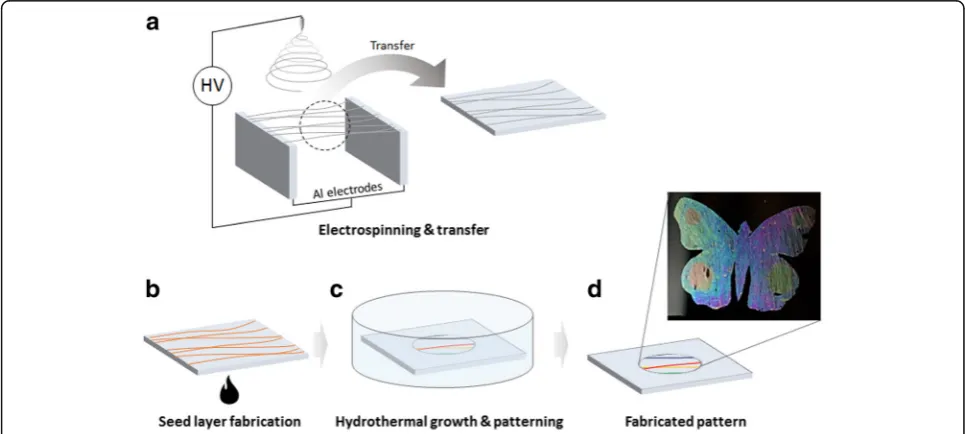
Aligned nanofibers are required to produce an optical switching pattern. Nanofibers floating in air are aligned using the parallel collector described above and then transferred to the target substrate (Fig. 1a). The aligned nanofibers on the target substrate are then heat-treated using hot plate (500 °C) to decompose the polymer com-ponent and form a thin ZnO seed layer (Fig. 1b). This layer can be grown hydrothermally to obtain the desired
structural colors, and the part where the hydrothermal growth occurs can be controlled by patterning the reac-tion area using a masking technique (Fig.1c). Then, final pattern is obtained by removing masking tape or add-itional patterning can be conducted by addadd-itional pat-terning and hydrothermal growth.
Figure 2 shows the structural color obtained by vary-ing the hydrothermal growth time of the microwires. As the hydrothermal growth time increases, the thickness of the microwire increases, which causes the optical properties to change. Figure 2ashows the hydrothermal growth time increasing from left to right by 2 min, and the bottom image shows a sample grown for four add-itional minutes. The structural colored pattern was reproducible for a given synthesis time, and the reaction region was localized using the masking method. Figure2b shows a sample made to fabricate the sample with randomly bright structural colors. To generate the random colors, a sample with a seed layer was sub-merged randomly to the hydrothermal growth solution by shaking the sample or spraying the hydrothermal growth solution on the substrate. A random color sam-ple resulted, free of a masking line. The lower SEM
[image:3.595.58.540.381.701.2]image demonstrates that microwires of various dimen-sions were produced with various colored segments.
Figure3 shows how the techniques based on this ZnO microwire fabrication method can be extended. The process of making a structural color using ZnO micro-wires is not disadvantageous to mass production. The simplest way to mass-produce is to use molds. Figures 3A and A’ show patterns produced using ZnO nanostructured patterns on a glass substrate and dupli-cated patterns using polydimethylsiloxane (PDMS), respectively. In the replicated pattern using PDMS, the shape of ZnO nanostructure is replicated intact in PDMS (ZnO nanostructure remains on the original glass substrate and does not transferred to PDMS pattern). Figure 3A is a pattern made on glass, while Fig. 3A’ is one made with PDMS; both were fabricated on a trans-parent substrate. Also, Fig. 3A is an optical image of a sample that has undergone replication 10 times. This confirms that the pattern is well fabricated during the repetitive replication process. In that way, we could observe the structural color when the light coming from the back penetrated the pattern. Since light must pass
through the pattern, the transparent substrate must be illuminated from the back, but the light source, the pat-tern, and the detector to observe do not have to be in a line. The structural color observed in the duplicated sample was similar. Figure3Bshows a sample that dem-onstrated structural color change through additional growth by restricting the portion to be grown after con-structing the structural color. The colors are clearly dif-ferent from each other. Figure 3B’ shows the result of close examination of the part labeled B′in Fig.3B with an optical microscope. Most of the nanofibers are well-aligned in the vertical direction. Clear boundaries are visible between the yellow-colored outer part of the circle indicated by C and the green-colored inner part of the circle indicated by D. Figure 3C, D shows SEM im-ages of C and D, respectively. Further synthesis led to an increase in the overall microwire dimension, but the change in the size of each nanostructure constituting the microwire caused the change in structural color. The SEM image shows that the size of each nanostructure has also been increased, which causes the quasi-ordered scattering.
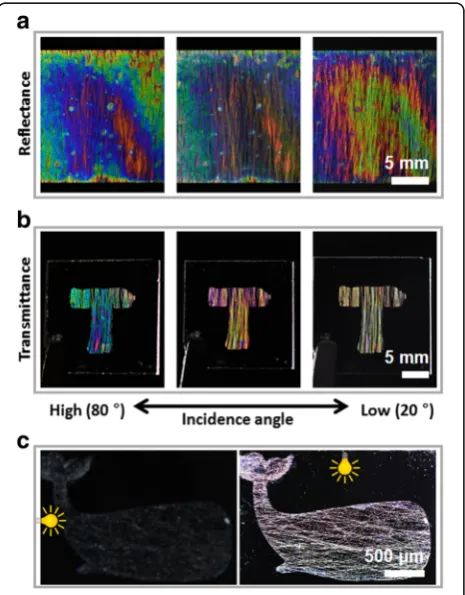
Structural color changes with viewing angle. Our structures displayed this feature. As noted above, the vis-ible color of a transparent substrate differs from that of a reflecting substrate. With a transparent substrate, light is observed through the substrate, while with a reflecting substrate, light is reflected by the substrate and observed directly by our eyes. In both environments, the charac-teristic of changing color depending on the angle of ob-servation was retained. Figure4a shows structural color fabricated on a reflecting substrate (silicon wafer), and Fig. 4b shows structural color made on a transparent substrate (glass). It is evident that the structural color changed according to the angle of incidence. Moreover, not only did the color change with observing angle, but the alignment of the nanofibers enabled the pattern to be made brighter or invisible simply by changing the angle of incidence. If light is incident parallel to the alignment direction of the nanofibers, they hardly reflect the light. On the other hand, if light is incident perpen-dicularly, it is reflected in many directions, which makes the fiber array easy to see (Fig. 4c). Specifically, light incident in the perpendicular direction is incident on the entire cylindrical portion of the fiber surface, which
results in clear visibility because it is reflected in a very wide direction. On the other hand, light incident in the parallel direction can only reflect in a limited direction, so that the total amount of light emitted is inevitably small, making it invisible.
Conclusion
We fabricated an optical switching pattern using ordered structural coloring nanostructures. The fabricated nano-structures are colored according to the principle of quasi-ordered scattering. Controlling the reaction time affects the size of the nanostructures and thereby the ob-servable colors. We also used electrospinning, which is the most common method for fabricating nanofibers, to form an aligned seed layer to fabricate the alignment pattern. Our fabrication process is highly flexible, because the electrospinning process controlling the position and size of the pattern and the hydrothermal growth control-ling the size of ZnO nanostructure can be modified inde-pendently. After the process is completed, the pattern can be modified by additional synthesis or etching, and the completed pattern can be mass-produced through replica-tion using PDMS. Large color-changing patterned areas can be produced, for which the color changes according to the viewing direction and the light transmission direc-tion. We successfully fabricated an optical switching pat-tern, for which the pattern was seen only on one side by aligning the nanofibers along one direction. We expect that our pattern-making method will find widespread ap-plications in apap-plications such as gas sensors and anti-tampering tags.
Abbreviations
DI:Deionized water; PDMS: Polydimethylsiloxane; PVP: Polyvinylpyrrolidone; SEM: Scanning electron microscopy; ZnO: Zinc oxide
Acknowledgements
This work was supported by the National Research Foundation of Korea (NRF) grants funded by the Korea government (MSIP) (NO. 2015R1A2A1A14027903; NO. 2018R1A2A2A05023037). The English in this document has been checked by at least two professional editors, both native speakers of English. For a certificate, please see:http://www.textcheck.com/certificate/cJpHky.
Availability of Data and Materials
All datasets are presented in the main paper.
Authors’Contributions
GHK carried out the experiment and prepared the manuscript. GHK, TA, and GL participated in the experiment and discussion of the results. TA and GL analyzed the data and helped modify the manuscript. All authors read and approved the final manuscript.
Competing Interests
The authors declare that they have no competing interests.
Publisher’s Note
Springer Nature remains neutral with regard to jurisdictional claims in published maps and institutional affiliations.
[image:5.595.58.291.378.676.2]Received: 27 May 2018 Accepted: 25 June 2018
References
1. Kim JH, Moon JH, Lee S-Y, Park J (2010) Biologically inspired humidity sensor based on three-dimensional photonic crystals. Appl Phys Lett 97: 103701.https://doi.org/10.1063/1.3486115
2. Zhao Y, Zhao X, Tang B et al (2010) Quantum-dot-tagged bioresponsive hydrogel suspension array for multiplex label-free DNA detection. Adv Funct Mater 20:976–982.https://doi.org/10.1002/adfm.200901812
3. Sönnichsen C, Reinhard BM, Liphardt J, Alivisatos AP (2005) A molecular ruler based on plasmon coupling of single gold and silver
nanoparticles. Nat Biotechnol 23:741–745.https://doi.org/10.1038/ nbt1100
4. Parker AR, McPhedran RC, McKenzie DR et al (2001) Photonic engineering. Aphrodite’s iridescence. Nature 409:36–37.https://doi.org/10.1038/35051168
5. Kuo W-K, Weng H-P, Hsu J-J, Yu HH (2016) A bioinspired color-changing polystyrene microarray as a rapid qualitative sensor for methanol and ethanol. Mater Chem Phys 173:285–290.https://doi.org/10.1016/j. matchemphys.2016.02.014
6. Kuo W-K, Weng H-P, Hsu J-J, Yu HH (2016) Photonic crystal-based sensors for detecting alcohol concentration. Appl Sci 6:67.https://doi.org/10.3390/ app6030067
7. Shieh J-Y, Kuo J-Y, Weng H-P, Yu HH (2013) Preparation and evaluation of the bioinspired PS/PDMS photochromic films by the self-assembly dip– drawing method. Langmuir 29:667–672.https://doi.org/10.1021/la303491c
8. Kim GH, An T, Lim G (2017) Bioinspired structural colors fabricated with ZnO quasi-ordered nanostructures. ACS Appl Mater Interfaces 9:19057–19062.
https://doi.org/10.1021/acsami.6b15892
9. Al-lami S, Jaber H (2014) Controlling ZnO nanostructure morphology on seedless substrate by tuning process parameters and additives. Chem Mater Res 6:101–109
10. Baruah S, Dutta J (2009) Hydrothermal growth of ZnO nanostructures. Sci Technol Adv Mater 10:013001.https://doi.org/10.1088/1468-6996/10/1/ 013001
11. Long T, Yin S, Takabatake K et al (2008) Synthesis and characterization of ZnO nanorods and nanodisks from zinc chloride aqueous solution. Nanoscale Res Lett 4:247–253.https://doi.org/10.1007/s11671-008-9233-2
12. Na J-S, Gong B, Scarel G, Parsons GN (2009) Surface polarity shielding and hierarchical ZnO nano-architectures produced using sequential hydrothermal crystal synthesis and thin film atomic layer deposition. ACS Nano 3:3191–3199.https://doi.org/10.1021/nn900702e
13. Position and density control in hydrothermal growth of ZnO nanorod arrays through pre-formed micro/nanodots—IOPscience. http://iopscience.iop.org/ article/10.1088/0957-4484/19/39/395602/meta. Accessed 5 Apr 2018 14. Density-controlled hydrothermal growth of well-aligned ZnO nanorod
arrays—IOPscience. http://iopscience.iop.org/article/10.1088/0957-4484/18/ 3/035605/meta. Accessed 5 Apr 2018
15. Li D, Wang Y, Xia Y (2004) Electrospinning nanofibers as uniaxially aligned arrays and layer-by-layer stacked films. Adv Mater 16:361–366.https://doi. org/10.1002/adma.200306226
16. Li D, Babel A, Jenekhe SA, Xia Y (2004) Nanofibers of conjugated polymers prepared by electrospinning with a two-capillary spinneret. Adv Mater 16: 2062–2066.https://doi.org/10.1002/adma.200400606
17. Zhang C-L, Lv K-P, Hu N-Y et al (2012) Macroscopic-scale alignment of ultralong Ag nanowires in polymer nanofiber mat and their hierarchical structures by magnetic-field-assisted electrospinning. Small 8:2936–2940.
https://doi.org/10.1002/smll.201201353
18. Kim Bumjoo, Cho Seong J., An Taechang, et al (2012) Optical switching patterns using electrospun nanofiber array. Phys status solidi RRL–Rapid Res Lett 6:409–411. doi:https://doi.org/10.1002/pssr.201206326
19. Li D, Ouyang G, McCann JT, Xia Y (2005) Collecting electrospun nanofibers with patterned electrodes. Nano Lett 5:913–916.https://doi.org/10.1021/ nl0504235
20. Ahmad R, Tripathy N, Jung D-U-J, Hahn Y-B (2014) Highly sensitive hydrazine chemical sensor based on ZnO nanorods field-effect transistor. Chem Commun 50:1890–1893.https://doi.org/10.1039/C3CC48197B
21. Ju S, Lee K, Janes DB et al (2005) Low operating voltage single ZnO nanowire field-effect transistors enabled by self-assembled organic gate nanodielectrics. Nano Lett 5:2281–2286.https://doi.org/10.1021/nl051658j