N A N O E X P R E S S
Open Access
Performance evaluation of thin film silicon solar
cell based on dual diffraction grating
Raghvendra Sarvjeet Dubey
1*, Sigamani Saravanan
1and Sivaperuman Kalainathan
2Abstract
Light-trapping structures are more demanding for optimal light absorption in thin film silicon solar cells. Accordingly, new design engineering of solar cells has been emphasized and found to be effective to achieve improved performance. This paper deals with a design of thin film silicon solar cells and explores the influence of bottom grating and combination of top and bottom (dual) grating as a part of back reflector with a distributed Bragg reflector (DBR). Use of metal layer as a part of back reflector has found to be promising for minimum requirement of DBR pairs. The effect of grating and anti-reflection coating thicknesses are also investigated for absorption enhancement. With optimization, high performance has been achieved from dual grating-based solar cell with a relative enhancement in short-circuit current approximately 68% while it was approximately 55% in case of bottom grating-based solar cell. Our designing efforts show enhanced absorption of light in UV and infrared part of solar spectrum.
Keywords:Dual grating; Absorption; Short-circuit current; Thin film solar cells
Background
Nowadays, non-conventional energy sources are demand-ing alternatives to overcome the problem of power scar-city at worldwide. This need has generated a huge scope of research in fundamental and advanced branches of sci-ence and technology. Severe work on silicon thin film solar cells including design and fabrication has been fo-cused by scientific community. Silicon technology is well known which is safe, non-toxic, and cheaper for thin film solar cells; however, weak absorption in longer wavelength is a major issue which needed to be attained to a max-imum possibility. To overcome this problem, new design engineering of solar devices are to be spotlighted which includes an efficient light-trapping structure. For efficient light-trapping structures, one-dimensional photonic crys-tal also known as distributed Bragg reflector and diffrac-tion grating are the components of bottom reflector and have been explored for thin film silicon solar cells. Distrib-uted Bragg reflector provides total internal reflection of longer wavelength light that passes through absorbing layer of solar cell; however, diffraction grating diffracts
and scatters the light. Diffraction grating can increase the light absorption by a factor of 4n2(nis medium's refract-ive index) through diffraction of the light at higher angles so that light can propagate through medium or couple the guided lights. The combination of both DBR and grating as back reflectors enforces the light towards active region and as a result enhances the absorption.
Several ideas of light trapping in solar cells have been re-ported by the researchers such as random or periodic pyr-amids, gratings, plasmonic nanoparticles, one-dimensional photonic crystals, etc [1-4]. Zeng et al. have demonstrated a combined effect of one-dimensional photonic crystal as a distributed Bragg reflector and diffraction grating on the performance of thin film solar cells. They have observed enhanced light absorption in active region due to high reflectivity and large angle diffraction. Experimentally, short-circuit current density was observed to be increased by 19% as comparison to simulated results [5]. Rao et al. have presented a modeling of a solar cell based on silicon diffraction grating [2]. A solar cell structure with 500 nm period and 150 nm depth has produced 76.5% enhance-ment of short-circuit current density. They have con-cluded that the positioning of grating on the rear surface can reduce the short wavelength losses. Further, the use of high refractive index material (silicon) can result in strong
* Correspondence:[email protected]
1Advanced Research Laboratory for Nanomaterials and Devices, Department
of Nanotechnology, Swarnandhra College of Engineering and Technology, Seetharampuram, Narsapur, Andhra Pradesh, India
Full list of author information is available at the end of the article
diffraction while light absorbed in the grating pillar can yield better performance of the device. Kuo et al. have demonstrated an amorphous silicon-based solar cell with a backside distributed Bragg reflector [6]. They have sug-gested using of more than one DBR structure as a part of back reflector in order to utilize wider bandwidth of solar spectrum. A solar cell with a combination of three DBR pairs has produced optimal quantum efficiency due to transmission of shorter wavelength and reflection of lon-ger wavelength of light. Gjessing et al. have presented a numerical investigation of a light-trapping structure con-sisting of a two-dimensional back diffraction grating in combination with an aluminum reflector [7]. An enhance-ment in short-circuit current density from 30.4 mA/cm2 to 35.5 mA/cm2has been achieved from 20μm thick sili-con solar cell. This enhancement in current density has been attributed to the increased path length due to in-coupling of light with decreased parasitic absorption in aluminum medium due to a spacer layer used. Recently, there is an intensive research that can be seen on multiple material-based grating structure with a combination of DBR. Abass et al. have numerically presented a study of complex dual interface grating system for thin film silicon solar cells which is just the combination of a plasmonic grating at the back side and a dielectric grating at the front side of the cell [8]. Such structures have shown a strong coupling of higher-order guided modes in addition to coupling of lower-order modes. Further, combination of blazing and dual interface grating structures were ob-served to be more accessible modes with a strong coup-ling efficiency which ultimately enhanced the light absorption. Chriki et al. have presented the solar cell architecture design with the use of two periodic layers of metallic and dielectric grating and analyzed that both layers can couple the incident light to photonic and plmonic modes; as a result, enhanced absorption can be as-sured [9]. The importance of the relative shift between these two gratings has been explored and shown to be crucial in enhancing the current density via the mechan-ism of coupling to dark modes providing additional ab-sorption. Schuster et al. have reported a simple layer transfer fabrication technique to enhance light trapping which allows independent patterning of thin film at both the sides. The fabricated dual grating structure showed an improvement over single grating pattern either on the top or bottom of the film [10]. Zhao et al. have demonstrated a design of solar cell with an indium tin oxide diffraction grating, a DBR of a-Si:H/ITO and an Ag reflector [11]. With the use of metal reflector, they have observed 69% and 72% weighted absorptance of solar cell in cases 4 and 8 pairs of a-Si:H/ITO DBR, respectively. It is claimed that the use of metal reflector is helpful to trap light in a better way with reduced number of DBR pairs and hence makes easy fabrication. Mutitu et al. have presented a
light-trapping design which can be applied to stand alone and multiple junction thin film silicon solar cells [12]. This de-sign includes diffraction grating and one-dimensional photonic crystals as band pass filters that reflect short light wavelengths and transmit longer wavelengths at the interface between two adjacent cells. Enhanced short-circuit current approximately 30.25 mA/cm2was achieved with 5μm cell thickness solar cell based on top and bot-tom triangular grating with a DBR.
In this paper, we present a design of thin film silicon solar cell by employing FDTD method and have found promising for absorption enhancement in UV and infra-red part of solar spectrum. With the influence of bottom and top grating, it is observed that the bottom grating enhances short-circuit current by 55% whereas combin-ation of top and bottom (dual) grating yields68%due to enhanced absorption. In the second section, simulation approach is presented and simulated results are dis-cussed in the third section. Finally, the fourth section concludes the paper.
Methods
Distributed Bragg reflector is composed of low and high re-fractive index layers arranged periodically in one direction. Plane wave method is one of the well-known techniques used to calculate band structure of photonic crystals. Here, we have designed a DBR which is composed of alternate layers of indium tin oxide and amorphous silicon (ITO/a-Si) respectively with their periodicity in x direction. For simulation, we have used plane wave method by applying perfectly matched layer boundary condition to y and z di-rections. Figure 1a shows band diagram of a DBR for both TE and TM polarizations. The considered values of refract-ive index arena-Si= 3.6 andnITO= 1.85, thickness ta-Si= 56
nm andtIT0= 108 nm, and lattice constantɅ=ta-Si+ tITO= 164 nm with center wavelength approximately 800 nm. At normal incidence, a complete photonic band gap is ob-tained at frequency0.162to0.242 (in the units ofωa/2πc) and so longer wavelength light can be trapped and enforced towards active silicon region after total internal/Bragg re-flection. This designed DBR is further incorporated into a design of 5μm thickness solar cell in between grating and metal layer as shown in Figure 1b. This solar cell consists of indium tin oxide-antireflection coating layer (ITO), crys-talline silicon (C-si)-active region, and a back reflector com-posed of diffraction grating, DBR, and metal layer.
incident onto the solar cell, the shorter wavelength light is being absorbed; however, longer wavelength light is passed through active silicon region and reaches to DBR where it decays evanescently and coming back after reflections. The occurrence of diffraction and scattering prolongs the optical path length in the absorbing layer which supports coupling of light and hence enhancement of solar cell performance can be expected.
Results and discussion
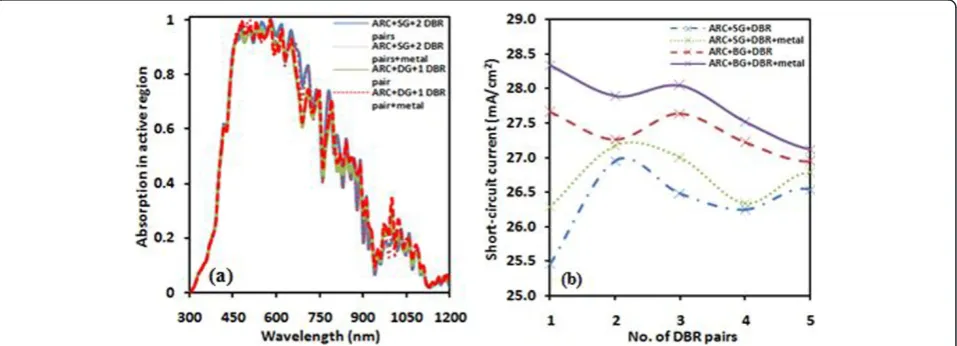
[image:3.595.59.540.88.277.2]In this work, we have explored the analysis of single layer (SG) (refer to Figure 1b), double layer (DG), and dual grating-based solar cells (refer to inset Figure 4b). We have designed four solar cells named as cell A (ARC + SG + 2 DBR), cell B (ARC + SG + 2 DBR + metal), cell C (ARC + DG + 1 DBR), and cell D (ARC + DG + 1 DBR + metal). Figure 2a shows absorption spectra of four solar cells A, B,
C, and D. The curve of solar cell A depicts overlapped ab-sorption curves with others at shorter wavelength but en-hanced absorption beyond approximately510 nm. Further, improved absorption can be noticed at approximately850 and1060 nm. By increasing number of DBR, an enhance-ment of light absorption was observed (not shown here) but it was maximum for two pairs of DBR-based solar cell. For cell B, use of a metal layer has given a similar trend in curve but with enhanced absorption as compared to the case of without metal layer. By comparing curves of cells A and B, we can observe enhanced absorption from cell B in wavelength range 507 to 1060 nm. The obtained short-circuit current are for cell A approximately26.95and cell B approximately 27.17 mA/cm2, respectively. Absorption curves of cells C ad D show distinct results when single grating is replaced with double grating. By comparing curves of cells A and B, we can observe an enhancement in Figure 1Photonic band structure (a) and schematic diagram of designed solar cell structure (b) and electric field distribution
[image:3.595.60.539.532.705.2]profile (c).
absorption; however, it is dominant in infrared region of in-cident solar spectrum. It is noteworthy that one DBR pair with double grating combination produces short-circuit current up to approximately27.65 mA/cm2whereas it was
26.95 mA/cm2for two DBR pairs with a single grating
com-bination. Further, the use of a metal layer (cell D) has im-proved the performance of solar cell in the wavelength approximately510to1060 nm.
Among four above discussed solar cells, double grating with one DBR pair and metal layer-based solar cell (cell D) gave46%relative enhancement in short-circuit whereas it is 40%for cell B. Figure 2b shows comparison of short-circuit current of best performed solar cells as a function of number of DBR pairs. The short-circuit current is found to be maximum approximately 26.95 and 27.17 mA/cm2for the cells A and B with two DBR pairs; however, cells C and
D show enhancement in current approximately27.65 and
28.33 mA/cm2with the use of only one DBR pair. The use
of double grating as a part of back reflector yields enhanced performance of the devices whereas metal layer plays a promising role to reduce the requirement of DBR pairs and hence, makes easy fabrication of solar cell.
The best performed solar cell D is again modeled for the optimization of anti-reflection coating layer thickness(tarc) and grating thickness(Gt)which is shown in Figure 3a. The
optimal short-circuit current approximately28.6 mA/cm2is obtained at tarc=80 nm and further it is found to be im-proved approximately29.2 mA/cm2at Gt=400 nm.These
optimized values oftarc andGtwere used to remodel the
[image:4.595.60.539.89.258.2] [image:4.595.60.540.530.705.2]solar cell and observed an enhancement in absorption. Figure 3b shows the absorption spectra of optimized and without optimized solar cells as a function of incident solar Figure 3Short-circuit current of cell D and comparison of absorption spectra.Short-circuit current of cell D(a)as a function of anti-reflection coating and grating thickness and absorption spectra(b)before and after optimization, respectively.
spectrum. We can observe the broadening of light absorp-tion curve in the range 470 to 725 nm and further en-hanced absorption in infrared part of wavelength.
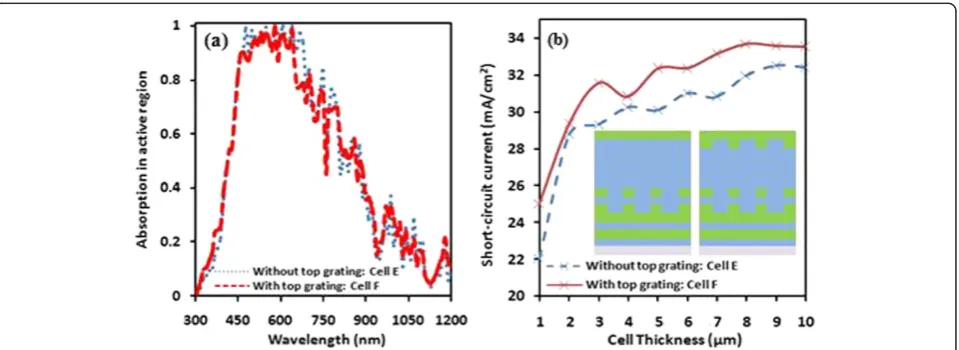
To observe the improved performance of the above designed solar cell based on double grating back re-flector, we have placed one more grating at the top of active silicon region. Figure 4a shows the comparison of absorption in silicon active region of solar cells without top grating (named cell E) and with top and bottom grating/dual grating (named cell F). An improvement in absorption can be observed for shorter wavelength as well as longer wavelength from approximately 780 to
1200 nm. This shows an efficient harvesting of light into solar cell based on dual grating. The short-circuit current (Jsc) obtained from cells E and F as a function of cell thickness is plotted in Figure 4b. The designed solar cell structures with and without top grating is shown in the inset of Figure 4b. Both curves depict as usual effect of cell thickness while dual grating based solar cell is found to be more efficient design with improved short-circuit current as comparison to cell E. The optimal obtained short-circuit current of cell E and F are approximately30and 31 mA/cm2, respectively. Remark-ably, the use of top grating showed diffraction of shorter wavelength (UV) whereas longer wavelength (IR) trap-ping is observed by bottom reflector.
Conclusions
We have designed and analyzed the performance of solar cells by considering various parameters. It is observed that the combination of metal layer at the bottom with grating and DBR reduces the requirement of DBR pairs. The double bottom grating-based solar cell showed bet-ter performance against to single grating. Our results showed that the use of bottom double grating is helpful to diffract longer wavelength whereas top grating is found to be a promising one to diffract shorter wave-length of solar spectrum. A relative enhancement in short-circuit current approximately 68% and 55% is achieved with dual grating and double bottom grating-based solar cells, respectively. This presented designing of solar cell is helpful to trap UV and infrared part of solar spectrum whereas fabrication challenges remain.
Competing interests
The authors declare that they have no competing interests.
Authors’contributions
RSD carried out the analysis of simulated results and drafted the manuscript. SS contributed in the design of solar cell structure using software tool. SK gave technical explanation on some results. All authors read and approved the final manuscript.
Acknowledgements
The financial support provided by the Defence Research and Development Organisation (DRDO), New Delhi, INDIA is highly acknowledged.
Author details
1
Advanced Research Laboratory for Nanomaterials and Devices, Department of Nanotechnology, Swarnandhra College of Engineering and Technology, Seetharampuram, Narsapur, Andhra Pradesh, India.2Centre for Crystal Growth, School of Advanced Sciences, VIT University, Vellore, Tamilnadu, India.
Received: 5 November 2014 Accepted: 12 December 2014 Published: 19 December 2014
References
1. Dewan R, Marinkovic M, Noriega R, Phadke S, Salleo A, Knipp D:Light trapping in thin-film silicon solar cells with submicron surface texture.
Opt Express2009,17:23058.
2. Rao J, Varlamov S:Light Trapping in Thin Film Polycrystalline Silicon Solar Cell using Diffractive Gratings.Energy Procedia2013,33:129–136. 3. Sreekanth KV, Sidharthan R, Murukeshan VM:Gap modes assisted
enhanced broadband light absorption in plasmonic thin film solar cell.
J Appl Phys2011,110:033107–1.
4. Deparis O, El Daif O:Optimization of slow light one-dimensional Bragg structures forphotocurrent enhancement in solar cells.Opt Lett2012,
37(20):4230–4232.
5. Zeng L, Bermel P, Yi Y, Alamariu BA, Broderick KA, Liu J, Hong C, Duan X, Joannopoulos J, Kimerling LC:Demonstration of enhanced absorption in thin film Si solar cells with textured photonic crystal back reflector.
Appl Phys Lett2008,93:221105.
6. Kuo MY, Hsing JY, Chiu TT, Li CN, Kuo WT, Lay TS, Shih MH:Quantum efficiency enhancement in selectively transparent silicon thin film solar cells by distributed Bragg reflectors.Opt Express2012,20(S6):A828. 7. Gjessing J, Marstein ES, Sudb A:2D back-side diffraction grating for
improved light trapping in thin silicon solar cells.Opt Express2010,
18(6):5481.
8. Abass A, Le KQ, Alu A, Burgelman M, Maes B:Dual-interface gratings for broadband absorption enhancement in thin-film solar cells.Phys Rev B 2012,85:115449.
9. Chriki R, Yanai A, Shappir J, Levy U:Enhanced efficiency of thin film solar cells using a shifted dual grating plasmonic structure.Opt Express2013,
21(S3):A882.
10. Schuster CS, Kowalczewski P, Martins ER, Patrini M, Scullion MG, Liscidini M, Lewis L, Reardon C, Andreani LC, Krauss TF:Dual gratings for enhanced light trapping in thin-film solar cells by a layer-transfer technique.
Opt Express2013,21(S3):A433.
11. Zhao L, Zuo YH, Zhou CL, Li HL, Diao HW, Wang WJ:A highly efficient light-trapping structure for thin-film silicon solar cells.Sol Energy2010,84:110. 12. Mutitu JG, Shi S, Chen C, Crezzo T, Barnett A, Honsberg C, Prather DW:
Thin film silicon solar cell design based on photonic crystal and diffraction grating structure.Opt Express2008,16(19):15238.
doi:10.1186/1556-276X-9-688
Cite this article as:Dubeyet al.:Performance evaluation of thin film
silicon solar cell based on dual diffraction grating.Nanoscale Research Letters20149:688.
Submit your manuscript to a
journal and benefi t from:
7Convenient online submission
7Rigorous peer review
7Immediate publication on acceptance
7Open access: articles freely available online
7High visibility within the fi eld
7Retaining the copyright to your article