© 2017, IRJET | Impact Factor value: 5.181 | ISO 9001:2008 Certified Journal
| Page 2766
Concurrent Engineering: A Review
Aniket U. Dongre
1, Bipin Kumar Jha
2*, Pratik S. Aachat
3, Vipul R. Patil
41, 4
Student Third Year, Dept. of Mechanical Engineering, GCOERC, Nashik (M.S), India
2, 3
Student B.E., Dept. of Mechanical Engineering, GCOERC, Nashik (M.S), India
---***---Abstract -
Concurrent Engineering is considered to be important for any engineering company to survive in market with their product. The current scenario of market demand is the product has less costs, best quality and that should be available within less time. These all aspects full filled by any organizations with their productivity rate. Getting a correct product is the main target, with an estimated term and controlled and reduced cost. This paper intends to carry a review of the concurrent engineering in various sector, and the traditional method as well as development of new products by advanced method based on a new approach.Key Words: Concurrent Engineering, Product Development Process, New Product Development, Team Work.
1
INTRODUCTION
Concurrent Engineering (CE) is a collaborative approach to develop product and process which is conducted concurrently by cross functional team including external organization representative and by taking into consideration the whole stage of product life cycle [1]. CE is not limited to manufacturing field its principles is used in various organization and universities, most notably in the aerospace industries to systematic approach for simultaneous work on product and related process including manufacturing to other support functions. The fundamental concept of CE is the right product get the right way within the specified time with reducing cost as well as by using appropriate materials and equipment from the sources, who where needed to develop the product. Last 30 years CE is providing the output in many industries around the world and it is not easy for any organization to changes its product development process by involving their several inter and intra organizational division from a serial to parallel activities [3].
Collaboration, process and information technology these three element comprised CE. The basic premises for CE revolves around two concepts. The first is the idea that all the elements of a product life cycle, from functionally, producibility, assembly, testability, maintenance issues, environmental impact and finally disposal and recycling should be taken into careful consideration in the early design phases. The second concept is that the preceding design activities should all be occurring at the same time, i.e. concurrently. The idea is that the concurrent nature of these
processes significantly increases productivity and product quality.
2
LITERATURE REVIEW
Concurrent Engineering (CE) is defined as ‘integrated, concurrent design of products and their related processes, including manufacture and support’ with the ultimate goals of customer satisfaction through the reduction of cost and time-to-market, and the improvement of product quality” [1]. A report on CE shows that by implementation of CE in industries it reduces the number of design changes by 50%, reduce design to production time by 40-70%, and decreases the scrap and rework by 75% [4]. CE philosophy has been discussed since the beginning of the twentieth century, but only in the past decades it has become the main approach in product development, due to the fast development of science and technology and to the increasing multi disciplinarily and interdisciplinary nature of current engineering problems [7]. Some progressive industries in the United States have applied CE technology into their product development processes and achieved significant benefits: 55 % less time to market, 70% higher return on assets, and 35% higher overall quality on average [8, 9]. By applying Concurrent Engineering concepts in to concurrent education and research, and they found that the results are saved-time (five weeks student’s school time was used), higher quality (a safety factor of ten was obtained), lowered cost (the cost reduced from $120 to $50 per part), and most importantly trained a new group CE-literate engineers [10].
A new methodology and tool based upon a process modelling and analysis technique, aimed at assisting in re-engineering of organizational processes and structures for a CE environment was introduced by Pawar et al. [19]. Further studies still needed to address or develop more comprehensive methodology a tools to help designers conduct the CE discipline.
3
CONCURRENT ENGINEERING
© 2017, IRJET | Impact Factor value: 5.181 | ISO 9001:2008 Certified Journal
| Page 2767
lead to shorter development times, improved product [image:2.595.37.290.248.457.2]quality, and lower development–production costs [11]. It is systematic and simultaneous focus on the development of a product and or process, educating all people should be involved in the first palace [5]. Over the last two decades, concurrent engineering (CE), the practice of executing dependent product development stages simultaneously, has become the common mode of new product development (NPD) because of the increasing importance of time-to-market [6].
Fig. 3-1: Traditional Process
Fig. 3-2: Concurrent Engineering Process
CE also called simultaneous engineering is defined as “The process of designing a product using all inputs and evaluations simultaneously and early during design to ensure that the need of customers is met at least cost. The aim of concurrent engineering is to:
Reduce the time gap between identification of a product idea and final delivery of the product. Design of products of high quality at minimum cost. Reduction of design changes at later stage.
3.1
Goals of CE
The goal is to improve quality, reduce manufacturing cost, or improve quality. The literature gives several goals and drivers of concurrent engineering. The situations and companies that achieve these goals:
Greater Competitiveness Improved Profitability
Rise Sales and profits from new products Reduce new product time to market Reduce human and capital cost Maintain and increase product quality Leverage knowledge and experience
Close integration between departments and promotion of team spirit.
By achieving these goals any organization improves their productivity and fulfilled the customer need as well as market demand. The goal a company is striving to achieve depends on the specific situation in that company, the complexity of the product, and the market it is in. Ultimately, control over the three issues is desired. These three issues are:
Lower product costs throughout the total life cycle; Better product quality;
Shorter time-to-market.
3.2
Sequential vs. Concurrent Engineering
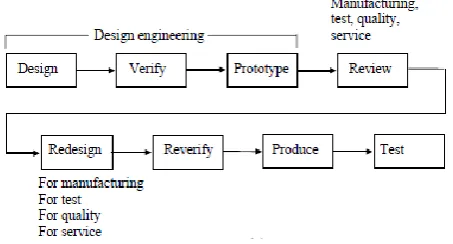
[image:2.595.312.539.434.556.2]Sequential engineering is also known as serial engineering, which can be defined as when the information is passed out after the product has been designed to design department. In sequential engineering various department functions is separated like design. For example, the prototype model is verified by simulation and other services and if the changes will occur it increases cost of the product as well as production time increases and their results comes on delay on the marketing of the product. If the changes cannot be made due to market demand and requirement of the product then it harm the product quality as well as product life. A flow diagram of sequential engineering is shown in Fig. 3-1
.
Fig. 3-3: Flow Diagram of Serial Engineering
In sequential engineering information flow in one way i.e. if the project is over for a department it can’t rework on that same project. Concurrent as well as sequential product development usually consist of seven groups of activities:
Definition of goals,
Product Planning,
Design,
Production Process Planning,
Production,
Manufacturing and assembly,
Delivery.
© 2017, IRJET | Impact Factor value: 5.181 | ISO 9001:2008 Certified Journal
| Page 2768
parameters such as manufacturability, testability and [image:3.595.42.278.146.239.2]serviceability along with customer performance, size, weight and cost. A flow diagram is as shown in Fig. 3-2.
Fig. 3-4: Flow Diagram of Concurrent Engineering
The decision making process in a CE environment differs from sequential engineering in that at every stage decisions are taken considering the constraints and the objectives of all stages of the product life cycle, thus taking at the product design level issues that are usually addressed much later, thus giving the possibility to achieve a better overall solution. The most distinguishing feature of CE is the multidisciplinary, cross functional team approach.
A recent study carried out by Bhuiyan et al. (2006), by means of comparison between the CE and SE projects in terms of process, tools and technology, communication, time to market, project performance, etc., showed that the use of the CE project was more successful than the SE project at Telcom, where tremendous improvements in terms of time to market, project development, cost and product quality were achieved.
Concurrent Engineering is not possible without well-organized team work. Team work is integral part of CE as it represents the means of organizational integration. Requirements for team work are:
Flexible, unplanned and continuous co-operation,
Flexible of obligations regarding achievement of goals
Communication by exchange of information
Ability to make compromises,
Consensus to spite disagreement
Reconciliation when carrying out interdependent activities
Continuous improvements in order to increase productivity and reduce process times.
3.3
CE and its Implementation
Over the last two decades considerable research work has been directed towards investigating the techniques and tools towards the implementation of CE strategy in small as well Medium Industries or organization.The implementation of Concurrent Engineering addresses three main areas: people, process, and technology. It involves major organizational changes because it requires the integration of people, business methods, and technology and is dependent on cross functional working and teamwork rather than the traditional hierarchical organization. One of the primary people issues is
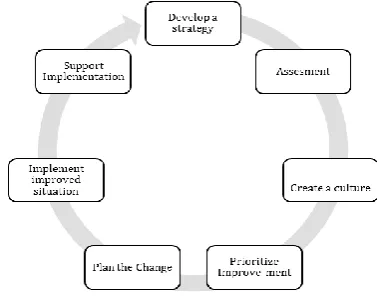
the formation of teams. Collaboration rather than individual effort is standard, and shared information is the key to success. Team members must commit to working cross functionally, be collaborative, and constantly think and learn. The role of the leader is to supply the basic foundation and support for change, rather than to tell the other team members what to do. Training addressed at getting people to work together in team plays an important role in the successful implementation of Concurrent Engineering. According to Pawar [19] there are seven steps to implementation of CE in any organization. These are as follows:
1. Develop a strategy by top management;
2. Assessment of organization’s existing condition by using a particular assessment tools as benchmarking, questionnaires and performance metrics;
3. Create a supported company to increase awareness to CE method and provide related CE implementing training; 4. Priorities improvements based on result from assessment
in step 2;
5. Plan the change by involving every person in charge, setting milestones/targets, and analyzing requires resources in CE project;
6. Implement improved situation 7. Support implementation.
These seven steps follows a repetitive cycle, since to implement CE a continuous improvement is required.
Fig. 3-5: CE Implementation Steps
Several problems in implementing CE in any organization. These impediments are:
a. Lack of expertise
b. Inadequate communication c. Improper organization structure d. Lack of knowledge of about CE approach e. Unsupported corporate culture.
Examples of successful implementation of Concurrent Engineering all over the world:
[image:3.595.333.522.425.573.2]© 2017, IRJET | Impact Factor value: 5.181 | ISO 9001:2008 Certified Journal
| Page 2769
for y’’ methods) within ZETA and MTX75 programmeslead Ford Motor Company to dramatically decrease time to market, whilst increasing quality and decreasing costs.
The support of management and the use of QFD, design for manufacture and assembly, a top–down approach and cross-functional teams were the keys to the success of the Hewlett Packard’s 34401A multimeter. In 1990 Bull Worldwide Information Systems Inc. improved manufacturers’ distributor performance using QFD; the key factors were maintaining employees’ motivation and involvement, continuing education for the work force, correctly anticipate and interpret customers’ expectations and emphasize prevention.
Although results of CE can be impressive, the adoption rate and the completeness of implementation differ markedly between different companies and different countries.
4
FUTURE SCOPE
Engineering has its roots in craftsmanship where design and manufacturing was truly integrated. An example is a blacksmith with journeyman designing the product in interaction with manufacturing (“the sledge hits”). Then there was an industrial age period of separated design and manufacturing which leaned to sequential process and standardized information carriers (drawings). Concurrent Engineering is a tuned version of sequential engineering implementing features of craftsmanship. The trend is that engineering will go through one more change. When considering the content producing methods one can find different types of knowledge building. It is not sequential, it is not parallel – it is networked. Content creation in knowledge communities is directed with competence and motivation and supported with knowledge sharing. The actions lean on efficient communication using networks as main infrastructure.
5
CONCLUSIONS
The world marked demand and customer requirement is quality product within time in a low cost. By applying latest technology we can achieve the quality and we provide the product within time but in that organizational profitability is less and therefore organization growth rate is reduces. Therefore by implementing the Concurrent engineering it can produce organizational benefits that far exceed the profits associated with any single product. The basic element if CE is team work so this article pays special attention on team work and the formation, structure and organizations of team in a small as well as medium industries.
REFERENCES
[1] R.I. Winner, J. P. Pennell, H. E. Betrand, and M. M. G. Slasurezuk, “The Role of Concurrent Engineering in Weapons System Acquisition,” Alexandria VA IDA Report R-338, 1988.
[2] Putu Dana Karningsih, Dewanti Anggrahini, Muhammad Iman Syafi, Concurrent Engineering implementation assessment:A case study in an Indonesian manufacturing company, Procedia Manufacturing, pp.200-207,2015
[3] David Juarez, Jesus Segui, Ana Mengual, Santiago Ferrandiz, Concurrent Engineering applied to key industrial sector, annals of the university of oradea, Issue 3, 2015
[4] Naval Surface Warfare Center, A Report on Concurrent Engineering Implementation in a Shipyard, Nov. 1995 [5] David Juarez, Jesus Segui, Ana Mengual, Santiago
Ferrandiz, Application of Concurrent engineeringin product and process design, annals of the university of oradea, Issue 3, 2015
[6] Yanjun Qian, Jun Lin, Recent Advances in Concurrent Engineering Modeling, 5th International Asia Conference on Industrial Engineering and Management Innovation (IEMI 2014), pp.6-9, 2014
[7] Jian, G., Oriet, L., Understanding and Implementation of Concurrent Engineering. The Proceedings of the 11th International Conference on Concurrent Enterprising. Munich, Germany, June 2005.
[8] M. Lawson and H.M. Karandikar, “A Survey of Concurrent Engineering,” Concurrent Engineering Research and Applications, Vol. 2, No. 1, 1994.
[9] Andrew Kusiak, Concurrent Engineering-Automation, Tools, and Techniques, John Wiley & Sons, 1993. [10] M. Young, The Technical Writer’s Handbook. Mill Valley,
CA: University Science, 1989.
[11] Jack Zhou, Shlomo Carmi, Alan Lau, and Spiros Koulas, Concurrent Engineering Concepts Applied to Concurrent Education and Research, International Conference on Concurrent Engineering, Research and Applications (CE96/ISPE), August 1996.
[12] Ali Yassine, Dan Braha, Complex Concurrent Engineering and the Design Structure Matrix Method, CONCURRENT ENGINEERING: Research and Applications, Vol.11 No.3 , Sept, 2003.
[13] Hassan S. Abdalla, Concurrent engineering for global manufacturing, Int. J. Production Economics 60-61 (1999) 251-260.
[14] Ganagambegai, Shanmugam, Managing Concurrent Engineering In Malaysian Small Medium Enterprises, Procedia - Social and Behavioral Sciences 57 ( 2012 ) 119 – 125.
[15] Morgan L. Swink, A tutorial on implementing concurrent engineering in new product development programs, Journal of Operations Management 16 (1998) 103-116. [16] Marko Starbek, Janez Grum, Concurrent engineering in small companies, International Journal of Machine Tools & Manufacture 42 (2002) 417–426.
© 2017, IRJET | Impact Factor value: 5.181 | ISO 9001:2008 Certified Journal
| Page 2770
a survey in Italy and Belgium, Robotics and ComputerIntegrated Manufacturing 19 (2003) 225–238.
[18] STEVEN D. EPPINGER, Model-based Approaches to Managing Concurrent Engineering, Journal of Engineering Design, Vol. 2, No. 4, 1991
[19] D. K. Pawar, H. Driva, D. K.-D. Thoben, D. R. Oehlmann, F. Weber, "Concurrent Engineering: From Concept to Implementation," presented at the International Conference on Agile Manufacturing, Banglore, 1996. [20] Dunbing Tang, Li Zheng, Zhizhong Li, Dongbo Li, Shiqi
Zhang, Re-engineering of the design process for concurrent engineering, Computers & Industrial Engineering 38 (2000) 479±491.
[21] T. A. Salomone, “What Every Engineer Should Know About Concurrent Engineering”. New York: Marcell Dekker Inc, 1995.
[22] J. Pollock, "Concurrent Engineering : A View to Implementation," Master Department of Mechanical and Manufacturing Engineering, UNSW, Sydney, 1998 [23] A. R. Young, N. Allen. Journal of Materials Processing
Technology 61 (1996) 181-186
[24] Anderson, R. E. (1990). "Concurrent Engineering Is Evolving From An Industry Goal To Reality - Linking Design And Test." Electronics 63(8): 76-78.
[25] K. Ehrlenspiel, Integrierte Produktentwicklung, Carl Hanser Verlag, Mu¨nchen, Wien, 1995.
[26] B. Prasad, Integrated Product and Process Organization, in: Concurrent Engineering Fundamentals, vol. I, Prentice Hall PTR, Englewood Cliffs, NJ, 1996, pp. 216– 276.
BIOGRAPHIES
Mr. Aniket Ulhas Dongare, was born in India. He has pursuing his Third year Bachelor’s Degree in Mechanical Engineering from Savitribai Phule Pune University. His current interests include Product Design & Development and Industrial Management.
Mr. Bipin Kumar Jha, was born in India. He has pursuing his Bachelor’s degree in Mechanical Engineering from Savitribai Phule Pune University. He has presented 2 paper in International journal. His current interests include Product Design & Development and Industrial Management. He is an active member of Institute of Mechanical Engineers and International Association of Engineers.
Mr. Pratik Sharad Aachat, was born in India. He has pursuing his Bachelor’s degree in Mechanical Engineering from Savitribai Phule Pune University. His current interests include Product Design & Development and Audit Management.