© 2017, IRJET | Impact Factor value: 5.181 | ISO 9001:2008 Certified Journal
| Page 2133
left the atmosphere, nor orbited the earth. the satellite is projected vertically upward from the ground to a distance 500meter using helium gas balloon(for prototype purpose) and is used to measure and send to ground station various parameter from the atmosphere. The data acquisition system in the satellite consist of temperature sensor, humidity sensor, pressure sensor, accelerometer sensor which is used as to measure information of atmosphere and send to ground station. By using GPS we are showing exactly position of LARS. In this LARS we are including real time camera. It is like surveillance camera to observe under satellite area. One of the most important part of the LARS is this system totally based on internet of things (IOT) by using Wi-Fi module. Information about atmosphere like temperature, humidity, pressure graph is plotted to Internet of things (IOT). All graphs are showed by thingspeak Internet of things (IOT). One of important part of satellite is solar panel, which is providing power to all system.
Key words: Wi-Fi, Internet of things (IOT), Sensors, solar panel, surveillance camera via satellite
I. INTRODUCTION
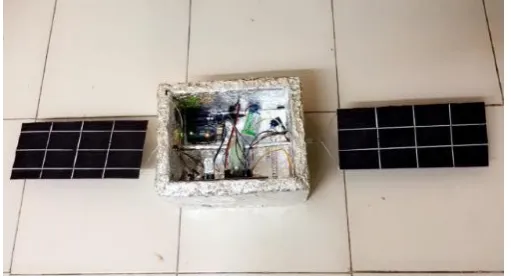
A LARS is a simulation of a real satellite, integrated within the small square box which is made by aluminum metal. The challenge is to fit all the major subsystems found in a satellite, such as power, sensors and a communication system, into this minimal volume. Lower atmosphere research satellite (LARS) is used to teach space technology. The main mission behind the LARS is to know about space technology .The construction of this satellite shown in fig1.0. The LARS is then launched to an altitude of a few hundred meters by balloon. In the LARS different sensor are used to know about atmosphere content .In LARS system wi-fi module sending all data to ground station. Ground station is nothing but IOT.
II.SYSTEM DESCRIPTION
[image:1.595.184.440.564.703.2]The system has two parts, namely; hardware and software. The hardware architecture consists of arduino, temperature sensor, humidity sensor, pressure sensor, and accelerometer Sensor, real time camera, GPS. Temperature sensor, humidity sensor, pressure sensor, accelerometer sensor are sense temperature, humidity, pressure, acceleration respectively and send to arduino. Arduino is collected data and give to Wi-Fi module .This Wi-Fi module send information to internet by using thinspeak(IOT). Second part of the LARS is software. We are using Wi-Fi module.by using IP address of this Wi-Fi module. We can shown data on IOT. This satellite required arduino software to load program of sensor.
© 2017, IRJET | Impact Factor value: 5.181 | ISO 9001:2008 Certified Journal
| Page 2134
Fig 1.1Bottom view
A. Transmitter section:
Show fig 1.1. all sensors are connected to arduino board and all sensors programming done by using arduino software. Shown fig2.0 all subsystem included in payload and payload attach to helium balloon which is 500meters to earth station and video surveillance via satellite.
B. Receiver (web server / thingspeak (IOT)
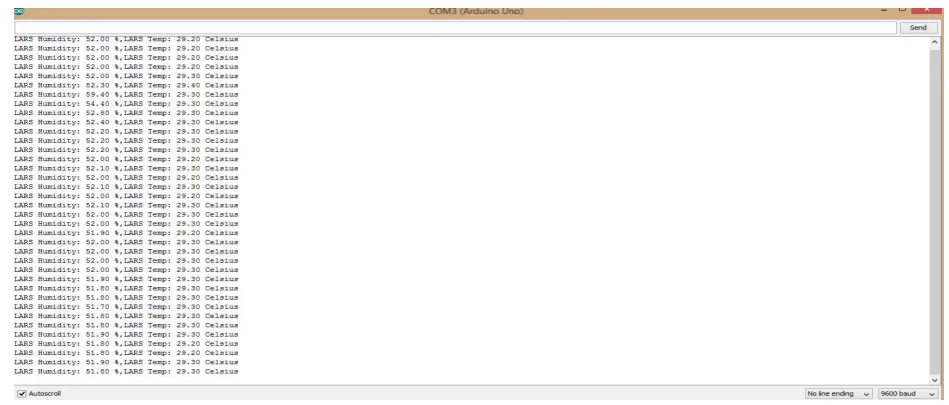
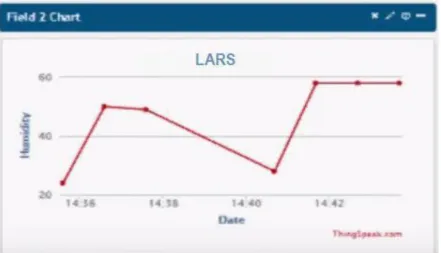
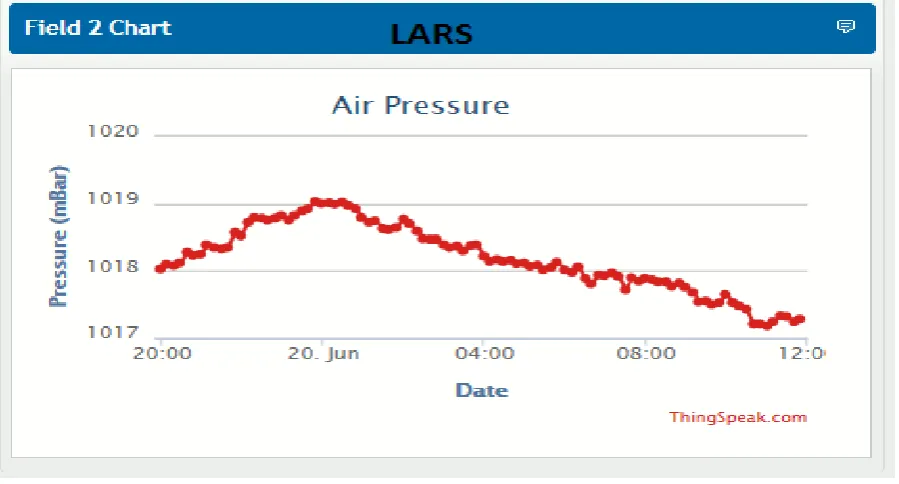
[image:2.595.60.535.531.733.2]In the receiver section information or sending data shown to web server as well as thingspeak (IOT).shown fig Temperature, humidity, acceleration and pressure value shown in web server also graph of this things are shown in thingspeak(IOT). Shown Fig 3.0, Fig 3.1,Fig 3.2,Fig 3.3, Fig 3.4 results of LARS
© 2017, IRJET | Impact Factor value: 5.181 | ISO 9001:2008 Certified Journal
| Page 2135
Fig 3.1 Arduino Result
Web Server Results
[image:3.595.67.509.418.671.2]IOT(internet of things) Result
© 2017, IRJET | Impact Factor value: 5.181 | ISO 9001:2008 Certified Journal
| Page 2136
Fig 3.3 Temperature and Time
[image:4.595.74.524.407.649.2]© 2017, IRJET | Impact Factor value: 5.181 | ISO 9001:2008 Certified Journal
| Page 2137
IV. REFERENCES 1. http://www.cwb.gov.tw/V7e/knowledge/encyclopedia/me031.htm 2. http://www.stensat.org/docs/cansat_lessons.pdf 3. https://en.wikipedia.org/wiki/Satellite 4. http://www.hindustantimes.com/india/hope-for-maharashtra-china-offers-to-bring-artificial-rain-in-drought-hit-state/story-6F2VeOnjZ1RoJOB2aVTnAM.html 5. http://www.networkinv.com/technology/video-via-satellite/video-surveillance-via-satellite/ 6. https://en.wikipedia.org/wiki/CanSat 7. http://www.cansatcompetition.com/ 8. https://www.esa.int/Education/CanSat 9. http://www.esero.org.uk/cansat 10. http://www.iuemag.com/.../cansat-satellite-designing-and-launching-workshop 11. http://www.bits-quark.org/cansat.pdf 12. https://www.narom.no/artikkel.php 13. http://www.engineersgarage.com/articles/humidity-sensor 14. http://www.iuemag.com/december2013/ef/cansat-satellite-designing-and-launching-workshop.php 15. https://www.arduino.cc/ 16. https://thingspeak.com/ 17. https://www.youtube.com/ 18. Artificial rain/ cloud seeding books19. Official web page of CanSat Program in Argentina. 20. Iran Cansat Competition.
21. Official web page of CanSat Program in South Africa. 22. Official web page of Korean CanSat Competition 23. CANduino - The CANsat Arduino project