© 2018, IRJET | Impact Factor value: 6.171 | ISO 9001:2008 Certified Journal | Page 3760
A Comparative Study on Internet Generations
Macarthy Osuo-Genseleke
1, Kabari Ledisi G.
21, 2Dept. of Computer Science, Ignatious Ajuru University of Education, Port Harcourt, Nigeria
---***---Abstract -
The influence of the Internet on society isalmost impossible to summarize properly because it is so all-encompassing. Though much of the world, unfortunately, still does not have Internet access, the influence that it has had on the lives of people living in developed countries with readily available Internet access is great and affects every aspect of life. The fast lane toward the development of Web is coined to be as an outright phenomenon in the today’s society with incorporated use of modern innovative technology and redefining the way of organizing, communicating and collaborating with individual which in terms lead us to mixture of spectacular successes and failures. This work describes the transformation of Web from a set of static information to set dynamic Web pages with the advent of new technologies. The focus is to understand and conceptualize the evolution of Web from the scratch to the upcoming trends in the field of Web Technology.
Key Words: Internet, Web, Processing mode, System
architecture, Programming language.
1. INTRODUCTION
The Internet is a worldwide system of interconnected computer networks that use the TCP/IP set of network protocols to reach billions of users. The Internet began as a U.S Department of Defense network to link scientists and university professors around the world. A network of networks, today, the Internet serves as a global data communications system that links millions of private, public, academic and business networks via an international telecommunications backbone that consists of various electronic and optical networking technologies. Decentralized by design, no one owns the Internet and it has no central governing authority. As a creation of the Defense Department for sharing research data, this lack of centralization was intentional to make it less vulnerable to wartime or terrorist attacks.
The terms "Internet" and "World Wide Web" are often used interchangeably; however, the Internet and World Wide Web are not one and the same. The Internet is a vast hardware and software infrastructure that enables computer interconnectivity. The Web, on the other hand, is a massive hypermedia database - a myriad collection of documents and other resources interconnected by hyperlinks. Imagine the World Wide Web as the platform which allows one to navigate the Internet with the use of a browser such as Google Chrome or Mozilla Firefox. The influence of the Internet on society is almost impossible to summarize properly because it is so all-encompassing. Though much of the world, unfortunately, still does not have Internet access, the influence that it has had on the lives of people living in developed countries with readily available Internet access is great and affects every aspect of life.
Things that seemed like science fiction only a couple of decades ago such as paying your bills from your mobile phone or accessing your music library anywhere are common place today thanks to the Internet. The concept of cloud computing and having all of your files with you at all times, even when you are miles away from your computer, is another aspect of the Internet that gives people great convenience and mobility that were unimaginable before it. For example, opening up and working on a Microsoft Word file located on your home computer can be done from anywhere, as long as you have Internet access, thanks to programs like Dropbox and Google Drive or a remote desktop access program or application.
© 2018, IRJET | Impact Factor value: 6.171 | ISO 9001:2008 Certified Journal | Page 3761 around the world for free instead of paying to talk via
landlines. Social networking sites such as Facebook, Twitter, YouTube and LinkedIn have also contributed to a social revolution that allows people to share their lives and everyday actions and thoughts with millions.
The Internet has also turned into big business and has created a completely new marketplace that did not exist before it. There are many people today that make a living off the Internet, and some of the biggest corporations in the world like Google, Yahoo and EBay have the Internet to thank for their success. Business practices have also changed drastically thanks to the Internet. Off-shoring and outsourcing have become industry standards thanks to the Internet allowing people to work together from different parts of the world remotely without having to be in the same office or even city to cooperate effectively. All this only scratches the surface when talking about the Internet’s impact on the world today, and to say that it has greatly influenced changes in modern society would still be an understatement.
2. WORKING PRINCIPLES OF INTERNET GENERATIONS
2.1 Web 1.0
Web 1.0 environment or the initial World Wide Web environment was where the web was an information portal and content was owned by a few people. The whole of the World Wide Web was divided into linked directories. Web 1.0 was all about read only content and static HTML sites. This period was dominated by the likes of Geocities (one of the oldest web-hosting service) and Hotmail (one of the first web-based email services) [1].
2.1.1 General features of Web 1.0
Typical web design features of that initial phase of Web 1.0 can be listed as follows:
Working Principles
In Web 1.0 static pages where used instead of dynamic user content. Content creators were few in Web 1.0 with the vast majority of users simply acting as consumers of content." Personal web pages were common, consisting mainly of static pages hosted on ISP-run web servers, or on free web hosting services such as GeoCities. Contents where organized through
the use of framesets (a feature of web 1.0 where content can be organised in frames)
Processing Mode
Content served from the server's file system instead of a relational database management system (RDBMS). Online guest books (feature of web 1.0 where a logging system allows visitors of a website to leave a public comment.)
Programming Language Used
Pages built using Server Side Includes or Common Gateway Interface (CGI) instead of a web application written in a dynamic programming language such as Perl, PHP, Python or Ruby. The use of HTML 3.2 introduced elements such as frames and tables to position and aligns elements on a page. These were often used in combination with spacer GIFs. Proprietary HTML extensions such as the <blink> and <marquee> tags introduced during the first browser war in 1995 between Netscape Navigator and Microsoft Internet Explorer [2].
System Architecture
GIF buttons, typically 88x31 pixels in size [2] promoting web browsers and other products. HTML forms sent via email. A user would fill in a form, and upon clicking submit their email client would attempt to send an email containing the form’s details. The popularity and complications of the mailto protocol led browser developers to incorporate email clients into their browsers. Being static pages in which users have no control over the content of the website, unless they are the authors of the website themselves, Web 1.0 trends included worries over privacy concerns resulting in a one-way flow of information.
2.2 Web 2.0
The change in the framework of the Web 1.0 environment brought in what is called as the Web 2.0 environment which was about user-generated content and the read-write web. Web 2.0 also followed a loose form of user-generated classification in the form of “tags”. Web 2.0 not only involved the user, but also had the intelligence to adapt and adjust to the user’s needs, requirements and depth of involvement. It had built-in features that fulfilled deeper needs such as collective intelligence, collaborated work, learning and community behaviour as well as social interactions.
© 2018, IRJET | Impact Factor value: 6.171 | ISO 9001:2008 Certified Journal | Page 3762 Typical web design features of the next phase of Web
2.0 can be listed as follows:
Working Principles
The leap from Web 1.0 to Web 2.0 is characterised majorly by change in user role from passive recipients to active contributors and producers of information. There was a huge change in user behaviour, user demands and needs. Instead of merely reading a Web 2.0 site, a user is invited to contribute to the site's content by commenting on published articles or creating a user account or profile on the site, which may enable increased participation [3]. The improvement in Web 2.0 involved technological advances which the new framework allowed (like AJAX, Flash platforms, widgets etc.).
Processing Mode
In Web 2.0 users are encouraged to rely more on their browser for user interface, application software ("apps") and file storage facilities. This has been called "network as platform" computing.Major features of Web 2.0 include social networking websites, self-publishing platforms (e.g., Word Press easy-to-use blog and website creation tools), "tagging"(which enables users to label websites, videos or photos in some fashion), "like" buttons(which enable a user to indicate that they are pleased by online content), and social bookmarking. Users can provide the data that is on a Web 2.0 site and exercise some control over that data. These sites may have an "architecture of participation" that encourages users to add value to the application as they use it.Users can add value in many ways, such as by commenting on a news story on a news website, by uploading a relevant photo on a travel website, or by adding a link to a video or TED talk which is pertinent to the subject being discussed on a website.
Programming Language Used
These technological refinements included such adaptations as “broadband, improved browsers, and AJAX, to the rise of Flash application platforms and the mass development of widgetization, such as Flickr and YouTube badges”. Use of technological features like AJAX and Flash players has given rise to popular websites like Google Maps and YouTube [4]. Flash is capable of doing many things which are not currently possible in HTML, the language used to construct web pages. It could be argued that the term Web 2.0 does not represent a major change from Web 1.0, but it is true that there is a visible change in use of web applications, their technology and the user
involvement. With the enhancement of the web technology, users are presented with an altogether different web experience like total immersion, anonymity etc which resulted in a new set of user behaviours and user expectations. The change in the role of users in the World Wide Web can also be responsible for the change in their behaviour and expectations [5].
System Architecture
The system architecture of the Web 2.0 can be described in three parts:
Rich Internet application (RIA) — defines the experience brought from desktop to browser, whether it is "rich" from a graphical point of view or a usability/interactivity or features point of view.
Web-oriented architecture (WOA) — defines how Web 2.0 applications expose their functionality so that other applications can leverage and integrate the functionality providing a set of much richer applications. Examples are feeds, RSS feeds, web services, mashups.
Social Web — defines how Web 2.0 websites tend to interact much more with the end user and make the end user an integral part of the website, either by adding his or her profile, adding comments on content, uploading new content, or adding user-generated content (e.g., personal digital photos).
As such, Web 2.0 draws together the capabilities of client- and server-side software, content syndication and the use of network protocols. Standards-oriented Web browsers may use plug-ins and software extensions to handle the content and the user interactions. Web 2.0 sites provide users with information storage, creation, and dissemination capabilities that were not possible in the environment now known as "Web 1.0" [6].
2.3 Web 3.0
© 2018, IRJET | Impact Factor value: 6.171 | ISO 9001:2008 Certified Journal | Page 3763 Semantic Web is sometimes used as a synonym for
"Web 3.0" though the definition of each term varies. Web 3.0 is the term used to describe the evolution of the Web as an extension of Web 2.0. Web 3.0 has started to emerge as a movement away from the centralisation of services like search, social media and chat applications that are dependent on a single organisation to function. This advancement introduced connective intelligence; connecting data, concepts, applications and ultimately people to the internet. While some call the the Semantic Web 'Web 3.0', some are of the opinion that the Semantic Web is just one of several converging technologies and trends that will define Web 3.0. Semantic Web is a feature of the World Wide Web where the meaning of information and of services is defined, allowing the web to match and satisfy the requests of people and machines while they are dynamically interactive [7]. In simpler terms, the effect of Semantic Web on a search engine for example, would be that the search engine would understand who you are, what you’ve been doing and what you are going to do next all by itself in an intelligent way and also remember it next time you use the web. However, elements of Semantic Web are either only in the form of formal specifications or expressed as a possibility in the future, but are yet to be implemented. It is uncertain that Semantic Web is Web 3.0. Web 3.0 is in some contexts, considered where the web can be accessed from anywhere, bringing mobile web to the forefront. It is certain though that these attempts at recognising Web 3.0, would bring us closer to a newer framework of World Wide Web, newer technological features possible in a browser and of course, newer patterns of user behaviour and needs [8].
2.3.1 General Features of Web 3.0
Typical web design features of the next phase of Web 3.0 can be listed as follows:
Working Principles
It is certain though that these attempts at recognising Web 3.0, would bring us closer to a newer framework of World Wide Web, newer technological features possible in a browser and of course, newer patterns of user behaviour and needs [9]. For the sake of convenience, we conceptualise Web 3.0 as a new platform which would include the features such as Portability (infotainment anywhere, anytime), Personal (focused on the individual, as opposed to community),
Dynamic and Contextual content (handling the aspect of Semantic Web). However, there are 5 main features that can help us define Web 3.0:
Semantic Web: The next evolution of the Web involves the Semantic Web. The semantic web improves web technologies in order to generate, share and connect content through search and analysis based on the ability to understand the meaning of words, rather than on keywords or numbers.
Artificial Intelligence: Combining this capability with natural language processing, in Web 3.0, computers can understand information like humans in order to provide faster and more relevant results. They become more intelligent to satisfy the needs of users.
3D Graphics: The three dimensional design is being used extensively in websites and services in Web 3.0. Museum guides, computer games, ecommerce, geospatial contexts, etc. are all examples that use 3D graphics.
Connectivity: With Web 3.0, information is more connected thanks to semantic metadata. As a result, the user experience evolves to another level of connectivity that leverages all the available information. A major application area concerned with connectivity is the Internet of things.
Ubiquity: Content is accessible by multiple applications, every device is connected to the web, the services can be used everywhere.
Processing Mode
The intent in Web 3.0 is to enhance the usability and usefulness of the Web and its interconnected resources by creating Semantic Web Services, such as:
Servers that expose existing data systems using the RDF and SPARQL standards. Many converters to RDF exist from different applications. Relational databases are an important source. The semantic web server attaches to the existing system without affecting its operation [10].
© 2018, IRJET | Impact Factor value: 6.171 | ISO 9001:2008 Certified Journal | Page 3764 services elsewhere on the site). Note that anything
that can be identified with a Uniform Resource Identifier (URI) can be described, so the semantic web can reason about animals, people, places, ideas, etc. There are four semantic annotation formats that can be used in HTML documents; Microformat, RDFa, Microdata and JSON-LD. Semantic markup is often generated automatically, rather than manually [11]. Common metadata vocabularies (ontologies) and maps between vocabularies that allow document creators to know how to mark up their documents so that agents can use the information in the supplied metadata (so that Author in the sense of 'the Author of the page' won't be confused with Author in the sense of a book that is the subject of a book review).
Automated agents to perform tasks for users of the semantic web using this data.
Web-based services (often with agents of their own) to supply information specifically to agents, for example, a Trust service that an agent could ask if some online store has a history of poor service or spamming. Such services could be useful to public search engines, or could be used for knowledge management within an organization.
Programming Languages Used
The Semantic Web takes the solution further. It involves publishing in languages specifically designed for data: Resource Description Framework (RDF), Web Ontology Language (OWL), and Extensible Markup Language (XML). HTML describes documents and the links between them. RDF, OWL, and XML, by contrast, can describe arbitrary things such as people, meetings, or airplane parts [1].These technologies are combined in order to provide descriptions that supplement or replace the content of Web documents. Thus, content may manifest itself as descriptive data stored in Web-accessible databases,or as markup within documents (particularly, in Extensible HTML (XHTML) interspersed with XML, or, more often, purely in XML, with layout or rendering cues stored separately) [2]. The machine-readable descriptions enable content managers to add meaning to the content, i.e., to describe the structure of the knowledge we have about that content. In this way, a machine can process knowledge itself, instead of text, using processes similar to human deductive reasoning and inference, thereby obtaining more meaningful results and helping computers to perform automated information gathering and research.
System Architecture
The term "Semantic Web" is often used more specifically to refer to the formats and technologies that enable it. The collection, structuring and recovery of linked data are enabled by technologies that provide a formal description of concepts, terms, and relationships within a given knowledge domain. These technologies are specified as W3C standards and include:
Resource Description Framework (RDF), a general method for describing information
RDF Schema (RDFS)
Simple Knowledge Organization System (SKOS)
SPARQL, an RDF query language
Notation3 (N3), designed with human-readability in mind
N-Triples, a format for storing and transmitting data
Turtle (Terse RDF Triple Language)
Web Ontology Language (OWL), a family of knowledge representation languages
Rule Interchange Format (RIF), a framework of web rule language dialects supporting rule interchange on the Web
[image:5.595.309.557.498.748.2]The Semantic Web Stack in Fig. 1 illustrates the architecture of the Semantic Web. The functions and relationships of the components can be summarized as follows:
Fig -1: The Semantic Web Stack [8]
© 2018, IRJET | Impact Factor value: 6.171 | ISO 9001:2008 Certified Journal | Page 3765 contained within. XML is not at present a necessary
component of Semantic Web technologies in most cases, as alternative syntaxes exists, such as Turtle. Turtle is a de facto standard, but has not been through a formal standardization process.
XML Schema is a language for providing and restricting the structure and content of elements contained within XML documents.
RDF is a simple language for expressing data models, which refer to objects ("web resources") and their relationships. An RDF-based model can be represented in a variety of syntaxes, e.g., RDF/XML, N3, Turtle, and RDFa. RDF is a fundamental standard of the Semantic Web.
RDF Schema extends RDF and is a vocabulary for describing properties and classes of RDF-based resources, with semantics for generalized-hierarchies of such properties and classes.
OWL adds more vocabulary for describing properties and classes: among others, relations between classes (e.g. disjointness), cardinality (e.g. "exactly one"), equality, richer typing of properties and characteristics of properties (e.g. symmetry), and enumerated classes.
SPARQL is a protocol and query language for semantic web data sources.
RIF is the W3C Rule Interchange Format. It's an XML language for expressing Web rules that computers can execute. RIF provides multiple versions, called dialects. It includes a RIF Basic Logic Dialect (RIF-BLD) and RIF Production Rules Dialect (RIF PRD) [3].
3. COMPARISON OF INTERNET GENERATIONS
3.1 Comparing Web 1.0, Web 2.0and Web 3.0
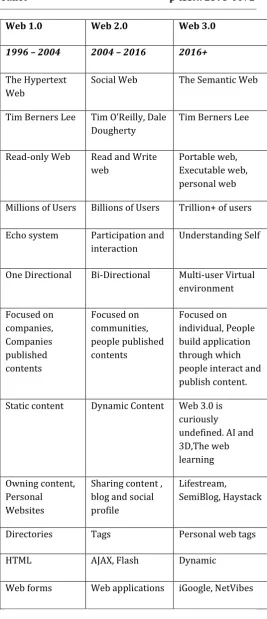
[image:6.595.303.571.62.683.2]The main difference between Web 1.0, Web 2.0 and Web 3.0 is that web 1.0 is consider as read-only web targets on content creativity of producer web 2.0 targets on content creativity of users and producers while web 3.0 targets on linked data sets. The very few comparative differences between Web 1.0, Web 2.0 and Web 3.0 are given in Table-1.
Table -1: Comparison Of Web 1.0, Web 2.0 and Web 3.0
Web 1.0 Web 2.0 Web 3.0
1996 – 2004 2004 – 2016 2016+
The Hypertext Web
Social Web The Semantic Web
Tim Berners Lee Tim O’Reilly, Dale Dougherty
Tim Berners Lee
Read-only Web Read and Write web
Portable web, Executable web, personal web
Millions of Users Billions of Users Trillion+ of users
Echo system Participation and interaction
Understanding Self
One Directional Bi-Directional Multi-user Virtual environment
Focused on companies, Companies published contents
Focused on communities, people published contents
Focused on individual, People build application through which people interact and publish content.
Static content Dynamic Content Web 3.0 is curiously
undefined. AI and 3D,The web learning
Owning content, Personal Websites
Sharing content , blog and social profile
Lifestream,
SemiBlog, Haystack
Directories Tags Personal web tags
HTML AJAX, Flash Dynamic
Web forms Web applications iGoogle, NetVibes
3.2 Web 4.0 and the Future Web
© 2018, IRJET | Impact Factor value: 6.171 | ISO 9001:2008 Certified Journal | Page 3766 connects all devices in the real and virtual world in
real-time.
Web 4.0 can be considered as an Ultra-Intelligent Electronic Agent, symbiotic web and Ubiquitous web [4]. Interaction between humans and machines in symbiosis was motive behind of the symbiotic web. Powerful as human brain, progress in the development of telecommunications, advancement on nanotechnology in the world and controlled interfaces using web 4.0. In simple words, machines would be clever on reading the contents of the web, and react in the form of executing and deciding what to execute first to load the websites fast with superior quality and performance and build more commanding interfaces. Web 4.0 will be read write concurrency web. It ensures global transparency, governance, distribution, participation, collaboration into key communities such as industry, political, social and other communities. WebOS will be such as a middleware in which will start functioning like an operating system. WebOS will be parallel to the human brain and implies a massive web of highly intelligent interactions [5].
The future of the Web will be about the (emotional) interaction between humans and computers. The interaction will become a daily habit for a lot of people based on neurotechnology. For the moment web is “emotionally” neutral, which means web does not perceive the users feel and emotions. This will change with the development of emotional web. One example of this is www.wefeelfine.org, which maps emotions of people. With headphones on, users will interact with content that interacts with their emotions or changes in facial recognition.
4. CONCLUSION
This work has described the transformation of Web from a set of static information to set dynamic Web pages with the advent of new technologies. Web 1.0, web 2.0, web 3.0 and web 4.0 were described as four generations of the web. The features of the generations are introduced and compared based on their working principles, processing modes, programming languages used and system architecture respectively. It is concluded web as an information space has had much progress since 1989 and it is moving toward using
artificial intelligent techniques to be as a massive web of highly intelligent interactions in close future.
REFERENCES
[1] Alexa Internet Inc. (2009). Alexa Top 500 Global Sites. Retrieved February 27, 2018, from Alexa
Internet Inc Web site:
http://www.alexa.com/topsites
[2] Berners-Lee, T., James, H., and Ora, L. (2001). "The Semantic Web". Retrieved February 27, 2018, from Scientific American Magazine Web site: http://www.sciam.com/article.cfm?id=the-semantic-webandprint=true.
[3] Isaías, P., Miranda, P., and Pífano, S. Critical Success Factors for Web 2.0: A Reference Framework. Online Communities and Social Computing, September 2009, pp. 354-363.
[4] Madden, N. (2008). Portals in a Web 2.0 world. Retrieved February 28, 2018, from Tech News
World Web site:
http://www.technewsworld.com/story/61820.ht ml
[5] Molich, R., and Nielsen, J. Heuristic Evaluation: Use and Abuse. , Oregon, USA. UPA. Bringing Usability to Life. July 2009, pp. 8-12.
[6] Nielsen, J. (1999). Designing Web Usability: The Practice of Simplicity New Riders. Indiana
[7] Nielsen, J. (2005). 10 Heuristics for User Interface Design. Retrieved February 28, 2018, from USEIT
Web Site:
http://www.useit.com/papers/heuristic/heuristic_ list.html
[8] Nielsen, J. (2010). How to conduct a Heuristic Evaluation. Retrieved February 28, 2018, from
USEIT Web site:
http://www.useit.com/papers/heuristic/heuristic_ evaluation.html
[9] O'Reilly, T. (2005). "What is Web 2.0: Design Patterns and Business Models for the Next Generation of Software". Retrieved February 28, 2018, from Oreillynet Web site: http://www.oreillynet.com/pub/a/oreilly/tim/ne ws/2005/09/30/what-is-web-20.html
[10] Prahlad, C. K., and Hart, L. S. (2004). The Fortune at
the Bottom of the Pyramid. New York: Content.
[11] Silva, P., and Dix, A. Usability– Not as we know it! .
![Fig -1: The Semantic Web Stack [8]](https://thumb-us.123doks.com/thumbv2/123dok_us/8132097.797180/5.595.309.557.498.748/fig-the-semantic-web-stack.webp)