© 2017, IRJET | Impact Factor value: 5.181 | ISO 9001:2008 Certified Journal
| Page 2543
A Study on the Strength Development of Geopolymer Concrete using
GGBS at ambient temperature
Ramesh Babu C
1, Ganesan N
2, Ganesh Kumaran R
3, Muthuramalingam R
3,Muthuswamy Praveen A
31 Associate Professor, Department of Civil Engineering, Kalasalingam University, Krishnankoil
2Asssitant Professor, Department of Civil Engineering, Kalasalingam University, Krishnankoil
3BTech Student, Department of Civil Engineering, Kalasalingam University, Krishnankoil
---***---
Abstract— Today Concrete usage around the globe is second only to water. The demand of concrete is increasing day by day and cement is used for satisfying the need of development of infrastructure facilities. The production of one ton of cement emits approximately one ton of carbon dioxide to the atmosphere. In order to reduce the use of cement a new generation concrete has been developed such as geopolymer concrete (GPC). Geopolymer is an excellent alternative material for cement concrete as it is produced from industrial by-products such as Flyash and GGBS replacing 100% of cement in concrete. Alkaline liquids are used for the binding of materials. In this paper, strength development of geopolymer concrete using GGBS along with activators such as sodium hydroxide (NaOH) and sodium silicate (Na2SiO3) has been used. 12 moles of sodium hydroxide solution is prepared before 24 hours of casting GPC. The optimum ratio of Na2SiO3/NaOH was determined by studying the strength development of GPC by varying the percentage of activator ratio such as 2:1, 2.5:1, 3:1, 3.5:1 and 4:1 by keeping the cement and w/c constant. The optimum activator ratio was found to be 2.5:1. Using this optimum ratio, 100mm cube specimen were casted for varying cement contents such as 450kg/m3 500kg/m3, 550kg/m3 keeping the w/c constant. The cubes were demoulded after 24 hours and cured in room temperature till the day of testing. The results showed that there was not much difference in the strength between these mixes and it was found that the specimen with GGBS 550kg/m3 gave better strength. The strength of GPC with GGBS content of 550kg/m3 was 71.67Mpa at 28 days.
Keywords: Geopolymer, GGBS, NaoH/Na2SiO3, Compressive Strength
Concrete usage around the world is second only to water. The demand of concrete is increasing day by day and cement is used for satisfying the need of development of infrastructure facilities. Ordinary Portland cement (OPC) is conventionally used as the primary binder to produce concrete. The production of one ton of cement emits approximately one ton of carbon dioxide to the atmosphere. In order to reduce the use of cement a new generation concrete has been developed such as geopolymer concrete (GPC). Geopolymer is an excellent alternative material for cement concrete as it is produced from industrial by-products such as Flyash and GGBS replacing 100% of cement in concrete[1]. Geopolymers are formed by alkaline activation of an aluminosilicate material like fly ash, GGBS, metakaolin, rice husk ash, activated bentonite, clay, red mud etc[2]. Effective use of GGBS in geopolymer concrete further reduces the environmental pollution. A clear mixture design procedure for geopolymer concrete is yet to be established. Although geopolymer concrete has some limitations, it provides not only performance comparable to conventional Portland cement concrete, but also additional advantages including rapid development of mechanical strength, small drying shrinkage, high fire resistance, superior acid resistance, effective immobilization of toxic and hazardous materials, and significantly reduced energy usage and greenhouse emissions[3,4,5]. The curing temperature plays a vital role in the strength development of geopolymer concrete and can be achieved it by curing above ambient temperature [6, 7, 8]. One of the disadvantages of geopolymer concrete is it need higher temperature for polymerisation to takes place. Hence it is only suitable for precast members. In order to enhance its application beyond precast members, geopolymer concrete has to be developed without using heat curing. This paper aimed to produce geopolymer concrete without elevated heat curing. Ground granulated blast furnace slag was activated by a comabination of sodium silicate and sodium hydroxide solution. The compressive strength development of various combinations of geopolymer concrete mixture was studied.
International Research Journal of Engineering and Technology
(IRJET)
e-ISSN: 2395 -0056Volume: 04 Issue: 04 | Apr -2017 www.irjet.net p-ISSN: 2395-0072
© 2017, IRJET | Impact Factor value: 5.181 | ISO 9001:2008 Certified Journal
| Page 2544
[image:2.612.174.438.276.685.2]Ground granulated blast furnace slag was used as the aluminosilicate material for making geopolymer concrete. The chemical composition of GGBS is shown in Table 1. X-Ray Diffraction (XRD) was also used to determine the chemical composition of the ggbs and is shown in Fig.1 . A mixture of sodim hydroxide and sodium silicate solution was used as the activator solution. Sodium hydroxide solution of 12M concentration was prepared by mixing NaOH pellets with distilled water. The concentration of NaOH solution was kept 12M for all the mixtures. Sodium silicate solution was obtained from a local vendor. Locally available river sand was used as the fine aggregate for concrete mixtures. The specific gravity of this sand determined as per IS: 2386-1968 Part III was 2.65, while the fineness modulus using the sieve analysis method described in IS: 2386-2386-1968 Part III was determined to be 2.57. The maximum size of the coarse aggregate was 20 mm and the specific gravity of this coarse aggregate determined as per IS: 2386-1968 Part III was 2.8. A high range water-reducing admixture (HRWR) La Hypercrete S25 (HTS code 38244090) was added in the mix with quantity of 1% of weight of GGBS to obtain necessary workability.
Table 1 Chemical composition of GGBS used
Chemical Analysis GGBS sample
SiO2% 31.86
Al2O3% 14.97
Fe2O3% 0.768
CaO% 33.75
MgO% 8.92
Actual SO3% 2.45
K2O% 0.55 Na2O% 0.24 TiO2% 0.34 P2O5% 0.03 MnO3% 0.19 Cl% 0.05 Sulfate 1.08 Physical Analysis
Blaine m2/kg 458
R-45 Micron% 7.85
II. EXPERIMENTAL INVESTIGATION
© 2017, IRJET | Impact Factor value: 5.181 | ISO 9001:2008 Certified Journal
| Page 2545
Fig. 1. X Ray Diffraction Analysis of GGBS
B. Mixture proportions
Geopolymer concrete were proportioned to study the effect of GGBS quantity and the ratio of sodium silicate to sodium hydroxide ratio on the strength development of geopolymer concrete. The concrete mixtures were proportioned based on the previous works on geopolymer concrete. The mixture proportions for varying cement contents and varying sodium silicate to sodium hydroxide solution are shown in Table 2 and Table 3 respectively.
Table 2 Mixture proportions with varying GGBS contents
Mix ID kg/mGGBS 3
Ratio Na2SiO3 lit/m3
NaOH lit/m3
Coarse aggregate
kg/m3
Fine aggregate
kg/m3
Admixture kg/m3
GPC450 450 2.5:1 112.5 45 1216 752 4.5
GPC500 500 2.5:1 125 50 1164 721 5
[image:3.612.29.566.514.638.2]International Research Journal of Engineering and Technology
(IRJET)
e-ISSN: 2395 -0056Volume: 04 Issue: 04 | Apr -2017 www.irjet.net p-ISSN: 2395-0072
[image:4.612.34.562.111.275.2]© 2017, IRJET | Impact Factor value: 5.181 | ISO 9001:2008 Certified Journal
| Page 2546
Table 3 Mixture proportions with varying activator ratios
Mix ID kg/mGGBS 3
Ratio Na2SiO3 lit/m3
NaOH lit/m3
Coarse aggregate
kg/m3
Fine aggregate
kg/m3
Admixture kg/m3
GPC2:1 550 2:1 128 64.5 1107 685 5.5
GPC2.5:1 550 2.5:1 137.5 55 1113 689 5.5
GPC3:1 550 3:1 144.3 48.1 1117 691 5.5
GPC3.5:1 550 3.5:1 149.7 42.7 1120 693 5.5
GPC4:1 550 4:1 154 38.5 1123 695 5.5
C. Mixing, sample preparation and testing
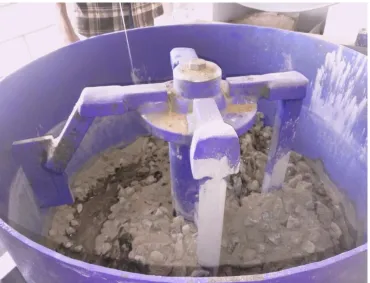
The sodium hydroxide and sodium silicate solutions of desired quantity were mixed together about 24 hours prior to the mixing of other ingredients to enhance the reactivity of the alkaline solution. Concrete ingredients were mixed in a laboratory pan mixer shown in Fig. 2. Mixing was continued for about 5 minutes to achieve a uniform mixing. 100mm cube moulds were filled with concrete in two layers and compacted on a vibrating table. Fig.3 shows the 100mm geopolymer cubes after demoulding. The cubes were then stored in a room temperature till the date of testing. Compresssive strength test was performed at 7 and 28 days as per IS 516 1959 in a compression testing machine as shown in Fig. 4
[image:4.612.128.498.409.692.2]© 2017, IRJET | Impact Factor value: 5.181 | ISO 9001:2008 Certified Journal
| Page 2547
Fig. 3 100mm geopolymer cubes after demoulding
[image:5.612.118.507.407.694.2]International Research Journal of Engineering and Technology
(IRJET)
e-ISSN: 2395 -0056Volume: 04 Issue: 04 | Apr -2017 www.irjet.net p-ISSN: 2395-0072
© 2017, IRJET | Impact Factor value: 5.181 | ISO 9001:2008 Certified Journal
| Page 2548
Eight mixtures of geopolymer concrete were designed to study the effect of GGBS content and the activator ratio on the strength development of concrete.
A. Effect of GGBS content
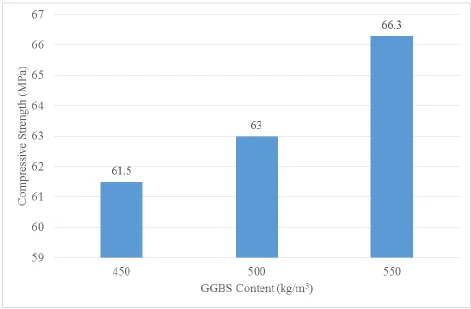
The compressive strength development of concrete with varying GGBS contents at 7 days and 28 days was shown in Fig. 5 and Fig. 6 respectively. It has been noted that by increasing the GGBS content there was an increase in strength in both 7 and 28 days. But the increase in strength was not substantial and it was only around 2 to 7% in 500 and 550 kg/m3 mixtures compared to 450kg/m3 GGBS content mixtures. Similar results were obtained at 28 days also.
B. Effect of sodium silicate to sodium hydroxide ratio
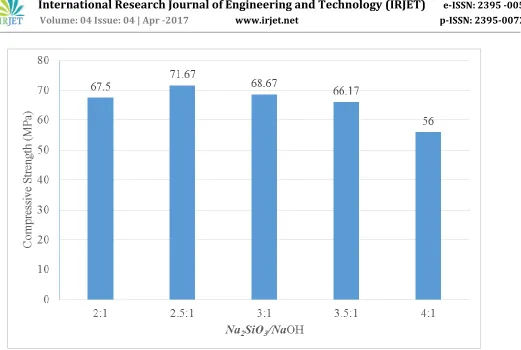
[image:6.612.45.516.332.641.2]The ratio of sodium silicate and sodium hydroxide was varied with 550kg/m3 GGBS content mixtures such as 2:1, 2.5:1, 3:1, 3.5:1 and 4:1. It is been performed to alter the composition of the activator solution and to investigate the effect on the compressive strength of GPC mixtures. The performance of difference activator solution ratio on the compressive strength development of geopolymer mixtures at 7 and 28 days mixtures was shown in Fig 7 and 8 respectively. It can been seen from figure 7 that ratio 2.5:1 showed higher strength at both 7 and 28 days respectively. From Fig. 8 it can be noticed that the 28 day compressive strength of the geopolymer concrete mixtures did not vary significantly due to the variation of activator ratio except for the 4:1 ratio.
© 2017, IRJET | Impact Factor value: 5.181 | ISO 9001:2008 Certified Journal
| Page 2549
Fig. 6 Compressive strength of concrete at 28 days with varying GGBS contents
[image:7.612.74.539.400.683.2]International Research Journal of Engineering and Technology
(IRJET)
e-ISSN: 2395 -0056Volume: 04 Issue: 04 | Apr -2017 www.irjet.net p-ISSN: 2395-0072
[image:8.612.40.561.51.401.2]© 2017, IRJET | Impact Factor value: 5.181 | ISO 9001:2008 Certified Journal
| Page 2550
Fig. 8 Compressive strength of concrete at 28 days with varying Na2SiO3/NaOH ratio
C. Microstructural observation
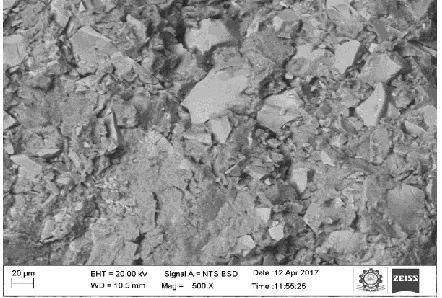
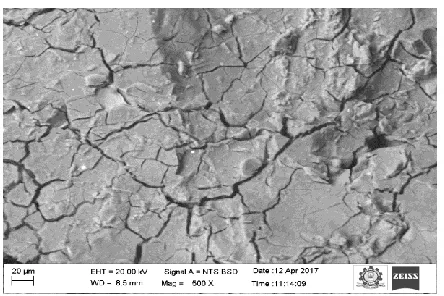
The microstructural features of the geopolymer mixtures with varying activator ratio were investigated using Scanning electron microscope. Fig. 9 to 14 shows the microstructural images of the samples at 28 days of age. As seen in SEM images, it is noticed that 2:1 and 2.5:1 is more compact and less porous than other activator ratios.
[image:8.612.186.426.490.660.2]© 2017, IRJET | Impact Factor value: 5.181 | ISO 9001:2008 Certified Journal
| Page 2551
[image:9.612.196.416.272.413.2]Fig. 10 SEM Image of Geopolymer Concrete GPC2.5:1
Fig. 12 SEM Image of Geopolymer Concrete GPC3:1
[image:9.612.196.417.459.608.2]International Research Journal of Engineering and Technology
(IRJET)
e-ISSN: 2395 -0056Volume: 04 Issue: 04 | Apr -2017 www.irjet.net p-ISSN: 2395-0072
[image:10.612.196.418.95.243.2]© 2017, IRJET | Impact Factor value: 5.181 | ISO 9001:2008 Certified Journal
| Page 2552
Fig. 14 SEM Image of Geopolymer Concrete GPC4:1
Based on the current study, the following salient conclusions can be drawn
•
GGBS was found to be a suitable material for producing geopolymer concrete of high strength concrete at ambient temperature•
By increasing the GGBS content, there was not substantial improvement in compressive strength•
The alkali activator ratio 2.5:1 shows the higher strength at 7 and 28 days compared to other activator ratios such as 2:1, 3:1, 2.5:1 and 4:1•
The alkali activator ratio 4:1 shows the lowest strength compared to other ratios•
The microstructure reveals that 2.5:1 and 2:1 shows less porosity compared to other activator ratiosACKNOWLEDGMENT
The authors wish to gratefully acknowledge the support of ACC cements Private Ltd. for the supply of GGBS and La greens chemical company for supplying the admixture.
REFERENCES
[1] MCG. Juenger, F. Winnefeld, J.L. Provis and J.H. Ideker, “Advances in alternative cementitious binders,” Cement and Concrete Research,., vol. 41, pp. 1232–1243, 2010.
[2] J. DavidovitsJuenger, “Geopolymer chemistry and application,” 2nd edition, Saint-Quentin(France); Institut Geopolymere; 2008. [3] Hardjito, Djwantoro and B. Vijaya Ranagan, “ On the development of flyash based geoplymer concrete”, ACI Materials Journal,
101, pp. 467-472, 2004
[4] Hardjito, Djwantoro and B. Vijaya Ranagan, “ Flyash based geoplymer concrete”, Australian Journal of Structural Engineering, 6, pp. 77-84, 2005
[5] Hardjito, Djwantoro and B. Vijaya Ranagan, “ Development and properties of low calcium flyash based geoplymer concrete”, Perth Australia, Curtin University of Technology, 2005
[6] V.F.F. Barbosa and K.J.D. Mackenzie, “ Thermal behavior of inorganic geopolymers and composites derived from sodium polysialate”, Master Research Bulletin, pp 319-331, 2003
[7] M. Rowles and O. Connor, “ Chemocal optimization of the compressive strength of aluminosilicate geopolymers synthesized by sodium silicate activation of metakaolinate”, J Mater Chrm, pp 1161-1165, 2003
[8] N.V. Chanh, B.D. Trung and D.V. Tuan, “ Recent research in geoplymer concrete”, the 3rd ACF International Conference, 2008 [9] IS 383, Specification for Coarse and Fine Aggregate from Natural Sources for Concrete, Bureau of Indian Standards, New Delhi,
India
[10] IS 516-1959, Methods of Tests for Strength of Concrete, Bureau of Indian Standards, New Delhi, India [11] IS 2386, Methods of Test for Aggregate in Concrete, Bureau of Indian Standards, New Delhi, India