© 2017, IRJET | Impact Factor value: 6.171 | ISO 9001:2008 Certified Journal
| Page 1702
Simulation and optimization of cyclohexanone ammoximation process
over TS-1 catalyst: equilibrium and kinetic reactor
Satmon John
1, Mingqiao Zhu
1, Sarah B. L.
2, Zhangfa Tong
31
Key Laboratory of Biomass Chemical Engineering of Ministry of Education, College of Chemical and Biological
Engineering, Zhejiang University, Hangzhou, 310027, China.
2
Process & Energy Engineering, Heriot-Watt University/ School of Engineering & Physical Sciences, Edinburgh, UK.
3
Guangxi Key Laboratory of Petrochemical Resource Processing and Process Intensification Technology, School of
Chemistry and Chemical Engineering, Guangxi University, Nanning, 530004, China.
---***---Abstract -
The cyclohexanone ammoximation is a crucial process to synthesize cyclohexanone oxime, which is the key intermediate in manufacture of Caprolactam. In green ammoximation process, cyclohexanone oxime was produced by reaction of cyclohexanone with ammonia and hydrogen peroxide over TS-1catalyst. This paper put forward a detailed simulation of a cyclohexanone ammoximation process and carry out sensitivity analysis studies and optimization by using Aspen plus V8.8 as the simulation and modeling tool. CSTR reactors are widely used in the industry due to the good mixing property and it becomes significant when there is a need for high conversion. In order to simulate the process as accurately as possible NRTL package was used as the property method. The results obtained from the simulation were compared with some experimental results reported. Theoptimum reactor operating temperature and volume was 80℃
and 32 m3 respectively. During this condition, cyclohexanone
conversion reached 99.86 % and it proved that simulation results are greater than the reported results. The developed model can be invoked as a guide for understanding the reaction kinetics for CSTR reactor.
Key Words: Process simulation, Process integration and optimization, Reactor design, Aspen Plus, Cyclohexanone ammoximation, Green process
1.
INTRODUCTION
The cyclohexanone ammoximation is a crucial process to synthesize cyclohexanone oxime, which is a key intermediate in the manufacture of caprolactam (CPL) and Nylon 6, after Beckmann rearrangement and polymerization, respectively. The conventional routes involve numerous steps with several drawbacks, such as the use of hazardous chemicals e.g. oleum and oxides of nitrogen. Additionally, large quantities of worthless by-product ammonium sulphate and considerable amount of waste are also produced (Hoelderich et al., 2001; J. Lin et al, 2014). An excellent green process for synthesized cyclohexanone oxime was the reaction of cyclohexanone with ammonia and hydrogen peroxide in the liquid phase using titanium silicate molecular sieves (G. Bellussi et al., 2001).
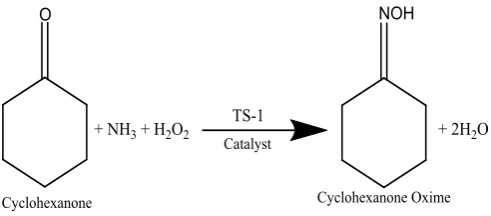
[image:1.595.311.557.419.527.2]The application of titanium silicalite-1 (TS-1) catalysts has solved the challenges concerned within the ammoximation of cyclohexanone reaction such as multiple reaction steps, harmful oximation agents, and enormous amounts of environmentally contaminated co-products (H. Ichihashi et al., 2001). Since the main by-product of the reaction is water and the reaction take place under mild conditions (Roffia et al., 1989). In 1987, EniChem Company developed a liquid phase single-step ammoximation process utilizing ammonia and hydrogen peroxide over titanium silicate TS-1 as the catalyst (Fig. 1). The process is an environmental benign process lead to high yield of cyclohexanone oxime that is greater than 99% (Thangaraj et al., 1991).
Fig. 1. Reaction equation for cyclohexanone
ammoximation.
© 2017, IRJET | Impact Factor value: 6.171 | ISO 9001:2008 Certified Journal
| Page 1703
2.
MATERIALS AND METHOD
In the following, a description of the methods used to carry out the process analysis and simulation is provided. In details, Section 2.1 reports the process simulation by using a commercial software (Aspen Plus), while Section 2.2 process design and description.
2.1.
Process Simulation with Aspen Plus
Process simulation application has evolved over the last two decades in the field of process engineering. Aspen Plus is one of the leading simulation software that has the ability and flexibility to design and simulate a chemical process comprehensively (Wijayarathne et al., 2014). It is commonly utilized in chemical engineering applications that use basic engineering relationships like as mass and energy balance, chemical phase equilibrium, and reaction kinetics to predict the thermodynamic behavior of chemical reactions (W.X. Meng et al., 2015).
2.1.1.
Material and energy balance equations
Aspen Plus uses the following material and energy balance equations (Aspen plus manual):
Overall mass balance:
Sub stream mass balance for j=1 to NSS:
Component mass balance for k=1 to NC, j=1 to NSS:
Overall energy balance:
2.1.2.
Reactor modeling and simulation
Equilibrium reactor
REquil are used to simulate a rigorous reactor, which includes phase equilibrium using Gibbs free energy minimization. The calculation of the equilibrium constant for the reaction Keq from the standard state change Gibbs free energy ∆G° of the components in the reaction. Using the following equation:
Where:
The effect of temperature on the reaction equilibrium constant can be calculated as:
Subsequently, the compositions of the products and reactants at equilibrium are calculated using:
Kinetic reactor
RCSTR are used to simulate a rigorous CSTR reactor with rate-controlled reactions based on specified kinetics.
The general power law expression:
It is composed of two parts, the kinetic factor and the driving force. For all cases, the kinetic factor is given by:
If To is not specified, Aspen Plus uses the reduced power law
expression:
2.2.
Process Design
[image:2.595.270.563.323.721.2]The cyclohexanone ammoximation process was simulated based on the new process developed by SINOPEC as revealed by Yang Jun & Feng Meiping (Yang Jun et al., 2013; W. Hongbo et al., 2004) and combined with versalis process technologies (Versalis technology).
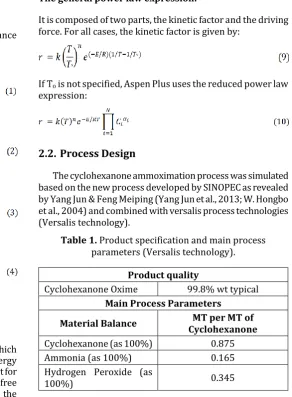
Table 1. Product specification and main process parameters (Versalis technology).
Product quality
Cyclohexanone Oxime 99.8% wt typical Main Process Parameters
Material Balance Cyclohexanone MT per MT of
Cyclohexanone (as 100%) 0.875
Ammonia (as 100%) 0.165
Hydrogen Peroxide (as
100%) 0.345
© 2017, IRJET | Impact Factor value: 6.171 | ISO 9001:2008 Certified Journal
| Page 1704
Material Balance Ktone/yr Cyclohexanone (as 100%) 87.5
Ammonia (as 100%) 16.5
Hydrogen Peroxide (as
100%) 34.5
The model was based on the equilibrium reactor as the heart of the process, (Yang Jun et al., 2013) mentioned that ammoximation reaction temperature and pressure are 80–85
℃ and 0.2–0.3 Mpa. The above process data will be used as initial data for simulation, and then optimum data will be investigated. Further optimized results beside the kinetic data obtained from literature (Luo et al., 2015) will be used for rigorous simulation and design of CSTR reactor.
2.2.1.
Thermodynamic models
Due to the presence of polar compounds such as water, the Non-random-two-liquid (NRTL) model was used to calculate the activity coefficient of the liquid phase. It is recommended for non-ideal chemical systems, and can be used for VLE and LLE applications.
[image:3.595.305.565.206.342.2]2.2.2.
Simulation method and materials
[image:3.595.298.572.381.523.2]Table 3. Summarizes the main reactors used in the Aspen Plus flow sheet and the operating conditions simulated.
Table 3. Equilibrium and Kinetic reactor required operating conditions.
Parameter Equilibrium reactor (REquil)
Kinetic reactor (CSTR)
Temperature 85 °C Will be determined based on REquil results
Pressure 0.25 Mpa Will be determined based on REquil results
Activation energy - 93.2 KJ/Kmol Pre-exponential
factor -
1.10 1012
L/g/min Reactor dimension - Will be optimized
Catalyst - TS-1
Catalyst Density - 600 Kg/m3
Catalyst particle
diameter - 0.3-0.7 cm
Initially we have assumed the CSTR reactor volume of 2 m3,
then the optimum dimension is to be determined based on conversion of cyclohexanone.
2.2.3.
Cyclohexanone ammoximation process
description
Cyclohexanone, ammonia and hydrogen peroxide were mixed and heated to the reaction temperature then fed to the reactor where the ammoximation reaction take place in the
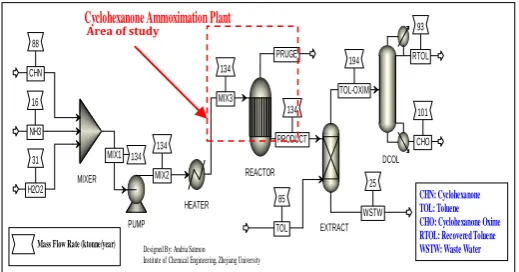
presence of TS-1. The catalyst acts by forming of solid microspheres dispersed in the reaction media. See (Fig. 2 and 3). The liquid reactor effluent composes primarily of cyclohexanone oxime, water, unconverted cyclohexanone and ammonia was directed to a liquid-liquid oxime extraction column where toluene was used as extracting agent to recover cyclohexanone oxime. Wastewater with traces of toluene and oxime coming out from the bottom of the oxime extraction column and cyclohexanone raw oxime with toluene was directed to oxime/toluene distillation column.
REACTOR MIXER
EXTRACT DCOL
PUMP HEATER 88
CHN
134
PRODUCT 16
NH3
31
H2O2
134 MIX1
PRUGE
85
TOL
25
WSTW 194
TOL-OXIM 93
RTOL
101
CHO 134
MIX2 134
MIX3
Mass Flow Rate (ktonne/year)
Cyclohexanone Ammoximation Plant
CHN: Cyclohexanone TOL: Toluene CHO: Cyclohexanone Oxime RTOL: Recovered Toluene WSTW: Waste Water Designed By: Andria Satmon
Institute of Chemical Engineering, Zhejiang University
Fig. 2. Overall cyclohexanone ammoximation process flowsheet using equilibrium reactor
Fig. 3. Overall cyclohexanone ammoximation process flowsheet using a CSTR reactor.
Toluene was recovered as the top product of the oxime/toluene distillation column and cyclohexanone oxime is recovered as bottom product from oxime/toluene distillation column.
3.
RESULTS AND DISCUSSIONS
In this section, the process analysis was discussed for both equilibrium reactor (Section 3.1) and CSTR reactor (Section 3.2) from technical point of view.
3.1.
Equilibrium reactor analysis
In order, to find the optimal operating parameters for the cyclohexanone ammoximation process, integration of reactant amount and sensitivity analysis of the results was performed. The effect of temperature, pressure, and reactants amount was also investigated.
Area of study
Area of study
[image:3.595.33.290.451.661.2]© 2017, IRJET | Impact Factor value: 6.171 | ISO 9001:2008 Certified Journal
| Page 1705
3.1.1.
Effect of reaction temperature
A sensitivity analysis was carried out to find the optimal reactor temperature, which results in maximum cyclohexanone oxime concentration in the product stream. Keeping all parameters constant as in the general simulation condition and pressure of 0.25 Mpa, the reactor temperature was increased gradually from 20 to 200 °C with a step change of 5 °C. Fig. 4. Shows, at the lowest temperature of 20 °C, the mole fraction of cyclohexanone oxime begins to increase very fast from 0.90, reaches 0.985 at 80 °C and the maximum value at 200 °C. At the same time, the mole fraction of water decreases to low value when the temperature was 200 °C.
20 30 40 50 60 70 80 90 100 110 120 130 140 150 160 170 180 190 200 0.62 0.64 0.66 0.68 0.70 0.72 0.74 0.76 0.78 0.80 0.82 0.84 0.86 0.88 0.90 0.92 0.94
Water Mole Fraction Cyclohexanone Oxime Mole Fraction
Reactor Temperature (C)
Wat er M ole Frac tion 0.90 0.91 0.92 0.93 0.94 0.95 0.96 0.97 0.98 0.99 1.00 Optimum temperature Cyc loh exanon e Oxime M ole Frac tion
[image:4.595.313.560.95.265.2]Current Operating temperature
Fig. 4. Effect of temperature on the cyclohexanone oxime and water mole fraction.
Thus, a clear indication that reaction temperature is a crucial parameter in equilibrium reactor, because the reaction rate increases with the reactor temperature and hence, the mole fractions of cyclohexanone oxime increase. Due to economical consideration such as operation cost, we chose the optimum reactor temperate of 80 °C which is in agreement with results reported by (Yang Jun et al., 2013; Yaquan W. et al, 2004).
3.1.2.
Effect of reaction pressure
The effect of pressure on the molar fractions of cyclohexanone oxime and water at 85 ℃, while all other parameters kept constant. Fig. 5. Shows, the increase of pressure from 0 to 1 Mpa lead to the decrease of cyclohexanone oxime mole fraction from 0.998 to 0.930 and the increase of water mole fraction from 0.881 to 0.914 at 85
℃. Obviously, pressure is also one of the critical factors that affect the mole fractions of products. It can be possible to conclude that a relatively low-pressure result in more production of cyclohexanone oxime in equilibrium reactor, which is consistent with the results reported before (Yang Jun et al., 2013; Yaquan W. et al, 2004).
0.0 0.1 0.2 0.3 0.4 0.5 0.6 0.7 0.8 0.9 1.0
0.935 0.940 0.945 0.950 0.955 0.960 0.965 0.970 0.975 0.980 0.985 0.990 0.995 1.000
Cyclohexanone Oxime Mole Fraction Water Mole Fraction
Reactor Pressure (Mpa)
[image:4.595.34.285.249.413.2]Cyc loh exanon e Oxime M ole Frac tion 0.879 0.882 0.885 0.888 0.891 0.894 0.897 0.900 0.903 0.906 0.909 0.912 0.915 Wat er M ole Frac tion Optimum pressure
Fig. 5. Effect of pressure on the cyclohexanone oxime and water mole fraction.
3.1.3.
Maximization of cyclohexanone oxime yield
and reactants integration
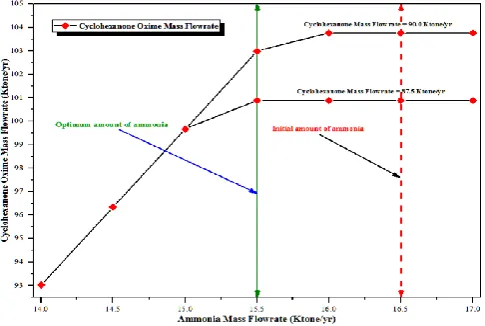
Keeping reactor conditions and other inlet parameters constant, as in the general simulation case, the ammonia mass flowrate was increased gradually from 14 Ktone/yr to 17 Ktone/yr.
Fig. 6. Variation of cyclohexanone and ammonia mass flowrate on the cyclohexanone oxime yield.
This was done to monitor the variation of cyclohexanone oxime mass flowrate in the product stream. Graphical results in Fig. 6. Shows that cyclohexanone oxime mass flowrate reached a maximum value of 101 Ktone/yr when the ammonia flow rate was 15.5 Ktone/yr and after that, it remained constant up 17 Ktone/yr.
[image:4.595.309.552.405.568.2]© 2017, IRJET | Impact Factor value: 6.171 | ISO 9001:2008 Certified Journal
| Page 1706
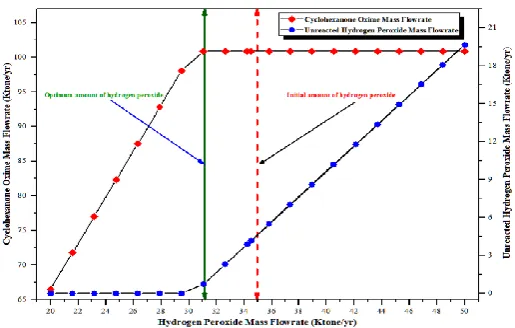
[image:5.595.322.547.98.222.2]from 31 to 50 Ktone/yr. Clearly, indicating that hydrogen peroxide is a limiting reactant. Our results show a lower amount of reactant required compare to the reported results (Yang Jun et al., 2013; Versalis technology), which we consider to be a significant reduction in cost.
Fig. 7. Variation of hydrogen peroxide mass flowrate on the cyclohexanone oxime yield.
3.1.4.
Simulation Results at optimum conditions
[image:5.595.35.293.150.314.2] [image:5.595.47.276.488.643.2]At the optimum reaction conditions (80 ℃, 0.1 Mpa and optimal amount of reactants), simulation for cyclohexanone ammoximation reactions was conducted. From the results in Table 4, one can see that the conversion of cyclohexanone reach 100%. Therefore, the optimized process achieves a high cyclohexanone conversion.
Table 4. Equilibrium reactor simulation results at optimum operating conditions.
Compound (Ktone/yr) Feed (Ktone/yr) Product
Cyclohexanone 87.5 0.000
Ammonia 15.5 0.317
Hydrogen Peroxide 31 0.674
Cyclohexanone
Oxime 0 100.88
Water 0 32.12
Optimal reaction temperature 80 °C Optimal reaction pressure 0.1 Mpa Cyclohexanone Conversion 100%
3.2.
Continuous Stirred Tank Reactor (CSTR)
Initially, the optimized operating condition obtained from equilibrium reactor with assumed reactor volume of 2 m3
was used to simulate the CSTR reactor as mentioned in Table 3. The simulated results in Table 5, shows low conversion than reported in (Yang Jun et al., 2013; Yaquan W. et al, 2004; Baojun et al., 2014; and Versalis technology).
Table 5. Initial simulation results.
Variable flowrate Molar (Kmol/yr)
Cyclohexanone feed 891540
Unreacted cyclohexanone 315845
Cyclohexanone oxime 575695
Cyclohexanone oxime mole
fraction 0.212
Cyclohexanone Conversion 57.96 %
In order to achieve a higher cyclohexanone conversion. Sensitivity analysis was performed and the effect of the reactor volume and pressure was investigated.
3.2.1.
Effect of reactor volume
One of the vital parameters to be taken into account in the design of the ammoximation reactor is the optimal size. Hence, the impact of reactor volume on the cyclohexanone conversion was investigated in order to determine the best design size for the reactor. The reactor volume was varied between 2 to 60 m3. Fig. 8 & 9, shows that a rise in the reactor
volume results to an increase in the cyclohexanone conversion and cyclohexanone oxime molar flow throughout the reactor. This increase can be attributed to the provision of more reaction space. In addition, the residence time of reactants increases with the size of the reactor, where it allows sufficient time for the reaction to occur. This implies that there is an optimal limit to the size of a reactor above that there will be no effect and the extra diameter will be redundant. Obviously, we found that reactor volume of 32 m3
was our best size as its shows a highest cyclohexanone conversion of 95.72%.
0 5 10 15 20 25 30 35 40 45 50 55 60 65
0 50000 100000 150000 200000 250000 300000 350000 400000
Unreacted Cyclohexanone Cyclohexanone Oxime
Reactor Volume (Cum)
U
nrea
cted C
y
cl
o
hex
a
no
ne (Km
o
l/
y
r)
500000 550000 600000 650000 700000 750000 800000 850000 900000
Cyc
loh
exanon
e
Oxime
(Km
ol/yr)
[image:5.595.304.565.514.688.2]© 2017, IRJET | Impact Factor value: 6.171 | ISO 9001:2008 Certified Journal
| Page 1707
Fig. 9. Variation of the reactor volume on cyclohexanone conversion.
3.2.2.
Effect of reaction pressure
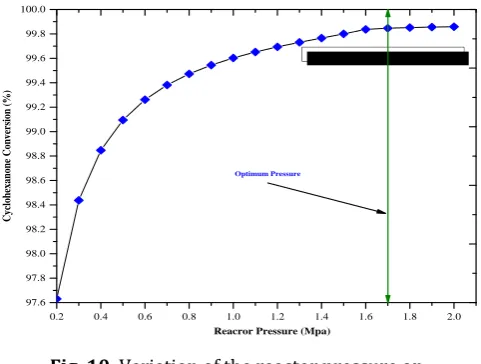
[image:6.595.290.570.112.237.2]The effect of pressure on the cyclohexanone conversion at 85 ℃, while all other parameters kept constant. Fig. 10. Shows, the increase of pressure from 0.2 to 2 Mpa leads to the increase of cyclohexanone conversion to 99.86% then remain constant. Obviously, pressure is among the critical factors that affect the cyclohexanone conversion.
Fig. 10. Variation of the reactor pressure on cyclohexanone conversion.
3.2.3.
Simulation results at optimum reactor Size
A rigorous simulation for cyclohexanone ammoximation reactions was conducted in CSTR reactor. From the results in Table 6, one can see that the conversion of cyclohexanone reaches 99.86% when reactor volume was 32 m3 at pressure
of 1.7 Mpa, which is even higher than reported in literatures [Table 7]. This results strongly agreed with author (Luo et al., 2015), kinetic data they have reported was appropriate for simulation and modeling ammoximation reactor.
Table 6. Optimized simulation results.
Variable Molar flowrate (Kmol/yr)
Cyclohexanone 891540
Unreacted cyclohexanone 591.43
Cyclohexanone oxime 890302
Cyclohexanone oxime mole
fraction 0.328
Cyclohexanone Conversion 99.86%
Table 7. Comparison between simulation and experiment reported results.
Results Simulation W. Hong bo et al., 2004
Yaqu an W. et al., 2004
Feng X. et al., 201 4
Zhang D. H. et al., 2015
Baoju n L. et al., 2014 Cyclohe
xanone Convers ion %
99.86 99.5 99.65 99.10 96.00 98.0
4.
CONCLUSION
In this work, Aspen Plus process found to be a powerful package to simulate the process of cyclohexanone oxime production from ammoximation of cyclohexanone. Sensitivity analysis studies was conducted to gain better insight about the development of an optimal reaction conditions and the simulation results were compared with experimental results obtained in previous work (see Table 7). It has been proven that, the conversion % increases as the reactor temperature and the volume of the CSTR reactor increase. The highest conversion of the reaction obtained at a reactor temperature of 80 ℃, pressure of 1.7 Mpa and reactor volume of 32 m3. These results improve the
understanding of reaction kinetics with reference to the ammoximation reaction, in which would be very helpful for operational modifications as well as design considerations of CSTR reactors.
ACKNOWLEDGEMENT
This work was financially supported by the Zhejiang Province Natural Science Foundation (Y4080247), Natural Science Foundation of China (21376213); and Opening Project of Guangxi Key Laboratory of Petrochemical Resource Processing and Process Intensification Technology (K002).
Cyc
loh
exanon
e
Conver
sion
(%
)
Reactor Volume (Cum)
Cyclohexanone Conversion
Selected Volume 99
96
93
90
87
84
81
78
75
72
69
66
63
60
57
4 8 12 16 20 24 28 32 36 40 44 48 52 56 60 64
C
ycl
ohex
ano
ne Co
nv
ers
io
n (%)
Reacror Pressure (Mpa)
Cyclohexanone Conversion
Optimum Pressure 100.0
99.8
99.6
99.4
99.2
99.0
98.8
98.6
98.4
98.2
98.0
97.8
97.6
[image:6.595.300.569.278.393.2] [image:6.595.42.283.429.611.2]© 2017, IRJET | Impact Factor value: 6.171 | ISO 9001:2008 Certified Journal
| Page 1708
NOTATIONS
Nomenclature
+1 for inlet streams, 1 for outlet streams Stream scale factor
Mass flow of stream i, Kg
Mass fraction of substream j in stream i Mass fraction of component k in substream j of stream i
Mass enthalpy of stream i, KJ/Kg Heat flow of heat stream j, KJ/hr. Work of stream k, KJ
Keq equilibrium constant for the reaction
standard state change Gibbs free energy, KJ Gibbs free energy change of pure species, KJ initial and final temperature respectively, enthalpy change, KJ/Kg
f the fugacity of a component r Rate of reaction, Kmol/L. S k Pre-exponential factor T Absolute temperature, To Reference temperature,
n Temperature exponent, e Activation energy, KJ/Kmol R Gas law constant, J / mol. K Π Product operator
N Number of components
Ci Concentration of the ith component, Kmol/L
+1 for inlet streams, 1 for outlet streams Stream scale factor
Abbreviations TS-1 Titanium Silicate-1
NM Number of combined inlet and outlet material streams
NH Number of combined inlet and outlet heat streams
NW Number of combined inlet and outlet work streams
NSS Number of substreams within material streams NC Number of components specified on the
Components
RHS Right hand side of the energy balance equation Greek Letters
Exponent of ith component
Subscripts Subscripts
REFERENCES
[1] Aspen Plus, “https://www.aspentech.com”, 2016.
[2] Baojun L. and W. Xiangyu, “Improving the performance of TS-1 catalysts for continuous cyclohexanone ammoximation through controlment of active species distribution”, New J. Chem., 2104, 38, pp. 4229-4234.
[3] Dahlhoff, G., Niederer, J.P.M., Hoelderich, W.F., “Epsilon-caprolactam: new by- product free synthesis routes”, Catal. Rev.-Sci. Eng., 2001, 43, pp. 381–441.
[4] Feng Xin, “Continuous heterogeneous cyclohexanone ammoximation reaction using a monolithic TS-1/cordierite catalyst”, RSC Adv., 2014, 4, pp. 27259– 27266.
[5] G. Bellussi and M. S. Rigutto, “Studies in Surface Science and Catalysis”, Elsevier, 2001, 137, pp. 911–955.
[6] H. Ichihashi and H. Sato, “The development of new heterogeneous catalytic processes for the production of ε-caprolactam”, Appl. Catal., A, 2001, 221, pp. 359–366.
[7] Lin, J., Xin, F., Yang, L., Zhuang, Z., “Synthesis, characterization of hierarchical TS-1 and its catalytic performance for cyclohexanone ammoximation”, Catal. Commun, 2014, 45, pp. 104–108.
[8] Luo G.S. et al, “Reaction kinetics of cyclohexanone ammoximation over TS-1 catalyst in a microreactor”, Chem. Eng. Sc., 2015, 126, pp. 633–640.
[9] Roffia, P., Paparatto, G., Cesana, A., Tauszik, G., “Process for producing cyclohexanone oxime”, Eur. Pat. 0301486, 1989.
[10]Thangaraj, A., Sivasankers, S., Ratnasamy, P., “Catalytic properties of crystalline titanium silicalites III. Ammoximation of Cyclohexanone”, J. Catal., 1991, 131(2), pp. 394-400.
[11]U. P. L. Wijayarathne, K. C. Wasalathilake, “Aspen Plus Simulation of Saponification of Ethyl Acetate in the Presence of Sodium Hydroxide in a Plug Flow Reactor”, Int. Sc. Ind., Chem. & Mol. Eng., 2014, 8, pp. 10–14.
[12]Versalis Technology, “http://www.versalis.eni.com”, 2016.
[13]W. Hongbo, “Technical and economic contrast and analysis of new cyclohexanone process and HPO process”, CHINA SYNTHETIC FIBER INDUSTRY, 2004, 27(3).
© 2017, IRJET | Impact Factor value: 6.171 | ISO 9001:2008 Certified Journal
| Page 1709
[15]Yang Jun, F. Meiping, “Caprolactam productiontechnological progress and project investment analysis”, CHINA SYNTHETIC FIBER INDUSTRY, 2013, 36(1), pp. 50–55.
[16]Yaquan Wang, “Process integration of H2O2 generation
and the ammoximation of cyclohexanone”, J. Chem. Technol. Biotechnol., 2004, pp. 0268–2575.
[17]Zhang D. H. and Y. J. Wang, “An Integrated Process for the Synthesis of Solid Hydroxylamine Salt with Ammonia and Hydrogen Peroxide as Raw Materials”, Ind. Eng. Chem. Res., 2015, 54, pp. 1068−1073.
BIOGRAPHIES
Satmon John T. Andria is a Master Student of Process System Engineering in College of Chemical and Biological Engineering at Zhejiang University, Hangzhou, China. His research focus on design, Simulation, Optimization, and Integration of Chemical Processes.