© 2017, IRJET | Impact Factor value: 6.171 | ISO 9001:2008 Certified Journal | Page 1432
DORA: SERVER BASED VANETs AND its APPLICATIONS
Gowshika.G
1, Thenamuthan.R
2, Amalorpavamary.S
3,
Dhineshkumar.M
41,3
B.E (Student), Department of Electronics and Communication Engineering, AMSEC, Namakkal, India
2,4Asst.Professor, Department of Electronics and Communication Engineering, AMSEC, Namakkal, India
---***---Abstract -
In this paper, we study Vehicle-to-vehicle (V2V) and Vehicle-to-roadside (V2R) communications for vehicles that aims to upload a file when it is within the APs’ coverage ranges, where both the channel contention level and transmission data rate vary over time. Dynamic optimal random access (DORA) algorithm scheme achieves an upload ratio 130% and 207% better than the heuristic schemes at low and high traffic densities, respectively. The problem with this DORA is that it provides communication to all nodes when one node request the service, this problem can be avoided by the same vehicle based algorithm with server based manner. We evaluate the performance of our system using the ns2 simulation platform and compare our scheme to existing solutions. The result shows the efficiency and feasibility of our scheme.Key Words: medium access control, vehicular ad hoc
networks, dynamic programming, Markov decision processes, Vehicle-2-Vehicle (V2V), Road Side Unit (RSU).
1.INTRODUCTION :
The concepts of the paper says about VEHICULAR ad hoc networks (VANETs) enable autonomous data exchanges among vehicles and road side access points (APs). Going to implement the same vehicle communication with server based manner and are essential to various intelligent transportation system (ITS) applications. VANETs support various ITS applications through different types of communication mechanisms, including vehicle-to roadside (V2R) and vehicle-to-vehicle (V2V) communications [3]. V2R communications involve data transmissions between vehicular nodes and roadside APs. V2V communications only involve data exchanges among vehicular nodes. For both types, we can further classify the communications as either single hop or multi-hop. In this paper, we focus on analysing V2Rsingle-hop uplink transmissions from vehicles to APs. Due to the limited communication opportunities between vehicles and APs, efficient resource allocation (either centralized or distributed) is crucial for the successful deployment of V2R ITS applications. In the distributed setting, the vehicles contend for the channel for transmission based on the applications’ QoS requirements. The scenario where the data packets are first distributed from the roadside units (RSUs) to the on board units (OBUs). The OBUs then bargain with each other for the missing data packets, and exchange them using Bit Torrent protocol. The
medium access control (MAC) module collects information of local data traffic, and the routing module finds a path with the minimum delay. The optimal pricing and bandwidth reservation of a service provider is obtained using game theory, and the optimal download policy of an OBU is obtained using constrained Markov decision processes distributed in nature and also we aim at designing an optimal uplink resource allocation scheme in VANETs analytically in this paper.
Consider the drive-thru scenario, where vehicles pass by several APs located along a highway and obtain Internet access for only a limited amount of time. We assume that a vehicle wants to upload a file when it is within the coverage ranges of the APs, and needs to pay for the attempts to access the channel. As both the channel contention level and achievable data rate vary over time, the vehicle needs to decide when to transmit by taking into account the required payment, the application’s QoS requirement, and the level of contention in current and future time slots. Because of the dynamic nature of the problem, we formulate it as a finite horizon sequential decision problem and solve it using the dynamic programming (DP).
1.1 Optimal Access Policy Design:
In the case of a single AP with random vehicular traffic, we propose a general dynamic optimal random access algorithm to compute the optimal access policy. We further extend the results to the case of multiple consecutive APs and propose a joint DORA (JDORA) algorithm to compute the optimal policy.
1.2 Low Complexity Algorithm:
We consider a special yet practically important case of a single AP with constant data rate. We show that the optimal policy in this case has a threshold structure, which motivates us to propose a low complexity and efficient monotone DORA algorithm.
2. Proposed Framework
© 2017, IRJET | Impact Factor value: 6.171 | ISO 9001:2008 Certified Journal | Page 1433 We focus on a vehicle that wants to upload a single file of size
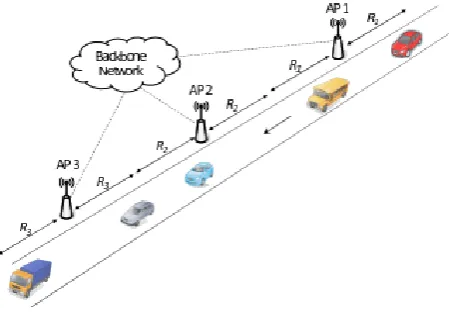
[image:2.595.45.270.266.422.2]S when it moves through a segment of this highway with a set of APs J ={1, . . . , J}, where the vehicles pass through the i the AP before the jth AP for i < j with i, j ∈ J. We assume that the jth AP has a transmission radius Rj. We also assume that the vehicle is connected to at most one AP at a time. If the coverage areas of the APs are overlapping, then proper handover between the APs will be performed [6]. For the ease of exposition, we assume that the APs are set up in a way that any position in this segment of highway is covered by an AP. Our work can easily be extended to consider the settings where the coverage areas of adjacent APs are isolated from each other
Fig. 1. Drive-thru vehicle-to-roadside (V2R) communications with multiple APs
2.1 Traffic Model
Let λ denote the average number of vehicles passing by a fixed AP per unit time. We assume that the number of vehicles moving into this segment of the highway follows a Poisson process [7] with a mean arrival rate λ. Let ρ denote the vehicle density representing the number of vehicles per unit distance along the road segment, and ν be the speed of the vehicles. From [8], we have
The relation between the vehicle density ρ and speed ν is given by the following equation [17]:
where νf is the free-flow speed when the vehicle is moving on the road without any other vehicles, and ρ max is the vehicle density during traffic jam. The maximum number of vehicles that can be accommodated
within the coverage range of the jth AP is given by
2.2 Channel Model
Wireless signal propagations suffer from path loss, shadowing, and fading. Since the distance between the vehicle and the AP varies in the drive-thru scenario, we focus on the dominant effect of channel attenuation due to path loss. The data rate at time slot t is given by
where W is the channel bandwidth, P is the transmit power of the vehicle, dt is the distance between the vehicle and the closest AP at time slot t, and γ is the path loss exponent. We assume that the additive white Gaussian noise has a zero mean and a power spectral density N0/2.
2.3 Distributed Medium Access Control (MAC)
We consider a slotted MAC protocol, where time is divided into equal time slots of length Δt. We assume that there is perfect synchronization between the APs and the vehicles with the use of global positioning system (GPS) [9]. The total number of time slots that the vehicle stays within the
coverage range of the jth AP is
When the vehicle first enters the coverage range of the jth AP, it declares the type of its application to the AP. In return, the jth AP informs the vehicle the channel contention in the coverage range, data rate in all the time slots in the jth coverage range, the price qj, and the estimated number of vehicle departures from the coverage range.
3. Problem Formulation
Here, we formulate the optimal transmission problem of a single vehicle as a finite-horizon sequential Decision problem[10]. After that, we describe how to obtain the optimal transmission policies in both single-AP and multiple-AP using finite-horizon sequential Dynamic Programming. When the traffic pattern can be estimated accurately, we consider a joint AP optimization.
3.1 Single AP Optimization with Random Vehicular Traffic.
© 2017, IRJET | Impact Factor value: 6.171 | ISO 9001:2008 Certified Journal | Page 1434 propose the general dynamic optimal random access (DORA)
algorithm in Algorithm1 to obtain the optimal policy
3.2 Joint AP Optimization with Deterministic Vehicular Traffic.
Now, consider the optimization problem in a single AP. So, we extend the result to the case of multiple APs, where we assume that the traffic pattern (i.e., the exact number of vehicles in the coverage ranges of the APs in each time slot) can be estimated accurately. The traffic pattern can be estimated in various ways, such as by installing a traffic monitor at a place before the first AP to observe the actual traffic pattern when the vehicles pass by (e.g., using computer vision [11] and pattern recognition [12]). If the traffic flow reaches the steady state the estimation of the number of vehicles at time can be accurate.
The JDORA algorithm for joint AP optimization is given in Algorithm 3. In Algorithm 3, the vehicle first needs to obtain the values of t , ∀ t ∈ T, from the traffic monitor. In the Planning phase, for each s ∈S and t ∈ T, the optimal decision rule δ∗t (s,t ) is the action that minimizes the expected total cost , where the expected total cost ψt (s, t ,a) for all possible actions is calculated based on vt+1 obtained in the previous iteration t+1.Afterthe process is repeated for all t ∈ T and s ∈S, we obtain the optimal policy π ∗ . In the transmission phase, the transmission decision in each time slot is made according to the optimal policy π ∗ ,and it follows the MAC protocol.
Now, we first compare Algorithms 1 and 3 with three heuristic schemes using the traffic model for both the single-AP and multiple single-AP scenarios. The three heuristic schemes that we consider are as follows. The first heuristic scheme is a greedy algorithm, in which each vehicle sends transmission requests at all the time slots if its file upload is not complete. That is, the greedy algorithm aims to maximize the total uploaded file size. The second heuristic scheme is the exponential bakeoff algorithm that is similar to the one used in the IEEE 8 02.11. We have slightly modified it for the system that we consider as follows. Each vehicle has a counter, which randomly and uniformly chooses an initial integer value cnt from the interval [0, cw), where cw is the contention window size. The value of cnt is decreased by one after each time slot. When cnt = 0, the vehicle will send a request. If the vehicle has sent a request in a time slot, the size of cw ∈ [cwmin, cwmax] will change according to the response from the AP: If an ACK is received from the AP, cw is set to cwmin. Otherwise, cw is doubled until it reaches cwmax. For the DORA, JDORA, greedy, and exponential schemes, we assume that the APs allow the vehicles to share the channel with an equal probability. Therefore, p tsucc= 1/nt. The third heuristic scheme is the MAC protocol in the multi-carrier burst contention (MCBC) scheme [13]. Similar to the greedy scheme, a vehicle will send a request if it has data to
send in each time slot. However, the vehicles need to undergo K rounds of contention in each time slot. First, in round r, a vehicle survives the contention with probability pr. Each of these vehicles will choose a random integer in {1, . . ., F}. Vehicles that have chosen the largest number can proceed to round r +1. The transmission is successful if there is only one vehicle left in round K. Otherwise, packet collision will occur. For the evaluations of all the schemes, we use the convex self-incurred penalty function.
4. Figures and the Tables
[image:3.595.347.520.335.435.2]In this section, the performance of Server Based DORA in VANET and its Applications is evaluated using Network Simulator. The performance of V2R and V2V is compared with the various parameters. This analysis can be obtained by varying the parameters such as throughput, drop performance, packet delay and packet delivery ratio with the simulation time
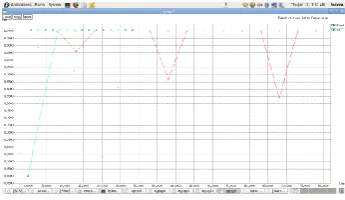
Fig 2: Packet delivery ratio
The results are demonstrated using more nodes. Here Fig2 represents the Packet Delivery Ratio (PDR). Fig 2 says about both existing system and the proposed system. The red color explain about the PDR of existing system and Green color explain about the (PDR) proposed system. Here the proposed system says the constant level of delay performance. Next, we are going to see about throughput performance of V2R and V2V in DORA concepts..
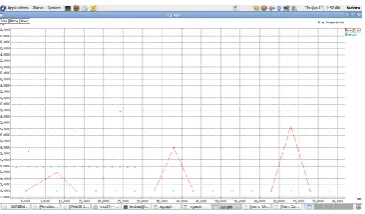
Fig 3 Throughput performance
[image:3.595.351.517.572.672.2]© 2017, IRJET | Impact Factor value: 6.171 | ISO 9001:2008 Certified Journal | Page 1435 tradeoff the total uploaded file size and total payment to the
[image:4.595.71.254.132.239.2]AP by a different degree.
Fig 4 Drop performance
[image:4.595.75.249.389.487.2]Next, we going to see the drop performance of proposed and existing systems. Since the DORA algorithm takes into account the varying channel contention level and data rate in determining the transmission policy,it is cost effectiveand achievesthe highestuploadratio. In Fig. 8, we can see that the JDORA scheme with perfect estimation achieves the highest upload ratio. In particular, it achieves an upload ratio 130% and 207% better than the exponential backoff scheme at low and high traffic density
Fig.5 Delay performance
Finally, we going to see about delay performance of existing and proposed systems. Here the delay has been decreased in V2V communication. Fig 5. Upload ratio versus traffic density ρ for file size S = 500 Mbits with five APs. The JDORA scheme with perfect estimation to achieves the highest upload ratio as compared with three other heuristic schemes. Moreover, a lower upload ratio
is
achieved when the precision of the estimation reduces5. Conclusion
The paper has implemented by using same vehicle with server based manner in V2V and V2R communication. Vehicles to provides communication between requested nodes and Do not give a chance to data drop and Easy to manipulate data-base.Then, uplink transmission from a vehicle to the APs in a dynamic drive-thru scenario, where both the channel contention level and data rate vary over time. Depending on the applications’ QoS requirements, the vehicle can achieve different levels of trade off between the
total uploaded file size and the total payment to the APs by tuning the self-incurred penalty and Path Traffic density will be enhanced.
References
[1] H. Hartenstein and K. P. Laberteaux, “A tutorial survey on vehicular ad hoc networks,” IEEE Commun. Mag., vol. 46, no. 6, pp. 164–171, June 2008.
[2] Y. Toor, P. M¨uhlethaler, A. Laouiti, and A. de La Fortelle, “Vehicle ad hoc networks: Applications and related technical issues,” IEEE Communications Surveys & Tutorials, vol. 10, no. 3, pp. 74–88, third quarter 2008.
[3] D. Niyato, E. Hossain, and P. Wang, “Optimal channel access management with QoS support for cognitive vehicular networks,” IEEE Trans. Mobile Computing, vol. 10, no. 5, pp. 573–591, Apr. 2011.
[4] D. Hadaller, S. Keshav, and T. Brecht, “MV-MAX: Improving wireless infrastructure access for multi-vehicular communication,” in Proc. ACM SIGCOMM Workshop, Pisa, Italy, Sept. 2006.
[5] J. Ott and D. Kutscher, “Drive-thru Internet: IEEE 802.11b for automobile users,” in Proc. IEEE INFOCOM, Hong Kong, China, Mar. 2004.
[6] J. Choi and H. Lee, “Supporting handover in an IEEE 802.11p-based wireless access system,” in Proc. ACM International Workshop on VANETs, Chicago, IL, Sept. 2010.
Characters VALUE
Number of APs J 1, 5
AP’s transmission radius R 100 m
Free-flow speed νf 110 km/h
Vehicle jam density ρmax 100 veh/km
Duration of a time slot Δt 0.02 sec
Duration for data transmission in a time
slot Δt data 0.018 sec
Channel bandwidth W 20 MHz
Transmit signal-to-noise ratio P/N0 W 60 dB
Path loss exponent γ 3
Payment per time slot q 1
Contention window cw ∈ [cwmin,cwmax] [1, 8]
MCBC parameter K (used in[11]) 3
MCBC parameter [p1 p2 ,p3 ] (used in
[11]) 12, 0.77, 0
© 2017, IRJET | Impact Factor value: 6.171 | ISO 9001:2008 Certified Journal | Page 1436 [7] R. J. Cowan, “Useful headway models,” Transportation
Research, vol.9, no. 6, pp. 371–375, Dec. 1975.
[8] Y. L. Morgan, “Notes on DSRC & WAVE standards suite: Its architecture, design, and characteristics,” IEEE Commun. Surveys & Tutorials, vol. 12, no. 4, pp. 504– 518, fourth quarter 2010.
[9]. L. Puterman, Markov Decision Processes: Discrete Stochastic Dynamic Programming. New York, NY: John Wiley and Sons, 2005.
BIOGRAPHIES
G. GOWSHIKA is persuing B.E. in the discipline of Electronics and Communication Engineering in Annai Mathammal Sheela Engineering College at Namakkal
R.THENAMUTHAN is currently working as an Assistant Professor in the Department of Electronics and Communication Engineering at Annai Mathammal Sheela Engineering College at Namakkal. He received his B.E. - Electronics and Communication Engineering
S.AMALORPAVAMARY is persuing B.E, in the discipline of Electronics and Communication Engineering in Annai Mathammal Sheela Engineering College at Namakkal
M. Dhineshkumar is currently working as an Assistant Professor in the Department of Electronics and Communication Engineering at Annai Mathammal Sheela Engineering College at Namakkal He received his B.E. - Electronics and Communication Engineering in Annai Mathammal Sheela Engineering College under Anna University, Chennai and M.E. – Communication Systems in Pavendar Bharathidasan College of Engineering and Technology at Trichy