© 2017, IRJET | Impact Factor value: 5.181 | ISO 9001:2008 Certified Journal | Page 91
Study And Experimental Analysis Of Horizontal Ground Source Heat
Pump System
Ashfaque Ansari
1, Mr. Ravindra Mohan
21
Thermal Engineering, IES College of Tech. Bhopal, Madhya Pradesh, India.
2
Assistant Professor, Dept. of Mechanical Eng., IES College of Tech. Bhopal, Madhya Pradesh, India.
---***---Abstract - In modern life as we seen that the requirement
of space heating and cooling is growing very fast. As a renewable energy technology, the ground source heat pump system plays an important role for the fulfill the requirement. The ground source heat pump system (GSHPs) also called as the geothermal heat pump system. Ground source heat pump system is highly efficient as compared to other conventional heat pumps. It absorbs heat from underground by pumping water through it. The heat pump then increases the temperature, and the heat is used to provide home heating. The pump needs electricity to run, but the idea is that it uses less electrical energy than the heat is produced. The heat pump performs the same role as a boiler does in a central heating system, but it uses ambient heat from the ground rather than burning fuel to generate heat. GSHP are receiving increasing interest because of their potential to reduce primary energy consumption and thus reduce emissions of greenhouse gases. This paper investigates the performance characteristics of Ground Source Heat Pump system, concentrating on thermodynamic analysis with R-22 as the refrigerant for a heating mode. The main purpose of this paper is to study the energetic potential of the deployment in Dhanbad, India of the Ground Source Heat Pump (GSHP) system for heating mode application. Therefore, a GSHP system using horizontal Ground Heat Exchanger (GHE) has been installed and experimented in BIT Sindri, Dhanbad, India. In the present study based upon the measurements made in the heating mode from the 5th of December till 10th of March 2016-2017, the heat extraction rate from the soil has been found to be, on an average, 2.53 KW. The heating coefficient of performance of the heat pump (COP)HP fluctuates between 2.11 to 3.13. The result shows that overall COP values for the complete system are 5–20% lower than the COP of heat pump. It may be concluded that these performance parameters obtained from the present study are fairly close to those reported by Bi et al. (2004).It is expected that the model present here would be beneficial to everyone dealing with the design, simulation and testing of GSHP systems in future.Key words: Renewable energy, heat pump, geothermal, GSHP, ground heat exchanger, R22, Space heating, COP.
1.Introduction
As we seen that dependency of our society on fossil fuel such as oil, coal natural gas. These resources are limited, these are created by natural process over millions of years. Burning them to produce energy results in emissions of ‘greenhouse gases’, including carbon dioxide (CO2). These gases trap solar radiation in the earths atmosphere and cause undesirable changes in the climate. So our conventional energy sources which are limited in quantity are decreasing continuously and arising a very serious problem and climate change is real threat to our future and also the fossil fuel which we uses in our home are responsible for the emission of carbon dioxide (CO2) which also contributes to the climate change . Renewable and sustainable energy offers a viable and potent solution to counter the effects of this problem and effects of global warming. By installing any one of the renewable energy technologies, one will be making a major personal contribution to the well being of future generations and could also benefit from lower fuel bills. So, if we describing the options for heating and cooling our house or looking for ways to reduce our energy bills, we may be considering ground-source heat pumps (GSHPs).
© 2017, IRJET | Impact Factor value: 5.181 | ISO 9001:2008 Certified Journal | Page 92
1.1
Advantages And Disadvantages of GSHPs.
Ground-source heat pumps system is more attractive alternative than conventional air source heat pumps systems. GSHPs have several advantages over air source heat pumps, which are:
They consume less energy to operate.
They tap the groundwater which is a more stable
energy source than air.
When the outside temperature is very low they do
not require extra energy.
They use less amount of refrigerant,
The design is simple and require less maintenance
and
They do not require the unit to be located where it is exposed to weathering
GSHPs can reduce GHG emissions by 66% or more
compared with conventional heating and cooling systems that use fossil fuels.
EESs use up to 75% less electricity than
conventional heating or cooling systems.
Maintenance costs for this type of technology can be cut in half and operating cost
reduced one-quarter of that of a conventional system
The main disadvantage is the higher initial capital cost, being about 30–50% more expensive than air source units. This is due to the extra expense and effort to bury heat exchangers in the earth or providing a well for the energy sources. However, once installed, the annual cost is less over the life of the system, resulting in net savings (Madani, 2011). This thesis makes an attempt to investigate the performance evaluation and thermodynamic analysis of GSHP system. An experimental set-up, described here, has been fabricated and tested for the first time on the basis of an academic study performed in BIT Sindri, Dhanbad Jharkhand, India, It consists of an experimental setup of GSHP, with R22 as a refrigerant for heating mode application. The experimental setup mainly includes the ground temperature, the temperature and flow rate of water circulating in GHE and the power consumption of heat pump and circulating pumps. These experimental data are essentially used to evaluate the coefficient of performance of the heat pump and the overall system for continuous operation mode.
1.2 Objective of the present work
The main objective of our present work is to prepare an experimental set up for GSHP for a given control volume. Following objectives have been defined.
Fabrication of Ground heat exchanger for utilization of geothermal energy.
Assembling of evaporator for taking heat from circulating water by refrigerant.
To assess the energy, environmental and
economical impact of the system compared to the conventional ASHP systems.
To determine the energy saving potential of GSHP
system for Sindri Dhanbad weather conditions.
To improve the understanding of geothermal
behaviour in the context of climatic conditions of Sindri Dhanbad.
Different parameters associated with the
experiment have to be analysed and variation of COP and heat extraction rate has be depicted with hourly variation over the months of December-February 2016-2017.
2 Description of the experimental set-up:
The aim of the experiments is to investigate the thermal performance analysis of a ground source heat pump. An experimental set up has been designed and fabricated. In this chapter, an experimental study on the feasibility of a ground source heat pump has been carried out. The heating mode of operation of a GSHP is analyzed for the climatic conditions of Sindri, Dhanbad. Coefficients of performance and heating capacity have also been studied in this chapter.
[image:2.595.310.584.424.657.2]The schematic set-up are illustrated in Fig. 2.1.
© 2017, IRJET | Impact Factor value: 5.181 | ISO 9001:2008 Certified Journal | Page 93
3. Experimental investigations:
In this study, the performance of the system designed under the conditions of Sindri, Dhanbad is analyzed using the measured data. The experiments were conducted on the ground source heat pump system under steady state conditions in the heating mode. In order to analyze the performance of the system under climatic conditions of Sindri, daily average values of 12 measurements between the months December 2016 to February 2017 for the hours between 09:30 to 12:00, with an interval of 15 minutes are used in the calculations.
3.1 Mathematical Model
The present work has been planned towards studying the performance of a ground-source heat pump coupled to a model-sized test room to meet its heating requirements. The following assumptions are adopted for the mathematical modeling.
a. All processes are steady state and steady flow with negligible potential and kinetic energy effects and no chemical or nuclear reactions.
b. The directions of heat transfer to the system and work transfer from the system are positive.
c. Heat transfer and refrigerant pressure drops in the tubing connecting the components are ignored, since their lengths are short.
d. The compressor operation has an adiabatic efficiency of 80%.
e. The compressor mechanical and the compressor motor electrical efficiencies are 70% and 72%, respectively. f. Air is an ideal gas with a constant specific heat, and its humidity content is negligible.
g. The power inputs to the fan coil fans and the circulating pumps are negligible compared with the power input to the compressor.
h. The dead state of the refrigerant is taken at ambient
temperature, To 293.15k and at a pressure, 0 P 100
kPa. equal to the saturation pressure of the refrigerant at 0 T.
In order to carry out design of GSHP system, experimental data reduction, result analysis, mathematical model and parametric analysis has been described in this section. Under the aforementioned assumptions, the heat input, the rate of exergy decrease, the rate of for a general
steady state, steady flow process, the four balance equations are applied to find out the work output irreversibility and the energy and exergy efficiencies.
The mass balance equation can be expressed in rate form as;
(3.1)
Where the mass flow rate, and the subscript in stands for inlet and out for outlet.
The general energy balance can be expressed as;
(3.2)
(Rate of energy transfer in by heat,work and mass) (Rate of energy transfer out by heat,work and mass)
The general energy balance equation can be written more explicitly as;
(3.3)
Where is the rate of net heat
input and is the rate of
net work output, h is the enthalpy per unit mass.
The rate of heat extracted (absorbed) by the unit in the heating mode (the ground heat exchanger load), is calculated from the following equation;
(3.4)
Where is the specific heat of the water–antifreeze solution, is the mass flow rate of the water/antifreeze
solution and and is the temperature
difference between the outlet and inlet of the GHE. The heat rejection rate in the condenser may be calculated by;
(3.5)
The heat transfer rate in the evaporator may be calculated by;
© 2017, IRJET | Impact Factor value: 5.181 | ISO 9001:2008 Certified Journal | Page 94 The work input rate to the compressor may be defined as;
(3.7)
In case the mass flow rate on the refrigerant side is not measured, the space heating load
may be estimated as;
(3.8)
Where is the mass flow rate of air is the specific
heat of air, and are the average air
temperatures entering and leaving the fan-coil units, respectively.
For an ideal heat pump system operating between the low and high temperature reservoirs at and , respectively, the maximum heating coefficient of performance,
is obtained from the Carnot cycle as;
(3.9)
The COP of the heat pump can be calculated as;
(3.10)
The coefficient of performance of the overall heating system
( ), which is the ratio of the condenser load to total
work consumptions of the compressor, the pumps (brine and water circulation pumps), and the fan-coil unit (or the condenser fan), may be computed by the following equation;
(3.11)
The earth connection is where heat transfer between the heat pump system and the soil occurs. Refrigerant as a heat-transfer fluid is circulated from the pump, around the tubing, and back to the pump in a closed loop. High density polyethylene (HDPE) pipe material is used as the coil for the ground heat exchanger, which has been used to extract heat from soil. So the length of ground heat exchanger can be determined by following equations, Length of ground heat exchanger (L);
(3.12)
Where, R Total is the total thermal resistance and
R Total Rcon Rpipe Rsoil
Thermal resistance due to convective heat transfer for flow of water in the pipe;
(3.13)
Thermal resistance due to conduction through pipe thickness;
(3.14)
Thermal resistance due to conduction in soil;
(3.15)
Where, S is the conduction shape factor of the pipe expressed as;
(3.16)
The sample calculation for the experimental purpose has been done in the section 4.2 for the Data set 1 of 5th December 2016.
3.2 data set 1 (5th
December 2016):
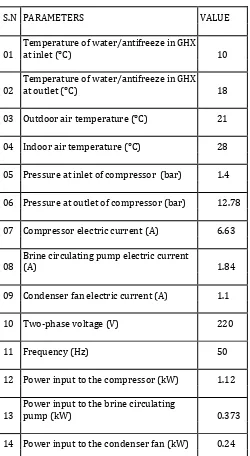
© 2017, IRJET | Impact Factor value: 5.181 | ISO 9001:2008 Certified Journal | Page 95 Table 3.2.1: Average measured parameters used in
experiment on 5th December 2016
S.N PARAMETERS VALUE
01 Temperature of water/antifreeze in GHX at inlet (ᵒC) 10
02 Temperature of water/antifreeze in GHX at outlet (ᵒC) 18
03 Outdoor air temperature (ᵒC) 21
04 Indoor air temperature (ᵒC) 28
05 Pressure at inlet of compressor (bar) 1.4
06 Pressure at outlet of compressor (bar) 12.78
07 Compressor electric current (A) 6.63
08 Brine circulating pump electric current (A) 1.84
09 Condenser fan electric current (A) 1.1
10 Two-phase voltage (V) 220
11 Frequency (Hz) 50
12 Power input to the compressor (kW) 1.12
13 Power input to the brine circulating pump (kW) 0.373
[image:5.595.38.288.128.584.2]14 Power input to the condenser fan (kW) 0.24
Table 3.2.2: Variation of various temperature of GHE with Time of day.
Time
of Day Water Temperature at the inlet of GHE ( C)
Water
Temperature at the Outlet of GHE (C)
9:30 14 20
10:00 13 19
10:30 10 17
11:00 11 15
11:30 9 14
12:00 8 14
[image:5.595.312.552.130.266.2]Figure 3.2.1: Variation of various temperature of GHE with Time of day for 5th December 2016
Table 3.2.3: Variation of various temperature of air with Time of day
Time of
Day Indoor Air Temperature (C) Outdoor Air temperature (C)
9:30 24 20
10:00 24.2 20.2
10:30 27 21
11:00 27.8 22.5
11:30 29.5 22
12:00 31.5 23.5
Figure 3.2.2: Variation of various temperature of air with Time of day for 5th December 2016
3.3 Sample Calculation.
These are the following assumptions were made:
(i) The volumetric efficiency of the compressor was taken to be 85%,
(ii) Compressor isentropic efficiency was taken to be 80%, (iii) There were no pressure losses in the cycle,
[image:5.595.310.560.463.595.2]© 2017, IRJET | Impact Factor value: 5.181 | ISO 9001:2008 Certified Journal | Page 96 properties have been calculated which are enlisted below.
The sample calculation has been given below is for 5th December 2016 of average readings after getting steady state (Data set 1, Table: 3.2.1)
Fluid properties:
Given data
Pressure at inlet of compressor ( P1) =1.4 bar Pressure at outlet of compressor ( P2 ) = 12.78 bar
Now from refrigeration table at given data ( P1) we get,
(Refrigeration table by S C Jain) For R-22.
Temperature at inlet of compressor ( T1 ) = -32 ᵒC
Enthalpy at inlet of compressor ( hg1) 391.79 = KJ Kg Entropy at inlet of compressor ( sg1) 1.80929 = KJ Kg K Now from refrigeration table at ( P2 ) we get, (Refrigeration
table by S C Jain)
Saturation temperature at outlet of compressor ( T2,sat ) =33 °C
Entropy of dry saturated vapour at outlet of compressor ( s2,sat ) =1.70826 KJ kg K
Enthalpy of dry saturated vapour at outlet of compressor ( h2,sat )= 415.207 KJ Kg
Enthalpy at outlet of condenser ( h3 ) = 240.520 KJ / Kg
3.3.1 Actual enthalpy at outlet of compressor.
First of all, let us find the temperature ( T2 ) of
superheated vapour at point 2. We know that in isentropic process entropy remains constant, that is
Entropy at inlet of compressor ( sg1 ) = Entropy at
outlet of compressor (s2)
Therefore it can be written in equation form as; Sg1 = s2,sat +cp
1.80912=1.70826+1.03 ln(T2/306) T2= 337.536 K
We know that enthalpy at point 2,
h2 = h2,sat+ cpv(T2 – T2,sat) = 415.207 +1.03(337.536-306) = 447.68 KJ/Kg.
As we know that isentropic efficiency of compressor ( c) = 85 %( given)
Now using the equation for isentropic efficiency of compressor, the actual enthalpy at compressor outlet can be calculated as:
3.3.2. Heat rejection rate in condenser.
For the calculation of heat rejection rate in
condenser, the mass flow rate of the refrigerant should be known. for this we use the following equation.
Now from equation (4.5) we may calculate the heat that rejected by condenser to test room
3.3.3. Heat transfer rate in evaporator.
The amount of heat that should be transfer in evaporator is calculated by equation (3.6). The heat transfer in evaporator is the amount of heat that extracted by refrigerant from water/antifreeze solution in the evaporator. Therefore, evaporating heat is calculated as,
3.3.4. Coefficient of performance of heat pump.
The COP of heat pump may be calculated from equation (4.10), It is the measure of performance of heat pump excluding circulating pump and fan coil unit. Therefore COP is given as,
3.3.5. Coefficient of performance of the system.
The COP of the system may be calculated by using equation (3.11).It is the measure of performance of overall system including heat pump, water/antifreeze circulating pump, forced fan. Therefore COP of the system is given as;
© 2017, IRJET | Impact Factor value: 5.181 | ISO 9001:2008 Certified Journal | Page 97
4. Results and discussion
4.1 Validation of experimental result
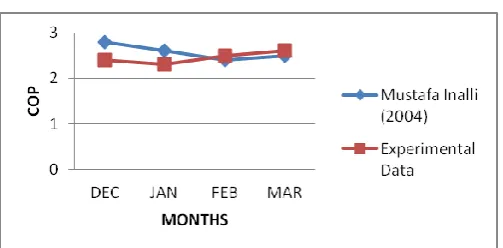
[image:7.595.307.573.176.312.2]Average best result of COP obtained from the experiments has been validated with the results of Inalli (2004) which shown in Fig. 4.1. the performance of the heat pump unit is low which may be due to a poor design of the system compared to the values given by inalli (2004). But the experimental results are more in the month of February and March due to the effect of local climate. The experimental results are found to be well within the permissible limit as compared to the inalli (2004).
Figure 4.1 validation of experimental result with inalli (2004)
4.2: Average performance parameters
The coefficient of performance of heat pump and system, heat extraction capacity, the heating capacity are the key parameters of this experiment. In this experiment these parameters have been calculated by the equations as explained previously, for this several readings have been taken. Some average experimental data and results are also given here and graphs have been plotted.
Fig 4.2 illustrates the date wise variation of the COPs. It shows a decrease in COP of system and heat pump until 5th January, and then it increases for GHE. The mean values of COPsys and COPhp for GHE are obtained to be 2.2 and 3.11, respectively. The highest COP of the system and COP of heat pump for GHE is found 2.67 and 3.8 in the month of February, while the lowest heating coefficient of the system and coefficient of performance of the heat pump for GHE is found 1.88 and 3.04 in the month of January.
Fig.4.3 depicts the date wise variation of the space-heating rate and heat extraction rate of ground source heat pump system. The mean heat rates rejected by the condenser unit to the room in the heating season for GHE found to be 3.5 kW. The lowest heating capacity for the GHE obtained as 3.2 kW on 5th January while the highest heating capacity for GHE 3.971 kW on 5th of December. Also the mean heat extracted from ground is the heat extracted throught the evaporator is
[image:7.595.37.289.297.421.2]found to be 2.7 kW. The lowest heat extracted on 20th December while highest extraction is found on 15th February through ground heat exchange.
Figure 4.2: variation of various COP with date of experiment
Figure 4.3: variation of various heating capacity with date of experiment
5: Conclusion And Future Scope
An experimental system was installed for investigating the thermal performance of a GSHPS for heating mode. The GSHP systems offer some proven advantages over conventional heating and cooling systems, particularly in terms of efficiency, maintenance costs, and overall operating costs.
5.1: Conclusion
The main conclusions that can be drawn from the present study are listed below:
(a) For the heat pump unit, the values for COPHP has been found to vary from 2.54 to 2.95 while those for overall COP were approximately 5–20 % lower than COPHP.
[image:7.595.306.571.350.488.2]© 2017, IRJET | Impact Factor value: 5.181 | ISO 9001:2008 Certified Journal | Page 98 capacity. It may be concluded that the pump selected
falls into the acceptable limits.
(c) The relevant soil properties are to be precisely measured before attempting the design of the GHE. Therefore, care may be taken in the design and construction of a ground loop for a heat pump application to ensure long ground loop life and reduce the installation costs.
5.2: Future Scope
The present work experimentally investigated the performance of GSHP system of heating mode for the climatic conditions of Sindri, Dhanbad. In his research we have been discovered many operating and designing parameters, but still there are mamy other issues that may be investigated. Recommended future studies are as follows:
(a) Experimental comparison of various GSHP systems for
different range of temperatures and different air flow rates.
(b) Experimental and numerical investigation of
performance of GSHP at different operating parameters like low humidity and for high temperature range (c) Numerical investigation of GSHP system for heat and
mass transfer model to optimize the design and operating parameters of ground heat exchanger can also be carried out.
(d) Experimental and numerical investigation of GSHP system by integrating different types of ground heat exchanger in the Indian climatic conditions.
References.
[1] Alavy M, Nguyen HV, Leong WH, Dworkin SB. A methodology and computerized approach for optimizing hybrid ground source heat pump system design. Renewable. Energy 2013; 57: 404–412.
[2] Al-Dabbas MA, Al-Rousan AA. Energy extracted from underground rock area by using a horizontal closed loop system in Mutah University/Jordan. Energy Convers Manage 2013; 65: 744–750.
[3] Bagdanavicius A, Jenkins N. Power requirements of ground source heat pumps in a residential area. Applied Energy 2013; 2102:591–600.
[4] Ben jemaa F, Houcine I, Chahbani MH. Potential of renew energy development for water desalination in Tunisia. Renew Energy 1999; 18(3): 331–47.
[5] Carli MD, Zarrella A. Design of borehole heat exchangers for ground-source heat pumps: A literature review, methodology comparison and analysis on the penalty temperature. Energy Build 2010; 55: 369–376.
[6] Chiasson A.D, Rees S.J, Spitler J.D, A preliminary assessment of the effects of groundwater flow on closed-loop ground-source heat pump systems, ASHRAE Trans. 2000; 106: 380–393.
[7] Congedo PM, Colangelo G, Starace G. CFD simulations of horizontal ground heat exchangers: A comparison among different configurations. Applied Thermal Engg 2012; 33–34: 24–32.
[8] Cui P, Yang H, Fang Z. Numerical analysis and experimental validation of heat transfer in ground heat exchangers in alternative operation modes. Energy Build 2008; 40: 1060–1066.
[9] Esen H, Inalli M. In-situ thermal response test for ground source heat pump system in Elazıg, Turkey. Energy Build 2009; 41: 395–401.
[10] Esen H, Inalli M, M. Esen, Numerical and experimental analysis of a horizontal ground-coupled heat pump system, Building and Environment 2007; 42: 1126–1134.
[11] Fan R, Jiang Y,Yao Y, Ma Z, Theoretical study on the performance of an integrated ground-source heat pump system in a whole year, Energy 2008; 33: 1671–1679. [12] Florides Georgios, Kalogirou Soteris. Ground heat exchangers. A review of systems, models and applications. Renewable Energy 2007; 32: 2461–2478.
[13] Guo Y, Zhang G, Zhou J,Wu J, ShenW. A techno-economic comparison of a direct expansion ground-source and a secondary loop ground-coupled heat pump system for cooling in a residential building. Applied Thermal Engg 2012; 35: 29–32
.[14] Hepbasli A. Performance evaluation of a vertical ground-source heat pump system in Izmir, Turkey. International Journal Energy Reserves 2002; 26: 1121–1139. [15] Hepbasli A, Akdemir O, Hancıoglu E. Experimental study of a closed loop vertical ground source heat pump system. Energy Converse Manage 2003; 44(4): 527–548.
[16] Hepbasli A , Tolga, Balta M, A study on modelling and performance assessment of a heat pump system for utilizing low temperature geothermal resources in buildings, Building and Environment 2007; 42: 3747–3756.
[17] Inalli M, Esen H. Seasonal cooling performance of a ground-coupled heat pump system in a hot and arid climate. Renew Energy 2005; 30(9): 1411–1424.
© 2017, IRJET | Impact Factor value: 5.181 | ISO 9001:2008 Certified Journal | Page 99 [19] Karlsson F, Fahlen P. Capacity-controlled ground source
heat pumps in hydraulic heating systems. Int J Refrig 2007; 30: 221–229.
[20] Kurevija T, Vulin D, Krapec V. Effect of borehole array geometry and thermal interferences on geothermal heat pump system. Energy Converse Manage 2012; 60: 134–142. [21] Leong WH, Tarnawski VR, Aittomaki A. Effect of soil type and moisture content on ground heat pump performance. Int J Refrig 1998; 21: 595–606.
[22] Li M, Lai Alvin CK. Thermodynamic optimization of ground heat exchangers with single U-tube by entropy generation minimization method. Energy Converse Manage 2013; 65: 133–139.
[23] Li X, Chen Z, Zhao J, Simulation and experiment on the thermal performance of Uvertical ground coupled heat exchanger, Applied Thermal Engineering 2006; 26: 1564– 1571.
[24] Lund JW, Freeston DH. World-wide direct uses of geothermal energy 2000. In: Proceedings of World Geothermal Congress. Geothermic 2001; 30: 29–68. [25] Madani H, Claesson J, Lundqvist P. Capacity control in ground source heat pump systems- Part II: Comparative analysis between on/off controlled and variable capacity systems. Int J Refrig 2011; 34: 1934–1942.
[26] Man Y, Yang H, Wang J. Study on hybrid ground-coupled heat pump system for airconditioning in hot-weather areas like Hong Kong. Applied Energy 2010; 87: 2826–33. [27] Nordell BO, Hellström G. High temperature solar heated seasonal storage system for low temperature heating of buildings. Sol Energy 2000; 69(6): 511–523.
[28] Omer AM. Ground-source heat pumps systems and applications. Renew Sustain Energy Rev 2008; 12(2): 344– 371.
[29] Ozyurt O, Ekinci DA. Experimental study of vertical ground-source heat pump performance evaluation for cold climate in Turkey. Appl. Energy 2011; 88: 1257– 1265. [30] Park H, Lee JS, Kim W, Kim Y. The cooling seasonal performance factor of a hybrid ground-source heat pump with parallel and serial configurations. Appl. Energy 2013; 102: 877–884.
[31] Popiel C, Wojtkowiak J, Biernacka B. Measurements of temperature distribution in ground. Exp Therm Fluid Sci 2001; 25: 301–309.
[32] Qi Z, Gao Q, Liu Y, Yan YY, Spitler JD. Status and development of hybrid energy systems from hybrid ground
source heat pump in China and other countries. Renew Sustain Energy Rev 2016; 29: 37–51.
[33] Sanner B, Karytsas C, Mendrinos D, Current status of ground source heat pumps and underground thermal energy storage in Europe, Geothermics 32 2003; (4-6): 579-588. [34] Sanaye S, Niroomand B. Horizontal ground coupled heatpump: thermal economic modelling and optimization. Energy Converse Manage 2010; 51: 2600–2612.
[35] Sarbu I, Sebarchievici C, General review of ground-sourceheat pump systems for heating and cooling of buildings, Energy Build. (2016); 70 (2): 441-454
36] Self SJ, Reddy BV, Rosen MA. Geothermal heat pumpsystems: status review and comparison with other heating options. Appl. Energy 2013; 101: 341–348.
[37] Swardt De, Meyer JP. A performance comparison between an air-source and a groundsource reversible heat pump. Int J Energy Res 2001; 25: 899–910.
[38] Urchueguia JF, Zacares the energy performance of a groundcoupled water to water heat pump system and an air to water heat pump system for heating and cooling in typical conditions of the European Mediterranean coast. Energy Converse Manage 2008; 49: 2917–2923.
[39] Wu W, Wang B, You T, Shi W, Li X. A potential solution for thermal imbalance of ground source heat pump systems in cold regions: ground source absorption heat pump. Renewable Energy 2013; 59: 39–48.
[40] Yang H, Cui P, Fang Z. Vertical-borehole ground-coupled heat pumps: a review of models and systems. Applied Energy 2009; 04-038.
[41] Zhai X.Q, Qu M., Yu X, Yang Y, Wang R.Z., A review for the applications and integrated approaches of ground-coupled heat pump systems, Renew. Sustainable Energy Rev. 2011; 15 (6): 3133-3140.