© 2017, IRJET | Impact Factor value: 5.181 | ISO 9001:2008 Certified Journal
| Page 1503
Automatic Number Plate Recognition and IoT Based Vehicle Tracking
Avadhut S Joshi
1, Digambar A Kulkarni
21,2
Dept. Of CSE, Gogte Institute of Technology, Belagavi, Karnataka, India.
---***---Abstract - License plate recognition (LPR) plays a significantrole throughout this busy world, owing to the rise in vehicles. Segmentation plays an important art, to avoid problems like unwanted illumination, tilt that degrades the segmentation which in turn affects the recognition accuracy algorithms are developed for this work. The work here presents a strong technique for localization, segmentation and recognition of the characters within the located plate. Images from still cameras or videos are obtained and regenerated in to grayscale images. Hough lines are determined using Hough transform and therefore the segmentation of grey scale image generated by finding edges for smoothing image is employed to cut back the quantity of connected part and then connected part is calculated. Finally, single character within the registration code is detected. It is necessary for every individual to track the vehicle. The proposed system will also be used for the tracking the vehicle from remote location. The theft vehicles, vehicles violating traffic rules can be tracked easily by making use of IOT based vehicle tracking.
Key Words: Number Plate, IoT, Segmentation,
Recognition, Tracking, Optical Character Recognition, Support Vector Machine
1.INTRODUCTION
Now a day’s, recognition or identifying the information present on the moving objects is turning of great importance. The increasing human dwelling and the growth of industry arena in the current scenario has made vehicle a mandatory need which in turn leads in serious traffic issues. The resting area for vehicles i.e. parking lots face overflow of vehicles due to the above mentioned problem.
One of the methods used for this purpose is, background subtraction or foreground segmentation. Background subtraction or foregrounds segmentations process of separation of objects in video or image and is a ubiquitous procedure in almost all the computer vision applications. With growing trends and enhancements in recent communications technologies has necessitated the need for Intelligent Surveillance Systems (ISS) technologies. This need facilitates obtaining information about the traffic, accidents and safety management. Operational efficiency can be improvised by vision based information. Separation of dynamic objects in picture sequences, is an emerging and a terribly beginning in this respect.
Automatic Number Plate Recognition (ANPR) falls under this category which is a method to recognize the characters on the images which can be captured using the traffic cameras or CCTVs. Vehicle registration Plate location, normalize and improvise the amount of plate, then the identification of character are the traditional steps followed in all Image processing techniques.
Plenty of systems that play the role of server are used in order to process the data received from the roads. Among these many systems just do the work of transferring the information to the systems which play a role of remote servers.
In this literature work, the implemented system uses template matching for number plate recognition of vehicle entry from a medium resolution camera. And also this work helps to track the vehicles location of the vehicles on the web or android phone using the GPS and mobile data.
1.1 EXISTING SYSTEM AND ITS LIMITATIONS
Identification of the characters and various algorithms for registration plate identification contribute positively in registration plate image analysis. Therefore, they are the heart of any ANPR system. The ANPR system encompasses a camera, software needed for image processing, a computer system, and frame grabber for analysis and recognition. Number Plate Recognition has gained a lot of importance in the last few years. Considerable amount of research work has been carried out to recognize the vehicle type like car, truck. The Support Vector Machine is used to identify the vehicle model. They demonstrated the numerical results on more than 50 data set pictures.
There are adequate number of applications and software available in the market to identify or recognize the registration number plates. These systems serve the purpose with few limitations. To cite a few: these applications consume ample amount of time for the recognition also they require image with high quality. Even though, these applications recognize the character on the number plate, they fail to achieve the accuracy. The existing ANPR systems recognize the number plate alone but lag in tracking the vehicles location.
© 2017, IRJET | Impact Factor value: 5.181 | ISO 9001:2008 Certified Journal
| Page 1504
of the registration plate and unnecessary characters arepresent on the number plate in many cases,
The following figure shows the Indian Standard Number Plate format which has first two characters as State Code, next two numbers represents District code following by the two characters for series code and finally a four-digit Registration number.
KA22 CS 8055
FIGURE 1 Indian Standard Number Plate Format
1.2 PROPOSED SYSTEM
In present days, there is a damn need of smart transportation system due to growing world & importance of the time in day to day life. Hence we provide system that provides the Smart Transportation System information of vehicle tracking and monitoring. In this proposed system, we recognize the vehicle number plate through the cameras, CCTV’s which will be converted from RGB image to Optical Character Recognition (OCR). This system also provides the feature for tracking the vehicle using its GPS location easily. The location of the vehicle can be traced and updated every ten seconds to track the vehicle continuously using Map along with data storage. Here, every vehicle need to carry the GPS. The GPS continuously sends the vehicle location to the server for the registered vehicle. By integrating both IOT technology and Image processing, we are going to design a whole Number Plate Recognition and vehicle tracking system. Whenever we want to track any GPS enabled vehicle, we can track it and also identify the registration plate in OCR form easily.
2. ARCHITECTURE OF THE SYSTEM
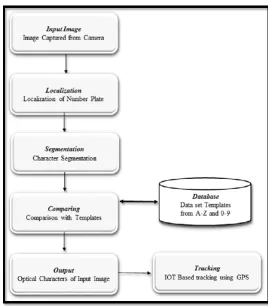
[image:2.595.307.576.96.403.2]System architecture describes the diagrammatic representation that has the building blocks of the system called components. During the implementation phase, these conceptual components will be transformed into working system components. Input to this literature is the image captured from the camera with a medium quality or high quality resolution. As shown in Figure 4.1, which illustrates the system flow for registration plate recognition by performing locating the image, segmenting the image, detection of the image from the registration plate.
FIGURE 2 System Architecture
There are several processing stages takes place in order to recognize the number plate as mentioned below:
Localization: Localizing registration plate is performed to eliminate the background which is unwanted details meaning that, we concentrate only on the number plate and rest of the area are ignored and hence the focusing on to the required details on the registration plate. To detect the registration plate, we apply a top-flat filter to the complete image begin by a multistage region search. One more approach has been proposed to consider the vertical edges, for extracting the registration plate using sable operator. An edge detection and Hough transforms techniques are used to detect the vertical and horizontal edges, by using the registration plate in a rectangular shape. Image captured from the camera from 8-10 meters away can be processed through the registration plate extraction with providing its output to segmentation.
© 2017, IRJET | Impact Factor value: 5.181 | ISO 9001:2008 Certified Journal
| Page 1505
outcome of different threshold methods, also implementingthe feedback from character recognition and character phases has been proposed.
Recognition of Character: This technique plays a vital role in this application to recognize the character extracted from the segmentation. The actual conversion of Number plate image into Optical Characters is performed in this phase and the clear identification of number plate is performed. For character recognition, we use the data set of individual character image of size 24X42. The extracted character will match with the similar data set and we get the proper optical character from the extracted image. For the character recognition, every character four data sets are collected of different variety. The test data set are used as alphanumeric such as characters A-Z only capital letters and the numbers from 0-9.
Tracking: Tracking is an important concept in this literature. The theft off vehicles, vehicles violating the traffic rules can be tracked using IOT based tracking scheme. To track the vehicle, the vehicle must be GPS enabled. The vehicle is tracked for every ten seconds and the exact location can be obtained with the help of latitude and longitude provided by GPS. To work with the GPS, the android application is developed by using which the owner or driver will register the system with valid information like Owner/Driver name, Vehicle registration number, Contact number and type of the vehicle etc.
3. METHODOLOGY
The implementation is started by capturing the number plate of the vehicle. The edge detection and gray scale filter is applied initially as a preprocessing for selected image to isolate the number plate region which is a smaller part from extracted image. The gray scale picture is obtained by quantizing from neutral gray starting from the black as a weakest intensity to white as a highly strongest intensity. Now it is required to binaries the by assigning the pixel values of 0 for black shade and 1 for white shade.
Furthermore, the registration plate is identified by observing the quick change in the contrast. Rest of the area in the images made filtered. The actual registration plate location is located by matching the width and height. The contrast extension and median filtering techniques enhances the gray level of registration plate image.
Contrast Extension: The image contrast can be extended by means of the process of enhancing the contrast. equalization of histogram of that particular picture. In other words, the image can be made sharpen by applying the extension of contrast. In order to improve poor picture contrast view, histogram equalization is a well-known technic.
Median Filtering: To eliminate the unwanted noisy regions, median filter is used. Median filtering is a technic that passes the image between 3X3 matrix. The dimension can be modified according to level of noise for this matrix. The progress follows as mentioned below.
The matrix of 3X3 is chosen for one pixel. The pixel around the neighborhood are assigned. The process of sorting is developed between nine
pixels from small to big.
Median element can be termed for the fifth element. The implementation of these procedures to all
pixels in the picture.
Character Segmentation: MATLAB Provides the function called Regionprops that identifies number plate region are segmented to have the bounding for each pixel. The smallest bounding returned by Regionprops which contains a character. This technic is favored to obtain the registration plate The segmentation can be done for database character matching with the training data sets.
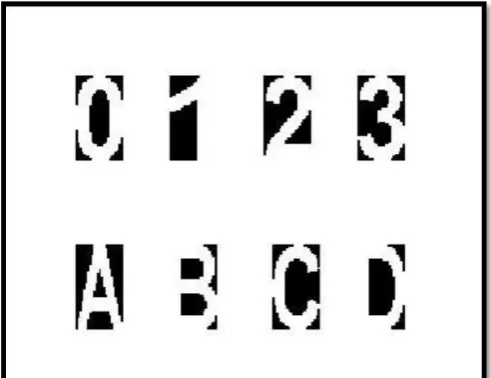
[image:3.595.310.556.537.726.2]OCR using Template Matching: The most commonly used technique for image comparison is Template Matching. In this technique, we are focusing to get the position of a sub-image called a template, in the given sub-image. The training data set matching describes the equality in a given training set. The process of comparing is done by pixel by pixel of the picture and the find the match for each possible displacement. It enables the matching of datasets character matching with training data. We have used almost all possible training data sets to match recognized inputs. Training data set are created to match each character, number (from A-Z and 0-9) using method 'Regular' font style. Figure 5.1 shows the training data set for some alphabets and numeric characters.
© 2017, IRJET | Impact Factor value: 5.181 | ISO 9001:2008 Certified Journal
| Page 1506
The process of ANPR starts with identifying a registrationplate of the vehicle. It involves the algorithms used which are able to identify rectangular area of registration plate from an original picture. The identification and recognition process takes place in four phases mainly.
Preprocessing of Image Localizing Registration Plate Segmentation of Characters
Recognition of Actual number plate.
Preprocessing the Image
The original picture contains large variety of colors and hence, in order to enhance the standard, the image is processed initially and prepared for further phase. The original image contains many colors so this phase converts the RGB to gray scale using equation.
Gray=0.299*Red+0.587*Green+0.114*Blue
In this phase, the median filter filters the grayscale image, in order to remove the noisy section of the image, but that affects slight tedious because of the sharpness of picture. The Median filter is used for nonlinear filter which swaps for each and every pixel with a efficiency obtained by calculating the median filter of different values of pixels. Picture can be sub-divided into multiple groups by
Total number of groups = Height / Candidate
Localizing Registration Plate
To detect the exact registration plate portion from the given complete image, this method is implemented. The major goal of this system is to locate the exact registration plate region from the complete picture from the CCTV, camera and video. The image quality plays important part. Thus localizing technic used for increasing the standard. The numbers and letters on a registration plate region must be placed in a same row. This gives the promotion for identifying changes within horizontal intensity because the rows will contain the number plate are expected to show variations.
Before this, the application of Hough transform application is given to edge detector for perfect edge detection. These vertical and horizontal edges facilitate to characterize the angle of fundamental.
Segmentation
The further step is segmentation of the registration plate. It’s totally clear that this is an important technic. If this process fails, then the characters will be improperly recognized. If we try to assume only one-row plates, the segmentation could
be a process of finding horizontal boundaries between characters [1].
Another method is implemented here called as aggregation of obtained segments. This phase of a number plate having characters not desirable parts like, hyphen, dashes and dots stretches further as redundant space on the edges of character. It is important to remove these parts and obtain only the registration plate characters. Since the segmented plate is deskewed, we could segment it by identifying spaces in its horizontal projection.
Recognition
The segmented numbers are compared with data sets from the database. Once an Image is obtained, segmentation is done is Grayscale. Before making the model ready, for each of the characters for more use, we'd like make some processing on the images. The subsequent operations that are performed like Binarization and Inversion of the characters. Realize the connected component that represents the optical character and realize the smallest rectangular region.
The image normalization is done with size 24X42. Here we store the intensity values below algorithmic rule mentioned for each and every characters. Compute the values for each of the characters. We need to compute template matching score of the characters separated from the training data. The training data set contain the large number of data to compared with the localized plate. Each localized plate is compared with the SVM i.e. Support Vector Machine classifier which exactly matches or similar match occur. So the template matching is performed by comparing the only required comparisons.
Tracking
© 2017, IRJET | Impact Factor value: 5.181 | ISO 9001:2008 Certified Journal
| Page 1507
4. CONCLUSIONSThis work developed completely unique methodology for the recognition of vehicle registration plate. The proposed method uses horizontal projection profile and Hough transform.
Firstly, the extraction process of number plate from a given input image is located, then performed segmented the plate characters independently and applied template matching by using template data set for recognition of plate characters. Further, it is assured to be approximately 96% for the extraction of plate region, 95% for the separation optical characters’ recognition unit accurate, giving the overall system performance better than the existing system. The recognition time is between 5 to 15 seconds which is relatively shorter than current time i.e. more than 30 sec. Also, the vehicle location can be accurately tracked for GPS enabled vehicles and the location can be refreshed for every ten seconds to update the vehicle information.
FUTURE WORK
There are many enhancements are possible with this research in order to add the quality and features. Here are some future enhancements possible as below.
This application can be modeled for international vehicle registration plates.
The literature can be modified to capture the number plates which are not in the Indian standard format i.e. number plate contains two lines.
Further, the regional language data set can be added to the database and the same will be recognized accurately.
Some number plate contains the unwanted data which can be recognized by redesigning the application.
The detected numbers can inform the user the RTO location, region, district etc.
REFERENCES
[1] Priyanka Prabhakar, AnupamaP, Resmi S R, - “Automatic Vehicle Number Plate Detection and Recognition”.International Conference on Control, Instrumentation, Communication and Computational Technologies (ICCICCT) -1-4799-4190-2/14/$31.00 ©2014 [2] Abbas M. Al-Ghaili, SyamsiahMashohor, Abdul Rahman Ramli, and AlyaniIsmail, “Vertical-Edge-Based Car License-Plate Detection Method.”, IEEE Transactions on Vehicular Technology vol. 62, no. 1, Jan 2013.
[3] B. Hongliang and L. Changping, “A hybrid license plate extraction method based on edge statistics and morphology,”, IEEE Proc. ICPR, pp. 831-834, 2004.
[4] H.J. Lee, S.Y. Chen, and S.Z. Wang, “Extraction and recognition of license plates of motorcycles and vehicles on highways,”, in Proc. ICPR, pp. 356-359, 2004.
[5] Hinde Anoual, Sanaa El Fkihi, AbdeilahJilbab and DrissAboutajdine, “A Novel Texture-Based Algorithm for Localizing Vehicle License Plates,”, in Journal of Theoretical and Applied Information Technology 15th November 2012. Vol. 45 No.1.
[6] A. Broumandnia and M. Fathy,“Application of pattern recognition for Farsi license plate recognition,”, presented at the ICGST Int. Conf Graphics, Vision and Image Processing (GVIP),[Online]. Available: http://www.icgst.com/gvip/v2/P1150439001.pdf, Dec. 2005.
[7] T. D. Duan, T. L. Hong Du, T. V. Phuoc and N. V. Hoang, “Building an automatic vehicle license plate recognition system,”, Iin Proc. Int. Conf. Comput.Sci. RIVF, pp. 59-63, 2005.
[8] C.T. Hsieh, Y.S Juan, and K.M. Hung, “Multiple license plate detection for complex background,”, in Proc. Int. Conf. AINA, vol. 2, pp. 389-392, 2005.