SYNTACTIC PRIMING AND ESL
QUESTION DEVELOPMENT
Kim McDonough
Northern Arizona UniversityAlison Mackey
Georgetown UniversityInteraction research that has investigated the relationship between language production and second language (L2) development has largely focused on learners’ immediate responses to interactional feedback. However, other speech production processes might help account for the beneficial relationship between interaction and L2 development. The current study examines whether syntactic priming— the tendency to produce a syntactic structure encountered in the recent discourse—is associated with English as a second language (ESL) question development. The participants were intermediate-level Thai learners of English (N= 46) at a large public university in northern Thailand. In two 20-min sessions, the participants carried out communicative activities with a more advanced L2 English inter-locutor who had been scripted with developmentally advanced ques-tion forms. They also completed an oral pretest and two posttests that consisted of activities similar to those carried out during the treat-ment sessions. The results indicated that participants who evidenced high levels of syntactic priming were likely to advance to a higher stage in the developmental sequence of ESL question formation.
The interaction hypothesis of SLA ~Gass, 2003; Gass & Mackey, 2007;Long,
1996;Pica,1994!states that second language~L2!learning is facilitated through
interaction that brings together input features ~e+g+,interactional feedback!,
internal learner capacities~e+g+,attention!,and language output+More than 40
studies and two meta-analyses~Keck,Iberri-Shea,Tracy-Ventura,& Wa-Mbaleka,
2006; Mackey & Goo, 2007! have reported that interaction facilitates L2
Address correspondence to:Kim McDonough,P+O+Box 6032,English Department,Northern Arizona University,Flagstaff,AZ 86011-6032;e-mail:kim+mcdonough@nau+edu+
learning+ Researchers have proposed a number of reasons why interaction
brings about positive L2 learning outcomes+For example,it can provide
inter-actional feedback~Long,2006!,enhance the salience of positive evidence~
Lee-man,2003!,raise learners’ awareness of language form~Ellis,1991;Gass,1997,
2003;Long,1996;Schmidt,1995,2001;Swain & Lapkin,1995!,and create
oppor-tunities for learners to produce the target language and modify their
inappro-priate or ungrammatical utterances~Swain,1995,2000,2005!+
Interaction research that examines the role of language production in L2 learning has focused narrowly on learners’ responses to interactional
feed-back,with several studies reporting positive associations between learners’
responses and developmental outcomes~e+g+,Havranek,2002;Loewen & Philp,
2006;McDonough, 2005;McDonough & Mackey, 2006!+Most of this research
has investigated learners’ responses to interactional feedback in the form of
~a!repetition of recasts and~b!reformulation of previous utterances,both of
which occur in the turn immediately following the feedback move+However,
McDonough and Mackey also investigated primed production, which they
defined as a learner’s production of a new utterance using the syntactic
struc-ture modeled in an interlocutor’s recast+ This type of response involved the
production of a new utterance with the syntactic structure provided by the
interlocutor, rather than the reformulation of a learner’s previous utterance
or the repetition of an interlocutor’s recast+They reported that both recasts
and primed production were associated with English as a second language
~ESL!question development,whereas immediate repetition of recasts was not+
What is not clear from their study,and what motivated the current study, is
whether primed production in the absence of any interactional feedback is
also associated with ESL question development+
Studying primed production,as opposed to reformulations or repetitions
of recasts,is motivated by first language~L1! speech production research in
syntactic priming+Syntactic priming is characterized by a speaker’s tendency
to produce a syntactic structure encountered in the recent discourse, as
opposed to an alternate structure+The idea is that speakers are sensitive to
experiences with a syntactic structure rather than to repeated experiences
with surface-level features+An example of syntactic priming in L2 speech
pro-duction is illustrated in~1!+
~1! Syntactic priming~numbers in brackets indicate turn number!
@95#Speaker 1:The man shows his wife the boot+
@96#Speaker 2:A teacher is teaching some kids a game+~McDonough,2006,p+182!
In this task,two English L2 speakers were taking turns describing pictures to
each other+ In the first turn, speaker 1 produced a double-object dative to
describe a picture of a man showing his boot to a woman+ In the next turn,
speaker 2 similarly produced a double-object dative to describe her picture+
Although speaker 2 could have used a prepositional dative or a single-object
structure as her interlocutor’s utterance+Syntactic priming has been found to
occur even when the initial and subsequent utterances have different topics,
lexical items,closed-class elements,thematic compositions, phonology, and
pragmatic features~Bock,1986, 1989, 1990;Bock & Loebell,1990;Bock,
Loe-bell,& Morey,1992;Hare & Goldberg,1999!and also even when there is
inter-vening material between the initial and subsequent utterances~Bock & Griffin,
2000;Branigan, Pickering,Stewart,& McLean, 2000;Huttenlocher, Vasilyeva,
& Shimpi,2004!+For example,in Bock and Griffin’s study,even when the
ini-tial and subsequent utterances were separated by up to 10 unrelated
interven-ing sentences,syntactic priming still occurred+
Current research in L1 speech production is exploring the mechanisms
responsible for syntactic priming+ Although Bock~1989! initially speculated
that syntactic priming might occur as the result of residual activation of the
mechanisms involved in speech production, subsequent research
demon-strated that it occurs even when speakers simply hear a particular syntactic
form+More recently,researchers have argued that syntactic priming might be
due to residual activation of the morphosyntactic information stored with
indi-vidual lexical items~Branigan,Pickering,Liversedge,Stewart,& Urbach,1995;
Pickering & Branigan,1998!+Also,because this linguistic information is shared
by the comprehension and production systems, either previously heard or
spoken syntactic structures can facilitate subsequent production+ In other
words,when a speaker hears or produces an utterance with a specific lexical
item in one of its possible syntactic structures, that syntactic information
becomes activated and facilitates the subsequent production of that same
syn-tactic structure with other lexical items+Additionally,simply hearing a lexical
item that only allows one syntactic structure might be sufficient to lead a speaker to produce that structure with subsequent lexical items that allow
alternative structures~Melinger & Dobel,2005!+
Syntactic priming is interesting for L2 learning for several reasons+Whereas
L1 speakers often alternate between two equally acceptable syntactic
struc-tures, such as a double-object dative or a prepositional dative, L2 learners
often face choices that involve developmentally simple or advanced forms,
nontargetlike or targetlike forms, and more appropriate or less appropriate
forms+ These choices are illustrated in~2!and ~3!, in which a participant in
the current study was carrying out communicative tasks with another English
L2 speaker+Throughout the conversation the learner alternated between two
forms ofwh-questions:questions with a frontedwh-word without the copula
and questions with a frontedwh-word and the copula+These forms are stage
three and four questions, respectively, in Pienemann and Johnston’s ~1987!
developmental sequence for ESL question formation+
~2! Wh-fronting without copula
What your favorite holiday?
~3! Wh-fronting with copula
What is the meaning of number 11 on the wall? What time is it?
Who is it?
In this situation,syntactic priming might lead the learner to produce the
devel-opmentally advanced structure rather than the less advanced structure+ By
facilitating the production of developmentally advanced structures,syntactic
priming might strengthen the knowledge representations that learners already
have stored ~Nobuyoshi & Ellis, 1993! and encourage automatic retrieval of
linguistic forms~de Bot,1996!+
Another possible contribution of syntactic priming to SLA concerns the
formation of more abstract syntactic representations+ In usage-based
ap-proaches to acquisition,development proceeds from formulaic expressions to
a limited-scope pattern and,finally,to abstract representations+In L1
acquisi-tion research,Tomasello~2000!has argued that in an early stage of linguistic
development~about 2–2+5 years!,children have only weak syntactic
represen-tations that are associated primarily with specific lexical items+Only after
fur-ther exposure to the type and token frequency with which certain linguistic structures appear in the input do children’s linguistic representations
gradu-ally grow in strength and abstractness+ For L2 speakers who produce a
syn-tactic form only as a formulaic utterance or as a limited-scope pattern,syntactic
priming might lead them to produce that form with a wider variety of lexical
items,which could facilitate the acquisition of more abstract representations+
In other words,syntactic priming might facilitate the production of a
particu-lar syntactic form across lexical items,thereby helping L2 learners recognize
that the syntactic form represents a general category rather than a lexically
specific construction~Ellis,1998,2002a,2002b,2005!+
Due to the fact that one of the goals of interaction research is to
under-stand why interaction is developmentally helpful,a logical question is whether
language production in the form of syntactic priming facilitates L2
develop-ment+ As mentioned previously, McDonough and Mackey ~2006! found that
primed production was positively associated with ESL question
develop-ment+However,in their study,primed production occurred in an interactive
context in which native English speakers also provided learners with recasts
that targeted developmentally advanced question forms+ Consequently, it is
difficult to determine whether primed production alone would also facilitate
development+Although previous interaction research has suggested that
mod-els might not be particularly beneficial for L2 learning when compared to
interactional feedback ~Iwashita, 2003;Long, Inagaki, & Ortega, 1998!, these
studies did not examine learners’ subsequent production of the structures
that had been modeled+The current study is expected to shed more light on
possible relationships among models, primed production, and L2
develop-ment,exploring whether syntactic priming in the absence of interactional
study was:Is there a relationship between syntactic priming and ESL ques-tion development?
METHOD
Participants
English as a Foreign Language Participants. The participants were 46
undergraduate students~37 women and 9 men!at a large public university in
northern Thailand+They were studying in the following bachelor degree
pro-grams:education~20!,agro-industry~14!,humanities~6!,business
administra-tion~3!,economics~2!,and engineering~1!+They were all native speakers of
Thai+ Their ages ranged from 19 to 21 years, with an average of 19+7 years+
Their amount of previous English study ranged from 8 to 18 years, with an
average of 12+3 years+Most of the participants~35046!did not report
knowl-edge of any L2 other than English,but 11 participants had studied a foreign
language,including German~5!,Japanese~3!,Chinese~2!,and French~1!+Only
five participants had ever been to a country where English was spoken as a
native language,and they reported a length of residence ranging from 4 days
to 3 months+They were recruited from four intact classes of an oral
commu-nication course for non-English majors, which they were taking as either a
requirement or an elective,depending on their degree program+
Scripted Interlocutors.The participants interacted with six scripted
inter-locutors~five women and one man!who were undergraduate students at the
same university+The scripted interlocutors were juniors and seniors who were
studying for bachelor degrees in English+ As English majors, they had
com-pleted many more English courses than the participants+ Their curriculum
included both skill-focused courses,such as oral communication and writing,
and content-based courses, such as phonetics, syntax, and literature+ They
were invited to assist with the data collection based on the recommendation of their psycholinguistics instructor and were paid to interact with the
par-ticipants+One of the researchers had a 90-min meeting with the scripted
inter-locutors during which they learned about~a!syntactic priming,~b!the purpose
of the study,~c! the communicative activities they would carry out with the
English as a foreign language learners,~d!the types of questions they were to
ask,and~e!the scripts for each activity+
Target Structure
The target structure was question formation,which was selected in order to
facilitate comparison with previous research that has explored the
relation-ship between interactional feedback and ESL question development ~e+g+,
Mackey,1999;McDonough,2005;Silver,2000;Spada & Lightbown,1999!+
with SLA in general~Pienemann,1998,2007!, making it a dependable
indica-tor of a L2 learner’s development of the target language+ESL question
devel-opment was operationalized as a learner’s movement to a higher stage in
Pienemann and Johnston’s~1987;Pienemann,Johnston,& Brindley,1988!
devel-opmental sequence for ESL question formation as evidenced by the produc-tion of at least two linguistically and contextually unique quesproduc-tions from a
higher stage+ The following developmental sequence, taken from Pienemann
and Johnston ~1987!, was used in this study:stage 3 ⫽fronting ~e+g+, Why
she do that?!, stage 4⫽ pseudo-inversion0yes-no inversion ~e+g+, Where are
they now?!, and stage 5⫽aux-second ~e+g+,What have you got?!+As Mackey
has pointed out,defining development as a learner’s movement to a higher
stage in this sequence allows researchers to assess and control learners’
readi-ness to acquire certain forms+
Design
The study used a pretest-posttest design to explore the relationship between
syntactic priming and ESL question development+ Because the dependent
variable under investigation—syntactic priming—is contingent upon learner
behavior,it was not possible to determine a priori whether it would occur+
Con-sequently, the treatment activities created contexts for syntactic priming to
occur,and each participant’s performance was subsequently analyzed to
deter-mine the extent to which it had occurred+One of the four oral communication
classes was randomly selected to serve as the control group,and students in
that class completed the pretest and posttests only+The students in the
remain-ing three classes were assigned to the primremain-ing group+ Participants in the
priming group completed the pretest and posttests and carried out
communi-cative activities with the scripted interlocutors during two 20-min sessions+The
scripted interlocutors had scripts containing developmentally advanced ques-tions for each communicative activity and were instructed to produce as many of those questions as possible while maintaining a primary focus on the
com-munication of meaning+
Materials
The testing and treatment materials consisted of communicative tasks
previ-ously used in interaction research carried out in this context ~McDonough,
2005;McDonough & Mackey,2006!+Two sets of treatment materials were
com-piled, and each set consisted of four communicative activities that elicited
contexts for questions+ The treatment materials included picture difference
tasks, map tasks, personal experience and interview topics, and guessing
games+Only the participants in the priming group carried out the treatment
activities with the scripted interlocutors+Three sets of testing materials were
contexts for questions+ The testing tasks included picture difference tasks,
story completion tasks, map tasks, and interviewing activities+ The
partici-pants interacted with each other to carry out the testing materials+
Procedure
The entire study was carried out over a 7-week period, with the pretest in
week 1, treatments in week 2, and posttests in weeks 3 and 7+ At the
begin-ning of the study,the participants self-selected a partner with whom they would
carry out the communicative activities during the pretest and both posttests+
As shown in Table 1, all participants completed a biodata questionnaire and
carried out the pretest in week 1+Participants assigned to the priming group
were scheduled for two 20-min sessions with the scripted interlocutors in
week 2,whereas the control group did not participate in any interaction+All
of the participants completed two posttests:one in week 3 and the other in
week 7+ The presentation of testing materials was randomized so that some
participants completed one of the three sets of activities during the pretest,
and others completed it during the first or second posttest+ All of the
inter-action during the test and treatment sessions was audio-taped using a digital
voice recorder placed on the table between the interlocutors+
The researcher running the experiment informed the participants that the scripted interlocutors were students at the same university who were
par-ticipating in the project as part of their psycholinguistics course+In order to
minimize possible discomfort triggered by the perception that the
interlocu-tors had better English skills, the participants were not informed that the
scripted interlocutors were English majors+ During the treatment sessions,
the researcher gave instructions for the communicative activities to both the
scripted interlocutor and the participant+The scripted interlocutor was asked
to speak first in order to ensure that the participants heard developmentally
advanced questions before they produced any questions, thereby creating
contexts for priming to occur+The interaction was not tightly controlled,
how-ever,in order to preserve as much authentic communication as possible+ As
a result, there was variation in the number of consecutive questions
pro-Table 1. Procedure
Week Priming group Control group
1 Pretest and biodata questionnaire Pretest and biodata questionnaire
2 Two 20-min sessions with a scripted
interlocutor
No interaction
3 Posttest 1 Posttest 1
duced by both the participants and the scripted interlocutors+ The partici-pants interacted with a different scripted interlocutor for each of the two
sessions,and the two sets of treatment materials were counterbalanced+If a
participant missed a scheduled appointment or a scripted interlocutor arrived
late,which happened four times,the participant carried out the tasks with a
researcher+ Neither the scripted interlocutors nor the researcher provided
any interactional feedback in response to the participants’ nontargetlike forms+
Analysis
The audio recordings of the treatment sessions were transcribed by the
scripted interlocutors, and the audio recordings of the test sessions were
transcribed by research assistants+ The transcripts were checked by one of
the researchers+ For the test data, a researcher coded all questions
pro-duced by the participants according to the stages in Pienemann and Johnston’s
~1987!developmental sequence for ESL question formation and then assigned
each participant to a stage in that sequence for each test+Stage assignment
was based on the highest stage from which a participant produced two
lin-guistically and contextually unique questions+Multiple exemplars of the same
question on the same task and formulaic chunks~such aswhere are you from?!
were not considered for stage assignment+Development was then
operation-alized as a stage increase on both posttests+
For the treatment data,the occurrence of syntactic priming involving
devel-opmentally advanced questions was identified+First,developmentally advanced
questions were operationalized as questions from a higher stage than a
par-ticipant’s pretest stage+ Because there was variation in the participants’
ini-tial stage assignment~either stage 3 or 4!,the types of questions classified as
developmentally advanced also varied+For example,if a participant had been
classified as stage 3 on the pretest,then stages 4 and 5 were considered
devel-opmentally more advanced+However, if a participant had been classified as
stage 4 on the pretest,then only stage 5 questions were classified as
develop-mentally advanced~stage 6 questions were very rare in this dataset!+The
spe-cific types of stage 4 and 5 questions considered in the analysis were~a!yes-no
questions with an auxiliary~excluding “do you⫹V” questions,which are often
formulaic chunks!,~b!yes-noquestions with the copula,~c!wh-questions with
the copula,and~d!wh-questions with auxiliaries+Morphological errors,such
as subject-verb agreement or verb tense,were not considered in the analysis+
Syntactic priming was operationalized as the tendency for speakers to pro-duce a syntactic structure when they have just been exposed to that
struc-ture,as opposed to when they have been exposed to alternative structures+
Therefore, syntactic priming was demonstrated when participants produced
developmentally advanced questions after the scripted interlocutor’s devel-opmentally advanced questions more often than they produced them after
the scripted interlocutor produced a developmentally advanced question, a
stage 5 question, in turn 90+In the following turn,the participant answered
the question and then produced a stage 5 question that was not a repetition of the scripted interlocutor’s question but was a new question that shared
the same syntactic structure~wh-fronting with auxiliary!+Later in the
conver-sation, the scripted interlocutor used a lower level question in turn 110~a
stage 4 wh-copula!+ However, in that context, the participant did not
pro-duce a stage 5 question+Syntactic priming was evidenced when the
partici-pant’s production of developmentally advanced questions was greater after
the scripted interlocutors’ advanced questions than after other question types+
~4! Syntactic priming
@90#Scripted interlocutor:Why did you decide to work in Bangkok?
@91#Participant:uh because I would like to study master degree in Bangkok00what
do you like to do in your free time?
@92#Scripted interlocutor:I like watching movies,especially soundtracks+
@110#Scripted interlocutor:How many clouds are in your picture?
@111#Participant:three00is there a bird?
@112#Scripted interlocutor:yeah near the woman on the right
Although the participant’s question generally occurred in the turn
immedi-ately following the scripted interlocutor’s question,in some cases several turns
of dialogue intervened+These were embedded adjacency pairs—using Sachs,
Shegloff,and Jefferson’s~1974!term—that occurred between the scripted
inter-locutor’s question and the participant’s question+ This is illustrated in ~5!+
After the scripted interlocutor’s question in turn 20, a wh-question with an
auxiliary, the participant answered the question in turn 21, after which the
researcher commented about her answer in turn 22+ The participant and
scripted interlocutor acknowledged the researcher’s comment in turns 23 and
24+When it was finally the participant’s turn to ask a question in turn 25,she
produced awh-question with an auxiliary+
~5! Syntactic priming with intervening dialogue
@20#Scripted interlocutor:what subject did you take?
@21#Participant:I study biotechnology
@22#Researcher:sounds very difficult
@23#Participant:yeah
@24#Scripted interlocutor:you must be smart
@25#Participant:uh where did you stay at uh six o’clock p+m+?
The intervening dialogue typically occurred when an interlocutor commented
on the content of an utterance by clarifying or expressing surprise+The
analy-sis considered only the first question produced by the participant after the end of the intervening dialogue and within 10 turns of the scripted
interlocu-tor’s question+
An independent rater coded a subset of the test and interaction data to
percentage agreement between the researcher’s and the rater’s coding was
95%+Alpha was set at+05 for all statistical tests+
RESULTS
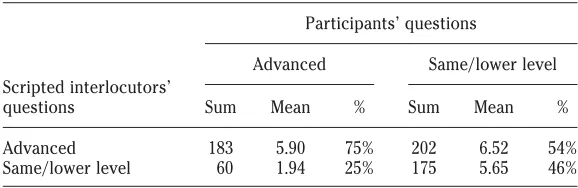
[image:10.432.70.359.505.599.2]The participants’ production of developmentally advanced and same or lower level questions following the scripted interlocutors’ questions is shown in
Table 2+ Overall, the participants produced more same or lower level
ques-tions~377!than developmentally advanced questions~243!+Their production
of same or lower level questions was not greater following the scripted
inter-locutor’s same or lower level questions+ However, the expected relationship
did occur for developmentally advanced questions,with the participants
pro-ducing more developmentally advanced questions after the scripted
interloc-utors’ developmentally advanced questions~183!than after their same or lower
level questions~60!+
Due to the fact that there was considerable variation in the extent to which
syntactic priming had occurred,the participants were further classified based
on the proportion of developmentally advanced questions they produced after
the scripted interlocutor’s developmentally advanced questions+Because the
mean proportion was +72, participants who scored higher than +72 were
assigned to the high-priming group, whereas those participants who scored
lower than+72 were assigned to the low-priming group+The high-priming group
consisted of 19 participants whose scores ranged from+75 to 1+00~X⫽+86,
SD⫽+09!,and the low-priming group consisted of 12 participants whose scores
ranged from+20 to+70~X⫽+49, SD⫽+16!+
To determine the relationship between syntactic priming and ESL question
development,the developmental outcomes for the high-priming group,the
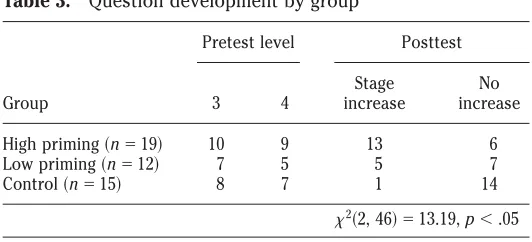
low-priming group,and the control group were compared+As illustrated in Table 3,
only one of the participants in the control group,which had carried out only
the testing tasks, advanced to a higher stage of question development+ For
the low-priming group,5 out of 12 participants advanced to a higher stage of
question development+Finally,for the high-priming group,13 out of 19
partici-Table 2. Syntactic priming during treatment tasks
Participants’ questions
Advanced Same0lower level
Scripted interlocutors’
questions Sum Mean % Sum Mean %
Advanced 183 5+90 75% 202 6+52 54%
pants advanced to a higher stage+ The results of a chi-square test indicated that the relationship between group membership and ESL question
develop-ment was significant+The analysis of the adjusted standardized residuals~
Hab-erman,1973!located the significance with the performance of the high-priming
group~63+1!and the control group~63+3!+
To summarize the findings, the current study found a positive
relation-ship between syntactic priming and ESL question development+Participants
who frequently produced developmentally advanced questions after hearing scripted interlocutors produce such questions moved to a higher stage of
ESL question development+ Thus, the findings indicate a clear positive
rela-tionship between syntactic priming and ESL question development+
DISCUSSION
Although syntactic priming was associated with ESL question development,
6 of the 19 participants in the high-priming group did not advance to a higher
stage+Thus,an important question is why syntactic priming was associated
with different developmental outcomes+ One possible explanation relates to
the role of type frequency—that is, how many different lexical items can be
applied to a syntactic structure—in helping learners recognize that the struc-ture represents a general category rather than a lexically specific
construc-tion~Ellis,2005!+Previous syntactic priming studies have shown that priming
might be greater when the prime and the participant’s response have the
same verb~Branigan,Pickering,& Cleland,2000;Pickering & Branigan,1998!,
and L1 acquisition researchers have shown that young children produce devel-opmentally advanced structures only when they can reuse high-frequency
lex-ical items such as pronouns~Savage,Lieven,Theakston,& Tomasello, 2003!+
An important question here then is whether the participants in the high-priming group differed in terms of the extent to which their developmentally advanced questions shared lexical items with the scripted interlocutors’
[image:11.432.82.348.68.189.2]primes+
Table 3. Question development by group
Pretest level Posttest
Group 3 4
Stage increase
No increase
High priming~n⫽19! 10 9 13 6
Low priming~n⫽12! 7 5 5 7
Control~n⫽15! 8 7 1 14
x2~2
To explore this possibility in more detail, a post hoc analysis was carried
out to determine whether the question words,subjects,main verbs,and
aux-iliary verbs in the scripted interlocutors’ and participants’ developmentally
advanced questions differed+For example, the participant in ~6! produced a
question in turn 36 that had the same question word~what!,the same subject
~you!,and the same verb~do!as the question produced by the scripted
inter-locutor in turn 35+
~6! Syntactic priming with shared lexical items
@35#Scripted interlocutor:what did you do at one p+m+?
@36#Participant:I had lunch at one00uh in in the midnight what were you doing?
In contrast,the participant in~7!produced a question in turn 101 that had a
different question word,auxiliary verb,subject,and main verb than the prime
produced by the scripted interlocutor in the previous turn@100#+
~7! Syntactic priming with different lexical items
@100#Scripted interlocutor:what does she look like?
@101#Participant:uh00I think she’s tall00she has white skin00and long black hair
00when do you have first love?
The percentage of different lexical items in the four categories~question word,
subject,main verb,and auxiliary verb!was calculated+As shown in Figure 1,
for the participants who developed, 58% of their questions had a different
question word than the one used by the scripted interlocutors,but only 39%
[image:12.432.54.376.397.581.2]of the participants who did not develop used different question words+A more
striking pattern was found for main verbs: Whereas 72% of the targets pro-duced by the participants who developed contained a different main verb than
the scripted interlocutors’ question,this occurred for only 31% of the
ques-tions produced by the participants who did not develop+ For auxiliary verbs
and subjects, there was little difference between those participants who did
and did not develop+Thus,the post hoc analysis indicated that those
high-priming participants whose questions contained different question words and
main verbs developed,whereas the participants who reused the lexical items
provided in the scripted interlocutors’ questions did not develop+ The
find-ings suggest that syntactic priming might be associated with L2 developmen-tal outcomes when participants apply the syntactic structure to a wide variety
of question words and main verbs+
An interesting parallel between the findings of the current study and those
of McDonough and Mackey~2006!concerns the issue of repetition+As several
researchers have suggested,productively using a form in one’s own way might
be more beneficial for development than simply repeating or mimicking that
form~Gass,2003;Panova & Lyster,2002!+McDonough and Mackey found that
immediate repetition of a recast was not associated with ESL question
devel-opment,but subsequently producing the question form modeled in the recast
was predictive of development+Similarly,in the current study,syntactic
prim-ing that involved the same lexical items produced by the scripted
interlocu-tors was not associated with development,but priming that involved different
question words and verbs was related to development+ Taken together, the
findings of the two studies suggest the importance of learners’ productive use
of developmentally advanced questions for ESL question development, as
opposed to simple repetition of question forms provided by an interlocutor+
The current study was conducted in a university-level program in a
for-eign language setting+It is possible that the setting might have an impact on
the developmental outcomes of interaction,particularly in the light of
ques-tions about foreign language versus L2 settings~Mackey & Goo,2007!+Thus,
these results might not be easily generalizable to other learners and
set-tings+The results reported here need to be interpreted with caution due to
the fact that only one target linguistic item was investigated+Future research
would profit from investigating a larger array of linguistic targets as well as
target languages+ Caution in interpreting the findings is also needed due to
the short-term nature of the experiment+Some researchers argue that
short-term treatments providing a limited amount of exposure to targeted linguis-tic items might not accurately represent how overall effective a longer time
interactional treatment could be; future research might thus benefit from
increasing the amount of interaction time~Long,2006;Long et al+,1998!+
Fur-thermore,a longitudinal study employing delayed posttests could shed more
light on the relationship between priming and L2 development+ Additionally,
because the current study examined only university-level learners of English
~all of whom were native speakers of Thai!,future studies would also benefit
vary not only in terms of proficiency, setting, and L1 but also in terms of
other individual differences, such as working memory capacity, that might
mediate the interaction-learning relationship noted in the literature+It is also
possible that learners’ particular aptitudes might predispose some of them
to benefit,or not, from the implicit learning processes associated with
syn-tactic priming+The inclusion of measures of individual differences might
ben-efit future studies that investigate these relationships+Research in these areas
might help to explain why some participants produced questions that shared
lexical items with the scripted interlocutors’ questions, whereas other
par-ticipants produced questions with different lexical items+
This study attempted to bridge the gap between syntactic priming research
in psychology and interaction research in SLA+ To achieve this,we used the
scripted interlocutor technique created by psychologists~Branigan et al+,2000!+
As originally devised,this technique involves a great deal of control over
turn-taking,which is generally not desirable in interaction research where
commu-nication is generally as authentic as possible+Consequently,we had to reduce
the level of control generally associated with syntactic priming research in
order to increase the validity of the interactional context+As a result,the
inter-action between the scripted interlocutors and participants involved
consecu-tive utterances and the intervening dialogue described previously+Although
these issues certainly make the analysis and drawing of conclusions more
com-plicated,messy data is,of course,inherent in the nature of interaction+
Whereas previous interaction research has suggested that interactional
feedback may be more beneficial for L2 learning than models~Iwashita,2003;
Leeman,2003;Long et al+,1998!,our findings suggest that models might also
contribute to L2 learning when learners have opportunities to produce the
syntactic structures contained in the models+ As noted earlier, the output
opportunities in this study seem to have promoted L2 development when learners generated new sentences that contained the modeled form but not
when they simply repeated many of the lexical items in the model+It might
be interesting to consider such findings in light of DeKeyser’s~1998!
cognitive-psychological view of L2 learning+ The learners who produced creative
sen-tences that included developmentally advanced question forms could be seen
as learners in later stages of skill acquisition~i+e+,automatizing or fine-tuning
procedural knowledge!, whereas those who just repeated the model might
be seen as undergoing practice for proceduralization of knowledge+ This is
compatible with current formulations of the interaction hypothesis ~Gass &
Mackey, 2007;Long, 1996!, which states that various combinations of input
and output features might be developmentally helpful+ For instance, while
engaging in conversation, learners might perceive negative evidence
pro-vided through negotiation or overt correction as an alert to problematic
aspects of their interlanguage, and they might use output to test a
hypoth-esis they might have come up with about the accuracy of target language+
Obviously,additional research is necessary to determine under which
are associated with development+ In this short-term study, primed
produc-tion during interacproduc-tion was associated with ESL quesproduc-tion development, and
we suggest that syntactic priming might beoneof the sources of
interaction-driven L2 learning+
~Received 1 February 2007!
REFERENCES
Bock,K+~1986!+Syntactic persistence in language production+Cognitive Psychology,18,355–387+ Bock,K+~1989!+Closed-class immanence in sentence production+Cognition,31,163–186+ Bock,K+~1990!+Structure in language:Creating form in talk+American Psychologist,45,1221–1236+ Bock,K+,& Griffin,Z+~2000!+The persistence of structural priming:Transient activation or implicit
learning?Journal of Experimental Psychology: General,129,177–192+ Bock,K+,& Loebell,H+~1990!+Framing sentences+Cognition,35,1–39+
Bock,K+,Loebell,H+,& Morey,R+~1992!+From conceptual roles to structural relations:Bridging the syntactic cleft+Psychological Review,99,150–171+
Branigan,H+,Pickering,M+,& Cleland,A+~2000!+Syntactic co-ordination in dialogue+Cognition,75, B13–B25+
Branigan,H+,Pickering,M+,Liversedge,S+,Stewart,A+,& Urbach,T+~1995!+Syntactic priming: Inves-tigating the mental representation of language+Journal of Psycholinguistic Research,24,489–506+ Branigan,H+,Pickering,M+,Stewart,A+,& McLean,J+~2000!+Syntactic priming in spoken production:
Linguistic and temporal interference+Memory & Cognition,28,1297–1302+
de Bot,K+~1996!+The psycholinguistics of the output hypothesis+Language Learning,46,529–555+ DeKeyser,R+~1998!+Beyond focus on form:Cognitive perspectives on learning and practicing
sec-ond language grammar+In C+J+Doughty & J+Williams~Eds+!,Focus on form in classroom second language acquisition~pp+42–63!+New York:Cambridge University Press+
Ellis,N+C+~1998!+Emergentism,connectionism,and language learning+Language Learning,48,631–664+ Ellis,N+C+~2002a!+Frequency effects in language acquisition:A review with implications for theo-ries of implicit and explicit language acquisition+Studies in Second Language Acquisition,24, 143–188+
Ellis,N+C+~2002b!+Reflections on frequency effects in language acquisition:A response to commen-taries+Studies in Second Language Acquisition,24,297–339+
Ellis,N+C+~2005!+Constructions,chunking and connectionism:The emergence of second language structure+In C+J+Doughty & M+H+Long~Eds+!,The handbook of second language acquisition
~pp+63–103!+Oxford:Blackwell+
Ellis,R+~1991!+The interaction hypothesis:A critical evaluation+In E+Sadtano~Ed+!,Language acqui-sition and the second/foreign language classroom~pp+179–211!+Singapore:Regional English Lan-guage Centre+
Gass,S+M+~1997!+Input, interaction, and the second language learner+Mahwah,NJ:Erlbaum+ Gass,S+M+~2003!+Input and interaction+In C+J+Doughty & M+H+Long~Eds+!,Handbook of second
language acquisition~pp+224–255!+Oxford:Blackwell+
Gass,S+M+,& Mackey,A+~2007!+Input,interaction and output in second language acquisition+In B+ VanPatten & J+Williams~Eds+!,Theories in second language acquisition~pp+175–199!+Mahwah, NJ:Erlbaum+
Haberman,S+~1973!+The analysis of residuals in cross-classified tables+Biometrics,29,205–220+ Hare,M+,& Goldberg,A+~1999!+Structural priming:Purely syntactic? In M+Hahn & S+Stones~Eds+!,
Proceedings of the 21st annual meeting of the Cognitive Science Society~pp+208–211!+Mahwah, NJ:Erlbaum+
Havranek,G+~2002!+When is corrective feedback most likely to succeed?International Journal of Educational Research,37,255–270+
Huttenlocher,J+,Vasilyeva,M+,& Shimpi,P+~2004!+Syntactic priming in young children+Journal of Memory and Language,50,182–195+
Iwashita,N+~2003!+Negative feedback and positive evidence in task-based interaction+Studies in Second Language Acquisition,25,1–36+
~Eds+!, Synthesizing research on language learning and teaching~pp+91–131!+Amsterdam: Benjamins+
Leeman,J+~2003!+Recasts and second language development:Beyond negative evidence+Studies in Second Language Acquisition,25,37–63+
Loewen,S+,& Philp,J+~2006!+Recasts in the adult English L2 classroom:Characteristics, explicit-ness,and effectiveness+Modern Language Journal,90,536–556+
Long,M+H+~1996!+The role of the linguistic environment in second language acquisition+In W+Ritchie & T+K+Bhatia ~Eds+!,Handbook of language acquisition: Vol. 2. Second language acquisition
~pp+413–468!+San Diego,CA:Academic Press+ Long,M+H+~2006!+Problems in SLA+Mahwah,NJ:Erlbaum+
Long,M+H+,Inagaki,S+,& Ortega,L+~1998!+The role of interactional feedback in SLA:Models and recasts in Japanese and Spanish+Modern Language Journal,82,357–371+
Mackey,A+~1999!+Input,interaction,and second language development:An empirical study of ques-tion formaques-tion in ESL+Studies in Second Language Acquisition,21,557–587+
Mackey,A+,& Goo,J+~2007!+Interaction research:A meta-analysis and research synthesis+In A+Mackey
~Ed+!,Conversational interaction in second language acquisition: A collection of empirical studies
~pp+407–452!+Oxford:Oxford University Press+
McDonough,K+~2005!+Identifying the impact of negative feedback and learners’ responses on ESL question development+Studies in Second Language Acquisition,27,79–103+
McDonough,K+~2006!+Interaction and syntactic priming:English L2 speakers’ production of dative constructions+Studies in Second Language Acquisition,28,179–207+
McDonough,K+,& Mackey,A+~2006!+Responses to recasts:Repetitions,primed production and lin-guistic development+Language Learning,54,693–720+
Melinger,A+,& Dobel,C+~2005!+Lexically-driven syntactic priming+Cognition,98,B11–B20+ Nobuyoshi,J+,& Ellis,R+~1993!+Focused communication tasks and second language acquisition+ELT
Journal,47,203–210+
Panova,I+,& Lyster,R+~2002!+Patterns of corrective feedback and uptake in an adult ESL classroom+ TESOL Quarterly,36,573–595+
Pica,T+~1994!+Research on negotiation:What does it reveal about second-language learning condi-tions,processes,and outcomes?Language Learning,44,493–527+
Pickering,M+,& Branigan,H+~1998!+The representation of verbs:Evidence from syntactic priming in language production+Journal of Memory and Language,39,633–651+
Pienemann,M+~1998!+Language processing and second language development: Processability theory+ Amsterdam:Benjamins+
Pienemann,M+~2007!+Processability theory+In B+VanPatten & J+Williams~Eds+!,Theories in second language acquisition~pp+137–154!+Mahwah,NJ:Erlbaum+
Pienemann,M+,& Johnston,M+~1987!+Factors influencing the development of language proficiency+ In D+Nunan~Ed+!,Applying second language acquisition research~pp+45–141!+Adelaide, Austra-lia:National Curriculum Resource Centre,AMEP+
Pienemann,M+,Johnston,M+,& Brindley,G+~1988!+Constructing an acquisition-based procedure for second language assessment+Studies in Second Language Acquisition,10,217–243+
Sachs,H+,Shegloff,E+A+,& Jefferson,G+~1974!+A simplest systematic for the organization of turn-taking for conversation+Language,50,696–735+
Savage,C+,Lieven,E+,Theakston,A+,& Tomasello,M+~2003!+Testing the abstractness of children’s linguistic representations:Lexical and structural priming of syntactic constructions in young children+Developmental Sciences,6,557–567+
Schmidt,R+~1995!+Consciousness and foreign language learning:A tutorial on the role of attention and awareness in learning+In R+Schmidt~Ed+!,Attention and awareness in foreign language learn-ing~Tech+Rep+No+9,pp+1–63!+Honolulu:University of Hawai‘i Press+
Schmidt,R+~2001!+Attention+In P+Robinson~Ed+!,Cognition and second language instruction~pp+3– 32!+New York:Cambridge University Press+
Silver,R+E+~2000!+Input,output,and negotiation:Conditions for second language development+In B+Swierzbin,F+Morris,M+E+Anderson,C+A+Klee,& E+Tarone~Eds+!,Social and cognitive fac-tors in second language acquisition: Selected proceedings of the 1999 Second Language Research Forum~pp+345–371!+Somerville,MA:Cascadilla Press+
Swain,M+~1995!+Three functions of output in second language learning+In G+Cook & B+Seidlhofer
~Eds+!,Principle and practice in applied linguistics: Studies in honour of H. G. Widdowson~pp+125– 144!+Oxford:Oxford University Press+
Swain,M+~2000!+The output hypothesis and beyond:Mediating acquisition through collaborative dialogue+In J+P+Lantolf~Ed+!,Sociocultural theory and second language learning~pp+97–114!+ Oxford:Oxford University Press+
Swain,M+~2005!+The output hypothesis:Theory and research+In E+Hinkel~Ed+!,Handbook of research in second language teaching and learning~pp+471–484!+Mahwah,NJ:Erlbaum+
Swain,M+,& Lapkin,S+~1995!+Problems in output and the cognitive processes they generate:A step towards second language learning+Applied Linguistics,16,371–391+