http://dx.doi.org/10.4236/health.2014.61017
A health economic analysis of combination therapy
with infliximab plus elemental diet for moderately to
severely active Crohn’s disease
Shota Saito1, Utako Shimizu1, Zhang Nan1, Junji Yokoyama2,3, Mayumi Watanabe4, Kenshi Terajima4, Kohei Akazawa4*
1
Department of Medical Informatics and Statistics, Niigata University Graduate School of Medicine, Niigata, Japan 2
Department of Gastroenterology and Hepatology, Niigata University Medical and Dental Hospital, Niigata, Japan 3
Department of Endoscopy, Niigata University Medical and Dental Hospital, Niigata, Japan 4
Department of Medical Informatics, Niigata University Medical and Dental Hospital, Niigata, Japan; *
Corresponding Author: [email protected]
Received 14 November 2013; revised 25 December 2013; accepted 8 January 2014
Copyright © 2014 Shota Saito etal. This is an open access article distributed under the Creative Commons Attribution License, which permits unrestricted use, distribution, and reproduction in any medium, provided the original work is properly cited. In accor-dance of the Creative Commons Attribution License all Copyrights © 2014 are reserved for SCIRP and the owner of the intellectual property Shota Saito etal. All Copyright © 2014 are guarded by law and by SCIRP as a guardian.
ABSTRACT
Although infliximab (IFX) is effective for induc-ing and maintaininduc-ing remission in patients with Crohn’s disease (CD), it is much more expensive than other treatments. The aim of this study is to evaluate the cost-effectiveness of several ther-apies, including IFX, for moderately to severely active CD. A Markov cohort model was con-structed to simulate treatment effectiveness and costs. Transition probabilities, utilities, direct medical costs, and productivity costs were es-timated using the results of published research. The primary effectiveness measurement was quality-adjusted life years (QALYs), as estimated by the 15D instrument. Expected effectiveness and total costs were calculated for a 10-year period using a yearly discount rate of 3% for QALYs and costs. Multiple one-way sensitivity analyses were performed by varying parameters that were likely to change QALYs and costs. As compared with nonbiologic therapy, therapy with IFX alone resulted in more QALYs and lower costs for the 10-year period. Combination ther-apy with IFX and elemental diet yielded an addi-tional 0.252 QALYs at an addiaddi-tional cost of $18,522 as compared with nonbiologic therapy over 10 years. The resulting incremental cost- effectiveness ratio (ICER) of combination ther-apy vs nonbiologic therther-apy was $73,500/QALY. Patient body weight was the most important factor for cost-effectiveness. In conclusion it
was revealed that combination therapy with IFX plus elemental diet appears not to be a cost- effective treatment for moderately to severely active CD.
KEYWORDS
Cost-Effectiveness; Crohn’s Disease; Elemental Diet; Infliximab; Markov Model
1. INTRODUCTION
Crohn’s disease (CD) is a chronic inflammatory dis-order of the gastrointestinal tract, and the etiology is un-known. CD is characterized by relapsing and remitting episodes that progress to stricture, fistulas, and/or ab-scesses [1]. Onset of CD is typically between age 15 and 30 years. There is currently no established curative ther-apy for CD, and the incidence of CD has been increasing in many countries [2,3]. In the United States and Canada, the number of CD patients has been estimated at 630,000, and in Europe between 23,000 and 41,000 new cases of CD are diagnosed annually [2]. In Japan, the incidence of CD was 5715 in 1989 and 30,891 in 2009, which represents a 440% increase during that period [3].
significantly more effective than placebo in maintaining clinical remission in patients who had responded to an initial infusion [4]. However, the 1-year maintenance re-mission rate for 8-week scheduled maintenance therapy with IFX was estimated to be 29% to 38%.
Some trials have investigated the efficacy of combina-tion therapy with IFX plus elemental diet [5,6]. In pros-pective clinical trials, Yamamoto et al. showed that con-comitant elemental diet during IFX maintenance therapy for patients with CD increased the 1-year maintenance remission rate from 67% for IFX maintenance therapy alone to 78%, although the difference was not significant due to the small sample size [6].
With respect to direct medical costs, the high preva-lence of CD results in a significant use of health services and is a considerable economic burden to society. On average, the annual total direct medical costs per patient for US patients with active CD were estimated at $18,022 to $18,932 in 2006 [7]. Moreover, direct medical costs increased with disease severity. Indeed, the costs for pa-tients with severe CD are 17 times those of papa-tients with mild disease [5]. In addition, progression of CD has a substantial adverse impact on an individual’s productivi-ty and qualiproductivi-ty of life [8]. Munkholm et al. reported that 15% to 24% of patients with CD work with some restric-tions 5 years after diagnosis and that 15% of patients are unable to work 15 years after diagnosis [9].
Several studies have attempted to estimate the cost- effectiveness of IFX in CD [10-14]. However, in our review of the literature, we found no study of the cost- effectiveness of combined therapy with IFX and ele-mental diet. Thus, we assessed the cost-effectiveness of combination therapy with IFX plus elemental diet for moderately to severely active CD among non-responders to conventional drug therapies.
2. METHODS
2.1. Model
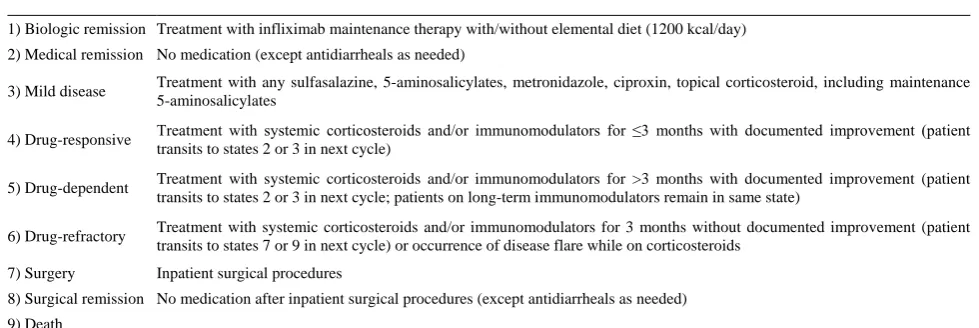
[image:2.595.309.539.82.329.2]A Markov cohort model was designed to assess the cost-effectiveness of combination therapy with IFX plus elemental diet for moderately to severely active CD. The model began in the initial state, and patients remained in the same state or transit to a possible subsequent state according to the transition probabilities at each cycle [15]. As shown in Figure 1, our model has nine Markov states: biologic remission, medical remission, mild disease, drug- responsive, drug-dependent, drug-refractory, surgery, sur-gical remission, and death. When the Markov cohort analysis was stopped at a projected endpoint, the total number of patient cycles for each state was divided by the person-years of the original cohort. Finally, the ex-pected time and cost that each patient incurred in each state was added to estimate total quality-adjusted life
Figure 1.Structure of Markov cohort model for the cost-effec- tiveness analysis of treatments for Crohn’s disease.
years (QALYs) and total cost. In our model, treatment with IFX alone, combination therapy with IFX plus ele-mental diet, and nonbiologic therapy were analyzed. Ta-ble 1 shows the definitions of the nine Markov states. They were defined by type of therapy used and by the magnitude of patient responses.
2.2. Assumptions
The model’s base-case consisted of a hypothetical co-hort of 30-year-old, 60-kg males with moderately to se-verely active CD that was refractory to conventional drug therapies. An age of 30 years was chosen as the entry age because CD onset typically occurs in the late teens to age 30 years [3].
All patients were assumed to have been diagnosed in the drug-refractory state and to have received intraven-ous infusion of IFX 5 mg/kg at week 0. Initial response to IFX was defined as a Crohn’s Disease Activity Index (CDAI) score of less than 150 points at week 2 after in-duction of the 5-mg/kg dose at baseline. We assumed that administration of IFX at 2 weeks and 6 weeks and every 8 weeks thereafter was continued for responders, i.e., those with a CDAI score less than 150 points.
Combination therapy consisted of consecutive admin-istration of IFX (every 8 weeks) and an elemental diet (Elental; Ajinomoto Pharma Co., Tokyo, Japan). For the elemental diet, patients are given 1200 kcal/day through a self-inserted tube and/or oral intake, which is known as the “half elemental diet” [16].
Table 1. Definition of Markov model treatment states according to requirements for medication and surgery in patients with Crohn’s disease.
1) Biologic remission Treatment with infliximab maintenance therapy with/without elemental diet (1200 kcal/day)
2) Medical remission No medication (except antidiarrheals as needed)
3) Mild disease Treatment with any sulfasalazine, 5-aminosalicylates, metronidazole, ciproxin, topical corticosteroid, including maintenance
5-aminosalicylates
4) Drug-responsive Treatment with systemic corticosteroids and/or immunomodulators for ≤3 months with documented improvement (patient
transits to states 2 or 3 in next cycle)
5) Drug-dependent Treatment with systemic corticosteroids and/or immunomodulators for >3 months with documented improvement (patient
transits to states 2 or 3 in next cycle; patients on long-term immunomodulators remain in same state)
6) Drug-refractory Treatment with systemic corticosteroids and/or immunomodulators for 3 months without documented improvement (patient
transits to states 7 or 9 in next cycle) or occurrence of disease flare while on corticosteroids
7) Surgery Inpatient surgical procedures
8) Surgical remission No medication after inpatient surgical procedures (except antidiarrheals as needed)
9) Death
occurred at initial infusion (i.e., at week 0) and that pa-tients who do not achieve remission at the initial admin-istration of IFX or in consecutive adminadmin-istrations of IFX would not be offered retreatment with IFX and that they would have the same prognosis as those receiving nonbi-ologic therapy. Nonbinonbi-ologic therapy included 5-amino- salicylic acid, antibiotics, immunomodulators, corticos-teroids, and surgical treatment.
Some recent studies have suggested that survival rates in patients with CD are similar to those of the general population, after adjustment for age and gender [17,18]. Therefore, the current analysis assumed that mortality in CD patients was equivalent to that of the general popula-tion of Japan.
2.3. Model Parameters
Transition probabilities, utilities, and costs were de-rived from published studies (Table 2). The response rate of 56.4% for initial administration of IFX was based on research by Matsumoto et al. [19]. The maintenance remission rates for combination therapy and therapy with IFX alone were assumed to be 78.1% and 35.1%, respec-tively, based on the findings of the ACCENT1 trial and Yamamoto et al. [4,6]. The rate of serious adverse ef-fects associated with IFX was assumed to be 10.0%, based on a systematic review of the literature, as pre-viously reported [20]. The age-specific death rates for the general population were estimated from the 2008 ab-ridged life table for Japan [21].
This study accounted for direct medical costs and prod-uctivity costs. Table 3 shows estimated direct medical costs and productivity costs at 3 months. Odes et al. [22] reported mean direct medical costs at 3 months for each health state of patients with CD. Then, we used these estimates of direct costs at 3 months and the transition probability for nonbiologic therapy. The productivity costs at different stages of CD were estimated using data
from Mesterton et al. [23], who estimated the value of lost productivity using the human capital approach. Ac-cording to this approach, the cost of reduced productivity in a patient is the amount employers would be willing to pay for the lost output. All costs were converted into US dollars using 2008 exchange rates reported by the Or-ganization for Economic Co-operation and Development [24].
The primary effectiveness measure in this study was QALYs. Estimated values, which reflect quality of life for various CD health states, were assigned, and QALYs represents the sum of the values. The values for health- related quality of life, which varied from 0 (death) to 1 (perfect health), are taken from Mesterton et al. [23], who examined the estimated health-state preferences of CD patients (n = 420) using the 15D instrument in Swe-den. We could not obtain the evidence of health-state preferences associated with IFX in CD. Therefore, a util-ity of 0.95 was assumed in this study. Other utilities were estimated from the work of Kaplan et al [11]. Costs and benefits were discounted at a rate of 3% per year in the base-case analysis [27].
2.4. Cost-Effectiveness Analysis
The overall costs and QALYs for patients with CD were calculated for a 10-year (3-month/cycle) follow-up period in the cost-effectiveness analysis. Cost-effectiveness was evaluated by using the incremental cost-effective- ness ratio (ICER), i.e., the ratio of increments in costs to increments in QALYs. An ICER lower than $80,000 was defined as cost-effective, based on Kaplan’s criteria [11]. In cost-effectiveness analysis, when a new protocol or treatment shows superior effectiveness and reduced cost, it is referred to as dominant.
Table 2. Model input parameters.
Parameter estimate Value Range Reference
Transition probabilities
IFX* initial response rate (2 weeks later) 0.564 0.371 - 0.756 [19]
Maintenance remission rate IFX alone
Maintenance of remission at 1 year 0.350 0.249 - 0.451 [4]
3-month rate 0.769 0.706 - 0.819
Combination therapy
Maintenance of remission at 1 year** 0.781 0.638 - 0.924 [4,6]
3-month rate 0.940 0.894 - 0.981
Adverse effect associated with IFX
Serious adverse effect 0.100 0.036 - 0.160 [20]
Death due to serious adverse effect 0.004 0.000 - 0.010 [20]
Mortality
Age-specific death rates 2008 life-table [21]
Nonbiologic therapy
Medical remission to mild disease 0.054 [22]
Medical remission to drug-responsive 0.037 [22]
Medical remission to drug-dependent 0.011 [22]
Medical remission to drug-refractory 0.126 [22]
Medical remission to surgery 0.210 [22]
Mild disease to medical remission 0.033 [22]
Mild disease to drug-responsive 0.021 [22]
Mild disease to drug-dependent 0.010 [22]
Mild disease to drug-refractory 0.020 [22]
Mild disease to surgery 0.011 [22]
Mild disease to death 0.001 [22]
Drug-responsive to medical remission 0.167 [22]
Drug-responsive to mild disease 0.497 [22]
Drug-responsive to drug-refractory 0.134 [22]
Drug-responsive to surgery 0.020 [22]
Drug-dependent to medical remission 0.121 [22]
Drug-dependent to mild disease 0.379 [22]
Drug-refractory to medical remission 0.019 [22]
Drug-refractory to mild disease 0.041 [22]
Drug-refractory to drug-responsive 0.001 [22]
Drug-refractory to surgery 0.032 [22]
Drug-refractory to death 0.001 [22]
Surgery to mild disease 0.421 [22]
Surgery to drug-responsive 0.167 [22]
Surgery to drug-dependent 0.040 [22]
Surgery to drug-refractory 0.105 [22]
Surgery to surgical remission 0.180 [22]
Surgical remission to mild disease 0.039 [22]
Surgical remission to drug-responsive 0.014 [22]
Surgical remission to drug-dependent 0.002 [22]
Surgical remission to drug-refractory 0.005 [22]
Surgical remission to surgery 0.025 [22]
Surgical remission to death 0.002 [22]
Quality of life utilities
Biologic remission 0.95 0.92 - 0.98
Medical remission 0.92 [23]
Mild disease 0.91 [23]
Drug-responsive 0.90 [23]
Drug-dependent 0.82 [23]
Drug-refractory 0.81 [23]
Surgery 0.77 [23]
Surgical remission 0.86 [11]
Death 0
Cost of drug and infusions ($)
IFX (100-mg vial) 580.94 [25]
Administration of intravenous infusion 193.00 [11]
Elental (300-kcal pack) 5.06 [26]
Discount rate (%) 3 0 - 5 [27]
*
Table 3. Estimated cost at 3 months.
Treatment states Direct medical cost [22] Productivity cost [23] Total cost ($)
Biologic remission
IFX* alone 3402 794 4196
Combination therapy 5244 794 6038
Medical remission 256 794 1050
Mild disease 440 1584 2024
Drug-responsive 2818 2374 5192
Drug-dependent 1435 3399 4834
Drug-refractory 1119 3765 4884
Surgery 9719 13,357 23,076
Surgical remission 331 794 1125
*
IFX, Infliximab.
one-way sensitivity analyses were conducted by varying the parameters for patient body weight, follow-up period, baseline age, response rate to initial administration of IFX, maintenance remission rate, serious adverse effect rate, and utility of biologic remission state.
All analyses were performed using the TreeAge Pro 2009 software program (TreeAge Software, Williams-town, MA, USA).
3. RESULTS
3.1. Base-Case Analysis
Costs, QALYs, and ICERs were calculated for each treatment strategy by using base-case analysis (Table 4). Therapy with IFX alone was superior to nonbiologic therapy in cost and QALY. Combination therapy yielded an additional 0.252 QALY at an additional cost of $18,522 as compared with nonbiologic therapy. The resulting ICER of combination therapy versus nonbiologic therapy was estimated at $73,500/QALY, which is lower than $80,000. Therefore, combination therapy was cost-effective in com- parison with nonbiologic therapy (Table 4). However, compared to IFX alone, the combination therapy would not to be perceived as a cost-effective strategy for mod-erately to severely active CD.
3.2. Sensitivity Analysis
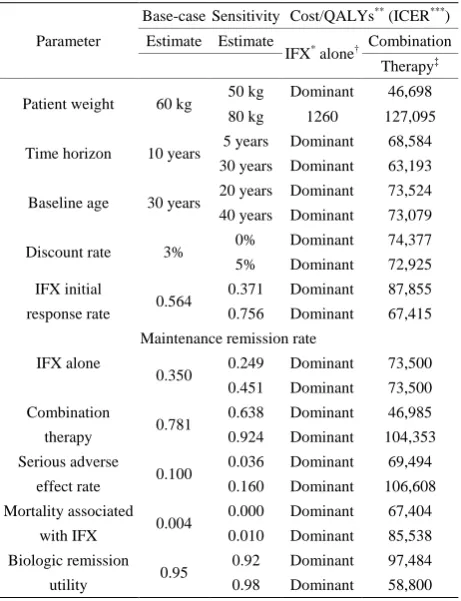
Table 5 shows the results of sensitivity analysis. For all parameters except patient body weight, therapy with IFX alone resulted in more QALYs and lower cost. Ther-apy with IFX alone was the dominant strategy in com-parison with nonbiologic therapy.
[image:5.595.309.539.289.369.2]One-way sensitivity analyses confirmed that the re-sults remained in the range of $46,698 to $127,095 at 10 years for combination therapy when patient body weight changed. This suggests that patient body weight is the most important factor in ICER for both combination ther-apy and therther-apy with IFX alone. The maintenance remis-sion rate was also an important parameter for ICER in
Table 4. Base-case analysis in Markov model, by treatment strategy.
Nonbiologic therapy IFX* alone Combination therapy
Cost ($) 120,415 117,111 138,522
Difference −3304 18,522
QALYs** 7.458 7.608 7.71
Difference 0.15 0.252
ICERs*** Dominant 73,500
*IFX, Infliximab; **QALYs, Quality-adjusted life years; ***ICER,
[image:5.595.309.540.416.717.2]Incre-mental cost-effectiveness ratio.
Table 5. Sensitivity analysis of important variables.
Parameter
Base-case Sensitivity Cost/QALYs** (ICER***)
Estimate Estimate
IFX* alone† Combination
Therapy‡
Patient weight 60 kg 50 kg Dominant 46,698
80 kg 1260 127,095
Time horizon 10 years 5 years Dominant 68,584
30 years Dominant 63,193
Baseline age 30 years 20 years Dominant 73,524
40 years Dominant 73,079
Discount rate 3% 0% Dominant 74,377
5% Dominant 72,925
IFX initial
0.564 0.371 Dominant 87,855
response rate 0.756 Dominant 67,415
Maintenance remission rate IFX alone
0.350 0.249 Dominant 73,500
0.451 Dominant 73,500
Combination
0.781 0.638 Dominant 46,985
therapy 0.924 Dominant 104,353
Serious adverse
0.100 0.036 Dominant 69,494
effect rate 0.160 Dominant 106,608
Mortality associated
0.004 0.000 Dominant 67,404
with IFX 0.010 Dominant 85,538
Biologic remission
0.95 0.92 Dominant 97,484
utility 0.98 Dominant 58,800
†
Base-case = Dominant; ‡Base-case = 73,500; *IFX, Infliximab; **QALYs,
combination therapy.
4. DISCUSSION
The results of our model indicate that combination therapy with IFX plus elemental diet was more cost-ef- fective than nonbiologic therapies for moderately to se-verely active CD, but more costly than IFX alone thera-py.
Several studies have attempted to estimate the cost- effectiveness of IFX for patients with CD [10-14]. Using appropriate assumptions regarding cost estimation and survival times for certain health states, a French lifetime cost-utility analysis of IFX reported that IFX therapy could be cost-effective in cases of relapse after first infu-sion only, although the ICER exceeded the predetermined threshold value according to their criteria for mainten-ance therapy [10]. In contrast, Lindsay et al. performed a cost-effectiveness analysis using a Markov model of hy-pothetical 60-kg adult CD patients treated with IFX (5 mg/kg every 8 weeks) based on the regimen in the AC-CENT1 trial and found that IFX maintenance therapy was cost-effective for both active luminal and fistulizing CD [12]. They used an ICER threshold of £30,000 for the definition of cost-effective based on the criteria of the National Institute for Health and Clinical Excellence in the United Kingdom. As a result, the scheduled adminis-tration of IFX for maintaining remission was considered cost-effective in the treatment of CD in the United King-dom.
Productivity cost is very important in evaluating cost- effectiveness among patients with CD, because the onset of CD nearly always occurs in the third decade of life, when patients are in their prime. Therefore, our cost- effectiveness analysis also included productivity costs and showed that therapy with IFX alone was dominant when compared with nonbiologic therapy.
Sensitivity analyses were performed by varying each base-case input parameter to assess variability of the model results. In one-way sensitivity analysis, a single variable is tested over its range of plausible values while all other variables remain constant. Body weight of CD patients was an important parameter affecting cost-ef- fectiveness. Because of the weight-based dosing of IFX, patient weight had the greatest impact on the ICER, which increased to $127,095 for combination therapy for an 80-kg patient. The other variable that affected ICER was the maintenance remission rate for combination ther-apy. Use of IFX and Elental markedly increased as the maintenance remission rate rose.
Some studies have investigated the long-term efficacy of the elemental diet for CD. The elemental diet was useful in maintaining remission and significantly reduced clinical and endoscopic recurrence after resection in pa-tients with CD [16,28,29]. In Japan, the elemental diet
has been the first-line therapy for both active and quies-cent CD, in accordance with the guidelines established by the Ministry of Health, Labour and Welfare; 38.1% and 27.2% of Japanese patients with CD were treated with an elemental diet and IFX therapy, respectively, in 13 university hospitals in 2009. Although the 1-year main-tenance remission rates in CD patients treated with IFX maintenance therapy plus elemental diet versus IFX maintenance therapy alone were 78% and 67%, respec-tively, the difference was not statistically significant [6]. However, the enhanced effectiveness of biologic therapy with concomitant elemental diet should reduce the need for further medications and thus spare patients from ad-verse effects associated with long-term drug use. There-fore, the effectiveness of combination therapy with IFX and elemental diet should be assessed in large-scale stu-dies with longer follow-up periods.
Although IFX is effective for patients with moderately to severely active CD, loss of response to the 5-mg/kg dose can occur. In our analysis, initial responders who lost response after stopping IFX treatment were switched back to nonbiologic therapy without IFX. However, in clinical practice, these patients receive escalating doses of IFX (to 10 mg/kg), a reduction in dose interval to every 4 or 6 weeks, or an alternative anti-TNF-α agent such as adalimumab or certolizumab pegol [8,30,31]. The IFX double-dosing and shortened dose-interval re-gimens were not included in this analysis because there are few data to support their efficacy.
Future cost-effectiveness analyses of CD are needed to determine the effectiveness of other biologics and regi-mens.
5. CONCLUSION
Combination therapy with IFX plus elemental diet appears not to be a cost-effective treatment for mod-erately to severely active CD.
ACKNOWLEDGEMENTS
This study was funded by a grant from the association of Platform for Clinical Information Statistical Analysis (NTT DATA Co., Tokyo, Japan). We also thank David Kipler for reviewing the language of the manuscript.
REFERENCES
[1] Colombel, J.F., Sandborn, W.J., Reinisch, W., Mantzaris, G.J., Kornbluth, A., Rachmilewitz, D., Lichtiger, S., D’Haens, G., Diamond, R.H., Broussard, D.L., Tang, K.L., van der Woude, C.J., Rutgeerts, P. and SONIC Study Group (2010) Infliximab, azathioprine, or combi- nation therapy for Crohn’s disease. New England Journal of Medicine, 362, 1383-1395.
[2] Lofts Jr., E.V. (2004) Clinical epidemiology of inflam- matory bowel disease: Incidence, prevalence, and envi- ronmental influences. Gastroenterology, 39, 1504-1507. http://dx.doi.org/10.1053/j.gastro.2004.01.063
[3] Japan Intractable Diseases Research Foundation (2010) Intractable Diseases Information Center.
http://www.nanbyou.or.jp
[4] Hanauer, S.B., Feagan, B.G., Lichternstein, G.R., Mayer, L.F., Schreiber, S., Colombel J.F., Rachmilewitz, D., Wolf, D.C., Olson, A., Bao, W., Rutgeerts, P. and ACCENT I Study Group (2002) Maintenance infliximab for Crohn’s disease. The ACCENT 1 randomised trial. Lancet, 359, 1541-1549.
http://dx.doi.org/10.1016/S0140-6736(02)08512-4
[5] Tanaka, T., Takahama, K., Kimura, T., Mizuno, T., Naga- saka, M., Iwata, K., Nakano, H., Muramatsu, M. and Ta- kazoe, M. (2006) Effect of concurrent elemental diet on infliximab treatment for Crohn’s disease. Journal of Gas- troenterology and Hepatology, 21, 1143-1149.
http://dx.doi.org/10.1111/j.1440-1746.2006.04317.x
[6] Yamamoto, T., Nakahigashi, M., Umegae, S. and Matsu- moto, K. (2010) Prospective clinical trial: Enteral nutri- tion during maintenance infliximab in Crohn’s disease.
Journal of Gastroenterology, 45, 24-29. http://dx.doi.org/10.1007/s00535-009-0136-5
[7] Yu, A.P., Cabanilla, L.A. and Wu, E.Q. (2008) The costs of Crohn’s disease in the United States and other Western countries: A systematic review. Current Medical Research and Opinion, 24, 319-328.
http://dx.doi.org/10.1185/030079908X260790
[8] Lichtiger, S., Binion, D.G., Wolf, D.C., Present, D.H., Bensimon, A.G., Wu, E., Yu, A.P., Cardoso, A.T., Chao, J., Mulani, P.M., Lomax, K.G. and Kent, J.D. (2010) The CHOICE trial: Adalimumab demonstrates safety, fistula healing, improved quality of life and increased work productivity in patients with Crohn’s disease who failed prior infliximab therapy. Alimentary Pharmacology & Therapeutics, 32, 1228-1239.
http://dx.doi.org/10.1111/j.1365-2036.2010.04466.x
[9] Munkholm, P., Langholz, E., Davidsen, M. and Binder, V. (1995) Disease activity courses in a regional cohort of Crohn’s disease patients. Scandinavian Journal of Gas- troenterology, 30, 699-706.
http://dx.doi.org/10.3109/00365529509096316
[10] Jaisson-Hot, I., Flourié, B., Descos, L. and Colin, C. (2004) Management for severe Crohn’s disease: A life- time cost-utility analysis. International Journal of Tech- nology Assessment in Health Care, 20, 274-279.
http://dx.doi.org/10.1017/S0266462304001084
[11] Kaplan, G.G., Hur, C., Korzenik. J. and Sands, B.E. (2007) Infliximab dose escalation VS. initiation of adali-mumab for loss of response in Crohn’s disease: A cost- effectiveness analysis. Alimentary Pharmacology & The- rapeutics, 26, 1509-1520.
http://dx.doi.org/10.1111/j.1365-2036.2007.03548.x
[12] Lindsay, J., Punekar, Y.S., Morris, J. and Chung-Faye, G. (2008) Health-economic analysis: Cost-effectiveness of scheduled maintenance treatment with infliximab for Crohn’s disease—Modeling outcomes in active luminal
and fistulizing disease in adults. Alimentary Pharmacol- ogy & Therapeutics, 28, 76-87.
http://dx.doi.org/10.1111/j.1365-2036.2008.03709.x
[13] Bodger, K., Kikuchi, T. and Hughes, D. (2009) Cost- effectiveness of biological therapy for Crohn’s disease: Markov cohort analyses incorporating United Kingdom patient-level cost data. Alimentary Pharmacology & Thera- peutics, 30, 265-274.
http://dx.doi.org/10.1111/j.1365-2036.2009.04033.x
[14] Punekar, Y.S., Sunderland, T., Hawkins. N. and Lindsay, J. (2010) Cost-effectiveness of Scheduled Maintenance Treatment with Infliximab for Pediatric Crohn’s Disease.
Value Health, 13, 188-195.
http://dx.doi.org/10.1111/j.1524-4733.2009.00658.x
[15] Nakamura, J., Toyabe, S.I., Aoyagi, Y. and Akazawa, K. (2008) Economic impact of extended treatment with pe- ginterferon α-2a and ribavirin for slow hepatitis C viro- logic responder. Journal of Viral Hepatitis, 15, 293-299. http://dx.doi.org/10.1111/j.1365-2893.2007.00943.x
[16] Takagi, S., Utsunomiya, K., Kuriyama, S., Yokoyama, H., Takahashi, S., Iwabuchi, M., Takahashi, H., Takahashi, S., Kinouchi, Y., Hiwatashi, N., Funayama, Y., Sasaki, I., Tsuji, I. and Shimosegawa, T. (2006) Effectiveness of an “half elemental diet” as maintenance therapy for Crohn’s disease: A randomized—Controlled trial. Alimentary Phar- macology & Therapeutics, 24, 1333-1340.
http://dx.doi.org/10.1111/j.1365-2036.2006.03120.x
[17] Jess, T., Loftus, E.V., Harmsen, W.S., Zinsmeister A.R., Tremaine, W.J., Melton III, L.J., Munkholm, P. and Sand- born, W.J. (2006) Survival and cause specific mortality in patients with inflammatory bowel disease: A long term outcome study in Olmsted Country, Minnesota, 1940- 2004. Gut, 4, 621-630.
[18] Lichtenstein, G.R., Feagan, B.G., Cohen, R.D., Salzberg, B.A., Diamond, R.H., Chen, D.M., Pritchard, M.L. and Sandborn W.J. (2006) Serious infections and mortality in association with therapies for Crohn’s Disease: TREAT registry. Clinical Gastroenterology and Hepatology, 4, 621-630. http://dx.doi.org/10.1016/j.cgh.2006.03.002 [19] Matsumoto, T., Iida. M., Motoya, S., Haruma, K., Suzuki,
Y., Kobayashi, K., Ito, H., Miyata M., Kusunoki, M., Chiba, T., Yamamoto, S. and Hibi, T. (2008) Therapeutic efficacy of infliximab on patients with short duration of Crohn’s disease: A Japanese multicenter survey. Diseases of the Colon & Rectum, 51, 916-923.
http://dx.doi.org/10.1007/s10350-008-9241-4
[20] Siegel, C.A., Hur, C., Korzenik, J.R. and Sands, B.E. (2006) Risk and benefits of infliximab for the treatment of Crohn’s disease. Clinical Gastroenterology and Hepa- tology, 4, 1017-1024.
http://dx.doi.org/10.1016/j.cgh.2006.05.020
[21] Tokyo Stastics and Information Department, Minister’s Secretariat, Ministry of Health, Labour, and Welfare (2010) Abridged life Table for Japan, 2008.
http://www.mhlw.go.jp/toukei/saikin/hw/life/life08/index. html
Langholz, E. (2010) Clinical and economic outcomes in a population-based European cohort of 948 ulcerative coli- tis and Crohn’s disease patients by Markov analysis. Ali- mentary Pharmacology & Therapeutics, 31, 735-744. http://dx.doi.org/10.1111/j.1365-2036.2009.04228.x
[23] Mesterton, J., Jönsson, L., Almer, S.H., Befrits, R., Friis- Liby, I. and Lindgren, S. (2009) Resource use and societ- al costs for Crohn’s disease in Sweden. Inflammatory Bowel Diseases, 15, 1882-1890.
http://dx.doi.org/10.1002/ibd.20939
[24] Organization for Economic Co-Operation and Develop-ment (2008) OECD economic outlook No. 87 annex tables—Table of contents 2008.
http://www.oecd.org/eco/outlook/economicoutlookannext ables.htm
[25] Yu, A.P., Johnson, S., Wang, S.T., Atanasov, P., Tang, J., Wu, E., Chao, J. and Mulani, P.M. (2009) Cost utility of adalimumab versus infliximab maintenance therapies in the United States for moderately to severely active Crohn’s disease. Pharmacoeconomics, 27, 609-621. http://dx.doi.org/10.2165/11312710-000000000-00000
[26] Ministry of Health, Labour and Welfare (2010) Various Information of Medical Fee.
http://www.iryohoken.go.jp/shinryohoshu/
[27] Weinsteins, M.C., Siegel, J.E., Gold, M.R., Kamlet, M.S. and Russell, L.B. (1996) Recommendations of the panel on cost-effectiveness in health and medicine. JAMA, 276, 1253-1258.
http://dx.doi.org/10.1001/jama.1996.03540150055031
[28] Verma, S., Kirkwood, B., Brown, S., Brown, S. and Giaf- fer, M.H. (2000) Oral nutritional supplementation is ef- fective in the maintenance of remission in Crohn’s dis- ease. Digestive and Liver Disease, 32, 769-774.
http://dx.doi.org/10.1016/S1590-8658(00)80353-9
[29] Yamamoto, T., Nakahigashi, M., Umedae, S., Kitagawa, T. and Matsumotom K. (2007) Impact of long-term enteral nutrition on clinical and endoscopic recurrence after re-section for Crohn’s disease: A prospective, non-random- ised, parallel, controlled study. Alimentary Pharmacology & Therapeutics, 25, 67-72.
http://dx.doi.org/10.1111/j.1365-2036.2006.03158.x
[30] Schreiber, S, Khaliq-Kareemi, M., Lawrance, I.C., Thom- sen, O.Ø. and Hanauer, S.B., McColm, J., Bloomfield, R., Sandborn, W.J., PRECISE 2 study investigators (2007) Maintenance therapy with certlizumab pegol for Crohn’s disease. New England Journal of Medicine, 357, 239-250. http://dx.doi.org/10.1056/NEJMoa062897
[31] Kopylov, U., Mantzaris, G.J., Katsanos, K.H., Reenaers, C., Ellul, P., Rahier, J.F., Israeli, E., Lakatos, P.L., Fiorino, G., Cesarini, M., Tsianos, E.V., Louis, E. and Ben-Horin, S. (2011) The efficacy of shortening the dosing interval to once every six weeks in Crohn’s patients losing response to maintenance dose of infliximab. Alimentary Pharma- cology & Therapeutics, 33, 349-357.