Feasibility study for genetic testing and SNP analysis in
infants
Madalynn Neu1, Marisa Ehringer2, Cassandra Marcheggiani-Howard1
1
College of Nursing, University of Colorado, Aurora Colorado, USA
2
Institute of Behavioral Genetics, University of Colorado, Boulder Colorado, USA
Email: [email protected], [email protected], [email protected]
Received 30 November 2013; revised 31 December 2013; accepted 21 January 2014
Copyright © 2014 Madalynn Neu et al. This is an open access article distributed under the Creative Commons Attribution License, which permits unrestricted use, distribution, and reproduction in any medium, provided the original work is properly cited. In accor-dance of the Creative Commons Attribution License all Copyrights © 2014 are reserved for SCIRP and the owner of the intellectual property Madalynn Neu et al. All Copyright © 2014 are guarded by law and by SCIRP as a guardian.
ABSTRACT
Purpose: Determine whether parents would consent to genotyping for temperament characteristics for their infants; establish that quality DNA is obtained from infants using a cheek swab. Design and Methods: Seventeen mother-father dyads and infants, 11 to 35 weeks of age, who had participated in a GERD (ga-stroesophageal reflux disease) massage study partici-pated in this feasibility study. Results: Seventy-one percent of parents agreed to genotyping. Most par- ents who participated were concurrently enrolled in the GERD massage study. Reasons provided for par- ticipating were support of research and the desire to help other families who had infants with GERD. Parents who participated also had higher educational attainment than those who declined. Reasons for de-clining were dislike of genetic research. All samples could be analyzed. Practice Implications. Many par- ents allowed genotyping, especially if currently en- gaged with research staff. Cheek swabs are a nonin-vasive and satisfactory method of DNA collection.
KEYWORDS
DNA; Infants; Temperament; Parent Consent
1. INTRODUCTION
Gastroesophageal reflux (GER), is the involuntary re-gurgitation of gastric contents into the esophagus and is common in infants. However, about one in four infants experience the more complicated form of GER, gastroe-sophageal reflux disease, called GERD [1]. GERD is characterized by frequent regurgitation, heightened irri-tability, and feeding difficulties, sometimes accompanied by back arching, cyanosis, and apnea [2]. The symptom
of irritability can result from a number of causes. Dis-comfort from acid reflux certainly is likely, butinfant crying and fussing have been shown to occur with bouts of both acid and nonacid reflux [3]. Thus, some infants may not experience pain with reflux but may perceive the sensation of reflux as discomforting. Anti-reflux me-dications relieve acid reflux but are not more effective than placebo in reducing crying in infants with GERD [4-6], suggesting that infant temperament characteristics, such as negativity (i.e. fussiness and crying) and toler-ance of discomfort, might play a role in irritability in infants with GERD. Several genes are reported to be associated with these temperament characteristics in in-fants: dopamine D4 receptor (gene symbol: DRD4), do-pamine transporter (gene symbol: DAT), Catechol-O- Methyltransferase (gene symbol: COMT), and the sero-tonin transporter (5-HTT, 5-hydroxytryptomine, gene symbol: SLC6A4) [7-11].
Before embarking on a large-scale genetic study in-vestigating temperament genes in infants with GERD, our research team conducted a feasibility study. Feasibil-ity studies often are necessary to determine whether a study can be conducted. Parameters of a feasibility study include willingness of participants to consent to the study, number of eligible participants that can be enrolled, de-signing a suitable outcome measure, and usability of data [12]. We designed the feasibility study to validate design and protocol for obtaining parental consent, and collect-ing and genotypcollect-ing DNA from infants uscollect-ing buccal swabs.
2. GENETIC TESTING
2.1. Potential Barriers to Parental Consent for Genetic Testing for Their Infants
have their infant’s DNA genotyped, creating possible barriers to consent. An obvious issue is that their infants cannot decide if they want their DNA genotyped. The parent must make the decision based on what they con-sider is in the best interest of the infant at the time they are consenting.
One potential barrier is that findings of this study would not lead to immediate diagnosis or treatment. Guidelines addressing genetic testing of minors clearly advocate that the main justification for testing is whether treatment is available [13]. Parents seem to support these guidelines. For example, when Danish parents (n = 397) were asked if they would participate in genetic research for their children related to risks for mental health dis-orders, only 30% said they would consent if no treatment was available [14]. Parents have expressed frustration and disappointment when genetic evaluation and testing leads to lack of a clear diagnosis or cause [15].
A second potential barrier is that parents would not be provided with individual genetic results of this feasibility study. Botkin [16] admonished that the purpose of re-search is not to provide results to individual participants but to advocate science and further asserted that when considering the disclosure of results to individual partic-ipants, the most important question is whether the infor-mation generated in the research has clinical significance [16]. When research is in the exploratory stages, report-ing results to the parents may not be beneficial. Never-theless, mothers have expressed that they want individual results of genetic studies of their children [15].
Lack of trust in researchers is a third potential barrier to consenting. Twenty-eight percent of mothers of new-borns (n = 177) mentioned fear that researchers would use the genetic samples for research other than what was specified in the consent, and that the researchers would not keep findings of the analysis of the samples confi-dential [17]. Jenkins et al. [15] also found maternal fear of disclosure of genetic findings.
Parental stress, especially in mothers, may be an addi-tional barrier to consent for genetic research. Mothers of infants with GERD have been reported to be more fru-strated and angry with their infants and believe that they are more problematic and demanding than mothers of other infants [18]. Our research team was therefore con-cerned that mothers (and fathers) trying to cope with an infant with GERD may agree to participate in a study providing an intervention to decrease GERD symptoms, but may be less willing to allow time for a study that had no potential for immediately helping the infants.
2.2. DNA Sampling Techniques in Infants
Collection of DNA using buccal swabs offers advantages to blood sampling and swabs are being used more
fre-quently because of the ease of collection and lack of discomfort [19]. Buccal cells are obtained by rotating a soft cotton swab or stiffer brush in the cheek of the infant. The swabs are then stored in solutions in which the DNA remains stable for many years [19]. Parents or non- medical research assistants are capable of collecting buccal samples, but need training. In one study, mothers of 39 infants collected DNA at home using buccal swabs and returned samples by mail. Eleven percent of the samples could not be genotyped due to low cell counts. To maximize the potential of collecting an adequate amount of DNA, thorough training in collection methods is necessary [20]. Another possible disadvantage to buc-cal swab collection is that they may yield insufficient quantity for studies examining multiple genes [21].
The aims of this study were to 1) to determine whether parents would consent to have DNA collected by cheek (buccal) swab from their infants for genotyping for tem-perament characteristics, and 2) to establish that an ade-quate amount of DNA could be obtained from infant buccal swabs for genotyping the four genes of interest.
3. MATERIALS AND METHODS
This feasibility study was done with parents from an ex-isting six-week GERD intervention study using massage therapy. Buccal swabs were obtained from a subsample of infants who were a part of this study. The massage intervention study was a randomized control trial with a goal of 34 infants. Infants were 4 to 12 weeks at enroll-ment, healthy at birth, and diagnosed with GERD by the infant’s pediatric provider. Infants were ineligible if; they required major surgery, had a chronic illness other than GERD, a congenital anomaly, symptoms of cow’s milk allergy, or bilious or projectile vomiting
3.1. Sample and Recruitment
Recruitment for this feasibility study occurred from two groups, parents of infants who had completed the mas-sage study for GERD (COMPL) and used directly for the production of any commercial product b) reports about the research done with their infant’s sample would not be kept in the infant’s health records, but couldbe kept with the study records or in other secure areas; c) the saliva sample would be de-identified; and d) they would not be informed of the results of the research.
col-lection using buccal swabs was explained. Mothers were informed that the DNA would be destroyed after geno-typing and that they would not receive individualized information about the findings from this genetic study on temperament.
3.2. DNA Procedures Collection
All identifying information was collected by the research team. Only members of that team had access to identify-ing information. Subject IDs were assigned to all genetic data, which was linked with laboratory IDs. The PI (MN) was blinded to the genetic data associated with a subject ID, and the geneticist (ME) and laboratory assistant were blinded to any identifying information (name, birth date etc.).
Three research assistants (RAs), who were nursing students, were trained to collect the DNA using buccal swabs in an in-house kit that the geneticist has used suc-cessfully with older children. To avoid contamination, the samples were obtained using sterile technique. All DNA samples were obtained in the homes of the infants. While the RA explained the genetic consent to parents, she interacted with the infant as much as possible before collecting the DNA. The mother was present while the DNA was obtained. To insure that an adequate amount of buccal cells were obtained, two separate swabbings were done. Each collection consisted of having the infant suck briefly on the swab (to moisten the swab), then the RA gently rolled the swab against the inside of the in-fant’s cheek to obtain cheek cells. The two swabs for each infant were placed immediately in a plastic tube containing a lysis solution to insure stability of the DNA until it was genotyped. This method has been used pre-viously by our group with adult sampling [22]. Samples were stored at room temperature. No special storage was needed. DNA collection was conducted from April through August, 2011and genotyping was completed in September 2011. DNA was isolated using a standard alkaline-lysis protocol. DNA concentrations were deter-mined using a Qubit Fluorometer and PicoGreen assays. DNA recovery amounts ranged from 120 ng to 3.2 ug, which is typical for buccal swab collections.
3.3. Protocol for SNP Genotyping
TaqMan assays were used for SNP genotyping according to the manufacturer’s instructions (Applied Biosystems, Foster City, California) previously described by Hoft, et al. [23]. Polymerase Chain Reaction (PCR) reactions were set up with a Biomek® 3000 Laboratory Automa-tion WorkstaAutoma-tion (Beckman Coulter Inc, Brea, California) and cycled in an ABI GeneAmp® 9700 PCR thermocyc-ler (Applied Biosystems, Foster City, California) or ABI PRISM® 7900 thermocycler (Applied Biosystems, Foster
City, California). Standard cycling parameters were used: 50˚C, a 95˚C hot start, followed by 50 cycles of 92˚C for 15 seconds, 60˚C 1 minute, and then 4˚C hold. The ABI PRISM® 7900 was used to analyze PCR products. In-itially, the genotype clusters were identified automati-cally by the Applied Biosystems TaqMan® Genotyper software (Applied Biosystems, Foster City, California), then independently validated by two genetic technicians DNA samples with overall call rates <90% (failed on >10% of the SNPs genotyped) were excluded. Since there were very few samples in this study, we used in-house control DNAs from another project in order to run 96 samples together and thus provide improved clus-tering. At least three wells containing only water were included on each plate.
4. RESULTS
4.1. Sample
Mean age of infants at the time of DNA collection was 10.2 months (SD = 0.9) in the COMPL and 11.9 weeks (SD = 2.6) in the ENROL group. Ethnicity of the infants was European/American except for two infants whose fathers were Asian and one whose father was Hispanic. Characteristics of parents who consented and declined are presented inTable 1.
4.2. Aim 1: Consent Agreement
Of 24 parents approached, 17 (71%) agreed to participate. Four parent-dyads did not have valid contact information from the COMPL pool, leaving nine parent-dyads avail-able in that group. Phone messages left for five of the remaining nine dyads were not returned after three con-tact attempts. The four remaining parent-dyads agreed to the genotyping. The next consecutive 15 parents of the ENROL group were approached for informed consent.
research. Two of these mothers were employed in re-search activities. Other mothers (n = 13) stated that they wanted to help families dealing with infant GERD and two mothers did not provide a reason.
4.3. Aim 2: Buccal Collection and Quality of DNA
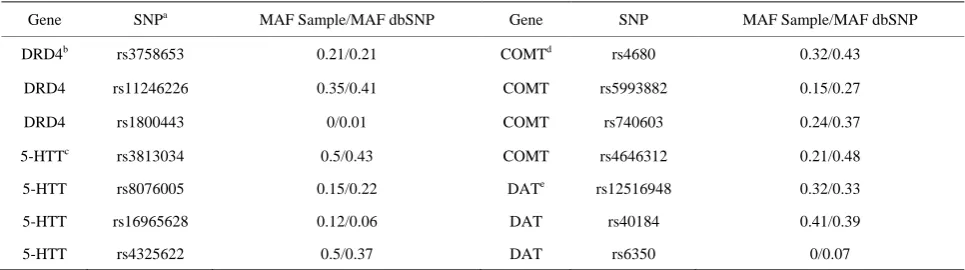
All 17 buccal samples were of sufficient quality to be analyzed from the two swabbings. No difficulties were encountered during the collection procedure. The young-er infants sucked on the swabs, but wyoung-ere quiet during the collection. Older infants reached for the swabs as the RA approached their mouths, but were accepting of the pro-cedure. Genotypes were obtained for all SNPs for all subjects. A single nucleotide polymorphisms (SNP) is a variation that occurs naturally in DNA. SNPs are com-monly used as markers to facilitate the location of genes associated with specific behaviors or disease [24]. Table 2 presents a summary of SNPs genotyped and 16 minor allele frequencies (MAF) observed in the 17 subjects, along with the MAF listed in a public dbSNP, a catalog of common SNPs
(http://www.ncbi.nlm.nih.gov/projects/SNP/).
5. DISCUSSION
5.1. Parental Consent
Well over half (71%) of parents allowed DNA collection
and genotyping of their infants. While most parents enrolling in the massage study consented (ENROL), less than half of parents from the COMPL group agreed. Be-cause parents in the COMPL group who did not partici-pate in this feasibility could not be reached after three attempts we were unable to ascertain their reasons for declining to return our phone calls. However, the fact that these parents did not even respond to phone calls and e-mails suggests total disengagement from the re-search team. Conversely, parents in the ENROL group had current contact with the Research Coordinator (who assisted with recruitment) and the research team. This suggests that positive engagement with the research team may have influenced the decision to participate in the genetics study as reported by others [25,26].
In the ENROL group, mothers stated while enrolling in the intervention study that they did not like genetic research.
[image:4.595.58.540.455.541.2]Mothers in parent dyads who agreed to participate ei-ther were supportive of research or wanted to help oei-thers. These altruistic reasons were similar to those voiced by mothers (n = 239) in a postpartum unit whose primary reason for participating was their belief that findings of the research would result in effective treatment for ge-netic disorders [17]. Adults who participated in gege-netic research also expressed that their willingness to partici-pate was based on benefitting society and contributing to the common good [27,28].
Table 1. Characteristics of parents of infants who consented and declined.
Characteristic Consented (n = 17) Declined (n = 7)
Mean maternal age 32.6 30.4
Mean maternal education (years)** 17.1 14.1
Mean paternal age 33.0 34
Mean paternal education (years)* 16.9 14.9
*p < 0.05; **p < 0.01.
Table 2. Minor allele frequencies observed for 16 snps in sample (n = 17).
Gene SNPa MAF Sample/MAF dbSNP Gene SNP MAF Sample/MAF dbSNP
DRD4b rs3758653 0.21/0.21 COMTd rs4680 0.32/0.43
DRD4 rs11246226 0.35/0.41 COMT rs5993882 0.15/0.27
DRD4 rs1800443 0/0.01 COMT rs740603 0.24/0.37
5-HTTc rs3813034 0.5/0.43 COMT rs4646312 0.21/0.48
5-HTT rs8076005 0.15/0.22 DATe rs12516948 0.32/0.33
5-HTT rs16965628 0.12/0.06 DAT rs40184 0.41/0.39
5-HTT rs4325622 0.5/0.37 DAT rs6350 0/0.07
a.SNP = single nucleotide polymorphisms; b. DRD4 = dopamine D4 receptor gene; c. 5-HTT = 5-hydroxytryptomine gene; d. COMT = Catechol-O-Methyl-
[image:4.595.56.539.581.716.2]Only one mother in the COMPL group asked about tracing identity from DNA. Five parent-dyads requested one or two days to consider the study before consenting. It is possible that the fact that parents knew that the sam-ples would be destroyed after collection and that only a few genes would be examined, lessened concerns about participating, although no-one stated this as a reason. The study was conducted by a research team from a large medical campus. Other research indicates that individu-als are more likely to consent to genetic research when approached by a medical professional than a lay person [29], or medical personnel who they have determined are experts in their condition [26,30]. The fact that research was conducted through a large university may have in-dicated to the participants that members of the research team were experts in infant GERD and in genetics.
A barrier that had not been considered by the research team was education level of the parents. Education level of both mothers and fathers were higher in the group that consented versus the group that declined. Mean educa-tional level of parents who consented was at the graduate level versus partial college for parents who declined. Other research has shown that individuals who are more highly educated (college) had more knowledge about genetic research than less educated individuals [31]. Perhaps having more knowledge of genetic research re-sults in a more positive attitude toward participating in genetic studies.
5.2. Aim 2: Quality of DNA
The second aim was to establish that an adequate amount of high quality DNA could be obtained from infants from a cheek swab. The quality of the DNA obtained from two buccal swabs from all 17 infants was usable when geno-typed. These findings are similar to the success reported by Erickson et al. [20] who used a buccal brush and Sziller et al. [32] who used buccal swabs.
The minor allele frequencies were similar to those listed in the major SNP database (dbSNP;
http://www.ncbi.nlm.nih.gov/SNP/), indicating the
qual-ity of the data are consistent with what is already known about these SNPs. No issues arose from swabbing, and storage of the buccal specimens was more convenient than the temperature controlled requirements of many other biological specimens.
This study showed that many parents (71%) are will-ing to have their infant’s DNA genotyped for research, even for temperament and a condition such as GERD that is not life threatening. Specific reasons for declining contact with the research team were not provided by parents, resulting in responses from only two parents who expressed dislike of genetic research and this is a limitation. Another limitation is that fathers’ opinion of genetic research was not obtained. Agreement to consent,
however, was higher in parents who were highly edu-cated, engaged with the research team, supported re-search, and wanted to help others.
Findings suggested that it is feasible to genotype DNA from infants using buccal swabs for four genes that have been found to be associated with temperament in infants [7-11]. Buccal swabbing can decrease the likelihood of discomfort and increase the parent’s interest in partici-pating. While the quality of DNA from buccal sampling was very good in this study, it was not compared to blood samples of Lehman et al. [21]. A comparison be-tween buccal swabs and blood samples would have strengthened findings of this study.
6. CONCLUSION
Feasibility studies are important prior to conducting stu-dies where issues like availability of subjects or quality of procedures for data collection are not known. Nurses conducting research involving parents of infants should be confident that parents in their target population are willing to participate in this type of research. Feasibility of collecting an adequate amount of DNA (for the spe-cific genes of interest) and for the laboratory methods used for genotyping, also is important. Whether to use buccal swabs or blood samples for collection of DNA continues to undergo study. Given that blood samples are the “gold standard” for DNA collection in infants, more head to head studies are needed to confidently use buccal instead of blood samples.
REFERENCES
[1] Nelson, S.P., Chen, E.H., Syniar, G.M. and Christoffel, K.K. (1997) Prevalence of symptoms of gastroesophageal reflux during infancy. A pediatric practice-based survey. ArchivesofPediatricandAdolescentMedicine, 151, 569- 572. http://dx.doi.org/10.1001/archpedi.154.2.150
[2] Sherman, P.M., Hassall, E., Fagundes-Neto, U., Gold, B.D., Kato, S., Koletzko, S. and Vandenplas, Y. (2009) A global, evidence-based consensus on the definition of ga- stroesophageal reflux disease in the pediatric population. AmericanJournalofGastroenterology, 104, 1278-1295. http://dx.doi.org/10.1038/ajg.2009.129
[3] Condino, A.A., Sondheimer, J., Pan, Z., Gralla, J., Perry, D. and O’Connor, J. (2006) Evaluation of infantile acid and nonacid gastroesophageal reflux using combined pH monitoring and impedance measurement. JournalofPe- diatricGastroenterologyandNutrition, 42, 16-21. http://dx.doi.org/10.1097/01.mpg.0000188008.66752.72 [4] Jordan, B., Heine, R.G., Meehan, M., Catto-Smith, A.G.
and Lubitz, L. (2006) Effect of antireflux medication, placebo and infant mental health intervention on persis- tent crying: A randomized clinical trial. JournalofPae- diatricsandChildHealth, 42, 49-58.
M.L. and Davidson, G.P. (2003) Double-blind placebo- controlled trial of omeprazole in irritable infants with ga-stroesophageal reflux. Journal of Pediatrics, 143, 219- 223. http://dx.doi.org/10.1067/S0022-3476(03)00207-5
[6] Neu, M., Corwin, E., Lareau, S.C. and Marchegianni- Howard, C. (2011) A review of nonsurgical treatment for the symptom of irritability in infants with GERD. Journal forSpecialistsinPediatricNursing, 17, 177-192. http://dx.doi.org/10.1111/j.1744-6155.2011.00310.x [7] De Luca, A., Rizzardi, M., Buccino, A., Alessandroni, R.,
Salvioli, G.P., Filograsso, N. and Dallapiccola, B. (2003) Association of dopamine D4 receptor (DRD4) exon III repeat polymorphism with temperament in 3-year-old in- fants. Neurogenetics, 4, 207-212.
http://dx.doi.org/10.1007/s10048-003-0146-z
[8] Ebstein, R.P., Levine, J., Geller, V., Auerbach, J., Grit- senko, I. and Belmaker, R.H. (1998) Dopamine D4 re- ceptor and serotonin transporter promoter in the determi- nation of neonatal temperament. MolecularPsychiatry, 3, 238-246.
http://dx.doi.org/10.1111/j.1601-183X.2010.00669.x
[9] Kim, S.J., Kim, Y.S., Lee, H.S., Kim, S.Y. and Kim, C.H. (2006) An interaction between the serotonin transporter promoter region and dopamine transporter polymor- phisms contributes to harm avoidance and reward depen- dence traits in normal healthy subjects. JournalofNeural Transmission, 113, 877-886.
http://dx.doi.org/10.1007/s00702-006-0444-3
[10] Posner, M.I. and Rothbart, M.K. (2009) Toward a physi- cal basis of attention and self-regulation. PhysicsofLife Reviews, 6, 103-120.
http://dx.doi.org/10.1016/j.plrev.2009.02.001
[11] Sheese, B.E., Voelker, P., Posner, M.I. and Rothbart, M.K. (2009) Genetic variation influences on the early development of reactive emotions and their regulation by attention. CognitiveNeuropsychiatry, 14, 332-355. http://dx.doi.org/10.1080/13546800902844064
[12] Arain, M., Campbell, M.J., Cooper, C.L. and Lancaster, G.A. (2010) What is a pilot or feasibility study? A review of current practice and editorial policy. BMC Medical ResearchMethodology, 10, 67.
http://dx.doi.org/10.1186/1471-2288-10-67
[13] Borry, P., Stultiens, L., Nys, H., Cassiman, J.J. and Die- ridkx, K. (2006) Presymptomatic and predictive genetic testing in monors: A systematic review of guidelines and position papers. ClinicalGenetics, 70, 374-381.
http://dx.doi.org/10.1111/j.1399-0004.2006.00692.x
[14] Laegsgaard, M.M., Kristensen, A.S. and Mors, O. (2009) Potential consumers’ attitudes toward psychiatric genetic research and testing and factors influencing their inten- tions to test. GeneticTestingandMolecular Biomakers, 13, 57-65. http://dx.doi.org/10.1089/gtmb.2008.0022 [15] Jenkins, M., Reed-Gross, E., Barfield, W.D., Prue, C.E.
Gallagher, M.L., Rasmussen, S.A. and Honein, M.A. (2011) Qualitative assessment of study materials and communi- cation strategies used in studies that include DNA collec- tion. National Center on Birth Defects and Developmen- tal Disabilities, Centers for Disease Control and Preven- tion, Atlanta, USA.
[16] Botkin, J.R. (2010) Informed consent for genetic research. CurrentProtocolsinHumanGenetics, Chap 1.
http://dx.doi.org/10.1002/0471142905.hg0116s66 [17] Neidich, A.B., Joseph, J.W., Ober, C. and Ross, L.F. (2008)
Empirical data about women’s attitude towards a hypo- thetical pediatric biobank. American JournalofMedical GeneticsPartA, 146, 297-304.
http://dx.doi.org/10.1002/ajmg.a.32145
[18] Mathisen, B., Worrall, L., Masel, J., Wall, C. and She- pherd, R.W. (1999) Feeding problems in infants with ga-stro-oesophageal reflux disease: A controlled study. Jour- nalofPediatricChildHealth, 35, 163-169.
http://dx.doi.org/10.1046/j.1440-1754.1999.t01-1-00334.x [19] Rasmussen, S.A., Lammer, E.J., Shaw, G.M., Finnell,
R.H., McGhee Jr., R.E., Gallagher, M. and Murray, J.C. (2002) Integeration of DNA sample collection into a mul- ti-site birth defects case-control study. Teratology, 66, 177-184. http://dx.doi.org/10.1002/tera.10086
[20] Erickson, S.W., MacLoed, S.L. and Hobbs, C.A. (2012) Cheek swabs, SNP chips, and CNVs: assessing the quali-ty of copy number variant calls generated with subject- collected mail-in buccal brush DNA samples on a high density genotyping microarray. BMCMedical Genetics, 13, 13-51. http://dx.doi.org/10.1186/1471-2350-13-51 [21] Lehmann, A.S., Hass, D.M., McCormick, C.L., Skaar,
T.C. and Renbarger, J.L. (2011) Collection of human ge- nomic DNA from neonates: A comparison between um- bilical cord blood and buccal swabs. AmericanJournalof ObstetricsandGynecology, 204, 362, e1-e6.
http://dx.doi.org/10.1016/j.ajog.2010.12.013
[22] Anchordoquy, H.C., McGeary, C., Liu, L., Krauter, K.S. and Smolen, A. (2003) Genotyping of three candidate genes after whole-genome preamplification of DNA col- lected from buccal cells. BehavioralGenetics, 33, 73-78. http://dx.doi.org/10.1023/A:1021007701808
[23] Hoft, N.R., Stitzel, J.A., Hutchison, K.E. and Ehringer, M.A. (2011) CHRNB2 promoter region: Association with subjective effects to nicotine and gene expression differ-ences. Genes, BrainandBehavior, 10, 176-185. http://dx.doi.org/10.1111/j.1601-183X.2010.00650.x [24] Lewis, R. (2011) Human genetics: Concepts and applica-
tions. 10th Edition, McGraw Hill, New York.
[25] Saldana, S.N., Hooper, D.K., Froehlich, T.E., Campbell, K.M., Prows, C.A., Sadhasivam, S. and Glauser, T.A. (2011). Characteristics of successful recruitment in pro-spective pediatric pharmacogenetic studies. ClinicalThe- rapeutics, 33, 2072-2081.
http://dx.doi.org/10.1016/j.clinthera.2011.10.026
[26] Wilson, P.M., Brooke, F., Procter, S. and Kendall, S. (2012) The nursing contribution to chronic disease man- agement: A case of public expectation? Qualitative find-ings from multiple case study design in England and Wales. InternationalJournal of Nursing Studies, 49, 2- 14.
[28] Peppercorn, J., Shapira, J., Deshields, T., Kroetz, D., Fried- man. P., Spears, P. and Bertagnolli, M.M. (2012) Ethical aspects of participation in the database of genotypes and phenotypes of the National Center for Biotechnology In- formation. Cancer, 118, 5060-5068.
http://dx.doi.org/10.1002/cncr.27515
[29] Wilde, A., Mitchell, P.B., Meiser, B. and Schofield, P.R. (2012) Implications of the use of use of genetic tests in psychiatry, with a focus on major depressive disorder: A review. DepressionandAnxiety, 30, 1-9.
http://dx.doi.org/10.1002/da.22000
[30] Barnoy, S., Ofra, L. and Bar-Tal, Y. (2012) What makes patients perceive their health care worker as an epistemic authority? NursingInquiry, 1, 128-133.
http://dx.doi.org/10.1111/j.1440-1800.2011.00562.x [31] Morren, M., Rijken, M., Baanders, A.N. and Bensing, J.
(2007) Perceived genetic knowledge, attitudes toward ge- netic testing, and the relationship between these among patients with a chronic disease. PatientEducational Coun-selingJournal, 65, 197-204.
http://dx.doi.org/10.1016/j.pec.2006.07.005
[32] Sziller, I., Hupuczi, P., Normand, N., Halmose, A., Pupp, Z. and Witkin, S.S. (2006) Fas (TNFRSF6) gene poly- morphism in pregnant women with hemolysis, elevated liver enzymes, and low platelets and in their neonates. Obstetrics&Gynecology, 107, 582-587.